Serendipity And Our Media Menu

Vintage radio, open book, steaming cup of tea with teapot and cookies on wooden table

We live an optimized life. But as is often the case with optimization, these helpers focus on efficiency, not necessarily effectiveness. 

There is a difference. Efficiency used time as the yardstick of success. The goal of the efficiency expert is to get more done in less time. To do this, they identify friction and eliminate it. Anything that looks like a sticking point is hunted down and eradicated.

Effectiveness is more focused on the end product. At the end of the process, how good were the results? Efficiency is focused on the means to an end. Effectiveness cares more about the end itself.

Our optimized world is a ruthless hunter of friction. We are obsessed with finding the shortest path, and by doing this, we have become myopically efficient. Technology is accelerating this, as the path to information is getting shorter and straighter than ever. AI takes us straight to exactly the information we were looking for and guides us through future prompts to take us by the hand down curated paths. It is undoubtedly more efficient. But are we losing sight of the things that might make us more effective?

As I have said before, I am a fan of friction in some things. I believe friction makes us more human. More imperfect? Undoubtedly. But also more curious, more contemplative and more appreciative of serendipity. Friction opens up the possibilities of discovery by taking us off the well-optimized route and sometimes letting us wander in the wilderness.

That’s one of the reasons I love public radio. In the U.S, that’s NPR. Here in Canada, our public broadcaster is the Canadian Broadcasting Corporation (CBC). Public radio is one of the few media choices left to us that still has one foot firmly planted in yesteryear. Listening to the CBC today is not all that different from listening to it in 1985.

Our media menu, like many things, has been optimized to the extreme. Algorithms determine what we hear, see and read based on what it predicts will capture our engagement, and thus provide the best returns for advertisers.

Public radio has resisted this trend, both through editorial policy and through the nature of the medium itself. It is at this confluence that I can find my media friction, leaving me the room to wander and get lost in new ideas by taking unexpected turns. Many of the topics that have made their way into my posts first germinated when I was listening to public radio.

So, let’s look at what makes public radio different, first by design, then by how we interact with this particular medium.

Public radio is editorially curated. Content is chosen by a human — or group of humans — trying to assemble topics based on what they think their audience might be interested in. This process is not that different from what happens at a newspaper like the New York Times or an online news platform like CNN. What does make public radio different is the breadth of its subject matter — covering every conceivable topic — and the make-up of the network itself, with multiple layers of contribution and editorial decision-making that go from international stories at the top to hyper-local stories at the individual station level.

But the biggest difference in public radio lies in how we consume this medium. Public radio is listened to in blocks. It is like we’re being served a set selection of media content rather than picking and choosing individual items from a tasting menu. A 10-minute segment on the disappearing cod population of the North Atlantic might be programmed directly adjacent to an exploration of how Brazilian Baila Funk music has roots going back to the Miami Bass artists of the 1980s. 

Public radio listeners typically don’t change the station because there is nothing else on the dial even remotely comparable. We usually just go along for the ride.

People who know that I am a public radio fan have suggested that I listen to podcasts because they’re “basically the same thing.” I have tried podcasts and always felt that something was missing, but couldn’t put my finger on what. It was only recently that I realized hat was missing: serendipity. I have never run into the unexpected in a podcast. With public radio, it happens all the time, usually at the top and bottom of the hour.

A Short History of the Long Legacy of Literacy

A man reading an old book with a quill pen and ink in a large, wooden library

Literacy has had a good run as a definer of social status. But after over 5,000 years, from ancient Mesopotamia to today, the ability to read and write and its role as a signifier of class power might finally be passé.

This is predictable, I guess. Once something becomes universal – or nearly so – it ceases to be special.

In the earliest days of days of scratching something down on paper (or papyrus) writing was the crucial link between royalty and common folk. Rulers issued edicts that required some type of record keeping. One of the first examples we have of this is from 3100 BCE and is a clay tablet that tracked beer allocation with symbols and tally marks. This type of record keeping was entrusted to scribes and priests, making them both the messengers and recorders of gods and kings.

For the next 4500 years, literacy remained a gift restricted to the few. In 1440 AD, fewer than 10% of the population in Europe could both read and write. But then, a goldsmith in Mainz, Germany was about to change the course of literacy. Johannes Gutenberg invented the first commercially practical system of mass printing using moveable type. The first mass medium was born. But it’s impact on literacy would take a while.

In perhaps the first example of media technology being well ahead of its market, the first books mass printed tended to be aimed at the same audience as before the printing press. Books were expensive, tended to be either religious or legal and were intended for clergy, universities and wealthy household. Printing would take a few centuries before it would bring literacy to the commoner.

The way this happened is fascinating to consider when we look at the impact of mass media on society. Literacy was always a way to maintain control and was historically concentrated with the church, universities and government. But the advent of mass printing began to loosen that chokehold. It began to put pamphlets and other printed forms in more and more hands, providing a printed communication infrastructure that allowed – for the first time – the questioning of authority rather than the preservation of it.

Between the Protestant Reform movement (1500 – 1600s), the Scientific Revolution (1600 – 1700s) and the Enlightenment (1700s – 1800s), the traditional seats of power were held up for scrutiny. These interlocking movements that transformed western society were all powered by the printed word. Eventually, the Republic of Letters emerged; an international society of thinkers, scientists and philosophers that reshaped how we looked at the world. And this free-form exchange of revolutionary ideas was all communicated through the written word. Literacy began to trickle down to the common people.

In the 1800’s, we began to strive for universal literacy. Public education instilled basic reading and writing skills in much of the youth of Northern Europe but was spotty in the rest of the world. Reading for leisure began to take off, now that there was a market for newspapers, magazines and novels. Writers like Charles Dickens, Victor Hugo, Alexandre Dumas, Jules Verne, Jane Austin and the Brontë sisters became household names. Finally – it seemed – literacy’s day had come!

But now, after waiting in the wings for thousands of years, after two short centuries, literacy seems to be waning. In a recent Atlantic essay, Rose Horowitch cites some sobering stats from recent surveys: fewer than half of all adults read a book of any kind in 2022 (from the National Endowment for the Arts). And, according to the American Time Use Survey, the proportion of Americans who read for pleasure on any given day dropped from 28% in 2004 to 16% in 2023.

It’s not just that we’re reading less. We’re also reading dumber. Books are simpler, sentences are shorter and vocabularies are shrinking. Books are following the leads of movies, TV shows and video games – more sensation, less intellectualization. Many of the books that do end up on the best seller charts are actually written for young adults – aimed at those with a grade 9 reading level.

Reading anything in long form is in danger of disappearing. What has happened in this market is that the middle of the market has been squeezed out to both ends. There has been an explosion of short form content, designed to be scanned quickly and digested in bite sized pieces, ala social media. But in a weird counter to this general trend, there is still a market for long-form essays in prestigious publications. In this market driven development, numbers might be down, but engagement is up, with readers spending significantly more time with longer pieces, giving more opportunity for publishers to push ads to them.

What is generally true across the board, however, is that the golden age of the printed word appears to be over. As I myself have seen in looking at the results of hundreds of eye tracking studies, we are instinctively drawn to content that instantly piques our senses: images, sounds, moving pictures. From there it’s a coin toss where we might go next – on to the next bright shiny object or to partake in that drudgery called reading, where we actually have to think about what we’re looking at.

My Tentative Embrace of AI

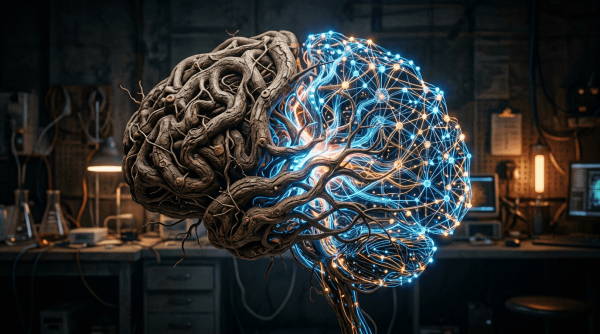
Hybrid brain model with organic roots and glowing digital network

I have dipped my toes a little further into the deep, deep waters of AI (which this week promises to get deeper with the recently announced OpenAI IPO). Here, then, are my updated thoughts on Artificial Intelligence.

For the past few months, I have been doing post-production on a documentary. The footage has been shot over the past 6 or 7 years and I have been wading through hours of interviews and other footage, writing the script, building edit sheets and – for the past month – actually doing the edits. In the process, I have tried to use AI judiciously. My rule of thumb has been this:  If I’m going to use AI, don’t be obvious about it.

Because I use Adobe tools for things like editing and some special effects, AI assistance is now built into almost everything I do. It lurks beneath the hood on pretty much every menu item and tool selection that Adobe offers. This is not the type of AI I am referring too. This built-in AI is what I call covert artificial intelligence.

I am referring to overt AI, where I have made a deliberate decision not to use the limited processing power of my own brain and have unleashed the AI Kraken to do my bidding. In my case, that has involved gathering information for the script, creating soundtracks, some video special effects and some other technical aspects.

I will say I did stop short of using AI for some special video effects which – upon viewing an example – created an uneasy feeling in my gut. Something told me I had stepped over the threshold into the realm of excessive creepiness.  When you’re dealing with people’s memories, especially of loved ones since departed, you have to tread carefully. Just because AI lets you do something, doesn’t mean you should.

But here’s my point. AI couldn’t have made that call. It couldn’t replicate my intuitive understanding of my audience, even to the point of anticipating reactions from specific individuals who I knew would be watching. AI can’t make gut calls about human consequences.

In that, it bears a resemblance to Phineas Gage.

Unless you’re a neuroscience geek, you may never have heard of poor Phineas, but it’s one of the most famous case studies in science. On September 13, 1848, Gage was working with a railway blasting crew in Vermont. Due to unexpected explosion of blasting powder, an iron crowbar was driven through the left side of his frontal brain. Miraculously, Gage retained much of his memory, language and reasoning ability. What was impaired was ability to make gut decisions, using something famed neuroscientist Antonio Damasio called “somatic markers.”  

It’s exactly these instincts, these abilities to predict the responses of others, that AI lacks. While it may be “intelligent” it is not necessarily “wise,” as wisdom requires judgement. It requires the ability to foresee reactions and to adjust your decisions accordingly.

When we look at the intersection of creativity and AI, it’s this human aspect that we should not be too quick to surrender to technology.

Take the writing of this post, for example. I did use AI to help me gather my thoughts. But the writing itself is – for better or worse – all me.  

I have been writing for pretty much all of my life. I have – I think – a human voice. My grammar isn’t perfect. I am Canadian, so my editor (the incredibly patient Phyllis Fine at MediaPost) has to “Americanize” my spellings. I started my career writing for radio, so my sentence structure can sometimes kindly be described as rambling. But all of this accurately reflects who I am. If I used AI to actually craft my words, I would have removed myself “from the loop.” Even as I write this text, my computer screen is littered with blue dotted underlines suggesting there may be better ways to word things.  I’m ignoring almost all of them.

I don’t know where the right AI-Human balance is. Even if I did know, it would be a moving target. The things AI can do today are a quantum leap ahead of what it could do even a year or two ago. But I don’t see AI gaining the ability to actually feel anything any time soon.

Asking Advice for a Friend

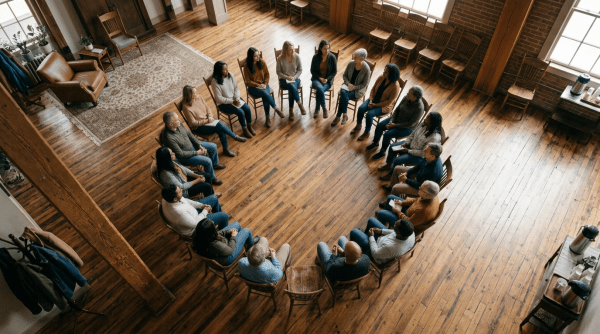
Diverse group of people sitting on wooden chairs in a circle in a room with wooden floors

I have a question for you, “Do you ask people for advice as often as you used to?”

It’s an important question, because the ability to exchange information is one of the most human of capabilities. It was that, probably more than any other factor, that sparked “The Great Leap” 50,000 years ago. Suddenly humans became more than slightly advanced primates and we started creating art, building advanced tools, forging long distance trade alliances and practicing religion. It was this cognitive revolution that started us on the path that led to where we are today.

Most anthropologists agree that while there could have been many factors that lead to the “Great Leap”, the most likely candidate was our ability – through the creation of symbolic language – to communicate abstract ideas and transfer complex skills. All the things that make us human came from this new ability to talk to each other: we could manage living in large groups, we could transfer knowledge from one person to the other, and – more importantly – we could pass information and skills from one generation to the next, ensuring our knowledge didn’t die with us.

So, yes, it’s important to ask if we still ask other people for advice. Because if we don’t, are we losing the ability to be human?

Now, I have a confession to make. All the stuff I just told you about the Great Leap came from A.I. I had the tiniest kernel of an idea and rather than share it with someone else, I typed the question into ChatGPT. I did reword its answer in my own words, but the above 3 paragraphs aren’t my ideas, nor do they come from any other human that I talked to. They were distilled from an algorithm. And here we have two intrinsically human strategies battling each other: the need to communicate, and the instinct to forage efficiently.

We humans are born communicators, but we are also natural foragers. We have an internal effort vs reward calculator that drives us down the most efficient path to get what we’re looking for. One of the dusty old UX concepts I used to drag around with me on the speaking circuit was Pirolli and Card’s Information Foraging Theory, which was formulated in 1999 at Xerox’s PARC (the Palo Alto Research Center, where I happened to have a wonderful visit with Peter Pirolli).

The theory may be long-in-the-tooth, but it’s still the single most elegant theory I’ve ever found to explain human behavior online. Simply put, we will expend the least amount of energy required to gain the information we’re looking for. That basic human tendency takes on new implications in our world of A.I.

If we’re looking for information, we will take the shortest path that will get us there. If the shortest path is asking ChatGPT, or, increasingly, using Gemini’s AI Mode in Google, then that’s what we’ll do.

So, I was just being human when I asked AI about the Great Leap. It took me 5 seconds to structure my query and 2 seconds later, I had my answer, impeccably reasoned and laid out in structured language. It did – in 7 seconds – what it would have taken at least a few hours to do the old way, by searching through words written by another human.

And heaven forbid asking another living, breathing human. That would have taken days, at least.

But if we stop asking each other for advice or information, we also have to ask ourselves, “what are we giving up?”  In our previous quest for information, we had to exercise two critical regions of our brain, our language centers (commonly called Broca’s Area and Wernicke’s Area), used to communicate with other humans, and the prefrontal cortex, where we synthesize information into a viable framework for action. If we were looking for the two areas of the brain that make us distinctly human, these would be two excellent candidates.

If we start using A.I. not just to gather information, but also to structure it into pre-made “thoughts”, we will inevitably use these areas of our brain less. And one of the features of our brain is that it automatically housecleans the least used parts of itself. It’s called synaptic pruning. Through it, the brain continually rewires itself to be best adapted to the tasks it does all the time.

If we stop doing the things that are instinctively human, like sharing knowledge, will our brain start trimming the very parts that make us human?

I’m asking for a friend.

Algorithmic Targeting is Messing with Our Zeitgeist

Broken mirror fragments showing city street at night, mountain, desert with camel, tropical forest, market street, autumn forest path, Paris cafe with Eiffel Tower, coastal lighthouse

You have to know where you stand. You,and by you I mean all of us, need to know how we fit into the big, universal, “whole-ball-a-wax” picture. We have to know, at our infinitesimal cog-in-the machine level, how we should interact with the universe.

That’s why having a Zeitgeist is important.

Now, you’ve probably heard that term. You’ve probably used it yourself. But give me a minute to explain why I believe it’s so important to have a reliable Zeitgeist.

The term Zeitgeist is usually associated with German philosopher Georg W.F. Hegel but it was used first by Johann Gottfried Herder. It became a dominant platform in German Idealist philosophy, which believed that reality wasn’t just made up of physical bits and pieces, it was shaped by our collective ideas, consciousness and the beliefs we shared. Our reality is defined by what is going through our collective brains. And that is Zeitgeist – the spirit of our times and the crucible of our reality. 

Given how important that is, we should think about how each draw our own perspective of what that Zeitgeist might be. How do we each determine what is the spirit of our time?

In our lifetimes, Zeitgeist has been predominately defined by media – and lately – what we see and hear through screens. We are spoon-fed reality by the keepers of Zeitgeist, who determine what and what won’t make it to our screens. 

There used to be some commonality to that. We all watched the same news, the same shows, the same sporting events. In my lifetime, my own Zeitgeist was hugely impacted but what I saw on television. But 30 years ago, what I watched wasn’t all that different from what you watched, or what my mother watched, or what my Uncle George watched. Our Zeitgeist has some common foundations which were determined by the gatekeepers of our media channels.

Now, however, algorithmic targeting determines what I see on my screen, and that will bear almost no resemblance to what you see, or what may be in my Uncle George’s feed. We are all seeing an algorithmically defined slice of Zeitgeist, served exclusively to us.

If you could crawl inside my Facebook feed, for example, you would be surrounded by a lot of old West Wing clips, a number of reels about biking through the Balkans, a bunch of AI generated videos showing what the stars of the sitcoms I watched in the 80’s look like now (here’s a sobering fact, a big percentage are dead), a truck load of political charged messaging that agrees completely with my own belief system and – somehow – the cast of Dirty Dancing slinking along to the opening theme of the Muppet Show. It’s a custom Zeitgeist bubble, algorithmically designed just for me.

So, what’s the harm with a little tailoring of Zeitgeist? Well, I’m pretty damned sure that none of that is an accurate picture of the current reality. And if that is the spirit of our times, heaven help us all (although I would welcome a president like Jed Bartlet in a heartbeat). 

We need a reliable Zeitgeist to set our personal compass to. We need to react to some semblance of reality. And when reality looks different for everyone, depending on the media we consume – well – we end with a world that looks a lot like the one we currently have.

No One Was Laughing this April Fool’s Day

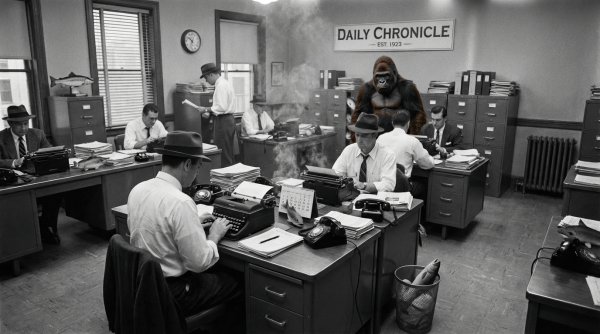
Men in fedoras at typewriters in a vintage newsroom with fish in unusual places.

Last Wednesday was April Fool’s Day. But I hardly saw any April Fool’s pranks. When I realized that, I thought to myself, “This is a sign of the times.”

April Fool’s probably started in 1582, when much of Europe switched from the Julian to the Gregorian calendar, which moved New Year’s from April 1st to January 1st. Those that still clung to the old calendar were called April Fools.

An alternative theory comes from Spring festivals that celebrated jokes, chaos and role reversals, like the Roman Hilaria or the medieval European “Feast of Fools.”

But April Fool’s really hit its peak when Mass Media joined in the fun. It was the BBC in Britain that got the ball rolling in 1957, with their famous “Spaghetti Tree Harvest” news documentary. Thousands jammed the BBC switchboards asking how they could grow their own spaghetti trees. The April Fool’s News Story became a BBC tradition.

Other media outlets followed in the BBC’s footsteps. In 1977, that stiff-lipped stalwart of British journalism, The Guardian, published a travel supplement for “San Serriffe” – a tropical nation made up of two main islands, Upper Caisse and Lower Caisse. The leader, General Pica, had a palace in the capital city of Bodoni. Anyone with some graphic design experience would soon realize the entire 7-page special supplement was full of typography puns, but it seems the British weren’t exactly that “type” – U.K. travel agencies received several calls wanting to book trips there.

Brands thought elaborate pranks would show how hip and relevant they were and jumped on the April Fool’s bandwagon in the 1980’s and 90’s. Taco Bell “bought” the Liberty Bell in 1996 and renamed it the Taco Liberty Bell. In 1998, Burger King introduced the Left-Handed Whopper. Even Big Tech joined the party with that wacky sense of humor computer engineers are known for. In 2013 Google introduced Google Nose, a search engine of smells. It included “Wet Dog” and had a Street Sense feature.

Ironically, Google also introduced Gmail on April 1st, in 2004, blurring the line between prank and product launch. No one believed you could get a free email account with 1 GB of storage. Competitors offered 2 to 4 megabytes.

Let’s fast forward to April 1, 2026. On that day – last Wednesday – crickets. There was no ha-ha to be found. And I thought, “What a sad state the world is in when we can’t even poke fun at ourselves.”

Maybe it’s because “Fake News” is now a real thing, 365 days a year, not just on April First.

Also, if you’re going to play a prank now, it’s probably going to be on social media. And how the hell can you compete with the wall-to-wall misinformation madness that fills everyone’s feed, every single day of the year.

But then I realized that attitudes towards April Fools have followed an arc directly related to how we get our information through media.

From the 1950s to the 90s, information was scarce and mass media outlets were the gate keepers. Trust was implied in the relationship, and it was that trust that was slyly mocked at on April the First. The April Fool’s prank hearkened back to the Medieval tradition of role reversal on Feast of Fools Day, when traditional hierarchies were inverted. This meant that – for one day – even the sober British media could play the fools. It was all done in a “wink wink” kind of way.

Then, in the late 90s and early 2000s, information became abundant. Those playing a prank expected to be fact checked. It was a way to drive viral traffic to online sources of information, which is why brands started to jump aboard with their own April Fool’s Pranks.

But now, in the age of misinformation and A.I. slop, every day is April Fool’s Day. Information (and misinformation) isn’t just abundant, it’s a pollutant. It’s everywhere and it’s often intentionally toxic. The very thing we used to smile about is a force that’s shattering our society.

It’s hard to laugh at that.

The Most Canadian of Social Networks

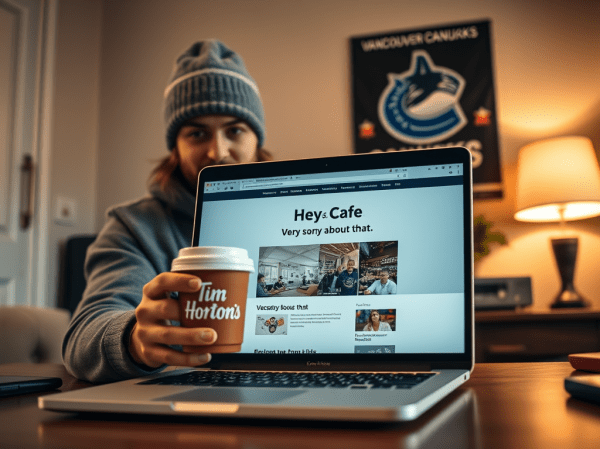
It may be the most polite social network in the world. It’s Hey.Cafe – a Facebook alternative built by Canadians for Canadians.

I first heard about Hey.Cafe through a reel on Facebook (oh, the irony) from Tod Maffin, a former CBC radio host, author and podcaster. Prompted by the not so veiled threats coming from south of the border, Tod’s been on a “buy Canadian” campaign for several months now and that has recently extended to Canadian alternatives for the big social media platforms. It was Tod that suggested to every Canadian listening (currently about 10,000,000 a week, according to Tod’s website) that we check out Hey.Cafe.

So, I did. It turned out that Anthony Lee, the creator of Hey.Cafe, lives about an hour down the highway from me, here in the heart of beautiful British Columbia. So I reached out and we had a chat – a nice, polite Canadian chat. Because that’s how we do things up here.

The first thing I learned, which was a surprise, is that Hey.Cafe is not new. In fact, it’s been around since 2001. That means there was a version of Hey.Cafe before there was ever a Facebook (which started in 2004). In addition to running a tech support company out of Penticton, BC, Anthony has been developing alternatives to the major social media platforms for the better part of 3 decades now, “Whenever I thought, ‘Oh, I think I have an idea,’ I’d make some changes, that kind of stuff. But it definitely wasn’t a sit down and work on it all day thing, unless I had some time free that I was just like, ‘Yeah, I’ll spend this week working on stuff.’”

Then I asked the obvious question, “Why now? Why is Hey.Cafe suddenly gaining attention?”

There is the “buy Canadian” thing, of course. But Anthony said it’s more than just Canadians being fed up with an American president and his bluster. We’re also fed up with social media founders that have their noses firmly pressed up against said President’s posterior simply because it’s good for business.

And let’s not even get into the simmering cesspool every major social media platform has become, driven by an ad-obsessed business model that monetizes eyeballs at the expense of ethics. Lee concurred, “It’s all about algorithm for them. They don’t care if it’s someone you follow or not. If, if it looks like it’s gonna make some attention, whether it be good or bad, they’re gonna push it in the feed.”

So, are Canadian’s kicking Hey.Cafes tires like a rink-side Zamboni? Yes, finally. Thanks to the plug from Tod Maffin, users shot up from about 5,000 to over 40,000 in two weeks. And it’s still growing. Because it’s still a side of the desk project, Anthony had to cap new accounts at 250 an hour.

Now, those numbers are infinitesimal compared to any of the major platforms, but they do signal a willingness by Canadians to try something not tied to business practices we don’t agree with. At the same time, it does bring up the elephant in the room for anyone going up against Facebook or any of the big platforms – the curse of Metcalfe’s Law. Metcalfe’s Law – named after Ethernet pioneer Robert Metcalfe – says that the value of a network is proportional to the square of the number of connected users. Having a telephone isn’t much use if no one else has one. For networks, bigger = better. And Facebook is currently 75,000 times bigger than Hey.Cafe.

Given that, does Hey.Cafe stand a chance? I hope so. I supported it with a one-year subscription because I would love to see Anthony Lee’s side project survive and – hopefully – succeed. I did go on and post a few things. I even started a new “café” – Hey.Cafe’s version of a Facebook Group. So far, nothing much has happened there, but we’ll politely wait and see. Again, that’s how we do things up here.

What I did find, however, is a community that seems genuinely, politely happy to be there. And not all of them are Canadian. This was a post from a nurse newly arrived from the U.S.: “Newly landed nurse practitioner from Oregon via Boston (long story). Love the concept of no ads and AI. Now to find some other communities, Bernese Mountain Dogs and skiing!”

I did ask Anthony, given the audience MediaPost (where this post also runs) reaches, if there’s any message he’d like to pass on. For media buyers especially, he offered this, “Whether it be HeyCafe, Bluesky, Mastodon, (consider) using more services that aren’t the big three players. Use more stuff that puts you in the spotlight of communities that are all over the place.”

While Anthony would love for Hey.Cafe to be economically sustainable, maybe the take-away here is not so much about financial success. Maybe these are Canadians signalling a change in our attitude. It’s as if we’ve been in an abusive relationship with Facebook for years but have put up with it because it’s been too hard to leave. But, at some point in abusive relationships, there comes a red line which, when crossed, you begin planning your exit. It doesn’t happen immediately. It may not happen at all, but there is a significant mental shift that happens where you become aware of how toxic the relationship really is and you start planning a life free from that toxicity.

For 40,000 Canadians and wannabe Canadians – at least – that switch may have happened.

Walk with Me, Talk with Me

In Aaron Sorkin’s acclaimed series, The West Wing, there was a recurring plot device. Characters, when faced with a thorny problem, often went for a walk and talked it out. The camera would capture it all in a long tracking shot.

Sorkin, who penned most of these scenes, used them to highlight the frenetic energy and pace of the White House. The characters exchanged rapid-fire, Sorkinesque dialogue while moving through spaces crammed with busy people buzzing in the background. The technique was – at the same time – both expository and transitional. It would move the story from location to location, often introduce additional characters as they joined the walk, then would veer off to do something important while it also furthered the story line with new details. It was the physical embodiment of multi-tasking, adding urgency to the pace, “There is so much to do and so little time to do it in.”

While Aaron Sorkin might not have intended it, there is also some solid neuroscience backing up the practice of walking and talking. And, as it turns out, you don’t even need to be walking with someone else to realize the cognitive benefits of a good stroll around the block.

German philosopher Friedrich Nietzsche wrote “All truly great thoughts are conceived by walking.” Nietzche seemed to be on to something. To come up with something new, the brain must do two different types of thinking: divergent and convergent. Divergent thinking could be defined as “thinking outside of the box.” Convergent thinking would be gathering up all those divergent thoughts and stuffing them “back in the box” to analyze the best option. According to a 2014 study from Stanford University, walking gives a significantly positive boost to divergent thinking but is less effective with convergent thinking.

Walking appears to open up the brain to new ideas. There is a positive “mind-body” effect that comes from just being active while you’re thinking, but walking also puts you in a different environment with varying stimuli. In the Stanford experiment, some participants walked outside and some just walked on a treadmill. Those that were outside realized the greatest creative boosts. 

But what if you’re walking with someone else? That’s where the benefits of walking really kick into high gear for certain kinds of brain activities. First of all, both the walkers are benefiting from the creative boost that walking gives you. But it also appears that walking allows you to connect with your fellow walker on both a physical and psychological level that operates at the subconscious level. 

Another study (Cheng, Kato, Saunders, Tseng, 2020) found that walkers soon synchronize their walking and this creates a physical bond between them. Those that walked together each evaluated the other person more highly after the walk than those that simply sat in the same room together. And, in case you’re wondering, the two didn’t even need to talk to each other. In the case of this study, both walkers were specifically instructed to stay silent during their walk.

That’s the “walk” part. But what about the “talk” part? As it turns out, walking brings its own benefits to that as well, and it’s not just the multi-tasking saving of time that Aaron Sorkin showed in the West Wing. 

Think about where you’re looking when you walk. The person you’re walking with is beside you but you’re looking ahead. You’re not looking them in the eye. For some types of communication, eye-to-eye might be the optimal mode, but for divergent thinking, this combination of being physically “in step” with the other person but also being free to let your eyes and mind wander a bit, enticed by what’s happening around you, turns out to be a very effective creative incubator. Your flow of fresh thoughts are not restricted by picking up negative micro-expressions from the other person. You’re not picking up any body language that may cause you to repress any creative ideas for fear of rejection. Soon, you’ll start to riff off each other’s ideas, adding to the idea generation process. 

There’s one more thing about walking. If you do need to just think for a while to process a new idea, those silences are a lot less awkward if you’re walking than if you’re across from each other at a boardroom table.

We’re Constantly Rewriting Our History

“No man ever steps into the same river twice, because it is not the same river, and he is not the same man.” – Heraclitus

Time is a funny thing. It is fluid and flowing and ever changing. It’s no surprise than that The Greek philosopher Heraclitus tried to describe it by using the analogy of a river. He then doubled down on the theme of change by saying it wasn’t only the river that was constantly changing. It was also the person stepping in the river. With time, nothing ever stays static. To try to capture the present we inhabit is simply taking a snapshot in time, from one of a million different vantage points.

This is also true when we look backwards. Like time itself, our history does not stay static. It is constantly being rewritten, depending on when and where we are and what our view of our own reality is. The past is constantly in flux – eternally in the process of being rewritten using the lens of today’s culture and political reality to interpret what happened yesterday.

This is happening everywhere.

Right now, in the occupied parts of Ukraine, school history curriculums are being rewritten en masse to conform to a Kremlin approved version of the past dictated by Moscow’s Ministry of Enlightenment. References to Ukraine and Kyiv are being edited out. There are numerous mentions of Putin as the savior of the area’s true Russian heritage. Teachers who try to remain pro-Ukrainian are being threatened with deportation, forcing them into hiding or being sent for “re-training.”

Here in Canada, the country’s history that is being taught in schools today bears scant resemblance to the history I learned as a child some six decades ago. The colonial heroes of the past (almost all of English, Scottish or French descent) are being re-examined in the light of our efforts to reconcile ourselves to our true history. What we know now were that many of the historic heroes we used to name universities after and erect statues to honor were astoundingly racist and complicit in a planned program of cultural eradication against our indigenous population.

And in the US, the MAGA-fication of cultural and heritage institutions is proceeding at a breakneck pace. Trump has tacked his name onto the Kennedy Centre. The White House is in the process of being “bedazzled” into a grotesque version of its former stately self, cloaked in a design sensibility more suitable for a 17th century French Sun King.

Perhaps the most overt example of rewriting history came with an executive order issued last year with the title “Restoring Truth and Sanity to American History.” This little Orwellian gem gives J.D. Vance (who sits on the Smithsonian’s Board of Regents) the power to eliminate “improper, divisive or anti-American ideology” from the museums and related centers. The inconvenient bits of history that this order aims to sweep under the carpet include slavery and the U.S.’s own sordid history of colonialism. These things have been determined to be “un-American.”

Compare all of this to the mission statement of the Smithsonian, which is to “increase and diffuse knowledge, providing Americans and the world with the tools and information they need to forge Our Shared Future.”

I wholeheartedly agree with that mission. I have said that we need to know our past to know what we aspire to be in the future. But that comes with a caveat; you have to embrace the past – as near as you’re able – for what it truly was, warts and all. Historians have an obligation to not whitewash the past. But we also must realize that actions we abhor today took place within a social context that made them more permissible – or even lauded – at the time. It is a historian’s job to record the past faithfully but also to interprete it given the societal and cultural context of the present.

This is the balancing act that historians have to engage in we’re truly going to use the past as something we can learn from.

Singing in Unison

It’s the year-end so it’s time to reflect and also to look forward, carrying what we’ve learned in the past into an uncertain future.

Let me share one thing I’ve learned; we have to get serious about how we create community. And by community, I will use a very specific definition. In fact, perhaps it would be more accurate to replace “community” with “choir.”

Let me explain my thought with a story.

In the late1980’s, Harvard professor Bob Putnam was in Italy doing research. He was studying Italy’s regional decentralization of power which began in 1970. For a political scientist like Putnam, this was an opportunity that didn’t come often. Italy had passed power down to its 20 regional governments and had also established a single framework for administration and governance. This framework was the constant. The variables were the people, the societal environment and the nature of the regions themselves. If anyone is familiar with Italy, you know that there are vast differences between these regions, especially from the north to the south.

For Bob Putnam, he looked at how effective each administrative government was – was democracy working in the region? Even though the administrators were all referring to the same playbook, the results were all over the map – literally. Generally speaking, governance in Northern and Central Italy was much more effective than in the South.

For Putnam, the next big question was – why? What was it about some regions that made democracy work better than in others. He looked for correlations in the reams of data he had collected. Was it education? Wealth? Occupational breakdowns? In examining each factor, he found some correlation, but they all came short of the perfect positive relationship he was looking for.

Finally, he took a break from the analysis and drove into the country with his wife, Rosemary.  Stopping in one town, he heard music coming from a small church, so the two stepped inside. There, a volunteer choir was singing.  It may sound cliché, but in that moment, Bob Putnam had an epiphany. Perhaps the answer lay in people coming together, engaging in civic activities and creating what is called “social capital” by working together as a group.

Maybe democracy works best in places where people actually want to sing together.

Bob Putnam relooked at the numbers and, sure enough, there was almost a perfect correlation. The regions that had the most clubs, civic groups, social organizations and – yes – choral societies also had the highest degree of democratic effectiveness. This set Putnam on a path that would lead to the publishing of this work in 1993 under the title of Making Democracy Work along with his subsequent 2000 best seller, Bowling Alone. (If you’d like to know more about Bob Putnam, check out the excellent Netflix documentary, Join or Die).

Putnam showed it’s better to belong – but that only explains part of the appeal of a choir. There has to be something special about singing together.

Singing as a group is one of those cultural universals; people do it everywhere in the world. And we’ve been doing it for ever, since before we started recording our history. Modern science has now started to discover why. Singing as a group causes the brain to release oxytocin – christened the “moral” molecule by neuro-economist Paul J. Zak – by the bucketload. Zak explains the impact of this chemical, “When oxytocin is raised, people are more generous, they’re more compassionate and, in particular, they’re empathetic – they connect better to people emotionally.”

The results of an oxytocin high are the creation of the building blocks of trust and social capital. People who sing together treat each other better. Our brains start something tuning into other brains through something called neural synchrony. We connect with other people in a profoundly and beautifully irrational way that burrows down through our consciousness to a deeply primal level.

But there is also something else going on here that, while not unique to singing together, finds a perfect home in your typical community choir.

Sociologist Émile Durkheim found that groups that do the same thing at the same time experience something called “collective effervescence.” This is the feeling of being “carried away” and being part of a whole that is greater than the sum of its parts. You find it in religious ceremonies, football stadiums, rock concerts and – yes – you’ll find it in choirs.

So, if singing together is so wonderful, why are we doing it less and less? When was the last time you sang – really sang, not just moved your lips – with others? For myself, it’s beyond the limits of my own memory. Maybe it was when I was still a kid. And I suspect the reason I haven’t sang out loud since is because someone, somewhere along the line, told me I can’t sing.

But that’s not the point. Singing shouldn’t be competitive. It should be spiritual. We shouldn’t judge ourselves against singers we see on media. This never used to be the case.  It’s just one more example of how we can never be good enough – at anything – if we use media for our mirror.

So, in 2026, I’m going to try singing more. Care to join me?