The Joy of Truly Playing

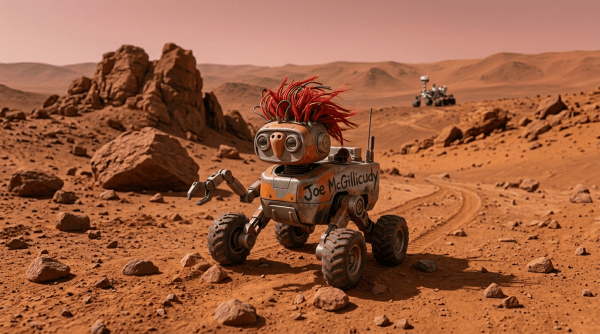
Mars rover with four wheels and red wiry appendages on a rocky reddish terrain.

Meet Joe McGillicudy. Joe lives on Mars and has an upside-down nose, which is fine on Mars, because it doesn’t rain there but it is dusty. Upside down noses work pretty well on Mars.

Joe doesn’t have feet, instead he has tires. That makes him fast and very quiet, which is important because Joe likes to sneak up on you and playfully grab your ankle and has been known to slip in a quick tickle now and then.

Joe McGillicudy is a game I play with my four-year-old grandson. We have both contributed to the description above. The upside-down nose was my idea. The tires instead of feet was his. And if you think this all sounds ridiculous and is a waste of valuable time – well – that’s really the point. Playing is ridiculous, especially if you’re an adult. But we should do it more.

For the past half dozen centuries, humans have been focusing on optimizing our lives. This is especially true in the past century or so. Our singular goal is to do things faster, be more focused, maximize our efficiency and strip every scrap of waste from our lives. Unstructured play has been the victim in all this. Kids barely do it anymore. And adults certainly don’t do it.

But playing – of a certain kind – is important. It creates room for surprise. It engages our imagination in a low-stress environment. It allows us to fail without fatal consequences. Playing is a real-life sandbox where we learn how to be better people: more creative, more cooperative, more understanding and more resilient. Most of all, it reintroduces serendipity into our lives. It gives us the capacity to savor the unexpected.

But play of this kind has some specific requirements. It can’t come with preset goals or pre-made rules. You have to make it up as you go along. This type of play pries open our imagination and sets our minds loose to wander and free-associate.

In the case of children, it’s the type of play that used to fill our days: building a fort with left over lumber from your dad’s workshop and no plan, turning a mound of snow in a parking lot into a kingdom to be conquered, launching a safari in your back yard or creating an interstellar spaceship from a large cardboard box.

This type of play is incredibly important for childhood development. But many of the moments children used to spend doing these things are being replaced by time in front of a screen playing a game that has been predesigned and prepackaged by a corporation, often with a for-profit agenda. The child is no longer making the rules, they are just following a path that has been set out for them. And often, they are doing so alone.

In our obsessive quest for an optimized life, adults are even less likely to spend time in unstructured “play.” One of the best ways to do this is to really play with your kids or grandkids and try seeing the world through their eyes. Try taking them to a hardware store  or thrift shop where there is no intended purchase and let them be the guide. See what you both discover.

But there are other ways: just wandering with no set destination, making something without plans or a blueprint, doing some creative improvisation through music or art, trying experimental cooking, playing a sport you’re really bad at (I admit I still have childhood trauma about this one), popping into a store at random just to see what’s on the shelves, skipping stones on a lake or turning a shovelful of dirt over in your garden and seeing what crawls out. 

Even better, find ways to “play” with others: role playing games, telling jokes and stories, going dancing, tossing a ball around or having a snowball fight.

I know – all of this sounds like a complete waste of time. And again I say – that’s the point.

The goal is to engage your mind in a way it rarely gets to do any more. As we rush to be productive, our brain gets over-trained for task accomplishment.  If you looked at a brain “at play” it would look very different than one playing a video game or scrolling a social media feed. Completely different areas would be engaged. Many of the ways we currently choose to spend time with a screen “light up” the same areas of the brain that are engaged when we’re gambling or engaging in other addictive behaviors. Some “free time” screen activities have even been shown to trigger anxiety and depression.

The biggest difference between unstructured play and many of our current past times comes in the way we’re rewarded. With unstructured play, the rewards come from inside us. We are not collecting points, climbing to the next level or competing for a bonus determined by some external party. We are just doing whatever we’re doing for fun.

You might just find that wasting time is the best way you can spend time.

Algorithmic Targeting is Messing with Our Zeitgeist

Broken mirror fragments showing city street at night, mountain, desert with camel, tropical forest, market street, autumn forest path, Paris cafe with Eiffel Tower, coastal lighthouse

You have to know where you stand. You,and by you I mean all of us, need to know how we fit into the big, universal, “whole-ball-a-wax” picture. We have to know, at our infinitesimal cog-in-the machine level, how we should interact with the universe.

That’s why having a Zeitgeist is important.

Now, you’ve probably heard that term. You’ve probably used it yourself. But give me a minute to explain why I believe it’s so important to have a reliable Zeitgeist.

The term Zeitgeist is usually associated with German philosopher Georg W.F. Hegel but it was used first by Johann Gottfried Herder. It became a dominant platform in German Idealist philosophy, which believed that reality wasn’t just made up of physical bits and pieces, it was shaped by our collective ideas, consciousness and the beliefs we shared. Our reality is defined by what is going through our collective brains. And that is Zeitgeist – the spirit of our times and the crucible of our reality. 

Given how important that is, we should think about how each draw our own perspective of what that Zeitgeist might be. How do we each determine what is the spirit of our time?

In our lifetimes, Zeitgeist has been predominately defined by media – and lately – what we see and hear through screens. We are spoon-fed reality by the keepers of Zeitgeist, who determine what and what won’t make it to our screens. 

There used to be some commonality to that. We all watched the same news, the same shows, the same sporting events. In my lifetime, my own Zeitgeist was hugely impacted but what I saw on television. But 30 years ago, what I watched wasn’t all that different from what you watched, or what my mother watched, or what my Uncle George watched. Our Zeitgeist has some common foundations which were determined by the gatekeepers of our media channels.

Now, however, algorithmic targeting determines what I see on my screen, and that will bear almost no resemblance to what you see, or what may be in my Uncle George’s feed. We are all seeing an algorithmically defined slice of Zeitgeist, served exclusively to us.

If you could crawl inside my Facebook feed, for example, you would be surrounded by a lot of old West Wing clips, a number of reels about biking through the Balkans, a bunch of AI generated videos showing what the stars of the sitcoms I watched in the 80’s look like now (here’s a sobering fact, a big percentage are dead), a truck load of political charged messaging that agrees completely with my own belief system and – somehow – the cast of Dirty Dancing slinking along to the opening theme of the Muppet Show. It’s a custom Zeitgeist bubble, algorithmically designed just for me.

So, what’s the harm with a little tailoring of Zeitgeist? Well, I’m pretty damned sure that none of that is an accurate picture of the current reality. And if that is the spirit of our times, heaven help us all (although I would welcome a president like Jed Bartlet in a heartbeat). 

We need a reliable Zeitgeist to set our personal compass to. We need to react to some semblance of reality. And when reality looks different for everyone, depending on the media we consume – well – we end with a world that looks a lot like the one we currently have.

When Did the Future Become So Scary?

The TWA hotel at JFK airport in New York gives one an acute case of temporal dissonance. It’s a step backwards in time to the “Golden Age of Travel” – the 1960s. But even though you’re transported back 60 years, it seems like you’re looking into the future. The original space – the TWA Flight Center – was designed in 1962 by Eero Saarinen. This was a time when America was in love with the idea of the future. Science and technology were going to be our saving grace. The future was going to be a utopian place filled with flying jet cars, benign robots and gleaming, sexy white curves everywhere.  The TWA Flight Center was dedicated to that future.

It was part of our love affair with science and technology during the 60s. Corporate America was falling over itself to bring the space-age fueled future to life as soon as possible. Disney first envisioned the community of tomorrow that would become Epcot. Global Expos had pavilions dedicated to what the future would bring. There were four World Fairs over 12 years, from 1958 to 1970, each celebrating a bright, shiny white future. There wouldn’t be another for 22 years.

This fascination with the future was mirrored in our entertainment. Star Trek (pilot in 1964, series start in 1966) invited all of us to boldly go where no man had gone before, namely a future set roughly three centuries from then.   For those of us of a younger age, the Jetsons (original series from 1963 to 64) indoctrinated an entire generation into this religion of future worship. Yes, tomorrow would be wonderful – just you wait and see!

That was then – this is now. And now is a helluva lot different.

Almost no one – especially in the entertainment industry – is envisioning the future as anything else than an apocalyptic hell hole. We’ve done an about face and are grasping desperately for the past. The future went from being utopian to dystopian, seemingly in the blink of an eye. What happened?

It’s hard to nail down exactly when we went from eagerly awaiting the future to dreading it, but it appears to be sometime during the last two decades of the 20th Century. By the time the clock ticked over to the next millennium, our love affair was over. As Chuck Palahniuk, author of the 1999 novel Invisible Monsters, quipped, “When did the future go from being a promise to a threat?”

Our dread about the future might just be a fear of change. As the future we imagined in the 1960’s started playing out in real time, perhaps we realized our vision was a little too simplistic. The future came with unintended consequences, including massive societal shifts. It’s like we collectively told ourselves, “Once burned, twice shy.” Maybe it was the uncertainty of the future that scared the bejeezus out of us.

But it could also be how we got our information about the impact of science and technology on our lives. I don’t think it’s a coincidence that our fear of the future coincided with the decline of journalism. Sensationalism and endless punditry replaced real reporting just about the time we started this about face. When negative things happened, they were amplified. Fear was the natural result. We felt out of control and we keep telling ourselves that things never used to be this way.  

The sum total of all this was the spread of a recognized psychological affliction called Anticipatory Anxiety – the certainty that the future is going to bring bad things down upon us. This went from being a localized phenomenon (“my job interview tomorrow is not going to go well”) to a widespread angst (“the world is going to hell in a handbasket”). Call it Existential Anticipatory Anxiety.

Futurists are – by nature – optimists. They believe things well be better tomorrow than they are today. In the Sixties, we all leaned into the future. The opposite of this is something called Rosy Retrospection, and it often comes bundled with Anticipatory Anxiety. It is a known cognitive bias that comes with a selective memory of the past, tossing out the bad and keeping only the good parts of yesterday. It makes us yearn to return to the past, when everything was better.

That’s where we are today. It explains the worldwide swing to the right. MAGA is really a 4-letter encapsulation of Rosy Retrospection – Make America Great Again! Whether you believe that or not, it’s a message that is very much in sync with our current feelings about the future and the past.

As writer and right-leaning political commentator William F. Buckley said, “A conservative is someone who stands athwart history, yelling Stop!”

Keep Those Cousins Close!

Demographic trends tend to play out on the timelines of multiple generations. Declining birth rates, increased life spans and widespread lifestyle changes can all have a dramatic impact on not only what our families look like, but also how we connect with them. And because families are the nucleus of our world, changes in families mean fundamental changes in us: who we are, what we believe and how we connect with our world.

I have previously written about one such trend – a surplus of grandparents. The ratio of grandparents to grandchildren has never been higher than it is right now, thanks to increased life expectancy and a declining birth rate. It’s closing in on 1:1, meaning for every child, there is one unique grandparent. As a grandparent, I have to believe this is a good thing.

But another demographic trend is playing out and this may not be as positive for our family structure. While the grandparent market is booming, our supply of cousins is dwindling. And – as I’ll explain shortly – cousins are a good thing for us to have.

But first, a little demographic math. In the U.S. in 1960, the average number of children per household was 3.62. This was a spike thanks to the post WWII Baby Boom, but it’s relevant because this generation and the one before were the ones that determined the current crop of cousins for people of my age.

My parents were born in the 1930s. If both of them had 3 siblings, as was the norm, that would give me 6 aunts or uncles, all having children during the Baby Boom. And each of them would have 3 to 4 kids. So that would potentially supply 24 first cousins for me.

Now, let’s skip ahead a generation. Since 1970, the average number of children per household in the U.S. has hovered between 1.5 and 2. If I had been born in 1995, that would mean I only had 2 aunts or uncles, one from my mother’s side and one from my father’s. And if they each had 2 children, that would drop my first cousin quota down to 4. That’s 20 less first cousins in just one generation!

But what does this lack of first cousins mean in real terms? Cousins play an interesting sociological and psychological role in our development. Thanks to evolution, we all have something called “kinship altruism.”  In the simplest of terms, we are hardwired to help those with which we share some DNA. Those evolved bonds are strongest with those with whom we share the most DNA. There is a hierarchy of kinship – topped by our parents and siblings.

But just one rung down the ladder are our first cousins. And those first cousins can play a critical role in how we get along with the world as we grow up. As journalist Faith Hill said, writing about this in The Atlantic, “Cousin connections can be lovely because they exist in that strange gray area between closeness and distance—because they don’t follow a strict playbook.”

As Hill said, cousins represent a unique middle ground. We have a lot in common with our cousins, but not too much. Our cousins can come from different upbringings, can span a wider range of ages than our siblings, can come from different socio-economic circumstances, can even live in different places. We may see them every day, or once every year or two. Yet, we are connected in an important way. Cousins play a critical role in helping us navigate relationships and learn to understand different perspectives. Having a lot of cousins is like having a big sandbox for our societal development.

If you overlay societal trends on this demographic trend towards fewer first cousins, the shift is even more noticeable. We are a lot more mobile now then our parents and grandparents were. Families used to generally live close to each other. Now they spread across the country. My wife, who is Italian, has almost 50 first cousins and almost all of them live in the same town. But that is rare. Most of us have a handful of cousins who we rarely see. We don’t have the advantage of growing up together. At a time when societal connection is more important than ever, I worry that this is one more instance of us losing the skills we need to get along with each other.

From my own experience, I have found that the relationship between my cousins is vital in negotiating the stewardship of our families as it’s handed off from our parent’s generation to our own. I personally have become closer to many cousins as – one by one – our parents are taken from us.  Through our cousins – we relive cherished memories and regain that common ground of shared experience and ancestry.