Our Digital World is No Place for the Elderly

My family is discovering – firsthand – just how the world could care less about the elderly.

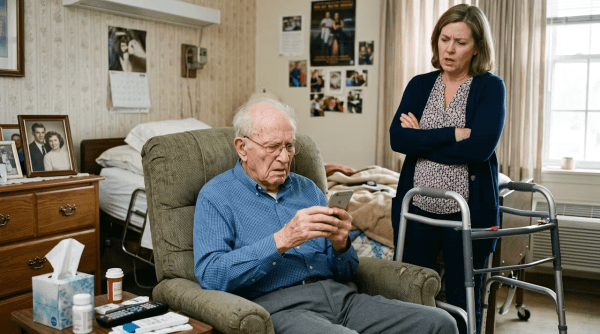
My stepfather just passed away. He was just a few months shy of his 91st birthday. For the past 10 years, my sister has been looking after the official side of Dad’s life – things like his income tax, pension, healthcare and other related needs. All these things have rushed online as local service counters and real, live humans whose job it was to assist their customers have virtually disappeared. The inner workings of these programs lie on the other side of either a website or a call centre. Neither of these things are designed for the elderly. They are barely functional for any of us, including those much younger than my stepdad.

For the past decade, as Dad has aged, it has become increasingly apparent that our world is not designed for the superannuated. In the last few years, his loss of hearing made it impossible for him to understand someone talking at a normal volume in the same room, let alone someone on a telephone call. This led to him being unable to follow the gist of most conversations. My sister, who has the patience of Job, acted as translator and guide for Dad but was constantly flummoxed by bureaucratic rules and privacy regulations that left no wiggle room for the elderly. A typical phone interaction (usually after waiting over an hour on hold) would go something like this:

My sister: “Hi, I’d like to ask about my father’s income tax return for 2025.”

Phone Agent: “I’m sorry, we can only give information to the person who files the return.”

“He’s here with me. I have his permission.”

“I’m sorry, I have to speak to him.”

“He can’t hear you. That’s why I’m calling.”

“I need to hear it from him. Can you hand him the phone?”

“He won’t hear you, but sure, knock yourself out.”

(Dad puts the phone to his ear, having no idea what’s going on. You can hear the person talking but Dad just looks at us blankly. My sister takes the phone back.)

“Your dad was unable to answer the security question I asked him to verify his identity.”

“As I said – repeatedly – Dad can’t hear. Can you ask me the question and I’ll ask him?”

“I need to hear the answer from him.”

“Is there an office we can go to and talk to someone in person?”

“No, all our support functions have moved online. You can use our website. Does your dad have an online account?”

“My dad has never touched a computer in his life. How would he have an online account?”

You get the gist. These scenarios always played out along the same lines but were typically spaced out so my sister had time to regain her incredible patience before the next episode. But when a person passes, suddenly all these things must be dealt with right away. Her days have been filled with circuitous phone calls trying to tie up Dad’s loose ends, stymied at every turn by the fact that while the system didn’t support him when he was alive, it’s doubly difficult now that he’s gone. Much as I’d like to help, I live in a different province and don’t have the legal authority to deal with these issues.

My Dad was caught on the far side of the grey digital divide. For the past few decades, technology has enabled companies and government services to offload the effort required to deliver their services or products from themselves to us, their customers. We now pump our own gas, do our own banking, configure our own phone plans, administer our own insurance policies and monitor our own pensions and income tax accounts. Programs and companies have gleefully eliminated physical locations and laid off customer support people to cut costs by transferring those functions to us. The only contact we have is either through a woefully designed website (I can tell you the Canadian Revenue Agency’s website is a usability nightmare) or a call center where one-hour waits are considered the norm.

Most of us, given no alternative, grudgingly jump through the hoops required to do what we have to do, which is what these agencies and companies used to do for us as part of their job. We struggle through archaic interfaces, learn new platforms every few years, constantly have to reset passwords and scramble through our various devices and authentication apps to sneak past the impenetrable security hurdles of two step verification. J.R.R. Tolkien made gaining access to Mordor look easy in comparison.

I understand that online fraud and identity theft is a real concern, but at some point, typically north of the age of 70, it gets harder for us to keep up. As our brains age, they tend to rely more on remembered strategies and routines because learning something new gets harder and harder. The world used to reward this accumulation of knowledge with age. Now it just kicks it to the curb like last week’s trash.

There are exceptions, of course. The elderly who are familiar with computers and technology can push the grey digital divide back substantially. But this was not my dad. In his life, he was a farmer, a sawmill worker and a chimney sweep. None of those things – especially in a time several decades past – required learning how to use a computer. The world literally passed Dad by. Just how far he was left behind has become acutely apparent to us in the last few weeks.

Through this all, we keep asking ourselves one very frightening question – If it was this hard for Dad, what is it like for those elderly who don’t have a person like my sister to help them?

What happens to them?

Serendipity And Our Media Menu

Vintage radio, open book, steaming cup of tea with teapot and cookies on wooden table

We live an optimized life. But as is often the case with optimization, these helpers focus on efficiency, not necessarily effectiveness. 

There is a difference. Efficiency used time as the yardstick of success. The goal of the efficiency expert is to get more done in less time. To do this, they identify friction and eliminate it. Anything that looks like a sticking point is hunted down and eradicated.

Effectiveness is more focused on the end product. At the end of the process, how good were the results? Efficiency is focused on the means to an end. Effectiveness cares more about the end itself.

Our optimized world is a ruthless hunter of friction. We are obsessed with finding the shortest path, and by doing this, we have become myopically efficient. Technology is accelerating this, as the path to information is getting shorter and straighter than ever. AI takes us straight to exactly the information we were looking for and guides us through future prompts to take us by the hand down curated paths. It is undoubtedly more efficient. But are we losing sight of the things that might make us more effective?

As I have said before, I am a fan of friction in some things. I believe friction makes us more human. More imperfect? Undoubtedly. But also more curious, more contemplative and more appreciative of serendipity. Friction opens up the possibilities of discovery by taking us off the well-optimized route and sometimes letting us wander in the wilderness.

That’s one of the reasons I love public radio. In the U.S, that’s NPR. Here in Canada, our public broadcaster is the Canadian Broadcasting Corporation (CBC). Public radio is one of the few media choices left to us that still has one foot firmly planted in yesteryear. Listening to the CBC today is not all that different from listening to it in 1985.

Our media menu, like many things, has been optimized to the extreme. Algorithms determine what we hear, see and read based on what it predicts will capture our engagement, and thus provide the best returns for advertisers.

Public radio has resisted this trend, both through editorial policy and through the nature of the medium itself. It is at this confluence that I can find my media friction, leaving me the room to wander and get lost in new ideas by taking unexpected turns. Many of the topics that have made their way into my posts first germinated when I was listening to public radio.

So, let’s look at what makes public radio different, first by design, then by how we interact with this particular medium.

Public radio is editorially curated. Content is chosen by a human — or group of humans — trying to assemble topics based on what they think their audience might be interested in. This process is not that different from what happens at a newspaper like the New York Times or an online news platform like CNN. What does make public radio different is the breadth of its subject matter — covering every conceivable topic — and the make-up of the network itself, with multiple layers of contribution and editorial decision-making that go from international stories at the top to hyper-local stories at the individual station level.

But the biggest difference in public radio lies in how we consume this medium. Public radio is listened to in blocks. It is like we’re being served a set selection of media content rather than picking and choosing individual items from a tasting menu. A 10-minute segment on the disappearing cod population of the North Atlantic might be programmed directly adjacent to an exploration of how Brazilian Baila Funk music has roots going back to the Miami Bass artists of the 1980s. 

Public radio listeners typically don’t change the station because there is nothing else on the dial even remotely comparable. We usually just go along for the ride.

People who know that I am a public radio fan have suggested that I listen to podcasts because they’re “basically the same thing.” I have tried podcasts and always felt that something was missing, but couldn’t put my finger on what. It was only recently that I realized hat was missing: serendipity. I have never run into the unexpected in a podcast. With public radio, it happens all the time, usually at the top and bottom of the hour.

A Short History of the Long Legacy of Literacy

A man reading an old book with a quill pen and ink in a large, wooden library

Literacy has had a good run as a definer of social status. But after over 5,000 years, from ancient Mesopotamia to today, the ability to read and write and its role as a signifier of class power might finally be passé.

This is predictable, I guess. Once something becomes universal – or nearly so – it ceases to be special.

In the earliest days of days of scratching something down on paper (or papyrus) writing was the crucial link between royalty and common folk. Rulers issued edicts that required some type of record keeping. One of the first examples we have of this is from 3100 BCE and is a clay tablet that tracked beer allocation with symbols and tally marks. This type of record keeping was entrusted to scribes and priests, making them both the messengers and recorders of gods and kings.

For the next 4500 years, literacy remained a gift restricted to the few. In 1440 AD, fewer than 10% of the population in Europe could both read and write. But then, a goldsmith in Mainz, Germany was about to change the course of literacy. Johannes Gutenberg invented the first commercially practical system of mass printing using moveable type. The first mass medium was born. But it’s impact on literacy would take a while.

In perhaps the first example of media technology being well ahead of its market, the first books mass printed tended to be aimed at the same audience as before the printing press. Books were expensive, tended to be either religious or legal and were intended for clergy, universities and wealthy household. Printing would take a few centuries before it would bring literacy to the commoner.

The way this happened is fascinating to consider when we look at the impact of mass media on society. Literacy was always a way to maintain control and was historically concentrated with the church, universities and government. But the advent of mass printing began to loosen that chokehold. It began to put pamphlets and other printed forms in more and more hands, providing a printed communication infrastructure that allowed – for the first time – the questioning of authority rather than the preservation of it.

Between the Protestant Reform movement (1500 – 1600s), the Scientific Revolution (1600 – 1700s) and the Enlightenment (1700s – 1800s), the traditional seats of power were held up for scrutiny. These interlocking movements that transformed western society were all powered by the printed word. Eventually, the Republic of Letters emerged; an international society of thinkers, scientists and philosophers that reshaped how we looked at the world. And this free-form exchange of revolutionary ideas was all communicated through the written word. Literacy began to trickle down to the common people.

In the 1800’s, we began to strive for universal literacy. Public education instilled basic reading and writing skills in much of the youth of Northern Europe but was spotty in the rest of the world. Reading for leisure began to take off, now that there was a market for newspapers, magazines and novels. Writers like Charles Dickens, Victor Hugo, Alexandre Dumas, Jules Verne, Jane Austin and the Brontë sisters became household names. Finally – it seemed – literacy’s day had come!

But now, after waiting in the wings for thousands of years, after two short centuries, literacy seems to be waning. In a recent Atlantic essay, Rose Horowitch cites some sobering stats from recent surveys: fewer than half of all adults read a book of any kind in 2022 (from the National Endowment for the Arts). And, according to the American Time Use Survey, the proportion of Americans who read for pleasure on any given day dropped from 28% in 2004 to 16% in 2023.

It’s not just that we’re reading less. We’re also reading dumber. Books are simpler, sentences are shorter and vocabularies are shrinking. Books are following the leads of movies, TV shows and video games – more sensation, less intellectualization. Many of the books that do end up on the best seller charts are actually written for young adults – aimed at those with a grade 9 reading level.

Reading anything in long form is in danger of disappearing. What has happened in this market is that the middle of the market has been squeezed out to both ends. There has been an explosion of short form content, designed to be scanned quickly and digested in bite sized pieces, ala social media. But in a weird counter to this general trend, there is still a market for long-form essays in prestigious publications. In this market driven development, numbers might be down, but engagement is up, with readers spending significantly more time with longer pieces, giving more opportunity for publishers to push ads to them.

What is generally true across the board, however, is that the golden age of the printed word appears to be over. As I myself have seen in looking at the results of hundreds of eye tracking studies, we are instinctively drawn to content that instantly piques our senses: images, sounds, moving pictures. From there it’s a coin toss where we might go next – on to the next bright shiny object or to partake in that drudgery called reading, where we actually have to think about what we’re looking at.

The Joy of Truly Playing

Mars rover with four wheels and red wiry appendages on a rocky reddish terrain.

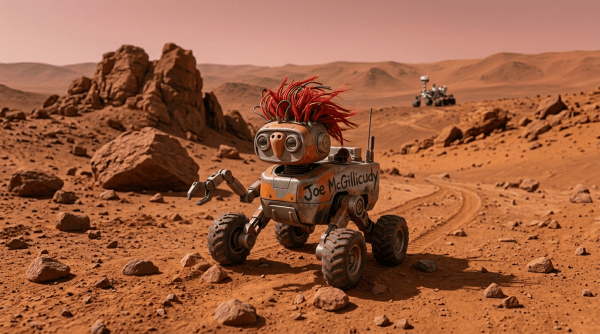
Meet Joe McGillicudy. Joe lives on Mars and has an upside-down nose, which is fine on Mars, because it doesn’t rain there but it is dusty. Upside down noses work pretty well on Mars.

Joe doesn’t have feet, instead he has tires. That makes him fast and very quiet, which is important because Joe likes to sneak up on you and playfully grab your ankle and has been known to slip in a quick tickle now and then.

Joe McGillicudy is a game I play with my four-year-old grandson. We have both contributed to the description above. The upside-down nose was my idea. The tires instead of feet was his. And if you think this all sounds ridiculous and is a waste of valuable time – well – that’s really the point. Playing is ridiculous, especially if you’re an adult. But we should do it more.

For the past half dozen centuries, humans have been focusing on optimizing our lives. This is especially true in the past century or so. Our singular goal is to do things faster, be more focused, maximize our efficiency and strip every scrap of waste from our lives. Unstructured play has been the victim in all this. Kids barely do it anymore. And adults certainly don’t do it.

But playing – of a certain kind – is important. It creates room for surprise. It engages our imagination in a low-stress environment. It allows us to fail without fatal consequences. Playing is a real-life sandbox where we learn how to be better people: more creative, more cooperative, more understanding and more resilient. Most of all, it reintroduces serendipity into our lives. It gives us the capacity to savor the unexpected.

But play of this kind has some specific requirements. It can’t come with preset goals or pre-made rules. You have to make it up as you go along. This type of play pries open our imagination and sets our minds loose to wander and free-associate.

In the case of children, it’s the type of play that used to fill our days: building a fort with left over lumber from your dad’s workshop and no plan, turning a mound of snow in a parking lot into a kingdom to be conquered, launching a safari in your back yard or creating an interstellar spaceship from a large cardboard box.

This type of play is incredibly important for childhood development. But many of the moments children used to spend doing these things are being replaced by time in front of a screen playing a game that has been predesigned and prepackaged by a corporation, often with a for-profit agenda. The child is no longer making the rules, they are just following a path that has been set out for them. And often, they are doing so alone.

In our obsessive quest for an optimized life, adults are even less likely to spend time in unstructured “play.” One of the best ways to do this is to really play with your kids or grandkids and try seeing the world through their eyes. Try taking them to a hardware store  or thrift shop where there is no intended purchase and let them be the guide. See what you both discover.

But there are other ways: just wandering with no set destination, making something without plans or a blueprint, doing some creative improvisation through music or art, trying experimental cooking, playing a sport you’re really bad at (I admit I still have childhood trauma about this one), popping into a store at random just to see what’s on the shelves, skipping stones on a lake or turning a shovelful of dirt over in your garden and seeing what crawls out. 

Even better, find ways to “play” with others: role playing games, telling jokes and stories, going dancing, tossing a ball around or having a snowball fight.

I know – all of this sounds like a complete waste of time. And again I say – that’s the point.

The goal is to engage your mind in a way it rarely gets to do any more. As we rush to be productive, our brain gets over-trained for task accomplishment.  If you looked at a brain “at play” it would look very different than one playing a video game or scrolling a social media feed. Completely different areas would be engaged. Many of the ways we currently choose to spend time with a screen “light up” the same areas of the brain that are engaged when we’re gambling or engaging in other addictive behaviors. Some “free time” screen activities have even been shown to trigger anxiety and depression.

The biggest difference between unstructured play and many of our current past times comes in the way we’re rewarded. With unstructured play, the rewards come from inside us. We are not collecting points, climbing to the next level or competing for a bonus determined by some external party. We are just doing whatever we’re doing for fun.

You might just find that wasting time is the best way you can spend time.

Want to Know the Future of Consumerism? Ask My Fridge.

Rusty discarded refrigerators and appliances scattered in a junkyard with overgrown vegetation and cloudy sky

I was recently shopping for a new fridge. All I wanted was a large metal box that does what fridges are supposed to do – keep things cold. That should be easy – right? The answer, as it turns out, is not so much. Refrigerators, and all large appliances, are now part of a huge consumer conspiracy. We are being hoodwinked, bamboozled, hornswoggled, swindled, duped and fleeced. We, my fellow large appliance shoppers, are sitting passively by while the proverbial wool is being pulled over our eyes.

And the most frustrating part? We asked for it.

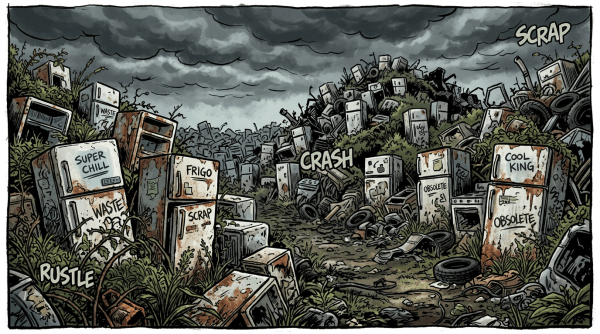
Large appliances are now considered a disposable commodity. They have a shelf life. They ship with an expiry date – like a carton of milk. The difference is that the expiry date on a refrigerator isn’t stamped anywhere. No where on the packaging does it say “You might get 8 to 10 years out of this fridge – 12 if you’re lucky. Then it will start making sounds like an Irish banshee and decide to stop cooling on a whim, likely during the hottest of summer days.”

Fridges never used to be like that. They used to last through 2 or even 3 generations. They were built of the same stuff as army tanks and battle ships, designed to survive the worst a family could throw at it and keep doing what they were supposed to. They didn’t pair with our smart phone, compile a grocery list, dispense iced lattes or remind us when our water filter needed changing. They simply did what they were supposed to do: keep our food cold so we didn’t die of salmonella. 

Somewhere along the line, we have made a conscious choice to trade bulletproof durability for bells and whistles. That’s true not just for major appliances, but for pretty much any consumer category we can think of. Everything today is “smart” but also ephemeral. They are designed to dazzle us in the short-term but they will soon need to be replaced. And this is all by design.

Let me give you one example of this planned obsolescence. We bought a fridge about 10 years ago. It has a water dispenser built in that has one small plastic part that has been replaced twice in the time we’ve had the fridge. Last year, that part broke again, so I went to order the replacement. I found what looked to be the part I was looking for, but when it arrived, I found that the manufacture had changed the dimensions by about an eighth of an inch, so the part didn’t fit anymore. It still looked exactly the same but the water dispenser could no longer be repaired because the original part I needed has been discontinued. 

Tell me that wasn’t deliberate. I now have a two-thousand-dollar fridge that may have to be replaced because a change was made to a little piece of plastic that costs about 4 cents to make.  

I’d like to find someone to blame, but the blame rests with us. We have accepted this questionable bargain with open arms and our whole hearts. Yes – Samsung, LG and the rest of your consumer-conning cabal – give me that microwave that pairs with my phone so I can start defrosting a roast while I’m miles from home. Give me an oven I can start by yelling from my armchair, like a sous-chef named Siri. Give me a fridge with an interior AI cam that keeps a vigilant eye on the doings-on that happen when the door is closed and that little light goes out. 

Yes, I need all that! Even if it only lasts for a few years. If I need cold food, I’ll get it from the fridge I have in my garage that I inherited from my grandmother. The one she got as a wedding present. 

My Tentative Embrace of AI

Hybrid brain model with organic roots and glowing digital network

I have dipped my toes a little further into the deep, deep waters of AI (which this week promises to get deeper with the recently announced OpenAI IPO). Here, then, are my updated thoughts on Artificial Intelligence.

For the past few months, I have been doing post-production on a documentary. The footage has been shot over the past 6 or 7 years and I have been wading through hours of interviews and other footage, writing the script, building edit sheets and – for the past month – actually doing the edits. In the process, I have tried to use AI judiciously. My rule of thumb has been this:  If I’m going to use AI, don’t be obvious about it.

Because I use Adobe tools for things like editing and some special effects, AI assistance is now built into almost everything I do. It lurks beneath the hood on pretty much every menu item and tool selection that Adobe offers. This is not the type of AI I am referring too. This built-in AI is what I call covert artificial intelligence.

I am referring to overt AI, where I have made a deliberate decision not to use the limited processing power of my own brain and have unleashed the AI Kraken to do my bidding. In my case, that has involved gathering information for the script, creating soundtracks, some video special effects and some other technical aspects.

I will say I did stop short of using AI for some special video effects which – upon viewing an example – created an uneasy feeling in my gut. Something told me I had stepped over the threshold into the realm of excessive creepiness.  When you’re dealing with people’s memories, especially of loved ones since departed, you have to tread carefully. Just because AI lets you do something, doesn’t mean you should.

But here’s my point. AI couldn’t have made that call. It couldn’t replicate my intuitive understanding of my audience, even to the point of anticipating reactions from specific individuals who I knew would be watching. AI can’t make gut calls about human consequences.

In that, it bears a resemblance to Phineas Gage.

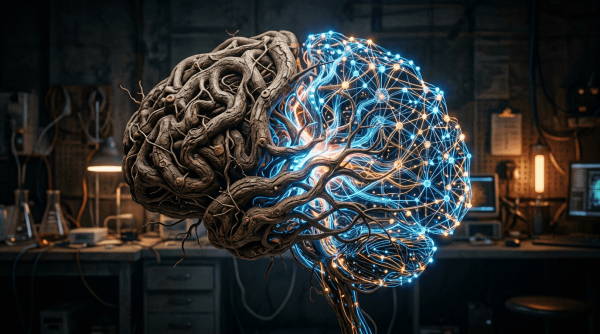
Unless you’re a neuroscience geek, you may never have heard of poor Phineas, but it’s one of the most famous case studies in science. On September 13, 1848, Gage was working with a railway blasting crew in Vermont. Due to unexpected explosion of blasting powder, an iron crowbar was driven through the left side of his frontal brain. Miraculously, Gage retained much of his memory, language and reasoning ability. What was impaired was ability to make gut decisions, using something famed neuroscientist Antonio Damasio called “somatic markers.”  

It’s exactly these instincts, these abilities to predict the responses of others, that AI lacks. While it may be “intelligent” it is not necessarily “wise,” as wisdom requires judgement. It requires the ability to foresee reactions and to adjust your decisions accordingly.

When we look at the intersection of creativity and AI, it’s this human aspect that we should not be too quick to surrender to technology.

Take the writing of this post, for example. I did use AI to help me gather my thoughts. But the writing itself is – for better or worse – all me.  

I have been writing for pretty much all of my life. I have – I think – a human voice. My grammar isn’t perfect. I am Canadian, so my editor (the incredibly patient Phyllis Fine at MediaPost) has to “Americanize” my spellings. I started my career writing for radio, so my sentence structure can sometimes kindly be described as rambling. But all of this accurately reflects who I am. If I used AI to actually craft my words, I would have removed myself “from the loop.” Even as I write this text, my computer screen is littered with blue dotted underlines suggesting there may be better ways to word things.  I’m ignoring almost all of them.

I don’t know where the right AI-Human balance is. Even if I did know, it would be a moving target. The things AI can do today are a quantum leap ahead of what it could do even a year or two ago. But I don’t see AI gaining the ability to actually feel anything any time soon.

Gemini vs. ChatGPT: Will Either Become Our New Habit?

Two tall skyscrapers with digital data patterns glowing on their surfaces at dusk in a cityscape

Back 20 years ago when I spoke about search, I used to talk a lot about the “Google Habit.”  In the remarkably short time from its debut to the early 2000s, Google had become our defacto search choice. In fact, it was so dominant, we didn’t even consider its competitors. We didn’t think at all…we just Googled. That is how a habit works. We do things without thinking about them.

Fast forward 20 years. Google still dominates the information retrieval space. When we talk about worldwide search, Google delivers the results on 9 out of every 10 searches launched. It’s monolithic presence in the online landscape hasn’t really changed. But the way we navigate that landscape is beginning to. For the first time in a long time, Google has a real competitor when it comes to the way we look for our answers.

Another favorite topic of mine, following hard on the heels of the “Googe Habit,” was talking about the “usefulness of search.” I argued that while Google did a good job of retrieving information, it feel well short of the goal of making that information immediately useful to us. Today, with agentic A.I., the tantalizing promise of usefulness has finally arrived. The question is, what tools will we use to mine that usefulness?

The battle seems to be between Google’s Gemini, deeply embedded in the entire Google ecosystem, and OpenAI’s ChatGPT, a standalone app. Anthropic’s Claude is currently focused on the enterprise AI market.

Back two decades ago, I envisioned search gradually disappearing “under the hood” of various apps that made our lives easier. The act of actually retrieving information would be one step removed from us. What we would interact with would be a distillation of that information, formed into something we could use to do the things we wanted to do. What I didn’t anticipate was the emergence of the Large Language Model that currently powers ChatGPT and other AI models.

But as it currently stands, the act of retrieving information that we can use and the act of processing huge reams of text to predict useful responses are quickly converging. For an ever-increasing number of queries (currently about 50%) Google’s Gemini AI answers are now predominately displayed in the prime real estate of the search results page, straddling the very top of the “Golden Triangle.”  And ChatGPT is increasingly asked to retrieve specific information as users interact with its chatbot. Both Google and OpenAI realize that the future lies in a hybrid of the two.

The battle now is for either Google or OpenAI to dominate the various user interfaces in our personal technologies. And in this regard, it will be hard to beat Google. This January, Google and Apple inked a deal that would make Gemini the foundational AI platform for a future version of Siri. It’s already embedded in all Android devices. OpenAI’s early mover advantage over Google in terms of consumer AI usage is rapidly disappearing, with the two currently running almost neck and neck (36.6% for ChatGPT vs 27.4% for Gemini, according to a recent Emarketer forecast).

Brian X. Chen, lead consumer technology writer for the New York Times, indicated in a recent article that Emarketer’s numbers could be understating the competitiveness of OpenAI’s rival.  Google said at their recent Google I/O conference that in one year, the number of people using the Gemini chatbot more than doubled to 900 million. That puts it in a dead heat with ChatGPT and, if current growth rates continue, moving well past it in the next year.

Chen points out another massive advantage for Google’s Gemini over OpenAI’s ChatGPT. While OpenAI’s numbers are not public, they likely lost between $8 and $9 billion last year. Even the most optimistic forecasts don’t put OpenAI in a profitable position til 2029.

Google, thanks to its dominance in the online ad space, made a profit of $112 billion in 2025 on revenue of $386 billion. It will be relatively easy for Google to fold Gemini into that vast advertising supported ecosystem, moving to a cash positive position almost immediately. Because of the enormous development costs of AI, it’s hard to argue with the logic that player with the deepest pockets will be the ultimate winner.

Asking Advice for a Friend

Diverse group of people sitting on wooden chairs in a circle in a room with wooden floors

I have a question for you, “Do you ask people for advice as often as you used to?”

It’s an important question, because the ability to exchange information is one of the most human of capabilities. It was that, probably more than any other factor, that sparked “The Great Leap” 50,000 years ago. Suddenly humans became more than slightly advanced primates and we started creating art, building advanced tools, forging long distance trade alliances and practicing religion. It was this cognitive revolution that started us on the path that led to where we are today.

Most anthropologists agree that while there could have been many factors that lead to the “Great Leap”, the most likely candidate was our ability – through the creation of symbolic language – to communicate abstract ideas and transfer complex skills. All the things that make us human came from this new ability to talk to each other: we could manage living in large groups, we could transfer knowledge from one person to the other, and – more importantly – we could pass information and skills from one generation to the next, ensuring our knowledge didn’t die with us.

So, yes, it’s important to ask if we still ask other people for advice. Because if we don’t, are we losing the ability to be human?

Now, I have a confession to make. All the stuff I just told you about the Great Leap came from A.I. I had the tiniest kernel of an idea and rather than share it with someone else, I typed the question into ChatGPT. I did reword its answer in my own words, but the above 3 paragraphs aren’t my ideas, nor do they come from any other human that I talked to. They were distilled from an algorithm. And here we have two intrinsically human strategies battling each other: the need to communicate, and the instinct to forage efficiently.

We humans are born communicators, but we are also natural foragers. We have an internal effort vs reward calculator that drives us down the most efficient path to get what we’re looking for. One of the dusty old UX concepts I used to drag around with me on the speaking circuit was Pirolli and Card’s Information Foraging Theory, which was formulated in 1999 at Xerox’s PARC (the Palo Alto Research Center, where I happened to have a wonderful visit with Peter Pirolli).

The theory may be long-in-the-tooth, but it’s still the single most elegant theory I’ve ever found to explain human behavior online. Simply put, we will expend the least amount of energy required to gain the information we’re looking for. That basic human tendency takes on new implications in our world of A.I.

If we’re looking for information, we will take the shortest path that will get us there. If the shortest path is asking ChatGPT, or, increasingly, using Gemini’s AI Mode in Google, then that’s what we’ll do.

So, I was just being human when I asked AI about the Great Leap. It took me 5 seconds to structure my query and 2 seconds later, I had my answer, impeccably reasoned and laid out in structured language. It did – in 7 seconds – what it would have taken at least a few hours to do the old way, by searching through words written by another human.

And heaven forbid asking another living, breathing human. That would have taken days, at least.

But if we stop asking each other for advice or information, we also have to ask ourselves, “what are we giving up?”  In our previous quest for information, we had to exercise two critical regions of our brain, our language centers (commonly called Broca’s Area and Wernicke’s Area), used to communicate with other humans, and the prefrontal cortex, where we synthesize information into a viable framework for action. If we were looking for the two areas of the brain that make us distinctly human, these would be two excellent candidates.

If we start using A.I. not just to gather information, but also to structure it into pre-made “thoughts”, we will inevitably use these areas of our brain less. And one of the features of our brain is that it automatically housecleans the least used parts of itself. It’s called synaptic pruning. Through it, the brain continually rewires itself to be best adapted to the tasks it does all the time.

If we stop doing the things that are instinctively human, like sharing knowledge, will our brain start trimming the very parts that make us human?

I’m asking for a friend.

Tucker Carlson, the Transactionalist Journalist

Man wearing a red 'Make America Great Again' cap in a library setting

Tucker Carlson is the proverbial worm in the midst of a turn. He – apparently – has now decided the approval for the Donald Trump he has been paying off-and-on support to for the past 10 years is – off again. A few weeks ago, he said this about his past lip service to Trump and the MAGA Movement, “It’s a moment to wrestle with our own consciences. We’ll be tormented by it for a long time. I will be. And I want to say I’m sorry for misleading people.”

But is he? Or is this just another pivot from a journalist that has more switchbacks in his past than an Olympic slalom skier?

There are those that are applauding Carlson for what seems to be an ethical epiphany, reasoning that it’s never too late to see the light and are quick to forgive him his past sins.

I say, “Not so fast.”

Tucker Carlson is a transactional journalist. Whatever comes out of his mouth is what he feels will immediately do him the most good. It’s not that he didn’t fully recognize Trump for what he was. He has, multiple times in the past. And he has gone on the record saying so. But then he would willingly swallow those reservations to be a MAGA team player and publicly support a figure about whom he privately said in a text, “I hate him passionately.”

This most recent turn likely comes from being released from the far-right editorial restraints of Fox News and now seeking an audience through his own podcast. This recent gnashing of teeth and clutching of pearls can simply be chalked up to just another pivot in search of an audience.

And, perhaps, this is one pivot too far. David A. Graham, a staff writer at The Atlantic, said this about Carlson and other prominent right-wing mouthpieces who have recently looked at Trump askance, “These pundits deserve no amnesty. Their second thoughts are wise, but to have erred so badly, when so many other commentators and journalists saw the truth, disqualifies them from being taken seriously on politics again.”

The casualty from all this transactionalism is trust. And it is just that – trust – that has been hardwired into us as the fundamental yardstick by which we judge all our own transactions. Yes, the real world is a place of pragmatic transactions, but when you strip trust and fairness from those transactions, you lose the very bearings you need to move from transaction to transaction with any sense of direction.

In Game Theory, there is a thought experiment called the Iterated Prisoner’s Dilemma. This is transactionalism boiled down to its essence. Together with your partner, you can choose to either cooperate for mutual benefit or betray them for individual gain. If you only play one round of the Prisoner’s Dilemma and you go first, the best option is to betray your partner. But if you play multiple rounds, the winning strategy is something called “Tit for Tat.”

Although the name doesn’t imply it, this is a strategy that embeds trust and co-operation. You start from that foundation and only move to retaliate if you’re betrayed by your partner. The “Tit for Tat” strategy self-corrects over time, consistently moving you back to your base of trust.

It’s this long-term ethical direction that is sacrificed by transactionalists like Tucker Carlson. It’s unfortunate that this ethical rot has crept into journalism, but a far more worrying concern is the fact that the U.S. – and much of the rest of the world – has now embraced transactionalism stripped of trust as their default position. This is true of the current administration, the billionaires who have eschewed their own personal ethics to support it, and every level of government, business and society propping up this transactional regime.

Increasingly in today’s world, there is no trust. There are only decisions made solely to secure immediate gains and exchanges built to amass profit and power. It is transactionalism run amok. And – as any good Game Theorist will tell you – the only possible outcome from that is mass betrayal.

No One Was Laughing this April Fool’s Day

Men in fedoras at typewriters in a vintage newsroom with fish in unusual places.

Last Wednesday was April Fool’s Day. But I hardly saw any April Fool’s pranks. When I realized that, I thought to myself, “This is a sign of the times.”

April Fool’s probably started in 1582, when much of Europe switched from the Julian to the Gregorian calendar, which moved New Year’s from April 1st to January 1st. Those that still clung to the old calendar were called April Fools.

An alternative theory comes from Spring festivals that celebrated jokes, chaos and role reversals, like the Roman Hilaria or the medieval European “Feast of Fools.”

But April Fool’s really hit its peak when Mass Media joined in the fun. It was the BBC in Britain that got the ball rolling in 1957, with their famous “Spaghetti Tree Harvest” news documentary. Thousands jammed the BBC switchboards asking how they could grow their own spaghetti trees. The April Fool’s News Story became a BBC tradition.

Other media outlets followed in the BBC’s footsteps. In 1977, that stiff-lipped stalwart of British journalism, The Guardian, published a travel supplement for “San Serriffe” – a tropical nation made up of two main islands, Upper Caisse and Lower Caisse. The leader, General Pica, had a palace in the capital city of Bodoni. Anyone with some graphic design experience would soon realize the entire 7-page special supplement was full of typography puns, but it seems the British weren’t exactly that “type” – U.K. travel agencies received several calls wanting to book trips there.

Brands thought elaborate pranks would show how hip and relevant they were and jumped on the April Fool’s bandwagon in the 1980’s and 90’s. Taco Bell “bought” the Liberty Bell in 1996 and renamed it the Taco Liberty Bell. In 1998, Burger King introduced the Left-Handed Whopper. Even Big Tech joined the party with that wacky sense of humor computer engineers are known for. In 2013 Google introduced Google Nose, a search engine of smells. It included “Wet Dog” and had a Street Sense feature.

Ironically, Google also introduced Gmail on April 1st, in 2004, blurring the line between prank and product launch. No one believed you could get a free email account with 1 GB of storage. Competitors offered 2 to 4 megabytes.

Let’s fast forward to April 1, 2026. On that day – last Wednesday – crickets. There was no ha-ha to be found. And I thought, “What a sad state the world is in when we can’t even poke fun at ourselves.”

Maybe it’s because “Fake News” is now a real thing, 365 days a year, not just on April First.

Also, if you’re going to play a prank now, it’s probably going to be on social media. And how the hell can you compete with the wall-to-wall misinformation madness that fills everyone’s feed, every single day of the year.

But then I realized that attitudes towards April Fools have followed an arc directly related to how we get our information through media.

From the 1950s to the 90s, information was scarce and mass media outlets were the gate keepers. Trust was implied in the relationship, and it was that trust that was slyly mocked at on April the First. The April Fool’s prank hearkened back to the Medieval tradition of role reversal on Feast of Fools Day, when traditional hierarchies were inverted. This meant that – for one day – even the sober British media could play the fools. It was all done in a “wink wink” kind of way.

Then, in the late 90s and early 2000s, information became abundant. Those playing a prank expected to be fact checked. It was a way to drive viral traffic to online sources of information, which is why brands started to jump aboard with their own April Fool’s Pranks.

But now, in the age of misinformation and A.I. slop, every day is April Fool’s Day. Information (and misinformation) isn’t just abundant, it’s a pollutant. It’s everywhere and it’s often intentionally toxic. The very thing we used to smile about is a force that’s shattering our society.

It’s hard to laugh at that.