A Short History of the Long Legacy of Literacy

A man reading an old book with a quill pen and ink in a large, wooden library

Literacy has had a good run as a definer of social status. But after over 5,000 years, from ancient Mesopotamia to today, the ability to read and write and its role as a signifier of class power might finally be passé.

This is predictable, I guess. Once something becomes universal – or nearly so – it ceases to be special.

In the earliest days of days of scratching something down on paper (or papyrus) writing was the crucial link between royalty and common folk. Rulers issued edicts that required some type of record keeping. One of the first examples we have of this is from 3100 BCE and is a clay tablet that tracked beer allocation with symbols and tally marks. This type of record keeping was entrusted to scribes and priests, making them both the messengers and recorders of gods and kings.

For the next 4500 years, literacy remained a gift restricted to the few. In 1440 AD, fewer than 10% of the population in Europe could both read and write. But then, a goldsmith in Mainz, Germany was about to change the course of literacy. Johannes Gutenberg invented the first commercially practical system of mass printing using moveable type. The first mass medium was born. But it’s impact on literacy would take a while.

In perhaps the first example of media technology being well ahead of its market, the first books mass printed tended to be aimed at the same audience as before the printing press. Books were expensive, tended to be either religious or legal and were intended for clergy, universities and wealthy household. Printing would take a few centuries before it would bring literacy to the commoner.

The way this happened is fascinating to consider when we look at the impact of mass media on society. Literacy was always a way to maintain control and was historically concentrated with the church, universities and government. But the advent of mass printing began to loosen that chokehold. It began to put pamphlets and other printed forms in more and more hands, providing a printed communication infrastructure that allowed – for the first time – the questioning of authority rather than the preservation of it.

Between the Protestant Reform movement (1500 – 1600s), the Scientific Revolution (1600 – 1700s) and the Enlightenment (1700s – 1800s), the traditional seats of power were held up for scrutiny. These interlocking movements that transformed western society were all powered by the printed word. Eventually, the Republic of Letters emerged; an international society of thinkers, scientists and philosophers that reshaped how we looked at the world. And this free-form exchange of revolutionary ideas was all communicated through the written word. Literacy began to trickle down to the common people.

In the 1800’s, we began to strive for universal literacy. Public education instilled basic reading and writing skills in much of the youth of Northern Europe but was spotty in the rest of the world. Reading for leisure began to take off, now that there was a market for newspapers, magazines and novels. Writers like Charles Dickens, Victor Hugo, Alexandre Dumas, Jules Verne, Jane Austin and the Brontë sisters became household names. Finally – it seemed – literacy’s day had come!

But now, after waiting in the wings for thousands of years, after two short centuries, literacy seems to be waning. In a recent Atlantic essay, Rose Horowitch cites some sobering stats from recent surveys: fewer than half of all adults read a book of any kind in 2022 (from the National Endowment for the Arts). And, according to the American Time Use Survey, the proportion of Americans who read for pleasure on any given day dropped from 28% in 2004 to 16% in 2023.

It’s not just that we’re reading less. We’re also reading dumber. Books are simpler, sentences are shorter and vocabularies are shrinking. Books are following the leads of movies, TV shows and video games – more sensation, less intellectualization. Many of the books that do end up on the best seller charts are actually written for young adults – aimed at those with a grade 9 reading level.

Reading anything in long form is in danger of disappearing. What has happened in this market is that the middle of the market has been squeezed out to both ends. There has been an explosion of short form content, designed to be scanned quickly and digested in bite sized pieces, ala social media. But in a weird counter to this general trend, there is still a market for long-form essays in prestigious publications. In this market driven development, numbers might be down, but engagement is up, with readers spending significantly more time with longer pieces, giving more opportunity for publishers to push ads to them.

What is generally true across the board, however, is that the golden age of the printed word appears to be over. As I myself have seen in looking at the results of hundreds of eye tracking studies, we are instinctively drawn to content that instantly piques our senses: images, sounds, moving pictures. From there it’s a coin toss where we might go next – on to the next bright shiny object or to partake in that drudgery called reading, where we actually have to think about what we’re looking at.

The Cost of Not Being Curious

The world is having a pandemic-proportioned wave of Ostrichitis.

Now, maybe you haven’t heard of Ostrichitis. But I’m willing to bet you’re showing at least some of the symptoms:

  • Avoiding newscasts, especially those that feature objective and unbiased reporting
  • Quickly scrolling past any online news items in your feed that look like they may be uncomfortable to read
  • Dismissing out of hand information coming from unfamiliar sources

These are the signs of Ostrichitis – or the Ostrich Effect – and I have all of them. This is actually a psychological effect, more pointedly called willful ignorance, which I wrote about a few years ago. And from where I’m observing the world, we all seem to have it to one extent or another.

I don’t think this avoidance of information comes as a shock to anyone. The world is a crappy place right now. And we all seem to have gained comfort from adopting the folk wisdom that “no news is good news.” Processing bad news is hard work, and we just don’t have the cognitive resources to crunch through endless cycles of catastrophic news. If the bad news affirms our existing beliefs, it makes us even madder than what we were. If it runs counter to our beliefs, it forces us to spin up our sensemaking mechanisms and reframe our view of reality. Either way, there are way more fun things to do.

A recent study from the University of Chicago attempted to pinpoint when children started avoid bad news. The research team found that while young children don’t tend to put boundaries around their curiosity, as they age they start avoiding information that challenges their beliefs or their own well-being. The threshold seems to be about 6 years old. Before that, children are actively seeking information of all kinds (as any parent barraged by never ending “Whys” can tell you). After that, chidren start strategizing the types of information they pay attention to.

Now, like everything about humans, curiosity tends to be an individual thing. Some of us are highly curious and some of us avoid seeking new information religiously. But even if we are a curious sort, we may pick and choose what we’re curious about. We may find “safe zones” where we let our curiosity out to play. If things look too menacing, we may protect ourselves by curbing our curiosity.

The unfortunate part of this is that curiosity, in all its forms, is almost always a good thing for humans (even if it can prove fatal to cats).

The more curious we are, the better tied we are to reality. The lens we use to parse the world is something called a sense-making loop. I’ve often referred to this in the past. It’s a processing loop that compares what we experience with what we believe, referred to as our “frame”. For the curious, this frame is often updated to match what we experience. For the incurious, the frame is held on to stubbornly, often by ignoring new information or bending information to conform to their beliefs. A curious brain is a brain primed to grow and adapt. An incurious brain is one that is stagnant and inflexible. That’s why the father of modern-day psychology, William James, called curiosity “the impulse towards better cognition.”

When we think about the world we want, curiosity is a key factor in defining it. Curiosity keeps us moving forward. The lack of curiosity locks us in place or even pushes us backwards, causing the world to regress to a more savage and brutal place. Writers of dystopian fiction knew this. That’s why authors including H.G. Wells, Aldous Huxley, Ray Bradbury and George Orwell all made a lack of curiosity a key part of their bleak future worlds. Our current lack of curiosity is driving our world in the same dangerous direction.

For all these reasons, it’s essential that we stay curious, even if it’s becoming increasingly uncomfortable.

Being in the Room Where It Happens

I spent the past weekend attending a conference that I had helped to plan. As is now often the case, this was a hybrid conference; you could choose to attend in person or online via Zoom. Although it involved a long plane ride, I choose to attend in person. It could be because – as a planner – I wanted to see how the event played out. Also, it’s been a long time since I attended a conference away from my home. Or – maybe – it was just FOMO.

Whatever the reason, I’m glad I was there, in the room.

This was a very small conference planned on a shoestring budget. We didn’t have money for extensive IT support or AV equipment. We were dependent solely on a laptop and whatever sound equipment our host was able to supply. We knew going into the conference that this would make for a less-than-ideal experience for those attending virtually. But – even accounting for that – I found there was a huge gap in the quality of that experience between those that were there and those that were attending online. And, over the duration of the 3-day conference, I observed why that might be so.

This conference was a 50/50 mix of those that already knew each other and those that were meeting each other for the first time. Even those who were familiar with each other tended to connect more often via a virtual meeting platform than in a physical meeting space. I know that despite the convenience and efficiency of being able to meet online, something is lost in the process. After the past two days, carefully observing what was happening in the room we were all in, I have a better understanding of what that loss might be – it was the vague and inexact art of creating a real bond with another person.

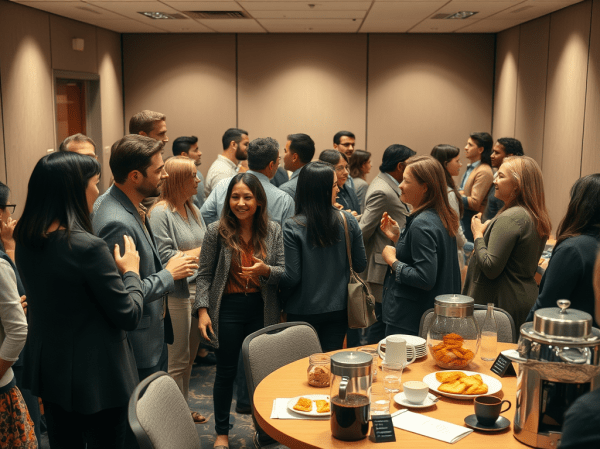
In that room, the bonding didn’t happen at the speaking podium and very seldom happened during the sessions we so carefully planned. It seeped in on the sidelines, over warmed-over coffee from conference centre urns, overripe bananas and the detritus of the picked over pastry tray. The bonding came from all of us sharing and digesting a common experience. You could feel a palpable energy in the room. You could pick up the emotion, read the body language and tune in to the full bandwidth of communication that goes far beyond what could be transmitted between an onboard microphone and a webcam.

But it wasn’t just the sharing of the experience that created the bonds. It was the digesting of those experiences after the fact. We humans are herding animals, and that extends to how we come to consensus about things we go through together. We do so through communication with others – not just with words and gesture, but also through the full bandwidth of our evolved mechanisms for coming to a collective understanding. It wasn’t just that a camera and microphone couldn’t transmit that effectively, it was that it happened where there was no camera or mic.

As researchers have discovered, there is a lived reality and a remembered reality and often, they don’t look very much alike. The difference between the effectiveness of an in-person experience and one accessed through an online platform shouldn’t come as a surprise to us. This is due to how our evolved sense-making mechanisms operate. We make sense of reality both internally, through a comparison with our existing cognitive models and externally, through interacting with others around us who have shared that same reality. This communal give-and-take colors what we take with us, in the form of both memories and an updated model of what we know and believe. When it comes to how humans are built, collective sense making is a feature, not a bug.

I came away from that conference with much more than the content that was shared at the speaker dais. I also came away with a handful of new relationships, built on sharing an experience and, through that, laying down the first foundations of trust and familiarity. I would not hesitate to reach out to any of these new friends if I had a question about something or a project I felt they could collaborate on.

I think that’s true largely because I was in the room where it happened.