My Tentative Embrace of AI

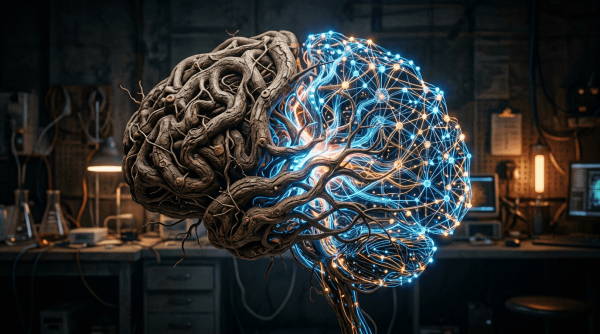
Hybrid brain model with organic roots and glowing digital network

I have dipped my toes a little further into the deep, deep waters of AI (which this week promises to get deeper with the recently announced OpenAI IPO). Here, then, are my updated thoughts on Artificial Intelligence.

For the past few months, I have been doing post-production on a documentary. The footage has been shot over the past 6 or 7 years and I have been wading through hours of interviews and other footage, writing the script, building edit sheets and – for the past month – actually doing the edits. In the process, I have tried to use AI judiciously. My rule of thumb has been this:  If I’m going to use AI, don’t be obvious about it.

Because I use Adobe tools for things like editing and some special effects, AI assistance is now built into almost everything I do. It lurks beneath the hood on pretty much every menu item and tool selection that Adobe offers. This is not the type of AI I am referring too. This built-in AI is what I call covert artificial intelligence.

I am referring to overt AI, where I have made a deliberate decision not to use the limited processing power of my own brain and have unleashed the AI Kraken to do my bidding. In my case, that has involved gathering information for the script, creating soundtracks, some video special effects and some other technical aspects.

I will say I did stop short of using AI for some special video effects which – upon viewing an example – created an uneasy feeling in my gut. Something told me I had stepped over the threshold into the realm of excessive creepiness.  When you’re dealing with people’s memories, especially of loved ones since departed, you have to tread carefully. Just because AI lets you do something, doesn’t mean you should.

But here’s my point. AI couldn’t have made that call. It couldn’t replicate my intuitive understanding of my audience, even to the point of anticipating reactions from specific individuals who I knew would be watching. AI can’t make gut calls about human consequences.

In that, it bears a resemblance to Phineas Gage.

Unless you’re a neuroscience geek, you may never have heard of poor Phineas, but it’s one of the most famous case studies in science. On September 13, 1848, Gage was working with a railway blasting crew in Vermont. Due to unexpected explosion of blasting powder, an iron crowbar was driven through the left side of his frontal brain. Miraculously, Gage retained much of his memory, language and reasoning ability. What was impaired was ability to make gut decisions, using something famed neuroscientist Antonio Damasio called “somatic markers.”  

It’s exactly these instincts, these abilities to predict the responses of others, that AI lacks. While it may be “intelligent” it is not necessarily “wise,” as wisdom requires judgement. It requires the ability to foresee reactions and to adjust your decisions accordingly.

When we look at the intersection of creativity and AI, it’s this human aspect that we should not be too quick to surrender to technology.

Take the writing of this post, for example. I did use AI to help me gather my thoughts. But the writing itself is – for better or worse – all me.  

I have been writing for pretty much all of my life. I have – I think – a human voice. My grammar isn’t perfect. I am Canadian, so my editor (the incredibly patient Phyllis Fine at MediaPost) has to “Americanize” my spellings. I started my career writing for radio, so my sentence structure can sometimes kindly be described as rambling. But all of this accurately reflects who I am. If I used AI to actually craft my words, I would have removed myself “from the loop.” Even as I write this text, my computer screen is littered with blue dotted underlines suggesting there may be better ways to word things.  I’m ignoring almost all of them.

I don’t know where the right AI-Human balance is. Even if I did know, it would be a moving target. The things AI can do today are a quantum leap ahead of what it could do even a year or two ago. But I don’t see AI gaining the ability to actually feel anything any time soon.

Gemini vs. ChatGPT: Will Either Become Our New Habit?

Two tall skyscrapers with digital data patterns glowing on their surfaces at dusk in a cityscape

Back 20 years ago when I spoke about search, I used to talk a lot about the “Google Habit.”  In the remarkably short time from its debut to the early 2000s, Google had become our defacto search choice. In fact, it was so dominant, we didn’t even consider its competitors. We didn’t think at all…we just Googled. That is how a habit works. We do things without thinking about them.

Fast forward 20 years. Google still dominates the information retrieval space. When we talk about worldwide search, Google delivers the results on 9 out of every 10 searches launched. It’s monolithic presence in the online landscape hasn’t really changed. But the way we navigate that landscape is beginning to. For the first time in a long time, Google has a real competitor when it comes to the way we look for our answers.

Another favorite topic of mine, following hard on the heels of the “Googe Habit,” was talking about the “usefulness of search.” I argued that while Google did a good job of retrieving information, it feel well short of the goal of making that information immediately useful to us. Today, with agentic A.I., the tantalizing promise of usefulness has finally arrived. The question is, what tools will we use to mine that usefulness?

The battle seems to be between Google’s Gemini, deeply embedded in the entire Google ecosystem, and OpenAI’s ChatGPT, a standalone app. Anthropic’s Claude is currently focused on the enterprise AI market.

Back two decades ago, I envisioned search gradually disappearing “under the hood” of various apps that made our lives easier. The act of actually retrieving information would be one step removed from us. What we would interact with would be a distillation of that information, formed into something we could use to do the things we wanted to do. What I didn’t anticipate was the emergence of the Large Language Model that currently powers ChatGPT and other AI models.

But as it currently stands, the act of retrieving information that we can use and the act of processing huge reams of text to predict useful responses are quickly converging. For an ever-increasing number of queries (currently about 50%) Google’s Gemini AI answers are now predominately displayed in the prime real estate of the search results page, straddling the very top of the “Golden Triangle.”  And ChatGPT is increasingly asked to retrieve specific information as users interact with its chatbot. Both Google and OpenAI realize that the future lies in a hybrid of the two.

The battle now is for either Google or OpenAI to dominate the various user interfaces in our personal technologies. And in this regard, it will be hard to beat Google. This January, Google and Apple inked a deal that would make Gemini the foundational AI platform for a future version of Siri. It’s already embedded in all Android devices. OpenAI’s early mover advantage over Google in terms of consumer AI usage is rapidly disappearing, with the two currently running almost neck and neck (36.6% for ChatGPT vs 27.4% for Gemini, according to a recent Emarketer forecast).

Brian X. Chen, lead consumer technology writer for the New York Times, indicated in a recent article that Emarketer’s numbers could be understating the competitiveness of OpenAI’s rival.  Google said at their recent Google I/O conference that in one year, the number of people using the Gemini chatbot more than doubled to 900 million. That puts it in a dead heat with ChatGPT and, if current growth rates continue, moving well past it in the next year.

Chen points out another massive advantage for Google’s Gemini over OpenAI’s ChatGPT. While OpenAI’s numbers are not public, they likely lost between $8 and $9 billion last year. Even the most optimistic forecasts don’t put OpenAI in a profitable position til 2029.

Google, thanks to its dominance in the online ad space, made a profit of $112 billion in 2025 on revenue of $386 billion. It will be relatively easy for Google to fold Gemini into that vast advertising supported ecosystem, moving to a cash positive position almost immediately. Because of the enormous development costs of AI, it’s hard to argue with the logic that player with the deepest pockets will be the ultimate winner.

There Are No Short Cuts to Being Human

The Velvet Sundown fooled a lot of people, including millions of fans on Spotify and the writers and editors at Rolling Stone. It was a band that suddenly showed up on Spotify several months ago, with full albums of vintage Americana styled rock. Millions started streaming the band’s songs – except there was no band. The songs, the album art, the band’s photos – it was all generated by AI.

When you know this and relisten to the songs, you swear you would have never been fooled. Those who are now in the know say the music is formulaic, derivative and uninspired. Yet we were fooled, or, at least, millions of us were – taken in by an AI hoax, or what is now euphemistically labelled on Spotify as “a synthetic music project guided by human creative direction and composed, voiced and visualized with the support of artificial intelligence.”

Formulaic. Derivative. Synthetic. We mean these as criticisms. But they are accurate descriptions of exactly how AI works. It is synthesis by formulas (or algorithms) that parse billions or trillions of data points, identify patterns and derive the finished product from it. That is AI’s greatest strength…and its biggest downfall.

The human brain, on the other hand, works quite differently. Our biggest constraint is the limit of our working memory. When we analyze disparate data points, the available slots in our temporary memory bank can be as low as in the single digits. To cognitively function beyond this limit, we have to do two things: “chunk” them together into mental building blocks and code them with emotional tags. That is the human brain’s greatest strength… and again, it’s biggest downfall. What the human brain is best at is what AI is unable to do. And vice versa.

A few posts back when talking about one less-than-impressive experience with an AI tool, I ended by musing what role humans might play as AI evolves and becomes more capable. One possible answer is something labelled “HITL” or “Humans in the Loop.” It plugs the “humanness” that sits in our brains into the equation, allowing AI to do what it’s best at and humans to provide the spark of intuition or the “gut checks” that currently cannot come from an algorithm.

As an example, let me return to the subject of that previous post, building a website. There is a lot that AI could do to build out a website. What it can’t do very well is anticipate how a human might interact with the website. These “use cases” should come from a human, perhaps one like me.

Let me tell you why I believe I’m qualified for the job. For many years, I studied online user behavior quite obsessively and published several white papers that are still cited in the academic world. I was a researcher for hire, with contracts with all the major online players. I say this not to pump my own ego (okay, maybe a little bit – I am human after all) but to set up the process of how I acquired this particular brand of expertise.

It was accumulated over time, as I learned how to analyze online interactions, code eye-tracking sessions, talked to users about goals and intentions. All the while, I was continually plugging new data into my few available working memory slots and “chunking” them into the building blocks of my expertise, to the point where I could quickly look at a website or search results page and provide a pretty accurate “gut call” prediction of how a user would interact with it. This is – without exception – how humans become experts at anything. Malcolm Gladwell called it the “10,000-hour rule.” For humans to add any value “in the loop” they must put in the time. There are no short cuts.

Or – at least – there never used to be. There is now, and that brings up a problem.

Humans now do something called “cognitive off-loading.” If something looks like it’s going to be a drudge to do, we now get Chat-GPT to do it. This is the slogging mental work that our brains are not particularly well suited to. That’s probably why we hate doing it – the brain is trying to shirk the work by tagging it with a negative emotion (brains are sneaky that way). Why not get AI, who can instantly sort through billions of data points and synthesize it into a one-page summary, to do our dirty work for us?

But by off-loading, we short circuit the very process required to build that uniquely human expertise. Writer, researcher and educational change advocate Eva Keiffenheim outlines the potential danger for humans who “off-load” to a digital brain; we may lose the sole advantage we can offer in an artificially intelligent world, “If you can’t recall it without a device, you haven’t truly learned it. You’ve rented the information. We get stuck at ‘knowing about’ a topic, never reaching the automaticity of ‘knowing how.’”

For generations, we’ve treasured the concept of “know how.” Perhaps, in all that time, we forgot how much hard mental work was required to gain it. That could be why we are quick to trade it away now that we can.

Bots and Agents – The Present and Future of A.I.

This past weekend I got started on a website I told a friend I’d help him build. I’ve been building websites for over 30 years now, but for this one, I decided to use a platform that was new to me. Knowing there would be a significant learning curve, my plan was to use the weekend to learn the basics of the platform. As is now true everywhere, I had just logged into the dashboard when a window popped up asking if I wanted to use their new AI co-pilot to help me plan and build the website.

“What the hell?” I thought, “Let’s take it for a spin!” Even if it could lessen the learning curve a little bit, it could still save me dozens of hours. The promise given me was intriguing – the AI co-pilot would ask me a few questions and then give me back the basic bones of a fully functional website. Or, at least, that’s what I thought.

I jumped on the chatbot and started typing. With each question, my expectations rose. It started with the basics: what were we selling, what were our product categories, where was our market? Soon, though, it started asking me what tone of voice I wanted, what was our color scheme, what search functionality was required, were there any competitor’s sites that we liked or disliked, and if so, what specifically did we like or dislike?  As I plugged my answers, I wondered what exactly I would get back.

The answer, as it turned out, was not much. As I was reassured that I had provided a strong enough brief for an excellent plan, I clicked the “finalize” button and waited. And waited. And waited. The ellipse below my last input just kept fading in and out. Finally, I asked, “Are you finished yet?” I was encouraged to just wait a few more minutes as it prepared a plan guaranteed to amaze.

Finally – ta da! – I got the “detailed web plan.” As far as I can tell, it had simply sucked in my input and belched it out again, formatted as a bullet list. I was profoundly underwhelmed.

Going into this, I had little experience with AI. I have used it sparingly for tasks that tend to have a well-defined scope. I have to say, I have been impressed more often than I have been disappointed, but I haven’t really kicked the tires of AI.

Every week, when I sit down to write this post, Microsoft Co-Pilot urges me to let it show what it can do. I have resisted, because when I do ask AI to write something for me, it reads like a machine did it. It’s worded correctly and usually gets the facts right, but there is no humanness in the process. One thing I think I have is an ability to connect the dots – to bring together seemingly unconnected examples or thoughts and hopefully join them together to create a unique perspective. For me, AI is a workhorse that can go out and gather the information in a utilitarian manner, but somewhere in the mix, a human is required to add the spark of intuition or inspiration. For now, anyway.

Meet Agentic AI

With my recent AI debacle still fresh in my mind, I happened across a blog post from Bill Gates. It seems I thought I was talking to an AI “Agent” when, in fact, I was chatting with a “Bot.” It’s agentic AI that will probably deliver the usefulness I’ve been looking for for the last decade and a half.

As it turns out, Gates was at least a decade and a half ahead of me in that search. He first talked about intelligent agents in his 1995 book The Road Ahead. But it’s only now that they’ve become possible, thanks to advances in AI. In his post, Gate’s describes the difference between Bots and Agents: “Agents are smarter. They’re proactive—capable of making suggestions before you ask for them. They accomplish tasks across applications. They improve over time because they remember your activities and recognize intent and patterns in your behavior. Based on this information, they offer to provide what they think you need, although you will always make the final decisions.”

This is exactly the “app-ssistant” I first described in 2010 and have returned to a few times since, even down to using the same example Bill Gates did – planning a trip. This is what I was expecting when I took the web-design co-pilot for a test flight. I was hoping that – even if it couldn’t take me all the way from A to Z – it could at least get me to M. As it turned out, it couldn’t even get past A. I ended up exactly where I started.

But the day will come. And, when it does, I have to wonder if there will still be room on the flight for we human passengers?

The Question We Need to Ask about AI

This past weekend I listened to a radio call-in show about AI. The question posed was this – are those using AI regularly achievers or cheaters? A good percentage of the conversation was focused on AI in education, especially those in post-secondary studies. Educators worried about being able to detect the use of AI to help complete coursework, such as the writing of papers. Many callers – all of which would probably be well north of 50 years old – bemoaned that fact that students today are not understanding the fundamental concepts they’re being presented because they’re using AI to complete assignments. A computer science teacher explained why he teaches obsolete coding to his students – it helps them to understand why they’re writing code at all. What is it they want to code to do? He can tell when his students are using AI because they submit examples of coding that are well beyond their abilities.

That, in a nutshell, sums up the problem with our current thinking about AI. Why are we worried about trying to detect the use of ChatGPT by a student who’s learning how to write computer code? Shouldn’t we be instead asking why we need humans to learn coding at all, when AI is better at it? Maybe it’s a toss-up right now, but it’s guaranteed not to stay that way for long. This isn’t about students using AI to “cheat.” This is about AI making humans obsolete.

As I was writing this, I happened across an essay by computer scientist Louis Rosenberg. He is worried that those in his circle, like the callers to the show I was listening too, “have never really considered what life will be like the day after an artificial general intelligence (AGI) is widely available that exceeds our own cognitive abilities.” Like I said, what we use AI for now it a poor indicator for what AI will be doing in the future.  To use an analogy I have used before, it’s like using a rocket to power your lawnmower.

But what will life be like when, in a somewhat chilling example put forward by Rosenberg, “I am standing alone in an elevator — just me and my phone — and the smartest one speeding between floors is the phone?”

It’s hard to wrap you mind around the possibilities. One of the callers to the show was a middle-aged man who was visually impaired. He talked about the difference it made to him when he got a pair of Meta Glasses last Christmas. Suddenly, his world opened up. He could make sure the pants and shirt he picked out to wear today were colors that matched. He could see if his recycling had been picked up before he made the long walk down the driveway to pick up the bin. He could cook for himself because the glasses could tell him what were in the boxes he took off his kitchen shelf. For him, AI gave him back his independence.

I personally believe we’re on the cusp of multiple AI revolutions. Healthcare will take a great leap forward when we lessen our requirements for expert advice coming from a human. In Canada, general practitioners are in desperately short supply. When you combine AI with the leaps being made by incorporating biomonitoring into wearable technology, I can’t imagine how great things would not be possible in terms of living longer, healthier lives. I hope the same is true for dealing with climate change, agricultural production and other existential problems we’re currently wrestling with.

But let’s back up to Rosenberg’s original question – what will life be like the day after AI exceeds our own abilities? The answer to that, I think, is dependent on who is in control of AI on the day before. The danger here is more than just humans becoming irrelevant. The danger is what humans are determining the future of direction of AI before AI takes over the steering wheel and determines its own future.

For the past 7 decades, the most pertinent question about our continued existence as a species has been this one, “Who is in charge of our combined nuclear arsenals?” But going forward, a more relevant question might be “who is setting the direction for AI?” Who is it that’s setting the rules, coming up with safeguards and determining what data the models are training on?  Who determines what tasks AI takes on? Here’s just one example. When does AI decide when the nuclear warheads are launched.

As I said, it’s hard to predict where AI will go. But I do know this. The general direction is already being determined. And we should all be asking, “By whom?”

Can OpenAI Make Searching More Useful?

As you may have heard, OpenAI is testing a prototype of a new search engine called SearchGPT. A press release from July 25 notes: “Getting answers on the web can take a lot of effort, often requiring multiple attempts to get relevant results. We believe that by enhancing the conversational capabilities of our models with real-time information from the web, finding what you’re looking for can be faster and easier.”

I’ve been waiting for this for a long time: search that moves beyond relevance to usefulness.  It was 14 years ago that I said this in an interview with Aaron Goldman regarding his book “Everything I Know About Marketing I Learned from Google”:“Search providers have to replace relevancy with usefulness. Relevancy is a great measure if we’re judging information, but not so great if we’re measuring usefulness. That’s why I believe apps are the next flavor of search, little dedicated helpers that allow us to do something with the information. The information itself will become less and less important and the app that allows utilization of the information will become more and more important.”

I’ve felt for almost two decades that the days of search as a destination were numbered. For over 30 years now (Archie, the first internet search engine, was created in 1990), when we’re looking for something online, we search, and then we have to do something with what we find on the results page. Sometimes, a single search is enough — but often, it isn’t. For many of our intended end goals, we still have to do a lot of wading through the Internet’s deep end, filtering out the garbage, picking up the nuggets we need and then assembling those into something useful.

I’ve spent much of those past two decades pondering what the future of search might be. In fact, my previous company wrote a paper on it back in 2007. We were looking forward to what we thought might be the future of search, but we didn’t look too far forward. We set 2010 as our crystal ball horizon. Then we assembled an all-star panel of search design and usability experts, including Marissa Mayer, who was then Google’s vice president of search user experience and interface design, and Jakob Nielsen, principal of the Nielsen Norman Group and the web’s best known usability expert. We asked them what they thought search would look like in three years’ time.

Even back then, almost 20 years ago, I felt the linear presentation of a results page — the 10 blue links concept that started search — was limiting. Since then, we have moved beyond the 10 blue links. A Google search today for the latest IPhone model (one of our test queries in the white paper) actually looks eerily similar to the mock-up we did for what a Google search might look like in the year 2010. It just took Google 14 extra years to get there.

But the basic original premise of search is still there: Do a query, and Google will try to return the most relevant results. If you’re looking to buy an iPhone, it’s probably more useful, mainly due to sponsored content. But it’s still well short of the usefulness I was hoping for.

It’s also interesting to see what directions search has (and hasn’t) taken since then. Mayer talked a lot about interacting with search results. She envisioned an interface where you could annotate and filter your results: “I think that people will be annotating search results pages and web pages a lot. They’re going to be rating them, they’re going to be reviewing them. They’re going to be marking them up, saying ‘I want to come back to this one later.’”

That never really happened. The idea of search as a sticky and interactive interface for the web sort of materialized, but never to the extent that Mayer envisioned.

From our panel, it was Nielsen’s crystal ball that seemed to offer the clearest view of the future: “I think if you look very far ahead, you know 10, 20, 30 years or whatever, then I think there can be a lot of things happening in terms of natural language understanding and making the computer more clever than it is now. If we get to that level then it may be possible to have the computer better guess at what each person needs without the person having to say anything, but I think right now, it is very difficult.”

Nielsen was spot-on in 2007. It’s exactly those advances in natural language processing and artificial intelligence that could allow ChatGPT to now move beyond the paradigm of the search results page and move searching the web into something more useful.

A decade and a half ago, I envisioned an ecosystem of apps that could bridge the gap between what we intended to do and the information and functionality that could be found online.  That’s exactly what’s happening at OpenAI — a number of functional engines powered by AI, all beneath a natural language “chat” interface.

At this point, we still have to “say” what we want in the form of a prompt, but the more we use ChatGPT (or any AI interface) the better it will get to know us. In 2007, when we wrote our white paper on the future of search, personalization was what we were all talking about. Now, with ChatGPT, personalization could come back to the fore, helping AI know what we want even if we can’t put it into words.

As I mentioned in a previous post, we’ll have to wait to see if SearchGPT can make search more useful, especially for complex tasks like planning a vacation, making a major purchase onr planning a big event.

But I think all the pieces are there. The monetization siloes that dominate the online landscape will still prove a challenge to getting all the way to our final destination, but SearchGPT could make the journey faster and a little less taxing.

Note: I still have a copy of our 2007 white paper if anyone is interested. Just email me (email in the contact us page), give me your email and I’ll send you a copy.