Our Digital World is No Place for the Elderly

My family is discovering – firsthand – just how the world could care less about the elderly.

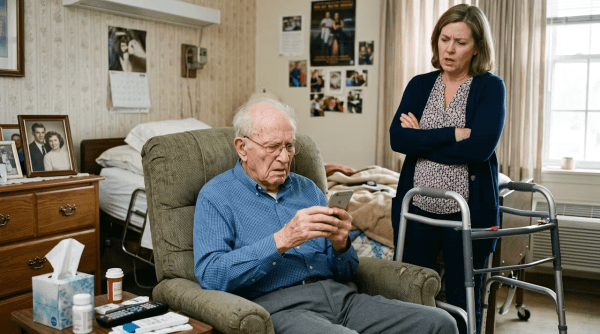
My stepfather just passed away. He was just a few months shy of his 91st birthday. For the past 10 years, my sister has been looking after the official side of Dad’s life – things like his income tax, pension, healthcare and other related needs. All these things have rushed online as local service counters and real, live humans whose job it was to assist their customers have virtually disappeared. The inner workings of these programs lie on the other side of either a website or a call centre. Neither of these things are designed for the elderly. They are barely functional for any of us, including those much younger than my stepdad.

For the past decade, as Dad has aged, it has become increasingly apparent that our world is not designed for the superannuated. In the last few years, his loss of hearing made it impossible for him to understand someone talking at a normal volume in the same room, let alone someone on a telephone call. This led to him being unable to follow the gist of most conversations. My sister, who has the patience of Job, acted as translator and guide for Dad but was constantly flummoxed by bureaucratic rules and privacy regulations that left no wiggle room for the elderly. A typical phone interaction (usually after waiting over an hour on hold) would go something like this:

My sister: “Hi, I’d like to ask about my father’s income tax return for 2025.”

Phone Agent: “I’m sorry, we can only give information to the person who files the return.”

“He’s here with me. I have his permission.”

“I’m sorry, I have to speak to him.”

“He can’t hear you. That’s why I’m calling.”

“I need to hear it from him. Can you hand him the phone?”

“He won’t hear you, but sure, knock yourself out.”

(Dad puts the phone to his ear, having no idea what’s going on. You can hear the person talking but Dad just looks at us blankly. My sister takes the phone back.)

“Your dad was unable to answer the security question I asked him to verify his identity.”

“As I said – repeatedly – Dad can’t hear. Can you ask me the question and I’ll ask him?”

“I need to hear the answer from him.”

“Is there an office we can go to and talk to someone in person?”

“No, all our support functions have moved online. You can use our website. Does your dad have an online account?”

“My dad has never touched a computer in his life. How would he have an online account?”

You get the gist. These scenarios always played out along the same lines but were typically spaced out so my sister had time to regain her incredible patience before the next episode. But when a person passes, suddenly all these things must be dealt with right away. Her days have been filled with circuitous phone calls trying to tie up Dad’s loose ends, stymied at every turn by the fact that while the system didn’t support him when he was alive, it’s doubly difficult now that he’s gone. Much as I’d like to help, I live in a different province and don’t have the legal authority to deal with these issues.

My Dad was caught on the far side of the grey digital divide. For the past few decades, technology has enabled companies and government services to offload the effort required to deliver their services or products from themselves to us, their customers. We now pump our own gas, do our own banking, configure our own phone plans, administer our own insurance policies and monitor our own pensions and income tax accounts. Programs and companies have gleefully eliminated physical locations and laid off customer support people to cut costs by transferring those functions to us. The only contact we have is either through a woefully designed website (I can tell you the Canadian Revenue Agency’s website is a usability nightmare) or a call center where one-hour waits are considered the norm.

Most of us, given no alternative, grudgingly jump through the hoops required to do what we have to do, which is what these agencies and companies used to do for us as part of their job. We struggle through archaic interfaces, learn new platforms every few years, constantly have to reset passwords and scramble through our various devices and authentication apps to sneak past the impenetrable security hurdles of two step verification. J.R.R. Tolkien made gaining access to Mordor look easy in comparison.

I understand that online fraud and identity theft is a real concern, but at some point, typically north of the age of 70, it gets harder for us to keep up. As our brains age, they tend to rely more on remembered strategies and routines because learning something new gets harder and harder. The world used to reward this accumulation of knowledge with age. Now it just kicks it to the curb like last week’s trash.

There are exceptions, of course. The elderly who are familiar with computers and technology can push the grey digital divide back substantially. But this was not my dad. In his life, he was a farmer, a sawmill worker and a chimney sweep. None of those things – especially in a time several decades past – required learning how to use a computer. The world literally passed Dad by. Just how far he was left behind has become acutely apparent to us in the last few weeks.

Through this all, we keep asking ourselves one very frightening question – If it was this hard for Dad, what is it like for those elderly who don’t have a person like my sister to help them?

What happens to them?

Serendipity And Our Media Menu

Vintage radio, open book, steaming cup of tea with teapot and cookies on wooden table

We live an optimized life. But as is often the case with optimization, these helpers focus on efficiency, not necessarily effectiveness. 

There is a difference. Efficiency used time as the yardstick of success. The goal of the efficiency expert is to get more done in less time. To do this, they identify friction and eliminate it. Anything that looks like a sticking point is hunted down and eradicated.

Effectiveness is more focused on the end product. At the end of the process, how good were the results? Efficiency is focused on the means to an end. Effectiveness cares more about the end itself.

Our optimized world is a ruthless hunter of friction. We are obsessed with finding the shortest path, and by doing this, we have become myopically efficient. Technology is accelerating this, as the path to information is getting shorter and straighter than ever. AI takes us straight to exactly the information we were looking for and guides us through future prompts to take us by the hand down curated paths. It is undoubtedly more efficient. But are we losing sight of the things that might make us more effective?

As I have said before, I am a fan of friction in some things. I believe friction makes us more human. More imperfect? Undoubtedly. But also more curious, more contemplative and more appreciative of serendipity. Friction opens up the possibilities of discovery by taking us off the well-optimized route and sometimes letting us wander in the wilderness.

That’s one of the reasons I love public radio. In the U.S, that’s NPR. Here in Canada, our public broadcaster is the Canadian Broadcasting Corporation (CBC). Public radio is one of the few media choices left to us that still has one foot firmly planted in yesteryear. Listening to the CBC today is not all that different from listening to it in 1985.

Our media menu, like many things, has been optimized to the extreme. Algorithms determine what we hear, see and read based on what it predicts will capture our engagement, and thus provide the best returns for advertisers.

Public radio has resisted this trend, both through editorial policy and through the nature of the medium itself. It is at this confluence that I can find my media friction, leaving me the room to wander and get lost in new ideas by taking unexpected turns. Many of the topics that have made their way into my posts first germinated when I was listening to public radio.

So, let’s look at what makes public radio different, first by design, then by how we interact with this particular medium.

Public radio is editorially curated. Content is chosen by a human — or group of humans — trying to assemble topics based on what they think their audience might be interested in. This process is not that different from what happens at a newspaper like the New York Times or an online news platform like CNN. What does make public radio different is the breadth of its subject matter — covering every conceivable topic — and the make-up of the network itself, with multiple layers of contribution and editorial decision-making that go from international stories at the top to hyper-local stories at the individual station level.

But the biggest difference in public radio lies in how we consume this medium. Public radio is listened to in blocks. It is like we’re being served a set selection of media content rather than picking and choosing individual items from a tasting menu. A 10-minute segment on the disappearing cod population of the North Atlantic might be programmed directly adjacent to an exploration of how Brazilian Baila Funk music has roots going back to the Miami Bass artists of the 1980s. 

Public radio listeners typically don’t change the station because there is nothing else on the dial even remotely comparable. We usually just go along for the ride.

People who know that I am a public radio fan have suggested that I listen to podcasts because they’re “basically the same thing.” I have tried podcasts and always felt that something was missing, but couldn’t put my finger on what. It was only recently that I realized hat was missing: serendipity. I have never run into the unexpected in a podcast. With public radio, it happens all the time, usually at the top and bottom of the hour.

My Tentative Embrace of AI

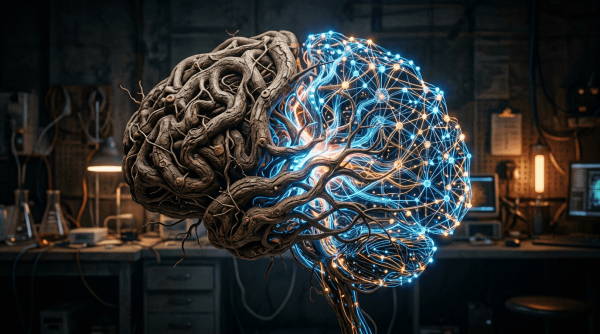
Hybrid brain model with organic roots and glowing digital network

I have dipped my toes a little further into the deep, deep waters of AI (which this week promises to get deeper with the recently announced OpenAI IPO). Here, then, are my updated thoughts on Artificial Intelligence.

For the past few months, I have been doing post-production on a documentary. The footage has been shot over the past 6 or 7 years and I have been wading through hours of interviews and other footage, writing the script, building edit sheets and – for the past month – actually doing the edits. In the process, I have tried to use AI judiciously. My rule of thumb has been this:  If I’m going to use AI, don’t be obvious about it.

Because I use Adobe tools for things like editing and some special effects, AI assistance is now built into almost everything I do. It lurks beneath the hood on pretty much every menu item and tool selection that Adobe offers. This is not the type of AI I am referring too. This built-in AI is what I call covert artificial intelligence.

I am referring to overt AI, where I have made a deliberate decision not to use the limited processing power of my own brain and have unleashed the AI Kraken to do my bidding. In my case, that has involved gathering information for the script, creating soundtracks, some video special effects and some other technical aspects.

I will say I did stop short of using AI for some special video effects which – upon viewing an example – created an uneasy feeling in my gut. Something told me I had stepped over the threshold into the realm of excessive creepiness.  When you’re dealing with people’s memories, especially of loved ones since departed, you have to tread carefully. Just because AI lets you do something, doesn’t mean you should.

But here’s my point. AI couldn’t have made that call. It couldn’t replicate my intuitive understanding of my audience, even to the point of anticipating reactions from specific individuals who I knew would be watching. AI can’t make gut calls about human consequences.

In that, it bears a resemblance to Phineas Gage.

Unless you’re a neuroscience geek, you may never have heard of poor Phineas, but it’s one of the most famous case studies in science. On September 13, 1848, Gage was working with a railway blasting crew in Vermont. Due to unexpected explosion of blasting powder, an iron crowbar was driven through the left side of his frontal brain. Miraculously, Gage retained much of his memory, language and reasoning ability. What was impaired was ability to make gut decisions, using something famed neuroscientist Antonio Damasio called “somatic markers.”  

It’s exactly these instincts, these abilities to predict the responses of others, that AI lacks. While it may be “intelligent” it is not necessarily “wise,” as wisdom requires judgement. It requires the ability to foresee reactions and to adjust your decisions accordingly.

When we look at the intersection of creativity and AI, it’s this human aspect that we should not be too quick to surrender to technology.

Take the writing of this post, for example. I did use AI to help me gather my thoughts. But the writing itself is – for better or worse – all me.  

I have been writing for pretty much all of my life. I have – I think – a human voice. My grammar isn’t perfect. I am Canadian, so my editor (the incredibly patient Phyllis Fine at MediaPost) has to “Americanize” my spellings. I started my career writing for radio, so my sentence structure can sometimes kindly be described as rambling. But all of this accurately reflects who I am. If I used AI to actually craft my words, I would have removed myself “from the loop.” Even as I write this text, my computer screen is littered with blue dotted underlines suggesting there may be better ways to word things.  I’m ignoring almost all of them.

I don’t know where the right AI-Human balance is. Even if I did know, it would be a moving target. The things AI can do today are a quantum leap ahead of what it could do even a year or two ago. But I don’t see AI gaining the ability to actually feel anything any time soon.

Gemini vs. ChatGPT: Will Either Become Our New Habit?

Two tall skyscrapers with digital data patterns glowing on their surfaces at dusk in a cityscape

Back 20 years ago when I spoke about search, I used to talk a lot about the “Google Habit.”  In the remarkably short time from its debut to the early 2000s, Google had become our defacto search choice. In fact, it was so dominant, we didn’t even consider its competitors. We didn’t think at all…we just Googled. That is how a habit works. We do things without thinking about them.

Fast forward 20 years. Google still dominates the information retrieval space. When we talk about worldwide search, Google delivers the results on 9 out of every 10 searches launched. It’s monolithic presence in the online landscape hasn’t really changed. But the way we navigate that landscape is beginning to. For the first time in a long time, Google has a real competitor when it comes to the way we look for our answers.

Another favorite topic of mine, following hard on the heels of the “Googe Habit,” was talking about the “usefulness of search.” I argued that while Google did a good job of retrieving information, it feel well short of the goal of making that information immediately useful to us. Today, with agentic A.I., the tantalizing promise of usefulness has finally arrived. The question is, what tools will we use to mine that usefulness?

The battle seems to be between Google’s Gemini, deeply embedded in the entire Google ecosystem, and OpenAI’s ChatGPT, a standalone app. Anthropic’s Claude is currently focused on the enterprise AI market.

Back two decades ago, I envisioned search gradually disappearing “under the hood” of various apps that made our lives easier. The act of actually retrieving information would be one step removed from us. What we would interact with would be a distillation of that information, formed into something we could use to do the things we wanted to do. What I didn’t anticipate was the emergence of the Large Language Model that currently powers ChatGPT and other AI models.

But as it currently stands, the act of retrieving information that we can use and the act of processing huge reams of text to predict useful responses are quickly converging. For an ever-increasing number of queries (currently about 50%) Google’s Gemini AI answers are now predominately displayed in the prime real estate of the search results page, straddling the very top of the “Golden Triangle.”  And ChatGPT is increasingly asked to retrieve specific information as users interact with its chatbot. Both Google and OpenAI realize that the future lies in a hybrid of the two.

The battle now is for either Google or OpenAI to dominate the various user interfaces in our personal technologies. And in this regard, it will be hard to beat Google. This January, Google and Apple inked a deal that would make Gemini the foundational AI platform for a future version of Siri. It’s already embedded in all Android devices. OpenAI’s early mover advantage over Google in terms of consumer AI usage is rapidly disappearing, with the two currently running almost neck and neck (36.6% for ChatGPT vs 27.4% for Gemini, according to a recent Emarketer forecast).

Brian X. Chen, lead consumer technology writer for the New York Times, indicated in a recent article that Emarketer’s numbers could be understating the competitiveness of OpenAI’s rival.  Google said at their recent Google I/O conference that in one year, the number of people using the Gemini chatbot more than doubled to 900 million. That puts it in a dead heat with ChatGPT and, if current growth rates continue, moving well past it in the next year.

Chen points out another massive advantage for Google’s Gemini over OpenAI’s ChatGPT. While OpenAI’s numbers are not public, they likely lost between $8 and $9 billion last year. Even the most optimistic forecasts don’t put OpenAI in a profitable position til 2029.

Google, thanks to its dominance in the online ad space, made a profit of $112 billion in 2025 on revenue of $386 billion. It will be relatively easy for Google to fold Gemini into that vast advertising supported ecosystem, moving to a cash positive position almost immediately. Because of the enormous development costs of AI, it’s hard to argue with the logic that player with the deepest pockets will be the ultimate winner.

Asking Advice for a Friend

Diverse group of people sitting on wooden chairs in a circle in a room with wooden floors

I have a question for you, “Do you ask people for advice as often as you used to?”

It’s an important question, because the ability to exchange information is one of the most human of capabilities. It was that, probably more than any other factor, that sparked “The Great Leap” 50,000 years ago. Suddenly humans became more than slightly advanced primates and we started creating art, building advanced tools, forging long distance trade alliances and practicing religion. It was this cognitive revolution that started us on the path that led to where we are today.

Most anthropologists agree that while there could have been many factors that lead to the “Great Leap”, the most likely candidate was our ability – through the creation of symbolic language – to communicate abstract ideas and transfer complex skills. All the things that make us human came from this new ability to talk to each other: we could manage living in large groups, we could transfer knowledge from one person to the other, and – more importantly – we could pass information and skills from one generation to the next, ensuring our knowledge didn’t die with us.

So, yes, it’s important to ask if we still ask other people for advice. Because if we don’t, are we losing the ability to be human?

Now, I have a confession to make. All the stuff I just told you about the Great Leap came from A.I. I had the tiniest kernel of an idea and rather than share it with someone else, I typed the question into ChatGPT. I did reword its answer in my own words, but the above 3 paragraphs aren’t my ideas, nor do they come from any other human that I talked to. They were distilled from an algorithm. And here we have two intrinsically human strategies battling each other: the need to communicate, and the instinct to forage efficiently.

We humans are born communicators, but we are also natural foragers. We have an internal effort vs reward calculator that drives us down the most efficient path to get what we’re looking for. One of the dusty old UX concepts I used to drag around with me on the speaking circuit was Pirolli and Card’s Information Foraging Theory, which was formulated in 1999 at Xerox’s PARC (the Palo Alto Research Center, where I happened to have a wonderful visit with Peter Pirolli).

The theory may be long-in-the-tooth, but it’s still the single most elegant theory I’ve ever found to explain human behavior online. Simply put, we will expend the least amount of energy required to gain the information we’re looking for. That basic human tendency takes on new implications in our world of A.I.

If we’re looking for information, we will take the shortest path that will get us there. If the shortest path is asking ChatGPT, or, increasingly, using Gemini’s AI Mode in Google, then that’s what we’ll do.

So, I was just being human when I asked AI about the Great Leap. It took me 5 seconds to structure my query and 2 seconds later, I had my answer, impeccably reasoned and laid out in structured language. It did – in 7 seconds – what it would have taken at least a few hours to do the old way, by searching through words written by another human.

And heaven forbid asking another living, breathing human. That would have taken days, at least.

But if we stop asking each other for advice or information, we also have to ask ourselves, “what are we giving up?”  In our previous quest for information, we had to exercise two critical regions of our brain, our language centers (commonly called Broca’s Area and Wernicke’s Area), used to communicate with other humans, and the prefrontal cortex, where we synthesize information into a viable framework for action. If we were looking for the two areas of the brain that make us distinctly human, these would be two excellent candidates.

If we start using A.I. not just to gather information, but also to structure it into pre-made “thoughts”, we will inevitably use these areas of our brain less. And one of the features of our brain is that it automatically housecleans the least used parts of itself. It’s called synaptic pruning. Through it, the brain continually rewires itself to be best adapted to the tasks it does all the time.

If we stop doing the things that are instinctively human, like sharing knowledge, will our brain start trimming the very parts that make us human?

I’m asking for a friend.

No One Was Laughing this April Fool’s Day

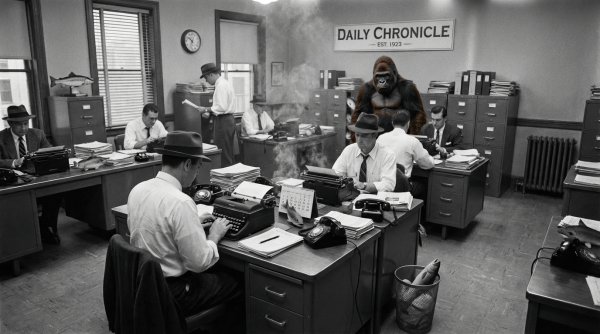
Men in fedoras at typewriters in a vintage newsroom with fish in unusual places.

Last Wednesday was April Fool’s Day. But I hardly saw any April Fool’s pranks. When I realized that, I thought to myself, “This is a sign of the times.”

April Fool’s probably started in 1582, when much of Europe switched from the Julian to the Gregorian calendar, which moved New Year’s from April 1st to January 1st. Those that still clung to the old calendar were called April Fools.

An alternative theory comes from Spring festivals that celebrated jokes, chaos and role reversals, like the Roman Hilaria or the medieval European “Feast of Fools.”

But April Fool’s really hit its peak when Mass Media joined in the fun. It was the BBC in Britain that got the ball rolling in 1957, with their famous “Spaghetti Tree Harvest” news documentary. Thousands jammed the BBC switchboards asking how they could grow their own spaghetti trees. The April Fool’s News Story became a BBC tradition.

Other media outlets followed in the BBC’s footsteps. In 1977, that stiff-lipped stalwart of British journalism, The Guardian, published a travel supplement for “San Serriffe” – a tropical nation made up of two main islands, Upper Caisse and Lower Caisse. The leader, General Pica, had a palace in the capital city of Bodoni. Anyone with some graphic design experience would soon realize the entire 7-page special supplement was full of typography puns, but it seems the British weren’t exactly that “type” – U.K. travel agencies received several calls wanting to book trips there.

Brands thought elaborate pranks would show how hip and relevant they were and jumped on the April Fool’s bandwagon in the 1980’s and 90’s. Taco Bell “bought” the Liberty Bell in 1996 and renamed it the Taco Liberty Bell. In 1998, Burger King introduced the Left-Handed Whopper. Even Big Tech joined the party with that wacky sense of humor computer engineers are known for. In 2013 Google introduced Google Nose, a search engine of smells. It included “Wet Dog” and had a Street Sense feature.

Ironically, Google also introduced Gmail on April 1st, in 2004, blurring the line between prank and product launch. No one believed you could get a free email account with 1 GB of storage. Competitors offered 2 to 4 megabytes.

Let’s fast forward to April 1, 2026. On that day – last Wednesday – crickets. There was no ha-ha to be found. And I thought, “What a sad state the world is in when we can’t even poke fun at ourselves.”

Maybe it’s because “Fake News” is now a real thing, 365 days a year, not just on April First.

Also, if you’re going to play a prank now, it’s probably going to be on social media. And how the hell can you compete with the wall-to-wall misinformation madness that fills everyone’s feed, every single day of the year.

But then I realized that attitudes towards April Fools have followed an arc directly related to how we get our information through media.

From the 1950s to the 90s, information was scarce and mass media outlets were the gate keepers. Trust was implied in the relationship, and it was that trust that was slyly mocked at on April the First. The April Fool’s prank hearkened back to the Medieval tradition of role reversal on Feast of Fools Day, when traditional hierarchies were inverted. This meant that – for one day – even the sober British media could play the fools. It was all done in a “wink wink” kind of way.

Then, in the late 90s and early 2000s, information became abundant. Those playing a prank expected to be fact checked. It was a way to drive viral traffic to online sources of information, which is why brands started to jump aboard with their own April Fool’s Pranks.

But now, in the age of misinformation and A.I. slop, every day is April Fool’s Day. Information (and misinformation) isn’t just abundant, it’s a pollutant. It’s everywhere and it’s often intentionally toxic. The very thing we used to smile about is a force that’s shattering our society.

It’s hard to laugh at that.

When Did the Future Become So Scary?

The TWA hotel at JFK airport in New York gives one an acute case of temporal dissonance. It’s a step backwards in time to the “Golden Age of Travel” – the 1960s. But even though you’re transported back 60 years, it seems like you’re looking into the future. The original space – the TWA Flight Center – was designed in 1962 by Eero Saarinen. This was a time when America was in love with the idea of the future. Science and technology were going to be our saving grace. The future was going to be a utopian place filled with flying jet cars, benign robots and gleaming, sexy white curves everywhere.  The TWA Flight Center was dedicated to that future.

It was part of our love affair with science and technology during the 60s. Corporate America was falling over itself to bring the space-age fueled future to life as soon as possible. Disney first envisioned the community of tomorrow that would become Epcot. Global Expos had pavilions dedicated to what the future would bring. There were four World Fairs over 12 years, from 1958 to 1970, each celebrating a bright, shiny white future. There wouldn’t be another for 22 years.

This fascination with the future was mirrored in our entertainment. Star Trek (pilot in 1964, series start in 1966) invited all of us to boldly go where no man had gone before, namely a future set roughly three centuries from then.   For those of us of a younger age, the Jetsons (original series from 1963 to 64) indoctrinated an entire generation into this religion of future worship. Yes, tomorrow would be wonderful – just you wait and see!

That was then – this is now. And now is a helluva lot different.

Almost no one – especially in the entertainment industry – is envisioning the future as anything else than an apocalyptic hell hole. We’ve done an about face and are grasping desperately for the past. The future went from being utopian to dystopian, seemingly in the blink of an eye. What happened?

It’s hard to nail down exactly when we went from eagerly awaiting the future to dreading it, but it appears to be sometime during the last two decades of the 20th Century. By the time the clock ticked over to the next millennium, our love affair was over. As Chuck Palahniuk, author of the 1999 novel Invisible Monsters, quipped, “When did the future go from being a promise to a threat?”

Our dread about the future might just be a fear of change. As the future we imagined in the 1960’s started playing out in real time, perhaps we realized our vision was a little too simplistic. The future came with unintended consequences, including massive societal shifts. It’s like we collectively told ourselves, “Once burned, twice shy.” Maybe it was the uncertainty of the future that scared the bejeezus out of us.

But it could also be how we got our information about the impact of science and technology on our lives. I don’t think it’s a coincidence that our fear of the future coincided with the decline of journalism. Sensationalism and endless punditry replaced real reporting just about the time we started this about face. When negative things happened, they were amplified. Fear was the natural result. We felt out of control and we keep telling ourselves that things never used to be this way.  

The sum total of all this was the spread of a recognized psychological affliction called Anticipatory Anxiety – the certainty that the future is going to bring bad things down upon us. This went from being a localized phenomenon (“my job interview tomorrow is not going to go well”) to a widespread angst (“the world is going to hell in a handbasket”). Call it Existential Anticipatory Anxiety.

Futurists are – by nature – optimists. They believe things well be better tomorrow than they are today. In the Sixties, we all leaned into the future. The opposite of this is something called Rosy Retrospection, and it often comes bundled with Anticipatory Anxiety. It is a known cognitive bias that comes with a selective memory of the past, tossing out the bad and keeping only the good parts of yesterday. It makes us yearn to return to the past, when everything was better.

That’s where we are today. It explains the worldwide swing to the right. MAGA is really a 4-letter encapsulation of Rosy Retrospection – Make America Great Again! Whether you believe that or not, it’s a message that is very much in sync with our current feelings about the future and the past.

As writer and right-leaning political commentator William F. Buckley said, “A conservative is someone who stands athwart history, yelling Stop!”

There Are No Short Cuts to Being Human

The Velvet Sundown fooled a lot of people, including millions of fans on Spotify and the writers and editors at Rolling Stone. It was a band that suddenly showed up on Spotify several months ago, with full albums of vintage Americana styled rock. Millions started streaming the band’s songs – except there was no band. The songs, the album art, the band’s photos – it was all generated by AI.

When you know this and relisten to the songs, you swear you would have never been fooled. Those who are now in the know say the music is formulaic, derivative and uninspired. Yet we were fooled, or, at least, millions of us were – taken in by an AI hoax, or what is now euphemistically labelled on Spotify as “a synthetic music project guided by human creative direction and composed, voiced and visualized with the support of artificial intelligence.”

Formulaic. Derivative. Synthetic. We mean these as criticisms. But they are accurate descriptions of exactly how AI works. It is synthesis by formulas (or algorithms) that parse billions or trillions of data points, identify patterns and derive the finished product from it. That is AI’s greatest strength…and its biggest downfall.

The human brain, on the other hand, works quite differently. Our biggest constraint is the limit of our working memory. When we analyze disparate data points, the available slots in our temporary memory bank can be as low as in the single digits. To cognitively function beyond this limit, we have to do two things: “chunk” them together into mental building blocks and code them with emotional tags. That is the human brain’s greatest strength… and again, it’s biggest downfall. What the human brain is best at is what AI is unable to do. And vice versa.

A few posts back when talking about one less-than-impressive experience with an AI tool, I ended by musing what role humans might play as AI evolves and becomes more capable. One possible answer is something labelled “HITL” or “Humans in the Loop.” It plugs the “humanness” that sits in our brains into the equation, allowing AI to do what it’s best at and humans to provide the spark of intuition or the “gut checks” that currently cannot come from an algorithm.

As an example, let me return to the subject of that previous post, building a website. There is a lot that AI could do to build out a website. What it can’t do very well is anticipate how a human might interact with the website. These “use cases” should come from a human, perhaps one like me.

Let me tell you why I believe I’m qualified for the job. For many years, I studied online user behavior quite obsessively and published several white papers that are still cited in the academic world. I was a researcher for hire, with contracts with all the major online players. I say this not to pump my own ego (okay, maybe a little bit – I am human after all) but to set up the process of how I acquired this particular brand of expertise.

It was accumulated over time, as I learned how to analyze online interactions, code eye-tracking sessions, talked to users about goals and intentions. All the while, I was continually plugging new data into my few available working memory slots and “chunking” them into the building blocks of my expertise, to the point where I could quickly look at a website or search results page and provide a pretty accurate “gut call” prediction of how a user would interact with it. This is – without exception – how humans become experts at anything. Malcolm Gladwell called it the “10,000-hour rule.” For humans to add any value “in the loop” they must put in the time. There are no short cuts.

Or – at least – there never used to be. There is now, and that brings up a problem.

Humans now do something called “cognitive off-loading.” If something looks like it’s going to be a drudge to do, we now get Chat-GPT to do it. This is the slogging mental work that our brains are not particularly well suited to. That’s probably why we hate doing it – the brain is trying to shirk the work by tagging it with a negative emotion (brains are sneaky that way). Why not get AI, who can instantly sort through billions of data points and synthesize it into a one-page summary, to do our dirty work for us?

But by off-loading, we short circuit the very process required to build that uniquely human expertise. Writer, researcher and educational change advocate Eva Keiffenheim outlines the potential danger for humans who “off-load” to a digital brain; we may lose the sole advantage we can offer in an artificially intelligent world, “If you can’t recall it without a device, you haven’t truly learned it. You’ve rented the information. We get stuck at ‘knowing about’ a topic, never reaching the automaticity of ‘knowing how.’”

For generations, we’ve treasured the concept of “know how.” Perhaps, in all that time, we forgot how much hard mental work was required to gain it. That could be why we are quick to trade it away now that we can.

The Credibility Crisis

We in the western world are getting used to playing fast and loose with the truth. There is so much that is false around us – in our politics, in our media, in our day-to-day conversations – that it’s just too exhausting to hold everything to a burden of truth. Even the skeptical amongst us no longer have the cognitive bandwidth to keep searching for credible proof.

This is by design. Somewhere in the past four decades, politicians and society’s power brokers have discovered that by pandering to beliefs rather than trading in facts, you can bend to the truth to your will. Those that seek power and influence have struck paydirt in falsehoods.

In a cover story last summer in the Atlantic, journalist Anne Applebaum explains the method in the madness: “This tactic—the so-called fire hose of falsehoods—ultimately produces not outrage but nihilism. Given so many explanations, how can you know what actually happened? What if you just can’t know? If you don’t know what happened, you’re not likely to join a great movement for democracy, or to listen when anyone speaks about positive political change. Instead, you are not going to participate in any politics at all.”

As Applebaum points out, we have become a society of nihilists. We are too tired to look for evidence of meaning. There is simply too much garbage to shovel through to find it. We are pummeled by wave after wave of misinformation, struggling to keep our heads above the rising waters by clinging to the life preserver of our own beliefs. In the process, we run the risk of those beliefs becoming further and further disconnected from reality, whatever that might be. The cogs of our sensemaking machinery have become clogged with crap.

This reverses a consistent societal trend towards the truth that has been happening for the past several centuries. Since the Enlightenment of the 18th century, we have held reason and science as the compass points of our True Norh. These twin ideals were buttressed by our institutions, including our media outlets. Their goal was to spread knowledge. It is no coincidence that journalism flourished during the Enlightenment. Freedom of the press was constitutionally enshrined to ensure they had the both the right and the obligation to speak the truth.

That was then. This is now. In the U.S. institutions, including media, universities and even museums, are being overtly threatened if they don’t participate in the wilful obfuscation of objectivity that is coming from the White House. NPR and PBS, two of the most reliable news sources according to the Ad Fontes media bias chart, have been defunded by the federal government. Social media feeds are awash with AI slop. In a sea of misinformation, the truth becomes impossible to find. And – for our own sanity – we have had to learn to stop caring about that.

But here’s the thing about the truth. It gives us an unarguable common ground. It is consistent and independent from individual belief and perspective. As longtime senator Daniel Patrick Moynihan famously said, “Everyone is entitled to his own opinion, but not to his own facts.” 

When you trade in falsehoods, the ground is consistently shifting below your feet. The story is constantly changing to match the current situation and the desired outcome. There are no bearings to navigate by. Everyone had their own compass, and they’re all pointing in different directions.

The path the world is currently going down is troubling in a number of ways, but perhaps the most troubling is that it simply isn’t sustainable. Sooner or later in this sea of deliberate chaos, credibility is going to be required to convince enough people to do something they may not want to do. And if you have consistently traded away your credibility by battling the truth, good luck getting anyone to believe you.

Bots and Agents – The Present and Future of A.I.

This past weekend I got started on a website I told a friend I’d help him build. I’ve been building websites for over 30 years now, but for this one, I decided to use a platform that was new to me. Knowing there would be a significant learning curve, my plan was to use the weekend to learn the basics of the platform. As is now true everywhere, I had just logged into the dashboard when a window popped up asking if I wanted to use their new AI co-pilot to help me plan and build the website.

“What the hell?” I thought, “Let’s take it for a spin!” Even if it could lessen the learning curve a little bit, it could still save me dozens of hours. The promise given me was intriguing – the AI co-pilot would ask me a few questions and then give me back the basic bones of a fully functional website. Or, at least, that’s what I thought.

I jumped on the chatbot and started typing. With each question, my expectations rose. It started with the basics: what were we selling, what were our product categories, where was our market? Soon, though, it started asking me what tone of voice I wanted, what was our color scheme, what search functionality was required, were there any competitor’s sites that we liked or disliked, and if so, what specifically did we like or dislike?  As I plugged my answers, I wondered what exactly I would get back.

The answer, as it turned out, was not much. As I was reassured that I had provided a strong enough brief for an excellent plan, I clicked the “finalize” button and waited. And waited. And waited. The ellipse below my last input just kept fading in and out. Finally, I asked, “Are you finished yet?” I was encouraged to just wait a few more minutes as it prepared a plan guaranteed to amaze.

Finally – ta da! – I got the “detailed web plan.” As far as I can tell, it had simply sucked in my input and belched it out again, formatted as a bullet list. I was profoundly underwhelmed.

Going into this, I had little experience with AI. I have used it sparingly for tasks that tend to have a well-defined scope. I have to say, I have been impressed more often than I have been disappointed, but I haven’t really kicked the tires of AI.

Every week, when I sit down to write this post, Microsoft Co-Pilot urges me to let it show what it can do. I have resisted, because when I do ask AI to write something for me, it reads like a machine did it. It’s worded correctly and usually gets the facts right, but there is no humanness in the process. One thing I think I have is an ability to connect the dots – to bring together seemingly unconnected examples or thoughts and hopefully join them together to create a unique perspective. For me, AI is a workhorse that can go out and gather the information in a utilitarian manner, but somewhere in the mix, a human is required to add the spark of intuition or inspiration. For now, anyway.

Meet Agentic AI

With my recent AI debacle still fresh in my mind, I happened across a blog post from Bill Gates. It seems I thought I was talking to an AI “Agent” when, in fact, I was chatting with a “Bot.” It’s agentic AI that will probably deliver the usefulness I’ve been looking for for the last decade and a half.

As it turns out, Gates was at least a decade and a half ahead of me in that search. He first talked about intelligent agents in his 1995 book The Road Ahead. But it’s only now that they’ve become possible, thanks to advances in AI. In his post, Gate’s describes the difference between Bots and Agents: “Agents are smarter. They’re proactive—capable of making suggestions before you ask for them. They accomplish tasks across applications. They improve over time because they remember your activities and recognize intent and patterns in your behavior. Based on this information, they offer to provide what they think you need, although you will always make the final decisions.”

This is exactly the “app-ssistant” I first described in 2010 and have returned to a few times since, even down to using the same example Bill Gates did – planning a trip. This is what I was expecting when I took the web-design co-pilot for a test flight. I was hoping that – even if it couldn’t take me all the way from A to Z – it could at least get me to M. As it turned out, it couldn’t even get past A. I ended up exactly where I started.

But the day will come. And, when it does, I have to wonder if there will still be room on the flight for we human passengers?