The Joy of Truly Playing

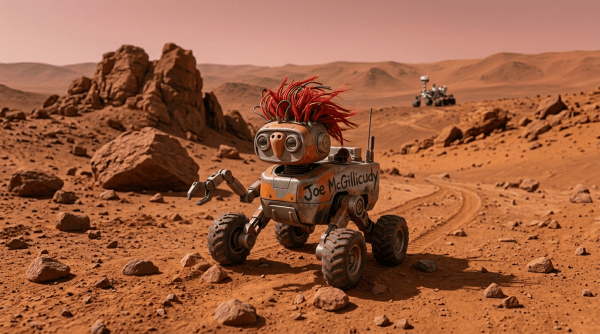
Mars rover with four wheels and red wiry appendages on a rocky reddish terrain.

Meet Joe McGillicudy. Joe lives on Mars and has an upside-down nose, which is fine on Mars, because it doesn’t rain there but it is dusty. Upside down noses work pretty well on Mars.

Joe doesn’t have feet, instead he has tires. That makes him fast and very quiet, which is important because Joe likes to sneak up on you and playfully grab your ankle and has been known to slip in a quick tickle now and then.

Joe McGillicudy is a game I play with my four-year-old grandson. We have both contributed to the description above. The upside-down nose was my idea. The tires instead of feet was his. And if you think this all sounds ridiculous and is a waste of valuable time – well – that’s really the point. Playing is ridiculous, especially if you’re an adult. But we should do it more.

For the past half dozen centuries, humans have been focusing on optimizing our lives. This is especially true in the past century or so. Our singular goal is to do things faster, be more focused, maximize our efficiency and strip every scrap of waste from our lives. Unstructured play has been the victim in all this. Kids barely do it anymore. And adults certainly don’t do it.

But playing – of a certain kind – is important. It creates room for surprise. It engages our imagination in a low-stress environment. It allows us to fail without fatal consequences. Playing is a real-life sandbox where we learn how to be better people: more creative, more cooperative, more understanding and more resilient. Most of all, it reintroduces serendipity into our lives. It gives us the capacity to savor the unexpected.

But play of this kind has some specific requirements. It can’t come with preset goals or pre-made rules. You have to make it up as you go along. This type of play pries open our imagination and sets our minds loose to wander and free-associate.

In the case of children, it’s the type of play that used to fill our days: building a fort with left over lumber from your dad’s workshop and no plan, turning a mound of snow in a parking lot into a kingdom to be conquered, launching a safari in your back yard or creating an interstellar spaceship from a large cardboard box.

This type of play is incredibly important for childhood development. But many of the moments children used to spend doing these things are being replaced by time in front of a screen playing a game that has been predesigned and prepackaged by a corporation, often with a for-profit agenda. The child is no longer making the rules, they are just following a path that has been set out for them. And often, they are doing so alone.

In our obsessive quest for an optimized life, adults are even less likely to spend time in unstructured “play.” One of the best ways to do this is to really play with your kids or grandkids and try seeing the world through their eyes. Try taking them to a hardware store  or thrift shop where there is no intended purchase and let them be the guide. See what you both discover.

But there are other ways: just wandering with no set destination, making something without plans or a blueprint, doing some creative improvisation through music or art, trying experimental cooking, playing a sport you’re really bad at (I admit I still have childhood trauma about this one), popping into a store at random just to see what’s on the shelves, skipping stones on a lake or turning a shovelful of dirt over in your garden and seeing what crawls out. 

Even better, find ways to “play” with others: role playing games, telling jokes and stories, going dancing, tossing a ball around or having a snowball fight.

I know – all of this sounds like a complete waste of time. And again I say – that’s the point.

The goal is to engage your mind in a way it rarely gets to do any more. As we rush to be productive, our brain gets over-trained for task accomplishment.  If you looked at a brain “at play” it would look very different than one playing a video game or scrolling a social media feed. Completely different areas would be engaged. Many of the ways we currently choose to spend time with a screen “light up” the same areas of the brain that are engaged when we’re gambling or engaging in other addictive behaviors. Some “free time” screen activities have even been shown to trigger anxiety and depression.

The biggest difference between unstructured play and many of our current past times comes in the way we’re rewarded. With unstructured play, the rewards come from inside us. We are not collecting points, climbing to the next level or competing for a bonus determined by some external party. We are just doing whatever we’re doing for fun.

You might just find that wasting time is the best way you can spend time.

Grandparenting in a Wired World

You might have missed it, but last Sunday was Grandparents Day. And the world has a lot of grandparents. In fact, according to an article in The Economist (subscription required), at no time in history has the ratio of grandparents to grandchildren been higher.

The boom in Boomer and Gen X grandparents was statistically predictable. Sine 1960, global life expectancy has jumped from 51 years to 72 years. At the same time, the number of children a woman can expect to have in her lifetime has been halved, from 5 to 2.4. Those two trendlines means that the ratio of grandparents to children under 15 has vaulted from 0.46 in 1960 to 0.8 today. According to a little research the Economist conducted, it’s estimated that there are 1.5 billion grandparents in the world.

My wife and I are two of them.

So – what does that mean to the three generations involved?

Grandparents have historically served two roles. First, they, and by they, I mean typically the grandmother, provided an extra set of hands to help with child rearing. And that makes a significant difference to the child, especially if they were born in an underdeveloped part of the world. Children in poorer nations with actively involved grandparents have a higher chance of survival. And in Sub Saharan Africa, a child living with a grandparent is more likely to go to school.

But what about in developed nations, like ours? What difference could grandparents make? That brings us to the second role of grandparents – passing on traditions and instilling a sense of history. And with the western world’s obsession with fast forwarding into the future, that could prove to be of equal significance.

Here I have to shift from looking at global samples to focussing on the people that happen to be under our roof. I can’t tell you what’s happening around the world, but I can tell you what’s happening in our house.

First of all, when it comes to interacting with a grandchild, gender specific roles are not as tightly bound in my generation as it was in previous generations.  My wife and I pretty much split the grandparenting duties down the middle. It’s a coin toss as to who changes the diaper. That would be unheard of in my parents’ generation. Grandpa seldom pulled a diaper patrol shift.

Kids learn gender roles by looking at not just their parents but also their grandparents. The fact that it’s not solely the grandmother that provides nurturing, love and sustenance is a move in the right direction.

But for me, the biggest role of being “Papa” is to try to put today’s wired world in context. It’s something we talk about with our children and their partners. Just last weekend my son-in-law referred to how they think about screen time with my 2-year-old grandson: Heads up vs Heads down.  Heads up is when we share screen time with the grandchild, cuddling on the couch while we watch something on a shared screen. We’re there to comfort if something is a little too scary, or laugh with them if something is funny. As the child gets older, we can talk about the themes and concepts that come up. Heads up screen time is sharing time – and it’s one of my favorite things about being a “Papa”.

Heads down screen time is when the child is watching something on a tablet or phone by themselves, with no one sitting next to them. As they get older, this type of screen time becomes the norm and instead of a parent or grandparent hitting the play button to keep them occupied, they start finding their own diversions.  When we talk about the potential damage too much screentime can do, I suspect a lot of that comes from “heads down” screentime. Grandparents can play a big role in promoting a healthier approach to the many screens in our lives.

As mentioned, grandparents are a child’s most accessible link to their own history. And it’s not just grandparents. Increasingly, great grandparents are also a part of childhood. This was certainly not the case when I was young. I was at least a few decades removed from knowing any of my great grandparents.

This increasingly common connection gives yet another generational perspective. And it’s a perspective that is important. Sometimes, trying to bridge the gap across four generations is just too much for a young mind to comprehend. Grandparents can act as intergenerational interpreters – a bridge between the world of our parents and that of our grandchildren.

In my case, my mother and father-in-law were immigrants from Calabria in Southern Italy. Their childhood reality was set in World War Two. Their history spans experiences that would be hard for a child today to comprehend – the constant worry of food scarcity, having to leave their own grandparents (and often parents) behind to emigrate, struggling to cope in a foreign land far away from their family and friends.  I believe that the memories of these experiences cannot be forgotten. It is important to pass them on, because history is important. One of my favorite recent movie quotes was in “The Holdovers” and came from Paul Giamatti (who also had grandparents who came from Southern Italy):

“Before you dismiss something as boring or irrelevant, remember, if you truly want to understand the present or yourself, you must begin in the past. You see, history is not simply the study of the past. It is an explanation of the present.”

Grandparents can be the ones that connect the dots between past, present and future. It’s a big job – an important job. Thank heavens there are a lot of us to do it.