Why The World No Longer Makes Sense

Does it seem that the world no longer makes sense? That may not just be you. The world may in fact no longer be making sense.

In the late 1960s, psychologist Karl Weick introduced the world to the concept of sensemaking, but we were making sense of things long before that. It’s the mental process we go through to try to reconcile who we believe we are to the world in which we find ourselves.  It’s how we give meaning to our life.

Weick identified 7 properties critical to the process of sensemaking. I won’t mention them all, but here are three that are critical to keep in mind:

  1. Who we believe we are forms the foundation we use to make sense of the world
  2. Sensemaking needs retrospection. We need time to mull over new information we receive and form it into a narrative that makes sense to us.
  3. Sensemaking is a social activity. We look for narratives that seem plausible, and when we find them, we share them with others.

I think you see where I’m going with this. Simply put, our ability to make sense of the world is in jeopardy, both for internal and external reasons.

External to us, the quality of the narratives that are available to us to help us make sense of the world has nosedived in the past two decades. Prior to social media and the implosion of journalism, there was a baseline of objectivity in the narratives we were exposed to. One would hope that there was a kernel of truth buried somewhere in what we heard, read or saw on major news providers.

But that’s not the case today. Sensationalism has taken over journalism, driven by the need for profitability by showing ads to an increasingly polarized audience. In the process, it’s dragged the narratives we need to make sense of the world to the extremes that lie on either end of common sense.

This wouldn’t be quite as catastrophic for sensemaking if we were more skeptical. The sensemaking cycle does allow us to judge the quality of new information for ourselves, deciding whether it fits with our frame of what we believe the world to be, or if we need to update that frame. But all that validation requires time and cognitive effort. And that’s the second place where sensemaking is in jeopardy: we don’t have the time or energy to be skeptical anymore. The world moves too quickly to be mulled over.

In essence, our sensemaking is us creating a model of the world that we can use without requiring us to think too much. It’s our own proxy for reality. And, as a model, it is subject to all the limitations that come with modeling. As the British statistician George E.P. Box said, “All models are wrong, but some are useful.”

What Box didn’t say is, the more wrong our model is, the less likely it is to be useful. And that’s the looming issue with sensemaking. The model we use to determine what is real is become less and less tethered to actual reality.

It was exactly that problem that prompted Daniel Schmachtenberger and others to set up the Consilience Project. The idea of the Project is this – the more diversity in perspectives you can include in your model, the more likely the model is to be accurate. That’s what “consilience” means: pulling perspectives from different disciplines together to get a more accurate picture of complex issues.  It literally means the “jumping together” of knowledge.

The Consilience Project is trying to reverse the erosion of modern sensemaking – both from an internal and external perspective – that comes from the overt polarization and the narrowing of perspective that currently typifies the information sources we use in our own sensemaking models.  As Schmachtenberger says,  “If there are whole chunks of populations that you only have pejorative strawman versions of, where you can’t explain why they think what they think without making them dumb or bad, you should be dubious of your own modeling.”

That, in a nutshell, explains the current media landscape. No wonder nothing makes sense anymore.

My Mind is Meandering

Thirty-seven years ago, when I first drove into the valley I now call home, I said to myself, “Now, this is a place for meandering!”

Meandering is a word we don’t use enough today. We certainly don’t do the actual act of meandering enough anymore. To “meander” is to “flow in a winding course.” It comes from Maiandros, the Greek name of a river in Turkey (also known as the Büyük Menderes) known for its sinuous path. This is perhaps what brought the word to mind when I drove into Western Canada’s Okanagan Valley. This is a valley formed by water, either in flowing or frozen form.

I have always loved the word meander. Even the sound of it is like a journey; you scale the heights of the hard “e,” pausing for a minute to rest against the soft “a”, after which you descend into the lush vale that is formed by its remaining syllable. The aquatic origins of the word are appropriate, because to meander is to be in a state of flow but with no purpose in mind. Meandering allows the mind to freewheel, to pick its own path.

You know what’s another great word? Saunter.

My favorite story about sauntering is that told by Albert Palmer in his 1919 book, The Mountain Trail and Its Message. He tells of an exchange with John Muir, the founder of the Sierra Club, who was called the Father of America’s National Parks. In the exchange, Muir explains why he finds the word “saunter” far more to his taste than “hike”:

“Do you know the origin of that word ‘saunter’? It’s a beautiful word. Away back in the Middle Ages people used to go on pilgrimages to the Holy Land, and when people in the villages through which they passed asked where they were going, they would reply, “A la sainte terre,’ ‘To the Holy Land.’ And so they became known as sainte-terre-ers or saunterers. Now these mountains are our Holy Land, and we ought to saunter through them reverently, not ‘hike’ through them.”

According to Google’s Ngram viewer, literary usage of the word “saunter”  hit Its peak in the 1800s and was in decline for most of the following century. That timeline makes sense. Sauntering would definitely be popular with the Romantic movement of the late 1800s. This was a movement back to appreciate the charms of nature and would have been an open invitation to “saunter” in Muir’s “Holy Land.”

For some reason, the word seems to be enjoying a bit of a resurgence in usage in the last 20 years.

Meander is a different story. It only started to really appear in books towards the end of the 1800s and continued to be used through the 20th century, although usage dropped during times of tribulation, notably World War I, the Great Depression of the 1930s and throughout World War II. Again, that’s not surprising. It’s hard to meander when you’re in a constant state of anxiety.

As my mind meandered down this path, I wondered if there is a digital equivalent to meandering or sauntering. Take scrolling through Facebook, for example. It is navigating without any specific destination in mind, so perhaps it qualifies as meandering. There is no direct line to connect A to B.

But I wouldn’t call social media scrolling sauntering. There’s a distinction between ”meandering” and “sauntering.” I think saunter implies that you know where you’re going, but there is no rigid schedule set to get there. You can take as much time as you like to smell the flowers on your way.

Also, as John Muir mentioned, sauntering requires a certain sense of place. The setting in which you saunter is of critical importance. However you would define your own “Holy Land,” that’s the place where you should saunter. It should be grounded in some gravitas.

That’s why I don’t think you can really saunter through social media. To me, Facebook, Instagram or TikTok are a far cry from being considered hallowed ground.

Google Leak? What Google Leak?

If this were 15 years ago, I might have cared about the supposed Google Leak that broke in late May.

But it’s not, and I don’t. And I’m guessing you don’t either. In fact, you could well be saying “what Google leak?” Unless you’re a SEO, there is nothing of interest here. Even if you are a SEO, that might be true.

I happen to know Rand Fishkin, the person who publicly broke the leak last week. Neither Rand nor I are in the SEO biz anymore, but obviously his level of interest in the leak far exceeded mine. He devoted almost 6000 words to it in the post where he first unveiled the leaked documents, passed on to him by Erfan Azimi, CEO and director of SEO of EA Eagle Digital.

Rand and I spoke at many of the same conferences before I left the industry in 2012. Even at that time, our interests were diverging. He was developing what would become the Moz SEO tool suite, so he was definitely more versed in the technical side of SEO. I had already focused my attention on the user side of search, looking at how people interacted with a search engine page. Still, I always enjoyed my chats with Rand.

Back then, SEO was an intensely tactical industry. Conference sessions that delved into the nitty gritty of ranking factors and shared ways to tweak sites up the SERP were the ones booked into the biggest conference rooms, because organizers knew they’d be jammed to the rafters.

I always felt a bit like a fish out of water at these conferences. I tried to take a more holistic view, looking at search as just one touchpoint in the entire online journey. To me, what was most interesting was what happened both before the search click and after it. That was far more intriguing to me than what Google might be hiding under their algorithmic hood.

Over time, my sessions developed their own audience. Thanks to mentors like Danny Sullivan, Chris Sherman and Brett Tabke, conference organizers carved out space for me on their agendas. Ken Fadner and the MediaPost team even let me build a conference that did its best to deal with search at a more holistic level, the Search Insider Summit. We broadened the search conversation to include more strategic topics like multipoint branding, user experience and customer journeys.

So, when the Google leak story bleeped on my radar, I was immediately taken back to the old days of SEO. Here, again, there was what appeared to be a dump of documents that might give some insights into the nuts and bolts of Google’s ranking factors. Mediapost’s own post said that “leaked Google documents has given the search industry proprietary insight into Google Search, revealing very important elements that the company uses to rank content.” Predictably, SEOs swarmed over it like a flock of seagulls attacking a half-eaten hot dog on a beach. They were still looking for some magic bullet that might move them higher in the organic results.

They didn’t come up with much. Brett Tabke, who I consider one of the founders of SEO (he coined the term SERP), spent five hours combing through the documents and said it wasn’t a leak and the documents contained no algorithm-related information. To mash up my metaphors, the half-eaten hotdog was actually a nothingburger.

But Oh My SEOs – you still love diving into the nitty gritty, don’t you?

What is more interesting to me is how the actual search experience has changed in the past decade or two. In doing the research for this, I happened to run into a great clip about Tech monopolies from Last Week Tonight with John Oliver. He shows how much of the top of the Google SERP is now dominated by information and links from Google. Again, quoting a study from Rand Fishkin’s new company, SparkToro, Oliver showed that “64.82% of searches on Google…ended..without clicking to another web property.”

That little tidbit has some massive implications for marketers. The days of relying on a high organic ranking are long gone, because even if you achieve it, you’ll be pushed well down the page.

And on that, Rand Fishkin and I seem to agree. In his post, he does say, “If there was one universal piece of advice I had for marketers seeking to broadly improve their organic search rankings and traffic, it would be: ‘Build a notable, popular, well-recognized brand in your space, outside of Google search.’”

Amen.

Can Media Move the Overton Window?

I fear that somewhere along the line, mainstream media has forgotten its obligation to society.

It was 63 years ago, (on May 9, 1961) that new Federal Communications Commission Chair Newton Minow gave his famous speech, “Television and the Public Interest,” to the convention of the National Association of Broadcasters.

In that speech, he issued a challenge: “I invite each of you to sit down in front of your own television set when your station goes on the air and stay there, for a day, without a book, without a magazine, without a newspaper, without a profit and loss sheet or a rating book to distract you. Keep your eyes glued to that set until the station signs off. I can assure you that what you will observe is a vast wasteland.”

Minow was saying that media has an obligation to set the cultural and informational boundaries for society. The higher you set them, the more we will strive to reach them. That point was a callback to the Fairness Doctrine, established by the FCC in 1949. The policy required that “holders of broadcast licenses to present controversial issues of public importance and to do so in a manner that fairly reflected differing viewpoints.” The Fairness Doctrine was abolished by the FCC in 1987.

What Minow realized, presciently, was that mainstream media is critically important in building the frame for what would come to be called, three decades later, the Overton Window. First identified by policy analyst Joseph Overton at the Mackinaw Center for Public Policy, the term would posthumously be named after Overton by his colleague Joseph Lehman.

The term is typically used to describe the range of topics suitable for public discourse in the political arena. But, as Lehman explained in an interview, the boundaries are not set by politicians: “The most common misconception is that lawmakers themselves are in the business of shifting the Overton Window. That is absolutely false. Lawmakers are actually in the business of detecting where the window is, and then moving to be in accordance with it.

I think the concept of the Overton Window is more broadly applicable than just within politics. In almost any aspect of our society where there are ideas shaped and defined by public discourse, there is a frame that sets the boundaries for what the majority of society understands to be acceptable — and this frame is in constant motion.

Again, according to Lehman,  “It just explains how ideas come in and out of fashion, the same way that gravity explains why something falls to the earth. I can use gravity to drop an anvil on your head, but that would be wrong. I could also use gravity to throw you a life preserver; that would be good.”

Typically, the frame drifts over time to the right or left of the ideological spectrum. What came as a bit of a shock in November of 2016 was just how quickly the frame pivoted and started heading to the hard right. What was unimaginable just a few years earlier suddenly seemed open to being discussed in the public forum.

Social media was held to blame. In a New York Times op-ed written just after Trump was elected president (a result that stunned mainstream media) columnist Farhad Manjoo said,  “The election of Donald J. Trump is perhaps the starkest illustration yet that across the planet, social networks are helping to fundamentally rewire human society.”

In other words, social media can now shift the Overton Window — suddenly, and in unexpected directions. This is demonstrably true, and the nuances of this realization go far beyond the limits of this one post to discuss.

But we can’t be too quick to lay all the blame for the erratic movements of the Overton Window on social media’s doorstep.

I think social media, if anything, has expanded the window in both directions — right and left. It has redefined the concept of public discourse, moving both ends out from the middle. But it’s still the middle that determines the overall position of the window. And that middle is determined, in large part, by mainstream media.

It’s a mistake to suppose that social media has completely supplanted mainstream media. I think all of us understand that the two work together. We use what is discussed in mainstream media to get our bearings for what we discuss on social media. We may move right or left, but most of us realize there is still a boundary to what is acceptable to say.

The red flags start to go up when this goes into reverse and mainstream media starts using social media to get its bearings. If you have the mainstream chasing outliers on the right or left, you start getting some dangerous feedback loops where the Overton Window has difficulty defining its middle, risking being torn in two, with one window for the right and one for the left, each moving further and further apart.

Those who work in the media have a responsibility to society. It can’t be abdicated for the pursuit of profit or by saying they’re just following their audience. Media determines the boundaries of public discourse. It sets the tone.

Newton Minow was warning us about this six decades ago.

Uncommon Sense

Let’s talk about common sense.

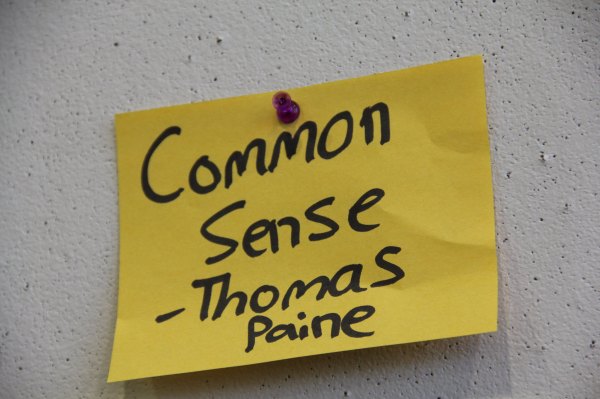
“Common sense” is one of those underpinnings of democracy that we take for granted. Basically, it hinges on this concept: the majority of people will agree that certain things are true. Those things are then defined as “common sense.” And common sense becomes our reference point for what is right and what is wrong.

But what if the very concept of common sense isn’t true? That was what researchers Duncan Watts and Mark Whiting set out to explore.

Duncan Watts is one of my favourite academics. He is a computational social scientist at the University of Pennsylvania. I’m fascinated by network effects in our society, especially as they’re now impacted by social media. And that pretty much describes Watt’s academic research “wheelhouse.” 

According to his profile he’s “interested in social and organizational networks, collective dynamics of human systems, web-based experiments, and analysis of large-scale digital data, including production, consumption, and absorption of news.”

Duncan, you had me at “collective dynamics.”

 I’ve cited his work in several columns before, notably his deconstruction of marketing’s ongoing love affair with so-called influencers. A previous study from Watts shot several holes in the idea of marketing to an elite group of “influencers.”

Whiting and Watts took 50 claims that would seem to fall into the category of common sense. They ranged from the obvious (“a triangle has three sides”) to the more abstract (“all human beings are created equal”). They then recruited an online panel of participants to rate whether the claims were common sense or not. Claims based on science were more likely to be categorized as common sense. Claims about history or philosophy were less likely to be identified as common sense.

What did they find? Well, apparently common sense isn’t very common. Their report says, “we find that collective common sense is rare: at most a small fraction of people agree on more than a small fraction of claims.” Less than half of the 50 claims were identified as common sense by at least 75% of respondents.

Now, I must admit, I’m not really surprised by this. We know we are part of a pretty polarized society. It no shock that we share little in the way of ideological common ground.

But there is a fascinating potential reason why common sense is actually quite uncommon: we define common sense based on our own realities, and what is real for me may not be real for you. We determine our own realities by what we perceive to be real, and increasingly, we perceive the “real” world through a lens shaped by technology and media – both traditional and social.

Here is where common sense gets confusing. Many things – especially abstract things – have subjective reality. They are not really provable by science. Take the idea that all human beings are created equal. We may believe that, but how do we prove it? What does “equal” mean?

So when someone appeals to our common sense (usually a politician) just what are they appealing to? It’s not a universally understood fact that everyone agrees on. It’s typically a framework of belief that is probably only agreed on by a relatively small percent of the population. This really makes it a type of marketing, completely reliant on messaging and targeting the right market.

Common sense isn’t what it once was. Or perhaps it never was. Either common or sensible.

Feature image: clemsonunivlibrary

Talking Out Loud to Myself

I talk to myself out loud. Yes, full conversations, questions and answers, even debates — I can do everything all by myself.

I don’t do it when people are around. I’m just not that confident in my own cognitive quirks. It doesn’t seem, well… normal, you know?

But between you and me, I do it all the time. I usually walk at the same time. For me, nothing works better than some walking and talking with myself to work out particularly thorny problems.

Now, if I was using Google to diagnose myself, it would be a coin toss whether I was crazy or a genius. It could go either way.  One of the sites I clicked to said it could be a symptom of psychosis. But another site pointed to a study at Bangor University (2012 – Kirkham, Breeze, Mari-Beffa) that indicates that talking to yourself out loud may indicate a higher level of intelligence. Apparently, Nikola Tesla talked to himself during lightning storms. Of course, he also had a severe aversion to women who wore pearl earrings. So the jury may still be out on that one.

I think pushing your inner voice through the language processing center of your brain and actually talking out loud does something to crystallize fleeting thoughts. One of the researchers of the Bangor study, Paloma Mari-Beffa, agrees with this hypothesis:

“Our results demonstrated that, even if we talk to ourselves to gain control during challenging tasks, performance substantially improves when we do it out loud.”

Mari-Beffa continues,

“Talking out loud, when the mind is not wandering, could actually be a sign of high cognitive functioning. Rather than being mentally ill, it can make you intellectually more competent. The stereotype of the mad scientist talking to themselves, lost in their own inner world, might reflect the reality of a genius who uses all the means at their disposal to increase their brain power.”

When I looked for any academic studies to support the value of talking out loud to yourself, I found one (Huang, Carr and Cao, 2001) that was obviously aimed at neuroscientists, something I definitely am not. But after plowing through it, I think it said the brain does work differently when you say things out loud.

Another one (Gruber, von Cramon 2001) even said that when we artificially suppress our strategy of verbalizing our thoughts, our brains seem to operate the same way that a monkey’s brain would, using different parts of the brain to complete different tasks (e.g., visual, spatial or auditory). But when allowed to talk to themselves, humans tend to use a verbalizing strategy to accomplish all kinds of tasks. This indicates that verbalization seems to be the preferred way humans work stuff out. It gives guide rails and a road map to our human brain.

But if we’ve learned anything about human brains, we’ve learned that they don’t all work the same way. Are some brains more likely to benefit from the owner talking to themselves out loud, for instance? Take introverts, for example. I am a self-confessed introvert. And I talk to myself. So I had to ask, are introverts more likely to have deep, meaningful conversations with themselves?

If you’re not an introvert, let me first tell you that introverts are generally terrible at small talk. But — if I do say so myself — we’re great at “big” talk. We like to go deep in our conversations, generally with just one other person. Walking and talking with someone is an introvert’s idea of a good time. So walking and talking with yourself should be the introvert’s holy grail.

While I couldn’t find any empirical evidence to support this correlation between self-talk and introversion, I did find a bucketful of sites about introverts noting that it’s pretty common for us to talk to ourselves. We are inclined to process information internally before we engage externally, so self-talk becomes an important tool in helping us to organize our thoughts.

Remember, external engagements tend to drain the battery of an introvert, so a little power management before the engagement to prevent running out of juice midway through a social occasion makes sense.

I know this is all a lot to think about. Maybe it would help to talk it out — by yourself.

Feature image by Brecht Bug – Flickr – Creative Commons

You Know What Government Agencies Need? Some AI

A few items on my recent to-do list  have necessitated dealing with multiple levels of governmental bureaucracy: regional, provincial (this being in Canada) and federal. All three experiences were, without exception, a complete pain in the ass. So, having spent a good part of my life advising companies on how to improve their customer experience, the question that kept bubbling up in my brain was, “Why the hell is dealing with government such a horrendous experience?”

Anecdotally, I know everyone I know feels the same way. But what about everyone I don’t know? Do they also feel that the experience of dealing with a government agency is on par with having a root canal or colonoscopy?

According to a survey conducted last year by the research firm Qualtrics XM, the answer appears to be yes. This report paints a pretty grim picture. Satisfaction with government services ranked dead last when compared to private sector industries.

The next question, being that AI is all I seem to have been writing about lately, is this: “Could AI make dealing with the government a little less awful?”

And before you say it, yes, I realize I recently took a swipe at the AI-empowered customer service used by my local telco. But when the bar is set as low as it is for government customer service, I have to believe that even with the limitations of artificially intelligent customer service as it currently exists, it would still be a step forward. At least the word “intelligent” is in there somewhere.

But before I dive into ways to potentially solve the problem, we should spend a little time exploring the root causes of crappy customer service in government.

First of all, government has no competitors. That means there are no market forces driving improvement. If I have to get a building permit or renew my driver’s license, I have one option available. I can’t go down the street and deal with “Government Agency B.”

Secondly, in private enterprise, the maxim is that the customer is always right. This is, of course, bullshit.  The real truth is that profit is always right, but with customers and profitability so inextricably linked, things generally work out pretty well for the customer.

The same is not true when dealing with the government. Their job is to make sure things are (supposedly) fair and equitable for all constituents. And the determination of fairness needs to follow a universally understood protocol. The result of this is that government agencies are relentlessly regulation bound and fixated on policies and process, even if those are hopelessly archaic. Part of this is to make sure that the rules are followed, but let’s face it, the bigger motivator here is to make sure all bureaucratic asses are covered.

Finally, there is a weird hierarchy that exists in government agencies.  Frontline people tend to stay in place even if governments change. But the same is often not true for their senior management. Those tend to shift as governments come and go. According to the Qualtrics study cited earlier, less than half (48%) of government employees feel their leadership is responsive to feedback from employees. About the same number (47%) feel that senior leadership values diverse perspectives.

This creates a workplace where most of the people dealing with clients feel unheard, disempowered and frustrated. This frustration can’t help but seep across the counter separating them from the people they’re trying to help.

I think all these things are givens and are unlikely to change in my lifetime. Still, perhaps AI could be used to help us navigate the serpentine landscape of government rules and regulations.

Let me give you one example from my own experience. I have to move a retaining wall that happens to front on a lake. In Canada, almost all lake foreshores are Crown land, which means you need to deal with the government to access them.

I have now been bouncing back and forth between three provincial ministries for almost two years to try to get a permit to do the work. In that time, I have lost count of how many people I’ve had to deal with. Just last week, someone sent me a couple of user guides that “I should refer to” in order to help push the process forward. One of them is 29 pages long. The other is 42 pages. They are both about as compelling and easy to understand as you would imagine a government document would be. After a quick glance, I figured out that only two of the 71 combined pages are relevant to me.

As I worked my way through them, I thought, “surely some kind of ChatGPT interface would make this easier, digging through the reams of regulation to surface the answers I was looking for. Perhaps it could even guide you through the application process.”

Let me tell you, it takes a lot to make me long for an AI-powered interface. But apparently, dealing with any level of government is enough to push me over the edge.

Dove’s Takedown Of AI: Brilliant But Troubling Brand Marketing

The Dove brand has just placed a substantial stake in the battleground over the use of AI in media. In a campaign called “Keep Beauty Real”, the brand released a 2-minute video showing how AI can create an unattainable and highly biased (read “white”) view of what beauty is.

If we’re talking branding strategy, this campaign in a master class. It’s totally on-brand with Dove, who introduced its “Campaign for Real Beauty” 18 years ago. Since then, the company has consistently fought digital manipulation of advertising images, promoted positive body image and reminded us that beauty can come in all shapes, sizes and colors. The video itself is brilliant. You really should take a couple minutes to see it if you haven’t already.

But what I found just as interesting is that Dove chose to use AI as a brand differentiator. The video starts with by telling us, “By 2025, artificial intelligence is predicted to generate 90% of online content” It wraps up with a promise: “Dove will never use AI to create or distort women’s images.”

This makes complete sense for Dove. It aligns perfectly with its brand. But it can only work because AI now has what psychologists call emotional valency. And that has a number of interesting implications for our future relationship with AI.

“Hot Button” Branding

Emotional valency is just a fancy way of saying that a thing means something to someone. The valence can be positive or negative. The term valence comes from the German word valenz, which means to bind. So, if something has valency, it’s carrying emotional baggage, either good or bad.

This is important because emotions allow us to — in the words of Nobel laureate Daniel Kahneman — “think fast.” We make decisions without really thinking about them at all. It is the opposite of rational and objective thinking, or what Kahneman calls “thinking slow.”

Brands are all about emotional valency. The whole point of branding is to create a positive valence attached to a brand. Marketers don’t want consumers to think. They just want them to feel something positive when they hear or see the brand.

So for Dove to pick AI as an emotional hot button to attach to its brand, it must believe that the negative valence of AI will add to the positive valence of the Dove brand. That’s how branding mathematics sometimes work: a negative added to a positive may not equal zero, but may equal 2 — or more. Dove is gambling that with its target audience, the math will work as intended.

I have nothing against Dove, as I think the points it raises about AI are valid — but here’s the issue I have with using AI as a brand reference point: It reduces a very complex issue to a knee-jerk reaction. We need to be thinking more about AI, not less. The consumer marketplace is not the right place to have a debate on AI. It will become an emotional pissing match, not an intellectually informed analysis. And to explain why I feel this way, I’ll use another example: GMOs.

How Do You Feel About GMOs?

If you walk down the produce or meat aisle of any grocery store, I guarantee you’re going to see a “GMO-Free” label. You’ll probably see several. This is another example of squeezing a complex issue into an emotional hot button in order to sell more stuff.

As soon as I mentioned GMO, you had a reaction to it, and it was probably negative. But how much do you really know about GMO foods? Did you know that GMO stands for “genetically modified organisms”? I didn’t, until I just looked it up now. Did you know that you almost certainly eat foods that contain GMOs, even if you try to avoid them? If you eat anything with sugar harvested from sugar beets, you’re eating GMOs. And over 90% of all canola, corn and soybeans items are GMOs.

Further, did you know that genetic modifications make plants more resistance to disease, more stable for storage and more likely to grow in marginal agricultural areas? If it wasn’t for GMOs, a significant portion of the world’s population would have starved by now. A 2022 study suggests that GMO foods could even slow climate change by reducing greenhouse gases.

If you do your research on GMOs — if you “think slow’ about them — you’ll realize that there is a lot to think about, both good and bad. For all the positives I mentioned before, there are at least an equal number of troubling things about GMOs. There is no easy answer to the question, “Are GMOs good or bad?”

But by bringing GMOs into the consumer world, marketers have shut that down that debate. They are telling you, “GMOs are bad. And even though you consume GMOs by the shovelful without even realizing it, we’re going to slap some GMO-free labels on things so you will buy them and feel good about saving yourself and the planet.”

AI appears to be headed down the same path. And if GMOs are complex, AI is exponentially more so. Yes, there are things about AI we should be concerned about. But there are also things we should be excited about. AI will be instrumental in tackling the many issues we currently face.

I can’t help worrying when complex issues like AI and GMOs are broad-stroked by the same brush, especially when that brush is in the hands of a marketer.

Feature image: Body Scan 002 by Ignotus the Mage, used under CC BY-NC-SA 2.0 / Unmodified

We SHOULD Know Better — But We Don’t

“The human mind is both brilliant and pathetic.  Humans have built hugely complex societies and technologies, but most of us don’t even know how a toilet works.”

– from The Knowledge Illusion: Why We Never Think Alone” by Steven Sloman and Philip Fernback.

Most of us think we know more than we do — especially about things we really know nothing about. This phenomenon is called the Dunning-Kruger Effect. Named after psychologists Justin Kruger and David Dunning, this bias causes us to overestimate our ability to do things that we’re not very good at.

That’s the basis of the new book “The Knowledge Illusion: Why We Never Think Alone.” The basic premise is this: We all think we know more than we actually do. Individually, we are all “error prone, sometimes irrational and often ignorant.” But put a bunch of us together and we can do great things. We were built to operate in groups. We are, by nature, herding animals.

This basic human nature was in the back of mind when I was listening to an interview with Es Devlin on CBC Radio. Devlin is self-described as an artist and stage designer.  She was the vision behind Beyonce’s Renaissance Tour, U2’s current run at The Sphere in Las Vegas, and the 2022 Superbowl halftime show with Dr. Dre, Snoop Dogg, Eminem and Mary J. Blige.

When it comes to designing a visually spectacular experience,  Devlin has every right to be a little cocky. But even she admits that every good idea doesn’t come directly from her. She said the following in the interview (it’s profound, so I’m quoting it at length):

“I learned quite quickly in my practice to not block other people’s ideas — to learn that, actually,  other people’s ideas are more interesting than my own, and that I will expand by absorbing someone else’s idea.

“The real test is when someone proposes something in a collaboration that you absolutely, [in] every atom of your body. revile against. They say, ‘Why don’t we do it in bubblegum pink?’ and it was the opposite of what you had in mind. It was the absolute opposite of anything you would dream of doing.

“But instead of saying, ‘Oh, we’re not doing that,’  you say ‘OK,’ and you try to imagine it. And then normally what will happen is that you can go through the veil of the pink bubblegum suggestion, and you will come out with a new thing that you would never have thought of on your own.

“Why? Because your own little batch of poems, your own little backpack of experience. does not converge with that other person, so you are properly meeting not just another human being, but everything that led up to them being in that room with you. “

From Interview with Tom Powers on Q – CBC Radio, March 18, 2024

We live in a culture that puts the individual on a pedestal.  When it comes to individualistic societies, none are more so than the United States (according to a study by Hofstede Insights).  Protection of personal rights and freedom are the cornerstone of our society (I am Canadian, but we’re not far behind on this world ranking of individualistic societies). The same is true in the U.K. (where Devlin is from), Australia, the Netherlands and New Zealand.

There are good things that come with this, but unfortunately it also sets us up as the perfect targets for the Dunning-Kruger effect. This individualism and the cognitive bias that comes with it are reinforced by social media. We all feel we have the right to be heard — and now we have the platforms that enable it.

With each post, our unshakable belief in our own genius and infallibility is bulwarked by a chorus of likes from a sycophantic choir who are jamming their fingers down on the like button. Where we should be cynical of our own intelligence and knowledge, especially about things we know nothing about, we are instead lulled into hiding behind dangerous ignorance.

What Devlin has to say is important. We need to be mindful of our own limitations and be willing to ride on the shoulders of others so we can see, know and do more. We need to peek into the backpack of others to see what they might have gathered on their own journey.

(Feature Image – Creative Commons – https://www.flickr.com/photos/tedconference/46725246075/)

The Messaging of Climate Change

86% of the world believes that climate change is a real thing. That’s the finding of a massive new mega study with hundreds of authors (the paper’s author acknowledgement is a page and a half). 60,000 participants from 63 countries around the world took part. And, as I said, 86% of them believe in climate change.

Frankly, there’s no surprise there. You just have to look out your window to see it. Here in my corner of the world, wildfires wiped out hundreds of homes last summer and just a few weeks ago, a weird winter whiplash took temperatures from unseasonably warm to deep freeze cold literally overnight. This anomaly wiped out this region’s wine industry. The only thing surprising I find about the 86 percent stat is that 14% still don’t believe. That speaks of a determined type of ignorance.

What is interesting about this study is that it was conducted by behavioral scientists. This is an area that has always fascinated me. From the time I read Richard Thaler and Cass Sunstein’s book, Nudge, I have always been interested in behavioral interventions. What are the most effective “nudges” in getting people to shift their behaviors to more socially acceptable directions?

According to this study, that may not be that easy. When I first dove into this study, my intention was to look at how different messages had different impacts depending on the audience: right wing vs left wing for instance. But in going through the results, what struck me the most was just how poorly all the suggested interventions performed. It didn’t matter if you were liberal or conservative or lived in Italy or Iceland. More often than not, all the messaging fell on deaf ears.

What the study did find is that how you craft your campaign about climate change depends on what you want people to do. Do you want to shift non-believers in Climate Change towards being believers? Then decrease the psychological distance. More simply put, bring the dangers of climate change to their front doorstep. If you live next to a lot of trees, talk about wildfires. If you live on the coast, talk about flooding. If you live in a rural area, talk about the impacts of drought. But it should be noted that we weren’t talking a massive shift here – with an “absolute effect size of 2.3%”. It was the winner by the sheer virtue of sucking the least.

If you want to build support for legislation that mitigates climate change, the best intervention was to encourage people to write a letter to a child that’s close to you, with the intention that they read it in the future. This forces the writer to put some psychological skin in the game.  

Who could write a future letter to someone you care about without making some kind of pledge to make sure there’s still a world they can live in? And once you do that, you feel obligated to follow through. Once again, this had a minimal impact on behaviors, with an overall effect size of 2.6%.

A year and a half ago, I talked about Climate Change messaging, debating Mediapost Editor-in-Chief Joe Mandese about whether a doom and gloom approach would move the needle on behaviors. In a commentary from the summer of 2022, Mandese wrapped up by saying, “What the ad industry really needs to do is organize a massive global campaign to change the way people think, feel and behave about the climate — moving from a not-so-alarmist “change” to an “our house is on fire” crisis.”

In a follow up, I worried that doom and gloom might backfire on us, “Cranking up the crisis intensity on our messaging might have the opposite effect. It may paralyze us.”

So, what does this study say?

The answer, again, is, “it depends.” If we’re talking about getting people to share posts on social media, then Doom and Gloom is the way to go. Of all the various messaging options, this had the biggest impact on sharing, by a notable margin.

This isn’t really surprising. A number of studies have shown that negative news is more likely to be shared on social media than positive news.

But what if we’re asking people to make a change that requires some effort beyond clicking the “share” button? What if they actually have to do something? Then, as I suspected, Doom and Gloom messaging had the opposite effect, decreasing the likelihood that people would make a behavioral change to address climate change (the study used a tree planting initiative as an example). In fact, when asking participants to actually change their behavior in an effortful way, all the tested climate interventions either had no effect or, worse, they “depress(ed) and demoralize(d) the public into inaction”.

That’s not good news. It seems that no matter what the message is, or who the messenger is, we’re likely to shoot them if they’re asking us to do anything beyond bury our head in the sand.

What’s even worse, we may be losing ground. A study from 10 years ago by Yale University had more encouraging results. They showed that effective climate change messaging, was able to shift public perceptions by up to 19 percent. While not nearly as detailed as this study, the results seem to indicate a backslide in the effectiveness of climate messaging.

One of the commentators that covered the new worldwide study perhaps summed it up best by saying, “if we’re dealing with what is probably the biggest crisis ever in the history of humanity, it would help if we actually could talk about it.”