Singing in Unison

It’s the year-end so it’s time to reflect and also to look forward, carrying what we’ve learned in the past into an uncertain future.

Let me share one thing I’ve learned; we have to get serious about how we create community. And by community, I will use a very specific definition. In fact, perhaps it would be more accurate to replace “community” with “choir.”

Let me explain my thought with a story.

In the late1980’s, Harvard professor Bob Putnam was in Italy doing research. He was studying Italy’s regional decentralization of power which began in 1970. For a political scientist like Putnam, this was an opportunity that didn’t come often. Italy had passed power down to its 20 regional governments and had also established a single framework for administration and governance. This framework was the constant. The variables were the people, the societal environment and the nature of the regions themselves. If anyone is familiar with Italy, you know that there are vast differences between these regions, especially from the north to the south.

For Bob Putnam, he looked at how effective each administrative government was – was democracy working in the region? Even though the administrators were all referring to the same playbook, the results were all over the map – literally. Generally speaking, governance in Northern and Central Italy was much more effective than in the South.

For Putnam, the next big question was – why? What was it about some regions that made democracy work better than in others. He looked for correlations in the reams of data he had collected. Was it education? Wealth? Occupational breakdowns? In examining each factor, he found some correlation, but they all came short of the perfect positive relationship he was looking for.

Finally, he took a break from the analysis and drove into the country with his wife, Rosemary.  Stopping in one town, he heard music coming from a small church, so the two stepped inside. There, a volunteer choir was singing.  It may sound cliché, but in that moment, Bob Putnam had an epiphany. Perhaps the answer lay in people coming together, engaging in civic activities and creating what is called “social capital” by working together as a group.

Maybe democracy works best in places where people actually want to sing together.

Bob Putnam relooked at the numbers and, sure enough, there was almost a perfect correlation. The regions that had the most clubs, civic groups, social organizations and – yes – choral societies also had the highest degree of democratic effectiveness. This set Putnam on a path that would lead to the publishing of this work in 1993 under the title of Making Democracy Work along with his subsequent 2000 best seller, Bowling Alone. (If you’d like to know more about Bob Putnam, check out the excellent Netflix documentary, Join or Die).

Putnam showed it’s better to belong – but that only explains part of the appeal of a choir. There has to be something special about singing together.

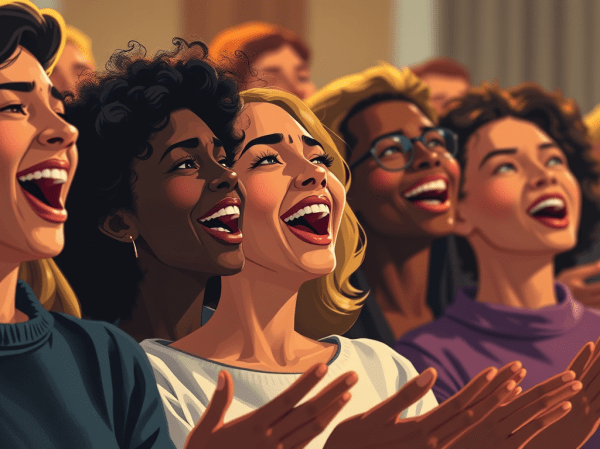
Singing as a group is one of those cultural universals; people do it everywhere in the world. And we’ve been doing it for ever, since before we started recording our history. Modern science has now started to discover why. Singing as a group causes the brain to release oxytocin – christened the “moral” molecule by neuro-economist Paul J. Zak – by the bucketload. Zak explains the impact of this chemical, “When oxytocin is raised, people are more generous, they’re more compassionate and, in particular, they’re empathetic – they connect better to people emotionally.”

The results of an oxytocin high are the creation of the building blocks of trust and social capital. People who sing together treat each other better. Our brains start something tuning into other brains through something called neural synchrony. We connect with other people in a profoundly and beautifully irrational way that burrows down through our consciousness to a deeply primal level.

But there is also something else going on here that, while not unique to singing together, finds a perfect home in your typical community choir.

Sociologist Émile Durkheim found that groups that do the same thing at the same time experience something called “collective effervescence.” This is the feeling of being “carried away” and being part of a whole that is greater than the sum of its parts. You find it in religious ceremonies, football stadiums, rock concerts and – yes – you’ll find it in choirs.

So, if singing together is so wonderful, why are we doing it less and less? When was the last time you sang – really sang, not just moved your lips – with others? For myself, it’s beyond the limits of my own memory. Maybe it was when I was still a kid. And I suspect the reason I haven’t sang out loud since is because someone, somewhere along the line, told me I can’t sing.

But that’s not the point. Singing shouldn’t be competitive. It should be spiritual. We shouldn’t judge ourselves against singers we see on media. This never used to be the case.  It’s just one more example of how we can never be good enough – at anything – if we use media for our mirror.

So, in 2026, I’m going to try singing more. Care to join me?

The Long-Term Fallout from MAGA: One Canadian’s Perspective

The other day, an American friend asked how Canada was currently feeling about Trump and the whole MAGA thing. You may remember some months back a number of broadsides towards Canada from the president that seemingly came from nowhere -– Trump threatening/cajoling us to become the 51st state, on again-off again tariffs, continued assertions that the US does not need Canada for anything, completely unveiled threats towards us from Pete Hoekstra, the American Ambassador to Canada.

We took it personally. “Elbows up” became the Canadian rallying cry – a reference to protecting yourself in our beloved national sport – fighting along the boards balanced on frozen water while wearing sharp blades on your feet. Liquor stores had shelf after empty shelf that once were laden with California reds and Kentucky bourbon. Canadian trips to Disneyland and Las Vegas plummeted. Grocery stores started labeling products that (supposedly – which is another story) came from Canada. Canadian consumers and businesses scrambled to find Canadian substitutes for traditional American suppliers.

That was then. What about now?

Trump and the MAGA train have moved on to an endless list of other scandals and dumpster fires. I haven’t heard a whisper of the 51st state for a long time. While our trade war continues on, fueled by shots across the bow from both sides, I think it’s fair to say that we are now just lumped with every other country reeling from the daily bat-shit crazy barrage coming from Washington. Canadians are used to being ignored, for good or bad, so we’re back to situation normal – all F*$%ed up.

But have Canadians moved on? Have we dropped said elbows? The honest answer is – it’s complicated.

Predictably the patriotic fervor we had early this year has cooled off. California reds are back on the shelves. More Canadians are planning to visit Hawaii and Florida this winter. “Grown in the U.S.A.” stickers are back where they belong, in the produce bins at our grocery stores. When it comes to our American habit – it’s like the line from Brokeback Mountain – “We wish we knew how to quit you.”

Like all relationships, the one between the US and Canada is complex. It’s unrealistic to expect a heavily intertwined relationship like ours to disappear overnight. There are probably no two countries in the world more involved with each other’s business than we are. And that cuts both ways, despite what Mr. Trump says. We have been married to each other for a very long time. Even if we want to go through with it, a divorce is going to take some time.

The numbers from the first six months of our “Buy Canadian” campaign are in, and they are less than inspiring. According to StatsCan, 70% of Canadian businesses saw no increase in sales at all. Even with those that did, the impact was minimal and any gain was usually offset by other sales challenges.  

But if you dig a little deeper, there are signs that there might be more long-term damage done here than first meets the eye. In Canadian grocery stores over the past six months, sales of “Made in Canada” products are up 10% while U.S. made goods are down 9%. Those aren’t huge swings, but they have been sustained over 6 months, and in the words of one Canadian analyst speaking on CBC Radio, when something lasts for 6 months, “you’re moving from fad territory to trend territory.”

The dilemma facing Canadians is something called the “Attitude Behavior Gap” – the difference between what we want to do and what we are actually doing. Canadians – 85% of us anyway – want to buy Canadian rather than American, but it’s really hard to do that. Canadian goods are harder to find and typically cost more. It’s the reality of having a trading partner that outnumbers you both in market size and output by a factor of 10 to 1. If we want to have a Ceasar salad in December, we’re going to have to buy lettuce grown in the U.S.

But we are talking relationships here, so let’s relook at that 85% intention to “Buy Canadian” number again. That means that – 6 months after we were insulted – we still feel that a fundamental trust was irrevocably broken. We’re being pragmatic about it, but our intention is clear, we’re looking for alternatives to our past default behavior – buying American. When those alternatives make economic and behavioral sense to us, we’ll find other partners. That is what is happening in Canada right now.

Should Americans care? I believe so. Because I’m sure we’re not the only ones. The world is currently reeling from the sharp American pivot away from being a globally trusted partner. The short-term reality is that we will put up with it for now and pander to the Presidential powers that be, because we have to.

But we’re looking for options. Our dance card is suddenly wide open.

The Cost of Not Being Curious

The world is having a pandemic-proportioned wave of Ostrichitis.

Now, maybe you haven’t heard of Ostrichitis. But I’m willing to bet you’re showing at least some of the symptoms:

  • Avoiding newscasts, especially those that feature objective and unbiased reporting
  • Quickly scrolling past any online news items in your feed that look like they may be uncomfortable to read
  • Dismissing out of hand information coming from unfamiliar sources

These are the signs of Ostrichitis – or the Ostrich Effect – and I have all of them. This is actually a psychological effect, more pointedly called willful ignorance, which I wrote about a few years ago. And from where I’m observing the world, we all seem to have it to one extent or another.

I don’t think this avoidance of information comes as a shock to anyone. The world is a crappy place right now. And we all seem to have gained comfort from adopting the folk wisdom that “no news is good news.” Processing bad news is hard work, and we just don’t have the cognitive resources to crunch through endless cycles of catastrophic news. If the bad news affirms our existing beliefs, it makes us even madder than what we were. If it runs counter to our beliefs, it forces us to spin up our sensemaking mechanisms and reframe our view of reality. Either way, there are way more fun things to do.

A recent study from the University of Chicago attempted to pinpoint when children started avoid bad news. The research team found that while young children don’t tend to put boundaries around their curiosity, as they age they start avoiding information that challenges their beliefs or their own well-being. The threshold seems to be about 6 years old. Before that, children are actively seeking information of all kinds (as any parent barraged by never ending “Whys” can tell you). After that, chidren start strategizing the types of information they pay attention to.

Now, like everything about humans, curiosity tends to be an individual thing. Some of us are highly curious and some of us avoid seeking new information religiously. But even if we are a curious sort, we may pick and choose what we’re curious about. We may find “safe zones” where we let our curiosity out to play. If things look too menacing, we may protect ourselves by curbing our curiosity.

The unfortunate part of this is that curiosity, in all its forms, is almost always a good thing for humans (even if it can prove fatal to cats).

The more curious we are, the better tied we are to reality. The lens we use to parse the world is something called a sense-making loop. I’ve often referred to this in the past. It’s a processing loop that compares what we experience with what we believe, referred to as our “frame”. For the curious, this frame is often updated to match what we experience. For the incurious, the frame is held on to stubbornly, often by ignoring new information or bending information to conform to their beliefs. A curious brain is a brain primed to grow and adapt. An incurious brain is one that is stagnant and inflexible. That’s why the father of modern-day psychology, William James, called curiosity “the impulse towards better cognition.”

When we think about the world we want, curiosity is a key factor in defining it. Curiosity keeps us moving forward. The lack of curiosity locks us in place or even pushes us backwards, causing the world to regress to a more savage and brutal place. Writers of dystopian fiction knew this. That’s why authors including H.G. Wells, Aldous Huxley, Ray Bradbury and George Orwell all made a lack of curiosity a key part of their bleak future worlds. Our current lack of curiosity is driving our world in the same dangerous direction.

For all these reasons, it’s essential that we stay curious, even if it’s becoming increasingly uncomfortable.

Being in the Room Where It Happens

I spent the past weekend attending a conference that I had helped to plan. As is now often the case, this was a hybrid conference; you could choose to attend in person or online via Zoom. Although it involved a long plane ride, I choose to attend in person. It could be because – as a planner – I wanted to see how the event played out. Also, it’s been a long time since I attended a conference away from my home. Or – maybe – it was just FOMO.

Whatever the reason, I’m glad I was there, in the room.

This was a very small conference planned on a shoestring budget. We didn’t have money for extensive IT support or AV equipment. We were dependent solely on a laptop and whatever sound equipment our host was able to supply. We knew going into the conference that this would make for a less-than-ideal experience for those attending virtually. But – even accounting for that – I found there was a huge gap in the quality of that experience between those that were there and those that were attending online. And, over the duration of the 3-day conference, I observed why that might be so.

This conference was a 50/50 mix of those that already knew each other and those that were meeting each other for the first time. Even those who were familiar with each other tended to connect more often via a virtual meeting platform than in a physical meeting space. I know that despite the convenience and efficiency of being able to meet online, something is lost in the process. After the past two days, carefully observing what was happening in the room we were all in, I have a better understanding of what that loss might be – it was the vague and inexact art of creating a real bond with another person.

In that room, the bonding didn’t happen at the speaking podium and very seldom happened during the sessions we so carefully planned. It seeped in on the sidelines, over warmed-over coffee from conference centre urns, overripe bananas and the detritus of the picked over pastry tray. The bonding came from all of us sharing and digesting a common experience. You could feel a palpable energy in the room. You could pick up the emotion, read the body language and tune in to the full bandwidth of communication that goes far beyond what could be transmitted between an onboard microphone and a webcam.

But it wasn’t just the sharing of the experience that created the bonds. It was the digesting of those experiences after the fact. We humans are herding animals, and that extends to how we come to consensus about things we go through together. We do so through communication with others – not just with words and gesture, but also through the full bandwidth of our evolved mechanisms for coming to a collective understanding. It wasn’t just that a camera and microphone couldn’t transmit that effectively, it was that it happened where there was no camera or mic.

As researchers have discovered, there is a lived reality and a remembered reality and often, they don’t look very much alike. The difference between the effectiveness of an in-person experience and one accessed through an online platform shouldn’t come as a surprise to us. This is due to how our evolved sense-making mechanisms operate. We make sense of reality both internally, through a comparison with our existing cognitive models and externally, through interacting with others around us who have shared that same reality. This communal give-and-take colors what we take with us, in the form of both memories and an updated model of what we know and believe. When it comes to how humans are built, collective sense making is a feature, not a bug.

I came away from that conference with much more than the content that was shared at the speaker dais. I also came away with a handful of new relationships, built on sharing an experience and, through that, laying down the first foundations of trust and familiarity. I would not hesitate to reach out to any of these new friends if I had a question about something or a project I felt they could collaborate on.

I think that’s true largely because I was in the room where it happened.

Lilith Fair: A Quarter Century and A Different World Ago

Lilith Fair: Building a Mystery, a new documentary released on Hulu (CBC Gem in Canada), is much more than a chronicle of a music festival. It’s a very timely statement on the both the strength and fragility of community.

Lilith Fair was the festival launched in 1997 by Canadian singer/songwriter Sarah McLachlan. It was conceived as a feminine finger in the eye of a determinedly misogynistic music industry. At the end of the 90’s, despite a boom in talented female singer songwriters (Tracy Chapman, Jewel, Paula Cole, Sheryl Crow, Natalie Merchant, Shawn Colvin, Lisa Loeb, Suzanne Vega and others too numerous to mention), radio stations wouldn’t run two songs by women back-to-back. They also wouldn’t book two women on the same concert ticket. The feeling, based on nothing other than male intuition, was that it would be too much “femininity” for the audience to handle.

McLachlan, in her charmingly polite Canadian way, said “Fudge you!” and launched her own festival. The first one, in 1997, played almost 40 concerts over 51 days across North America. The line-up was exclusively female – 70 singers in all playing on three stages. Almost every concert sold out. Apparently, there was an audience for female talent. Lilith Fair would be repeated in 1998 and 1999, with both tours being smashing successes.

The World needed Lilith Fair in the late 90s. It wasn’t only the music industry that was misogynistic and homophobic. It was our society. The women who played Lilith Fair found a community of support unlike anything they had ever experienced in their careers. Performers who had been feeling isolated for years suddenly found support and – more than anything – understanding.

It was women who made the rules and ran the Lilith Fair show. It was okay to perform when you were 8 months pregnant. It was okay to hold your baby onstage as you performed the group encore. It was okay to bring the whole family on tour and let the kids play backstage while you did your set. These were things that were – up until then – totally foreign in the music industry. It was the very definition of community – diverse people having something in common and joining together to deal from a position of strength.

But it didn’t happen overnight. It took a while – and a lot of bumping into each other backstage – for the community to gel. It also needed a catalyst, which turned out to be Amy Ray and Emily Saliers – officially known as the Indigo Girls. It was their out-going friendliness that initially broke the ice “because we were so gay and so puppy dog-like.”

This sense of community extended beyond the stage to the thousands who attended: men and women, old and young, straight and gay. It didn’t matter – Lilith Fair was a place where you would be accepted and understood. As documentary producer Dan Levy (of Schitt’s Creek fame) – who was 12 years old when he attended and was yet to come out – said, “Being there was one of the earliest memories I’ve had of safety.”

The unity and inclusiveness of Lilith Fair stood in stark contrast to another festival of the same era – Woodstock 99. There, toxic masculinity from acts like Limp Bizkit singer Fred Durst and Kid Rock, swung the vibe of the event heavily towards anarchy and chaos rather than community.

But while Lilith Fair showed the importance of community, it also showed how fragile it could be. The festival became the butt of jokes on late night television (including one particularly cringe-worthy one by Jay Leno about Paula Cole’s body hair) and those that sought to diminish its accomplishments and importance. Finally, at the end of the 1999 tour, McLachlan had had enough. The last concert was played in the rain at Edmonton, Alberta on August 31st.

McLachlan did try to revive Lilith Fair in 2010, but it was a complete failure. Whatever lightening in a bottle she had captured the first time was gone. The world had passed it by. The documentary didn’t dwell on this other than offering a few reasons why this might be. Perhaps Lilith Fair wasn’t needed anymore. Maybe it had done its job. After all, women had mounted some of the top tours of that time, including Taylor Swift, Madonna, Pink and Lady Gaga.

Or maybe it had nothing to do with the industry. Maybe it had everything to do with us, the audience.

The world of 1999 was very different place than the world of 2010. Community was in the midst of being redefined from those sharing a common physical location to those sharing a common ideology in online forums. And that type of community didn’t require a coming together. If anything, those types of communities kept us apart, staring at a screen – alone in our little siloes.

According to the American Time Use Survey, the time spent in-person socializing has been on a steady decline since 2000.  This is especially true for those under the age of 25, the prime market for musical festivals. When we did venture forth to see a concert, we are looking for spectacle, not community. This world was moving too fast for the coalescing of the slow, sweet magic that made Lilith Fair so special.

At the end of the documentary, Sarah McLachlan made it clear that she’ll never attempt to bring Lilith Fair back to life. It was a phenomenon of that time. And that is sad – sad indeed.

When Did the Future Become So Scary?

The TWA hotel at JFK airport in New York gives one an acute case of temporal dissonance. It’s a step backwards in time to the “Golden Age of Travel” – the 1960s. But even though you’re transported back 60 years, it seems like you’re looking into the future. The original space – the TWA Flight Center – was designed in 1962 by Eero Saarinen. This was a time when America was in love with the idea of the future. Science and technology were going to be our saving grace. The future was going to be a utopian place filled with flying jet cars, benign robots and gleaming, sexy white curves everywhere.  The TWA Flight Center was dedicated to that future.

It was part of our love affair with science and technology during the 60s. Corporate America was falling over itself to bring the space-age fueled future to life as soon as possible. Disney first envisioned the community of tomorrow that would become Epcot. Global Expos had pavilions dedicated to what the future would bring. There were four World Fairs over 12 years, from 1958 to 1970, each celebrating a bright, shiny white future. There wouldn’t be another for 22 years.

This fascination with the future was mirrored in our entertainment. Star Trek (pilot in 1964, series start in 1966) invited all of us to boldly go where no man had gone before, namely a future set roughly three centuries from then.   For those of us of a younger age, the Jetsons (original series from 1963 to 64) indoctrinated an entire generation into this religion of future worship. Yes, tomorrow would be wonderful – just you wait and see!

That was then – this is now. And now is a helluva lot different.

Almost no one – especially in the entertainment industry – is envisioning the future as anything else than an apocalyptic hell hole. We’ve done an about face and are grasping desperately for the past. The future went from being utopian to dystopian, seemingly in the blink of an eye. What happened?

It’s hard to nail down exactly when we went from eagerly awaiting the future to dreading it, but it appears to be sometime during the last two decades of the 20th Century. By the time the clock ticked over to the next millennium, our love affair was over. As Chuck Palahniuk, author of the 1999 novel Invisible Monsters, quipped, “When did the future go from being a promise to a threat?”

Our dread about the future might just be a fear of change. As the future we imagined in the 1960’s started playing out in real time, perhaps we realized our vision was a little too simplistic. The future came with unintended consequences, including massive societal shifts. It’s like we collectively told ourselves, “Once burned, twice shy.” Maybe it was the uncertainty of the future that scared the bejeezus out of us.

But it could also be how we got our information about the impact of science and technology on our lives. I don’t think it’s a coincidence that our fear of the future coincided with the decline of journalism. Sensationalism and endless punditry replaced real reporting just about the time we started this about face. When negative things happened, they were amplified. Fear was the natural result. We felt out of control and we keep telling ourselves that things never used to be this way.  

The sum total of all this was the spread of a recognized psychological affliction called Anticipatory Anxiety – the certainty that the future is going to bring bad things down upon us. This went from being a localized phenomenon (“my job interview tomorrow is not going to go well”) to a widespread angst (“the world is going to hell in a handbasket”). Call it Existential Anticipatory Anxiety.

Futurists are – by nature – optimists. They believe things well be better tomorrow than they are today. In the Sixties, we all leaned into the future. The opposite of this is something called Rosy Retrospection, and it often comes bundled with Anticipatory Anxiety. It is a known cognitive bias that comes with a selective memory of the past, tossing out the bad and keeping only the good parts of yesterday. It makes us yearn to return to the past, when everything was better.

That’s where we are today. It explains the worldwide swing to the right. MAGA is really a 4-letter encapsulation of Rosy Retrospection – Make America Great Again! Whether you believe that or not, it’s a message that is very much in sync with our current feelings about the future and the past.

As writer and right-leaning political commentator William F. Buckley said, “A conservative is someone who stands athwart history, yelling Stop!”

It’s Tough to Consume Conscientiously

It’s getting harder to be both a good person and a wise consumer.

My parents never had this problem when I was a kid. My dad was a Ford man. Although he hasn’t driven for 10 years, he still is. If you grew up in the country, your choices were simple – you needed a pickup truck. And in the 1960s and 70s, there were only three choices: Ford, GMC or Dodge. For dad, the choice was Ford – always.

Back then, brand relationships were pretty simple. We benefited from the bliss of ignorance. Did the Ford Motor Company do horrible things during that time? Absolutely. As just one example, they made a cost-benefit calculation and decided to keep the Pinto on the road even though they knew it tended to blow up when hit from the rear. There is a corporate memo saying – in black and white – that it would be cheaper to settle the legal claims of those that died than to fix the problem. The company was charged for negligent homicide. It doesn’t get less ethical than that.

But that didn’t matter to Dad. He either didn’t know or didn’t care. The Pinto Problem, along with the rest of the shady stuff done by the Ford Motor Company, including bribes, kickbacks and improper use of corporate funds by Henry Ford II, was not part of Dad’s consumer decision process. He still bought Ford. And he still considered himself a good person. The two things had little to do with each other.

Things are harder now for consumers. We definitely have more choice, and those choices are harder, because we know more.  Even buying eggs becomes an ethical struggle. Do we save a few bucks, or do we make some chicken’s life a little less horrible?

Let me give you the latest example from my life. Next year, we are planning to take our grandchildren to a Disney theme park. If our family has a beloved brand, it would be Disney. The company has been part of my kids’ lives in one form or another since they were born and we all want it to be part of their kid’s lives as well.

Without getting into the whole debate, I personally have some moral conflicts with some of Disney’s recent corporate decisions. I’m not alone. A Facebook group for those planning a visit to this particular park has recently seen posts from those agonizing over the same issue. Does taking the family to the park make us complicit in Disney’s actions that we may not agree with? Do we care enough to pull the plug on a long-planned park visit?

This gets to the crux of the issue facing consumers now – how do we balance our beliefs about what is wrong and right with our desire to consume? Which do we care more about? The answer, as it turns out, seems to almost always be to click the buy button as we hold our noses.

One way to make that easier is to tell ourselves that one less visit to a Disney mark will make virtually no impact on the corporate bottom line. Depriving ourselves of a long-planned family experience will make no difference. And – individually – this is true. But it’s exactly this type of consumer apathy which, when aggregated, allows corporations to get away with being bad moral characters.

Even if we want to be more ethically deliberate in our consumer decisions, it’s hard to know where to draw the line. Where are we getting our information about corporate behavior from? Can it be trusted? Is this a case of one regrettable action, or is there a pattern of unethical conduct? These decisions are always complex, and coming to any decision that involves complexity is always tricky.

To go back to a simpler time, my grandmother had a saying that she applied liberally to any given situation, “What does all this have to do with the price of tea in China?” Maybe she knew what was coming.

There Are No Short Cuts to Being Human

The Velvet Sundown fooled a lot of people, including millions of fans on Spotify and the writers and editors at Rolling Stone. It was a band that suddenly showed up on Spotify several months ago, with full albums of vintage Americana styled rock. Millions started streaming the band’s songs – except there was no band. The songs, the album art, the band’s photos – it was all generated by AI.

When you know this and relisten to the songs, you swear you would have never been fooled. Those who are now in the know say the music is formulaic, derivative and uninspired. Yet we were fooled, or, at least, millions of us were – taken in by an AI hoax, or what is now euphemistically labelled on Spotify as “a synthetic music project guided by human creative direction and composed, voiced and visualized with the support of artificial intelligence.”

Formulaic. Derivative. Synthetic. We mean these as criticisms. But they are accurate descriptions of exactly how AI works. It is synthesis by formulas (or algorithms) that parse billions or trillions of data points, identify patterns and derive the finished product from it. That is AI’s greatest strength…and its biggest downfall.

The human brain, on the other hand, works quite differently. Our biggest constraint is the limit of our working memory. When we analyze disparate data points, the available slots in our temporary memory bank can be as low as in the single digits. To cognitively function beyond this limit, we have to do two things: “chunk” them together into mental building blocks and code them with emotional tags. That is the human brain’s greatest strength… and again, it’s biggest downfall. What the human brain is best at is what AI is unable to do. And vice versa.

A few posts back when talking about one less-than-impressive experience with an AI tool, I ended by musing what role humans might play as AI evolves and becomes more capable. One possible answer is something labelled “HITL” or “Humans in the Loop.” It plugs the “humanness” that sits in our brains into the equation, allowing AI to do what it’s best at and humans to provide the spark of intuition or the “gut checks” that currently cannot come from an algorithm.

As an example, let me return to the subject of that previous post, building a website. There is a lot that AI could do to build out a website. What it can’t do very well is anticipate how a human might interact with the website. These “use cases” should come from a human, perhaps one like me.

Let me tell you why I believe I’m qualified for the job. For many years, I studied online user behavior quite obsessively and published several white papers that are still cited in the academic world. I was a researcher for hire, with contracts with all the major online players. I say this not to pump my own ego (okay, maybe a little bit – I am human after all) but to set up the process of how I acquired this particular brand of expertise.

It was accumulated over time, as I learned how to analyze online interactions, code eye-tracking sessions, talked to users about goals and intentions. All the while, I was continually plugging new data into my few available working memory slots and “chunking” them into the building blocks of my expertise, to the point where I could quickly look at a website or search results page and provide a pretty accurate “gut call” prediction of how a user would interact with it. This is – without exception – how humans become experts at anything. Malcolm Gladwell called it the “10,000-hour rule.” For humans to add any value “in the loop” they must put in the time. There are no short cuts.

Or – at least – there never used to be. There is now, and that brings up a problem.

Humans now do something called “cognitive off-loading.” If something looks like it’s going to be a drudge to do, we now get Chat-GPT to do it. This is the slogging mental work that our brains are not particularly well suited to. That’s probably why we hate doing it – the brain is trying to shirk the work by tagging it with a negative emotion (brains are sneaky that way). Why not get AI, who can instantly sort through billions of data points and synthesize it into a one-page summary, to do our dirty work for us?

But by off-loading, we short circuit the very process required to build that uniquely human expertise. Writer, researcher and educational change advocate Eva Keiffenheim outlines the potential danger for humans who “off-load” to a digital brain; we may lose the sole advantage we can offer in an artificially intelligent world, “If you can’t recall it without a device, you haven’t truly learned it. You’ve rented the information. We get stuck at ‘knowing about’ a topic, never reaching the automaticity of ‘knowing how.’”

For generations, we’ve treasured the concept of “know how.” Perhaps, in all that time, we forgot how much hard mental work was required to gain it. That could be why we are quick to trade it away now that we can.

The Credibility Crisis

We in the western world are getting used to playing fast and loose with the truth. There is so much that is false around us – in our politics, in our media, in our day-to-day conversations – that it’s just too exhausting to hold everything to a burden of truth. Even the skeptical amongst us no longer have the cognitive bandwidth to keep searching for credible proof.

This is by design. Somewhere in the past four decades, politicians and society’s power brokers have discovered that by pandering to beliefs rather than trading in facts, you can bend to the truth to your will. Those that seek power and influence have struck paydirt in falsehoods.

In a cover story last summer in the Atlantic, journalist Anne Applebaum explains the method in the madness: “This tactic—the so-called fire hose of falsehoods—ultimately produces not outrage but nihilism. Given so many explanations, how can you know what actually happened? What if you just can’t know? If you don’t know what happened, you’re not likely to join a great movement for democracy, or to listen when anyone speaks about positive political change. Instead, you are not going to participate in any politics at all.”

As Applebaum points out, we have become a society of nihilists. We are too tired to look for evidence of meaning. There is simply too much garbage to shovel through to find it. We are pummeled by wave after wave of misinformation, struggling to keep our heads above the rising waters by clinging to the life preserver of our own beliefs. In the process, we run the risk of those beliefs becoming further and further disconnected from reality, whatever that might be. The cogs of our sensemaking machinery have become clogged with crap.

This reverses a consistent societal trend towards the truth that has been happening for the past several centuries. Since the Enlightenment of the 18th century, we have held reason and science as the compass points of our True Norh. These twin ideals were buttressed by our institutions, including our media outlets. Their goal was to spread knowledge. It is no coincidence that journalism flourished during the Enlightenment. Freedom of the press was constitutionally enshrined to ensure they had the both the right and the obligation to speak the truth.

That was then. This is now. In the U.S. institutions, including media, universities and even museums, are being overtly threatened if they don’t participate in the wilful obfuscation of objectivity that is coming from the White House. NPR and PBS, two of the most reliable news sources according to the Ad Fontes media bias chart, have been defunded by the federal government. Social media feeds are awash with AI slop. In a sea of misinformation, the truth becomes impossible to find. And – for our own sanity – we have had to learn to stop caring about that.

But here’s the thing about the truth. It gives us an unarguable common ground. It is consistent and independent from individual belief and perspective. As longtime senator Daniel Patrick Moynihan famously said, “Everyone is entitled to his own opinion, but not to his own facts.” 

When you trade in falsehoods, the ground is consistently shifting below your feet. The story is constantly changing to match the current situation and the desired outcome. There are no bearings to navigate by. Everyone had their own compass, and they’re all pointing in different directions.

The path the world is currently going down is troubling in a number of ways, but perhaps the most troubling is that it simply isn’t sustainable. Sooner or later in this sea of deliberate chaos, credibility is going to be required to convince enough people to do something they may not want to do. And if you have consistently traded away your credibility by battling the truth, good luck getting anyone to believe you.

Bots and Agents – The Present and Future of A.I.

This past weekend I got started on a website I told a friend I’d help him build. I’ve been building websites for over 30 years now, but for this one, I decided to use a platform that was new to me. Knowing there would be a significant learning curve, my plan was to use the weekend to learn the basics of the platform. As is now true everywhere, I had just logged into the dashboard when a window popped up asking if I wanted to use their new AI co-pilot to help me plan and build the website.

“What the hell?” I thought, “Let’s take it for a spin!” Even if it could lessen the learning curve a little bit, it could still save me dozens of hours. The promise given me was intriguing – the AI co-pilot would ask me a few questions and then give me back the basic bones of a fully functional website. Or, at least, that’s what I thought.

I jumped on the chatbot and started typing. With each question, my expectations rose. It started with the basics: what were we selling, what were our product categories, where was our market? Soon, though, it started asking me what tone of voice I wanted, what was our color scheme, what search functionality was required, were there any competitor’s sites that we liked or disliked, and if so, what specifically did we like or dislike?  As I plugged my answers, I wondered what exactly I would get back.

The answer, as it turned out, was not much. As I was reassured that I had provided a strong enough brief for an excellent plan, I clicked the “finalize” button and waited. And waited. And waited. The ellipse below my last input just kept fading in and out. Finally, I asked, “Are you finished yet?” I was encouraged to just wait a few more minutes as it prepared a plan guaranteed to amaze.

Finally – ta da! – I got the “detailed web plan.” As far as I can tell, it had simply sucked in my input and belched it out again, formatted as a bullet list. I was profoundly underwhelmed.

Going into this, I had little experience with AI. I have used it sparingly for tasks that tend to have a well-defined scope. I have to say, I have been impressed more often than I have been disappointed, but I haven’t really kicked the tires of AI.

Every week, when I sit down to write this post, Microsoft Co-Pilot urges me to let it show what it can do. I have resisted, because when I do ask AI to write something for me, it reads like a machine did it. It’s worded correctly and usually gets the facts right, but there is no humanness in the process. One thing I think I have is an ability to connect the dots – to bring together seemingly unconnected examples or thoughts and hopefully join them together to create a unique perspective. For me, AI is a workhorse that can go out and gather the information in a utilitarian manner, but somewhere in the mix, a human is required to add the spark of intuition or inspiration. For now, anyway.

Meet Agentic AI

With my recent AI debacle still fresh in my mind, I happened across a blog post from Bill Gates. It seems I thought I was talking to an AI “Agent” when, in fact, I was chatting with a “Bot.” It’s agentic AI that will probably deliver the usefulness I’ve been looking for for the last decade and a half.

As it turns out, Gates was at least a decade and a half ahead of me in that search. He first talked about intelligent agents in his 1995 book The Road Ahead. But it’s only now that they’ve become possible, thanks to advances in AI. In his post, Gate’s describes the difference between Bots and Agents: “Agents are smarter. They’re proactive—capable of making suggestions before you ask for them. They accomplish tasks across applications. They improve over time because they remember your activities and recognize intent and patterns in your behavior. Based on this information, they offer to provide what they think you need, although you will always make the final decisions.”

This is exactly the “app-ssistant” I first described in 2010 and have returned to a few times since, even down to using the same example Bill Gates did – planning a trip. This is what I was expecting when I took the web-design co-pilot for a test flight. I was hoping that – even if it couldn’t take me all the way from A to Z – it could at least get me to M. As it turned out, it couldn’t even get past A. I ended up exactly where I started.

But the day will come. And, when it does, I have to wonder if there will still be room on the flight for we human passengers?