Face Time in the Real World is Important

For all the advances made in neuroscience, we still don’t fully understand how our brains respond to other people. What we do know is that it’s complex.

Join the Chorus

Recent studies, including this one from Rochester University, are showing that when we see someone we recognize, the brain responds with a chorus of neuronal activity. Neurons from different parts of the brain fire in unison, creating a congruent response that may simultaneously pull from memory, from emotion, from the rational regions of our prefrontal cortex and from other deep-seated areas of our brain. The firing of any one neuron may be relatively subtle, but together this chorus of neurons can create a powerful response to a person. This cognitive choir represents our total comprehension of an individual.

Non-Verbal Communication

“You’ll have your looks, your pretty face. – And don’t underestimate the importance of body language!” – Ursula, The Little Mermaid

Given that we respond to people with different parts of the brain, it makes sense that we use part of the brain we didn’t realize when communicating with someone else. In 1967, psychologist Albert Mehrabian attempted to pin this down with some actual numbers, publishing a paper in which he put forth what became known as Mehrabian’s Rule: 7% of communication is verbal, 38% is tone of voice and 55% is body language.

Like many oft-quoted rules, this one is typically mis-quoted. It’s not that words are not important when we communication something. Words convey the message. But it’s the non-verbal part that determines how we interpret the message – and whether we trust it or not.

Folk wisdom has told us, “Your mouth is telling me one thing, but your eyes are telling me another.” In this case, folk wisdom is right. We evolved to respond to another person with our whole bodies, with our brains playing the part of conductor. Maybe the numbers don’t exactly add up to Mehrabian’s neat and tidy ratio, but the importance of non-verbal communication is undeniable. We intuitively pick up incredibly subtle hints: a slight tremor in the voice, a bead of sweat on the forehead, a slight turn down of one corner of the mouth, perhaps a foot tapping or a finger trembling, a split-second darting of the eye. All this is subconsciously monitored, fed to the brain and orchestrated into a judgment about a person and what they’re trying to tell us. This is how we evolved to judge whether we should build trust or lose it.

Face to Face vs Face to Screen

Now, we get to the question you knew was coming, “What happens when we have to make these decisions about someone else through a screen rather than face to face?”

Given that we don’t fully understand how the brain responds to people yet, it’s hard to say how much of our ability to judge whether we should convey trust or withhold it is impaired by screen-to-screen communication. My guess is that the impairment is significant, probably well over 50%. It’s difficult to test this in a laboratory setting, given that it generally requires some type of neuroimaging, such as an fMRI scanner. In order to present a stimulus for the brain to respond to when the subject is strapped in, a screen is really the only option. But common sense tells me – given the sophisticated and orchestrated nature of our brain’s social responses – that a lot is lost in translation from a real-world encounter to a screen recording.

New Faces vs Old Ones

If we think of how our brains respond to faces, we realize that in today’s world, a lot of our social judgements are increasing made without face-to-face encounters. In a case where we know someone, we will pull forward a snapshot of our entire history with that person. The current communication is just another data point in a rich collection of interpersonal experience. One would think that would substantially increase our odds of making a valid judgement.

But what if we must make a judgement on someone we’ve never met before, and have only seen through a screen; be it a TikTok post, an Instagram Reel, a YouTube video or a Facebook Post? What if we have to decide whether to believe an influencer when making an important life decision? Are we willing to rely on a fraction of our brain’s capacity when deciding whether to place trust in someone we’ve never met?

Bread and Circuses: A Return to the Roman Empire?

Reality sucks. Seriously. I don’t know about you, but increasingly, I’m avoiding the news because I’m having a lot of trouble processing what’s happening in the world. So when I look to escape, I often turn to entertainment. And I don’t have to turn very far. Never has entertainment been more accessible to us. We carry entertainment in our pocket. A 24-hour smorgasbord of entertainment media is never more than a click away. That should give us pause, because there is a very blurred line between simply seeking entertainment to unwind and becoming addicted to it.

Some years ago I did an extensive series of posts on the Psychology of Entertainment. Recently, a podcast producer from Seattle ran across the series when he was producing a podcast on the same topic and reached out to me for an interview. We talked at length about the ubiquitous nature of entertainment and the role it plays in our society. In the interview, I said, “Entertainment is now the window we see ourselves through. It’s how we define ourselves.”

That got me to thinking. If we define ourselves through entertainment, what does that do to our view of the world? In my own research for this column, I ran across another post on how we can become addicted to entertainment. And we do so because reality stresses us out, “Addictive behavior, especially when not to a substance, is usually triggered by emotional stress. We get lonely, angry, frustrated, weary. We feel ‘weighed down’, helpless, and weak.”

Check. That’s me. All I want to do is escape reality. The post goes on to say, “Escapism only becomes a problem when we begin to replace reality with whatever we’re escaping to.”

I believe we’re at that point. We are cutting ties to reality and replacing them with a manufactured reality coming from the entertainment industry. In 1985 – forty years ago – author and educator Neil Postman warned us in his book Amusing Ourselves to Death that we were heading in this direction. The calendar had just ticked past the year 1984 and the world collectively sighed in relief that George Orwell’s eponymous vision from his novel hadn’t materialized. Postman warned that it wasn’t Orwell’s future we should be worried about. It was Aldous Huxley’s forecast in Brave New World that seemed to be materializing:

“As Huxley remarked in Brave New World Revisited, the civil libertarians and rationalists who are ever on the alert to oppose tyranny “failed to take into account man’s almost infinite appetite for distractions…  Orwell feared that what we fear will ruin us. Huxley feared that what we desire will ruin us.”

Postman was worried then – 40 years ago – that the news was more entertainment than information. Today, we long for even the kind of journalism that Postman was already warning us about. He would be aghast to see what passes for news now. 

While things unknown to Postman (social media, fake news, even the internet) are throwing a new wrinkle in our downslide into an entertainment induced coma, it’s not exactly new.   This has happened at least once before in history, but you have to go back almost 2000 years to find an example. Near the end of the Western Roman Empire, as it was slipping into decline, the Roman poet Juvenal used a phrase that summed it up – panem et circenses – “bread and circuses”:

“Already long ago, from when we sold our vote to no man, the People have abdicated our duties; for the People who once upon a time handed out military command, high civil office, legions — everything, now restrains itself and anxiously hopes for just two things: bread and circuses.”

Juvenal was referring to the strategy of the Roman emperors to provide free wheat and circus games and other entertainment games to gain political power. In an academic article from 2000, historian Paul Erdkamp said the ploy was a “”briberous and corrupting attempt of the Roman emperors to cover up the fact that they were selfish and incompetent tyrants.”

Perhaps history is repeating itself.

One thing we touched on in the podcast was a noticeable change in the entertainment industry itself. Scarlett Johansenn noticed the 2025 Academy Awards ceremony was a much more muted affair than in years past. There was hardly any political messaging or sermons about how entertainment provided a beacon of hope and justice. In an interview with Vanity Fair  – Johanssen mused that perhaps it’s because almost all the major studies are now owned by Big-Tech Billionaires, “These are people that are funding studios. It’s all these big tech guys that are funding our industry, and funding the Oscars, and so there you go. I guess we’re being muzzled in all these different ways, because the truth is that these big tech companies are completely enmeshed in all aspects of our lives.”

If we have willingly swapped entertainment for reality, and that entertainment is being produced by corporations who profit from addicting as many eyeballs as possible, prospects for the future do not look good.

We should be taking a lesson from what happened to Imperial Rome.

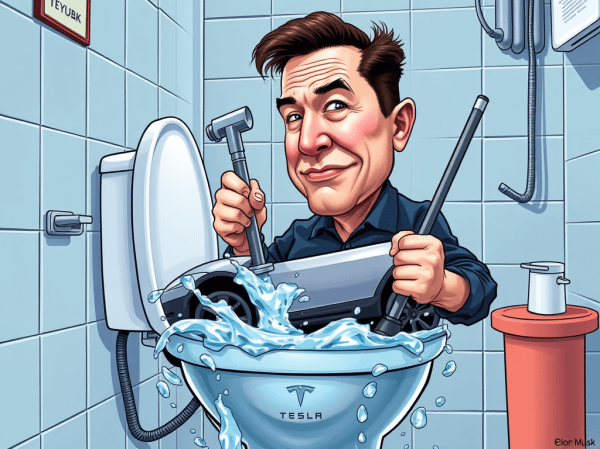
The Tesla Cybertruck’s Branding Blow-Up

The inexact science of branding is nowhere more evident that in the case of the Tesla Cybertruck, which looks like it might usurp the Edsel’s title as the biggest automotive flop in history.

First, a little of the Tesla backstory. No, it wasn’t founded by Elon Musk. It was founded in 2003 by Martin Eberhard and Marc Tarpenning. Musk came in a year later as a money man. Soon, he had forced Eberhard and Tarpenning out of the company. But their DNA remained, notably in the design and engineering of the hugely popular Tesla Model S, Model X and Model 3. These designs drove Tesla to capture over 50% of the electric car market and are straight line extensions of the original technology developed by Eberhard, Tarpenning and their initial team

Musk is often lauded as an eccentric genius in the mold of Steve Jobs, who had his fingers in every aspect of Tesla. While he was certainly influential, it’s not in the way most people think. The Model S, Model X and Model 3 soon became plagued by production issues, failed software updates, product quality red flags and continually failing to meet to meet Musk’s wildly optimistic and often delusional predictions, both in terms of sales and promised updates. Those things all happened on Musk’s watch.  Even with all this, Tesla was the darling of investors and media, driving it to be the most valuable car company in the world.

Then came the Cybertruck.

Introduced in 2019, the Cybertruck did have Musk’s fingerprints all over it. The WTF design, the sheer impracticality of a truck in name only, a sticker price nearly double of what Musk originally promised and a host of quality issues including body panels that have a tendency to fall off have caused sales to not even come close to projections.

In its first year of sales (2024), the Cybertruck sold 40,000 units, about 16% of what Musk predicted annual sales could be. That makes it a bigger fail than the Edsel, which sold 63,000 units against a target of 200,000 sales in its introductory year – 1958. The Edsel did worse in 1959 and was yanked from the market in 1960. The Cybertruck is sinking even faster. In the first quarter of this year, only 6406 Cybertrucks were sold, half the number sold in the same quarter a year ago. There are over 10,000 Cybertrucks on Tesla lots in the U.S., waiting for buyers that have yet to show up.

But it’s not just that the Cybertruck is a flawed product. Musk has destroyed Tesla’s brand in a way that can only be marvelled at. His erratic actions have managed to generate feelings of visceral hate in a huge segment of the market and that hate has found a visible target in the Cybertruck. It has become the symbol of Elon Musk’s increasingly evident meltdown.

I remember my first reaction when I heard that Musk had jumped on the MAGA bandwagon. “How the hell,” I thought, “does that square with the Tesla brand?” That brand, pre-Musk-meltdown and pre-Cybertruck, was a car for the environmentally conscious who had a healthy bank account – excitingly leading edge but not dangerously so. Driving a Tesla made a statement that didn’t seem to be in the MAGA lexicon at all. It was all very confusing.

But I think it’s starting to make a little more sense. That brand was built by vehicles that Musk had limited influence over. Sure, he took full credit for the brand, but just like company he took over, it’s initial form and future direction was determined by others.

The Cybertruck was a different story. That was very much Musk’s baby. And just like his biological ones (14 and counting), it shows all the hallmarks of Musk’s “bull in a China shop” approach to life. He lurches from project to project, completely tone-deaf to the implications of his actions. He is convinced that his genius is infallible. If the Tesla brand is a reflection of Musk, then the Cybertruck gives us a much truer picture. It shows what Tesla would have been if there had never been a Martin Eberhard and Marc Tarpenning and Musk was the original founder.

To say that the Cybertruck is “off brand” for Tesla is like saying that the Titanic had a tiny mishap. But it’s not that Musk made a mistake in his brand stewardship. It’s that he finally had the chance to build a brand that he believed in.

Media Modelling of Masculinity       

According to a study that was just released by the Movember Institute of Men’s Health, nearly two-thirds of 3000 young men surveyed in the US, the UK and Australia were regularly engaging with online masculinity influencers. They looked to them for inspiration on how to be fitter, more financially successful and how to increase the quantity and/or quality of their relationships.

Did they find what they were looking for?

It’s hard to say based on the survey results. While these young men said they found these influencers inspiring and were optimistic about their personal circumstances and the future social circumstances of men in general, they said some troubling things about their own mental health. They were less willing to prioritize mental health and were more likely to engage in risky health behaviors such as steroid use or ignoring their own bodies and pushing themselves to exercise too hard. These mixed signals seemed to come from influencers telling them that a man who can’t control is emotions is weak and is not a real man.

Also, not all the harm inflicted by these influencers was felt just by the men in their audience. Those in the study who followed influencers were more likely to report negative and limiting attitudes towards women and what they bring to a relationship. They felt that often women were being rude to them and that they didn’t have the same dating values as men.

Finally, men who followed influencers were almost twice as likely to value traits in their male friends such as ambition, popularity and wealth. They were less likely to look for trustworthiness or kindness in their male friends.

This brings us to a question. Why do young men need influencers to tell them how to be a better man? For that matter, why do any of us, regardless of age or sex, need someone to influence us? Especially if it’s someone who’s only qualification to dispense advice is that they happen to have a TikTok account with a million followers.

This is another unfortunate effect of social media. We have evolved to look for role models because to do so gives us a step up. Again, this made sense in our evolutionary past but may not do so today.

When we all belonged to a social group that was geographically bound together, it was advantageous to look at the most successful members of that group and emulate them. When we all competed in the same environment for the same resources, copying the ones that got the biggest share was a pretty efficient way to improve our own fortunes.

There was also a moral benefit to emulating a role model. Increasingly, as our fortunes relied more on creating better relationships with those outside our immediate group, things like trustworthiness became a behavior that we would do well to copy. Also, respect tended to accrue to the elderly. Our first role models were our parents and grandparents. In a community that depended on rules for survival, authority figures were another logical place to look for role models.

Let’s fast forward to today. Our decoupling with our evolutionarily determined, geographically limited idea of community has thrown several monkey wrenches into the delicate machinery of our society. Who we turn to as role models is just one example. As soon as we make the leap from rules based on physical proximity to the lure of mass influence, we inevitably run into problems.

Let’s go back to our masculinity influencers. These online influencers have one goal – to amass as many followers as possible. The economic reality of online influence is this: size of audience x depth of engagement = financial success. And how do you get a ton of followers? By telling them what they want to hear.

Let’s stare down some stark realities – well adjusted, mentally secure, emotionally mature, self-confident young males are less likely to desperately look for answers in online social media. There is no upside for influencers to go after this market. So they look elsewhere – primarily to young males who are none of the above things. And that audience doesn’t want to hear about emotional vulnerability or realistic appraisals of their dating opportunities. They want to hear that they can have it all – they can be real men. So the message (and the messenger) follows the audience, down a road that leads towards toxic masculinity.

Media provides a very distorted lens through which why might seek our new role models. We will still seek the familiar and the successful, but both those things are determined by what we see through media, rather than what we observe in real life. There is no proof that their advice or approach will pay off in the real world, but if they have a large following, they must be right.

Also, these are one-way “mentorships”. The influencers may know their audience in the aggregate, if only in terms of a market to be monetized, but they don’t know them individually. These are relationships without any reciprocity. There is no price that will be pad for passing on potentially harmful advice.

If there is damage done, it’s no big deal. It’s just one less follower.

Do We Have the Emotional Bandwidth to Stay Curious?

Curiosity is good for the brain. It’s like exercise for our minds. It stretches the prefrontal cortex and whips the higher parts of our brains into gear. Curiosity also nudges our memory making muscles into action and builds our brain’s capacity to handle uncertain situations.

But it’s hard work – mentally speaking. It takes effort to be curious, especially in situations where curiosity could figuratively “kill the cat.” The more dangerous our environment, the less curious we become.

A while back I talked about why the world no longer seems to make sense. Part of this is tied to our appetite for curiosity. Actively trying to make sense of the world puts us “out there”, leaving the safe space of our established beliefs behind. It is literally the definition of an “open mind” – a mind that has left itself open to being changed. And that’s a very uncomfortable place to be when things seem to be falling down around our ears.

Some of us are naturally more curious than others. Curious people typically achieve higher levels of education (learning and curiosity are two sides of the same coin). They are less likely to accept things at face value. They apply critical thinking to situations as a matter of course. Their brains are wired to be rewarded with a bigger dopamine hit when they learn something new.

Others rely more on what they believe to be true. They actively filter out information that may challenge those beliefs. They double down on what is known and defend themselves from the unknown. For them, curiosity is not an invitation, it’s a threat.

Part of this is a differing tolerance for something which neuroscientists call “prediction error” – the difference between what we think will happen and what actually does happen. Non-curious people perceive predictive gaps as threats and respond accordingly, looking for something or someone to blame. They believe that it can’t be a mistaken belief that is to blame, it must be something else that caused the error. Curious people look at prediction errors as continually running scientific experiments, given them a chance to discover the errors in their current mental models and update them based on new information.

Our appetite for curiosity has a huge impact on where we turn to be informed. The incurious will turn to information sources that won’t challenge their beliefs. These are people who get their news from either end of the political bias spectrum, either consistently liberal or consistently conservative. Given that, they can’t really be called information sources so much as opinion platforms. Curious people are more willing to be introduced to non-conforming information. In terms of media bias, you’ll find them consuming news from the middle of the pack.

Given the current state of the world, more curiosity is needed but is becoming harder to find. When humans (or any animal, really) are threatened, we become less curious. This is a feature, not a bug. A curious brain takes a lot longer to make a decision than a non-curious one. It is the difference between thinking “fast” and “slow” – in the words of psychologist and Nobel laureate Daniel Kahneman. But this feature evolved when threats to humans were usually immediate and potentially fatal. A slow brain is not of any benefit if you’re at risk of being torn apart by a pack of jackals. But today, our jackal encounters are usually of the metaphorical type, not the literal one. And that’s a threat of a very different kind.

Whatever the threat, our brain throttles back our appetite for curiosity. Even the habitually curious develop defense mechanisms in an environment of consistently bad news. We seek solace in the trivial and avoid the consequential. We start saving cognitive bandwidth from whatever impending doom we may be facing. We seek media that affirms our beliefs rather than challenges them.

This is unfortunate, because the threats we face today could use a little more curiosity.

The Whole US – Canada Thing – “IMHO”

“Our old relationship with the United States, a relationship based on steadily increasing integration, is over. The system of open global trade anchored by the United States – a system that Canada has relied on since the second world war, a system that while not perfect has helped deliver prosperity for a country for decades – is over”

Mark Carney, the New Prime Minister of Canada

I hope the above is not true. Because I’m not ready to sever my relationships with a whole bunch of Americans that I truly love and respect. Maybe that’s denialism, or maybe it’s just my hope that someday – eventually – cooler heads will prevail, and we’ll put this current spat behind us.

There was a good stretch of my life where I spent almost as much time in the U.S. as I did in Canada. I crossed the border repeatedly every month. I was on a first name basis with some of the U.S. Customs and Border officials at SeaTac airport in Seattle. I ran out of visa stamp pages on my Canadian passport and had to get more added. Many people in the search industry at the time just assumed I was American. Some back here in Canada even told me I had picked up an American accent somewhere along the way.

In that time, I made many wonderful friends, who came from every corner of the US:  Boston, Atlanta, Sacramento, Minneapolis, Chicago, New York, Hartford, Phoenix, Palo Alto, San Diego and Seattle.

I have to admit, my trips to the U.S. have dropped dramatically since November 2016. Part of that is that I no longer need to go to the U.S. for business. But part of it is also just my emotional distress, especially in the past few months. One of the analogies that really seemed to resonate with me is that the current US-Canadian relationship is akin to a messy divorce, and we’re the kids caught in the consequences of that. Going to the U.S. right now would be like going to a family reunion after your mom and dad have just split up. You don’t want to have to deal with the inevitable awkwardness and potential confrontations.

I’m not alone in my reluctance to cross the border. Travel from Canada to the U.S. has plummeted this year. According to U.S. Customs and Border Protection, Canadian entries into the U.S. fell by 12.5% in February and dropped a further 18% in March.  A lot of Canadians have opted out of U.S travel, probably for many of the same reasons that I have.

But I think that’s part of the problem. As awkward as a conversation maybe between a Canadian and an American, whatever their politics, we need more of them, not less. Yes, there is a rift and damage has been done to one of the most successful international alliances in history, but as any counsellor will tell you, healing any relationship requires communication.

Also, I’ve never seen so much media attention from the U.S. turned towards Canada. Half of America seems to have chosen us as a beacon of democracy, truth and justice. While I appreciate that, I feel I have to level with you, my American friends and cousins; we are far from perfect. In fact, I have grave concerns about the future of Canada. We have our own extreme political polarization that has to be recognized and dealt with. It may be a little more polite and nuanced than what is happening currently in the U.S., but it is no less real.

We still have at least two provinces (Alberta and Quebec) who have political leaders that feel their futures would be better outside the Canadian dominion than within it. We have large segments of our population that feel unheard by our current government. We have many acute crises, including housing, a rising cost of living, broken promises to our indigenous community, an environment ravaged by climate change and many others. It’s just that the current economic crisis caused by Trump’s tariffs and vocal sabre rattling about becoming a 51st State has –  well – “Trumped” them all.

While we’re talking about Donald Trump, I have to admit that he does have a point – Canada has taken advantage of America’s willingness to protect the world. We have fallen well short of our 2% defense spending commitment to NATO since the end of the Cold War (we currently spend about 1.37% of our GDP). We have always enjoyed the benefits of cozying up to our American big brother. And in return, we have often repaid that with our own blend of passive aggressive sarcasm and a quiet feeling of moral superiority that is as much a part of the Canadian identity as hockey and Tim Horton’s coffee.

Being Canadian, I feel the need to apologize for that. I’m sorry.

Look. We’re in a tough spot right now. I get that. But I also believe this is not the time to retreat behind our own fences and refuse to talk to each other. This is the time to recognize how special what we had was. Emotions are running high but at some point, I’m fervently hoping this isn’t a permanent split.

Maybe we’re just taking a break. If you want to talk about it, I’m here.

Will There Be a Big-Tech Reckoning?

Jeff Bezos, Mark Zuckerberg and Tim Cook must be thanking their lucky stars that Elon Musk is who he is. Musk is taking the brunt of any Anti-Trump backlash and seems to be relishing in it. Heaven only knows what is motivating Musk, but he is casting a smoke screen so wide and dense it’s obliterating the ass-kissing being done by the rest of the high-tech oligarchs.  In addition to Bezos, Zuckerberg and Cook, Microsoft’s Satya Nadella, Google’s Sundar Pichai and many other high-tech leaders have been making goo-goo eyes at Donald Trump.

Let’s start with Jeff Bezos. One assumes he is pandering to the president because his companies have government contracts worth billions. That pandering has included a pilgrimage to Trump’s Mar-a-Lago, a one million donation to his inauguration fund (which was streamed live on Amazon Prime), and green-lighting a documentary on Melania Trump. The Bezos-owned Washington Post declined from endorsing Kamala Harris as a presidential candidate, prompting some of its editorial staff to resign. At Amazon, the company has backed off some of its climate pledge commitments and started stripping Diversity, Equity and Inclusion programs from their HR handbook.

Mark Zuckerberg joined Trump supporting podcaster Joe Rogan for almost three hours to explain how they were realigning Facebook to be more Trump-friendly. This included canning their fact checkers and stopping policing of misinformation. During the interview, Zuckerberg took opportunities to slam media and the outgoing Biden administration for daring to question Facebook about misleading posts about Covid-19 vaccines. Zuckerberg, like Bezos, also donated $1 million to Trump’s inaugural fund and has rolled back DEI initiatives at Meta.

Tim Cook’s political back-bend had been a little more complicated. On the face of it, Apple’s announcement that it would be investing more than $500 billion in the U.S. and creating thousands of new jobs certainly sounds like a massive kiss to the Trumpian posterior but if you dig through the details, it’s really just putting a new spin on commitments Apple already made to support their development of Apple’s AI. And in many cases, the capital investment isn’t even coming from Apple. For instance, that new A.I. server manufacturing plant in Houston that was part of the announcement? That plant is actually being built by Apple partner Foxconn, not Apple.

As far as the rest of the Big Tech cabal, including Microsoft, Google and OpenAI, their new alignment with Trump is not surprising. Trump is promising to make the U.S. the undisputed leader in A.I. One would also imagine he would be more inclined than the Democrats to look the other way when it comes to things like anti-trust investigations and enforcement. So Big-Tech’s deferment to Trump is both entirely predictable and completely self-serving. I’m also guessing that all of them think they’re smarter than Trump and his administration, providing them a strategic opportunity to play Trump like a fiddle while pursuing their long-term corporate goals free from any governmental oversight or resistance. All evidence to date shows that they’re probably not mistaken in that assumption.

But all this comes at what cost? This could play out one of two ways. First, what happens if these High-Tech Frat Rat’s bets are wrong? There is an anti-Trump, anti-MAGA revolt building. Who knows what will happen, but in politically unprecedented times like this one has to consider every scenario, no matter how outrageous they may seem. One scenario is a significant percentage of Republicans decide their political future (and, hopefully, the future of the US as a democracy also factors into their thinking) is better off without a Donald Trump in it and start the wheels turning to remove him from power. If this is the case, things are going to get really, really nasty. There is going to be recrimination and finger pointing everywhere. And some of those fingers are going to be pointed at the big tech leaders who scrapped the ground bowing to Trump’s bluster and bullying.

Will that translate into a backlash against high-tech? I really am not sure. To date, these companies have been remarkably adept at sluffing off blame. IF MAGA ends up going down in flames, will Big Tech even get singed as they warm their hands at Donald Trump’s own bonfire of his vanities? Will we care about Big Tech’s obsequiousness when it comes time to order something from Amazon or get a new iPhone?

Probably not.  

But the other scenario is even more frightening: Trump stays in power and Big Tech is free to do whatever they hell they want. Based on what you know about Elon Musk, Mark Zuckerberg, Jeff Bezos and the rest, are you willing to let them be the sole architects of your future? Their about-face on Trump has shown that they will always, always, always place profitability above their personal ethics.

Paying the Price for Not Trusting

This will surprise no one, but a recent Gallup Poll showed professional trust in the U.S. at its lowest level since they started tracking it in 1999. In their index of 11 core professions, including nursers, bankers, business execs, Members of Congress and 7 others, the average honesty and ethics rates have dropped to the point where just 30% of those professions having high or very high ratings.

Those professionals who received the higher trust marks are nurses, teachers, military officers, pharmacists and doctors. Those in the medical categories have slipped since the pandemic but are still well in positive territory.

The least trusted professions? Car salesmen, advertising practitioners, TV reporters, Members of Congress and lobbyists. The percentage of respondents rating them as highly or very highly trustworthy and ethical was in the single digits for all but one of them (TV reporters). 

Again, not all that surprising. But what does this say about our society? Societal trust is the glue holds communities and nations together. If you’re a student of history, you’ll know that – without exception – cultures and societies with high levels of trust prosper over the long term and those that lack trust inexorably slip backwards.  Four years ago I wrote about this and used North and South Italy as examples. Southern Italy – partly because of geography that restricted widespread trade – historically had low levels of trust. You trusted your family, you may trust your paesani (townspeople) and that was about it. Northern Italy, with a more open geography and proximity to the rest of Europe, developed a widespread trading network that allowed the economies of renaissance City States like Venice, Florence and Milan to prosper, along with arts and culture. The difference between North and South Italy is startling, even to this day.

That is the price paid for distrust. Essentially, you can choose one of two paths: to trust or to fear. If you choose the later – as at least half of America has apparently done – understand that you are essentially choosing the strategy of the schoolyard bully, competing through fear and intimidation. Let’s take a closer look at that path with as objective a viewpoint as possible.

Bullying is a viable evolutionary survival strategy and it is common in nature. There are undeniably advantages to bullying. It gives you greater access to resources, such as food, shelter and sexual access. But it is a primal strategy and that defines its limits. It is dependent on the bully’s strength alone. It typically causes those being bullied to create new alliances, pushing them into a position where they must trust each other. And that creates a long-term advantage for the alliance, where they eventually gain strength from trusting each other while the bully loses strength by isolating itself. The Bully’s cycle always plays out the same way; gaining temporary advantage but eventually losing it in the long term as trust-based networks emerge. And – once lost – that advantage is very hard to regain.

It’s not just history where the advantage of trust has been proven. Game Theory looks at exactly these types of interactions. In one well-known scenario, the most successful strategy was called “Tit for Tat.” It starts with a default position of mutual trust and only moves to the offensive if one of the parties tries to defect from cooperating. Then, it goes into a cycle of zero sum back and forth retaliations. The advantage of this strategy is that it self-corrects towards trust. Only if that trust is broken does it retaliate. The benefits accrue during cooperation cycles and the strategy continually tries to move back to cooperation. Cooperation always beats confrontation.

As I said a few columns ago, it is a lack of trust in institutions that makes us think that everything is fundamentally broken. This distrust extends to everything but is particularly prevalent with trust in media and government. The Gallup Poll showed that TV reporters and Members of Congress are amongst the least trusted professions of those surveyed.

The Gallup Poll is backed up by the annual Edelman Trust Barometer study, which looks at institutional trust in government, business, media and NGOs (non-governmental not-for-profit organizations)  around the world, using 28 countries as its index. The decline in media and especially governmental trust over the past decade has been stunning, prompting CEO Richard Edelman to note, Starting in 2005, we noticed the decline of belief in establishment leaders. Prime ministers, presidents, CEOs, and mainstream media lost their dominant status as opinion formers. Peer trust emerged, as friends and family depended on one another for advice and used social media as the connection point.”

This last point about peer trust is troubling. It essentially means a return to tribalism, this time mediated through social media. It really doesn’t sound all that different from the way society has operated in low trust and economically challenged regions such as Southern Italy for centuries now.

I’m not a Doctor, But I Play One on Social Media

Step 1. You have a cough
Step 2. You Google It
Step 3. You spend 3 hours learning about a rare condition you have never heard of before today but are now convinced you have.

We all joke about Doctor Google. The health anxiety business is booming, thanks to online diagnostic tools that convince us that we have a rare disease that affects about .002% of the population.

It you end up on WebMD, at least they suggest talking to a doctor. But there’s another source of medical information that offers no such caveats – social media influencers.

As healthcare becomes an increasingly for-profit business there are a new band of influencers who are promoting dubious tests and procedures because there is a financial incentive to do so.  They are also offering their decidedly non-expert opinion on important health practices such as vaccination. Unfortunately, people are listening.

During Covid, we saw how social media fostered antipathy towards vaccinations and public health measures such as wearing face masks. These posts ran counter to the best advice coming from trusted health authorities and created a distrust in science. But that misinformation campaign didn’t stop when the worst of Covid was over. It continues to influence many of us today.

Take the recent measles outbreak in Texas. As of the writing of this, the outbreak has grown to over 250 cases and 2 deaths. Measles cases across the US have already surpassed the number of cases for all of 2024. Vaccination rates for children in the US seem stuck at the 90% range and have been for a while. This is below the 95% vaccination rate required to stop the spread of measles.

One of the reasons is a group of social media influencers who have targeted women and spread the false impression that they’re being “bad moms” if they allow their children to be vaccinated. According to a study by the University of Washington, these posts often include a link to a unproven “natural” or homeopathic remedy sold through an affiliate program or multi-level marketing campaign.

Measles was something the medical community considered eradicated in North America in 2000. But it has resurfaced thanks to misinformation spread through social media. And that’s tragic. The first child to die in the most recent outbreak was the first measles related fatality in 10 years in America. The child was otherwise healthy. It didn’t have to happen.

It’s not just measles. There is an army of social media influencers all hawking dubious tests, treatments and tinctures for profit. None of them have the slightest clue what they’re talking about. They have no medical training. They do – however – know how to market themselves and how to capitalize on a mistrust of the medical system by spreading misinformation for monetary gain.

A recently published study looked at the impact of social media influences dispensing uneducated medical advice. They warned, “alarming evidence suggests widespread dissemination of health-related content by individuals lacking the requisite expertise, often driven by commercial rather than public health interests.”

Another study looked at 1000 posts by influencers to a combined audience of 194 million followers. The posts were promoting medical tests including full-body MRI scans, genetic screening for early detection of cancer, blood tests for testosterone levels, the anti-Mullerian hormone test and a gut microbiome test. 85 percent of the posts touted benefits without mentioning any risks. They also failed to mention the limited usefulness of these tests. Lead study author Brooke Nickel said, “These tests are controversial, as they all lack evidence of net benefit for healthy people and can lead to harms including overdiagnosis and overuse of the medical system. If information about medical tests on social media sounds too good to be true, it probably is.”

Social media misinformation is at epidemic levels. And – in the case of medical information – it can sometimes be a matter of life and death.

Trump, The Media and the Problem of “Pretty Good.”

A number of years back, I was in China for a conference and during a dinner thrown by the hosts for their international presenters, I was lucky enough to find myself sitting next to James Fallows, who was in China on assignment for the Atlantic. His dispatches back eventually became the book Postcards from Tomorrow Square: Reports from China.

It was my first trip to China and I was stunned by the apparent contradiction of the most entrepreneurial society I had ever seen under the rule of a Communist Regime. I asked James how China’s then leader, Hu Jintao, managed to maintain that seemingly impossible balance without widespread insurrection. He said something I’ll always remember: “As long as the Chinese people believe that their lives today are better than they were yesterday, and that they will be even better tomorrow, they will continue to follow their leader.”

That same very simple equation is what populists, some of whom may eventually become dictators, depend on – promising to make life better for their base. If you were Hitler, or Mussolini, or Francisco Franco, that was easy to do. Each of those countries and their economies were fundamentally broken in the 1920’s or 30’s. You didn’t have to be a genius to make things better for the average German, Italian or Spaniard. Just getting trains to run on time was a pretty big step in the right direction.

But that’s not the U.S.A. Things there are (or were) pretty good. Perfect? Not by a long shot. But pretty good.

You disagree? The plain facts are that at no time in history have people ate more, had more, did more or lived longer than right now. And that is doubly true for the U.S., who has about 5% of the world’s population but consumes about 20 to 25% of the world’s resources. Yes, there’s a lot that can be fixed (for instance, there are huge disparities in wealth and consumption), but things are pretty good. Especially in the U.S. of A.

So where does that leave a populist like Trump? Populists say that they – and they alone – can make life better tomorrow for their base. But when things are pretty good already, that’s a hard promise to keep. The U.S. – and the rest of the world – is a complex place that exists thanks to complex systems. The economy, financial markets, diplomacy, healthcare, immigration, education – all of these things are complex. And because of this complexity, the problems that do exist are what are called “wicked” problems – problems that have no quick or simple solution. In fact, they may have no solution at all.

Someone like Trump has no clue about complexity. He will spout inanely ignorant “fixes” and back them up with talking points that have no basis in reality.

Take Trump’s insanely stupid “tariff” solution he imposed just over a week ago. It wasn’t even 24 hours old when he started pulling it back because the U. S. economy started running off the rails. As I said a month ago, imposing a 25% blanket tariff is like doing open heart surgery with a hand grenade

And this is a big problem for Trump. He has no idea how to keep his promise to make life better for people in a complex environment.  It’s not just tariffs. The flurry of executive orders and the chainsaw massacre that is DOGE are similarly stupid solutions to complex issues. They are doomed to fail, which means the U.S. will inevitably slip backwards, rather than leap forward.

Trump will blunder for mistake to mistake, blowing up all the systems that made things “pretty good” in America. He is bulldozing through the complex international relationships that have enabled the U.S. to perch on top of the world order for 100 years. He is blowing up trade agreements and mutual defense pacts. He is pissing off every other country in the world with the exception of one: Russia.

As the Canadian prime minister Justin Trudeau just said – “Make that Make Sense.”

It would be easy to blame Donald Trump. But I won’t. He’s just being Trump, just like a shark is just being a shark. It would also be easy to blame the Republican sycophants that are letting him do this. But again – sharks will be sharks. They have evolved to swim towards blood. No, to truly assign blame, we have to ask “why” a few times.

Why was Trump put in the position where he could do this? He’s there because 77 million Americans voted for him. And why did they vote for him? Because they believed he could make things better tomorrow than they are today. It’s a pretty simple equation.

Let’s ask why one more time.  Why did they believe that Trump could save them? Ah! Now, we’re getting somewhere. The Media – our media – built this belief. They built it because there is no profit in saying things are “pretty good.”  The Media thrives by creating conflict. And so they built the belief that things were fundamentally broken and needed fixing. They created the illusion that there are simple solutions to complex problems. They allowed ignorance to flourish in an absence of reliable and objective reporting. They gave Trump the air he needed to breath.

The media – especially social media – also planted the false notion that we deserve better than “pretty good.” It has fostered the nonsensical equation that all of us should have the same as the richest of us.  We are entitled to it. And if we don’t get it, somebody is to blame. No one stops to think that the equation is mathematically impossible.

That is what we have to fix.