The Relationship Between Young(er) People and Capitalism: It’s Complicated

If you, like me, spend any time hanging out with Millennials or Gen Z’s, you’ll know that capitalism is not their favorite thing. That’s fair enough. I have my own qualms with capitalism.

But with capitalism, like most things, it’s not really what you say about it that counts. It’s what you do about it. And for all of us, Millennials and Gen Z included, we can talk all we want, but until we stop buying, nothing is going to change. And – based on a 2019 study from Epsilon – Gen Z and Millennials are outspending Baby Boomers in just about every consumer category.

Say all the nasty stuff you want about capitalism and our consumption obsessed society, but the truth is – buying shit is a hard habit to break

It’s not that hard to trace how attitudes towards capitalism have shifted over the generations that have been born since World War II, at least in North America. For four decades after the war, capitalism was generally thought to be a good thing, if only because it was juxtaposed against the bogeyman of socialism. Success was defined by working hard to get ahead, which led to all good things: buying a house and paying off the mortgage, having two vehicles in the garage and having a kitchen full of gleaming appliances. The capitalist era peaked in the 1980s: during the reign of Ronald Reagan in the US and the UK’s Margaret Thatcher.

But then the cracks of capitalism began to show. We began to realize the Earth wasn’t immune to being relentlessly plundered. We started to see the fabric of society showing wear and tear from being constantly pulled by conspicuous consumerism. With the end of the Cold War, the rhetoric against socialism began to be dialed down. Generations who grew up during this period had – understandably – a more nuanced view towards capitalism.

Our values and ethics are essentially formed during the first two decades of our lives. They come in part from our parents and in part from others in our generational cohort. But a critical factor in forming those values is also the environment we grow up in. And for those growing up since World War II, media has been a big part of that environment. We are – in part – formed by what we see on our various screens and feeds. Prior to 1980, you could generally count on bad guys in media being Communists or Nazis. But somewhere mid-decade, CEOs of large corporations and other Ultra-Capitalists started popping up as the villains.

I remember what the journalist James Fallows once said when I met him at a conference in communist China. I was asking how China managed to maintain the precarious balance between a regime based on Communist ideals and a society that embraced rampant entrepreneurialism. He said that as long as each generation believed that their position tomorrow would be better than it was yesterday, they would keep embracing the systems of today.

I think the same is true for generational attitudes towards capitalism. If we believed it was a road to a better future, we embraced it. But as soon as it looked like it might lead to diminishing returns, attitudes shifted. A recent article in The Washington Post detailed the many, many reasons why Americans under 40 are so disillusioned about capitalism. Most of it relates back to the same reason Fallows gave – they don’t trust that capitalism is the best road to a more promising tomorrow.

And this is where it gets messy with Millennials and Gen Z. If they grew up in the developed world, they grew up in a largely capitalistic society. Pretty much everything they understand about their environment and world has been formed, rightly or wrongly, by capitalism. And that makes it difficult to try to cherry-pick your way through an increasingly problematic relationship with something that is all you’ve ever known.

Let’s take their relationship with consumer brands, for example. Somehow, Millennials and Gen Z have managed the nifty trick of separating branding and capitalism. This is, of course, a convenient illusion. Brands are inextricably tied to capitalism. And Millennials and Gen Z are just as strongly tied to their favorite brands.

 According to a 2018 study from Ipsos, 57% of Millennials in the US always try to buy branded products. In fact, Millennials are more likely than Baby Boomers to say they rely on the brands they trust. This also extends to new brand offerings. A whopping 84% of Millennials are more likely to trust a new product from a brand they already know.

But – you may counter – it all depends on what the brand stands for. If it is a “green” brand that aligns with the values of Gen X and Millennials, then a brand may actually be anti-capitalistic.  

It’s a nice thought, but the Ipsos survey doesn’t support it. Only 12% of Millennials said they would choose a product or service because of a company’s responsible behavior and only 16% would boycott a product based on irresponsible corporate behavior. These numbers are about the same through every generational cohort, including Gen X and Baby Boomers.

I won’t even delve into the thorny subject of “greenwashing” and the massive gap between what a brand says they do in their marketing and what they actually do in the real world. No one has defined what we mean by a “ethical corporation” and until someone does and puts some quantifiable targets around it, companies are free to say whatever they want when it comes to sustainability and ethical behavior.

This same general disconnect between capitalism and marketing extends to advertising. The Ipsos study shows that – across all types of media – Millennials pay more attention to advertising than Baby Boomers and Gen X. And Millennials are also more likely to share their consumer opinions online than Boomers and Gen X. They may not like capitalism and consumerism, but they are still buying lots of stuff and talking about it.

The only power we have to fight the toxic effects of capitalism is with our wallets. Once something becomes unprofitable, it will disappear. But – as every generation is finding out – ethical consumerism is a lot easier said than done.


Why Time Seems to Fly Faster Every Year

Last week, I got an email congratulating me on being on LinkedIn for 20 years.

My first inclination was that it couldn’t be twenty years. But when I did the mental math, I realized it was right.  I first signed up in 2004. LinkedIn had just started 2 years before, in 2002.

LinkedIn would have been my first try at a social platform. I couldn’t see the point of MySpace, which started in 2003. And I was still a couple years away from even being aware Facebook existed. It started in 2004, but it was still known as TheFacebook. It wouldn’t become open to the public until 2006, two years later, after it dropped the “The”. So, 20 years pretty much marks the sum span of my involvement with social media.

Twenty years is a significant chunk of time. Depending on your genetics, it’s probably between a quarter and a fifth of your life. A lot can happen in 20 years. But we don’t process time the same way as we get older. 20 years when you’re 18 seems like a lot bigger chunk of time than it does when you’re in your 60’s.

I always mark these things in my far-off distant youth by my grad year, which was in 1979. If I use that as the starting point, rolling back 20 years would take me all the way to 1959, a year that seemed pre-historic to me when I was a teenager. That was a time of sock hops, funny cars with tail fins, and Frankie Avalon. These things all belonged to a different world than the one I knew in 1979. Ancient Rome couldn’t have been further removed from my reality.

Yet, that same span of time lies between me and the first time I set up my profile on LinkedIn. And that just seems like yesterday to me. This all got me wondering – do we process time differently as we age? The answer, it turns out, is yes. Time is time – but the perception of time is all in our heads.

The reason why we feel time “flies” as we get older was explained in a paper published by Professor Adrian Bejan. In it, he states, “The ‘mind time’ is a sequence of images, i.e. reflections of nature that are fed by stimuli from sensory organs. The rate at which changes in mental images are perceived decreases with age, because of several physical features that change with age: saccades frequency, body size, pathways degradation, etc. “

So, it’s not that time is moving faster, it’s just that our brain is processing it slower. If our perception of time is made up of mental snapshots of what is happening around us, we simply become slower at taking the snapshots as we get older. We notice less of what’s happening around us. I suspect it’s a combination of slower brains and perhaps not wanting to embrace a changing world quite as readily as we did when we were young. Maybe we don’t notice change because we don’t want things to change.

If we were using a more objective yardstick (speaking of which, when is the last time you actually used a yardstick?), I’m guessing the world changed at least as much between 2004 and 2024 as it did between 1959 and 1979. If I were at 18 years old today, I’m guessing that Britney Spears, The Lord of the Rings and the last episode of Frasier would seem as ancient to me as a young Elvis, Ben-Hur and The Danny Thomas Show seemed to me then.

To me, all these things seem like they were just yesterday. Which is probably why it comes as a bit of a shock to see a picture of Britney Spears today. She doesn’t look like the 22-year-old we remember, which we mistakenly remember as being just a few years ago. But Britney is 42 now, and as a 42-year-old, she’s held up pretty well.

And, now that I think of it, so has LinkedIn. I still have my profile, and I still use it.

Why The World No Longer Makes Sense

Does it seem that the world no longer makes sense? That may not just be you. The world may in fact no longer be making sense.

In the late 1960s, psychologist Karl Weick introduced the world to the concept of sensemaking, but we were making sense of things long before that. It’s the mental process we go through to try to reconcile who we believe we are to the world in which we find ourselves.  It’s how we give meaning to our life.

Weick identified 7 properties critical to the process of sensemaking. I won’t mention them all, but here are three that are critical to keep in mind:

  1. Who we believe we are forms the foundation we use to make sense of the world
  2. Sensemaking needs retrospection. We need time to mull over new information we receive and form it into a narrative that makes sense to us.
  3. Sensemaking is a social activity. We look for narratives that seem plausible, and when we find them, we share them with others.

I think you see where I’m going with this. Simply put, our ability to make sense of the world is in jeopardy, both for internal and external reasons.

External to us, the quality of the narratives that are available to us to help us make sense of the world has nosedived in the past two decades. Prior to social media and the implosion of journalism, there was a baseline of objectivity in the narratives we were exposed to. One would hope that there was a kernel of truth buried somewhere in what we heard, read or saw on major news providers.

But that’s not the case today. Sensationalism has taken over journalism, driven by the need for profitability by showing ads to an increasingly polarized audience. In the process, it’s dragged the narratives we need to make sense of the world to the extremes that lie on either end of common sense.

This wouldn’t be quite as catastrophic for sensemaking if we were more skeptical. The sensemaking cycle does allow us to judge the quality of new information for ourselves, deciding whether it fits with our frame of what we believe the world to be, or if we need to update that frame. But all that validation requires time and cognitive effort. And that’s the second place where sensemaking is in jeopardy: we don’t have the time or energy to be skeptical anymore. The world moves too quickly to be mulled over.

In essence, our sensemaking is us creating a model of the world that we can use without requiring us to think too much. It’s our own proxy for reality. And, as a model, it is subject to all the limitations that come with modeling. As the British statistician George E.P. Box said, “All models are wrong, but some are useful.”

What Box didn’t say is, the more wrong our model is, the less likely it is to be useful. And that’s the looming issue with sensemaking. The model we use to determine what is real is become less and less tethered to actual reality.

It was exactly that problem that prompted Daniel Schmachtenberger and others to set up the Consilience Project. The idea of the Project is this – the more diversity in perspectives you can include in your model, the more likely the model is to be accurate. That’s what “consilience” means: pulling perspectives from different disciplines together to get a more accurate picture of complex issues.  It literally means the “jumping together” of knowledge.

The Consilience Project is trying to reverse the erosion of modern sensemaking – both from an internal and external perspective – that comes from the overt polarization and the narrowing of perspective that currently typifies the information sources we use in our own sensemaking models.  As Schmachtenberger says,  “If there are whole chunks of populations that you only have pejorative strawman versions of, where you can’t explain why they think what they think without making them dumb or bad, you should be dubious of your own modeling.”

That, in a nutshell, explains the current media landscape. No wonder nothing makes sense anymore.

The Adoption of A.I.

Recently, I was talking to a reporter about AI. She was working on a piece about what Apple’s integration of AI into the latest iOS (cleverly named Apple Intelligence) would mean for its adoption by users. Right at the beginning, she asked me this question, “What previous examples of human adoption of tech products or innovations might be able to tell us about how we will fit (or not fit) AI into our daily lives?”

That’s a big question. An existential question, even. Luckily, she gave me some advance warning, so I had a chance to think about it.  Even with the heads up, my answer was still well short of anything resembling helpfulness. It was, “I don’t think we’ve ever dealt with something quite like this. So, we’ll see.”

Incisive? Brilliant? Erudite? No, no and no.

But honest? I believe so.

When we think in terms of technology adoption, it usually falls into two categories: continuous and discontinuous. Continuous innovation simply builds on something we already understand. It’s adoption that follows a straight line, with little risk involved and little effort required. It’s driving a car with a little more horsepower, or getting a smartphone with more storage.

Discontinuous innovation is a different beast. It’s an innovation that displaces what went before it. In terms of user experience, it’s a blank slate, so it requires effort and a tolerance for risk to adopt it. This is the type of innovation that is adopted on a bell curve, first identified by American sociologist Everett Rogers in 1962. The acceptance of these new technologies spreads along a timeline defined by the personalities of the marketplace. Some are the type to try every new gadget, and some hang on to the tried and true for as long as they possibly can. Most of us fall somewhere in between.

As an example, think about going from driving a tradition car to an electric vehicle. The change from one to the other requires some effort. There’s a learning curve involved. There’s also risk. We have no baseline of experience to measure against. Some will be ahead of the curve and adopt early. Some will drive their gas clunker until it falls apart.

Falling into this second category of discontinuous innovation, but different by virtue of both the nature of the new technology and the impact it wields, are a handful of innovations that usher in a completely different paradigm. Think of the introduction of electrical power distribution in the late 19th century, the introduction of computers in the second half of the 20th century, or the spread of the internet in the 21st Century.

Each of these was foundational, in that they sparked an explosion of innovation that wouldn’t have been possible if it were not for the initial innovation. These innovations not only change all the rules, they change the very game itself. And because of that, they impact society at a fundamental level. When these types of innovations come along, your life will change whether you choose to adopt the technology or not. And it’s these types of technological paradigm shifts that are rife with unintended consequences.

If I was trying to find a parallel for what AI means for us, I would look for it amongst these examples. And that presents a problem when we pull out our crystal ball and try to peer ahead at what might be. We can’t know. There’s just too much in flux – too many variables to compute with any accuracy. Perhaps we can project forward a few months or a year at the most, based on what we know today. But trying to peer any further forward is a fool’s game. Could you have anticipated what we would be doing on the Internet in 2024 when the first BBS (Bulletin Board System) was introduced in Chicago in 1978?

A.I. is like these previous examples, but it’s also different in one fundamental way. All these other innovations had humans at the switch. Someone needed to turn on the electrical light, boot up the computer or log on to the internet. At this point, we are still “using” A.I., whether it’s as an add-on in software we’re familiar with, like Adobe Photoshop, or a stand-alone app like ChatGPT, but generative A.I.’s real potential can only be discovered when it slips from the grasp of human control and starts working on its own, hidden under some algorithmic hood, safe from our meddling human hands.

We’ve never dealt with anything like this before. So, like I said, we’ll see.

Can Media Move the Overton Window?

I fear that somewhere along the line, mainstream media has forgotten its obligation to society.

It was 63 years ago, (on May 9, 1961) that new Federal Communications Commission Chair Newton Minow gave his famous speech, “Television and the Public Interest,” to the convention of the National Association of Broadcasters.

In that speech, he issued a challenge: “I invite each of you to sit down in front of your own television set when your station goes on the air and stay there, for a day, without a book, without a magazine, without a newspaper, without a profit and loss sheet or a rating book to distract you. Keep your eyes glued to that set until the station signs off. I can assure you that what you will observe is a vast wasteland.”

Minow was saying that media has an obligation to set the cultural and informational boundaries for society. The higher you set them, the more we will strive to reach them. That point was a callback to the Fairness Doctrine, established by the FCC in 1949. The policy required that “holders of broadcast licenses to present controversial issues of public importance and to do so in a manner that fairly reflected differing viewpoints.” The Fairness Doctrine was abolished by the FCC in 1987.

What Minow realized, presciently, was that mainstream media is critically important in building the frame for what would come to be called, three decades later, the Overton Window. First identified by policy analyst Joseph Overton at the Mackinaw Center for Public Policy, the term would posthumously be named after Overton by his colleague Joseph Lehman.

The term is typically used to describe the range of topics suitable for public discourse in the political arena. But, as Lehman explained in an interview, the boundaries are not set by politicians: “The most common misconception is that lawmakers themselves are in the business of shifting the Overton Window. That is absolutely false. Lawmakers are actually in the business of detecting where the window is, and then moving to be in accordance with it.

I think the concept of the Overton Window is more broadly applicable than just within politics. In almost any aspect of our society where there are ideas shaped and defined by public discourse, there is a frame that sets the boundaries for what the majority of society understands to be acceptable — and this frame is in constant motion.

Again, according to Lehman,  “It just explains how ideas come in and out of fashion, the same way that gravity explains why something falls to the earth. I can use gravity to drop an anvil on your head, but that would be wrong. I could also use gravity to throw you a life preserver; that would be good.”

Typically, the frame drifts over time to the right or left of the ideological spectrum. What came as a bit of a shock in November of 2016 was just how quickly the frame pivoted and started heading to the hard right. What was unimaginable just a few years earlier suddenly seemed open to being discussed in the public forum.

Social media was held to blame. In a New York Times op-ed written just after Trump was elected president (a result that stunned mainstream media) columnist Farhad Manjoo said,  “The election of Donald J. Trump is perhaps the starkest illustration yet that across the planet, social networks are helping to fundamentally rewire human society.”

In other words, social media can now shift the Overton Window — suddenly, and in unexpected directions. This is demonstrably true, and the nuances of this realization go far beyond the limits of this one post to discuss.

But we can’t be too quick to lay all the blame for the erratic movements of the Overton Window on social media’s doorstep.

I think social media, if anything, has expanded the window in both directions — right and left. It has redefined the concept of public discourse, moving both ends out from the middle. But it’s still the middle that determines the overall position of the window. And that middle is determined, in large part, by mainstream media.

It’s a mistake to suppose that social media has completely supplanted mainstream media. I think all of us understand that the two work together. We use what is discussed in mainstream media to get our bearings for what we discuss on social media. We may move right or left, but most of us realize there is still a boundary to what is acceptable to say.

The red flags start to go up when this goes into reverse and mainstream media starts using social media to get its bearings. If you have the mainstream chasing outliers on the right or left, you start getting some dangerous feedback loops where the Overton Window has difficulty defining its middle, risking being torn in two, with one window for the right and one for the left, each moving further and further apart.

Those who work in the media have a responsibility to society. It can’t be abdicated for the pursuit of profit or by saying they’re just following their audience. Media determines the boundaries of public discourse. It sets the tone.

Newton Minow was warning us about this six decades ago.

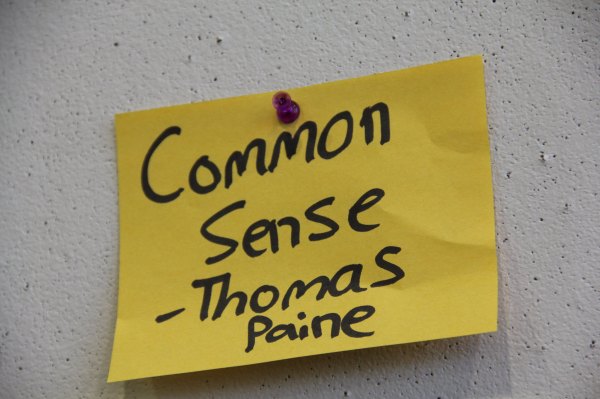
Uncommon Sense

Let’s talk about common sense.

“Common sense” is one of those underpinnings of democracy that we take for granted. Basically, it hinges on this concept: the majority of people will agree that certain things are true. Those things are then defined as “common sense.” And common sense becomes our reference point for what is right and what is wrong.

But what if the very concept of common sense isn’t true? That was what researchers Duncan Watts and Mark Whiting set out to explore.

Duncan Watts is one of my favourite academics. He is a computational social scientist at the University of Pennsylvania. I’m fascinated by network effects in our society, especially as they’re now impacted by social media. And that pretty much describes Watt’s academic research “wheelhouse.” 

According to his profile he’s “interested in social and organizational networks, collective dynamics of human systems, web-based experiments, and analysis of large-scale digital data, including production, consumption, and absorption of news.”

Duncan, you had me at “collective dynamics.”

 I’ve cited his work in several columns before, notably his deconstruction of marketing’s ongoing love affair with so-called influencers. A previous study from Watts shot several holes in the idea of marketing to an elite group of “influencers.”

Whiting and Watts took 50 claims that would seem to fall into the category of common sense. They ranged from the obvious (“a triangle has three sides”) to the more abstract (“all human beings are created equal”). They then recruited an online panel of participants to rate whether the claims were common sense or not. Claims based on science were more likely to be categorized as common sense. Claims about history or philosophy were less likely to be identified as common sense.

What did they find? Well, apparently common sense isn’t very common. Their report says, “we find that collective common sense is rare: at most a small fraction of people agree on more than a small fraction of claims.” Less than half of the 50 claims were identified as common sense by at least 75% of respondents.

Now, I must admit, I’m not really surprised by this. We know we are part of a pretty polarized society. It no shock that we share little in the way of ideological common ground.

But there is a fascinating potential reason why common sense is actually quite uncommon: we define common sense based on our own realities, and what is real for me may not be real for you. We determine our own realities by what we perceive to be real, and increasingly, we perceive the “real” world through a lens shaped by technology and media – both traditional and social.

Here is where common sense gets confusing. Many things – especially abstract things – have subjective reality. They are not really provable by science. Take the idea that all human beings are created equal. We may believe that, but how do we prove it? What does “equal” mean?

So when someone appeals to our common sense (usually a politician) just what are they appealing to? It’s not a universally understood fact that everyone agrees on. It’s typically a framework of belief that is probably only agreed on by a relatively small percent of the population. This really makes it a type of marketing, completely reliant on messaging and targeting the right market.

Common sense isn’t what it once was. Or perhaps it never was. Either common or sensible.

Feature image: clemsonunivlibrary

You Know What Government Agencies Need? Some AI

A few items on my recent to-do list  have necessitated dealing with multiple levels of governmental bureaucracy: regional, provincial (this being in Canada) and federal. All three experiences were, without exception, a complete pain in the ass. So, having spent a good part of my life advising companies on how to improve their customer experience, the question that kept bubbling up in my brain was, “Why the hell is dealing with government such a horrendous experience?”

Anecdotally, I know everyone I know feels the same way. But what about everyone I don’t know? Do they also feel that the experience of dealing with a government agency is on par with having a root canal or colonoscopy?

According to a survey conducted last year by the research firm Qualtrics XM, the answer appears to be yes. This report paints a pretty grim picture. Satisfaction with government services ranked dead last when compared to private sector industries.

The next question, being that AI is all I seem to have been writing about lately, is this: “Could AI make dealing with the government a little less awful?”

And before you say it, yes, I realize I recently took a swipe at the AI-empowered customer service used by my local telco. But when the bar is set as low as it is for government customer service, I have to believe that even with the limitations of artificially intelligent customer service as it currently exists, it would still be a step forward. At least the word “intelligent” is in there somewhere.

But before I dive into ways to potentially solve the problem, we should spend a little time exploring the root causes of crappy customer service in government.

First of all, government has no competitors. That means there are no market forces driving improvement. If I have to get a building permit or renew my driver’s license, I have one option available. I can’t go down the street and deal with “Government Agency B.”

Secondly, in private enterprise, the maxim is that the customer is always right. This is, of course, bullshit.  The real truth is that profit is always right, but with customers and profitability so inextricably linked, things generally work out pretty well for the customer.

The same is not true when dealing with the government. Their job is to make sure things are (supposedly) fair and equitable for all constituents. And the determination of fairness needs to follow a universally understood protocol. The result of this is that government agencies are relentlessly regulation bound and fixated on policies and process, even if those are hopelessly archaic. Part of this is to make sure that the rules are followed, but let’s face it, the bigger motivator here is to make sure all bureaucratic asses are covered.

Finally, there is a weird hierarchy that exists in government agencies.  Frontline people tend to stay in place even if governments change. But the same is often not true for their senior management. Those tend to shift as governments come and go. According to the Qualtrics study cited earlier, less than half (48%) of government employees feel their leadership is responsive to feedback from employees. About the same number (47%) feel that senior leadership values diverse perspectives.

This creates a workplace where most of the people dealing with clients feel unheard, disempowered and frustrated. This frustration can’t help but seep across the counter separating them from the people they’re trying to help.

I think all these things are givens and are unlikely to change in my lifetime. Still, perhaps AI could be used to help us navigate the serpentine landscape of government rules and regulations.

Let me give you one example from my own experience. I have to move a retaining wall that happens to front on a lake. In Canada, almost all lake foreshores are Crown land, which means you need to deal with the government to access them.

I have now been bouncing back and forth between three provincial ministries for almost two years to try to get a permit to do the work. In that time, I have lost count of how many people I’ve had to deal with. Just last week, someone sent me a couple of user guides that “I should refer to” in order to help push the process forward. One of them is 29 pages long. The other is 42 pages. They are both about as compelling and easy to understand as you would imagine a government document would be. After a quick glance, I figured out that only two of the 71 combined pages are relevant to me.

As I worked my way through them, I thought, “surely some kind of ChatGPT interface would make this easier, digging through the reams of regulation to surface the answers I was looking for. Perhaps it could even guide you through the application process.”

Let me tell you, it takes a lot to make me long for an AI-powered interface. But apparently, dealing with any level of government is enough to push me over the edge.

Dove’s Takedown Of AI: Brilliant But Troubling Brand Marketing

The Dove brand has just placed a substantial stake in the battleground over the use of AI in media. In a campaign called “Keep Beauty Real”, the brand released a 2-minute video showing how AI can create an unattainable and highly biased (read “white”) view of what beauty is.

If we’re talking branding strategy, this campaign in a master class. It’s totally on-brand with Dove, who introduced its “Campaign for Real Beauty” 18 years ago. Since then, the company has consistently fought digital manipulation of advertising images, promoted positive body image and reminded us that beauty can come in all shapes, sizes and colors. The video itself is brilliant. You really should take a couple minutes to see it if you haven’t already.

But what I found just as interesting is that Dove chose to use AI as a brand differentiator. The video starts with by telling us, “By 2025, artificial intelligence is predicted to generate 90% of online content” It wraps up with a promise: “Dove will never use AI to create or distort women’s images.”

This makes complete sense for Dove. It aligns perfectly with its brand. But it can only work because AI now has what psychologists call emotional valency. And that has a number of interesting implications for our future relationship with AI.

“Hot Button” Branding

Emotional valency is just a fancy way of saying that a thing means something to someone. The valence can be positive or negative. The term valence comes from the German word valenz, which means to bind. So, if something has valency, it’s carrying emotional baggage, either good or bad.

This is important because emotions allow us to — in the words of Nobel laureate Daniel Kahneman — “think fast.” We make decisions without really thinking about them at all. It is the opposite of rational and objective thinking, or what Kahneman calls “thinking slow.”

Brands are all about emotional valency. The whole point of branding is to create a positive valence attached to a brand. Marketers don’t want consumers to think. They just want them to feel something positive when they hear or see the brand.

So for Dove to pick AI as an emotional hot button to attach to its brand, it must believe that the negative valence of AI will add to the positive valence of the Dove brand. That’s how branding mathematics sometimes work: a negative added to a positive may not equal zero, but may equal 2 — or more. Dove is gambling that with its target audience, the math will work as intended.

I have nothing against Dove, as I think the points it raises about AI are valid — but here’s the issue I have with using AI as a brand reference point: It reduces a very complex issue to a knee-jerk reaction. We need to be thinking more about AI, not less. The consumer marketplace is not the right place to have a debate on AI. It will become an emotional pissing match, not an intellectually informed analysis. And to explain why I feel this way, I’ll use another example: GMOs.

How Do You Feel About GMOs?

If you walk down the produce or meat aisle of any grocery store, I guarantee you’re going to see a “GMO-Free” label. You’ll probably see several. This is another example of squeezing a complex issue into an emotional hot button in order to sell more stuff.

As soon as I mentioned GMO, you had a reaction to it, and it was probably negative. But how much do you really know about GMO foods? Did you know that GMO stands for “genetically modified organisms”? I didn’t, until I just looked it up now. Did you know that you almost certainly eat foods that contain GMOs, even if you try to avoid them? If you eat anything with sugar harvested from sugar beets, you’re eating GMOs. And over 90% of all canola, corn and soybeans items are GMOs.

Further, did you know that genetic modifications make plants more resistance to disease, more stable for storage and more likely to grow in marginal agricultural areas? If it wasn’t for GMOs, a significant portion of the world’s population would have starved by now. A 2022 study suggests that GMO foods could even slow climate change by reducing greenhouse gases.

If you do your research on GMOs — if you “think slow’ about them — you’ll realize that there is a lot to think about, both good and bad. For all the positives I mentioned before, there are at least an equal number of troubling things about GMOs. There is no easy answer to the question, “Are GMOs good or bad?”

But by bringing GMOs into the consumer world, marketers have shut that down that debate. They are telling you, “GMOs are bad. And even though you consume GMOs by the shovelful without even realizing it, we’re going to slap some GMO-free labels on things so you will buy them and feel good about saving yourself and the planet.”

AI appears to be headed down the same path. And if GMOs are complex, AI is exponentially more so. Yes, there are things about AI we should be concerned about. But there are also things we should be excited about. AI will be instrumental in tackling the many issues we currently face.

I can’t help worrying when complex issues like AI and GMOs are broad-stroked by the same brush, especially when that brush is in the hands of a marketer.

Feature image: Body Scan 002 by Ignotus the Mage, used under CC BY-NC-SA 2.0 / Unmodified

AI Customer Service: Not Quite Ready For Prime Time

I had a problem with my phone, which is a landline (and yes, I’ve heard all the smartass remarks about being the last person on earth with a landline, but go ahead, take your best shot).

The point is, I had a problem. Actually, the phone had a problem, in that it didn’t work. No tone, no life, no nothing. So that became my problem.

What did I do? I called my provider (from my cell, which I do have) and after going through this bizarre ID verification process that basically stopped just short of a DNA test, I got routed through to their AI voice assistant, who pleasantly asked me to state my problem in one short sentence.

As soon as I heard that voice, which used the same dulcet tones as Siri, Alexa and the rest of the AI Geek Chorus, I knew what I was dealing with. Somewhere at a board table in the not-too-distant past, somebody had come up with the brilliant idea of using AI for customer service. “Do you know how much money we could save by cutting humans out of our support budget?” After pointing to a chart with a big bar and a much smaller bar to drive the point home, there would have been much enthusiastic applause and back-slapping.

Of course, the corporate brain trust had conveniently forgotten that they can’t cut all humans out of the equation, as their customers still fell into that category.  And I was one of them, now dealing face to face with the “Artificially Intelligent” outcome of corporate cost-cutting. I stated my current state of mind more succinctly than the one short sentence I was instructed to use. It was, instead, one short word — four letters long, to be exact. Then I realized I was probably being recorded. I sighed and thought to myself, “Buckle up. Let’s give this a shot.”

I knew before starting that this wasn’t going to work, but I wasn’t given an alternative. So I didn’t spend too much time crafting my sentence. I just blurted something out, hoping to bluff my way to the next level of AI purgatory. As I suspected, Ms. AI was stumped. But rather than admit she was scratching her metaphysical head, she repeated the previous instruction, preceded by a patronizing “pat on my head” recap that sounded very much like it was aimed at someone with the IQ of a soap dish. I responded again with my four-letter reply — repeated twice, just for good measure.

Go ahead, record me. See if I care.

This time I tried a roundabout approach, restating my issue in terms that hopefully could be parsed by the cybernetic sadist that was supposedly trying to help me. Needless to say, I got no further. What I did get was a helpful text with all the service outages in my region. Which I knew wasn’t the problem. But no one asked me.

I also got a text with some troubleshooting tips to try at home. I had an immediate flashback to my childhood, trying to get my parents’ attention while they were entertaining friends at home, “Did you try to figure it out yourself, Gordie? Don’t bother Mommy and Daddy right now. We’re busy doing grown up things. Run along and play.”

At this point, the scientific part of my brain started toying with the idea of making this an experiment. Let’s see how far we can push the boundaries of this bizarre scenario: equally frustrating and entertaining. My AI tormenter asked me, “Do you want to continue to try to troubleshoot this on the phone with me?”

I was tempted, I really was. Probably by the same part of my brain that forces me to smell sour milk or open the lid of that unidentified container of green fuzz that I just found in the back of the fridge.  And if I didn’t have other things to do in my life, I might have done that. But I didn’t. Instead, in desperation I pleaded, “Can I just talk to a human, please?”

Then I held my breath. There was silence. I could almost hear the AI wheels spinning. I began to wonder if some well-meaning programmer had included a subroutine for contrition. Would she start pleading for forgiveness?

After a beat and a half, I heard this, “Before I connect you with an agent, can I ask you for a few more details so they’re better able to help you?” No thanks, Cyber-Sally, just bring on a human, posthaste! I think I actually said something to that effect. I might have been getting a little punchy in my agitated state.

As she switched me to my requested human, I swore I could hear her mumble something in her computer-generated voice. And I’m pretty sure it was an imperative with two words, the first a verb with four letters, the second a subject pronoun with three letters.

And, if I’m right, I may have newfound respect for AI. Let’s just call it my version of the Turing Test.

We SHOULD Know Better — But We Don’t

“The human mind is both brilliant and pathetic.  Humans have built hugely complex societies and technologies, but most of us don’t even know how a toilet works.”

– from The Knowledge Illusion: Why We Never Think Alone” by Steven Sloman and Philip Fernback.

Most of us think we know more than we do — especially about things we really know nothing about. This phenomenon is called the Dunning-Kruger Effect. Named after psychologists Justin Kruger and David Dunning, this bias causes us to overestimate our ability to do things that we’re not very good at.

That’s the basis of the new book “The Knowledge Illusion: Why We Never Think Alone.” The basic premise is this: We all think we know more than we actually do. Individually, we are all “error prone, sometimes irrational and often ignorant.” But put a bunch of us together and we can do great things. We were built to operate in groups. We are, by nature, herding animals.

This basic human nature was in the back of mind when I was listening to an interview with Es Devlin on CBC Radio. Devlin is self-described as an artist and stage designer.  She was the vision behind Beyonce’s Renaissance Tour, U2’s current run at The Sphere in Las Vegas, and the 2022 Superbowl halftime show with Dr. Dre, Snoop Dogg, Eminem and Mary J. Blige.

When it comes to designing a visually spectacular experience,  Devlin has every right to be a little cocky. But even she admits that every good idea doesn’t come directly from her. She said the following in the interview (it’s profound, so I’m quoting it at length):

“I learned quite quickly in my practice to not block other people’s ideas — to learn that, actually,  other people’s ideas are more interesting than my own, and that I will expand by absorbing someone else’s idea.

“The real test is when someone proposes something in a collaboration that you absolutely, [in] every atom of your body. revile against. They say, ‘Why don’t we do it in bubblegum pink?’ and it was the opposite of what you had in mind. It was the absolute opposite of anything you would dream of doing.

“But instead of saying, ‘Oh, we’re not doing that,’  you say ‘OK,’ and you try to imagine it. And then normally what will happen is that you can go through the veil of the pink bubblegum suggestion, and you will come out with a new thing that you would never have thought of on your own.

“Why? Because your own little batch of poems, your own little backpack of experience. does not converge with that other person, so you are properly meeting not just another human being, but everything that led up to them being in that room with you. “

From Interview with Tom Powers on Q – CBC Radio, March 18, 2024

We live in a culture that puts the individual on a pedestal.  When it comes to individualistic societies, none are more so than the United States (according to a study by Hofstede Insights).  Protection of personal rights and freedom are the cornerstone of our society (I am Canadian, but we’re not far behind on this world ranking of individualistic societies). The same is true in the U.K. (where Devlin is from), Australia, the Netherlands and New Zealand.

There are good things that come with this, but unfortunately it also sets us up as the perfect targets for the Dunning-Kruger effect. This individualism and the cognitive bias that comes with it are reinforced by social media. We all feel we have the right to be heard — and now we have the platforms that enable it.

With each post, our unshakable belief in our own genius and infallibility is bulwarked by a chorus of likes from a sycophantic choir who are jamming their fingers down on the like button. Where we should be cynical of our own intelligence and knowledge, especially about things we know nothing about, we are instead lulled into hiding behind dangerous ignorance.

What Devlin has to say is important. We need to be mindful of our own limitations and be willing to ride on the shoulders of others so we can see, know and do more. We need to peek into the backpack of others to see what they might have gathered on their own journey.

(Feature Image – Creative Commons – https://www.flickr.com/photos/tedconference/46725246075/)