Trump, The Media and the Problem of “Pretty Good.”

A number of years back, I was in China for a conference and during a dinner thrown by the hosts for their international presenters, I was lucky enough to find myself sitting next to James Fallows, who was in China on assignment for the Atlantic. His dispatches back eventually became the book Postcards from Tomorrow Square: Reports from China.

It was my first trip to China and I was stunned by the apparent contradiction of the most entrepreneurial society I had ever seen under the rule of a Communist Regime. I asked James how China’s then leader, Hu Jintao, managed to maintain that seemingly impossible balance without widespread insurrection. He said something I’ll always remember: “As long as the Chinese people believe that their lives today are better than they were yesterday, and that they will be even better tomorrow, they will continue to follow their leader.”

That same very simple equation is what populists, some of whom may eventually become dictators, depend on – promising to make life better for their base. If you were Hitler, or Mussolini, or Francisco Franco, that was easy to do. Each of those countries and their economies were fundamentally broken in the 1920’s or 30’s. You didn’t have to be a genius to make things better for the average German, Italian or Spaniard. Just getting trains to run on time was a pretty big step in the right direction.

But that’s not the U.S.A. Things there are (or were) pretty good. Perfect? Not by a long shot. But pretty good.

You disagree? The plain facts are that at no time in history have people ate more, had more, did more or lived longer than right now. And that is doubly true for the U.S., who has about 5% of the world’s population but consumes about 20 to 25% of the world’s resources. Yes, there’s a lot that can be fixed (for instance, there are huge disparities in wealth and consumption), but things are pretty good. Especially in the U.S. of A.

So where does that leave a populist like Trump? Populists say that they – and they alone – can make life better tomorrow for their base. But when things are pretty good already, that’s a hard promise to keep. The U.S. – and the rest of the world – is a complex place that exists thanks to complex systems. The economy, financial markets, diplomacy, healthcare, immigration, education – all of these things are complex. And because of this complexity, the problems that do exist are what are called “wicked” problems – problems that have no quick or simple solution. In fact, they may have no solution at all.

Someone like Trump has no clue about complexity. He will spout inanely ignorant “fixes” and back them up with talking points that have no basis in reality.

Take Trump’s insanely stupid “tariff” solution he imposed just over a week ago. It wasn’t even 24 hours old when he started pulling it back because the U. S. economy started running off the rails. As I said a month ago, imposing a 25% blanket tariff is like doing open heart surgery with a hand grenade

And this is a big problem for Trump. He has no idea how to keep his promise to make life better for people in a complex environment.  It’s not just tariffs. The flurry of executive orders and the chainsaw massacre that is DOGE are similarly stupid solutions to complex issues. They are doomed to fail, which means the U.S. will inevitably slip backwards, rather than leap forward.

Trump will blunder for mistake to mistake, blowing up all the systems that made things “pretty good” in America. He is bulldozing through the complex international relationships that have enabled the U.S. to perch on top of the world order for 100 years. He is blowing up trade agreements and mutual defense pacts. He is pissing off every other country in the world with the exception of one: Russia.

As the Canadian prime minister Justin Trudeau just said – “Make that Make Sense.”

It would be easy to blame Donald Trump. But I won’t. He’s just being Trump, just like a shark is just being a shark. It would also be easy to blame the Republican sycophants that are letting him do this. But again – sharks will be sharks. They have evolved to swim towards blood. No, to truly assign blame, we have to ask “why” a few times.

Why was Trump put in the position where he could do this? He’s there because 77 million Americans voted for him. And why did they vote for him? Because they believed he could make things better tomorrow than they are today. It’s a pretty simple equation.

Let’s ask why one more time.  Why did they believe that Trump could save them? Ah! Now, we’re getting somewhere. The Media – our media – built this belief. They built it because there is no profit in saying things are “pretty good.”  The Media thrives by creating conflict. And so they built the belief that things were fundamentally broken and needed fixing. They created the illusion that there are simple solutions to complex problems. They allowed ignorance to flourish in an absence of reliable and objective reporting. They gave Trump the air he needed to breath.

The media – especially social media – also planted the false notion that we deserve better than “pretty good.” It has fostered the nonsensical equation that all of us should have the same as the richest of us.  We are entitled to it. And if we don’t get it, somebody is to blame. No one stops to think that the equation is mathematically impossible.

That is what we have to fix.

When Branding and Politics Collide

It is the worst timing possible to open a Tesla dealership.

 In Kelowna, the western Canadian city I live in, a new 30,000 square foot Tesla dealership is scheduled to open their doors any day now.  When they do, I’m guessing business will not be brisk. It takes a lot to get Canadians worked up (hockey games aside) but the Trump administration has managed to do something I haven’t seen before in my lifetime – uniting Canadians in a passionate rage. Between picking a totally unjustified trade war with us and continually threatening to make us a 51st State, Donald Trump hasn’t made any friends in my country. And – by extension – that includes his hatchet/chainsaw man and the face of Tesla, Elon Musk.

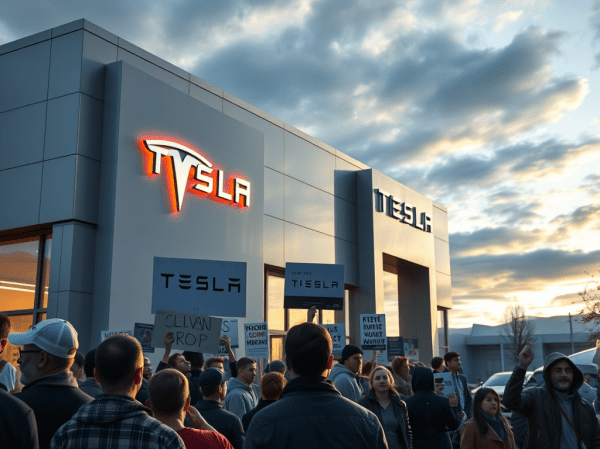
This is not just happening here in Canada. Tesla owners are having a rough month everywhere. Their cars are being customized with swastikas. Their daily drive is regularly punctuated with middle finger salutes. They are being verbally accosted at Tesla charging stations. And, if they happen to have to go to their dealership, chances are very good that they’ll have to navigate past a pack of protesters. According to the website Actionnetwork.org, there are 101 TeslaTakedown protests scheduled across the US and around the world in the next few weeks.

That is a dramatic turnaround for a car brand that single handedly made driving an electric vehicle cool. The TeslaTakedown campaign is urging drivers to dump their cars and shareholders to sell their stock. A recent survey out of the Netherlands says that one in three Tesla owners are considering selling.

This has nothing to do with whether Teslas are good cars or not. They’re the same vehicles they were 6 months ago. This is simply about branding, and right now, the Tesla brand and Elon Musk are one and the same. That brand is not popular with the majority of the world right now, especially here in Canada.

Like I said – it’s really bad timing to open a new dealership.

As this is all playing out, it got me thinking about another car brand that got on the wrong side of politics 80 years ago. In 1945, Volkswagen was not the 2nd largest car manufacturer in the world, as it is now. It was a shuttered factory in Wolfsburg, Germany that was set to be dismantled by the Allied occupiers, led by the British.  

Volkswagen was founded in 1937 by the Nazi Party’s German Labor Front as a prestige project to show that German workers could produce the world’s best “People’s Car” (which is literally what “Volkswagen” means). That vehicle would be the first prototype of the now much-loved Beetle that we of a certain age immediately associate with Volkswagen. In 1938, Hitler himself christened this the KdF-Wagen, which stood for “Kraft durch Freude” – Strength through Joy. Even the car’s name was a banner for Nazi propaganda.

Eight years later – in 1945 – it was a different story. The Wolfsburg factory was to be dismantled as part of the de-Nazification of German industry and the equipment was to be sent to a British car manufacturer, but none of them wanted it. Three things saved Volkswagen:

  • The design was solid. The wartime version of the VW – the Kubelwagen – was exceptionally reliable
  • There was a desperate need for military transportation in the now occupied zone and there was no manufacturer able to fulfill that need
  • There was a factory ready to go and a skilled workforce who were in danger of starving if they didn’t go back to work

These three things convinced the British trustees to reopen the Wolfsburg plant. By March of 1946, the plant was producing 1000 cars a month.  In 1947, Volkswagen began exporting passenger vehicles to other European markets, including the Netherlands, Switzerland and Denmark. This export model became the Beetle in the form I first knew it.

By the end of the 1950’s, Volkswagen had expanded through Europe and was ready to take on the US, a market dominated by the Big Three (Ford, GM and Chrysler) domestic manufacturers. At the time, almost no imported vehicles were sold in America.

Thanks to an inspired “Think Small” advertising campaign, created by copywriter Julian Koenig and Art Director Helmut Krone from Doyle Dane Bernbach, Volkswagen became the US’s favorite import. The campaign used humor, honesty and irony to spark a love for the VW brand. This branding and the oil crisis of the 1970’s placed VW in the perfect position to capitalize on a sudden market for smaller, more fuel-efficient vehicles. In 1961, Volkswagen passed the 1 million vehicles manufactured per year milestone. By 1972, that had more than doubled to almost 2.2 million cars made per year. Three quarters of those were sold in export markets.

As I said, today the Volkswagen group is now the number 1 or 2 auto manufacturer in the world, depending on which yardstick you use (per unit sales or total revenue). They do fall short on the list of most valuable car companies in the world, based on market capitalization.

So, what is the most valuable car company in the world? Tesla.

For now, anyway.

Curation is Our Future. But Can You Trust It?

 You can get information from anywhere. But the meaning of that information can come from only one place: you. Everything we take in from the vast ecosystem of information that surrounds us goes through the same singular lens – one crafted by a lifetime of collected beliefs and experiences.

Finding meaning has always been an essentially human activity. Meaning motivates us – it is our operating system. And the ability to create shared meaning can create or crumble societies. We are seeing the consequences of shared meaning play out right now in real time.

The importance of influencing meaning creates an interesting confluence between technology and human behavior. For much of the past two decades, technology has been focusing on filtering and organizing information. But we are now in an era where technology will start curating our information for us. And that is a very different animal.

What does it mean to “curate” an answer, rather than simply present it to you? Curation is more than just collecting and organizing things. The act of curation is to put that information in a context that provides additional value by providing a possible meaning. This crosses the line that delineates just disseminating information from attempting to influence individuals by providing them a meaningful context for that information. 

Not surprisingly, the roots of curation lie – in part – with religion. It comes from the Latin “curare” – “to take care of”. In medieval times, curates were priests who cared for souls. And they cared for souls by providing a meaning that lay beyond the realms of our corporal lives. If you really think about religion, it is one massive juxtaposition of a pre-packaged meaning on the world as we perceive it.

In the future, as we access our world through technology platforms, we will rely on technology to mediate meaning. For example, searches on Google now include an “AI Overview” at the top of the search results The Google Page explaining what the Overview is says it shows up when “you want to quickly understand information from a range of sources, including information from across the web and Google’s Knowledge Graph.” That is Google – or rather Google’s AI – curating an answer for you.

It could be argued that this is just another step to make search more useful – something I’ve been asking for a decade and a half now. In 2010, I said that “search providers have to replace relevancy with usefulness. Relevancy is a great measure if we’re judging information, but not so great if we’re measuring usefulness.” If AI could begin to provide actionable answers with a high degree of reliability, it would be a major step forward. There are many that say such curated answers could make search obsolete. But we have to ask ourselves, is this curation something we can trust?

With Google, this will probably start as unintentional curation – giving information meaning through a process of elimination. Given how people scan search listings (something I know a fair bit about) it’s reasonable to assume that many searchers will scan no further than the AI Overview, which is at the top of the results page. In that case, you will be spoon-fed whatever meaning happens to be the product of the AI compilation without bothering to qualify it by scanning any further down the results page. This conveyed meaning may well be unintentional, a distillation of the context from whatever sources provided the information. But given that we are lazy information foragers and will only expend enough effort to get an answer that seems reasonable, we will become trained to accept anything that is presented to us “top of page” at face value.

From there it’s not that big a step to intentional curation – presenting information to support a predetermined meaning. Given that pretty much every tech company folded like a cheap suit the minute Trump assumed office, slashing DEI initiatives and aligning their ethics – or lack of – to that of the White House, is it far-fetched to assume that they could start wrapping the information they provide in a “Trump Approved” context, providing us with messaged meaning that supports specific political beliefs? One would hate to think so but based on Facebook’s recent firing of its fact checkers, I’m not sure it’s wise to trust Big Tech to be the arbitrators of meaning.

They don’t have a great track record.

Getting Tired of Trying to tell the Truth

It’s not always easy writing these weekly posts. I try to deal with things of consequence, and usually I choose things that may be negative in nature. I also try to learn a little bit more about these topics by doing some research and approaching the post in a thoughtful way.  All of this means I have gone down several depressing rabbit holes in the course of writing these pieces over the years.

I have to tell you that, cumulatively, it takes a toll. Some weeks, it can only be described as downright depressing. And that’s just for myself, who only does these once a week. What if this were my full-time job? What if I were a journalist reporting on an ever more confounding world? How would I find the motivation to do my job every day?

The answer, at least according to a recent survey of 402 journalists by PR industry platform creator Muck Rake, is that I could well be considering a different job. Last year, 56% of those journalists considered quitting.

The reasons are many. I and others have repeatedly talked the dismal state of journalism in North America. The advertising-based economic model that supports true reporting is falling apart. Publishers have found that it’s more profitable to pander to prejudice and preconceived beliefs than it is to actually try to report the truth and hope to change people’s minds. When it comes to journalism, it appears that Colonel Nathan R. Jessup (from the movie A Few Good Men) may have been right. We can’t handle the truth. We prefer to spoon fed polarized punditry that aligns with our beliefs. When profitability is based on the number of eye-balls gained, you get a lot more of them at a far lower cost by peddling opinion rather than proof. This has led to round after round of mass layoffs, cutting newsroom staffing by double digit percentages.

This reality brings a crushing load of economic pressure down on journalists. According to the Muck Rake survey, most journalist are battling burnout due to working longer hours with fewer resources. But it’s not just the economic restraints that are taking their toll on journalists. A good part of the problem is the evolving nature of how news develops and propagates through our society.

There used to be such a thing as a 24-hour news cycle which was defined by a daily publication deadline, whether that was the printing of a newspaper or the broadcast of the nightly news. As tight as 24 hours was, it was downright leisurely compared to the split-second reality of today’s information environment. New stories develop, break and fade from significance in minutes now rather than days or weeks as was true in the past. And that means that a journalist that hopes to keep up always has to be on. There is no such thing as downtime or being “off the grid.” Even with new tools and platforms to help monitor and filter the tidal wave of signal vs. noise that is today’s information ecosystem, a journalist always has to be plugged in and logged on to do their job.

That is exhausting.

But perhaps the biggest reason why journalists are considering a career change is not the economic constraints nor the hours worked. It’s the nature of the job itself. No one choses to be a journalist because they want to get rich. It’s a career built on passion. Good journalists want to do something significant and make a difference. They do it because they value objectivity and truth and believe that by reporting it, they can raise the level of thought and discourse in our society. Given the apparent dumpster fire that seems to sum up the world today, can you blame them for becoming disillusioned with their chosen career?

All of this is tremendously sad. But even more than that, it is profoundly frightening. In a time when we need more reliably curated, reliably reported information about the state of affairs than ever before, those we have always trusted to provide this are running – in droves – towards the nearest exit.

Is This The Time to Say No?

I like to be agreeable. I’m not really into rocking boats or stirring things up. If there is a flow to be found, I will usually be found going with it.

But today, one day after Trump v2.0 became official, I’m wondering if I should change my tune and say “no” more often. Trump hasn’t even been president for 24 hours yet and already the world seems to be changing, and not in any way I’m comfortable with.

There has been a lot of talk about how Big Tech is embracing the wild and wacky world of misinformation in the new era of MAGA. Musk’s malevolent makeover of X has proven to be prescient rather than puerile. Mark Zuckerberg is following suit by sending Meta’s Fact Checkers packing. Jeff Bezos first blocked the Washington Post from endorsing Kamala Harris and then dialed back diversity, equity and inclusion at Amazon to be better aligned with Trumpian sensibilities.

All of these moves are driven purely by business motives. The Tech Broligarchs (the worlds most exclusive white male club) are greasing the wheels for maximum profitability over the next 4 years for their respective empires. They are tripping over each other rushing to scatter rose petals at Trump’s toes. When collectively those three are worth close to 1 trillion dollars – well – a dude has the right to protect his assets, doesn’t he?

No. I don’t think so. I’m not okay with any of this. As Big Tech primes the profitability pump by pandering to the new president, we are all going to pay a much bigger price. The erosion of social capital is going to be massive. And so, I feel the time has come to say when I don’t agree with something. And I don’t agree with this.

We all somehow believe that free markets will eventually lead us to the best moral choice. And nothing could be further from the truth. Nobel prize winning economist Milt Friedman was wrong when he said, “an entity’s greatest responsibility lies in the satisfaction of the shareholders.” This doctrine has guided the corporate world for half a century now, towing along our western governments in its wake. The enshrining of profits as more important than social responsibility has led us inevitably to where we are now, where the personal worth of a handful of tech billionaires is judged as more important than the sustainability and fairness of our own society.

Normally, we would rely on our governments to put in place legislation to protect us from the worst instincts of big business. But yesterday, with the second swearing in of Donald Trump as president, we saw that dynamic flipped on its head. For the next four years, the U.S. will have a sitting president that will be leading the way in the race to the bottom. Corporate America will be hard pressed to keep up.

So, if big business is not looking out for us, and our government is looking the other way, who should we turn to? The answer, sadly, is there is no one left but ourselves. If we don’t agree with something – if the world is going in a direction contrary to our own values – we have to say something. We also have to do something. We have to become a little more defiant.

That is the theme of the brand-new book “Defy” by organizational psychologist Dr. Sunita Sah. She says that we are typically hard-wired to comply rather than defy, “There are situations where you want to defy, but you go along with it. Maybe the costs are too great, the benefits too meager, or the situation is dangerous. We all have to do that at times, even our defiant heroes like Rosa Parks. How many times did she comply with the segregation laws? A lot, but there comes a moment when we decide now is the time to defy. It’s figuring out when that time is.”

For myself, that time has come.

My 1000th Post – and My 20 Year Journey

Note: This week marks the 1000th post I’ve written for MediaPost. For this blog, all of those posts are here, plus a number that I’ve written for other publications and exclusively for Out of My Gord. But the sentiments here apply to all those posts. If you’re wondering, I’ve written 1233 posts in total.

According to the MediaPost search tool, this is my 1000th post for this publication. There are a few duplicates in there, but I’m not going to quibble. No matter how you count them up, that’s a lot of posts.

My first post was written on August 19th, 2004. Back then I wrote exclusively for the emerging search industry. Google was only 6 years old.  They had just gone public, with investors hoping to cash in on this new thing called paid search. Social media was even greener. There was no Facebook. Something called Myspace had launched the year before.

In the 20 years I’ve written for MediaPost, I’ve bounced from masthead to masthead. My editorial bent evolved from being Search industry specific to eventually find my sweet spot, which I found at the intersection of human behavior and technology.

It’s been a long and usually interesting journey. When I started, I was the parent of two young children who I dragged along to industry events, using the summer search conference in San Jose as an opportunity to take a family camping vacation. I am now a grandfather, and I haven’t been to a digital conference for almost 10 years (the last being the conferences I used to host and program for the good folks here at MediaPost).

When I started writing these posts, I was both a humanist and a technophile. I believed that people were inherently good, and that technology would be the tool we would use to be better. The Internet was just starting to figure out how to make money, but it was still idealistic enough that people like me believed it would be mostly a good thing. Google still had the phrase “Don’t be Evil” as part of its code of conduct.

Knowing this post was coming up, I’ve spent the past few months wondering what I’d write when the time came. I didn’t want it to be yet another look back at the past 20 years. The history I have included I’ve done so to provide some context.

No, I wanted this to be what this journey has been like for me. There is one thing about having an editorial deadline that forces you to come up with something to write about every week or two. It compels you to pay attention. It also forces you to think. The person I am now – what I believe and how I think about both people and technology – has been shaped in no small part by writing these 1000 posts over the past 20 years.

So, If I started as a humanist and technophile, what am I now, 20 years later? That is a very tough question to answer. I am much more pessimistic now. And this post has forced me to examine the causes of my pessimism.

I realized I am still a humanist. I still believe that if I’m face to face with a stranger, I’ll always place my bet on them helping me if I need it. I have faith that it will pay off more often than it won’t. If anything, we humans may be just a tiny little bit better than we were 20 years ago: a little more compassionate, a little more accepting, a little more kind.

So, if humans haven’t changed, what has? Why do I have less faith in the future than I did 20 years ago? Something has certainly changed. But what was it, I wondered?

Coincidentally, as I was thinking of this, I was also reading the late Philip Zimbardo’s book – The Lucifer Effect: Understanding How Good People Turn Evil. Zimbardo was the researcher who oversaw the Stanford Prison Experiment, where ordinary young men were randomly assigned roles as guards or inmates in a makeshift prison set up in a Stanford University basement. To make a long story short – ordinary people started doing such terrible things that they had to cut the experiment short after just 6 days.

 Zimbardo reminded me that people are usually not dispositionally completely good or bad, but we can find ourselves in situations that can push us in either direction. We all have the capacity to be good or evil. Our behavior depends on the environment we function in. To use an analogy Zimbardo himself used, it may not be the apples that are bad. It could be the barrel.

So I realized, it isn’t people who have changed in the last 20 years, but the environment we live in. And a big part of that environment is the media landscape we have built in those two decades. That landscape looks nothing like it did back in 2004.  With the help of technology, we have built an information landscape that doesn’t really play to the strengths of humanity. It almost always shows us the worst side of ourselves. Journalism has been replaced by punditry. Dialogue and debate have been pushed out of the way by demagoguery and divisiveness.

So yes, I’m more pessimistic now that I was when I started this journey 20 years ago. But there is a glimmer of hope here. If people had truly changed, there is not a lot we can do about that. But if it’s the media landscape that’s changed, that’s a different story. Because we built it, we can also fix it.

It’s something I’ll be thinking about as I start a new year.

The Strange Social Media Surge for Luigi Mangione

Luigi Mangione is now famous. Just one week ago, we had never heard of him. But now, he has become so famous, I don’t even have to recount the reason for his fame.

But, to me, what’s more interesting than Mangione’s sudden fame is how we feel about him. According to the Network Contagion Research Institute there is a lot of online support for Luigi Mangione. An online funding campaign has raised over $130,000 for his legal defense fund. The hashtag #FreeLuigi, #TeamLuigi and other pro-Luigi memes have taken over every social media channel. Amazon, Etsy and E-Bay are scrambling to keep Luigi inspired merchandise out of their online stores. His X (formerly Twitter) account has ballooned from 1500 followers to almost half a million.

It’s an odd reaction for someone who is accused of gunning down a prominent American businessman in cold blood.

The outpouring of support for Luigi Mangione is so consequential, it’s threatening to lay a very heavy thumb on the scales of justice. There is so much public support for Luigi Mangione, prosecutors are worried that it could lead to jury nullification. It may be impossible to find unbiased and impartial jurors who would find Mangione guilty, even if it’s proven beyond a reasonable doubt.

Now, I certainly don’t want to comment or Mr. Mangione’s guilt, innocence or whether he’s appropriate material from which to craft a folk hero. Nor do I want to talk about the topic of American Healthcare and the corporate ethics of United Healthcare or any other medical insurance provider.  I won’t even dive into the admittedly juicy and ironic twist that our latest anti-capitalist hero of the common people is a young, white, male, good looking, wealthy and privately educated scion who probably leans right in his political beliefs.

No, I will leave all of that well enough alone. What I do want to talk about is how this had played out through social media and why it’s different than anything we’ve seen before.

We behave and post differently depending on what social platform we’re on at the time. In sociology and psychology, this is called “modality.”  How we act depends on what role we’re playing and what mode we’re in. The people we are, the things we do, the things we say and the way we behave are very different when we’re being a parent at home, an employee at work or a friend having a few drinks after work with our buddies. Each mode comes with different scripts and we usually know what is appropriate to say in each setting.

It was sociologist Erving Goffman who likened it to being on stage in his 1956 book, The Presentation of Self in Everyday Life. The roles we choose to play depends on the audience we’re playing too. We try to stay consistent with the expectations we think the audience has of us. Goffman said, “We are all just actors trying to control and manage our public image, we act based on how others might see us.”

Now, let’s take this to the world of social media. What we post depends on how it plays to the audience of the platform we’re on. We may have a TikTok persona, a Facebook persona and an X persona. But all of those are considered mainstream platforms, especially when compared to platforms like 4Chan, Parler or Reddit. If we’re on any of those platforms, we are probably taking on a very different role and reading from a different script.

Think of it this way. Posting something on Facebook is a little like getting up and announcing something at a townhall meeting that’s being held at your kid’s school. You assume that the audience will be somewhat heterogenous in terms of tastes and ideologies, and you consider your comments accordingly.

But posting something on 4Chan is like the conversation that might happen with your 4 closest bros (4Chan’s own demos admit their audience is 70% male) after way too many beers at a bar. Fear about stepping over the line is non-existent. Racial slurs, misogynistic comments and conspiracy theories abound in this setting.

The thing that’s different with the Mangione example is that comments we would only expect to see on the fringes of social media are showing up in the metaphorical Town Square of Facebook and Instagram (I no longer put X in this category, thank to Mr. Musk’s flirting with the Fringe). In the report from the Network Contagion Research Institute, the authors said,  “While this phenomenon was once largely confined to niche online subcultures, we are now witnessing similar dynamics emerging on mainstream platforms, amplifying the risk of further escalation,”

As is stated in this report, the fear is that by moving discussions of this sort into a mainstream channel, we legitimize it. We have moved the frame of what’s acceptable to say (my oft referenced example of Overton’s Window) into uncharted territory in a new and much more public arena. This could create an information cascade, when can encourage copycats and other criminal behavior.

This is a social phenomenon that will have implications for our future. The degrees of separation between the wild, wacky outer fringes of social media and the mainstream information sources that we use to view the world through are disappearing, one by one. With the Luigi Mangione example, we just realized how much things have changed.

Why Hate is Trending Up

There seems to be a lot of hate in the world lately. But hate is a hard thing to quantify. There are, however, a couple places that may put some hard numbers behind my hunch.

Google’s NGram viewer tracks the frequency of the appearance of a word through published books from 2022 all the way back to 1800. According to NGram, the usage of “hate” has skyrocketed, beginning in the mid 1980s. In 2022, the last year you can search for, the frequency of usage of “hate” was 3 times higher than it historically was.

NGram also allows you to search separately for usage in American English and British English. You’ll either be happy or dismayed to learn that hate knows no boundaries. The British hate almost as much as Americans. They had the same steep incline over the past 4 decades. However, Americans still have an edge on usage, with a frequency that is about 40% higher than those speaking the Queen’s English.

One difference between the two graphs were during the years of the First World War. Then, usage of “hate” in England spiked briefly. The U.S. didn’t have the same spike.

Another way to measure hate is provided by the Southern Poverty Law Center in Montgomery, Alabama, who have been publishing a “hate map” since 2000. The map tracks hate and antigovernment groups. In the year 2000, the first year of the map, the SPLC tracked 599 hate groups across the U.S. By 2023, the number of hate groups had exploded by 240 percent to 1430.

So – yeah – it looks like we all hate a little more than we used to. I’ve talked before about Overton’s Window, that construct that defines what it is acceptable to talk about in public. And based on both these quantitative measures, it looks like “hate” is trending up. A lot.

I’m not immune to trends. I don’t personally track such things, but I’m pretty sure the word “hate” has slipped from my lips more often in the past few years. But here’s the thing. It’s almost never used towards a person I know well. It’s certainly never used towards a person I’m in the same room with. It’s almost always used towards a faceless construct that represents a person or a group of people that I really don’t know very well. It’s not like I sit down and have a coffee with them every week. And there we have one of the common catalysts of hate – something called “dehumanization.”

Dehumanization is a mental backflip where we take a group and strip them of their human qualities, including intelligence, compassion, kindness or social awareness. We in our own “in group” make those in the “out group” less than human so it’s easier to hate them. They are “stupid”, “ignorant”, “evil” or “animals”.

But an interesting thing happens when we’re forced to sit face to face with a representative from this group and actually engage then in conversation so we can learn more about them. Suddenly, we see they’re not as stupid, evil or animalistic as we thought. Sure, we might not agree with them on everything, but we don’t hate them. And the reason for this is due to another thing that makes us human, a molecule called oxytocin.

Oxytocin has been called the “Trust molecule” by neuroeconomist Paul Zak. It kicks off a neurochemical reaction that readies our brains to be empathetic and trusting. It is part of our evolved trust sensing mechanism, orchestrating a delicate dance by our prefrontal cortex and other regions like the amygdala.

But to get the oxytocin flowing, you really need to be face-to-face with a person. You need to be communicating with your whole body, not just your eyes or ears. The way we actually communicate has been called the 7-38-55 rule, thanks to research done in the 1960’s and 70’s by UCLA body language researcher Albert Mehrabian. He showed that 7% of communication is verbal, 38% is tone of voice and 55% is through body language.

It’s that 93% of communication that is critical in the building of trust. And it can only happen face to face. Unfortunately, our society has done a dramatic about-face away from communication that happens in a shared physical space towards communication that is mediated through electronic platforms. And that started to happen about 40 years ago.

Hmmm, I wonder if there’s a connection?

The World vs Big Tech

Around the world, governments have their legislative cross hairs trained on Big Tech. It’s happening in the US, the EU and here in my country,  Canada. The majority of these are anti-trust suits. But Australia has just introduced a different type of legislation, a social media ban for those under 16. And that could change the game – and the conversation -completely for Big Tech.

There are more anti-trust actions in the queue in the US than at any time in the previous five decades. The fast and loose interpretation of antitrust enforcement in the US is that monopolies are only attacked when they may cause significant harm to customers through lack of competition. The US approach to anti-trust since the 1970s has typically followed the Chicago School of neoclassical economy theory, which places all trust in the efficiency of markets and tells government to keep their damned hands off the economy. Given this and given the pro-business slant of all US administrations, both Republican and Democratic, since Reagan, it’s not surprising that we’ve seen relatively few anti-trust suits in the past 50 years.

But the rapid rise of monolithic Big Tech platforms has raised more discussion about anti-trust in the past decade than in the previous 5 decades. These platforms suck along the industries they spawn in their wake and leave little room for upstart competitors to survive long enough to gain significant market share.

Case in point: Google. 

The recent Canadian lawsuit has the Competition Bureau (our anti-trust watchdog) suing Google for anti-competitive practices selling its online advertising services north of the 49th parallel. They’re asking Google to sell off two of its ad-tech tools, pay penalties worth up to 3% of the platform’s global gross revenues and prohibit the company from engaging in anti-competitive practices in the future.

According to a 3-year inquiry into Google’s Canadian business practices by the Bureau, Google controls 90% of all ad servers and 70% of advertising networks operating in the country. Mind you, Google started the online advertising industry in the relatively green fields of Canada back when I was still railing about the ignorance of Canadian advertisers when it came to digital marketing. No one else really had a chance. But Google made sure they never got one by wrapping its gigantic arms around the industry in an anti-competitive bear hug.

The recent Australian legislation is of a different category, however. Anti-trust suits are – by nature – not personal. They are all about business. But the Australian ban puts Big Tech in the same category as Big Tobacco, Big Alcohol and Big Pharma – alleging that they are selling an addictive product that causes physical or emotional harm to individuals. And the rest of the world is closely watching what Australia does. Canada is no exception.

The most pertinent question is how will Australia enforce the band? Restricting social media access to those under 16 is not something to be considered lightly.  It’s a huge technical, legal and logistical hurdle to get over. But if Australia can figure it out, it’s certain that other jurisdictions around the world will follow in their footsteps.

This legislation opens the door to more vigorous public discourse about the impact of social media on our society. Politicians don’t introduce legislation unless they feel that – by doing so – they will continue to get elected. And the key to being elected is one of two things; give the electorate what they want or protect them against what they fear. In Australia, recent polling indicates the ban is supported by 77% of the population. Even those opposing the ban aren’t doing so in defense of social media. They’re worried that the devil might be in the details and that the legislation is being pushed through too quickly.

These types of things tend to follow a similar narrative arc: fads and trends drive widespread adoption – evidence mounts about the negative impacts – industries either ignore or actively sabotage the sources of the evidence – and, with enough critical mass, government finally gets into the act by introducing protective legislation.

With tobacco in the US, that arc took a couple of decades, from the explosion of smoking after World War II to the U.S. Surgeon General’s 1964 report linking smoking and cancer. The first warning labels on cigarette packages appeared two years later, in 1966.

We may be on the cusp of a similar movement with social media. And, once again, it’s taken 20 years. Facebook was founded in 2004.

Time will tell. In the meantime, keep an eye on what’s happening Down Under.

Is the Customer Always Right?

You can’t always get what you want
But if you try sometimes, well, you might find
You get what you need

The Rolling Stones – 1969

When I retired from marketing 11 years ago, I did a brief stint running a tourism business, putting together custom bike tours. I thought it would be an ideal semi-retirement gig – riding bikes and hanging out with others who loved road cycling. Like many customer facing businesses, we lived and died by ratings. Because we were an experience curator, we regularly dealt with dozens of other tourism-based businesses. We were all dealing in the same currency – those elusive five-star ratings.

In theory, I think customer ratings are a good idea. But there is a dark side – the overly entitled customer that wields the threat of a negative review over the head of a proprietor. By the end of the season, all the operators we were dealing with were burnt out and frustrated. Overt entitlement sucked all the joy out of being in the tourism biz. This trend got much worse as we were pulling out of Covid. It was as if the entitled had doubled down on their demands during the pandemic. That was when I decided to hang up my cycling shoes. Life was too short to stress about catering to a bunch of whiny, demanding guests who threatened to bring the wrath of a bad TripAdvisor review down on me.

The internet’s early promise was to democratize markets that were traditionally asymmetrical. Suddenly, everyone had a voice. And, at first, it was wonderful. But predictably, we found a way to screw it up. Compared to the dumpster fire that is social media, online ratings are not pure evil, but they do have their dark side in a culture full of entitled customers.

If you doubt that North America is narcissistically entitled, I direct you to Jean Twenge and Keith Campbell’s book, the Narcissism Epidemic. Based on years of extensive research, it shows how we have fostered an age of entitlement that lives by the maxim that everyone should be treated special. That is now the baseline of expectation. We have brought this on ourselves, by insisting that we – and especially our children – receive special treatment. But, as any statistician can tell you, we can’t all be above average. Sooner or later, something has to give.

This is especially true in tourism. We all long for that magical, once-in a lifetime vacation. In fact, we now demand it. But that is impossible to deliver on. Just check into the most popular vacation destinations in the world: Paris, Rome, Barcelona, Venice and London. All are creaking under the weight of unprecedented numbers of tourist. And the supporting infrastructure can’t support it. Those places are popular because they have a sense of romance, history and magic. Everyone wants to experience strolling through the secluded streets of Rome at twilight, stopping to toss a coin into the Trevi Fountain.

But the reality is far different. Last year, Rome was invaded by an onslaught of 35 million tourists. Crowds ten to twelve deep push towards the fountain, crushing each other and providing the ideal environment for pick pockets. It’s gotten so bad; the City of Rome is looking at instituting a ticket reservation system to see the fountain.

That is the reality. Over tourism has stripped Rome of its magic. But marketing continues to push the elusive dream of the ideal Roman Holiday, leading us to believe that we’re entitled to that. Everyone else can put up with the crowds and the hassles. But not us – we’re special. And that expectation of special treatment unleashes a vicious cycle. Disappointment is sure to follow. We’ll voice our disappointment by leaving a nasty review somewhere. And some poor tourism operator who’s just trying to keep up will see his or her business slip away as the negative reviews pile up.

I do believe this idea of customer entitlement is particularly prevalent with North Americans. We have constructed it on pagan alter of crazy consumerism, as this post from on the Zendesk Blog by Susan Lahey explains, “ U.S. culture, especially American consumer culture, focuses a lot on making people feel special. After being treated like this in enough scenarios, people come to expect it. Then, when they don’t get their way, they’re upset. They feel like they have a right to act however they want towards others until they’re appeased—which winds up isolating the consumer and shaping their view of the world as ‘me against them.’ “

Lahey provides a counter-example of sustainable consumerism –aligned to a culture that embraces egalitarianism. You’ll find it in what are supposed to be the happiest countries on earth – Finland, Denmark, Iceland and Sweden: “One thing these countries have in common is a set of social norms called the Jante Laws, which say that no one is more special than anyone else. Far from making citizens unhappy, it seems to make them more resilient when they don’t get what they want.”

Less entitlement, more resiliency – that doesn’t sound like a bad plan for the future!