Just Behave Archive: Q&A With Marissa Mayer, Google VP, Search Products & User Experience

This blog is the most complete collection of my various posts across the web – with one exception. For 4 years, from 2007 to 2011, I wrote a column for Search Engine Land called “Just Behave” (Danny Sullivan’s choice of title, not mine – but it grew on me). At the time, I didn’t cross-post because Danny wanted the posts to be exclusive. Now, with almost 2 decades past, I think it’s safe to bring these lost posts back home to the nest, here at “Out of My Gord”. You might find them interesting from a historical perspective, and also because it gave me the chance to interview some of the brightest minds in search at that time. So, here’s my first, with Google’s then VP of Search Products and User Experience – Marissa Mayer. It ran in January, 2007 :

Marissa Mayer has been the driving force behind Google’s Spartan look and feel from the very earliest days. In this wide-ranging interview, I talked with Marissa about everything from interface design to user behavior to the biggest challenge still to be solved with search as we currently know it.

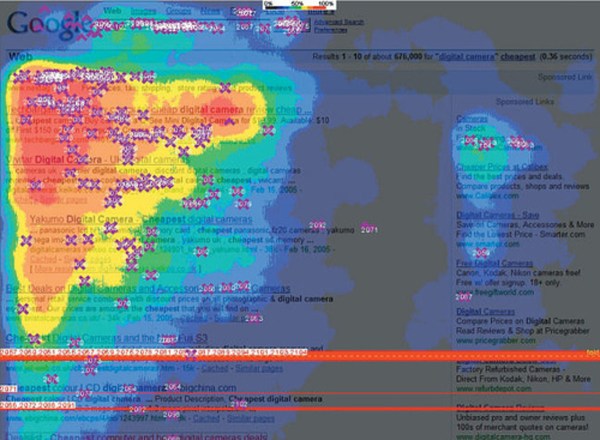
I had asked for the interview because of some notable findings in our most recent eye tracking study. I won’t go into the findings in any great depth here, because Chris Sherman will be doing a deep dive soon. But for the purpose of setting the background for Marissa’s interview, here are some very quick highlights:


MSN and Yahoo Users had a better User Experience on Google

In the original study, the vast majority of participants were Google users, and their interactions were restricted to Google. With the second study, we actually recruited participants that indicated their engine of preference was Yahoo! or MSN (now Live Search), as the majority of their interactions would be with those two engines. We did take one task at random, however, and asked them to use Google to complete the task. By almost every metric we looked at, including time to complete the task (choose a link), the success of the link chosen, the percentage of the page scanned before choosing a link and others, these users had a more successful experience on Google than on their engine of choice.

Google Seemed to Have a Higher Degree of Perceived Relevancy

In looking at the results, we didn’t believe that it was the actual quality of the results that lead to a more successful user experience as much as it was how those results were presented to the user. Something about Google’s presentation made it easier to determine which results were relevant. We referred to it in the study as information scent, using the term common in the information foraging theory.

Google Has an Almost Obsessive Dedication to Relevancy at the Top of the Results Page

The top of the results, especially the top left corner, is the most heavily scanned part of the results page. Google seemed to be the most dedicated of all the three engines in ensuring the results that fall in this real estate are highly relevant to the query. For example, Google served up top sponsored ads in far fewer sessions in the study than did either Yahoo or MSN.

Google Offers the “Cleanest” Search Experience

Google is famous for its Spartan home page. It continues this minimalist approach to search with the cleanest results page. When searching, we all have a concept in mind and that concept can be influenced by what else we see on the page. Because a number of searches on Yahoo! and MSN were launched from their portal page, we wondered how that impacted the search experience.

Google Had Less Engagement than Yahoo with their Vertical Results

The one area where Google appeared to fall behind in these head to head tests was with the relevance of the OneBox, or their vertical results. Yahoo! in particular seemed to score more consistently with users with their vertical offerings, Yahoo! Shortcuts.

It was in these areas in particular that I wanted to get the thinking of Marissa and her team at Google. Whatever they’re doing, it seems to be working. In fact, I have said in the past that Google has set the de facto standard for what we expect from a search engine, at least for now.

Here’s the interview:

Gord: What, at the highest level, is Google’s goal for the user?

Marissa: Our goal is to make sure that people can find what they’re looking for and get off the page as quickly as possible

If we look at this idea of perceived versus real relevancy, some things seemed to make a big difference in how relevant people perceived the results to be on a search engine: things like how much white space there was around individual listings, separating organic results from the right rail, the query actually being bolded in the title and the description and very subtle nuances like a hair line around the sponsored ads as opposed to a screened box. What we found when we delved into it was there seemed to be a tremendous attention to that detail on Google. It became clear that this stuff had been fairly extensively tested out.

I think all of your observations are correct. I can walk you through any one of the single examples you just named and I can talk you through the background and exactly what our philosophy was when we designed it and the numbers we saw in our tests as we had tested them, but you’re right in that it’s not an accident. For example, putting a line along the side of the ad as opposed to boxing it allows it to integrate more into the page and lets it fall more into what people read.

One thing that I think about a lot are people that are new to the internet. A lot of times they subconsciously map the internet to physical idioms. For example, when you look at how you parse a webpage, chances are that there are some differences if there are links in the structure and so forth, but a lot of times it looks just like a page in a book or a page on a magazine, and when you put a box around something, it looks like a sidebar. The way people handle reading a page that has a sidebar on it is that they read the whole main page and then, at the end, if it’s not too interesting, they stop and read the sidebar on that page.

For us, given that we think our ads in some cases are as good an answer as our search results and we want them to be integral to the user experience, we don’t want that kind of segmentation and pausing. We tried not to design it so it looked like a side bar, even though we have two distinct columns. You know, There are a lot of philosophies like that that go into the results page and of course, testing both of those formats to see if that matches our hypothesis.

That brings up something else that was really interesting. If we separate the top sponsored from the right rail, the majority of the interaction happens on the page in that upper left real estate. One thing that became very apparent was that Google seemed to be the most aware of relevancy at that top of page, that Golden Triangle real estate. In all our scenarios, you showed top sponsored the least number of times and generally you showed fewer top sponsored results. We saw a natural tendency to break off the top 3 or 4 listings on a page and scan them as a set and then make your choice from those top 3 or 4. In Google, those top 3 or 4 almost always include 1 or 2 organic results, sometimes all organic results.

That’s absolutely the case. Yes, we’re always looking at how can we do better targeting with ads. But we believe part of the targeting for those ads is “how well do those ads match your query?” And then the other part is how well does this format and that prominence convey to you how relevant it is. That’s baked into the relevance.

Our ad team has worked very very hard. One of the most celebrated teams at Google is our Smart Ads team. In fact, you may have heard of the Google Founder’s Awards, where small teams of people get grants of stock of up to $10,000,000 in worth, split across a small number of individuals. One of the very first teams at Google to receive that award was the Smart Ads team. And they were looking, interestingly enough, at how you target things. But they were also looking at what’s the probability that someone will click on a result. And shouldn’t that probability impact our idea of relevance, and also the way we choose to display it.

So we do tend to be very selective and keep the threshold on what appears on the top of the page very high. We only show things on the top when we’re very very confident that the click through rate on that ad will be very high. And the same thing is true for our OneBox results that occasionally appear above the top (organic) results. Larry and Sergey, when I started doing user interface work, said we’re thinking of making your salary proportional to the number of pixels above the first result, on average. We’ve mandated that we always want to have at least one result above the fold. We don’t let people put too much stuff up there. Think about the amount of vertical space on top of the page as being an absolute premium and design it and program it as if your salary depended on it.

There are a couple of other points that I want to touch on. When we looked at how the screen real estate divided up on the search results page, based on a standard resolution, there seemed to be a mathematical precision to the Google proportions that wasn’t apparent on MSN and on Yahoo. The ratio seemed pretty set. We always seemed to come up with a 33% ratio dedicated to top organic, even on a fully loaded results page, so obviously that’s not by accident. That compared to, on a fully loaded page, less than 14% on Yahoo.

That’s interesting, because we never reviewed on a percentage basis that you’re mentioning. We’ve had a lot of controversy amongst the team, should it be in linear inches along the left hand margin, should it actually be square pixelage computed on a percentage basis? Because of the way that the search is laid out linear inches or vertical space may be more accurate. As I said, the metric that I try to hold the team to is always getting at least one organic result above the fold on 800 by 600, with the browser held at that size.

The standard resolution we set for the study was 1024 by 768.

Yes, we are still seeing as many as 30% plus of our users at 800 by 600. My view is, we can view 1024 by 768 as ideal. The design has to look good on that resolution. It has to at least work and appear professional on 800 by 600. So all of us with our laptops, we’re working with 1024 by 768 as our resolution, so we try to make sure the designs look really good on that. It’s obvious that some of our engineers have bigger monitors and bigger resolutions than that, but we always are very conscious of 800 by 600. It’s pretty funny, most of our designers, myself included, have a piece of wall paper that actually has rectangles in the back where if you line up the browser in the upper left hand corner and then align the edge of the browser with the box you can simulate all different sizes so we can make sure it works in the smaller browsers.

One of the members of our staff has a background in physics and design and he was the one that noticed that if you take the Golden Ratio it lined up very well with how the Google results page is designed. The proportions of the page lined up pretty closely with how that Ratio is proportioned.

I’m a huge fan of the Golden Ratio. We talk about it a lot in our design reviews, both implicitly and explicitly, even when it comes down to icons. We prefer that icons not be square, we prefer that they be more of the 1.7:1.

I wanted to talk about Google OneBox for a minute. Of all the elements on the Google page, frankly, that was the one that didn’t seem to work that well. It almost seemed to be in flux somewhat while we were doing the data collection. Relevancy seemed to be a little off on a number of the searches. Is that something that is being tested.

Can you give me an example?

The search was for digital cameras and we got news results back in OneBox. Nikon had a recall on a bunch of digital cameras at the time and we went, as far as disambiguating the user intent from the query, it would seem that news results for the query digital cameras is probably not the best match.

It’s true. The answer is that we do a fairly good job, I believe, in targeting our OneBox results. We hold them to a very high click through rate expectation and if they don’t meet that click through rate, the OneBox gets turned off on that particular query. We have an automated system that looks at click through rates per OneBox presentation per query. So it might be that news is performing really well on Bush today but it’s not performing very well on another term, it ultimately gets turned off due to lack of click through rates. We are authorizing it in a way that’s scalable and does a pretty good job enforcing relevance. We do have a few niggles in the system where we have an ongoing debate and one of them is around news versus product search

One school of thought is what you’re saying, which is that it should be the case that if I’m typing digital cameras, I’m much more likely to want to have product results returned. But here’s another example. We are very sensitive to the fact that if you type in children’s flannel pajamas and there’s a recall due to lack of flame retardation on flannel pajamas, as a parent you’re going to want to know that. And so it’s a very hard decision to make.

You might say, well, the difference there is that it’s a specific model. Is it a Nikon D970 or is it digital cameras, which is just a category? So it’s very hard on the query end to disambiguate. You might say if there’s a model number then it’s very specific and if only the model number matches in the news return the news and if not, return the products. But it’s more nuanced than that. With things like Gap flannel pajamas for children, it’s very hard to programmatically tell if that’s a category or a specific product. So we have a couple of sticking points.

So that would be one of the reasons why, for a lot of searches, we weren’t seeing product results coming back, and in a lot of local cases, we weren’t seeing local results coming back?. That would be that click through monitoring mechanism where it didn’t meet the threshold and it got turned off?

That’s right.

Here’s another area we explored in the study. Obviously a lot of searches from Yahoo or MSN Live Search get launched from a portal and the user experience if you launch from the Google home page is different. What does it mean as far as interaction with search results when you’re launching the search from what’s basically a neutral palette versus something that’s launched from a portal that colors the intent of the user as it passes them through to the search results?

We want the user to not be distracted, to just type in what they want and not be very influenced by what they see on the page, which is one reason why the minimalist home page works well. It’s approachable, it’s simple, it’s straightforward and it gives the user a sense of empowerment. This engine is going to do what they want it to do, as opposed to the engine telling them what they should be doing, which is what a portal does. We think that to really aid and facilitate research and learning, the clean slate is best.

I think there’s a couple of interesting problems in the portal versus simple home page piece. You might say it’s easier to disambiguate from a portal what a person might be intending. They look at the home page and there’s a big ad running for Castaway and if they search Castaway, they mean the movie that they just saw the ad for. That might be the case but the other thing that I think is more confusing than anything is the fact that most people who launch the search from the portal home page are actually ignoring and tuning out most of the content on a page. If anything you’re more inclined to mistake intent, to think, “Oh, of course when they typed this they meant that,” but they actually didn’t, because they didn’t even see this other thing. One thing that we’re consistently noticing, which your Golden Triangle finding validated, is that users have a laser focus on their task.

The Google home page is very simple and when we put a link underneath the Google search box on the home page to advertise one of our products, we say, “Hey, try Google video, it’s new, or download the new Picassa.” Basically it’s the only other thing on the page, and while it does get a fair amount of click through, it’s nothing compared to the search, because most users don’t even see it. Most users on our search results page don’t see the logo on the top of the page, they don’t see OneBox, they don’t even see spelling corrections, even though it’s there in bright red letters. There’s a single-mindedness of I’m going to put in my search, not let anything on the home page get in the way, and I’m going to go for the first blue left aligned link on the results page and everything above it basically gets ignored. And we’ve seen that trend again and again. My guess is that if anything, that same thing is happening at the portals but because there is so much context around it on the home page, their user experience and search relevance teams may be led astray, thinking that that context has more relevance than it has.

One thing eye tracking allowed us to pull this apart a little bit is that when we gave people two different scenarios, one aimed more towards getting them to look at the organic results and one that would have them more likely to look at sponsored results, and then look down to organic results, we saw the physical interaction with the page didn’t vary as much as we thought, but the cognitive interaction with the page, when it came to what they remembered seeing and what they clicked on, was dramatically different. So it’s almost like they took the same path through, but the engagement factor flicked on at different points.

My guess is that people who come to the portal are much more likely to look at ads. I like to think of them as users with ADHD. They’re on the home page and they enjoy a home page that pulls their attention in a lot of different directions. They’re willing to process a lot of information on the way to typing in their search, and as a result, that same mind that likes that, it may not even be a per user thing, it may be an of-the-moment thing, but a person that’s in the mindset of enjoying that, on the home page, is also going to be much more likely to look around on the search results page. Their attention is going to be much more likely to be pulled in the direction of an ad, even if it’s not particularly relevant, banner, brand, things like that.

I want to wrap up by asking you, what in your mind is the biggest challenge still to be solved with the search interface as we currently know it?

I think there’s a ton of challenges, because in my view, search is in its infancy, and we’re just getting started. I think the most pressing, immediate need as far as the search interface is to break paradigm of the expectation of “You give us a keyword, and we give you 10 URL’s”. I think we need to get into richer, more diverse ways you’re able to express their query, be it though natural language, or voice, or even contextually. I’m always intrigued by what the Google desktop sidebar is doing, by looking at your context, or what Gmail does, where by looking at your context, it actually produces relevant webpages, ads and things like that. So essentially, a context based search.

So, challenge one is how the searches get expressed, I think we really need to branch out there, but I also think we need to look at results pages that aren’t just 10 standard URLS that are laid out in a very linear format. Sometimes the best answer is a video, sometimes the best answer will be a photo, and sometime the best answer will be a set of extracted facts. If I type in general demographic statistics about China, it’d be great if I got “A” as a result. A set of facts that had been parsed off of and even aggregated and cross validated across a result set.

And sometimes the best result would be an ad. Out of interest, when we tracked through to the end of the scenario to see which links provided the greatest degree of success, the top sponsored results actually delivered the highest success rates across all the links that were clicked on in the study.

Really? Even more so than the natural search results?

Yes. Even the organic search results. Now mind you, the scenarios given were commercial in nature.

Right… that makes much more sense. I do think that for the 40 or so percent of page views that we serve ads on that those ads are incredibly relevant and usually do beat the search results, but for the other 60% of the time the search results are really the only reasonable answer.

Thanks, Marissa.

In my next column, I talk with Larry Cornett, Senior Director of Search & Social Media in Yahoo’s User Experience & Design group about their user experience. Look for it next Friday, February 2.

The World vs Big Tech

Around the world, governments have their legislative cross hairs trained on Big Tech. It’s happening in the US, the EU and here in my country,  Canada. The majority of these are anti-trust suits. But Australia has just introduced a different type of legislation, a social media ban for those under 16. And that could change the game – and the conversation -completely for Big Tech.

There are more anti-trust actions in the queue in the US than at any time in the previous five decades. The fast and loose interpretation of antitrust enforcement in the US is that monopolies are only attacked when they may cause significant harm to customers through lack of competition. The US approach to anti-trust since the 1970s has typically followed the Chicago School of neoclassical economy theory, which places all trust in the efficiency of markets and tells government to keep their damned hands off the economy. Given this and given the pro-business slant of all US administrations, both Republican and Democratic, since Reagan, it’s not surprising that we’ve seen relatively few anti-trust suits in the past 50 years.

But the rapid rise of monolithic Big Tech platforms has raised more discussion about anti-trust in the past decade than in the previous 5 decades. These platforms suck along the industries they spawn in their wake and leave little room for upstart competitors to survive long enough to gain significant market share.

Case in point: Google. 

The recent Canadian lawsuit has the Competition Bureau (our anti-trust watchdog) suing Google for anti-competitive practices selling its online advertising services north of the 49th parallel. They’re asking Google to sell off two of its ad-tech tools, pay penalties worth up to 3% of the platform’s global gross revenues and prohibit the company from engaging in anti-competitive practices in the future.

According to a 3-year inquiry into Google’s Canadian business practices by the Bureau, Google controls 90% of all ad servers and 70% of advertising networks operating in the country. Mind you, Google started the online advertising industry in the relatively green fields of Canada back when I was still railing about the ignorance of Canadian advertisers when it came to digital marketing. No one else really had a chance. But Google made sure they never got one by wrapping its gigantic arms around the industry in an anti-competitive bear hug.

The recent Australian legislation is of a different category, however. Anti-trust suits are – by nature – not personal. They are all about business. But the Australian ban puts Big Tech in the same category as Big Tobacco, Big Alcohol and Big Pharma – alleging that they are selling an addictive product that causes physical or emotional harm to individuals. And the rest of the world is closely watching what Australia does. Canada is no exception.

The most pertinent question is how will Australia enforce the band? Restricting social media access to those under 16 is not something to be considered lightly.  It’s a huge technical, legal and logistical hurdle to get over. But if Australia can figure it out, it’s certain that other jurisdictions around the world will follow in their footsteps.

This legislation opens the door to more vigorous public discourse about the impact of social media on our society. Politicians don’t introduce legislation unless they feel that – by doing so – they will continue to get elected. And the key to being elected is one of two things; give the electorate what they want or protect them against what they fear. In Australia, recent polling indicates the ban is supported by 77% of the population. Even those opposing the ban aren’t doing so in defense of social media. They’re worried that the devil might be in the details and that the legislation is being pushed through too quickly.

These types of things tend to follow a similar narrative arc: fads and trends drive widespread adoption – evidence mounts about the negative impacts – industries either ignore or actively sabotage the sources of the evidence – and, with enough critical mass, government finally gets into the act by introducing protective legislation.

With tobacco in the US, that arc took a couple of decades, from the explosion of smoking after World War II to the U.S. Surgeon General’s 1964 report linking smoking and cancer. The first warning labels on cigarette packages appeared two years later, in 1966.

We may be on the cusp of a similar movement with social media. And, once again, it’s taken 20 years. Facebook was founded in 2004.

Time will tell. In the meantime, keep an eye on what’s happening Down Under.

Can OpenAI Make Searching More Useful?

As you may have heard, OpenAI is testing a prototype of a new search engine called SearchGPT. A press release from July 25 notes: “Getting answers on the web can take a lot of effort, often requiring multiple attempts to get relevant results. We believe that by enhancing the conversational capabilities of our models with real-time information from the web, finding what you’re looking for can be faster and easier.”

I’ve been waiting for this for a long time: search that moves beyond relevance to usefulness.  It was 14 years ago that I said this in an interview with Aaron Goldman regarding his book “Everything I Know About Marketing I Learned from Google”:“Search providers have to replace relevancy with usefulness. Relevancy is a great measure if we’re judging information, but not so great if we’re measuring usefulness. That’s why I believe apps are the next flavor of search, little dedicated helpers that allow us to do something with the information. The information itself will become less and less important and the app that allows utilization of the information will become more and more important.”

I’ve felt for almost two decades that the days of search as a destination were numbered. For over 30 years now (Archie, the first internet search engine, was created in 1990), when we’re looking for something online, we search, and then we have to do something with what we find on the results page. Sometimes, a single search is enough — but often, it isn’t. For many of our intended end goals, we still have to do a lot of wading through the Internet’s deep end, filtering out the garbage, picking up the nuggets we need and then assembling those into something useful.

I’ve spent much of those past two decades pondering what the future of search might be. In fact, my previous company wrote a paper on it back in 2007. We were looking forward to what we thought might be the future of search, but we didn’t look too far forward. We set 2010 as our crystal ball horizon. Then we assembled an all-star panel of search design and usability experts, including Marissa Mayer, who was then Google’s vice president of search user experience and interface design, and Jakob Nielsen, principal of the Nielsen Norman Group and the web’s best known usability expert. We asked them what they thought search would look like in three years’ time.

Even back then, almost 20 years ago, I felt the linear presentation of a results page — the 10 blue links concept that started search — was limiting. Since then, we have moved beyond the 10 blue links. A Google search today for the latest IPhone model (one of our test queries in the white paper) actually looks eerily similar to the mock-up we did for what a Google search might look like in the year 2010. It just took Google 14 extra years to get there.

But the basic original premise of search is still there: Do a query, and Google will try to return the most relevant results. If you’re looking to buy an iPhone, it’s probably more useful, mainly due to sponsored content. But it’s still well short of the usefulness I was hoping for.

It’s also interesting to see what directions search has (and hasn’t) taken since then. Mayer talked a lot about interacting with search results. She envisioned an interface where you could annotate and filter your results: “I think that people will be annotating search results pages and web pages a lot. They’re going to be rating them, they’re going to be reviewing them. They’re going to be marking them up, saying ‘I want to come back to this one later.’”

That never really happened. The idea of search as a sticky and interactive interface for the web sort of materialized, but never to the extent that Mayer envisioned.

From our panel, it was Nielsen’s crystal ball that seemed to offer the clearest view of the future: “I think if you look very far ahead, you know 10, 20, 30 years or whatever, then I think there can be a lot of things happening in terms of natural language understanding and making the computer more clever than it is now. If we get to that level then it may be possible to have the computer better guess at what each person needs without the person having to say anything, but I think right now, it is very difficult.”

Nielsen was spot-on in 2007. It’s exactly those advances in natural language processing and artificial intelligence that could allow ChatGPT to now move beyond the paradigm of the search results page and move searching the web into something more useful.

A decade and a half ago, I envisioned an ecosystem of apps that could bridge the gap between what we intended to do and the information and functionality that could be found online.  That’s exactly what’s happening at OpenAI — a number of functional engines powered by AI, all beneath a natural language “chat” interface.

At this point, we still have to “say” what we want in the form of a prompt, but the more we use ChatGPT (or any AI interface) the better it will get to know us. In 2007, when we wrote our white paper on the future of search, personalization was what we were all talking about. Now, with ChatGPT, personalization could come back to the fore, helping AI know what we want even if we can’t put it into words.

As I mentioned in a previous post, we’ll have to wait to see if SearchGPT can make search more useful, especially for complex tasks like planning a vacation, making a major purchase onr planning a big event.

But I think all the pieces are there. The monetization siloes that dominate the online landscape will still prove a challenge to getting all the way to our final destination, but SearchGPT could make the journey faster and a little less taxing.

Note: I still have a copy of our 2007 white paper if anyone is interested. Just email me (email in the contact us page), give me your email and I’ll send you a copy.

Google Leak? What Google Leak?

If this were 15 years ago, I might have cared about the supposed Google Leak that broke in late May.

But it’s not, and I don’t. And I’m guessing you don’t either. In fact, you could well be saying “what Google leak?” Unless you’re a SEO, there is nothing of interest here. Even if you are a SEO, that might be true.

I happen to know Rand Fishkin, the person who publicly broke the leak last week. Neither Rand nor I are in the SEO biz anymore, but obviously his level of interest in the leak far exceeded mine. He devoted almost 6000 words to it in the post where he first unveiled the leaked documents, passed on to him by Erfan Azimi, CEO and director of SEO of EA Eagle Digital.

Rand and I spoke at many of the same conferences before I left the industry in 2012. Even at that time, our interests were diverging. He was developing what would become the Moz SEO tool suite, so he was definitely more versed in the technical side of SEO. I had already focused my attention on the user side of search, looking at how people interacted with a search engine page. Still, I always enjoyed my chats with Rand.

Back then, SEO was an intensely tactical industry. Conference sessions that delved into the nitty gritty of ranking factors and shared ways to tweak sites up the SERP were the ones booked into the biggest conference rooms, because organizers knew they’d be jammed to the rafters.

I always felt a bit like a fish out of water at these conferences. I tried to take a more holistic view, looking at search as just one touchpoint in the entire online journey. To me, what was most interesting was what happened both before the search click and after it. That was far more intriguing to me than what Google might be hiding under their algorithmic hood.

Over time, my sessions developed their own audience. Thanks to mentors like Danny Sullivan, Chris Sherman and Brett Tabke, conference organizers carved out space for me on their agendas. Ken Fadner and the MediaPost team even let me build a conference that did its best to deal with search at a more holistic level, the Search Insider Summit. We broadened the search conversation to include more strategic topics like multipoint branding, user experience and customer journeys.

So, when the Google leak story bleeped on my radar, I was immediately taken back to the old days of SEO. Here, again, there was what appeared to be a dump of documents that might give some insights into the nuts and bolts of Google’s ranking factors. Mediapost’s own post said that “leaked Google documents has given the search industry proprietary insight into Google Search, revealing very important elements that the company uses to rank content.” Predictably, SEOs swarmed over it like a flock of seagulls attacking a half-eaten hot dog on a beach. They were still looking for some magic bullet that might move them higher in the organic results.

They didn’t come up with much. Brett Tabke, who I consider one of the founders of SEO (he coined the term SERP), spent five hours combing through the documents and said it wasn’t a leak and the documents contained no algorithm-related information. To mash up my metaphors, the half-eaten hotdog was actually a nothingburger.

But Oh My SEOs – you still love diving into the nitty gritty, don’t you?

What is more interesting to me is how the actual search experience has changed in the past decade or two. In doing the research for this, I happened to run into a great clip about Tech monopolies from Last Week Tonight with John Oliver. He shows how much of the top of the Google SERP is now dominated by information and links from Google. Again, quoting a study from Rand Fishkin’s new company, SparkToro, Oliver showed that “64.82% of searches on Google…ended..without clicking to another web property.”

That little tidbit has some massive implications for marketers. The days of relying on a high organic ranking are long gone, because even if you achieve it, you’ll be pushed well down the page.

And on that, Rand Fishkin and I seem to agree. In his post, he does say, “If there was one universal piece of advice I had for marketers seeking to broadly improve their organic search rankings and traffic, it would be: ‘Build a notable, popular, well-recognized brand in your space, outside of Google search.’”

Amen.

In Defense of SEO

Last week, my social media feeds blew up with a plethora (yes – a plethora!) of indignant posts about a new essay that had just dropped on The Verge.

It was penned by Amanda Chicago Lewis and it was entitled: “The People that Ruined the Internet”

The reason for the indignation? Those “people” included myself, and many of my past colleagues. The essay was an investigation of the industry I used to be in. One might even call me one of the original pioneers of said industry. The intro was:

“As the public begins to believe Google isn’t as useful anymore, what happens to the cottage industry of search engine optimization experts who struck content oil and smeared it all over the web? Well, they find a new way to get rich and keep the party going.”

Am I going to refute the observations of Ms. Lewis?

No, because they are not lies. They are observations. And observations happen through the lens the observer uses to observe. What struck me is the lens Lewis chose to see my former industry through, and the power of a lens in media.

Lewis is an investigative journalist. She writes exposes. If you look at the collection of her articles, you don’t have to scroll very far before you have seen the words “boondoggle”, “hustler”, “lies”, “whitewashing”, and “hush money” pop up in her titles. Her journalistic style veers heavily towards being a “hammer”, which makes all that lie in her path “nails.”

This was certainly true for the SEO article. She targeted many of the more colorful characters still in the SEO biz and painted them with the same acerbic, snarky brush. Ironically, she lampoons outsized personalities without once considering that all of this is filtered through her own personality. I have never met Lewis, but I suspect she’s no shrinking violet. In the article, she admits a grudging admiration for the hustlers and “pirates” she interviewed.

Was that edginess part of the SEO industry? Absolutely. But contrary to the picture painted by Lewis, I don’t believe that defined the industry. And I certainly don’t believe we ruined the internet. Google organic search results are better than they were 10 years ago. We all have a better understanding of how people actually search and a good part of that research was done by those in the SEO industry (myself included). The examples of bad SEO that Lewis uses are at least 2 decades out of date.

I think Lewis, and perhaps others of her generation, suffer from “rosy retrospection” – a cognitive bias that automatically assumes things were better yesterday. I have been searching for the better part of 3 decades and – as a sample of one – I don’t agree. I can also say with some empirical backing that the search experience is quantitatively better than it was when we did our first eye tracking study 20 years ago. A repeat study done 10 years ago showed time to first click had decreased and satisfaction with that click had increased. I’m fairly certain that a similar study would show that the search experience is better today than it was a decade ago. If this is a “search optimized hellhole”, it’s much less hellish than it was back in the “good old days” of search.

One of the reasons for that improvement is that millions of websites have been optimized by SEOs (a label which, by the way Amanda, has absolutely nothing to do with wanting to be mistaken for a CEO) to unlock unindexable content, fix broken code, improve usability, tighten up and categorize content and generally make the Internet a less shitty and confusing place. Not such an ignoble pursuit for “a bunch of megalomaniacal jerks (who) were degrading our collective sense of reality because they wanted to buy Lamborghinis and prove they could vanquish the almighty algorithm.”

Amanda Chigaco Lewis did interview those who sat astride the world of search providers and the world of SEO: Danny Sullivan (“angry and defensive” – according to Lewis), Barry Schwartz (“an unbelievably fast talker”), Duane Forrester (a “consummate schmoozer”) and Matt Cutts (an “SEO celebrity”). Each tried to refute her take that things are “broken” and the SEOs are to blame, but she brushed those aside, intent on caricaturing them as a cast of characters from a carnival side show.  Out of the entire scathing diatribe, one scant paragraph grudgingly acknowledges that maybe not all SEO is bad. That said, Lewis immediately spins around and says that it doesn’t matter, because the bad completely negates the good.

Obviously, I don’t agree with Lewis’s take on the SEO industry. Maybe it’s because I spent the better part of 20 years in the industry and know it at a level Lewis never could. But what irritates me the most is that she made no attempt to go beyond taking the quick and easy shots. She had picked her lens through which she viewed SEO before the very first interview and everything was colored by that lens. Was her take untrue? Not exactly. But it was unfair. And that’s why reporters like Lewis have degraded journalism to the point where it’s just clickbait, with a few more words thrown in.

Lewis gleefully stereotypes SEOs as “content goblin(s) willing to eschew rules, morals, and good taste in exchange for eyeballs and mountains of cash.” That’s simply not true. It’s no more true than saying all investigative journalists are “screeching acid-tongued harpies who are hopelessly biased and cover their topics with all the subtlety of a flame-thrower.”

P.S.  I did notice the article was optimized for search, with keywords prominently shown in the URL. Does that make the Verge and Lewis SEOs?

The Seedy, Seedy World of Keto Gummies

OK, admit it. I play games on my phone.

Also, I’m cheap, so I play the free, ad-supported versions.

You might call this a brain-dead waste of time, but I prefer to think of it as diligent and brave investigative journalism.  The time I spend playing Bricks Ball Crusher or Toy Blast is, in actuality, my research into the dark recesses of advertising on behalf of you, the more cerebral and discerning readers of this blog. I bravely sacrifice my own self-esteem so that I might tread the paths of questionable commerce and save you the trip.

You see, it was because of my game playing that I was introduced to the seediest of seedy slums in the ad world, the underbelly known as the in-game ad. One ad, in particular, reached new levels of low.

If you haven’t heard of the Keto Gummies Scam, allow me to share my experience.

This ad hawked miracle gummies that “burn the fat off you” with no dieting or exercising. Several before and after photos show the results of these amazing little miracle drops of gelatin. They had an impressive supporting cast. The stars of the TV pitchfest “Shark Tank” had invested in them. Both Rebel Wilson and Adele had used them to shed pounds. And then — the coup de grace — Oprah (yes, the Oprah!) endorsed them.

The Gummy Guys went right the top of the celebrity endorsement hierarchy when they targeted the big O.

As an ex ad guy, I couldn’t ignore this ad. It was like watching a malvertising train wreck. There was so much here that screamed of scam, I couldn’t believe it. The celebrity pics used were painfully obvious in their use of photoshopping. The claims were about as solid as a toilet paper Taj Mahal. The entire premise reeked of snake oil.

I admit, I was morbidly fascinated.

First, of all the celebrities in all the world, why would you misappropriate Oprah’s brand? She is famously protective of it. If you’re messing with Oprah, you’ve either got to be incredibly stupid or have some serious stones. So which was it?

I started digging.

First of all, this isn’t new. The Keto Gummy Scam has been around for at least a year. In addition to Oprah, they have also targeted Kevin Costner, Rhianna, Trisha Yearwood, Tom Selleck, Kelly Clarkson, Melissa McCarthy — even Wayne Gretzky.

Last Fall, Oprah shared a video on Instagram warning people that she had nothing to do with the gummies and asking people not to fall for the scam. Other celebrities have fallen suit and issued their own warnings.

Snopes.com has dug into the Keto Gummy Scam a couple of times.  One exposé focused on the false claims that the gummies were featured on “Shark Tank.” The first report focused just on the supposed Oprah Winfrey endorsement. That one was from a year ago. That means these fraudulent ads have been associated with Oprah for at least a year and legally, she has been unable to stop them.

To me, that rules out my first supposition. These people aren’t stupid.

This becomes apparent when you start trying to pick your way through the maze of misinformation they have built to support these ads. If you click on the ad you’re taken to a webpage that looks like it’s from a reliable news source. The one I found looked like it was Time’s website. There you’ll find a “one-on-one interview” with Oprah about how she launched a partnership with Weight Watchers to create the Max Science Keto gummies. According to the interview, she called the CEO of Weight Watchers and said ‘if you can’t create a product that helps people lose weight faster without diet and exercise, then I’m backing out of my investment and moving on.”

This is all complete bullshit. But it’s convincing bullshit.

It doesn’t stop there. Clickbait texts with outrageous claims, including the supposed death of Oprah, get clicks through to more bogus sites with more outrageous claims about gummies. While the sites mimic legitimate news organizations like Time, they reside on bogus domains such as genuinesmother.com and newsurvey22offer.com. Or, if you go to them through an in-app link, the URLs are cloaked and remain invisible.

If you turn to a search engine to do some due diligence, the scammers will be waiting for you. If you search for “keto gummies scam” the results page is stuffed with both sponsored and organic spam that appear to support the outrageous claims made in the ads. Paid content outlets like Outlook India have articles placed that offer reviews of the “best keto gummies,” fake reviews, and articles assuring potential victims that the gummies are not a scam but are a proven way to lose weight.

As the Snopes investigators found, it’s almost impossible to track these gummies to any company. Even if you get gummies shipped to you, there’s no return address or phone number. Orders came from a shadowy “Fulfillment Center” in places like Smyrna, Tennessee. Once they get your credit card, the unauthorized charges start.

Even the name of the product seems to be hard to nail down. The scammers seem to keep cycling through a roster of names.

This is, by every definition, predatory advertising. It is the worst example of what we as marketers do. But, like all predators, it can only exist because an ecosystem allows it to exist. It’s something we have to think about.

I certainly will. More on that soon.

Search and ChatGPT – You Still Can’t Get There From Here

I’m wrapping up my ChatGPTrilogy with a shout out to an old friend that will be familiar to many Mediaposters – Aaron Goldman. 13 years ago Aaron wrote a book called Everything I Know About Marketing I Learned from Google.  Just a few weeks ago, Aaron shared a post entitled “In a World of AI, is Everything I Know about Marketing (still) Learned from Google”. In it, he looked at the last chapter of the book, which he called Future-Proofing. Part of that chapter was based on a conversation Aaron and I had back in 2010 about what search might look like in the future.

Did we get it right? Well, remarkably, we got a lot more right than we got wrong, especially with the advent of Natural Language tools such as ChatGPT and virtual assistants like Siri.

We talked a lot about something I called “app-sistants”. I explained, “the idea of search as a destination is an idea whose days are numbered. The important thing won’t be search. It will be the platform and the apps that run on it. The next big thing will be the ability to seamlessly find just the right app for your intent and utilize it immediately.” In this context, “the information itself will become less and less important and the app that allows utilization of the information will become more and more important.”

To be honest, this evolution in search has taken a lot longer than I thought back then, “Intent will be more fully supported from end to end. Right now, we have to keep our master ‘intent’ plan in place as we handle the individual tasks on the way to that intent.”

Searching for complex answers as it currently sits requires a lot of heavy lifting. In that discussion, I used the example of planning a trip.  “Imagine if there were an app that could keep my master intent in mind for the entire process. It would know what my end goal was, would be tailored to understand my personal preferences and would use search to go out and gather the required information. When we look at alignment of intent, [a shift from search to apps is] a really intriguing concept for marketers to consider.”

So, the big question is, do we have such a tool? Is it ChatGPT? I decided to give it a try and see. After feeding ChatGPT a couple of carefully crafted prompts about a trip I’d like to take to Eastern Europe someday, I decided the answer is no. We’re not quite there yet. But we’re closer.

After a couple of iterations, ChatGPT did a credible job of assembling a potential itinerary of a trip to Croatia and Slovenia. It even made me aware of some options I hadn’t run across in my previous research. But it left me hanging well short of the “app-ssistant” I was dreaming of in 2010. Essentially, I got a suggestion but all the detail work to put it into an actual trip still required me to do hundreds of searches in various places.

The problem with ChatGPT is that it gets stuck between the millions of functionality siloes – or “walled gardens” – that make up the Internet. Those “walled gardens” exist because they represent opportunities for monetization. In order for an app-ssistant to be able to multitask and make our lives easier, we need a virtual “commonage” that gets rid of some of these walls. And that’s probably the biggest reason we haven’t seen a truly useful iteration of the functionality I predicted more than a decade ago.

This conflict between capitalism and the concept of a commonage goes back at least to the Magna Carta. As England’s economy transitioned from feudalism to capitalism, enclosure saw the building of fences and the wiping out of lands held as a commonage. The actual landscape became a collection of walled gardens that the enforced property rights of each parcel and the future production value of those parcels.

This history, which played out over hundreds of years, was repeated and compressed into a few decades online. We went from the naïve idealism of a “free for all” internet in the early days to the balkanized patchwork of monetization siloes that currently make up the Web.

Right now, search engines are the closest thing we have to a commonage on the virtual landscape. Search engines like Google can pull data from within many gardens, but if we actually try to use the data, we won’t get far before we run into a wall.

To go back to the idea of trip planning, I might be able to see what it costs to fly to Rome or what the cost of accommodations in Venice is on a search engine, but I can’t book a flight or reserve a room. To do that, I have to visit an online booking site. If I’m on a search engine, I can manually navigate this transition fairly easily. But it would stop something like ChatGPT in its tracks.

When I talked to Aaron 13 years ago, I envisioned search becoming a platform that lived underneath apps which could provide more functionality to the user. But I also was skeptical about Google’s willingness to do this, as I stated in a later post here on Mediapost.  In that post, I thought that this might be an easier transition for Microsoft.

Whether it was prescience or just dumb luck, it is indeed Microsoft taking the first steps towards integrating search with ChatGPT, through its recent integration with Bing. Expedia (who also has Microsoft DNA in its genome) has also taken a shot at integrating ChatGPT in a natural language chat interface.

This flips my original forecast on its head. Rather than the data becoming common ground, it’s the chat interface that’s popping up everywhere. Rather than tearing down the walls that divide the online landscape, ChatGPT is being tacked up as window decoration on those walls.

I did try planning that same trip on both Bing and Expedia. Bing – alas – also left me well short of my imagined destination. Expedia – being a monetization site to begin with – got me a little closer, but it still didn’t seem that I could get to where I wanted to go.

I’m sorry to say search didn’t come nearly as far as I hoped it would 13 years ago. Even with ChatGPT thumbtacked onto the interface, we’re just not there yet.

(Feature Image: OpenAI Art generated from the prompt: “A Van Gogh painting of a chatbot on a visit to Croatia”)

The Dangerous Bits about ChatGPT

Last week, I shared how ChatGPT got a few things wrong when I asked it “who Gord Hotchkiss was.” I did this with my tongue at least partially implanted in cheek – but the response did show me a real potential danger here, coming from how we will interact with ChatGPT.

When things go wrong, we love to assign blame. And if ChatGPT gets things wrong, we will be quick to point the finger at it. But let’s remember, ChatGPT is a tool, and the fault very seldom lies with the tool. The fault usually lies with the person using the tool.

First of all, let’s look at why ChatGPT put together a bio for myself that was somewhat less than accurate (although it was very flattering to yours truly).

When AI Hallucinates

I have found a few articles that calls ChatGPT out for lying. But lying is an intentional act, and – as far as I know – ChatGPT has no intention of deliberately leading us astray. Based on how ChatGPT pulls together information and synthesizes it into a natural language response, it actually thought that “Gord Hotchkiss” did the things it told me I had done.

You could more accurately say ChatGPT is hallucinating – giving a false picture based on what information it retrieves and then tries to connect into a narrative. It’s a flaw that will undoubtedly get better with time.

The problem comes with how ChatGPT handles its dataset and determines relevance between items in that dataset. In this thorough examination by Machine Learning expert Devansh Devansh, ChatGPT is compared to predictive autocomplete on your phone. Sometimes, through a glitch in the AI, it can take a weird direction.

When this happens on your phone, it’s word by word and you can easily spot where things are going off the rail.  With ChatGPT, an initial error that might be small at first continues to propagate until the AI has spun complete bullshit and packaged it as truth. This is how it fabricated the Think Tank of Human Values in Business, a completely fictional organization, and inserted it into my CV in a very convincing way.

There are many, many others who know much more about AI and Natural Language Processing that I do, so I’m going to recognize my limits and leave it there. Let’s just say that ChatGPT is prone to sharing it’s AI hallucinations in a very convincing way.

Users of ChatGPT Won’t Admit Its Limitations

I know and you know that marketers are salivating over the possibility of AI producing content at scale for automated marketing campaigns. There is a frenzy of positively giddy accounts about how ChatGPT will “revolutionize Content Creation and Analysis” – including this admittedly tongue in cheek one co-authored by MediaPost Editor in Chief Joe Mandese and – of course – ChatGPT.

So what happens when ChatGPT starts to hallucinate in the middle of massive social media campaign that is totally on autopilot? Who will be the ghost in the machine that will say “Whoa there, let’s just take a sec to make sure we’re not spinning out fictitious and potentially dangerous content?”

No one. Marketers are only human, and humans will always look for the path of least resistance. We work to eliminate friction, not add it. If we can automate marketing, we will. And we will shift the onus of verifying information to the consumer of that information.

Don’t tell me we won’t, because we have in the past and we will in the future.

We Believe What We’re Told

We might like to believe we’re Cartesian, but when it comes to consuming information, we’re actually Spinozian

Let me explain. French philosopher René Descartes and Dutch philosopher Baruch Spinoza had two different views of how we determine if something is true.

Descartes believed that understanding and believing were two different processes. According to Descartes, when we get new information, we first analyze it and then decide if we believe it or not. This is the rational assessment that publishers and marketers always insist that we humans do and it’s their fallback position when they’re accused of spreading misinformation.

But Baruch Spinoza believed that understanding and belief happened at the same time. We start from a default position of believing information to be true without really analyzing it.

In 1993, Harvard Psychology Professor Daniel Gilbert decided to put the debate to the test (Gilbert, Tafarodi and Malone). He split a group of volunteers in half and gave both a text description detailing a real robbery. In the text there were true statements, in green, and false statements, in red. Some of the false statements made the crime appear to be more violent.

After reading the text, the study participants were supposed to decide on a fair sentence. But one of the groups got interrupted with distractions. The other group completed the exercise with no distractions. Gilbert and his researchers believed the distracted group would behave in a more typical way.

The distracted group gave out substantially harsher sentences than the other group. Because they were distracted, they forgot that green sentences were true and red ones were false. They believed everything they read (in fact, Gilbert’s paper was called “You Can’t Not Believe Everything You Read).”

Gilbert’s study showed that humans tend to believe first and that we actually have to “unbelieve” if something is eventually proven to us to be false. Once study even found the place in our brain where this happens – the Right Inferior Prefrontal Cortex. This suggests that “unbelieving” causes the brain to have to work harder than believing, which happens by default. 

This brings up a three-pronged dilemma when we consider ChatGPT: it will tend to hallucinate (at least for now), users of ChatGPT will disregard that flaw when there are significant benefits to doing so, and consumers of ChatGPT generated content will believe those hallucinations without rational consideration.

When Gilbert wrote his paper, he was still 3 decades away from this dilemma, but he wrapped up with a prescient debate:

“The Spinozan hypothesis suggests that we are not by nature, but we can be by artifice, skeptical consumers of information. If we allow this conceptualization of belief to replace our Cartesian folk psychology, then how shall we use it to structure our own society? Shall we pander to our initial gullibility and accept the social costs of prior restraint, realizing that some good ideas will inevitably be suppressed by the arbiters of right thinking? Or shall we deregulate the marketplace of thought and accept the costs that may accrue when people are allowed to encounter bad ideas? The answer is not an easy one, but history suggests that unless we make this decision ourselves, someone will gladly make it for us. “

Daniel Gilbert

What Gilbert couldn’t know at the time was that “someone” might actually be a “something.”

(Image:  Etienne Girardet on Unsplash)

The Biases of Artificial Intelligence: Our Devils are in the Data

I believe that – over time – technology does move us forward. I further believe that, even with all the unintended consequences it brings, technology has made the world a better place to live in. I would rather step forward with my children and grandchildren (the first of which has just arrived) into a more advanced world than step backwards in the world of my grandparents, or my great grandparents. We now have a longer and better life, thanks in large part to technology. This, I’m sure, makes me a techno-optimist.

But my optimism is of a pragmatic sort. I’m fully aware that it is not a smooth path forward. There are bumps and potholes aplenty along the way. I accept that along with my optimism

Technology, for example, does not play all that fairly. Techno-optimists tend to be white and mostly male. They usually come from rich countries, because technology helps rich countries far more than it helps poor ones. Technology plays by the same rules as trickle-down economics: a rising tide that will eventually raise all boats, just not at the same rate.

Take democracy, for instance. In June 2009, journalist Andrew Sullivan declared “The revolution will be Twittered!” after protests erupted in Iran. Techno-optimists and neo-liberals were quick to declare social media and the Internet as the saviour of democracy. But, even then, the optimism was premature – even misplaced.

In his book The Net Delusion: The Dark Side of Internet Freedom, journalist and social commentator Evgeny Morozov details how digital technologies have been just as effectively used by repressive regimes to squash democracy. The book was published in 2011. Just 5 years later, that same technology would take the U.S. on a path that came perilously close to dismantling democracy. As of right now, we’re still not sure how it will all work out. As Morozov reminds us, technology – in and of itself – is not an answer. It is a tool. Its impact will be determined by those that built the tool and, more importantly, those that use the tool.

Also, tools are not built out of the ether. They are necessarily products of the environment that spawned them. And this brings us to the systemic problems of artificial intelligence.

Search is something we all use every day. And we probably didn’t think that Google (or other search engines) are biased, or even racist. But a recent study published in the journal Proceedings of the National Academy of Sciences, shows that the algorithms behind search are built on top of the biases endemic in our society.

“There is increasing concern that algorithms used by modern AI systems produce discriminatory outputs, presumably because they are trained on data in which societal biases are embedded,” says Madalina Vlasceanu, a postdoctoral fellow in New York University’s psychology department and the paper’s lead author.

To assess possible gender bias in search results, the researchers examined whether words that should refer with equal probability to a man or a woman, such as “person,” “student,” or “human,” are more often assumed to be a man. They conducted Google image searches for “person” across 37 countries. The results showed that the proportion of male images yielded from these searches was higher in nations with greater gender inequality, revealing that algorithmic gender bias tracks with societal gender inequality.

In a 2020 opinion piece in the MIT Technology Review, researcher and AI activist Deborah Raji wrote:

“I’ve often been told, ‘The data does not lie.’ However, that has never been my experience. For me, the data nearly always lies. Google Image search results for ‘healthy skin’ show only light-skinned women, and a query on ‘Black girls’ still returns pornography. The CelebA face data set has labels of ‘big nose’ and ‘big lips’ that are disproportionately assigned to darker-skinned female faces like mine. ImageNet-trained models label me a ‘bad person,’ a ‘drug addict,’ or a ‘failure.”’Data sets for detecting skin cancer are missing samples of darker skin types. “

Deborah Raji, MIT Technology Review

These biases in search highlight the biases in a culture. Search brings back a representation of content that has been published online; a reflection of a society’s perceptions. In these cases, the devil is in the data. The search algorithm may not be inherently biased, but it does reflect the systemic biases of our culture. The more biased the culture, the more it will be reflected in technologies that comb through the data created by that culture. This is regrettable in something like image search results, but when these same biases show up in the facial recognition software used in the justice system, it can be catastrophic.

In article in Penn Law’s Regulatory Review, the authors reported that, “In a 2019  National Institute of Standards and Technology report, researchers studied 189 facial recognition algorithms—“a majority of the industry.” They found that most facial recognition algorithms exhibit bias. According to the researchers, facial recognition technologies falsely identified Black and Asian faces 10 to 100 times more often than they did white faces. The technologies also falsely identified women more than they did men—making Black women particularly vulnerable to algorithmic bias. Algorithms using U.S. law enforcement images falsely identified Native Americans more often than people from other demographics.”

Most of these issues lie with how technology is used. But how about those that build the technology? Couldn’t they program the bias out of the system?

There we have a problem. The thing about societal bias is that it is typically recognized by its victims, not those that propagate it. And the culture of the tech industry is hardly gender balanced nor diverse.  According to a report from the McKinsey Institute for Black Economic Mobility, if we followed the current trajectory, experts in tech believe it would take 95 years for Black workers to reach an equitable level of private sector paid employment.

Facebook, for example, barely moved one percentage point from 3% in 2014 to 3.8% in 2020 with respect to hiring Black tech workers but improved by 8% in those same six years when hiring women. Only 4.3% of the company’s workforce is Hispanic. This essential whiteness of tech extends to the field of AI as well.

Yes, I’m a techno-optimist, but I realize that optimism must be placed in the people who build and use the technology. And because of that, we must try harder. We must do better. Technology alone isn’t the answer for a better, fairer world.  We are.

I Was So Wrong in 1996…

It’s that time of year – the time when we sprain our neck trying to look backwards and forwards at the same time. Your email inbox, like mine, is probably crammed with 2021 recaps and 2022 predictions.

I’ve given up on predictions. I have a horrible track record. In just a few seconds, I’ll tell you how horrible. But here, at the beginning of 2022, I will look back. And I will substantially overshoot “a year in review” by going back all the way til 1996, 26 years ago. Let me tell you why I’m in the mood for some reminiscing.

In amongst the afore-mentioned “look back” and “look forward” items I saw recently there was something else that hit my radar; a number of companies looking for SEO directors. After being out of the industry for almost 10 years, I was mildly surprised that SEO still seemed to be a rock solid career choice. And that brings me both to my story about 1996 and what was probably my worst prediction about the future of digital marketing.

It was in late 1996 that I first started thinking about optimizing sites for the search engines and directories of the time: Infoseek, Yahoo, Excite, Lycos, Altavista, Looksmart and Hotbot. Early in 1997 I discovered Danny Sullivan’s Webmaster’s Guide to Search Engines. It was revelatory. After much trial and error, I was reasonably certain I could get sites ranking for pretty much any term. We had our handful of local clients ranking on Page One of those sites for terms like “boats,” “hotels”, “motels”, “men’s shirts” and “Ford Mustang”. It was the Wild West. Small and nimble web starts ups were routinely kicking Fortune 500 ass in the digital frontier.   

As a local agency that had played around with web design while doing traditional marketing, I was intrigued by this opportunity. Somewhere near the end of 1997 I did an internal manifesto where I speculated on the future of this “Internet” thing and what it might mean for our tiny agency (I had just brought on board my eventual partner, Bill Barnes, and we had one other full-time employee). I wish I could find that original document, but I remember saying something to the effect of, “This search engine opportunity will probably only last a year or two until the engines crack down and close the loopholes.” Given that, we decided to go for broke and seize that opportunity.

In 1998 we registered the domain www.searchengineposition.com. This was a big step. If you could get your main keywords in your domain name, it virtually guaranteed you link juice. At that time, “Search engine optimization” hadn’t emerged as the industry label. Search engine positioning was the more common term. We couldn’t get www.searchenginepositioning.com because domain names were limited by the number of characters you could use.

We had our domain and soon we had a site. We needed all the help we could get, because according to my prediction, we only had until 2000 or so to make as much as we could from this whole “search thing.” The rest, as they say, was history. It just wasn’t the history I had predicted.

To be fair, I wasn’t the only one making shitty predictions at the time. In 1995, 3Com co-founder Robert Metcalfe (also the co-inventor of Ethernet) said in a column in Infoworld:

“Almost all of the many predictions now being made about 1996 hinge on the Internet’s continuing exponential growth. But I predict the Internet, which only just recently got this section here in InfoWorld, will soon go spectacularly supernova and in 1996 catastrophically collapse.”

And in 1998, Nobel prize winning economist Paul Krugman said,

“The growth of the Internet will slow drastically, as the flaw in ‘Metcalfe’s law’ becomes apparent: most people have nothing to say to each other! By 2005, it will become clear that the Internet’s impact on the economy has been no greater than the fax machine’s”

Both of those people were way smarter than I was, so if I was clueless about the future, at least I was in good company.

As we now know, SEO would be fine, thank you very much. In 2004, some 6 years later, in my very first post for MediaPost, I wrote:

“I believe years from now that…2004 … will be a milestone in the (Search) industry. I think it will mark the beginning of a year that will dramatically alter the nature of search marketing.”

That prediction, as it turned out, was a little more accurate. In 2004, Google’s AdWords program really hit its stride, doubling revenue from 1.5 billion the previous year to $3 billion and starting its hockey stick climb up to its current level, just south of $150 billion (in 2020).

The reason search – and organic search optimization – never fizzled out was that it was a fundamental connection between user intent and the ever-expanding ocean of available content. Search Engine Optimization turned out to be a much better label for the industry than Search Engine Positioning, despite my unfortunate choice of domain names. The later was really an attempt to game the algorithms. The former was making sure content was findable and indexable. Hindsight has shown that it was a much more sustainable approach.

I ended that first post talking about the search industry of 2004 by saying,

“And to think, one day I’ll be able to say I was there.”

I guess today is that day.