Not Everything is Political. Hurricanes, for Example.

During the two recent “once in a lifetime” hurricanes that happened to strike the southern US within two weeks of each other, people apparently thought they were a political plot and that meteorologists were in on the conspiracy,

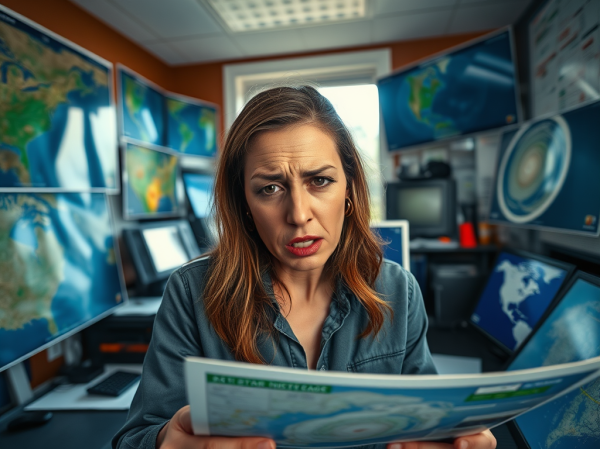
Michigan meteorologist Katie Nickolaou received death threats through social media.

“I have had a bunch of people saying I created and steered the hurricane, there are people assuming we control the weather. I have had to point out that a hurricane has the energy of 10,000 nuclear bombs and we can’t hope to control that. But it’s taken a turn to more violent rhetoric, especially with people saying those who created Milton should be killed.”

Many weather scientists were simply stunned at the level of stupidity and misinformation hurled their way. After someone suggested that someone should “stop the breathing” of those that “made” the hurricanes, Nickolaou responded with this post, “Murdering meteorologists won’t stop hurricanes. I can’t believe I just had to type that.”

Washington, D.C. based meteorologist Matthew Cappucci also received threats: “Seemingly overnight, ideas that once would have been ridiculed as very fringe, outlandish viewpoints are suddenly becoming mainstream, and it’s making my job much more difficult.” 

Marjorie Taylor Greene, U.S. Representative for  Georgia’s 14th congressional district, jumped forcefully into the fray by suggesting the conspiracy was politically motivated.  She posted on X: “This is a map of hurricane affected areas with an overlay of electoral map by political party shows how hurricane devastation could affect the election.”

And just in case you’re giving her the benefit of the doubt by saying she might just be pointing out a correlation, not a cause, she doubled down with this post on X: “Yes they can control the weather, it’s ridiculous for anyone to lie and say it can’t be done.” 

You may say that when it comes to MTG, we must consider the source and sigh “You can’t cure stupid.”   But Marjorie Taylor Greene easily won a democratic election with almost 66% of the vote, which means the majority of people in her district believed in her enough to elect her as their representative. Her opponent, Marcus Flowers, is a 10-year veteran of the US Army and he served 20 years as a contractor or official for the State Department and Department of Defense. He’s no slouch. But in Georgia’s 14th Congressional district, two out of three voters decided a better choice would be the woman who believes that the Nazi Secret Police were called the Gazpacho.

I’ve talked about this before. Ad nauseum – actually. But this reaches a new level of stupidity…and stupidity on this scale is f*&king frightening. It is the most dangerous threat we as humans face.

That’s right, I said the “biggest” threat.  Bigger than climate change. Bigger than AI. Bigger than the new and very scary alliance emerging between Russia, Iran, North Korea and China. Bigger than the fact that Vladimir Putin, Donald Trump and Elon Musk seem to be planning a BFF pajama party in the very near future.

All of those things can be tackled if we choose to. But if we are functionally immobilized by choosing to be represented by stupidity, we are willfully ignoring our way to a point where these existential problems – and many others we’re not aware of yet – can no longer be dealt with.

Brian Cox, a professor of particle physics at the University of Manchester and host of science TV shows including Universe and The Planets, is also warning us about rampant stupidity. “We may laugh at people who think the Earth is flat or whatever, the darker side is that, if we become unmoored from fact, we have a very serious problem when we attempt to solve big challenges, such as AI regulation, climate or avoiding global war. These are things that require contact with reality.” 

At issue here is that people are choosing politics over science. And there is nothing that tethers political to reality. Politics are built on beliefs. Science strives to be built on provable facts. If we choose politics over science, we are embracing wilful ignorance. And that will kill us.

Hurricanes offer us the best possible example of why that is so. Let’s say you, along with Marjorie Taylor Greene, believe that hurricanes are created by meteorologist and mad weather scientists. So, when those nasty meteorologists try to warn you that the storm of the century is headed directly towards you, you respond in one of two ways: You don’t believe them and/or you get mad and condemn them as part of a conspiracy on social media. Neither of those things will save you. Only accepting science as a reliable prediction of the impending reality will give you the best chance of survival, because it allows you to take action.

Maybe we can’t cure stupid. But we’d better try, because it’s going to be the death of us.

Why Time Seems to Fly Faster Every Year

Last week, I got an email congratulating me on being on LinkedIn for 20 years.

My first inclination was that it couldn’t be twenty years. But when I did the mental math, I realized it was right.  I first signed up in 2004. LinkedIn had just started 2 years before, in 2002.

LinkedIn would have been my first try at a social platform. I couldn’t see the point of MySpace, which started in 2003. And I was still a couple years away from even being aware Facebook existed. It started in 2004, but it was still known as TheFacebook. It wouldn’t become open to the public until 2006, two years later, after it dropped the “The”. So, 20 years pretty much marks the sum span of my involvement with social media.

Twenty years is a significant chunk of time. Depending on your genetics, it’s probably between a quarter and a fifth of your life. A lot can happen in 20 years. But we don’t process time the same way as we get older. 20 years when you’re 18 seems like a lot bigger chunk of time than it does when you’re in your 60’s.

I always mark these things in my far-off distant youth by my grad year, which was in 1979. If I use that as the starting point, rolling back 20 years would take me all the way to 1959, a year that seemed pre-historic to me when I was a teenager. That was a time of sock hops, funny cars with tail fins, and Frankie Avalon. These things all belonged to a different world than the one I knew in 1979. Ancient Rome couldn’t have been further removed from my reality.

Yet, that same span of time lies between me and the first time I set up my profile on LinkedIn. And that just seems like yesterday to me. This all got me wondering – do we process time differently as we age? The answer, it turns out, is yes. Time is time – but the perception of time is all in our heads.

The reason why we feel time “flies” as we get older was explained in a paper published by Professor Adrian Bejan. In it, he states, “The ‘mind time’ is a sequence of images, i.e. reflections of nature that are fed by stimuli from sensory organs. The rate at which changes in mental images are perceived decreases with age, because of several physical features that change with age: saccades frequency, body size, pathways degradation, etc. “

So, it’s not that time is moving faster, it’s just that our brain is processing it slower. If our perception of time is made up of mental snapshots of what is happening around us, we simply become slower at taking the snapshots as we get older. We notice less of what’s happening around us. I suspect it’s a combination of slower brains and perhaps not wanting to embrace a changing world quite as readily as we did when we were young. Maybe we don’t notice change because we don’t want things to change.

If we were using a more objective yardstick (speaking of which, when is the last time you actually used a yardstick?), I’m guessing the world changed at least as much between 2004 and 2024 as it did between 1959 and 1979. If I were at 18 years old today, I’m guessing that Britney Spears, The Lord of the Rings and the last episode of Frasier would seem as ancient to me as a young Elvis, Ben-Hur and The Danny Thomas Show seemed to me then.

To me, all these things seem like they were just yesterday. Which is probably why it comes as a bit of a shock to see a picture of Britney Spears today. She doesn’t look like the 22-year-old we remember, which we mistakenly remember as being just a few years ago. But Britney is 42 now, and as a 42-year-old, she’s held up pretty well.

And, now that I think of it, so has LinkedIn. I still have my profile, and I still use it.

Why The World No Longer Makes Sense

Does it seem that the world no longer makes sense? That may not just be you. The world may in fact no longer be making sense.

In the late 1960s, psychologist Karl Weick introduced the world to the concept of sensemaking, but we were making sense of things long before that. It’s the mental process we go through to try to reconcile who we believe we are to the world in which we find ourselves.  It’s how we give meaning to our life.

Weick identified 7 properties critical to the process of sensemaking. I won’t mention them all, but here are three that are critical to keep in mind:

  1. Who we believe we are forms the foundation we use to make sense of the world
  2. Sensemaking needs retrospection. We need time to mull over new information we receive and form it into a narrative that makes sense to us.
  3. Sensemaking is a social activity. We look for narratives that seem plausible, and when we find them, we share them with others.

I think you see where I’m going with this. Simply put, our ability to make sense of the world is in jeopardy, both for internal and external reasons.

External to us, the quality of the narratives that are available to us to help us make sense of the world has nosedived in the past two decades. Prior to social media and the implosion of journalism, there was a baseline of objectivity in the narratives we were exposed to. One would hope that there was a kernel of truth buried somewhere in what we heard, read or saw on major news providers.

But that’s not the case today. Sensationalism has taken over journalism, driven by the need for profitability by showing ads to an increasingly polarized audience. In the process, it’s dragged the narratives we need to make sense of the world to the extremes that lie on either end of common sense.

This wouldn’t be quite as catastrophic for sensemaking if we were more skeptical. The sensemaking cycle does allow us to judge the quality of new information for ourselves, deciding whether it fits with our frame of what we believe the world to be, or if we need to update that frame. But all that validation requires time and cognitive effort. And that’s the second place where sensemaking is in jeopardy: we don’t have the time or energy to be skeptical anymore. The world moves too quickly to be mulled over.

In essence, our sensemaking is us creating a model of the world that we can use without requiring us to think too much. It’s our own proxy for reality. And, as a model, it is subject to all the limitations that come with modeling. As the British statistician George E.P. Box said, “All models are wrong, but some are useful.”

What Box didn’t say is, the more wrong our model is, the less likely it is to be useful. And that’s the looming issue with sensemaking. The model we use to determine what is real is become less and less tethered to actual reality.

It was exactly that problem that prompted Daniel Schmachtenberger and others to set up the Consilience Project. The idea of the Project is this – the more diversity in perspectives you can include in your model, the more likely the model is to be accurate. That’s what “consilience” means: pulling perspectives from different disciplines together to get a more accurate picture of complex issues.  It literally means the “jumping together” of knowledge.

The Consilience Project is trying to reverse the erosion of modern sensemaking – both from an internal and external perspective – that comes from the overt polarization and the narrowing of perspective that currently typifies the information sources we use in our own sensemaking models.  As Schmachtenberger says,  “If there are whole chunks of populations that you only have pejorative strawman versions of, where you can’t explain why they think what they think without making them dumb or bad, you should be dubious of your own modeling.”

That, in a nutshell, explains the current media landscape. No wonder nothing makes sense anymore.

My Mind is Meandering

Thirty-seven years ago, when I first drove into the valley I now call home, I said to myself, “Now, this is a place for meandering!”

Meandering is a word we don’t use enough today. We certainly don’t do the actual act of meandering enough anymore. To “meander” is to “flow in a winding course.” It comes from Maiandros, the Greek name of a river in Turkey (also known as the Büyük Menderes) known for its sinuous path. This is perhaps what brought the word to mind when I drove into Western Canada’s Okanagan Valley. This is a valley formed by water, either in flowing or frozen form.

I have always loved the word meander. Even the sound of it is like a journey; you scale the heights of the hard “e,” pausing for a minute to rest against the soft “a”, after which you descend into the lush vale that is formed by its remaining syllable. The aquatic origins of the word are appropriate, because to meander is to be in a state of flow but with no purpose in mind. Meandering allows the mind to freewheel, to pick its own path.

You know what’s another great word? Saunter.

My favorite story about sauntering is that told by Albert Palmer in his 1919 book, The Mountain Trail and Its Message. He tells of an exchange with John Muir, the founder of the Sierra Club, who was called the Father of America’s National Parks. In the exchange, Muir explains why he finds the word “saunter” far more to his taste than “hike”:

“Do you know the origin of that word ‘saunter’? It’s a beautiful word. Away back in the Middle Ages people used to go on pilgrimages to the Holy Land, and when people in the villages through which they passed asked where they were going, they would reply, “A la sainte terre,’ ‘To the Holy Land.’ And so they became known as sainte-terre-ers or saunterers. Now these mountains are our Holy Land, and we ought to saunter through them reverently, not ‘hike’ through them.”

According to Google’s Ngram viewer, literary usage of the word “saunter”  hit Its peak in the 1800s and was in decline for most of the following century. That timeline makes sense. Sauntering would definitely be popular with the Romantic movement of the late 1800s. This was a movement back to appreciate the charms of nature and would have been an open invitation to “saunter” in Muir’s “Holy Land.”

For some reason, the word seems to be enjoying a bit of a resurgence in usage in the last 20 years.

Meander is a different story. It only started to really appear in books towards the end of the 1800s and continued to be used through the 20th century, although usage dropped during times of tribulation, notably World War I, the Great Depression of the 1930s and throughout World War II. Again, that’s not surprising. It’s hard to meander when you’re in a constant state of anxiety.

As my mind meandered down this path, I wondered if there is a digital equivalent to meandering or sauntering. Take scrolling through Facebook, for example. It is navigating without any specific destination in mind, so perhaps it qualifies as meandering. There is no direct line to connect A to B.

But I wouldn’t call social media scrolling sauntering. There’s a distinction between ”meandering” and “sauntering.” I think saunter implies that you know where you’re going, but there is no rigid schedule set to get there. You can take as much time as you like to smell the flowers on your way.

Also, as John Muir mentioned, sauntering requires a certain sense of place. The setting in which you saunter is of critical importance. However you would define your own “Holy Land,” that’s the place where you should saunter. It should be grounded in some gravitas.

That’s why I don’t think you can really saunter through social media. To me, Facebook, Instagram or TikTok are a far cry from being considered hallowed ground.

Can Media Move the Overton Window?

I fear that somewhere along the line, mainstream media has forgotten its obligation to society.

It was 63 years ago, (on May 9, 1961) that new Federal Communications Commission Chair Newton Minow gave his famous speech, “Television and the Public Interest,” to the convention of the National Association of Broadcasters.

In that speech, he issued a challenge: “I invite each of you to sit down in front of your own television set when your station goes on the air and stay there, for a day, without a book, without a magazine, without a newspaper, without a profit and loss sheet or a rating book to distract you. Keep your eyes glued to that set until the station signs off. I can assure you that what you will observe is a vast wasteland.”

Minow was saying that media has an obligation to set the cultural and informational boundaries for society. The higher you set them, the more we will strive to reach them. That point was a callback to the Fairness Doctrine, established by the FCC in 1949. The policy required that “holders of broadcast licenses to present controversial issues of public importance and to do so in a manner that fairly reflected differing viewpoints.” The Fairness Doctrine was abolished by the FCC in 1987.

What Minow realized, presciently, was that mainstream media is critically important in building the frame for what would come to be called, three decades later, the Overton Window. First identified by policy analyst Joseph Overton at the Mackinaw Center for Public Policy, the term would posthumously be named after Overton by his colleague Joseph Lehman.

The term is typically used to describe the range of topics suitable for public discourse in the political arena. But, as Lehman explained in an interview, the boundaries are not set by politicians: “The most common misconception is that lawmakers themselves are in the business of shifting the Overton Window. That is absolutely false. Lawmakers are actually in the business of detecting where the window is, and then moving to be in accordance with it.

I think the concept of the Overton Window is more broadly applicable than just within politics. In almost any aspect of our society where there are ideas shaped and defined by public discourse, there is a frame that sets the boundaries for what the majority of society understands to be acceptable — and this frame is in constant motion.

Again, according to Lehman,  “It just explains how ideas come in and out of fashion, the same way that gravity explains why something falls to the earth. I can use gravity to drop an anvil on your head, but that would be wrong. I could also use gravity to throw you a life preserver; that would be good.”

Typically, the frame drifts over time to the right or left of the ideological spectrum. What came as a bit of a shock in November of 2016 was just how quickly the frame pivoted and started heading to the hard right. What was unimaginable just a few years earlier suddenly seemed open to being discussed in the public forum.

Social media was held to blame. In a New York Times op-ed written just after Trump was elected president (a result that stunned mainstream media) columnist Farhad Manjoo said,  “The election of Donald J. Trump is perhaps the starkest illustration yet that across the planet, social networks are helping to fundamentally rewire human society.”

In other words, social media can now shift the Overton Window — suddenly, and in unexpected directions. This is demonstrably true, and the nuances of this realization go far beyond the limits of this one post to discuss.

But we can’t be too quick to lay all the blame for the erratic movements of the Overton Window on social media’s doorstep.

I think social media, if anything, has expanded the window in both directions — right and left. It has redefined the concept of public discourse, moving both ends out from the middle. But it’s still the middle that determines the overall position of the window. And that middle is determined, in large part, by mainstream media.

It’s a mistake to suppose that social media has completely supplanted mainstream media. I think all of us understand that the two work together. We use what is discussed in mainstream media to get our bearings for what we discuss on social media. We may move right or left, but most of us realize there is still a boundary to what is acceptable to say.

The red flags start to go up when this goes into reverse and mainstream media starts using social media to get its bearings. If you have the mainstream chasing outliers on the right or left, you start getting some dangerous feedback loops where the Overton Window has difficulty defining its middle, risking being torn in two, with one window for the right and one for the left, each moving further and further apart.

Those who work in the media have a responsibility to society. It can’t be abdicated for the pursuit of profit or by saying they’re just following their audience. Media determines the boundaries of public discourse. It sets the tone.

Newton Minow was warning us about this six decades ago.

Uncommon Sense

Let’s talk about common sense.

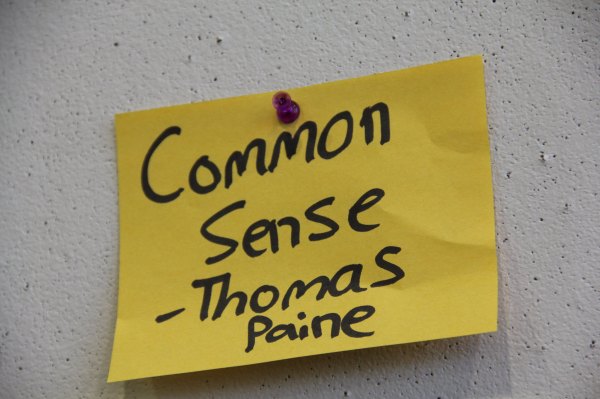
“Common sense” is one of those underpinnings of democracy that we take for granted. Basically, it hinges on this concept: the majority of people will agree that certain things are true. Those things are then defined as “common sense.” And common sense becomes our reference point for what is right and what is wrong.

But what if the very concept of common sense isn’t true? That was what researchers Duncan Watts and Mark Whiting set out to explore.

Duncan Watts is one of my favourite academics. He is a computational social scientist at the University of Pennsylvania. I’m fascinated by network effects in our society, especially as they’re now impacted by social media. And that pretty much describes Watt’s academic research “wheelhouse.” 

According to his profile he’s “interested in social and organizational networks, collective dynamics of human systems, web-based experiments, and analysis of large-scale digital data, including production, consumption, and absorption of news.”

Duncan, you had me at “collective dynamics.”

 I’ve cited his work in several columns before, notably his deconstruction of marketing’s ongoing love affair with so-called influencers. A previous study from Watts shot several holes in the idea of marketing to an elite group of “influencers.”

Whiting and Watts took 50 claims that would seem to fall into the category of common sense. They ranged from the obvious (“a triangle has three sides”) to the more abstract (“all human beings are created equal”). They then recruited an online panel of participants to rate whether the claims were common sense or not. Claims based on science were more likely to be categorized as common sense. Claims about history or philosophy were less likely to be identified as common sense.

What did they find? Well, apparently common sense isn’t very common. Their report says, “we find that collective common sense is rare: at most a small fraction of people agree on more than a small fraction of claims.” Less than half of the 50 claims were identified as common sense by at least 75% of respondents.

Now, I must admit, I’m not really surprised by this. We know we are part of a pretty polarized society. It no shock that we share little in the way of ideological common ground.

But there is a fascinating potential reason why common sense is actually quite uncommon: we define common sense based on our own realities, and what is real for me may not be real for you. We determine our own realities by what we perceive to be real, and increasingly, we perceive the “real” world through a lens shaped by technology and media – both traditional and social.

Here is where common sense gets confusing. Many things – especially abstract things – have subjective reality. They are not really provable by science. Take the idea that all human beings are created equal. We may believe that, but how do we prove it? What does “equal” mean?

So when someone appeals to our common sense (usually a politician) just what are they appealing to? It’s not a universally understood fact that everyone agrees on. It’s typically a framework of belief that is probably only agreed on by a relatively small percent of the population. This really makes it a type of marketing, completely reliant on messaging and targeting the right market.

Common sense isn’t what it once was. Or perhaps it never was. Either common or sensible.

Feature image: clemsonunivlibrary

We SHOULD Know Better — But We Don’t

“The human mind is both brilliant and pathetic.  Humans have built hugely complex societies and technologies, but most of us don’t even know how a toilet works.”

– from The Knowledge Illusion: Why We Never Think Alone” by Steven Sloman and Philip Fernback.

Most of us think we know more than we do — especially about things we really know nothing about. This phenomenon is called the Dunning-Kruger Effect. Named after psychologists Justin Kruger and David Dunning, this bias causes us to overestimate our ability to do things that we’re not very good at.

That’s the basis of the new book “The Knowledge Illusion: Why We Never Think Alone.” The basic premise is this: We all think we know more than we actually do. Individually, we are all “error prone, sometimes irrational and often ignorant.” But put a bunch of us together and we can do great things. We were built to operate in groups. We are, by nature, herding animals.

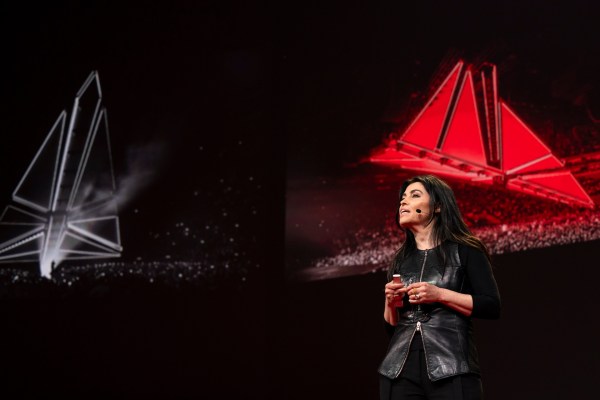
This basic human nature was in the back of mind when I was listening to an interview with Es Devlin on CBC Radio. Devlin is self-described as an artist and stage designer.  She was the vision behind Beyonce’s Renaissance Tour, U2’s current run at The Sphere in Las Vegas, and the 2022 Superbowl halftime show with Dr. Dre, Snoop Dogg, Eminem and Mary J. Blige.

When it comes to designing a visually spectacular experience,  Devlin has every right to be a little cocky. But even she admits that every good idea doesn’t come directly from her. She said the following in the interview (it’s profound, so I’m quoting it at length):

“I learned quite quickly in my practice to not block other people’s ideas — to learn that, actually,  other people’s ideas are more interesting than my own, and that I will expand by absorbing someone else’s idea.

“The real test is when someone proposes something in a collaboration that you absolutely, [in] every atom of your body. revile against. They say, ‘Why don’t we do it in bubblegum pink?’ and it was the opposite of what you had in mind. It was the absolute opposite of anything you would dream of doing.

“But instead of saying, ‘Oh, we’re not doing that,’  you say ‘OK,’ and you try to imagine it. And then normally what will happen is that you can go through the veil of the pink bubblegum suggestion, and you will come out with a new thing that you would never have thought of on your own.

“Why? Because your own little batch of poems, your own little backpack of experience. does not converge with that other person, so you are properly meeting not just another human being, but everything that led up to them being in that room with you. “

From Interview with Tom Powers on Q – CBC Radio, March 18, 2024

We live in a culture that puts the individual on a pedestal.  When it comes to individualistic societies, none are more so than the United States (according to a study by Hofstede Insights).  Protection of personal rights and freedom are the cornerstone of our society (I am Canadian, but we’re not far behind on this world ranking of individualistic societies). The same is true in the U.K. (where Devlin is from), Australia, the Netherlands and New Zealand.

There are good things that come with this, but unfortunately it also sets us up as the perfect targets for the Dunning-Kruger effect. This individualism and the cognitive bias that comes with it are reinforced by social media. We all feel we have the right to be heard — and now we have the platforms that enable it.

With each post, our unshakable belief in our own genius and infallibility is bulwarked by a chorus of likes from a sycophantic choir who are jamming their fingers down on the like button. Where we should be cynical of our own intelligence and knowledge, especially about things we know nothing about, we are instead lulled into hiding behind dangerous ignorance.

What Devlin has to say is important. We need to be mindful of our own limitations and be willing to ride on the shoulders of others so we can see, know and do more. We need to peek into the backpack of others to see what they might have gathered on their own journey.

(Feature Image – Creative Commons – https://www.flickr.com/photos/tedconference/46725246075/)

Post-mortem of a Donald Trump Sound Bite

This past weekend, Donald Trump was campaigning in Dayton, Ohio. This should come as news to no one. You’ve all probably seen various blips come across your social media radar. And, as often happens, what Trump said has been picked up in the mainstream press.

Now, I am quite probably the last person in the world that would ever come to Donald Trump’s defense. But I did want to take this one example of how it’s the media, including social media, that is responsible for the distortion of reality that we often see happen.

My first impression of what happened is that Trump promised a retributive bloodbath for any and all opposition if he’s not elected president. And, like many of you, that first impression came through my social media feeds. Joe Biden’s X (formerly Twitter) post said “It’s clear this guy wants another January 6th” Republican Lawyer and founding member of the Lincoln Project George Conway also posted: “This is utterly unhinged.”  

There was also retweeting of ABC coverage featuring a soundbite from Trump that said, “There would be a bloodbath if he is not re-elected in November.” This was conflated with Trump’s decision to open the stump speech with a recording of “Justice for All” by the J6 Choir, made of inmates awaiting trial for their roles in the infamous insurrection after the last election. Trump saluted during the playing of the recording.

To be crystal clear, I don’t condone any of that. But that’s not the point. I’m not the audience this was aimed at.

First of all, Donald Trump was campaigning. In this case, he was making a speech aimed at his base in Ohio, many of whom are auto-workers. And the “bloodbath” comment had nothing to do with armed insurrection. It was Trump’s prediction of what would happen if he wasn’t elected and couldn’t protect American auto jobs from the possibility of a trade war with China over auto manufacturing.

But you would be hard pressed to know that based on what you saw, heard or read on either social media or traditional media.

You can say a lot of derogatory things about Donald Trump, but you can’t say he doesn’t know his base or what they want to hear. He’s on the campaign trail to be elected President of the United State. The way that game is played, thanks to a toxic ecosystem created by the media, is to pick your audience and tell them exactly what they want to hear. The more you can get that message amplified through both social and mainstream media, the better. And if you can get your opposition to help you by also spreading the message, you get bonus points.

Trump is an expert at playing that game. He is the personification of the axiom, “There is no such thing as bad press.”

If we try to pin this down to the point where we can assign blame, it becomes almost impossible. There was nothing untrue in the coverage of the Dayton Rally. It was just misleading due to incomplete information, conflation, and the highlighting of quotes without context. It was sloppy reporting, but it wasn’t illegal.

The rot here isn’t acute. It isn’t isolated to one instance. It’s chronic and systemic. It runs through the entire media ecosystem. It benefits from round after round of layoffs that have dismantled journalism and gutted the platform’s own fact checking and anti-misinformation teams. Republicans, led by House Judiciary Chairman Jim Jordan, are doubling down on this by investigating alleged anti-conservative censorship by the platforms.

I’m pretty sure things won’t get better. Social media feeds are – if anything – more littered than ever with faulty information and weaponized posts designed solely to provoke. So far, management of the platforms have managed to slither away from anything resembling responsibility. And the campaigns haven’t even started to heat up. In the 230 days between now and November 5th, the stakes will get higher and posts will become more inflammatory.

Buckle up. It promises to be a bumpy (or Trumpy?) ride!

The Messaging of Climate Change

86% of the world believes that climate change is a real thing. That’s the finding of a massive new mega study with hundreds of authors (the paper’s author acknowledgement is a page and a half). 60,000 participants from 63 countries around the world took part. And, as I said, 86% of them believe in climate change.

Frankly, there’s no surprise there. You just have to look out your window to see it. Here in my corner of the world, wildfires wiped out hundreds of homes last summer and just a few weeks ago, a weird winter whiplash took temperatures from unseasonably warm to deep freeze cold literally overnight. This anomaly wiped out this region’s wine industry. The only thing surprising I find about the 86 percent stat is that 14% still don’t believe. That speaks of a determined type of ignorance.

What is interesting about this study is that it was conducted by behavioral scientists. This is an area that has always fascinated me. From the time I read Richard Thaler and Cass Sunstein’s book, Nudge, I have always been interested in behavioral interventions. What are the most effective “nudges” in getting people to shift their behaviors to more socially acceptable directions?

According to this study, that may not be that easy. When I first dove into this study, my intention was to look at how different messages had different impacts depending on the audience: right wing vs left wing for instance. But in going through the results, what struck me the most was just how poorly all the suggested interventions performed. It didn’t matter if you were liberal or conservative or lived in Italy or Iceland. More often than not, all the messaging fell on deaf ears.

What the study did find is that how you craft your campaign about climate change depends on what you want people to do. Do you want to shift non-believers in Climate Change towards being believers? Then decrease the psychological distance. More simply put, bring the dangers of climate change to their front doorstep. If you live next to a lot of trees, talk about wildfires. If you live on the coast, talk about flooding. If you live in a rural area, talk about the impacts of drought. But it should be noted that we weren’t talking a massive shift here – with an “absolute effect size of 2.3%”. It was the winner by the sheer virtue of sucking the least.

If you want to build support for legislation that mitigates climate change, the best intervention was to encourage people to write a letter to a child that’s close to you, with the intention that they read it in the future. This forces the writer to put some psychological skin in the game.  

Who could write a future letter to someone you care about without making some kind of pledge to make sure there’s still a world they can live in? And once you do that, you feel obligated to follow through. Once again, this had a minimal impact on behaviors, with an overall effect size of 2.6%.

A year and a half ago, I talked about Climate Change messaging, debating Mediapost Editor-in-Chief Joe Mandese about whether a doom and gloom approach would move the needle on behaviors. In a commentary from the summer of 2022, Mandese wrapped up by saying, “What the ad industry really needs to do is organize a massive global campaign to change the way people think, feel and behave about the climate — moving from a not-so-alarmist “change” to an “our house is on fire” crisis.”

In a follow up, I worried that doom and gloom might backfire on us, “Cranking up the crisis intensity on our messaging might have the opposite effect. It may paralyze us.”

So, what does this study say?

The answer, again, is, “it depends.” If we’re talking about getting people to share posts on social media, then Doom and Gloom is the way to go. Of all the various messaging options, this had the biggest impact on sharing, by a notable margin.

This isn’t really surprising. A number of studies have shown that negative news is more likely to be shared on social media than positive news.

But what if we’re asking people to make a change that requires some effort beyond clicking the “share” button? What if they actually have to do something? Then, as I suspected, Doom and Gloom messaging had the opposite effect, decreasing the likelihood that people would make a behavioral change to address climate change (the study used a tree planting initiative as an example). In fact, when asking participants to actually change their behavior in an effortful way, all the tested climate interventions either had no effect or, worse, they “depress(ed) and demoralize(d) the public into inaction”.

That’s not good news. It seems that no matter what the message is, or who the messenger is, we’re likely to shoot them if they’re asking us to do anything beyond bury our head in the sand.

What’s even worse, we may be losing ground. A study from 10 years ago by Yale University had more encouraging results. They showed that effective climate change messaging, was able to shift public perceptions by up to 19 percent. While not nearly as detailed as this study, the results seem to indicate a backslide in the effectiveness of climate messaging.

One of the commentators that covered the new worldwide study perhaps summed it up best by saying, “if we’re dealing with what is probably the biggest crisis ever in the history of humanity, it would help if we actually could talk about it.”

A Look Back at 2023 from the Inside.

(Note: This refers to the regular feature on Mediapost – The Media Insider – which I write for every Tuesday)

It seems that every two years, I look back at what the Media Insiders were musing about over the past year. The ironic part is that I’m not an Insider. I haven’t been “inside” the Media industry for over a decade. Maybe that affords me just enough distance to be what I hope could be called an “informed observer.”

I first did this in 2019, and then again in 2021. This year, I decided to grab a back of an envelope (literally) and redo this far from scientific poll. Categorization of themes is always a challenge when I do this, but there are definitely some themes that have been consistent across the past 5 years.  I have tremendous respect for my fellow Insiders and I always find it enlightening to learn what was on their minds.

In 2019, the top three things we were thinking about were (in order): disruptions in the advertising business, how technology is changing us and how politics changed social media.

In 2021, the top three topics included (again) how technology was changing us, general marketing advice and the toxic impact of social media.

So, what about 2023? What were we writing about? After eliminating the columns that were reruns, I ended up with 230 posts in the past year.

It probably comes as a surprise to no one that artificial intelligence was the number one topic by a substantial margin. Almost 15% of all our Insider posts talked about the rise of AI and its impact on – well – pretty much everything!

The number two topic – at 12% – was TV, video and movies. Most of the posts touched on how this industry is going through ongoing disruption in every aspect – creation, distribution, buying and measurement.

Coming in at number three, at just under 12%, was social media. Like in the previous years, most of the posts were about the toxic nature of social media, but there was a smattering of positive case studies about how social platforms were used for positive change.

We Insiders have always been an existential bunch and last year was no different. Our number four topic was about our struggling to stay human in a world increasingly dominated by tech. This accounted for almost 11% of all our posts.

The next two most popular topics were both firmly grounded in the marketing industry itself. Posts about how to be a better marketer generated almost 9% of Insider content for 2023 and various articles about the business of tech marketing added another 8% of posts.

Continuing down the list, we have world events and politics (Dave Morgan’s columns about the Ukraine were a notable addition to this topic), examples of marketing gone wrong and the art and science of brand building.

We also looked at the phenomenon of fame and celebrity, sustainability, and the state of the News industry. In what might have been a wistful look back at what we remember as simpler times, there were even a few columns about retro-media, including the resurgence of the LP.

Interestingly, former hot topics like performance measurement, data and search all clustered near the bottom of the list in terms of number of posts covering these topics.

With 2023 in our rear view mirror, what are the takeaways? What can we glean from the collected year-long works of these very savvy and somewhat battle-weary veterans of marketing?

Well, the word “straddle” comes to mind. We all seem to have one foot still planted in the world and industry we thought we knew and one tentatively dipping its toes into the murky waters of what might come. You can tell that the Media Insiders are no less passionate about the various forms of media we write about, but we do go forward with the caution that comes from having been there and done that.

I think that, in total, I found a potentially worrying duality in this review of our writing. Give or take a few years –  all my fellow Insiders are of the same generation. But we are not your typical Gen-Xers/Baby Boomers (or, in my case, caught in the middle as a member of Generation Jones). We have worked with technology all our lives. We get it. The difference is, we have also accumulated several decades of life wisdom. We are past the point where we’re mesmerized by bright shiny objects. I think this gives us a unique perspective. And, based on what I read, we’re more than a little worried about what future might bring.

Take that for what it’s worth.