Dove’s Takedown Of AI: Brilliant But Troubling Brand Marketing

The Dove brand has just placed a substantial stake in the battleground over the use of AI in media. In a campaign called “Keep Beauty Real”, the brand released a 2-minute video showing how AI can create an unattainable and highly biased (read “white”) view of what beauty is.

If we’re talking branding strategy, this campaign in a master class. It’s totally on-brand with Dove, who introduced its “Campaign for Real Beauty” 18 years ago. Since then, the company has consistently fought digital manipulation of advertising images, promoted positive body image and reminded us that beauty can come in all shapes, sizes and colors. The video itself is brilliant. You really should take a couple minutes to see it if you haven’t already.

But what I found just as interesting is that Dove chose to use AI as a brand differentiator. The video starts with by telling us, “By 2025, artificial intelligence is predicted to generate 90% of online content” It wraps up with a promise: “Dove will never use AI to create or distort women’s images.”

This makes complete sense for Dove. It aligns perfectly with its brand. But it can only work because AI now has what psychologists call emotional valency. And that has a number of interesting implications for our future relationship with AI.

“Hot Button” Branding

Emotional valency is just a fancy way of saying that a thing means something to someone. The valence can be positive or negative. The term valence comes from the German word valenz, which means to bind. So, if something has valency, it’s carrying emotional baggage, either good or bad.

This is important because emotions allow us to — in the words of Nobel laureate Daniel Kahneman — “think fast.” We make decisions without really thinking about them at all. It is the opposite of rational and objective thinking, or what Kahneman calls “thinking slow.”

Brands are all about emotional valency. The whole point of branding is to create a positive valence attached to a brand. Marketers don’t want consumers to think. They just want them to feel something positive when they hear or see the brand.

So for Dove to pick AI as an emotional hot button to attach to its brand, it must believe that the negative valence of AI will add to the positive valence of the Dove brand. That’s how branding mathematics sometimes work: a negative added to a positive may not equal zero, but may equal 2 — or more. Dove is gambling that with its target audience, the math will work as intended.

I have nothing against Dove, as I think the points it raises about AI are valid — but here’s the issue I have with using AI as a brand reference point: It reduces a very complex issue to a knee-jerk reaction. We need to be thinking more about AI, not less. The consumer marketplace is not the right place to have a debate on AI. It will become an emotional pissing match, not an intellectually informed analysis. And to explain why I feel this way, I’ll use another example: GMOs.

How Do You Feel About GMOs?

If you walk down the produce or meat aisle of any grocery store, I guarantee you’re going to see a “GMO-Free” label. You’ll probably see several. This is another example of squeezing a complex issue into an emotional hot button in order to sell more stuff.

As soon as I mentioned GMO, you had a reaction to it, and it was probably negative. But how much do you really know about GMO foods? Did you know that GMO stands for “genetically modified organisms”? I didn’t, until I just looked it up now. Did you know that you almost certainly eat foods that contain GMOs, even if you try to avoid them? If you eat anything with sugar harvested from sugar beets, you’re eating GMOs. And over 90% of all canola, corn and soybeans items are GMOs.

Further, did you know that genetic modifications make plants more resistance to disease, more stable for storage and more likely to grow in marginal agricultural areas? If it wasn’t for GMOs, a significant portion of the world’s population would have starved by now. A 2022 study suggests that GMO foods could even slow climate change by reducing greenhouse gases.

If you do your research on GMOs — if you “think slow’ about them — you’ll realize that there is a lot to think about, both good and bad. For all the positives I mentioned before, there are at least an equal number of troubling things about GMOs. There is no easy answer to the question, “Are GMOs good or bad?”

But by bringing GMOs into the consumer world, marketers have shut that down that debate. They are telling you, “GMOs are bad. And even though you consume GMOs by the shovelful without even realizing it, we’re going to slap some GMO-free labels on things so you will buy them and feel good about saving yourself and the planet.”

AI appears to be headed down the same path. And if GMOs are complex, AI is exponentially more so. Yes, there are things about AI we should be concerned about. But there are also things we should be excited about. AI will be instrumental in tackling the many issues we currently face.

I can’t help worrying when complex issues like AI and GMOs are broad-stroked by the same brush, especially when that brush is in the hands of a marketer.

Feature image: Body Scan 002 by Ignotus the Mage, used under CC BY-NC-SA 2.0 / Unmodified

A Column About Nothing

What do I have to say in my last post for 2023? Nothing.

Last week, I talked about the cost of building a brand. Then, this week, I (perhaps being the last person on earth to do so) heard about Nothing.  No – not small “n” nothing as in the absence of anything – Big “N” Nothing as in the London based tech start-up headed by Chinese born entrepreneur Carl Pei.

Nothing, according to their website, crafts “intuitive, flawlessly connected products that improve our lives without getting in the way. No confusing tech-speak. No silly product names. Just artistry, passion and trust. And products we’re proud to share with our friends and family. Simple.”

Now, just like the football talents of David Beckham I explored in my last post, the tech Nothing produces is good – very good – but not uniquely good. The Nothing phone (1) and the just released Nothing Phone (2) are capable mid-range smart phones. Again, from the Nothing website, you are asked to “imagine a world where all your devices are seamlessly connected.”

It may just be me, but isn’t that what Apple has been promising (and occasionally delivering) for the better part of the last quarter century? Doesn’t Google make the same basic promise? Personally, I see nothing earth shaking in Nothing’s mission. It all feels very “been there, done that.” Or, if you’ll allow me – it all seems like much ado about Nothing (sorry). Yet people have paid thousands over the asking price when the 100 units of the first Nothing phone were put up for auction prior to its public launch.

Why?  Because of the value of the Nothing brand. And that value comes from one place. No, not the tech. The community. Pei may be a pretty good building of phones, but he’s an even better building of community. He has expertly built a fan base who love to rave about Nothing. On the “Community” section of the Nothing Website, you’re invited to “abandon the glorification of I and open up to the potential of We.”  I’m not sure exactly what that means, but it all sounds very cool and idealistic, if a little vague.

Another genius move by Pei was to open up to the potential of Nothing. In what is probably a latent (or perhaps not so latent) backlash against over advertising and in-your-face branding, we were eager to jump on the Nothing bandwagon. It seems like anti-branding, but it’s not. It’s actually expertly crafted, by-the-book branding. Just like Seinfeld, a show about nothing that became one of the most popular tv shows in history, it has been shown that there is some serious branding swagger to the concept of nothing. I can’t believe no one thought to stake a claim to this branding goldmine before now.

The Branding Case Study of David Beckham

I have to admit, I’m not a sports fan. And of the few sports I know a little about, European football is certainly not one of them. So my choice to watch the recent Beckham documentary on Netflix is certainly not typical. That said, I did find it a fascinating case study in something I was not expecting: the making and valuation of a personal brand.

First, a controversial question must be posed: was Beckham a good player? According to those that know much more about the sport than I do, the answer is definitely “Yes” – but he wasn’t the GOAT (Greatest of All Time) – he wasn’t even a GOHT (Greatest of His Time). The closest Beckham ever came to winning the Ballon d’Or, given to the best player  of the year,  was to place second behind Rivaldo Ferreira in 1999. During his time at Real Madrid CF, he wasn’t even the best player on the team. Granted, it was a stacked team and Beckham was one of the “galácticos” (superstars), along with Figo, Zidane and Ronaldo. But, unlike Beckham, all those other players have at least one Ballon d’Or in their trophy case (Note, fellow Mediapost Jon Last recently took an interesting look at this topic in his column – The Death of Meritocracy in Sports Pay).

But despite this, Beckham was certainly the highest paid player in the world when Timothy Leiweke lured him to LA Galaxy, where his contract also gave him a piece of the profits. So, if he wasn’t the greatest player, but he was the most valuable one, what created that value? Why was David Beckham worth hundreds of millions of dollars?

As the documentary showed, there was a dimension to Beckham’s signing to a team that went far beyond his ability to put a round ball in the net. He was a global brand – the most famous football player in the world. And that’s what Real Madrid president Florentino Pérez and Timothy Leiweke respectively bought when they signed Beckham.

As I said, the documentary revealed some interesting truths about branding. What creates brand value? Who owns that value? What is the price paid for the value of a personal brand?

What the Beckham documentary showed, more than anything, is that brand value is determined in a public market. Beckham certainly brought brand assets to the table: his own athletic ability, being exceedingly good looking, a kaleidoscope of hair styles, and a marriage to one of the most popular pop stars in the world, Victoria Adams – Posh Spice from the Spice Girls. Those were the table stakes for establishing his brand value, the price of entry.

But beyond that, the value of his brand was really whatever the public determined it to be. For example, after he was red-carded in a critical match against Argentina the 1998 World Cup, all of Britain decided that Beckham had cost them the championship. Whether that was true or not (there are a lorry-full of “ifs” in that opinion) it caused his brand value to plummet. There was really nothing Beckham could do. His brand was out of his control. It was owned by the media and public.

The documentary really highlights the viral and frenzied nature of the market that determines the value of a personal brand. And remember, this all took place in the days before social media and the very real impact of being publicly cancelled! Since Beckham’s prime in the 1990s and early 2000’s, the market effect of branding has since been amplified and compressed. The market of public opinion is now wired, meaning network effects happen on incredibly short timelines and without even the illusion of control.

Certainly the monetary benefits of brand usually accrue to the supposed owner of the brand. David and Victoria Beckham are reportedly worth a half billion dollars, making him one of the richest athletes in the world. But the documentary makes it clear that there was a price paid that was not monetary. Much of what we would all call “our lives” had to be traded by the Beckhams for a brand that was controlled by the public and the press. There were no boundaries, no privacy, no refuge from fame.

When we pull back from the story of David and Victoria Beckham, there are takeaways there for anyone attempting to build a brand, whether it be personal or corporate. You may be able to plant the seeds, but after that, everything else is going to be largely out of your control.

X Marks the Spot

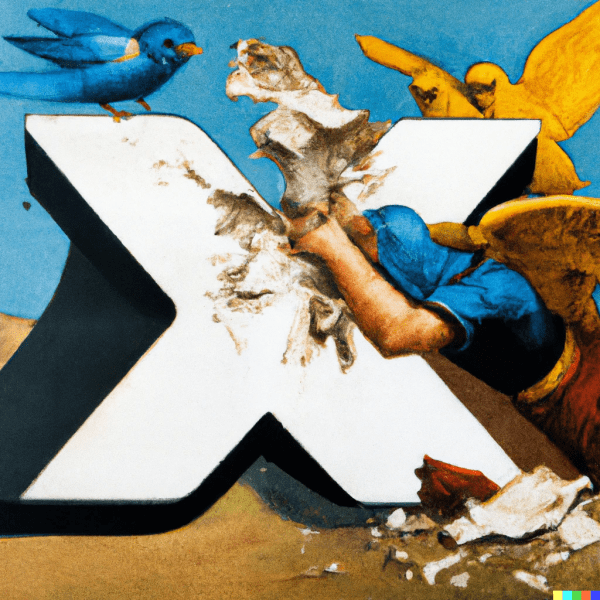
Elon Musk has made his mark. Twitter and its cute little birdy logo are dead. Like Monty Python’s famous parrot, this bird has shuffled off its mortal coil.

So Twitter is dead, Long live X?

I know — that seems weird to me, too.

Musk clearly has a thing for the letter X. He founded a company called X.com that merged with PayPal in 2000. In his portfolio of companies, you’ll find SpaceX, xAI, X Corp. Its seldom you see so much devotion to 1/26th of the Latin alphabet.

It’s not unprecedented to pick a letter and turn it into a brand. Steve Jobs managed to make the letter “i” the symbol for everything Apple. Mind you, he also tacked on helpful product descriptors to keep us from getting confused. If he had changed the name of Apple to “I” and just left it at that, it might not have worked so well.

At their best, brands should immediately bridge the gap between the DNA of a company and a long-term niche in the brains of those of us in the marketplace. Twitter did that. When you saw the iconic bird logo or hear the word Twitter, you know exactly what it referred to.

This is easier when the company is known for a handful of products. But when companies stretch into multiple areas, it’s tough to make one brand synonymous with hundreds or thousands of products. 

This brand diffusion is common with the hyper-accelerated world of tech. You launch a product and it’s so successful, it becomes a mega-corporation. At some point you’re stuck with an awkward transition: You leave the original brand associated with that product and create an umbrella brand that is vague enough to shelter a diverse and expanding portfolio of businesses. That’s why Google created the generic Alpha brand, and why Facebook became Meta.

But Musk didn’t create an umbrella to shelter Twitter and its brand. He used it to beat the brand to death. Maybe he just doesn’t like blue birds.

When a brand does its job well, we feel a personal relationship with it. Twitter’s brand did this. It was unique in tech branding, primarily because it was cute and organic. It was an accessible brand, a breath of fresh air in a world of cryptic acronyms and made-up terms with weird spellings. It made sense to us. And we are sorry to see it go.

In fact, some of us are flat-out refusing to admit the bird is dead. One programmer has already whipped together a Chrome extension that strips out the X branding and brings our favorite little Tweeter back from the beyond. Much as I admire this denial, I suspect this is only delaying the inevitable. It’s time to say bye-bye birdy. 

This current backlash against Musk’s rebranding could be a natural outcome of his effort to move from being one tied to a product to one that creates a bigger tent for multiple products. He has been pretty vocal about X becoming an “everything” app, a la China’s WeChat.

I suspect the road to making X a viable brand is going to be a rocky one. First of all, if you were going to pick the most generic symbol imaginable, X would be your choice. It literally has been a stand in for pretty much everything you could think of for centuries now. Even my great, great grandfather signed his name with an “X.”

We Hotchkisses have always been ahead of our time.

But the ubiquity of “X” brings up another problem, this time on the legal front. According to a lengthy analysis of Twitter’s rebranding by Emma Roth, you can trademark a single letter, but trying to make X your brand will come with some potentially litigious baggage. Microsoft has a trademark on X. So does Meta.

As long at Musk’s X sticks to its knitting, that might not be a problem. Microsoft registered X for its Xbox gaming console. Meta’s trademark also has to do with gaming. Apparently, as long as you don’t cross industries and confuse customers, having the same trademark shouldn’t be an issue.

But the chances of Elon Musk playing nice and following the rules of trademark law while pursuing his plan for world domination are somewhat less than zero. In this case, I think it’s fair to speculate that the formula for the future will be: X = a shitload of lawyer fees

Also, even if you succeed in making X a recognized and unique brand, protecting that brand will be a nightmare. How do you build a legal fence around X when the choice of it as a brand was literally to tear down fences?

But maybe Musk has already foreseen all this. Maybe he has some kind of superpower to see things we can’t.

Kind of like Superman’s X-Ray vision.

It’s All in How You Spin It

I generally get about 100 PR pitches a week. And I’m just a guy who writes a post on tech, people and marketing now and then. I’m not a journalist. I’m not even gainfully employed by anyone. I am just one step removed — thanks to the platform  MediaPost has provided me — from “some guy” you might meet at your local coffee shop.

But still, I get 100 PR pitches a week. Desperation for coverage is the only reason I can think of for this to be so. 99.9999% of the time, they go straight to my trash basket. And the reason they do is that they’re almost never interesting. They are — well, they’re pitches for free exposure.

Now, the average pitch, even if it isn’t interesting, should at least try to match the target’s editorial interest. It should be in the strike zone, so to speak.

Let’s do a little postmortem on one I received recently. It was titled “AI in Banking.” Fair enough. I have written a few posts on AI. Specifically, I have written a few posts on my fear of AI.

I have also written about my concerns about misuse of data. When it comes to the nexus between AI and data, I would be considered more than a little pessimistic. So, something linking AI and banking did pique my interest, but not in a good way. I opened the email.

There, in the first paragraph, I read this: “AI is changing how banks provide personalized recommendations and insights based on enriched financial data offering tailored suggestions, such as optimizing spending, suggesting suitable investment opportunities, or identifying potential financial risks.”

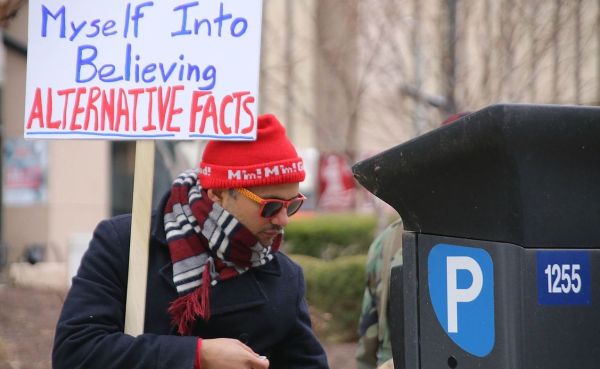
This, for those of you not familiar with “PR-ese,” is what we in the biz call “spin.” Kellyanne Conway once called it — more euphemistically — an alternative fact.

Let me give you an example. Let’s say that during the Tour de France half the Peloton crashes and bicyclists get a nasty case of road rash. A PR person would spin that to say that “Hundreds of professional cyclists discover a new miracle instant exfoliation technique from the South of France.”

See? It’s not a lie, it’s just an alternative fact.

Let’s go on. The second paragraph of the pitch continued: “Bud, a company that specializes in data intelligence is working with major partners across the country (Goldman Sachs, HSBC, 1835i, etc.) to categorize and organize financial information and data so that users are empowered to make informed decisions and gain a deeper understanding of their financial situation.”

Ah — we’re now getting closer to the actual fact. The focus is beginning to switch from the user, empowered to make better financial decisions thanks to AI, to what is actually happening: a data marketplace being built on the backs of users for sale to corporate America.

Let’s now follow the link to Bud’s website. There, in big letters on the home page, you read:

“Turn transactional data into real-time underwriting intelligence

Bud’s AI platform and data visualizations help lenders evaluate risk, reduce losses and unlock hidden revenue potential.”

Bingo. This is not about users, at least, not beyond using them as grist in a data mill. This is about slipping a Trojan Horse into your smartphone in the form of an app and hoovering your personal data up to give big banks an intimate glimpse into not just your finances, but also your thinking about those finances. As you bare your monetary soul to this helpful “Bud,” you have established a direct pipeline to the very institutions that hold your future in their greedy little fingers. You’re giving an algorithm everything it needs to automatically deny you credit.

This was just one pitch that happened to catch my eye long enough to dig a little deeper. But it serves as a perfect illustration of why I don’t trust big data or AI in the hands of for-profit corporations.

And that will continue to be true — no matter how you PR pros spin it.

The Spark in the Jar: Jon Ive and Steve Jobs

I sold all my Apple stock shortly after Steve Jobs passed away. It was premature (which is another word for stupid). Apple stock is today worth about 10 times what I sold it for.

My reasoning was thus: Apple couldn’t function without Steve Jobs – not for long, anyway.

Well, 12 years later, it’s doing quite well, thank you. It has a stock price of almost $200 per share (as of the writing of this). Sales have never been stronger. While replacement CEO Tim Cook is no Steve Jobs, financially he has grown Apple into a monolithic force with a market capitalization of almost 3 trillion dollars. There is no other company even close to that.

Now, with the benefit of hindsight, I realize I underestimated Tim Cook. But I stand with my original instinct: whatever Apple was under Steve Jobs, it couldn’t survive without him. And to understand why, let’s take a quick look back.

Jobs was infamously ousted from Apple in 1985. He remained in “NeXTile” for 12 years, coming back in 1997 to lead Apple into what many believe was its Golden Era. He passed away in 2011.

In the 14 years Jobs led Apple in his second run, the stock price went from about 20 cents to about 12 dollars. That’s growth of about 6000%.  Steve Jobs brought Apple back from the brink of death. If it wasn’t for a lifeline thrown to it by its number one competitor, Microsoft, in 1997, Apple would be no more. As Jobs himself said, “Apple was in very serious trouble,” said Jobs. “And what was really clear was that if the game was a zero-sum game where for Apple to win, Microsoft had to lose, then Apple was going to lose.

But those growth numbers are a little misleading. For you to be one of the fastest growing companies in history, it helps when you start with a very, very small number. A share price of $0.20 is a very, very small number.

Much as everyone lauds Steve Jobs for the turnaround of Apple, I would argue that Tim Cooks performance is even more impressive. To say that Apple was already on a roll when Cook took over is an understatement. In 2011, Apple was going from success to success and could seem to do no wrong. That was one of the reasons I was pessimistic about its future. I thought it couldn’t sustain its run, especially when it came to introducing new products. How many Jobs inspired home runs could it possibly have in its pipeline?

But what Tim Cook was great at was logistics. He took that pipeline and managed to squeeze out another decade plus of value building thanks to what may be the best supply chain strategy in the world. Analysts have said that half of Apple’s 3 trillion dollars in value is directly attributable to that supply chain.

But when you squeeze every last inch of efficiency out of a supply chain, something has to give. And in this case, it may have been creativity.

The Job’s era Apple was a very rare and delicate thing in the corporate world: a leader who was uncompromising on user experience and a design team able to rise and meet the challenge. Was it dictorial? Absolutely. Was it magical? Almost always. It was like catching a spark in a jar.

That design team was headed by Jonathon Ive. And when you have a team that’s the absolute best in the world, you can put up with an asshole here and there, especially when that asshole keeps challenging you to be better.  And when you keep delivering.

The alchemy that made Apple spectacularly successful from 1996 to 2011 was a fragile thing. It wouldn’t take much to change the formula forever. For example, if you removed the catalyst – which was Steve Jobs – it couldn’t survive. But equally important to that formula was Jon Ive.

As David Price, the editor of Macworld said,

“What Ive brought to Apple was a coherent personal vision. That doesn’t mean Apple’s designs on his watch were always perfect, of course; there were plenty of missteps. In broader terms, his arch-minimalism could be frustrating for those who wanted more physical controls”

David Price, Macworld

Ive and Jobs were, by all accounts, inseparable. In a heartfelt tribute to Jobs published shortly after his passing, Ive remembered,

“We worked together for nearly 15 years. We had lunch together most days and spent our afternoons in the sanctuary of the design studio. Those were some of the happiest, most creative and joyful times of my life,” Ive wrote. “I loved how he saw the world. The way he thought was profoundly beautiful.”

Jon Ive

For Jobs and Ive – “Think Different” was both a manifesto and a mantra. That philosophy started a not-so-slow death the minute Jobs passed from this earth. Finally, in June 2019, Ive announced his departure “after years of frustration, seeing the company migrate from a design-centric entity to one that was more utilitarian.”

It seems that companies can excel at either creativity or execution. It’s very difficult – perhaps impossible – to do both. The Apple of Steve Jobs was the world’s most creative corporation. The Apple of Tim Cook is a world leader in execution. But for one to happen, the other had to make room. Today, Apple is trying to be creative by committee. Macworld’s David Price mourns the Apple that was, “Maybe Apple is no longer a company that focuses on individual personality, or indeed on thinking different. This week we also got the news that Ive’s replacement will not be replaced, with a core group of 20 designers instead reporting directly to the chief operating officer, who is no stranger to design and likely has his own ideas. If design by committee has been the de facto approach for the past four years, it’s now been made official.”

And committees always suck all the oxygen from the room. In that atmosphere, the spark that once was Apple inevitably had to go out.

Why I’m Worried About AI

Even in my world, which is nowhere near the epicenter of the technology universe, everyone is talking about AI And depending on who’s talking – it’s either going to be the biggest boon to humanity, or it’s going to wipe us out completely. Middle ground seems to be hard to find.

I recently attended a debate at the local university about it. Two were arguing for AI, and two were arguing against. I went into the debate somewhat worried. When I walked out at the end of the evening, my worry was bubbling just under the panic level.

The “For” Team had a computer science professor – Kevin Leyton-Brown, and a philosophy professor – Madeleine Ransom. Their arguments seemed to rely mainly on creating more leisure time for us by freeing us from the icky jobs we’d rather not do. Leyton-Brown did make a passing reference to AI helping us to solve the many, many wicked problems we face, but he never got into specifics.

“Relax!” seemed to be the message. “This will be great! Trust us!”

The “Against” Team was comprised of a professor in Creative and Critical Studies – Bryce Traister. As far as I could see, he seemed to be mainly worried about AI replacing Shakespeare. He did seem quite enamored with the cleverness of his own quips.

It was the other “Against” debater who was the only one to actually talk about something concrete I could wrap my head around. Wendy Wong is a professor of Political Science. She has a book on data and human rights coming out this fall. Many of her concerns focused on this area.

Interestingly, the AI debaters all mentioned Social Media in their arguments. And on this point, they were united. All the debaters agreed that the impact of Social Media has been horrible. But the boosters were quick to say that AI is nothing like Social Media.

Except that it is. Maybe not in terms of the technology that lies beneath it, but in terms of the unintended consequences it could unleash, absolutely! Like Social Media, what will get us with AI are the things we don’t know we don’t know.

I remember when social media first appeared on the scene. Like AI, there were plenty of evangelists lining up saying that technology would connect us in ways we couldn’t have imagined. We were redefining community, removing the physical constraints that had previously limited connections.

If there was a difference between social media and AI, it was that I don’t remember the same doomsayers at the advent of social media. Everyone seemed to be saying “This will be great! Trust us!”

Today, of course, we know better. No one was warning us that social media would divide us in ways we never imagined, driving a wedge down the ideological middle of our society. There were no hints that social media could (and still might) short circuit democracy.

Maybe that’s why we’re a little warier when it comes to AI. We’ve already been fooled once.

I find that AI Boosters share a similar mindset – they tend to be from the S.T.E.M. (Science, Technology, Engineering and Math) School of Thought. As I’ve said before, these types of thinkers tend to mistake complex problems for complicated ones. They think everything is solvable, if you just have a powerful enough tool and apply enough brain power. For them, AI is the Holy Grail – a powerful tool that potentially applies unlimited brain power.

But the dangers of AI are hidden in the roots of complexity, not complication, and that requires a different way of thinking. If we’re going to get some glimpse of what’s coming our way, I am more inclined to trust the instincts of those that think in terms of the humanities. A thinker, for example, such as Yuval Noah Harari, author of Sapiens.

Harari recently wrote an essay in the Economist that may be the single most insightful thing I’ve read about the dangers of AI: “AI has gained some remarkable abilities to manipulate and generate language, whether with words, sounds or images. AI has thereby hacked the operating system of our civilisation.”

In my previous experiments with ChatGPT, it was this fear that was haunting me. Human brains operate on narratives. We are hard-wired to believe them. By using language, AI has a back door into our brains that bypass all our protective firewalls.

My other great fear is that the development of AI is being driven by for-profit corporations, many of which rely on advertising as their main source of revenue. If ever there was a case of putting the fox in charge of the henhouse, this is it!

When it comes to AI it’s not my job I’m afraid of losing. It’s my ability to sniff out AI generated bullshit. That’s what’s keeping me up a night.

My Many Problems with the Metaverse

I recently had dinner with a comedian who had just did his first gig in the Metaverse. It was in a new Meta-Comedy Club. He was excited and showed me a recording of the gig.

I have to admit, my inner geek thought it was very cool: disembodied hands clapping with avataresque names floating above, bursts of virtual confetti for the biggest laughs and even a virtual-hook that instantly snagged meta-hecklers, banning them to meta-purgatory until they promised to behave. The comedian said he wanted to record a comedy meta-album in the meta-club to release to his meta-followers.

It was all very meta.

As mentioned, as a geek I’m intrigued by the Metaverse. But as a human who ponders our future (probably more than is healthy) – I have grave concerns on a number of fronts. I have mentioned most of these individually in previous posts, but I thought it might be useful to round them up:

Removed from Reality

My first issue is that the Metaverse just isn’t real. It’s a manufactured reality. This is at the heart of all the other issues to come.

We might think we’re clever, and that we can manufacturer a better world than the one that nature has given us, but my response to that would be Orgel’s Second Rule, courtesy of Sir Francis Crick, co-discoverer of DNA: “Evolution is cleverer than you are.”

For millions of years, we have evolved to be a good fit in our natural environment. There are thousands of generations of trial and error baked into our DNA that make us effective in our reality. Most of that natural adaptation lies hidden from us, ticking away below the surface of both our bodies and brains, silently correcting course to keep us aligned and functioning well in our world.

But we, in our never-ending human hubris, somehow believe we can engineer an environment better than reality in less than a single generation. If we take Second Life as the first iteration of the metaverse, we’re barely two decades into the engineering of a meta-reality.

If I was placing bets on who is the better environmental designer for us, humans or evolution, my money would be on evolution, every time.

Who’s Law is It Anyway?

One of the biggest selling features of the Metaverse is that it frees us from the restrictions of geography. Physical distance has no meaning when we go meta.

But this also has issues. Societies need laws and our laws have evolved to be grounded within the boundaries of geographical jurisdictions. What happens when those geographical jurisdictions become meaningless? Right now, there are no laws specifically regulating the Metaverse. And even if there are laws in the future, in what jurisdiction would they be enforced?

This is a troubling loophole – and by hole I mean a massive gaping metaverse-sized void. You know who is attracted by a lack of laws? Those who have no regard for the law. If you don’t think that criminals are currently eyeing the metaverse looking for opportunity, I have a beautiful virtual time-share condo in the heart of meta-Boca Raton that I’d love to sell you.

Data is Matter of the Metaverse

Another “selling feature” for the metaverse is the ability to append metadata to our own experiences, enriching them with access to information and opportunities that would be impossible in the real world. In the metaverse, the world is at our fingertips – or in our virtual headset – as the case may be. We can stroll through worlds, real or imagined, and the sum of all our accumulated knowledge is just one user-prompt away.

But here’s the thing about this admittedly intriguing notion: it makes data a commodity and commodities are built to be exchanged based on market value. In order to get something of value, you have to exchange something of value. And for the builders of the metaverse, that value lies in your personal data. The last shreds of personal privacy protection will be gone, forever!

A For-Profit Reality

This brings us to my biggest problem with the Metaverse – the motivation for building it. It is being built not by philanthropists or philosophers, academics or even bureaucrats. The metaverse is being built by corporations, who have to hit quarterly profit projections. They are building it to make a buck, or, more correctly, several billion bucks.

These are the same people who have made social media addictive by taking the dirtiest secrets of Las Vegas casinos and using them to enslave us through our smartphones. They have toppled legitimate governments for the sake of advertising revenue. They have destroyed our concept of truth, bashed apart the soft guardrails of society and are currently dismantling democracy. There is no noble purpose for a corporation – their only purpose is profit.

Do you really want to put your future reality in those hands?

Looking at Life through Ad-Coloured Glasses

Love em or hate em – you have to admit that ads are a fascinating creative form. They are – more perhaps than any other form of creative expression – a message with a mission.

Orson Welles once said, “The Enemy of Art Is the Absence of Limitations.”

Lorne Michaels – Executive Producer of Saturday Night Live, agreed, “To me there’s no creativity without boundaries. If you’re gonna write a sonnet, it’s 14 lines, so it’s solving the problem within the container.”

I do agree with both Mr. Michaels and Mr. Welles, so let’s strip down advertising to the 4 bare walls that make up the boundaries of a commercial message:

  • It has to get your attention when you may not want to give it
  • It has to get you to think about something you’re not currently thinking about
  • It has to persuade you to buy something or do something you probably don’t absolutely need to have or do
  • It needs to get its message across in an incredibly short span of time

Given these limitations, a successful ad gives us a fascinating glimpse into the context of the culture it was created within. In order to successfully tick all the boxes above, it can’t be subtle. It has to prick our consciousness, piercing through the fog of the cloud of cultural content we exist within. And, in doing all that, it then has to leave us feeling somewhere north of ambivalent about the product or brand that the ad is about.

For this reason, ads have to be unapologetically commercial, often blunt and sometimes push against the edge of what’s acceptable to us. They have to arouse our brains without triggering outrage. The boundaries of an ad help define the form of creativity that goes into the creation of an effective ad. This creativity, in turn, becomes an interesting reflection of the culture in which that ad has to perform.

I’ve talked before about the psychological concept called “leveling and sharpening” – where our brains repackage our experiences to make them easier to remember and retell as stories. Unnecessary detail is “leveled” out and certain outstanding details are “sharpened” to add interest. I suspect ads may represent an intentional leveling and sharpening that make them caricatures of the culture they come from.

I have a friend who’s a history professor. Some years ago, he oversaw an archeological dig at a site that had been a railway laborer camp 100 years before. He told me that for an archeologist, the most interesting area to dig was where they had the latrines, because that’s where you threw everything you didn’t want people to find. It was there that you found out what life was really like in the camps. In this way, maybe ads are a kind of metaphorical outhouse for our culture.

This all came to mind when I happened across an online post that featured ads from the past that would be unacceptable to us now, but as a relic of the culture they came from, gives us a fascinating and often uncomfortable glimpse of what was acceptable in a different time and place.

Looking Kellogg’s ad from the early 1900s. Source: Veronica Costa / Flickr / The Commons)

Take an ad for Kellogg’s Pep Cereal, circa 1940s. The ad’s headline is, “So The Harder a Wife Works, The Cuter She Looks” The ad features a picture of a couple, wife in front wearing a dress and apron while holding a feather duster, while the husband hugs her from behind with an admiring look in his eye. This messaging is not so far removed from the cultural context that would have surrounded it. Women were meant to be at home, making the house tidy and cooking dinner for her husband. Her only other worth is hinted at in the headline.

At least that ad is a little more subtle than the one for Pitney Bowes Postage Meters from 1947. The headline here is “Is It Always Illegal to Kill a Woman?” The premise – wait for it – is that the postage meter makes life so easy for a secretary that she has more time to gossip and slack off at work, driving her boss to justifiable homicide.

(Image Source: Monolith68 / Flickr / The Commons)

This ad, in particular, makes my point. Obviously, the supposed humor in the situation has been grossly exaggerated to get your attention. But even with this, there had to be a culture that saw this as being within the bounds of the acceptable, resulting in a “wink-wink” type of bemusement rather than moral outrage.

You also have to wonder about the targeting strategies of these ads. In the case of Kellogg’s Pep, it would have been assumed that women did the grocery shopping, so the ad would have been targeted with this unspoken message: “Women, throw some Kellogg’s Pep in your grocery cart and you’ll be the perfect wife.”

In the case of the Pitney Bowes ad, men would buy postage machines for an office (no women should have that much power) and so the ad played on what an “unsufferable pain in the ass female employees were.”

It’s in these ads where you see how misogynistic the culture truly was. These attitudes towards the place of women in society were more muted and often glamorized in other longer-form media, such as movies. Consider the bluntness of the chauvinism found in these ads compared to the more subtle forms found in popular movies of the time – such as the loyalty of Donna Reed to James Stewart in It’s a Wonderful Life or Ingrid Bergman’s “Ilsa” in Casablanca. All views came from the same culture, but through a different lens.

Ads didn’t have the luxury of being subtle. When you only have a few seconds to get your message across, there is no room for nuance. The boundaries defined the form of the message, and the message was that culturally, women were still considered chattel.

In our current reality of cancel culture, these ads are in a category of poor taste that can only be described as jaw dropping. But they do act as a lens through which to look at another place and time. They are cultural caricatures that – hopefully – point out that we have made some progress and perhaps, the past wasn’t as golden and innocent as some would have us believe.

Risk, Reward and the Rebound Market

Twelve years ago, when looking at B2B purchases and buying behaviors, I talked about a risk/reward matrix. I put forward the thought that all purchases have an element of risk and reward in them. In understanding the balance between those two, we can also understand what a buyer is going through.

At the time, I was saying how many B2B purchases have low reward but high risk. This explains the often-arduous B2B buying process, involving RFPs, approved vendor lists, many levels of sign off and a nasty track record of promising prospects suddenly disappearing out of a vendors lead pipeline. It was this mystifying marketplace that caused us to do a large research investigation into B2B buying and lead to me writing the book, The Buyersphere Project: How Businesses Buy from Businesses in the Digital Marketplace.

When I wrote about the matrix right here on Mediapost back then, there were those that said I had oversimplified buying behavior – that even the addition of a third dimension would make the model more accurate and more useful. Better yet, do some stat crunching on realtime data, as suggested by Andre Szykier:

“Simple StatPlot or SPSS in the right hands is the best approach rather than simplistic model proposed in the article.”

Perhaps, but for me, this model still serves as a quick and easy way to start to understand buyer behavior. As British statistician George P. Box once said, “All models are wrong, but some are useful.”

Fast forward to the unusual times we now find ourselves in. As I have said before, as we emerge from a forced 2-year hiatus from normal, it’s inevitable that our definitions of risk and reward in buying behaviors might have to be updated. I was reminded of this when I was last week’s commentary – “Cash-Strapped Consumers Seek Simple Pleasures” by Aaron Paquette. He starts by saying, “With inflation continuing to hover near 40-year highs, consumers seek out savings wherever they can find them — except for one surprising segment.”

Surprising? Not when I applied the matrix. It made perfect sense. Paquette goes on,

“Consumers will trade down for their commodities, but they pay up for their sugar, caffeine or cholesterol fix. They’re going without new clothes or furniture, and buying the cheapest pantry staples, to free scarce funds for a daily indulgence. Starbucks lattes aren’t bankrupting young adults — it’s their crushing student loans. And at a time when consumers face skyrocketing costs for energy, housing, education and medical care, they find that a $5 Big Mac, Frappuccino, or six pack of Coca-Cola is an easy way to “treat yo self.”

I have talked before about what we might expect as the market puts a global pandemic behind us. The concepts of balancing risk and reward are very much at the heart of our buying behaviors. Sociologist Nicholas Christakis explores this in his book Apollo’s Arrow. Right now, we’re in a delicate transition time. We want to reward ourselves but we’re still highly risk averse. We’re going to make purchases that fall into this quadrant of the matrix.

This is a likely precursor to what’s to come, when we move into reward seeking with a higher tolerance of risk. Christakis predicts this to come sometime in 2024: “What typically happens is people get less religious. They will relentlessly seek out social interactions in nightclubs and restaurants and sporting events and political rallies. There’ll be some sexual licentiousness. People will start spending their money after having saved it. They’ll be joie de vivre and a kind of risk-taking, a kind of efflorescence of the arts, I think.”

The consumer numbers shared by Paquette shows we’re dipping our toes into the waters of hedonism . The party hasn’t started yet but we are more than ready to indulge ourselves a little with a reward that doesn’t carry a lot of risk.