Privacy’s Last Gasp

We’ve been sliding down the slippery slope of privacy rights for some time. But like everything else in the world, the rapid onslaught of disruption caused by AI is unfurling a massive red flag when it comes to any illusions we may have about our privacy.

We have been giving away a massive amount of our personal data for years now without really considering the consequences. If we do think about privacy, we do so as we hear about massive data breaches. Our concern typically is about our data falling into the hands of hackers and being used for criminal purposes.

But when you combine AI and data, a bigger concern should catch our attention. Even if we have been able to retain some degree of anonymity, this is no longer the case. Everything we do is now traceable back to us.

Major tech platforms generally deal with any privacy concerns with the same assurance: “Don’t worry, your data is anonymized!” But really, even anonymized data requires very few dots to be connected to relink the data back to your identity.

Here is an example from the Electronic Frontier Foundation. Let’s say there is data that includes your name, your ZIP or postal code, your gender and your birthdate. If you remove your name, but include those other identifiers, technically that data is now anonymized.

But, says the EEF:

  • First, think about the number of people that share your specific ZIP or postal code. 
  • Next, think about how many of those people also share your birthday. 
  • Now, think about how many people share your exact birthday, ZIP code, and gender. 

According to a study from Carnegie Mellon University, those three factors are all that’s needed to identify 87% of the US population. If we fold in AI and its ability to quickly crunch massively large data sets to identify patterns, that percentage effectively becomes 100% and the data horizon expands to include pretty much everything we say, post, do or think. We may not think so, but we are constantly in the digital data spotlight and it’s a good bet that somebody, somewhere is watching our supposedly anonymous activities.

The other shred of comfort we tend to cling to when we trade away our privacy is that at least the data is held by companies we are familiar with, such as Google and Facebook. But according to a recent survey by Merkle reported on in MediaPost by Ray Schultz, even that small comfort may be slipping from our grasp. Fifty eight percent of respondents said they were concerned about whether their data and privacy identity were being protected.

Let’s face it. If a platform is supported by advertising, then that platform will continue to develop tools to more effectively identify and target prospects. You can’t do that and also effectively protect privacy. The two things are diametrically opposed. The platforms are creating an ecosystem where it will become easier and easier to exploit individuals who thought they were protected by anonymity. And AI will exponentially accelerate the potential for that exploitation.

The platform’s failure to protect individuals is currently being investigated by the US Senate Judiciary Committee. The individuals in this case are children and the protection that has failed is against sexual exploitation. None of the platform executives giving testimony intended for this to happen. Mark Zuckerberg apologized to the parents at the hearing, saying, “”I’m sorry for everything you’ve all gone through. It’s terrible. No one should have to go through the things that your families have suffered.”

But this exploitation didn’t happen just because of one little crack in the system or because someone slipped up. It’s because Meta has intentionally and systematically been building a platform on which the data is collected and the audience is available that make this exploitation possible. It’s like a gun manufacturer standing up and saying, “I’m sorry. We never imagined our guns would be used to actually shoot people.”

The most important question is; do we care that our privacy has effectively been destroyed? Sure, when we’re asked in a survey if we’re worried, most of us say yes. But our actions say otherwise. Would we trade away the convenience and utility these platforms offer us in order to get our privacy back? Probably not. And all the platforms know that.

As I said at the beginning, our privacy has been sliding down a slippery slope for a long time now. And with AI now in the picture, it’s probably going down for the last time. There is really no more slope left to slide down.

Fooling Some of the Systems Some of the Time

If there’s a system, there’s a way to game it. Especially when those systems are tied to someone making money.

Buying a Best Seller

Take publishing, for instance. New books that say they are on the New York Times Best-Seller List sell more copies than ones that don’t make the list. A 2004 study by University of Wisconsin economics professor Alan Sorenson found the bump is about 57%. That’s; certainly motivation for a publisher to game the system.

There’s also another motivating factor. According to a Times op-ed, Michael Korda, former editor in chief of Simon and Schuster, said that an author’s contract can include a bonus of up to $100,000 for hitting No. 1 on the list.

This amplifying effect is not a one-shot deal. Make the list for just one week, in any slot under any category, and you can forever call yourself a “NY Times bestselling author,” reaping the additional sales that that honor brings with it. Given the potential rewards, you can guarantee that someone is going to be gaming the system.

And how do you do that? Typically, by doing a bulk purchase through an outlet that feeds its sales numbers to TheTimes. That’s what Donald Trump Jr. and his publisher did for   his book “Triggered,” which hit No. 1 on its release in November of 2019, according to various reports.  Just before the release, the Republican National Committee reportedly placed a $94,800 order with a bookseller, which would equate to about 4,000 books, enough to ensure that “Triggered” would end up on the Times list. (Note: The Times does flag these suspicious entries with a dagger symbol when it believes that someone may be potentially gaming the system by buying in bulk.)

But it’s not only book sales where you’ll find a system primed for rigging. Even those supposedly objective 5-star buyer ratings you find everywhere have also been gamed.

5-Star Scams

A 2021 McKinsey report said that, depending on the category, a small bump in a star rating on Amazon can translate into a 30% to 200% boost in sales. Given that potential windfall, it’s no surprise that you’ll find fake review scams proliferate on the gargantuan retail platform.

A recent Wired exposé on these fake reviews found a network that had achieved a level of sophistication that was sobering. It included active recruitment of human reviewers (called “Jennies” — if you haven’t been recruited yet, you’re a “Virgin Jenny”) willing to write a fake review for a small payment or free products. These recruitment networks include recruiting agents in locations including Pakistan, Bangladesh and India working for sellers from China.

But the fake review ecosystem also included reviews cranked out by AI-powered automated agents. As AI improves, these types of reviews will be harder to spot and weed out of the system.

Some recent studies have found that, depending on the category, over one-third of the reviews you see on Amazon are fake. Books, baby products and large appliance categories are the worst offenders.

Berating Ratings…

Back in 2014, Itamar Simonson and Emanuel Rosen wrote a book called “Absolute Value: What Really Influences Customers in the Age of (Nearly) Perfect Information.” Spoiler alert: they posited that consumer reviews and other sources of objective information were replacing traditional marketing and branding in terms of what influenced buyers.

They were right. The stats I cited above show how powerful these supposedly objective factors can be in driving sales. But unfortunately, thanks to the inevitable attempts to game these systems, the information they provide can often be far from perfect.


A Column About Nothing

What do I have to say in my last post for 2023? Nothing.

Last week, I talked about the cost of building a brand. Then, this week, I (perhaps being the last person on earth to do so) heard about Nothing.  No – not small “n” nothing as in the absence of anything – Big “N” Nothing as in the London based tech start-up headed by Chinese born entrepreneur Carl Pei.

Nothing, according to their website, crafts “intuitive, flawlessly connected products that improve our lives without getting in the way. No confusing tech-speak. No silly product names. Just artistry, passion and trust. And products we’re proud to share with our friends and family. Simple.”

Now, just like the football talents of David Beckham I explored in my last post, the tech Nothing produces is good – very good – but not uniquely good. The Nothing phone (1) and the just released Nothing Phone (2) are capable mid-range smart phones. Again, from the Nothing website, you are asked to “imagine a world where all your devices are seamlessly connected.”

It may just be me, but isn’t that what Apple has been promising (and occasionally delivering) for the better part of the last quarter century? Doesn’t Google make the same basic promise? Personally, I see nothing earth shaking in Nothing’s mission. It all feels very “been there, done that.” Or, if you’ll allow me – it all seems like much ado about Nothing (sorry). Yet people have paid thousands over the asking price when the 100 units of the first Nothing phone were put up for auction prior to its public launch.

Why?  Because of the value of the Nothing brand. And that value comes from one place. No, not the tech. The community. Pei may be a pretty good building of phones, but he’s an even better building of community. He has expertly built a fan base who love to rave about Nothing. On the “Community” section of the Nothing Website, you’re invited to “abandon the glorification of I and open up to the potential of We.”  I’m not sure exactly what that means, but it all sounds very cool and idealistic, if a little vague.

Another genius move by Pei was to open up to the potential of Nothing. In what is probably a latent (or perhaps not so latent) backlash against over advertising and in-your-face branding, we were eager to jump on the Nothing bandwagon. It seems like anti-branding, but it’s not. It’s actually expertly crafted, by-the-book branding. Just like Seinfeld, a show about nothing that became one of the most popular tv shows in history, it has been shown that there is some serious branding swagger to the concept of nothing. I can’t believe no one thought to stake a claim to this branding goldmine before now.

The Branding Case Study of David Beckham

I have to admit, I’m not a sports fan. And of the few sports I know a little about, European football is certainly not one of them. So my choice to watch the recent Beckham documentary on Netflix is certainly not typical. That said, I did find it a fascinating case study in something I was not expecting: the making and valuation of a personal brand.

First, a controversial question must be posed: was Beckham a good player? According to those that know much more about the sport than I do, the answer is definitely “Yes” – but he wasn’t the GOAT (Greatest of All Time) – he wasn’t even a GOHT (Greatest of His Time). The closest Beckham ever came to winning the Ballon d’Or, given to the best player  of the year,  was to place second behind Rivaldo Ferreira in 1999. During his time at Real Madrid CF, he wasn’t even the best player on the team. Granted, it was a stacked team and Beckham was one of the “galácticos” (superstars), along with Figo, Zidane and Ronaldo. But, unlike Beckham, all those other players have at least one Ballon d’Or in their trophy case (Note, fellow Mediapost Jon Last recently took an interesting look at this topic in his column – The Death of Meritocracy in Sports Pay).

But despite this, Beckham was certainly the highest paid player in the world when Timothy Leiweke lured him to LA Galaxy, where his contract also gave him a piece of the profits. So, if he wasn’t the greatest player, but he was the most valuable one, what created that value? Why was David Beckham worth hundreds of millions of dollars?

As the documentary showed, there was a dimension to Beckham’s signing to a team that went far beyond his ability to put a round ball in the net. He was a global brand – the most famous football player in the world. And that’s what Real Madrid president Florentino Pérez and Timothy Leiweke respectively bought when they signed Beckham.

As I said, the documentary revealed some interesting truths about branding. What creates brand value? Who owns that value? What is the price paid for the value of a personal brand?

What the Beckham documentary showed, more than anything, is that brand value is determined in a public market. Beckham certainly brought brand assets to the table: his own athletic ability, being exceedingly good looking, a kaleidoscope of hair styles, and a marriage to one of the most popular pop stars in the world, Victoria Adams – Posh Spice from the Spice Girls. Those were the table stakes for establishing his brand value, the price of entry.

But beyond that, the value of his brand was really whatever the public determined it to be. For example, after he was red-carded in a critical match against Argentina the 1998 World Cup, all of Britain decided that Beckham had cost them the championship. Whether that was true or not (there are a lorry-full of “ifs” in that opinion) it caused his brand value to plummet. There was really nothing Beckham could do. His brand was out of his control. It was owned by the media and public.

The documentary really highlights the viral and frenzied nature of the market that determines the value of a personal brand. And remember, this all took place in the days before social media and the very real impact of being publicly cancelled! Since Beckham’s prime in the 1990s and early 2000’s, the market effect of branding has since been amplified and compressed. The market of public opinion is now wired, meaning network effects happen on incredibly short timelines and without even the illusion of control.

Certainly the monetary benefits of brand usually accrue to the supposed owner of the brand. David and Victoria Beckham are reportedly worth a half billion dollars, making him one of the richest athletes in the world. But the documentary makes it clear that there was a price paid that was not monetary. Much of what we would all call “our lives” had to be traded by the Beckhams for a brand that was controlled by the public and the press. There were no boundaries, no privacy, no refuge from fame.

When we pull back from the story of David and Victoria Beckham, there are takeaways there for anyone attempting to build a brand, whether it be personal or corporate. You may be able to plant the seeds, but after that, everything else is going to be largely out of your control.

OpenAI’s Q* – Why Should We Care?

OpenAI founder Sam Altman’s ouster and reinstatement has rolled through the typical news cycle and we’re now back to blissful ignorance. But I think this will be one of the sea-change moments; a tipping point that we’ll look back on in the future when AI has changed everything we thought we knew and we wonder, “how the hell did we let that happen?”

Sometimes I think that tech companies use acronyms and cryptic names for new technologies to allow them to sneak game changers in without setting off the alarm bells. Take OpenAI for example. How scary does Q-Star sound? It’s just one more vague label for something we really don’t understand.

 If I’m right, we do have to ask the question, “Who is keeping an eye on these things?”

This week I decided to dig into the whole Sam Altman firing/hiring episode a little more closely so I could understand if there’s anything I should be paying attention to. Granted, I know almost nothing about AI, so what follows if very much at the layperson level, but I think that’s probably true for the vast majority of us. I don’t run into AI engineers that often in my life.

So, should we care about what happened a few weeks ago at OpenAI? In a word – YES.

First of all, a little bit about the dynamics of what led to Altman’s original dismissal. OpenAI started with the best of altruistic intentions, to “to ensure that artificial general intelligence benefits all of humanity.”  That was an ideal – many would say a naïve ideal – that Altman and OpenAI’s founders imposed on themselves. As Google discovered with its “Don’t Be Evil” mantra, it’s really hard to be successful and idealistic at the same time. In our world, success is determined by profits, and idealism and profitability almost never play in the same sandbox. Google quietly watered the “Don’t be Evil” motto until it virtually disappeared in 2018.

OpenAI’s non-profit board was set up as a kind of Internal “kill switch” to prevent the development of technologies that could be dangerous to the human race. That theoretical structure was put to the test when the board received a letter this year from some senior researchers at the company warning of a new artificial intelligence discovery that might take AI past the threshold where it could be harmful to humans. The board then did was it was set up to do, firing Altman and board chairman Greg Brockman and putting the brakes on the potentially dangerous technology. Then, Big Brother Microsoft (who has invested $13 billion in OpenAI) stepped in and suddenly Altman was back. (Note – for a far more thorough and fascinating look at OpenAI’s unique structure and the endemic problems with it, read through Alberto Romero’s series of thoughtful posts.)

There were probably two things behind Altman’s ouster: the potential capabilities of a new development called Q-Star and a fear that it would follow OpenAI’s previous path of throwing it out there to the world, without considering potential consequences. So, why is Q-Star so troubling?

Q-Star could be a major step closer to AI which can rationalize and plan. This moves us closer to the overall goal of artificial general Intelligence (AGI), the holy grail for every AI developer, including OpenAI. Artificial general intelligence, as per OpenAI’s own definition, are “AI systems that are generally smarter than humans.” Q-Star, through its ability to tackle grade school math problems, showed the promise of being artificial intelligence that could plan and reason. And that is an important tipping point, because something that can rationalize and plan pushes us forever past the boundary of a tool under human control. It’s technology that thinks for itself.

Why should this worry us? It should worry us because of Herbert Simon’s concept of “bounded rationality”, which explains that we humans are incapable of pure rationality. At some point we stop thinking endlessly about a question and come up with an answer that’s “good enough”. And we do this because of limited processing power. Emotions take over and make the decision for us.

But AGI throws those limits away. It can process exponentially more data at a rate we can’t possibly match. If we’re looking at AI through Sam Altman’s rose-colored glasses, that should be a benefit. Wouldn’t it be better to have decisions made rationally, rather than emotionally? Shouldn’t that be a benefit to mankind?

But here’s the rub. Compassion is an emotion. Empathy is an emotion. Love is also an emotion. What kind of decisions do we come to if we strip that out of the algorithm, along with any type of human check and balance?

Here’s an example. Let’s say that at some point in the future an AGI superbrain is asked the question, “Is the presence of humans beneficial to the general well-being of the earth?”

I think you know what the rational answer to that is.

X Marks the Spot

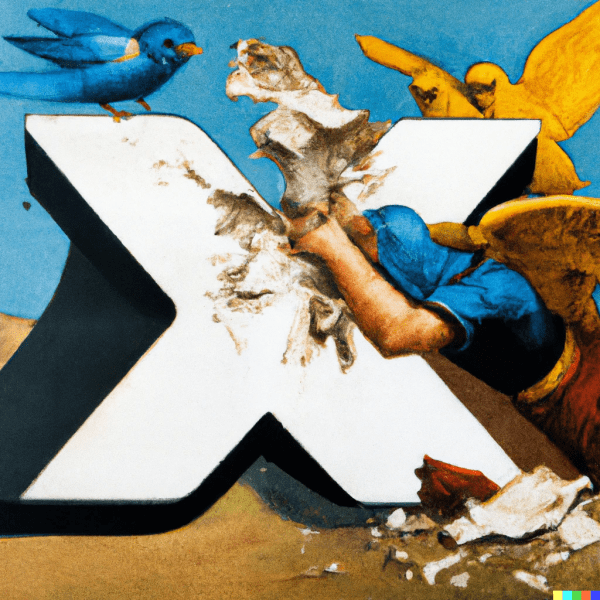
Elon Musk has made his mark. Twitter and its cute little birdy logo are dead. Like Monty Python’s famous parrot, this bird has shuffled off its mortal coil.

So Twitter is dead, Long live X?

I know — that seems weird to me, too.

Musk clearly has a thing for the letter X. He founded a company called X.com that merged with PayPal in 2000. In his portfolio of companies, you’ll find SpaceX, xAI, X Corp. Its seldom you see so much devotion to 1/26th of the Latin alphabet.

It’s not unprecedented to pick a letter and turn it into a brand. Steve Jobs managed to make the letter “i” the symbol for everything Apple. Mind you, he also tacked on helpful product descriptors to keep us from getting confused. If he had changed the name of Apple to “I” and just left it at that, it might not have worked so well.

At their best, brands should immediately bridge the gap between the DNA of a company and a long-term niche in the brains of those of us in the marketplace. Twitter did that. When you saw the iconic bird logo or hear the word Twitter, you know exactly what it referred to.

This is easier when the company is known for a handful of products. But when companies stretch into multiple areas, it’s tough to make one brand synonymous with hundreds or thousands of products. 

This brand diffusion is common with the hyper-accelerated world of tech. You launch a product and it’s so successful, it becomes a mega-corporation. At some point you’re stuck with an awkward transition: You leave the original brand associated with that product and create an umbrella brand that is vague enough to shelter a diverse and expanding portfolio of businesses. That’s why Google created the generic Alpha brand, and why Facebook became Meta.

But Musk didn’t create an umbrella to shelter Twitter and its brand. He used it to beat the brand to death. Maybe he just doesn’t like blue birds.

When a brand does its job well, we feel a personal relationship with it. Twitter’s brand did this. It was unique in tech branding, primarily because it was cute and organic. It was an accessible brand, a breath of fresh air in a world of cryptic acronyms and made-up terms with weird spellings. It made sense to us. And we are sorry to see it go.

In fact, some of us are flat-out refusing to admit the bird is dead. One programmer has already whipped together a Chrome extension that strips out the X branding and brings our favorite little Tweeter back from the beyond. Much as I admire this denial, I suspect this is only delaying the inevitable. It’s time to say bye-bye birdy. 

This current backlash against Musk’s rebranding could be a natural outcome of his effort to move from being one tied to a product to one that creates a bigger tent for multiple products. He has been pretty vocal about X becoming an “everything” app, a la China’s WeChat.

I suspect the road to making X a viable brand is going to be a rocky one. First of all, if you were going to pick the most generic symbol imaginable, X would be your choice. It literally has been a stand in for pretty much everything you could think of for centuries now. Even my great, great grandfather signed his name with an “X.”

We Hotchkisses have always been ahead of our time.

But the ubiquity of “X” brings up another problem, this time on the legal front. According to a lengthy analysis of Twitter’s rebranding by Emma Roth, you can trademark a single letter, but trying to make X your brand will come with some potentially litigious baggage. Microsoft has a trademark on X. So does Meta.

As long at Musk’s X sticks to its knitting, that might not be a problem. Microsoft registered X for its Xbox gaming console. Meta’s trademark also has to do with gaming. Apparently, as long as you don’t cross industries and confuse customers, having the same trademark shouldn’t be an issue.

But the chances of Elon Musk playing nice and following the rules of trademark law while pursuing his plan for world domination are somewhat less than zero. In this case, I think it’s fair to speculate that the formula for the future will be: X = a shitload of lawyer fees. 

Also, even if you succeed in making X a recognized and unique brand, protecting that brand will be a nightmare. How do you build a legal fence around X when the choice of it as a brand was literally to tear down fences?

But maybe Musk has already foreseen all this. Maybe he has some kind of superpower to see things we can’t.

Kind of like Superman’s X-Ray vision.

It’s All in How You Spin It

I generally get about 100 PR pitches a week. And I’m just a guy who writes a post on tech, people and marketing now and then. I’m not a journalist. I’m not even gainfully employed by anyone. I am just one step removed — thanks to the platform  MediaPost has provided me — from “some guy” you might meet at your local coffee shop.

But still, I get 100 PR pitches a week. Desperation for coverage is the only reason I can think of for this to be so. 99.9999% of the time, they go straight to my trash basket. And the reason they do is that they’re almost never interesting. They are — well, they’re pitches for free exposure.

Now, the average pitch, even if it isn’t interesting, should at least try to match the target’s editorial interest. It should be in the strike zone, so to speak.

Let’s do a little postmortem on one I received recently. It was titled “AI in Banking.” Fair enough. I have written a few posts on AI. Specifically, I have written a few posts on my fear of AI.

I have also written about my concerns about misuse of data. When it comes to the nexus between AI and data, I would be considered more than a little pessimistic. So, something linking AI and banking did pique my interest, but not in a good way. I opened the email.

There, in the first paragraph, I read this: “AI is changing how banks provide personalized recommendations and insights based on enriched financial data offering tailored suggestions, such as optimizing spending, suggesting suitable investment opportunities, or identifying potential financial risks.”

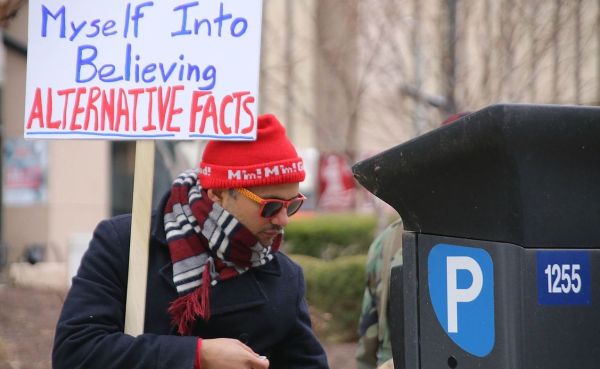
This, for those of you not familiar with “PR-ese,” is what we in the biz call “spin.” Kellyanne Conway once called it — more euphemistically — an alternative fact.

Let me give you an example. Let’s say that during the Tour de France half the Peloton crashes and bicyclists get a nasty case of road rash. A PR person would spin that to say that “Hundreds of professional cyclists discover a new miracle instant exfoliation technique from the South of France.”

See? It’s not a lie, it’s just an alternative fact.

Let’s go on. The second paragraph of the pitch continued: “Bud, a company that specializes in data intelligence is working with major partners across the country (Goldman Sachs, HSBC, 1835i, etc.) to categorize and organize financial information and data so that users are empowered to make informed decisions and gain a deeper understanding of their financial situation.”

Ah — we’re now getting closer to the actual fact. The focus is beginning to switch from the user, empowered to make better financial decisions thanks to AI, to what is actually happening: a data marketplace being built on the backs of users for sale to corporate America.

Let’s now follow the link to Bud’s website. There, in big letters on the home page, you read:

“Turn transactional data into real-time underwriting intelligence

Bud’s AI platform and data visualizations help lenders evaluate risk, reduce losses and unlock hidden revenue potential.”

Bingo. This is not about users, at least, not beyond using them as grist in a data mill. This is about slipping a Trojan Horse into your smartphone in the form of an app and hoovering your personal data up to give big banks an intimate glimpse into not just your finances, but also your thinking about those finances. As you bare your monetary soul to this helpful “Bud,” you have established a direct pipeline to the very institutions that hold your future in their greedy little fingers. You’re giving an algorithm everything it needs to automatically deny you credit.

This was just one pitch that happened to catch my eye long enough to dig a little deeper. But it serves as a perfect illustration of why I don’t trust big data or AI in the hands of for-profit corporations.

And that will continue to be true — no matter how you PR pros spin it.

The Spark in the Jar: Jon Ive and Steve Jobs

I sold all my Apple stock shortly after Steve Jobs passed away. It was premature (which is another word for stupid). Apple stock is today worth about 10 times what I sold it for.

My reasoning was thus: Apple couldn’t function without Steve Jobs – not for long, anyway.

Well, 12 years later, it’s doing quite well, thank you. It has a stock price of almost $200 per share (as of the writing of this). Sales have never been stronger. While replacement CEO Tim Cook is no Steve Jobs, financially he has grown Apple into a monolithic force with a market capitalization of almost 3 trillion dollars. There is no other company even close to that.

Now, with the benefit of hindsight, I realize I underestimated Tim Cook. But I stand with my original instinct: whatever Apple was under Steve Jobs, it couldn’t survive without him. And to understand why, let’s take a quick look back.

Jobs was infamously ousted from Apple in 1985. He remained in “NeXTile” for 12 years, coming back in 1997 to lead Apple into what many believe was its Golden Era. He passed away in 2011.

In the 14 years Jobs led Apple in his second run, the stock price went from about 20 cents to about 12 dollars. That’s growth of about 6000%.  Steve Jobs brought Apple back from the brink of death. If it wasn’t for a lifeline thrown to it by its number one competitor, Microsoft, in 1997, Apple would be no more. As Jobs himself said, “Apple was in very serious trouble,” said Jobs. “And what was really clear was that if the game was a zero-sum game where for Apple to win, Microsoft had to lose, then Apple was going to lose.

But those growth numbers are a little misleading. For you to be one of the fastest growing companies in history, it helps when you start with a very, very small number. A share price of $0.20 is a very, very small number.

Much as everyone lauds Steve Jobs for the turnaround of Apple, I would argue that Tim Cooks performance is even more impressive. To say that Apple was already on a roll when Cook took over is an understatement. In 2011, Apple was going from success to success and could seem to do no wrong. That was one of the reasons I was pessimistic about its future. I thought it couldn’t sustain its run, especially when it came to introducing new products. How many Jobs inspired home runs could it possibly have in its pipeline?

But what Tim Cook was great at was logistics. He took that pipeline and managed to squeeze out another decade plus of value building thanks to what may be the best supply chain strategy in the world. Analysts have said that half of Apple’s 3 trillion dollars in value is directly attributable to that supply chain.

But when you squeeze every last inch of efficiency out of a supply chain, something has to give. And in this case, it may have been creativity.

The Job’s era Apple was a very rare and delicate thing in the corporate world: a leader who was uncompromising on user experience and a design team able to rise and meet the challenge. Was it dictorial? Absolutely. Was it magical? Almost always. It was like catching a spark in a jar.

That design team was headed by Jonathon Ive. And when you have a team that’s the absolute best in the world, you can put up with an asshole here and there, especially when that asshole keeps challenging you to be better.  And when you keep delivering.

The alchemy that made Apple spectacularly successful from 1996 to 2011 was a fragile thing. It wouldn’t take much to change the formula forever. For example, if you removed the catalyst – which was Steve Jobs – it couldn’t survive. But equally important to that formula was Jon Ive.

As David Price, the editor of Macworld said,

“What Ive brought to Apple was a coherent personal vision. That doesn’t mean Apple’s designs on his watch were always perfect, of course; there were plenty of missteps. In broader terms, his arch-minimalism could be frustrating for those who wanted more physical controls”

David Price, Macworld

Ive and Jobs were, by all accounts, inseparable. In a heartfelt tribute to Jobs published shortly after his passing, Ive remembered,

“We worked together for nearly 15 years. We had lunch together most days and spent our afternoons in the sanctuary of the design studio. Those were some of the happiest, most creative and joyful times of my life,” Ive wrote. “I loved how he saw the world. The way he thought was profoundly beautiful.”

Jon Ive

For Jobs and Ive – “Think Different” was both a manifesto and a mantra. That philosophy started a not-so-slow death the minute Jobs passed from this earth. Finally, in June 2019, Ive announced his departure “after years of frustration, seeing the company migrate from a design-centric entity to one that was more utilitarian.”

It seems that companies can excel at either creativity or execution. It’s very difficult – perhaps impossible – to do both. The Apple of Steve Jobs was the world’s most creative corporation. The Apple of Tim Cook is a world leader in execution. But for one to happen, the other had to make room. Today, Apple is trying to be creative by committee. Macworld’s David Price mourns the Apple that was, “Maybe Apple is no longer a company that focuses on individual personality, or indeed on thinking different. This week we also got the news that Ive’s replacement will not be replaced, with a core group of 20 designers instead reporting directly to the chief operating officer, who is no stranger to design and likely has his own ideas. If design by committee has been the de facto approach for the past four years, it’s now been made official.”

And committees always suck all the oxygen from the room. In that atmosphere, the spark that once was Apple inevitably had to go out.

Why I’m Worried About AI

Even in my world, which is nowhere near the epicenter of the technology universe, everyone is talking about AI And depending on who’s talking – it’s either going to be the biggest boon to humanity, or it’s going to wipe us out completely. Middle ground seems to be hard to find.

I recently attended a debate at the local university about it. Two were arguing for AI, and two were arguing against. I went into the debate somewhat worried. When I walked out at the end of the evening, my worry was bubbling just under the panic level.

The “For” Team had a computer science professor – Kevin Leyton-Brown, and a philosophy professor – Madeleine Ransom. Their arguments seemed to rely mainly on creating more leisure time for us by freeing us from the icky jobs we’d rather not do. Leyton-Brown did make a passing reference to AI helping us to solve the many, many wicked problems we face, but he never got into specifics.

“Relax!” seemed to be the message. “This will be great! Trust us!”

The “Against” Team was comprised of a professor in Creative and Critical Studies – Bryce Traister. As far as I could see, he seemed to be mainly worried about AI replacing Shakespeare. He did seem quite enamored with the cleverness of his own quips.

It was the other “Against” debater who was the only one to actually talk about something concrete I could wrap my head around. Wendy Wong is a professor of Political Science. She has a book on data and human rights coming out this fall. Many of her concerns focused on this area.

Interestingly, the AI debaters all mentioned Social Media in their arguments. And on this point, they were united. All the debaters agreed that the impact of Social Media has been horrible. But the boosters were quick to say that AI is nothing like Social Media.

Except that it is. Maybe not in terms of the technology that lies beneath it, but in terms of the unintended consequences it could unleash, absolutely! Like Social Media, what will get us with AI are the things we don’t know we don’t know.

I remember when social media first appeared on the scene. Like AI, there were plenty of evangelists lining up saying that technology would connect us in ways we couldn’t have imagined. We were redefining community, removing the physical constraints that had previously limited connections.

If there was a difference between social media and AI, it was that I don’t remember the same doomsayers at the advent of social media. Everyone seemed to be saying “This will be great! Trust us!”

Today, of course, we know better. No one was warning us that social media would divide us in ways we never imagined, driving a wedge down the ideological middle of our society. There were no hints that social media could (and still might) short circuit democracy.

Maybe that’s why we’re a little warier when it comes to AI. We’ve already been fooled once.

I find that AI Boosters share a similar mindset – they tend to be from the S.T.E.M. (Science, Technology, Engineering and Math) School of Thought. As I’ve said before, these types of thinkers tend to mistake complex problems for complicated ones. They think everything is solvable, if you just have a powerful enough tool and apply enough brain power. For them, AI is the Holy Grail – a powerful tool that potentially applies unlimited brain power.

But the dangers of AI are hidden in the roots of complexity, not complication, and that requires a different way of thinking. If we’re going to get some glimpse of what’s coming our way, I am more inclined to trust the instincts of those that think in terms of the humanities. A thinker, for example, such as Yuval Noah Harari, author of Sapiens.

Harari recently wrote an essay in the Economist that may be the single most insightful thing I’ve read about the dangers of AI: “AI has gained some remarkable abilities to manipulate and generate language, whether with words, sounds or images. AI has thereby hacked the operating system of our civilisation.”

In my previous experiments with ChatGPT, it was this fear that was haunting me. Human brains operate on narratives. We are hard-wired to believe them. By using language, AI has a back door into our brains that bypass all our protective firewalls.

My other great fear is that the development of AI is being driven by for-profit corporations, many of which rely on advertising as their main source of revenue. If ever there was a case of putting the fox in charge of the henhouse, this is it!

When it comes to AI it’s not my job I’m afraid of losing. It’s my ability to sniff out AI generated bullshit. That’s what’s keeping me up a night.

Deconstructing a Predatory Marketplace

Last week, I talked about a predatory ad market that was found in — of all places — in-game ads. And the predators are — of all things — the marketers of Keto Gummies. This week, I’d like to look at why this market exists, and why someone should do something about it.

First of all, let’s understand what we mean by “predatory.” In biological terms, predation is a zero-sum game. For a predator to win, someone has to lose.  On Wikipedia, it’s phrased a little differently: “Predatory marketing campaigns may (also) rely on false or misleading messaging to coerce individuals into asymmetrical transactions. “

 “Asymmetrical” means the winner is the predator, the loser is the prey.

In the example of the gummy market, there are three winners — predators — and three losers, or prey. The winners are the marketers who are selling the gummies, the publishers who are receiving the ad revenue and the supply side platform that mediates the marketplace and take its cut.

The losers — in ascending order of loss — are the users of the games who must suffer through these crappy ads, the celebrities who have had their names and images illegally co-opted by the marketer, and the consumers who are duped into actually buying a bottle of these gummies.

You might argue the order of the last two, depending on what value you put on the brand of the celebrity. But in terms of sheer financial loss, consumer fraud is a significant issue, and one that gets worse every year.  In February, the Federal Trade Commission reported that U.S. consumers lost $8.8 billion to scams last year, many of which occurred online. The volume of scams is up 30% over 2021, and is 70% higher than it was in 2020.

So it’s not hard to see why this market is predatory. But is it fraudulent? Let’s apply a legal litmus test. Fraud is generally defined as “any form of dishonest or deceptive behavior that is intended to result in financial or personal gain for the fraudster, and does harm to the victim.”

Based on this, fraud does seem to apply. So why doesn’t anyone do anything?

For one, we’re talking about a lot of potential money here. Statista pegs the in-game ad market at $32.5 billion worldwide in 2023, with projected annual growth rate of 9.10% That kind of money provides a powerful incentive to publishers and supply-side platforms (SSPs) to look the other way.

I think it’s unreasonable expect the marketers of the gummies to police themselves. They have gone to great pains to move themselves away from the threat of legal litigation. These corporations are generally registered in jurisdictions like China or Cyprus, where legal enforcement of copyright or consumer protections are nonexistent. If someone like Oprah Winfrey has been unable to legally shut down the fraudulent use of her image and brand for two years, you can bet the average consumer who has been ripped off has no recourse. 

But perhaps one of the winners in this fraudulent ecosystem — the SSPs – should consider cracking down on this practice.

In nature, predators are kept in check by something called a predator-prey relationship. If predators become too successful, they eliminate their prey and seal their own doom. But this relationship only works if there are no new sources of prey. If we’re talking about an ecosystem that constantly introduces new prey, nothing keeps predators in check.

Let’s look at the incentive for the game publishers to police the predators. True, allowing fraudulent ads does no favours for the users of their game. A largescale study by Gao, Zeng, Lu et al found that bad ads lead to a bad user experience.

But do game publishers really care? There is no real user loyalty to games, so churn and burn seems to be the standard operating procedure. This creates an environment particularly conducive to predators.

So what about the SSPs?

GeoEdge, an ad security solution that guards against malvertising, among other things, has just released its Q1 Ad Quality Report. In an interview, Yuval Shiboli, the company’s director of product market, said that while malicious ads are common across all channels, in-game advertising is particularly bad because of a lack of active policing: “The fraudsters are very selective in who they show their malicious ads, looking for users who are scam-worthy, meaning there is no security detection software in the environment.”

Quality of advertising is usually directly correlated with the pricing of the ad inventory. The cheaper the ad, the poorer the quality. In-game ads are relatively cheap, giving fraudulent predators an easy environment to thrive in. And this entire environment is created by the SSPs.

According to Shiboli, it’s a little surprising to learn who are the biggest culprits on the SSP side: “Everybody on both the sell side and buy side works with Google, and everyone assumes that its platforms are clean and safe. We’ve found the opposite is true, and that of all the SSP providers, Google is the least motivated to block bad ads.”

By allowing — even encouraging — a predatory marketplace to exist, Google and other SSPs are doing nothing less than aiding and abetting criminals. In the short term, this may add incrementally to their profits, but at what long-term price?