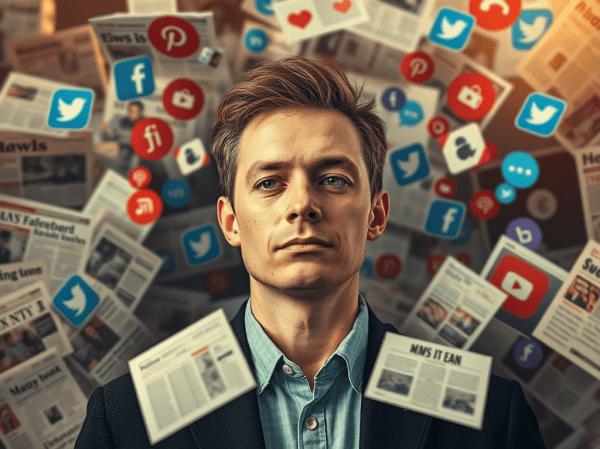
Strategies for Surviving the News

When I started this post, I was going to unpack some of the psychology behind the consumption of the news. I soon realized that the topic is far beyond the confines of this post to realistically deal with. So I narrowed my focus to this – which has been very top of mind for me lately – how do you stay informed without becoming a trembling psychotic mess? How do you arm yourself for informed action rather than becoming paralyzed into inaction by the recent fire hose of sheer WTF insanity that makes up the average news feed.

Pick Your Battles

There are few things more debilitating to humans than fretting about things we can’t do anything about. Research has found a strong correlation between depression and our locus of control – the term psychologists use for the range of things we feel we can directly impact. There is actually a term for being so crushed by bad news that you lose the perspective needed to function in your own environment. It’s called Mean World Syndrome.

If effecting change is your goal, decide what is realistically within your scope of control. Then focus your information gathering on those specific things. When it comes to informing yourself to become a better change agent, going deep rather than wide might be a better strategy.

Be Deliberate about Your Information Gathering

The second strategy goes hand in hand with the first. Make sure you’re in the right frame of mind to gather information. There are two ways the brain processes information: top-down and bottom-up. Top-down processing is cognition with purpose – you have set an intent and you’re working to achieve specific goals. Bottom up is passively being exposed to random information and allowing your brain to be stimulated by it. The way you interpret the news will be greatly impacted by whether you’re processing it with a “top-down” intent or letting your brain parse it from the “bottom-up”

By being more deliberate in gathering information with a specific intent in mind, you completely change how your brain will process the news. It will instantly put it in a context related to your goal rather than let it rampage through our brains, triggering our primordial anxiety circuits.

Understand the Difference between Signal and Noise

Based on the top two strategies, you’ve probably already guessed that I’m not a big fan of relying on social media as an information source. And you’re right. A brain doom scrolling through a social media feed is not a brain primed to objectively process the news.

Here is what I did. For the broad context, I picked two international information sources I trust to be objective: The New York Times and the Economist out of the U.K. I subscribed to both because I wanted sources that weren’t totally reliant on advertising as a revenue source (a toxic disease which is killing true journalism). For Americans, I would highly recommend picking at least one source outside the US to counteract the polarized echo chamber that typifies US journalism, especially that which is completely ad supported.

Depending on your objectives, include sources that are relevant to those objectives. If local change is your goal, make sure you are informed about your community. With those bases in place, even If you get sucked down a doom scrolling rabbit hole, at least you’ll have a better context to allow you to separate signal from noise.

Put the Screen Down

I realize that the majority of people (about 54% of US Adults according to Pew Research) will simply ignore all of the above and continue to be informed through their Facebook or X feeds. I can’t really change that.

But for the few of you out there that are concerned about the direction the world seems to be spinning and want to filter and curate your information sources to effect some real change, these strategies may be helpful.

For my part, I’m going to try to be much more deliberate in how I find and consume the news.  I’m also going to be more disciplined about simply ignoring the news when I’m not actively looking for it. Taking a walk in the woods or interacting with a real person are two things I’m going to try to do more.

The Messaging of Climate Change

86% of the world believes that climate change is a real thing. That’s the finding of a massive new mega study with hundreds of authors (the paper’s author acknowledgement is a page and a half). 60,000 participants from 63 countries around the world took part. And, as I said, 86% of them believe in climate change.

Frankly, there’s no surprise there. You just have to look out your window to see it. Here in my corner of the world, wildfires wiped out hundreds of homes last summer and just a few weeks ago, a weird winter whiplash took temperatures from unseasonably warm to deep freeze cold literally overnight. This anomaly wiped out this region’s wine industry. The only thing surprising I find about the 86 percent stat is that 14% still don’t believe. That speaks of a determined type of ignorance.

What is interesting about this study is that it was conducted by behavioral scientists. This is an area that has always fascinated me. From the time I read Richard Thaler and Cass Sunstein’s book, Nudge, I have always been interested in behavioral interventions. What are the most effective “nudges” in getting people to shift their behaviors to more socially acceptable directions?

According to this study, that may not be that easy. When I first dove into this study, my intention was to look at how different messages had different impacts depending on the audience: right wing vs left wing for instance. But in going through the results, what struck me the most was just how poorly all the suggested interventions performed. It didn’t matter if you were liberal or conservative or lived in Italy or Iceland. More often than not, all the messaging fell on deaf ears.

What the study did find is that how you craft your campaign about climate change depends on what you want people to do. Do you want to shift non-believers in Climate Change towards being believers? Then decrease the psychological distance. More simply put, bring the dangers of climate change to their front doorstep. If you live next to a lot of trees, talk about wildfires. If you live on the coast, talk about flooding. If you live in a rural area, talk about the impacts of drought. But it should be noted that we weren’t talking a massive shift here – with an “absolute effect size of 2.3%”. It was the winner by the sheer virtue of sucking the least.

If you want to build support for legislation that mitigates climate change, the best intervention was to encourage people to write a letter to a child that’s close to you, with the intention that they read it in the future. This forces the writer to put some psychological skin in the game.  

Who could write a future letter to someone you care about without making some kind of pledge to make sure there’s still a world they can live in? And once you do that, you feel obligated to follow through. Once again, this had a minimal impact on behaviors, with an overall effect size of 2.6%.

A year and a half ago, I talked about Climate Change messaging, debating Mediapost Editor-in-Chief Joe Mandese about whether a doom and gloom approach would move the needle on behaviors. In a commentary from the summer of 2022, Mandese wrapped up by saying, “What the ad industry really needs to do is organize a massive global campaign to change the way people think, feel and behave about the climate — moving from a not-so-alarmist “change” to an “our house is on fire” crisis.”

In a follow up, I worried that doom and gloom might backfire on us, “Cranking up the crisis intensity on our messaging might have the opposite effect. It may paralyze us.”

So, what does this study say?

The answer, again, is, “it depends.” If we’re talking about getting people to share posts on social media, then Doom and Gloom is the way to go. Of all the various messaging options, this had the biggest impact on sharing, by a notable margin.

This isn’t really surprising. A number of studies have shown that negative news is more likely to be shared on social media than positive news.

But what if we’re asking people to make a change that requires some effort beyond clicking the “share” button? What if they actually have to do something? Then, as I suspected, Doom and Gloom messaging had the opposite effect, decreasing the likelihood that people would make a behavioral change to address climate change (the study used a tree planting initiative as an example). In fact, when asking participants to actually change their behavior in an effortful way, all the tested climate interventions either had no effect or, worse, they “depress(ed) and demoralize(d) the public into inaction”.

That’s not good news. It seems that no matter what the message is, or who the messenger is, we’re likely to shoot them if they’re asking us to do anything beyond bury our head in the sand.

What’s even worse, we may be losing ground. A study from 10 years ago by Yale University had more encouraging results. They showed that effective climate change messaging, was able to shift public perceptions by up to 19 percent. While not nearly as detailed as this study, the results seem to indicate a backslide in the effectiveness of climate messaging.

One of the commentators that covered the new worldwide study perhaps summed it up best by saying, “if we’re dealing with what is probably the biggest crisis ever in the history of humanity, it would help if we actually could talk about it.”