The Cost of Not Being Curious

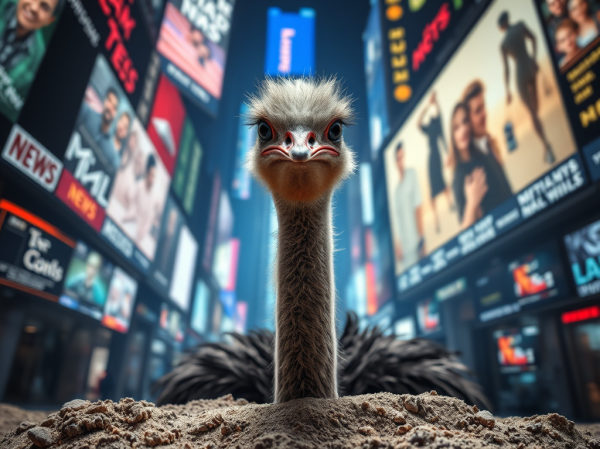
The world is having a pandemic-proportioned wave of Ostrichitis.

Now, maybe you haven’t heard of Ostrichitis. But I’m willing to bet you’re showing at least some of the symptoms:

  • Avoiding newscasts, especially those that feature objective and unbiased reporting
  • Quickly scrolling past any online news items in your feed that look like they may be uncomfortable to read
  • Dismissing out of hand information coming from unfamiliar sources

These are the signs of Ostrichitis – or the Ostrich Effect – and I have all of them. This is actually a psychological effect, more pointedly called willful ignorance, which I wrote about a few years ago. And from where I’m observing the world, we all seem to have it to one extent or another.

I don’t think this avoidance of information comes as a shock to anyone. The world is a crappy place right now. And we all seem to have gained comfort from adopting the folk wisdom that “no news is good news.” Processing bad news is hard work, and we just don’t have the cognitive resources to crunch through endless cycles of catastrophic news. If the bad news affirms our existing beliefs, it makes us even madder than what we were. If it runs counter to our beliefs, it forces us to spin up our sensemaking mechanisms and reframe our view of reality. Either way, there are way more fun things to do.

A recent study from the University of Chicago attempted to pinpoint when children started avoid bad news. The research team found that while young children don’t tend to put boundaries around their curiosity, as they age they start avoiding information that challenges their beliefs or their own well-being. The threshold seems to be about 6 years old. Before that, children are actively seeking information of all kinds (as any parent barraged by never ending “Whys” can tell you). After that, chidren start strategizing the types of information they pay attention to.

Now, like everything about humans, curiosity tends to be an individual thing. Some of us are highly curious and some of us avoid seeking new information religiously. But even if we are a curious sort, we may pick and choose what we’re curious about. We may find “safe zones” where we let our curiosity out to play. If things look too menacing, we may protect ourselves by curbing our curiosity.

The unfortunate part of this is that curiosity, in all its forms, is almost always a good thing for humans (even if it can prove fatal to cats).

The more curious we are, the better tied we are to reality. The lens we use to parse the world is something called a sense-making loop. I’ve often referred to this in the past. It’s a processing loop that compares what we experience with what we believe, referred to as our “frame”. For the curious, this frame is often updated to match what we experience. For the incurious, the frame is held on to stubbornly, often by ignoring new information or bending information to conform to their beliefs. A curious brain is a brain primed to grow and adapt. An incurious brain is one that is stagnant and inflexible. That’s why the father of modern-day psychology, William James, called curiosity “the impulse towards better cognition.”

When we think about the world we want, curiosity is a key factor in defining it. Curiosity keeps us moving forward. The lack of curiosity locks us in place or even pushes us backwards, causing the world to regress to a more savage and brutal place. Writers of dystopian fiction knew this. That’s why authors including H.G. Wells, Aldous Huxley, Ray Bradbury and George Orwell all made a lack of curiosity a key part of their bleak future worlds. Our current lack of curiosity is driving our world in the same dangerous direction.

For all these reasons, it’s essential that we stay curious, even if it’s becoming increasingly uncomfortable.

Do We Have the Emotional Bandwidth to Stay Curious?

Curiosity is good for the brain. It’s like exercise for our minds. It stretches the prefrontal cortex and whips the higher parts of our brains into gear. Curiosity also nudges our memory making muscles into action and builds our brain’s capacity to handle uncertain situations.

But it’s hard work – mentally speaking. It takes effort to be curious, especially in situations where curiosity could figuratively “kill the cat.” The more dangerous our environment, the less curious we become.

A while back I talked about why the world no longer seems to make sense. Part of this is tied to our appetite for curiosity. Actively trying to make sense of the world puts us “out there”, leaving the safe space of our established beliefs behind. It is literally the definition of an “open mind” – a mind that has left itself open to being changed. And that’s a very uncomfortable place to be when things seem to be falling down around our ears.

Some of us are naturally more curious than others. Curious people typically achieve higher levels of education (learning and curiosity are two sides of the same coin). They are less likely to accept things at face value. They apply critical thinking to situations as a matter of course. Their brains are wired to be rewarded with a bigger dopamine hit when they learn something new.

Others rely more on what they believe to be true. They actively filter out information that may challenge those beliefs. They double down on what is known and defend themselves from the unknown. For them, curiosity is not an invitation, it’s a threat.

Part of this is a differing tolerance for something which neuroscientists call “prediction error” – the difference between what we think will happen and what actually does happen. Non-curious people perceive predictive gaps as threats and respond accordingly, looking for something or someone to blame. They believe that it can’t be a mistaken belief that is to blame, it must be something else that caused the error. Curious people look at prediction errors as continually running scientific experiments, given them a chance to discover the errors in their current mental models and update them based on new information.

Our appetite for curiosity has a huge impact on where we turn to be informed. The incurious will turn to information sources that won’t challenge their beliefs. These are people who get their news from either end of the political bias spectrum, either consistently liberal or consistently conservative. Given that, they can’t really be called information sources so much as opinion platforms. Curious people are more willing to be introduced to non-conforming information. In terms of media bias, you’ll find them consuming news from the middle of the pack.

Given the current state of the world, more curiosity is needed but is becoming harder to find. When humans (or any animal, really) are threatened, we become less curious. This is a feature, not a bug. A curious brain takes a lot longer to make a decision than a non-curious one. It is the difference between thinking “fast” and “slow” – in the words of psychologist and Nobel laureate Daniel Kahneman. But this feature evolved when threats to humans were usually immediate and potentially fatal. A slow brain is not of any benefit if you’re at risk of being torn apart by a pack of jackals. But today, our jackal encounters are usually of the metaphorical type, not the literal one. And that’s a threat of a very different kind.

Whatever the threat, our brain throttles back our appetite for curiosity. Even the habitually curious develop defense mechanisms in an environment of consistently bad news. We seek solace in the trivial and avoid the consequential. We start saving cognitive bandwidth from whatever impending doom we may be facing. We seek media that affirms our beliefs rather than challenges them.

This is unfortunate, because the threats we face today could use a little more curiosity.