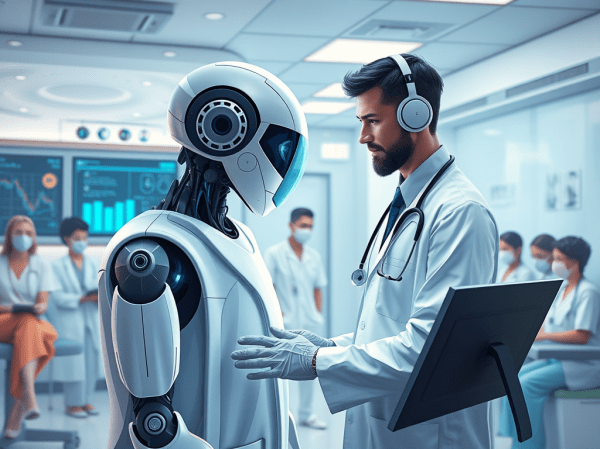
Paging Dr. Robot

When it comes to the benefits of A.I. one of the most intriguing opportunities is in healthcare. Microsoft’s recent announcement that, given a diagnostic challenge where their Microsoft AI Diagnostic Orchestrator (MAI-DxO) went head to head with 21 general-practice practitioners, the A.I. system correctly diagnosed 85% of 300 challenging cases gathered from the New England Journal of Medicine. The human doctors only managed to get 20% of the diagnoses correct.

This is of particular interest to me, because Canada has a health care problem. In a recent comparison of international health policies conducted by the Commonwealth Fund, Canada came in last amongst 9 countries, most of which also have universal health care, on most key measures of timely access.

This is a big problem, but it’s not an unsolvable one. This does not qualify as a “wicked” problem, which I’ve talked about before. Wicked problems have no clear solution. I believe our healthcare problems can be solved, and A.I. could play a huge role in the solution.

The Canadian Medical Association outlined both the problems facing our healthcare system and some potential solutions. The overarching narrative is one of a system stretched beyond its resources and patients unable to access care in a timely manner. Human resources are burnt out and demotivated. Our back-end health record systems are siloed and inconsistent. An aging population, health misinformation, political beliefs and climate change are creating more demand for health services just as the supply of those services are being depleted.

Here’s one personal example of the gaps in our own health records. I recently had to go to my family doctor for a physical that is required to maintain my commercial driver’s license. I was delegated to a student doctor, given that it was a very routine check-up. Because I was seeing the doctor anyway, I thought it a good time to ask for a regular blood panel test because it had been a while since I had had one. Being a male of a certain age, I also asked for a Prostate-Specific Antigen test (PSA) and was told that it isn’t recommended as a screening test in my province anymore.

I was taken aback. I had been diagnosed with prostate cancer a decade earlier and had been successfully treated for it. It was a PSA test that led to an early diagnosis. I mentioned this to the doctor, who was sitting behind a computer screen with my records in front of him. He looked back at the screen and said, “Oh, you had prostate cancer? I didn’t know that. Sure, I’ll add a PSA to the requisition.”

I wish I could say that’s an isolated incident, but it’s not. These gaps is our medical history records happen all the time here in my part of Canada. And they can all be solved. It’s the aggregation and analysis of data beyond the limits of humans to handle that A.I. excels at. Yet our healthcare system continues to overwork exhausted healthcare providers and keep our personal health data hostage in siloed data centers because of systemic resistance to technology. I know there are concerns, but surely these concerns can be addressed.

I write this from a Canadian perspective, but I know these problems – and others – exist in the U.S. as well.  If A.I. can do certain jobs four times better than a human, it’s time to accept that and build it into our healthcare system. The answer to Canada’s healthcare problems may not be easy, but they are doable: integrate our existing health records, open the door to incorporation of personal biometric data from new wearable devices, use A.I. to analyze all this, and use humans where they can do things A.I. and technology can’t.

We need to start opening our mind to new solutions, because when it comes to a broken healthcare system, it’s literally a matter of life and death.
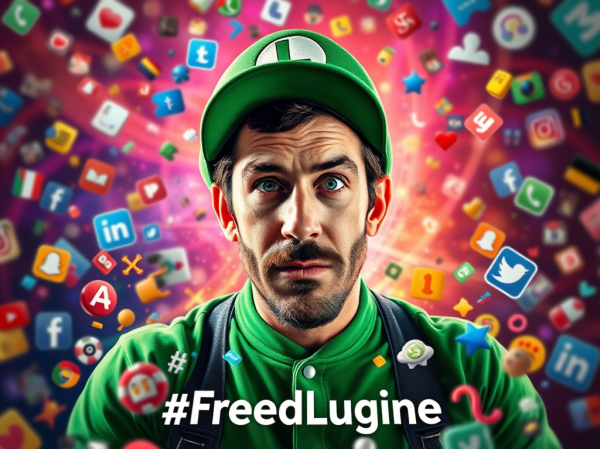
The Strange Social Media Surge for Luigi Mangione

Luigi Mangione is now famous. Just one week ago, we had never heard of him. But now, he has become so famous, I don’t even have to recount the reason for his fame.

But, to me, what’s more interesting than Mangione’s sudden fame is how we feel about him. According to the Network Contagion Research Institute there is a lot of online support for Luigi Mangione. An online funding campaign has raised over $130,000 for his legal defense fund. The hashtag #FreeLuigi, #TeamLuigi and other pro-Luigi memes have taken over every social media channel. Amazon, Etsy and E-Bay are scrambling to keep Luigi inspired merchandise out of their online stores. His X (formerly Twitter) account has ballooned from 1500 followers to almost half a million.

It’s an odd reaction for someone who is accused of gunning down a prominent American businessman in cold blood.

The outpouring of support for Luigi Mangione is so consequential, it’s threatening to lay a very heavy thumb on the scales of justice. There is so much public support for Luigi Mangione, prosecutors are worried that it could lead to jury nullification. It may be impossible to find unbiased and impartial jurors who would find Mangione guilty, even if it’s proven beyond a reasonable doubt.

Now, I certainly don’t want to comment or Mr. Mangione’s guilt, innocence or whether he’s appropriate material from which to craft a folk hero. Nor do I want to talk about the topic of American Healthcare and the corporate ethics of United Healthcare or any other medical insurance provider.  I won’t even dive into the admittedly juicy and ironic twist that our latest anti-capitalist hero of the common people is a young, white, male, good looking, wealthy and privately educated scion who probably leans right in his political beliefs.

No, I will leave all of that well enough alone. What I do want to talk about is how this had played out through social media and why it’s different than anything we’ve seen before.

We behave and post differently depending on what social platform we’re on at the time. In sociology and psychology, this is called “modality.”  How we act depends on what role we’re playing and what mode we’re in. The people we are, the things we do, the things we say and the way we behave are very different when we’re being a parent at home, an employee at work or a friend having a few drinks after work with our buddies. Each mode comes with different scripts and we usually know what is appropriate to say in each setting.

It was sociologist Erving Goffman who likened it to being on stage in his 1956 book, The Presentation of Self in Everyday Life. The roles we choose to play depends on the audience we’re playing too. We try to stay consistent with the expectations we think the audience has of us. Goffman said, “We are all just actors trying to control and manage our public image, we act based on how others might see us.”

Now, let’s take this to the world of social media. What we post depends on how it plays to the audience of the platform we’re on. We may have a TikTok persona, a Facebook persona and an X persona. But all of those are considered mainstream platforms, especially when compared to platforms like 4Chan, Parler or Reddit. If we’re on any of those platforms, we are probably taking on a very different role and reading from a different script.

Think of it this way. Posting something on Facebook is a little like getting up and announcing something at a townhall meeting that’s being held at your kid’s school. You assume that the audience will be somewhat heterogenous in terms of tastes and ideologies, and you consider your comments accordingly.

But posting something on 4Chan is like the conversation that might happen with your 4 closest bros (4Chan’s own demos admit their audience is 70% male) after way too many beers at a bar. Fear about stepping over the line is non-existent. Racial slurs, misogynistic comments and conspiracy theories abound in this setting.

The thing that’s different with the Mangione example is that comments we would only expect to see on the fringes of social media are showing up in the metaphorical Town Square of Facebook and Instagram (I no longer put X in this category, thank to Mr. Musk’s flirting with the Fringe). In the report from the Network Contagion Research Institute, the authors said,  “While this phenomenon was once largely confined to niche online subcultures, we are now witnessing similar dynamics emerging on mainstream platforms, amplifying the risk of further escalation,”

As is stated in this report, the fear is that by moving discussions of this sort into a mainstream channel, we legitimize it. We have moved the frame of what’s acceptable to say (my oft referenced example of Overton’s Window) into uncharted territory in a new and much more public arena. This could create an information cascade, when can encourage copycats and other criminal behavior.

This is a social phenomenon that will have implications for our future. The degrees of separation between the wild, wacky outer fringes of social media and the mainstream information sources that we use to view the world through are disappearing, one by one. With the Luigi Mangione example, we just realized how much things have changed.