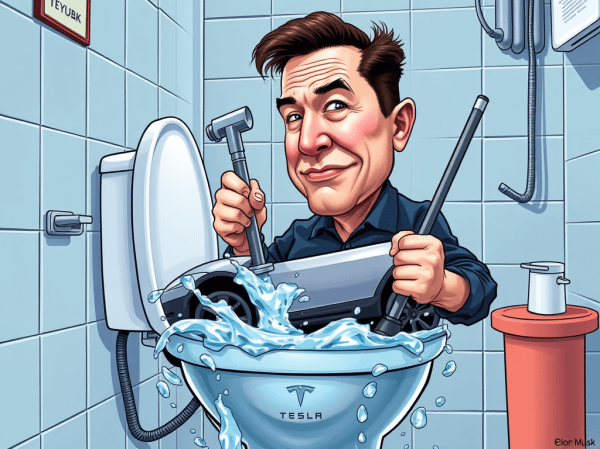
The Tesla Cybertruck’s Branding Blow-Up

The inexact science of branding is nowhere more evident that in the case of the Tesla Cybertruck, which looks like it might usurp the Edsel’s title as the biggest automotive flop in history.

First, a little of the Tesla backstory. No, it wasn’t founded by Elon Musk. It was founded in 2003 by Martin Eberhard and Marc Tarpenning. Musk came in a year later as a money man. Soon, he had forced Eberhard and Tarpenning out of the company. But their DNA remained, notably in the design and engineering of the hugely popular Tesla Model S, Model X and Model 3. These designs drove Tesla to capture over 50% of the electric car market and are straight line extensions of the original technology developed by Eberhard, Tarpenning and their initial team

Musk is often lauded as an eccentric genius in the mold of Steve Jobs, who had his fingers in every aspect of Tesla. While he was certainly influential, it’s not in the way most people think. The Model S, Model X and Model 3 soon became plagued by production issues, failed software updates, product quality red flags and continually failing to meet to meet Musk’s wildly optimistic and often delusional predictions, both in terms of sales and promised updates. Those things all happened on Musk’s watch.  Even with all this, Tesla was the darling of investors and media, driving it to be the most valuable car company in the world.

Then came the Cybertruck.

Introduced in 2019, the Cybertruck did have Musk’s fingerprints all over it. The WTF design, the sheer impracticality of a truck in name only, a sticker price nearly double of what Musk originally promised and a host of quality issues including body panels that have a tendency to fall off have caused sales to not even come close to projections.

In its first year of sales (2024), the Cybertruck sold 40,000 units, about 16% of what Musk predicted annual sales could be. That makes it a bigger fail than the Edsel, which sold 63,000 units against a target of 200,000 sales in its introductory year – 1958. The Edsel did worse in 1959 and was yanked from the market in 1960. The Cybertruck is sinking even faster. In the first quarter of this year, only 6406 Cybertrucks were sold, half the number sold in the same quarter a year ago. There are over 10,000 Cybertrucks on Tesla lots in the U.S., waiting for buyers that have yet to show up.

But it’s not just that the Cybertruck is a flawed product. Musk has destroyed Tesla’s brand in a way that can only be marvelled at. His erratic actions have managed to generate feelings of visceral hate in a huge segment of the market and that hate has found a visible target in the Cybertruck. It has become the symbol of Elon Musk’s increasingly evident meltdown.

I remember my first reaction when I heard that Musk had jumped on the MAGA bandwagon. “How the hell,” I thought, “does that square with the Tesla brand?” That brand, pre-Musk-meltdown and pre-Cybertruck, was a car for the environmentally conscious who had a healthy bank account – excitingly leading edge but not dangerously so. Driving a Tesla made a statement that didn’t seem to be in the MAGA lexicon at all. It was all very confusing.

But I think it’s starting to make a little more sense. That brand was built by vehicles that Musk had limited influence over. Sure, he took full credit for the brand, but just like company he took over, it’s initial form and future direction was determined by others.

The Cybertruck was a different story. That was very much Musk’s baby. And just like his biological ones (14 and counting), it shows all the hallmarks of Musk’s “bull in a China shop” approach to life. He lurches from project to project, completely tone-deaf to the implications of his actions. He is convinced that his genius is infallible. If the Tesla brand is a reflection of Musk, then the Cybertruck gives us a much truer picture. It shows what Tesla would have been if there had never been a Martin Eberhard and Marc Tarpenning and Musk was the original founder.

To say that the Cybertruck is “off brand” for Tesla is like saying that the Titanic had a tiny mishap. But it’s not that Musk made a mistake in his brand stewardship. It’s that he finally had the chance to build a brand that he believed in.

Will There Be a Big-Tech Reckoning?

Jeff Bezos, Mark Zuckerberg and Tim Cook must be thanking their lucky stars that Elon Musk is who he is. Musk is taking the brunt of any Anti-Trump backlash and seems to be relishing in it. Heaven only knows what is motivating Musk, but he is casting a smoke screen so wide and dense it’s obliterating the ass-kissing being done by the rest of the high-tech oligarchs.  In addition to Bezos, Zuckerberg and Cook, Microsoft’s Satya Nadella, Google’s Sundar Pichai and many other high-tech leaders have been making goo-goo eyes at Donald Trump.

Let’s start with Jeff Bezos. One assumes he is pandering to the president because his companies have government contracts worth billions. That pandering has included a pilgrimage to Trump’s Mar-a-Lago, a one million donation to his inauguration fund (which was streamed live on Amazon Prime), and green-lighting a documentary on Melania Trump. The Bezos-owned Washington Post declined from endorsing Kamala Harris as a presidential candidate, prompting some of its editorial staff to resign. At Amazon, the company has backed off some of its climate pledge commitments and started stripping Diversity, Equity and Inclusion programs from their HR handbook.

Mark Zuckerberg joined Trump supporting podcaster Joe Rogan for almost three hours to explain how they were realigning Facebook to be more Trump-friendly. This included canning their fact checkers and stopping policing of misinformation. During the interview, Zuckerberg took opportunities to slam media and the outgoing Biden administration for daring to question Facebook about misleading posts about Covid-19 vaccines. Zuckerberg, like Bezos, also donated $1 million to Trump’s inaugural fund and has rolled back DEI initiatives at Meta.

Tim Cook’s political back-bend had been a little more complicated. On the face of it, Apple’s announcement that it would be investing more than $500 billion in the U.S. and creating thousands of new jobs certainly sounds like a massive kiss to the Trumpian posterior but if you dig through the details, it’s really just putting a new spin on commitments Apple already made to support their development of Apple’s AI. And in many cases, the capital investment isn’t even coming from Apple. For instance, that new A.I. server manufacturing plant in Houston that was part of the announcement? That plant is actually being built by Apple partner Foxconn, not Apple.

As far as the rest of the Big Tech cabal, including Microsoft, Google and OpenAI, their new alignment with Trump is not surprising. Trump is promising to make the U.S. the undisputed leader in A.I. One would also imagine he would be more inclined than the Democrats to look the other way when it comes to things like anti-trust investigations and enforcement. So Big-Tech’s deferment to Trump is both entirely predictable and completely self-serving. I’m also guessing that all of them think they’re smarter than Trump and his administration, providing them a strategic opportunity to play Trump like a fiddle while pursuing their long-term corporate goals free from any governmental oversight or resistance. All evidence to date shows that they’re probably not mistaken in that assumption.

But all this comes at what cost? This could play out one of two ways. First, what happens if these High-Tech Frat Rat’s bets are wrong? There is an anti-Trump, anti-MAGA revolt building. Who knows what will happen, but in politically unprecedented times like this one has to consider every scenario, no matter how outrageous they may seem. One scenario is a significant percentage of Republicans decide their political future (and, hopefully, the future of the US as a democracy also factors into their thinking) is better off without a Donald Trump in it and start the wheels turning to remove him from power. If this is the case, things are going to get really, really nasty. There is going to be recrimination and finger pointing everywhere. And some of those fingers are going to be pointed at the big tech leaders who scrapped the ground bowing to Trump’s bluster and bullying.

Will that translate into a backlash against high-tech? I really am not sure. To date, these companies have been remarkably adept at sluffing off blame. IF MAGA ends up going down in flames, will Big Tech even get singed as they warm their hands at Donald Trump’s own bonfire of his vanities? Will we care about Big Tech’s obsequiousness when it comes time to order something from Amazon or get a new iPhone?

Probably not.  

But the other scenario is even more frightening: Trump stays in power and Big Tech is free to do whatever they hell they want. Based on what you know about Elon Musk, Mark Zuckerberg, Jeff Bezos and the rest, are you willing to let them be the sole architects of your future? Their about-face on Trump has shown that they will always, always, always place profitability above their personal ethics.