The Long-Term Fallout from MAGA: One Canadian’s Perspective

The other day, an American friend asked how Canada was currently feeling about Trump and the whole MAGA thing. You may remember some months back a number of broadsides towards Canada from the president that seemingly came from nowhere -– Trump threatening/cajoling us to become the 51st state, on again-off again tariffs, continued assertions that the US does not need Canada for anything, completely unveiled threats towards us from Pete Hoekstra, the American Ambassador to Canada.

We took it personally. “Elbows up” became the Canadian rallying cry – a reference to protecting yourself in our beloved national sport – fighting along the boards balanced on frozen water while wearing sharp blades on your feet. Liquor stores had shelf after empty shelf that once were laden with California reds and Kentucky bourbon. Canadian trips to Disneyland and Las Vegas plummeted. Grocery stores started labeling products that (supposedly – which is another story) came from Canada. Canadian consumers and businesses scrambled to find Canadian substitutes for traditional American suppliers.

That was then. What about now?

Trump and the MAGA train have moved on to an endless list of other scandals and dumpster fires. I haven’t heard a whisper of the 51st state for a long time. While our trade war continues on, fueled by shots across the bow from both sides, I think it’s fair to say that we are now just lumped with every other country reeling from the daily bat-shit crazy barrage coming from Washington. Canadians are used to being ignored, for good or bad, so we’re back to situation normal – all F*$%ed up.

But have Canadians moved on? Have we dropped said elbows? The honest answer is – it’s complicated.

Predictably the patriotic fervor we had early this year has cooled off. California reds are back on the shelves. More Canadians are planning to visit Hawaii and Florida this winter. “Grown in the U.S.A.” stickers are back where they belong, in the produce bins at our grocery stores. When it comes to our American habit – it’s like the line from Brokeback Mountain – “We wish we knew how to quit you.”

Like all relationships, the one between the US and Canada is complex. It’s unrealistic to expect a heavily intertwined relationship like ours to disappear overnight. There are probably no two countries in the world more involved with each other’s business than we are. And that cuts both ways, despite what Mr. Trump says. We have been married to each other for a very long time. Even if we want to go through with it, a divorce is going to take some time.

The numbers from the first six months of our “Buy Canadian” campaign are in, and they are less than inspiring. According to StatsCan, 70% of Canadian businesses saw no increase in sales at all. Even with those that did, the impact was minimal and any gain was usually offset by other sales challenges.  

But if you dig a little deeper, there are signs that there might be more long-term damage done here than first meets the eye. In Canadian grocery stores over the past six months, sales of “Made in Canada” products are up 10% while U.S. made goods are down 9%. Those aren’t huge swings, but they have been sustained over 6 months, and in the words of one Canadian analyst speaking on CBC Radio, when something lasts for 6 months, “you’re moving from fad territory to trend territory.”

The dilemma facing Canadians is something called the “Attitude Behavior Gap” – the difference between what we want to do and what we are actually doing. Canadians – 85% of us anyway – want to buy Canadian rather than American, but it’s really hard to do that. Canadian goods are harder to find and typically cost more. It’s the reality of having a trading partner that outnumbers you both in market size and output by a factor of 10 to 1. If we want to have a Ceasar salad in December, we’re going to have to buy lettuce grown in the U.S.

But we are talking relationships here, so let’s relook at that 85% intention to “Buy Canadian” number again. That means that – 6 months after we were insulted – we still feel that a fundamental trust was irrevocably broken. We’re being pragmatic about it, but our intention is clear, we’re looking for alternatives to our past default behavior – buying American. When those alternatives make economic and behavioral sense to us, we’ll find other partners. That is what is happening in Canada right now.

Should Americans care? I believe so. Because I’m sure we’re not the only ones. The world is currently reeling from the sharp American pivot away from being a globally trusted partner. The short-term reality is that we will put up with it for now and pander to the Presidential powers that be, because we have to.

But we’re looking for options. Our dance card is suddenly wide open.

The Presidential Post-a-Palooza Problem

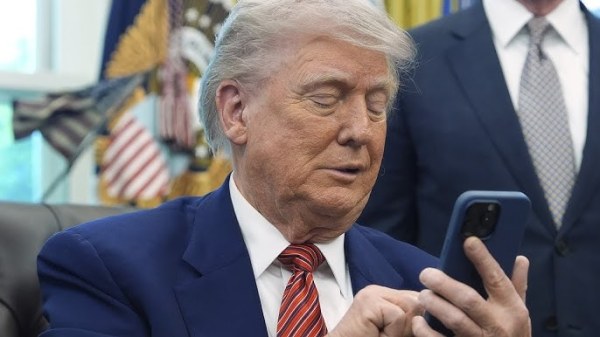
As of June 3rd of this year, President Donald Trump had posted 2262 times to Truth Social in the132 days since his inauguration. That’s 17 posts per day – or night.  According to a recent article in the Washington Post, the president’s social media use is far exceeding his posting in his first term: “His posting now overshadows even the most explosive Twitter days of his first presidency: He tweeted 14 times on his biggest-posting day in early 2017, the data show — a tenth of the 138 posts his Truth Social account sent on a single day this March.”

According to the White House, this is a good thing: “President Trump is the most transparent president in history and is meeting the American people where they are to directly communicate his policies, message, and important announcements,” said White House Assistant Press Secretary Taylor Rogers.

Transparent? I suppose – as in Saran Wrap transparency – only a few microns thick and unable to stand on its own. But the biggest problem with Trump’s brand of social media transparency is that it is a pinball type of presidentialism – continually launching projectiles just to see what they bump into.

Here’s how this scenario often plays out. Trump sends out many of his missives in the middle of the night. They are posted to Truth Social, the media platform he owns and which he is contractually obligated to post first on. In terms of comparison, X has almost 600 million users, Truth Social has about 1 percent of that – about 6 million. And that is hardly a diverse sampling. LA Times reporter Lorraine Ali dared to spend 24 hours on Truth Social last year, “so you don’t have to.” She found Truth Social to be like “a MAGA town hall in a ventless conference room, where an endless line of folks step up to the mic to share how the world is out to get them.”

Ali went on, “The Truth Social feed I experienced was a mix of swaggering gun talk, typo-filled Bible scripture, violent Biden bashing, nonsensical conspiracy theories and more misguided memes about Jan. 6 “hostages,” trans satanists and murderous migrants than anyone should be subjected to in one day. Or ever.”

This is the audience that is the first stop for Trump’s midnight social media musings. Truth Social is not the place for thoughtful policy statements or carefully crafted communication. Rather, it is a place that laps up posts like the beaut that Trump launched on Memorial Day, which started with: “Happy Memorial Day to all, including the scum that spent the last four years trying to destroy our country through warped radical left minds, who allowed 21,000,000 million people to illegally enter our country, many of them being criminals and the mentally insane.”

He then shortly followed that up by reposting this: “There is no #JoeBiden – executed in 2020. #Biden clones doubles & robotic engineered soulless mindless entities are what you see. >#Democrats don’t know the difference.”

From Truth Social, his posts rapidly move to more mainstream platforms. The Post article plotted the typical course of a Trump “Truth”:

“ ‘His messaging moves in real time from Truth to X, and it spreads just as far if not farther on X than it did when he was tweeting himself on the platform,’ said Darren Linvill, a professor and co-director of the Media Forensics Hub at Clemson University who studies social media.

What’s more, Truth Social’s almost exclusively congenial audience insulates the president from negative responses. ‘His current social media behavior suggests that with time he has been pulled even farther into his own echo chambers,’ Linvill said. ‘Truth Social gives him complete and constant positive feedback.’”

By the time dawn breaks over the White House, these missives have been echoing through the echo chambers of social media for at least a couple hours. Trump has received endorsement from the Truth Social crowd and the posts are out in the world, demanding to be dealt with. This is not even government by fiat. It’s as if you woke from a fever dream at 3 in the morning and decided that the two-headed dragon that was eating your Froot Loops needed to be taken out by an all-out military operation. And you were the President. And you could make it happen. And the Two-Headed Dragon was Iran – or Greenland – or Canada.

It is a quantum leap beyond insane that this is how government policy is currently being determined. Even more unbelievable is the fact that this has now been normalized by the same White House spokesperson Taylor Rogers, who said “President Trump was elected in a historic landslide victory and even won the popular vote — no further validation is needed.”

OMG – yes Taylor, further validation is needed. Desperately! These posts are determining the future of the world and everyone who lives in it. They should be given great thought. Or – at least – more thought than that generated by the mind-altering after-effects of Big Mac eaten at 1:30 in the morning

The Whole US – Canada Thing – “IMHO”

“Our old relationship with the United States, a relationship based on steadily increasing integration, is over. The system of open global trade anchored by the United States – a system that Canada has relied on since the second world war, a system that while not perfect has helped deliver prosperity for a country for decades – is over”

Mark Carney, the New Prime Minister of Canada

I hope the above is not true. Because I’m not ready to sever my relationships with a whole bunch of Americans that I truly love and respect. Maybe that’s denialism, or maybe it’s just my hope that someday – eventually – cooler heads will prevail, and we’ll put this current spat behind us.

There was a good stretch of my life where I spent almost as much time in the U.S. as I did in Canada. I crossed the border repeatedly every month. I was on a first name basis with some of the U.S. Customs and Border officials at SeaTac airport in Seattle. I ran out of visa stamp pages on my Canadian passport and had to get more added. Many people in the search industry at the time just assumed I was American. Some back here in Canada even told me I had picked up an American accent somewhere along the way.

In that time, I made many wonderful friends, who came from every corner of the US:  Boston, Atlanta, Sacramento, Minneapolis, Chicago, New York, Hartford, Phoenix, Palo Alto, San Diego and Seattle.

I have to admit, my trips to the U.S. have dropped dramatically since November 2016. Part of that is that I no longer need to go to the U.S. for business. But part of it is also just my emotional distress, especially in the past few months. One of the analogies that really seemed to resonate with me is that the current US-Canadian relationship is akin to a messy divorce, and we’re the kids caught in the consequences of that. Going to the U.S. right now would be like going to a family reunion after your mom and dad have just split up. You don’t want to have to deal with the inevitable awkwardness and potential confrontations.

I’m not alone in my reluctance to cross the border. Travel from Canada to the U.S. has plummeted this year. According to U.S. Customs and Border Protection, Canadian entries into the U.S. fell by 12.5% in February and dropped a further 18% in March.  A lot of Canadians have opted out of U.S travel, probably for many of the same reasons that I have.

But I think that’s part of the problem. As awkward as a conversation maybe between a Canadian and an American, whatever their politics, we need more of them, not less. Yes, there is a rift and damage has been done to one of the most successful international alliances in history, but as any counsellor will tell you, healing any relationship requires communication.

Also, I’ve never seen so much media attention from the U.S. turned towards Canada. Half of America seems to have chosen us as a beacon of democracy, truth and justice. While I appreciate that, I feel I have to level with you, my American friends and cousins; we are far from perfect. In fact, I have grave concerns about the future of Canada. We have our own extreme political polarization that has to be recognized and dealt with. It may be a little more polite and nuanced than what is happening currently in the U.S., but it is no less real.

We still have at least two provinces (Alberta and Quebec) who have political leaders that feel their futures would be better outside the Canadian dominion than within it. We have large segments of our population that feel unheard by our current government. We have many acute crises, including housing, a rising cost of living, broken promises to our indigenous community, an environment ravaged by climate change and many others. It’s just that the current economic crisis caused by Trump’s tariffs and vocal sabre rattling about becoming a 51st State has –  well – “Trumped” them all.

While we’re talking about Donald Trump, I have to admit that he does have a point – Canada has taken advantage of America’s willingness to protect the world. We have fallen well short of our 2% defense spending commitment to NATO since the end of the Cold War (we currently spend about 1.37% of our GDP). We have always enjoyed the benefits of cozying up to our American big brother. And in return, we have often repaid that with our own blend of passive aggressive sarcasm and a quiet feeling of moral superiority that is as much a part of the Canadian identity as hockey and Tim Horton’s coffee.

Being Canadian, I feel the need to apologize for that. I’m sorry.

Look. We’re in a tough spot right now. I get that. But I also believe this is not the time to retreat behind our own fences and refuse to talk to each other. This is the time to recognize how special what we had was. Emotions are running high but at some point, I’m fervently hoping this isn’t a permanent split.

Maybe we’re just taking a break. If you want to talk about it, I’m here.

Can Innovation Survive in Trump’s America?

If there was one thing that has sparked America’s success, it has been innovation. That has been the engine that has driven the U.S. forward for at least the last several decades. Yes, the U.S. has natural resources. Yes, at one time the U.S. led the world in manufacturing output. But in their pursuit of adding value to economic output to maximize profit, the U.S. has moved beyond resource extraction and manufacturing to the far-right end of the value chain, where the American economic engine relies heavily on innovation.

Donald Trump can talk all he wants about making America great again by bringing back manufacturing jobs that have migrated elsewhere in the world (a goal that many, including the Economic Policy Institute, feel is delusion, at least using Trump’s approach), but if innovation dies in the process, the U.S. loses. Game over. It’s innovation that now fuels the American Dream.

Given that, MAGA adherents should be careful what they wish for. The Great America they envision is a place where it may be impossible for that kind of innovation to survive.

World class innovation needs an ecosystem, where there is adequate funding for start-ups, a friendly regulatory framework, a robust research environment and an open-door policy for innovative immigrants from other countries – all of which the US has historically had in spades. And – theoretically at least – it’s an ecosystem that Trump is promising high tech and why the tech broligarchy has been quick to court him. But like so many things with Trump, the reality will fall far short of his promises. In fact, he will likely stop innovation in its tracks and send U.S. ingenuity reeling backwards.

Next to the regulatory and economic inputs required for innovation – and perhaps more important than both – the biggest requirement for innovation is an environment that fosters divergent thinking. Study after study has shown that innovation lives best in an environment that fosters collaboration, invites different perspectives and provides a safe space for experimentation. All those things can be found in exactly the opposite of the direction in which the U.S. is currently headed.

Each year, the World Intellectual Property Organization publishes their Global Innovation Index. In 2024, the U.S. was in third spot, behind Switzerland and Sweden. To understand how innovation flourishes, it’s worth looking at what the most innovative countries have in common. Of the top ten (the others are Singapore, the U.K., South Korea, Finland, Netherlands, Germany and Denmark), almost all score the highest marks from the Economist Democracy Index for the strength of their democracy. Singapore is still struggling towards full democracy, and the U.S. is now considered to be a “flawed democracy”, in real danger of becoming an authoritarian regime.

The European contenders also receive very high marks for their social values and enshrining personal rights and freedoms. Those are exactly the things currently being dismantled in America.

There is only one country which is defined as an authoritarian regime that made the top 25 of the Global Innovation Index. China sits in the 11th spot. This brings us to a good question, “Can innovation happen in an authoritarian regime?” The answer, I believe, is a qualified yes. But it’s innovation we may not recognize, and which may turn out to be a lot less attractive than we thought.

I happened to visit China right around the time that Google was trying to move into the huge Chinese Market. Their main competition was Baidu, the home-grown search engine. I was talking to a Google engineer about how they were competing with Baidu. He said it was almost impossible to match the speed at which they could roll out new features. The reason wasn’t that they were more innovative. It was because they innovated through brute force. They could throw hundreds of programmers at an issue and hard code it at the interface level, rather than take the Western approach of embedding core functionality in the base code in a more elegant and sustainable approach. The Chinese could afford to endlessly code and recode.

It’s Brute Force Innovation that you’ll find in authoritarian regimes and dictatorships. It’s what the Soviets used to compete in the space race. It’s what Nazi Germany used when they developed rocket science in a desperate bid to survive World War II. It is innovation dictated by the regime, innovating in prioritized areas by sheer force despite the fact that the typical underpinnings of innovation – creative freedom, divergent thinking, the security needed to experiment and fail – have been eliminated.

If you look at the playbook Trump seems to be following – akin to the one Victor Orbán used in Hungary (ranked 36th on the Global Innovation Index) or Putin’s Russia (ranked 59th) – there appears to be  little hope for the U.S. to retain its world dominance in innovation.

The Quaint Concept of Borders

According to a recent Leger poll, one in five Americans would like their state to secede and join Canada. In contrast, according to the same poll, only one in 10 Canadians would like to see Canada become the 51st State.

Of course, no one takes either suggestion very seriously, except perhaps the President of the United States. And, given the current state of things, that job title is a little ridiculous. Those States are probably less united than they have been at any time since the American Civil War.

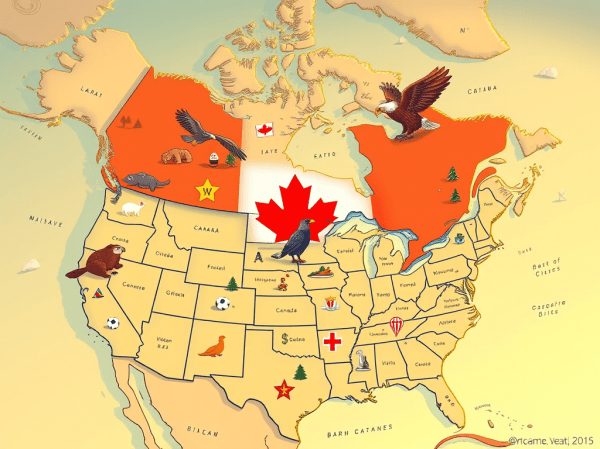
All this talk about borders does make a good Facebook meme though. You might have seen it – under the title “Problem Solved” there’s a map of North American with the Canadian border redrawn to extend down the east and west coast to include Washington, Oregon, California, New York, New Jersey and The New England States. Minnesota also gets to become part of the Great White North.

But – even if we took the suggestion seriously – does redrawing borders really solve any problem? Let’s assume that Canada really did become part of the US. It would be a “big, beautiful state,” according to Donald Trump. There have been a few that have pointed out that that state, with our 40 million potential voters, would probably vote overwhelmingly against Trump. Again, according to Canadian pollster Leger, only about 12% of Canadians support Trump.

While we’re redrawing the map of the world, even oceans can’t get in the way. Here in Canada, we are rushing to realign with Europe and its markets. The idea has even been floated that Canada should join the European Union.  Our new prime minister, Mark Carney, has said we have more in common with Europe and the values found there than we do with our American neighbors to the south.

But again, we use the faulty logic of Canadians, Americans or Europeans being identified as a cohesive bloc defined by a border. The recent rush of patriotism aside, Canadians rarely speak with one voice. For example, support for Trump runs highest in Alberta, where 23% of the province’s voters support him. He’s least popular in Canada’s Atlantic provinces, where support dips to 8%

Or let’s hop across the border to the state closest to me – Washington. If you take the state in aggregate, it is a blue state by almost 20 points. But again, that designation depends on an aggregation of votes within a territory defined by a fairly arbitrary border. If you look at Washington on a county-by-county basis, it’s hardly a cohesive voting bloc. Yes, the urban centers of Seattle and Olympia went heavily for Kamala Harris (74% in King County) but eastern Washington is a very different story. There in many counties, for every voter that chose Harris, 3 chose Trump. Ideologically, a resident of Pend Orielle County, Washington has much more in common with someone from Bonner County, which lies just across the border in Idaho, than they do with someone from Jefferson County, which lies on the west coast of Washington.

My point is this: given the polarization of our society, it’s almost impossible to draw a line anywhere on a map and think that it defines the people within that line in any identifiable way. Right now, nowhere on earth defines this more starkly than the United States. Because of the borders of the U.S. and the political structures that determine who leads the people within those borders, almost 2/3rds of Americans lives are being determined by a man they didn’t vote for. In fact, a big percentage of those 2/3rds are vehemently opposed to their President and his policies. How does that make any sense?

Borders were necessary where our survival was tied to a specific location and the resources to be found within that location. This forced a commonality on those that lived within those boundaries. They ate the same food, drank the same water, tilled the same fields, worked at the same factory, shopped at the same stores, attended the same church and their children went to the same schools.

But our digital world has lost much of that commonality. Online, we are defined by how we think, not where we live. This creates a new definition of “tribe” and, by extension, tribal territories. The divides between us now are based on differences in beliefs, not geographical obstacles. And the gap between our beliefs is getting wider and wider. This leaves the concept of a border threatened as something that is becoming increasingly anachronistic. Borders define something that is becoming less and less real and more and more problematic as the people who live in a state or country find less and less in common with their fellow citizens.  As Scottish journalist James Crawford says in his book, The Edge of the Plain: How Borders Make and Break Our World, the tension is usually felt more acutely on those arbitrary borders: “Wherever there are borders … that’s where you are going to find the most concentrated injustice.”

This redefining of our world as it decouples from the concept of “place” will place more and more pressure on the old idea of a border defining a place and a common ideology.  When there is less cohesivity between those living within the border than there is between ideologically aligned factions spread across the globe, we must wonder how to manage this given our current political structures based on the foundation of a common territory. This is particularly true for democracies, where you get a whipsaw backlash between the right and left as the two factions grow further and further apart. That prognosis is not a good one. As Steven Levitsky and Daniel Ziblatt said in their book How Democracies Die, “Democracies rarely survive extreme partisanship.”

Will There Be a Big-Tech Reckoning?

Jeff Bezos, Mark Zuckerberg and Tim Cook must be thanking their lucky stars that Elon Musk is who he is. Musk is taking the brunt of any Anti-Trump backlash and seems to be relishing in it. Heaven only knows what is motivating Musk, but he is casting a smoke screen so wide and dense it’s obliterating the ass-kissing being done by the rest of the high-tech oligarchs.  In addition to Bezos, Zuckerberg and Cook, Microsoft’s Satya Nadella, Google’s Sundar Pichai and many other high-tech leaders have been making goo-goo eyes at Donald Trump.

Let’s start with Jeff Bezos. One assumes he is pandering to the president because his companies have government contracts worth billions. That pandering has included a pilgrimage to Trump’s Mar-a-Lago, a one million donation to his inauguration fund (which was streamed live on Amazon Prime), and green-lighting a documentary on Melania Trump. The Bezos-owned Washington Post declined from endorsing Kamala Harris as a presidential candidate, prompting some of its editorial staff to resign. At Amazon, the company has backed off some of its climate pledge commitments and started stripping Diversity, Equity and Inclusion programs from their HR handbook.

Mark Zuckerberg joined Trump supporting podcaster Joe Rogan for almost three hours to explain how they were realigning Facebook to be more Trump-friendly. This included canning their fact checkers and stopping policing of misinformation. During the interview, Zuckerberg took opportunities to slam media and the outgoing Biden administration for daring to question Facebook about misleading posts about Covid-19 vaccines. Zuckerberg, like Bezos, also donated $1 million to Trump’s inaugural fund and has rolled back DEI initiatives at Meta.

Tim Cook’s political back-bend had been a little more complicated. On the face of it, Apple’s announcement that it would be investing more than $500 billion in the U.S. and creating thousands of new jobs certainly sounds like a massive kiss to the Trumpian posterior but if you dig through the details, it’s really just putting a new spin on commitments Apple already made to support their development of Apple’s AI. And in many cases, the capital investment isn’t even coming from Apple. For instance, that new A.I. server manufacturing plant in Houston that was part of the announcement? That plant is actually being built by Apple partner Foxconn, not Apple.

As far as the rest of the Big Tech cabal, including Microsoft, Google and OpenAI, their new alignment with Trump is not surprising. Trump is promising to make the U.S. the undisputed leader in A.I. One would also imagine he would be more inclined than the Democrats to look the other way when it comes to things like anti-trust investigations and enforcement. So Big-Tech’s deferment to Trump is both entirely predictable and completely self-serving. I’m also guessing that all of them think they’re smarter than Trump and his administration, providing them a strategic opportunity to play Trump like a fiddle while pursuing their long-term corporate goals free from any governmental oversight or resistance. All evidence to date shows that they’re probably not mistaken in that assumption.

But all this comes at what cost? This could play out one of two ways. First, what happens if these High-Tech Frat Rat’s bets are wrong? There is an anti-Trump, anti-MAGA revolt building. Who knows what will happen, but in politically unprecedented times like this one has to consider every scenario, no matter how outrageous they may seem. One scenario is a significant percentage of Republicans decide their political future (and, hopefully, the future of the US as a democracy also factors into their thinking) is better off without a Donald Trump in it and start the wheels turning to remove him from power. If this is the case, things are going to get really, really nasty. There is going to be recrimination and finger pointing everywhere. And some of those fingers are going to be pointed at the big tech leaders who scrapped the ground bowing to Trump’s bluster and bullying.

Will that translate into a backlash against high-tech? I really am not sure. To date, these companies have been remarkably adept at sluffing off blame. IF MAGA ends up going down in flames, will Big Tech even get singed as they warm their hands at Donald Trump’s own bonfire of his vanities? Will we care about Big Tech’s obsequiousness when it comes time to order something from Amazon or get a new iPhone?

Probably not.  

But the other scenario is even more frightening: Trump stays in power and Big Tech is free to do whatever they hell they want. Based on what you know about Elon Musk, Mark Zuckerberg, Jeff Bezos and the rest, are you willing to let them be the sole architects of your future? Their about-face on Trump has shown that they will always, always, always place profitability above their personal ethics.

Trump, The Media and the Problem of “Pretty Good.”

A number of years back, I was in China for a conference and during a dinner thrown by the hosts for their international presenters, I was lucky enough to find myself sitting next to James Fallows, who was in China on assignment for the Atlantic. His dispatches back eventually became the book Postcards from Tomorrow Square: Reports from China.

It was my first trip to China and I was stunned by the apparent contradiction of the most entrepreneurial society I had ever seen under the rule of a Communist Regime. I asked James how China’s then leader, Hu Jintao, managed to maintain that seemingly impossible balance without widespread insurrection. He said something I’ll always remember: “As long as the Chinese people believe that their lives today are better than they were yesterday, and that they will be even better tomorrow, they will continue to follow their leader.”

That same very simple equation is what populists, some of whom may eventually become dictators, depend on – promising to make life better for their base. If you were Hitler, or Mussolini, or Francisco Franco, that was easy to do. Each of those countries and their economies were fundamentally broken in the 1920’s or 30’s. You didn’t have to be a genius to make things better for the average German, Italian or Spaniard. Just getting trains to run on time was a pretty big step in the right direction.

But that’s not the U.S.A. Things there are (or were) pretty good. Perfect? Not by a long shot. But pretty good.

You disagree? The plain facts are that at no time in history have people ate more, had more, did more or lived longer than right now. And that is doubly true for the U.S., who has about 5% of the world’s population but consumes about 20 to 25% of the world’s resources. Yes, there’s a lot that can be fixed (for instance, there are huge disparities in wealth and consumption), but things are pretty good. Especially in the U.S. of A.

So where does that leave a populist like Trump? Populists say that they – and they alone – can make life better tomorrow for their base. But when things are pretty good already, that’s a hard promise to keep. The U.S. – and the rest of the world – is a complex place that exists thanks to complex systems. The economy, financial markets, diplomacy, healthcare, immigration, education – all of these things are complex. And because of this complexity, the problems that do exist are what are called “wicked” problems – problems that have no quick or simple solution. In fact, they may have no solution at all.

Someone like Trump has no clue about complexity. He will spout inanely ignorant “fixes” and back them up with talking points that have no basis in reality.

Take Trump’s insanely stupid “tariff” solution he imposed just over a week ago. It wasn’t even 24 hours old when he started pulling it back because the U. S. economy started running off the rails. As I said a month ago, imposing a 25% blanket tariff is like doing open heart surgery with a hand grenade

And this is a big problem for Trump. He has no idea how to keep his promise to make life better for people in a complex environment.  It’s not just tariffs. The flurry of executive orders and the chainsaw massacre that is DOGE are similarly stupid solutions to complex issues. They are doomed to fail, which means the U.S. will inevitably slip backwards, rather than leap forward.

Trump will blunder for mistake to mistake, blowing up all the systems that made things “pretty good” in America. He is bulldozing through the complex international relationships that have enabled the U.S. to perch on top of the world order for 100 years. He is blowing up trade agreements and mutual defense pacts. He is pissing off every other country in the world with the exception of one: Russia.

As the Canadian prime minister Justin Trudeau just said – “Make that Make Sense.”

It would be easy to blame Donald Trump. But I won’t. He’s just being Trump, just like a shark is just being a shark. It would also be easy to blame the Republican sycophants that are letting him do this. But again – sharks will be sharks. They have evolved to swim towards blood. No, to truly assign blame, we have to ask “why” a few times.

Why was Trump put in the position where he could do this? He’s there because 77 million Americans voted for him. And why did they vote for him? Because they believed he could make things better tomorrow than they are today. It’s a pretty simple equation.

Let’s ask why one more time.  Why did they believe that Trump could save them? Ah! Now, we’re getting somewhere. The Media – our media – built this belief. They built it because there is no profit in saying things are “pretty good.”  The Media thrives by creating conflict. And so they built the belief that things were fundamentally broken and needed fixing. They created the illusion that there are simple solutions to complex problems. They allowed ignorance to flourish in an absence of reliable and objective reporting. They gave Trump the air he needed to breath.

The media – especially social media – also planted the false notion that we deserve better than “pretty good.” It has fostered the nonsensical equation that all of us should have the same as the richest of us.  We are entitled to it. And if we don’t get it, somebody is to blame. No one stops to think that the equation is mathematically impossible.

That is what we have to fix.

Is This The Time to Say No?

I like to be agreeable. I’m not really into rocking boats or stirring things up. If there is a flow to be found, I will usually be found going with it.

But today, one day after Trump v2.0 became official, I’m wondering if I should change my tune and say “no” more often. Trump hasn’t even been president for 24 hours yet and already the world seems to be changing, and not in any way I’m comfortable with.

There has been a lot of talk about how Big Tech is embracing the wild and wacky world of misinformation in the new era of MAGA. Musk’s malevolent makeover of X has proven to be prescient rather than puerile. Mark Zuckerberg is following suit by sending Meta’s Fact Checkers packing. Jeff Bezos first blocked the Washington Post from endorsing Kamala Harris and then dialed back diversity, equity and inclusion at Amazon to be better aligned with Trumpian sensibilities.

All of these moves are driven purely by business motives. The Tech Broligarchs (the worlds most exclusive white male club) are greasing the wheels for maximum profitability over the next 4 years for their respective empires. They are tripping over each other rushing to scatter rose petals at Trump’s toes. When collectively those three are worth close to 1 trillion dollars – well – a dude has the right to protect his assets, doesn’t he?

No. I don’t think so. I’m not okay with any of this. As Big Tech primes the profitability pump by pandering to the new president, we are all going to pay a much bigger price. The erosion of social capital is going to be massive. And so, I feel the time has come to say when I don’t agree with something. And I don’t agree with this.

We all somehow believe that free markets will eventually lead us to the best moral choice. And nothing could be further from the truth. Nobel prize winning economist Milt Friedman was wrong when he said, “an entity’s greatest responsibility lies in the satisfaction of the shareholders.” This doctrine has guided the corporate world for half a century now, towing along our western governments in its wake. The enshrining of profits as more important than social responsibility has led us inevitably to where we are now, where the personal worth of a handful of tech billionaires is judged as more important than the sustainability and fairness of our own society.

Normally, we would rely on our governments to put in place legislation to protect us from the worst instincts of big business. But yesterday, with the second swearing in of Donald Trump as president, we saw that dynamic flipped on its head. For the next four years, the U.S. will have a sitting president that will be leading the way in the race to the bottom. Corporate America will be hard pressed to keep up.

So, if big business is not looking out for us, and our government is looking the other way, who should we turn to? The answer, sadly, is there is no one left but ourselves. If we don’t agree with something – if the world is going in a direction contrary to our own values – we have to say something. We also have to do something. We have to become a little more defiant.

That is the theme of the brand-new book “Defy” by organizational psychologist Dr. Sunita Sah. She says that we are typically hard-wired to comply rather than defy, “There are situations where you want to defy, but you go along with it. Maybe the costs are too great, the benefits too meager, or the situation is dangerous. We all have to do that at times, even our defiant heroes like Rosa Parks. How many times did she comply with the segregation laws? A lot, but there comes a moment when we decide now is the time to defy. It’s figuring out when that time is.”

For myself, that time has come.

Democracy Dies in the Middle

As I write this, I don’t know what the outcome of the election will be. But I do know this. There has never been an U.S. Presidential election campaign quite like this one. If you were scripting a Netflix series, you couldn’t have made up a timeline like this (and this is only a sampling):

January 26 – A jury ordered Donald Trump to pay E. Jean Carroll $83 million in additional emotional, reputation-related, and punitive damages. The original award was $5 million.

April 15 – Trial of New York vs Donald Trump begins. Trump was charged with 34 counts of felony.

May 30 – Trump is found guilty on all 34 counts in his New York trial, making him the first U.S. president to be convicted of a felony

June 27 – Biden and Trump hold their first campaign debate hosted by CNN. Biden’s performance is so bad, it’s met with calls for him to suspend his campaign

July 1 – The U.S. Supreme Court delivers a 6–3 decision in Trump v. United States, ruling that Trump had absolute immunity for acts he committed as president within his core constitutional purview.  This effectively puts further legal action against Trump on hold until after the election

July 13 – Trump is shot in the ear in an assassination attempt at a campaign rally held in Butler, Pennsylvania. One bystander and the shooter are killed and two others are injured.

July 21 – Biden announces his withdrawal from the race, necessitating the start of an “emergency transition process” for the Democratic nomination. On the same day, Kamala Harris announces her candidacy for president.

September 6 – Former vice president Dick Cheney and former Congresswoman Liz Cheney announce their endorsements for Harris. That’s the former Republican Vice President and the former chair of the House Republican Conference, endorsing a Democrat.

September 15: A shooting takes place at the Trump International Golf Club in West Palm Beach, Florida, while Donald Trump is golfing. Trump was unharmed in the incident and was evacuated by Secret Service personnel.

With all of that, it’s rather amazing that – according to a recent PEW Research Centre report – Americans don’t seem to be any more interested in the campaign than in previous election years. Numbers of people closely following election news are running about the same as in 2020 and are behind what they were in 2016.

This could be attributed in part to a certain ennui on the part of Democrats. In the spring, their level of interest was running behind Republicans. It was only when Joe Biden dropped out in July that Democrats started tuning in in greater numbers. As of September, they were following just as closely as Republicans.

I also find it interesting to see where they’re turning for their election coverage. For those 50 plus, it is overwhelmingly television. News websites and apps come in a distant second.

But for those under 50, Social Media is the preferred source, with news websites and television tied in second place. This is particularly true for those under 30, where half turn to Social media. The 30 to 49 cohort is the most media-diverse, with their sources pretty much evenly split between TV, websites and social media. 

If we look at political affiliations impacting where people turn to be informed, there was no great surprise. Democrats favour the three networks (CBS, NBC and ABC, with CNN just behind. Republicans Turn first to Fox News, then the three networks, then conservative talk radio.

The thing to note here is that Republicans tend to stick to news platforms known for having a right-wing perspective, where Democrats are more open to what could arguably be considered more objective sources.

It is interesting to note that this flips a bit with younger Republicans, who are more open to mainstream media like the three networks or papers like the New York Times. Sixty percent of Republicans aged 18 – 29 cited the three networks as a source of election information, and 45% mentioned the New York Times.

But we also have to remember that all younger people, Republican or Democrat, are more apt to rely on social media to learn about the election. And there we have a problem. Recently, George Washington University political scientist Dave Karpf was interviewed on CBC Radio about how Big Tech is influencing this election.  What was interesting about Karpf’s comments is how social media is now just as polarized as our society. X has become a cesspool of right-leaning misinformation, led by Trump supporter Elon Musk, and Facebook has tried to depoliticize their content after coming under repeated fire for influencing previous campaigns.

So, the two platforms that Karpf said were the most stabilized in past elections have effectively lost their status as common ground for messaging to the right and the left.  Karpf explains, “Part of what we’re seeing with this election cycle is a gap where nothing has really filled into those voids and left campaigns wondering what they can do. They’re trying things out on TikTok, they’re trying things out wherever they can, but we lack that stability. It is, in a sense, the first post social media election.”

This creates a troubling gap. If those under the age of 30 turn first to social media to be informed, what are they finding there? Not much, according to Karpf. And what they are finding is terribly biased, to the point of lacking any real objectivity.

In 2017, the Washington Post added this line under their masthead: “Democracy Dies in Darkness”. , in this polarized mediascape, I think it’s more accurate to say “Democracy Dies in the Middle”.  There’s a Right-Wing reality and a Left-Wing reality. The truth is somewhere in the middle. But it’s getting pretty hard to find it.

Post-mortem of a Donald Trump Sound Bite

This past weekend, Donald Trump was campaigning in Dayton, Ohio. This should come as news to no one. You’ve all probably seen various blips come across your social media radar. And, as often happens, what Trump said has been picked up in the mainstream press.

Now, I am quite probably the last person in the world that would ever come to Donald Trump’s defense. But I did want to take this one example of how it’s the media, including social media, that is responsible for the distortion of reality that we often see happen.

My first impression of what happened is that Trump promised a retributive bloodbath for any and all opposition if he’s not elected president. And, like many of you, that first impression came through my social media feeds. Joe Biden’s X (formerly Twitter) post said “It’s clear this guy wants another January 6th” Republican Lawyer and founding member of the Lincoln Project George Conway also posted: “This is utterly unhinged.”  

There was also retweeting of ABC coverage featuring a soundbite from Trump that said, “There would be a bloodbath if he is not re-elected in November.” This was conflated with Trump’s decision to open the stump speech with a recording of “Justice for All” by the J6 Choir, made of inmates awaiting trial for their roles in the infamous insurrection after the last election. Trump saluted during the playing of the recording.

To be crystal clear, I don’t condone any of that. But that’s not the point. I’m not the audience this was aimed at.

First of all, Donald Trump was campaigning. In this case, he was making a speech aimed at his base in Ohio, many of whom are auto-workers. And the “bloodbath” comment had nothing to do with armed insurrection. It was Trump’s prediction of what would happen if he wasn’t elected and couldn’t protect American auto jobs from the possibility of a trade war with China over auto manufacturing.

But you would be hard pressed to know that based on what you saw, heard or read on either social media or traditional media.

You can say a lot of derogatory things about Donald Trump, but you can’t say he doesn’t know his base or what they want to hear. He’s on the campaign trail to be elected President of the United State. The way that game is played, thanks to a toxic ecosystem created by the media, is to pick your audience and tell them exactly what they want to hear. The more you can get that message amplified through both social and mainstream media, the better. And if you can get your opposition to help you by also spreading the message, you get bonus points.

Trump is an expert at playing that game. He is the personification of the axiom, “There is no such thing as bad press.”

If we try to pin this down to the point where we can assign blame, it becomes almost impossible. There was nothing untrue in the coverage of the Dayton Rally. It was just misleading due to incomplete information, conflation, and the highlighting of quotes without context. It was sloppy reporting, but it wasn’t illegal.

The rot here isn’t acute. It isn’t isolated to one instance. It’s chronic and systemic. It runs through the entire media ecosystem. It benefits from round after round of layoffs that have dismantled journalism and gutted the platform’s own fact checking and anti-misinformation teams. Republicans, led by House Judiciary Chairman Jim Jordan, are doubling down on this by investigating alleged anti-conservative censorship by the platforms.

I’m pretty sure things won’t get better. Social media feeds are – if anything – more littered than ever with faulty information and weaponized posts designed solely to provoke. So far, management of the platforms have managed to slither away from anything resembling responsibility. And the campaigns haven’t even started to heat up. In the 230 days between now and November 5th, the stakes will get higher and posts will become more inflammatory.

Buckle up. It promises to be a bumpy (or Trumpy?) ride!