The Raging Ripple Effect of AirBNB

Ripple Effect: the continuing and spreading results of an event or action.

I’m pretty sure Brian Chesky and Joe Gebbia had no idea what they were unleashing when they decided to rent out an air mattress in the front room of their San Francisco apartment in the fall of 2007. The idea made all kinds of sense: there was not a hotel room to be had, there was a huge conference in town and they were perpetually short on their rent. It seemed like the perfect win-win – and, at first, it was.

But then came the Internet. AirBnB was born and would unleash unintended consequences that would change the face of tourism, up-end real estate markets and tear apart neighborhoods in cities around the world..

For the past two decades we have seen the impact of simple ideas that can scale massively thanks to the networked world we live in. In a physical world, there are real world factors that limit growth. Distribution, logistics, production, awareness – each of these critical requirements for growth are necessarily limited by geography and physical reality. 

But in a wired world, sometimes all you need is to provide an intermediary link between two pools of latent potential and the effect is the digital equivalent of an explosion. There is no physical friction to moderate the effect. That’s what AirBnB Did. Chesky and Gebbia’s simple idea became the connection between frustrated travellers who were tired of exorbitant hotel prices and millions of ordinary people who happened to have a spare bed. There was enormous potential on both sides and all AirBNB had to do was facilitate the connection.

AirBnB’s rise was meteoric. After Chesky and Gebbia’s initial brainstorm in 2007, they launched a website the next spring, in 2008. One year later there were hosts in 1700 cities in 100 different countries. Two years after that, AirBnB had hosted their 1 millionth guest and had over 120,000 listings. By 2020, the year Covid threw a pandemic sized spanner in the works of tourism, AirBnB had 5.6 million listings and was heading towards an IPO. 

Surprisingly, though, a global pandemic wasn’t the biggest problem facing AirBnB. There was a global backlash building that had nothing to do with Covid 19. AirBnB’s biggest problem was the unintended ripple effects of Chesky and Gebbia’s simple idea.

Up until the debut of the internet and the virtual rewiring of our world, new business ideas usually grew slowly enough for the world to react to their unintended consequences. As problems emerged, new legislation could be passed, new safeguards could be introduced and new guidelines could be put in place. But when AirBnB grew from a simple idea to a global juggernaut in a decade, things happened too quickly for the physical world to respond. Everything was accelerated: business growth, demand and the impact on both tourism and the communities those tourists were flocking to. 

Before we knew what was happening, tourism had exploded to unsustainable levels, real estate markets went haywire and entire communities were being gutted as their character changed from a traditional neighborhood to temporary housing for wave after wave of tourists. It’s only recently that many cities that were being threatened with the “AirBnB” effect responded with legislation that either banned or severely curtailed short term vacation rentals.

The question is, now that it’s been unleashed, can the damage done by AirBnB be undone? Real estate markets that were artificially fueled by sales to prospective short term rental hosts may eventually find a new equilibrium, but many formerly affordable listings could remain priced beyond the reach of first time home buyers. Will cities deluged by an onslaught of tourism ever regain the charm that made them favored destinations in the first place? Will neighbourhoods that were transformed by owners cashing in on the AirBnB boom ever regain their former character?

In our networked world, the ripples of unintended consequences spread quickly, but their effects may be with us forever.

Paying the Price for Not Trusting

This will surprise no one, but a recent Gallup Poll showed professional trust in the U.S. at its lowest level since they started tracking it in 1999. In their index of 11 core professions, including nursers, bankers, business execs, Members of Congress and 7 others, the average honesty and ethics rates have dropped to the point where just 30% of those professions having high or very high ratings.

Those professionals who received the higher trust marks are nurses, teachers, military officers, pharmacists and doctors. Those in the medical categories have slipped since the pandemic but are still well in positive territory.

The least trusted professions? Car salesmen, advertising practitioners, TV reporters, Members of Congress and lobbyists. The percentage of respondents rating them as highly or very highly trustworthy and ethical was in the single digits for all but one of them (TV reporters). 

Again, not all that surprising. But what does this say about our society? Societal trust is the glue holds communities and nations together. If you’re a student of history, you’ll know that – without exception – cultures and societies with high levels of trust prosper over the long term and those that lack trust inexorably slip backwards.  Four years ago I wrote about this and used North and South Italy as examples. Southern Italy – partly because of geography that restricted widespread trade – historically had low levels of trust. You trusted your family, you may trust your paesani (townspeople) and that was about it. Northern Italy, with a more open geography and proximity to the rest of Europe, developed a widespread trading network that allowed the economies of renaissance City States like Venice, Florence and Milan to prosper, along with arts and culture. The difference between North and South Italy is startling, even to this day.

That is the price paid for distrust. Essentially, you can choose one of two paths: to trust or to fear. If you choose the later – as at least half of America has apparently done – understand that you are essentially choosing the strategy of the schoolyard bully, competing through fear and intimidation. Let’s take a closer look at that path with as objective a viewpoint as possible.

Bullying is a viable evolutionary survival strategy and it is common in nature. There are undeniably advantages to bullying. It gives you greater access to resources, such as food, shelter and sexual access. But it is a primal strategy and that defines its limits. It is dependent on the bully’s strength alone. It typically causes those being bullied to create new alliances, pushing them into a position where they must trust each other. And that creates a long-term advantage for the alliance, where they eventually gain strength from trusting each other while the bully loses strength by isolating itself. The Bully’s cycle always plays out the same way; gaining temporary advantage but eventually losing it in the long term as trust-based networks emerge. And – once lost – that advantage is very hard to regain.

It’s not just history where the advantage of trust has been proven. Game Theory looks at exactly these types of interactions. In one well-known scenario, the most successful strategy was called “Tit for Tat.” It starts with a default position of mutual trust and only moves to the offensive if one of the parties tries to defect from cooperating. Then, it goes into a cycle of zero sum back and forth retaliations. The advantage of this strategy is that it self-corrects towards trust. Only if that trust is broken does it retaliate. The benefits accrue during cooperation cycles and the strategy continually tries to move back to cooperation. Cooperation always beats confrontation.

As I said a few columns ago, it is a lack of trust in institutions that makes us think that everything is fundamentally broken. This distrust extends to everything but is particularly prevalent with trust in media and government. The Gallup Poll showed that TV reporters and Members of Congress are amongst the least trusted professions of those surveyed.

The Gallup Poll is backed up by the annual Edelman Trust Barometer study, which looks at institutional trust in government, business, media and NGOs (non-governmental not-for-profit organizations)  around the world, using 28 countries as its index. The decline in media and especially governmental trust over the past decade has been stunning, prompting CEO Richard Edelman to note, Starting in 2005, we noticed the decline of belief in establishment leaders. Prime ministers, presidents, CEOs, and mainstream media lost their dominant status as opinion formers. Peer trust emerged, as friends and family depended on one another for advice and used social media as the connection point.”

This last point about peer trust is troubling. It essentially means a return to tribalism, this time mediated through social media. It really doesn’t sound all that different from the way society has operated in low trust and economically challenged regions such as Southern Italy for centuries now.

When Branding and Politics Collide

It is the worst timing possible to open a Tesla dealership.

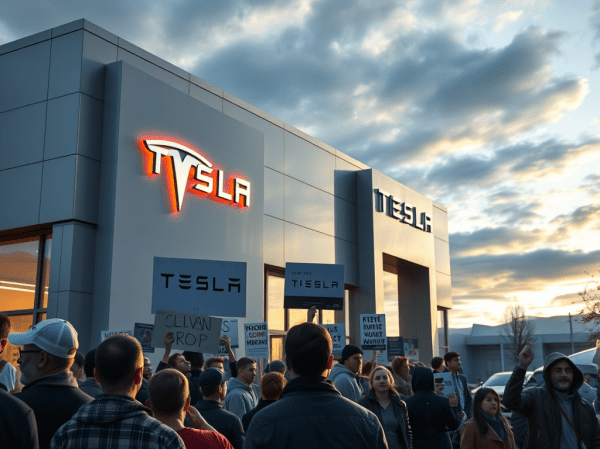
 In Kelowna, the western Canadian city I live in, a new 30,000 square foot Tesla dealership is scheduled to open their doors any day now.  When they do, I’m guessing business will not be brisk. It takes a lot to get Canadians worked up (hockey games aside) but the Trump administration has managed to do something I haven’t seen before in my lifetime – uniting Canadians in a passionate rage. Between picking a totally unjustified trade war with us and continually threatening to make us a 51st State, Donald Trump hasn’t made any friends in my country. And – by extension – that includes his hatchet/chainsaw man and the face of Tesla, Elon Musk.

This is not just happening here in Canada. Tesla owners are having a rough month everywhere. Their cars are being customized with swastikas. Their daily drive is regularly punctuated with middle finger salutes. They are being verbally accosted at Tesla charging stations. And, if they happen to have to go to their dealership, chances are very good that they’ll have to navigate past a pack of protesters. According to the website Actionnetwork.org, there are 101 TeslaTakedown protests scheduled across the US and around the world in the next few weeks.

That is a dramatic turnaround for a car brand that single handedly made driving an electric vehicle cool. The TeslaTakedown campaign is urging drivers to dump their cars and shareholders to sell their stock. A recent survey out of the Netherlands says that one in three Tesla owners are considering selling.

This has nothing to do with whether Teslas are good cars or not. They’re the same vehicles they were 6 months ago. This is simply about branding, and right now, the Tesla brand and Elon Musk are one and the same. That brand is not popular with the majority of the world right now, especially here in Canada.

Like I said – it’s really bad timing to open a new dealership.

As this is all playing out, it got me thinking about another car brand that got on the wrong side of politics 80 years ago. In 1945, Volkswagen was not the 2nd largest car manufacturer in the world, as it is now. It was a shuttered factory in Wolfsburg, Germany that was set to be dismantled by the Allied occupiers, led by the British.  

Volkswagen was founded in 1937 by the Nazi Party’s German Labor Front as a prestige project to show that German workers could produce the world’s best “People’s Car” (which is literally what “Volkswagen” means). That vehicle would be the first prototype of the now much-loved Beetle that we of a certain age immediately associate with Volkswagen. In 1938, Hitler himself christened this the KdF-Wagen, which stood for “Kraft durch Freude” – Strength through Joy. Even the car’s name was a banner for Nazi propaganda.

Eight years later – in 1945 – it was a different story. The Wolfsburg factory was to be dismantled as part of the de-Nazification of German industry and the equipment was to be sent to a British car manufacturer, but none of them wanted it. Three things saved Volkswagen:

  • The design was solid. The wartime version of the VW – the Kubelwagen – was exceptionally reliable
  • There was a desperate need for military transportation in the now occupied zone and there was no manufacturer able to fulfill that need
  • There was a factory ready to go and a skilled workforce who were in danger of starving if they didn’t go back to work

These three things convinced the British trustees to reopen the Wolfsburg plant. By March of 1946, the plant was producing 1000 cars a month.  In 1947, Volkswagen began exporting passenger vehicles to other European markets, including the Netherlands, Switzerland and Denmark. This export model became the Beetle in the form I first knew it.

By the end of the 1950’s, Volkswagen had expanded through Europe and was ready to take on the US, a market dominated by the Big Three (Ford, GM and Chrysler) domestic manufacturers. At the time, almost no imported vehicles were sold in America.

Thanks to an inspired “Think Small” advertising campaign, created by copywriter Julian Koenig and Art Director Helmut Krone from Doyle Dane Bernbach, Volkswagen became the US’s favorite import. The campaign used humor, honesty and irony to spark a love for the VW brand. This branding and the oil crisis of the 1970’s placed VW in the perfect position to capitalize on a sudden market for smaller, more fuel-efficient vehicles. In 1961, Volkswagen passed the 1 million vehicles manufactured per year milestone. By 1972, that had more than doubled to almost 2.2 million cars made per year. Three quarters of those were sold in export markets.

As I said, today the Volkswagen group is now the number 1 or 2 auto manufacturer in the world, depending on which yardstick you use (per unit sales or total revenue). They do fall short on the list of most valuable car companies in the world, based on market capitalization.

So, what is the most valuable car company in the world? Tesla.

For now, anyway.

The World vs Big Tech

Around the world, governments have their legislative cross hairs trained on Big Tech. It’s happening in the US, the EU and here in my country,  Canada. The majority of these are anti-trust suits. But Australia has just introduced a different type of legislation, a social media ban for those under 16. And that could change the game – and the conversation -completely for Big Tech.

There are more anti-trust actions in the queue in the US than at any time in the previous five decades. The fast and loose interpretation of antitrust enforcement in the US is that monopolies are only attacked when they may cause significant harm to customers through lack of competition. The US approach to anti-trust since the 1970s has typically followed the Chicago School of neoclassical economy theory, which places all trust in the efficiency of markets and tells government to keep their damned hands off the economy. Given this and given the pro-business slant of all US administrations, both Republican and Democratic, since Reagan, it’s not surprising that we’ve seen relatively few anti-trust suits in the past 50 years.

But the rapid rise of monolithic Big Tech platforms has raised more discussion about anti-trust in the past decade than in the previous 5 decades. These platforms suck along the industries they spawn in their wake and leave little room for upstart competitors to survive long enough to gain significant market share.

Case in point: Google. 

The recent Canadian lawsuit has the Competition Bureau (our anti-trust watchdog) suing Google for anti-competitive practices selling its online advertising services north of the 49th parallel. They’re asking Google to sell off two of its ad-tech tools, pay penalties worth up to 3% of the platform’s global gross revenues and prohibit the company from engaging in anti-competitive practices in the future.

According to a 3-year inquiry into Google’s Canadian business practices by the Bureau, Google controls 90% of all ad servers and 70% of advertising networks operating in the country. Mind you, Google started the online advertising industry in the relatively green fields of Canada back when I was still railing about the ignorance of Canadian advertisers when it came to digital marketing. No one else really had a chance. But Google made sure they never got one by wrapping its gigantic arms around the industry in an anti-competitive bear hug.

The recent Australian legislation is of a different category, however. Anti-trust suits are – by nature – not personal. They are all about business. But the Australian ban puts Big Tech in the same category as Big Tobacco, Big Alcohol and Big Pharma – alleging that they are selling an addictive product that causes physical or emotional harm to individuals. And the rest of the world is closely watching what Australia does. Canada is no exception.

The most pertinent question is how will Australia enforce the band? Restricting social media access to those under 16 is not something to be considered lightly.  It’s a huge technical, legal and logistical hurdle to get over. But if Australia can figure it out, it’s certain that other jurisdictions around the world will follow in their footsteps.

This legislation opens the door to more vigorous public discourse about the impact of social media on our society. Politicians don’t introduce legislation unless they feel that – by doing so – they will continue to get elected. And the key to being elected is one of two things; give the electorate what they want or protect them against what they fear. In Australia, recent polling indicates the ban is supported by 77% of the population. Even those opposing the ban aren’t doing so in defense of social media. They’re worried that the devil might be in the details and that the legislation is being pushed through too quickly.

These types of things tend to follow a similar narrative arc: fads and trends drive widespread adoption – evidence mounts about the negative impacts – industries either ignore or actively sabotage the sources of the evidence – and, with enough critical mass, government finally gets into the act by introducing protective legislation.

With tobacco in the US, that arc took a couple of decades, from the explosion of smoking after World War II to the U.S. Surgeon General’s 1964 report linking smoking and cancer. The first warning labels on cigarette packages appeared two years later, in 1966.

We may be on the cusp of a similar movement with social media. And, once again, it’s taken 20 years. Facebook was founded in 2004.

Time will tell. In the meantime, keep an eye on what’s happening Down Under.

Is the Customer Always Right?

You can’t always get what you want
But if you try sometimes, well, you might find
You get what you need

The Rolling Stones – 1969

When I retired from marketing 11 years ago, I did a brief stint running a tourism business, putting together custom bike tours. I thought it would be an ideal semi-retirement gig – riding bikes and hanging out with others who loved road cycling. Like many customer facing businesses, we lived and died by ratings. Because we were an experience curator, we regularly dealt with dozens of other tourism-based businesses. We were all dealing in the same currency – those elusive five-star ratings.

In theory, I think customer ratings are a good idea. But there is a dark side – the overly entitled customer that wields the threat of a negative review over the head of a proprietor. By the end of the season, all the operators we were dealing with were burnt out and frustrated. Overt entitlement sucked all the joy out of being in the tourism biz. This trend got much worse as we were pulling out of Covid. It was as if the entitled had doubled down on their demands during the pandemic. That was when I decided to hang up my cycling shoes. Life was too short to stress about catering to a bunch of whiny, demanding guests who threatened to bring the wrath of a bad TripAdvisor review down on me.

The internet’s early promise was to democratize markets that were traditionally asymmetrical. Suddenly, everyone had a voice. And, at first, it was wonderful. But predictably, we found a way to screw it up. Compared to the dumpster fire that is social media, online ratings are not pure evil, but they do have their dark side in a culture full of entitled customers.

If you doubt that North America is narcissistically entitled, I direct you to Jean Twenge and Keith Campbell’s book, the Narcissism Epidemic. Based on years of extensive research, it shows how we have fostered an age of entitlement that lives by the maxim that everyone should be treated special. That is now the baseline of expectation. We have brought this on ourselves, by insisting that we – and especially our children – receive special treatment. But, as any statistician can tell you, we can’t all be above average. Sooner or later, something has to give.

This is especially true in tourism. We all long for that magical, once-in a lifetime vacation. In fact, we now demand it. But that is impossible to deliver on. Just check into the most popular vacation destinations in the world: Paris, Rome, Barcelona, Venice and London. All are creaking under the weight of unprecedented numbers of tourist. And the supporting infrastructure can’t support it. Those places are popular because they have a sense of romance, history and magic. Everyone wants to experience strolling through the secluded streets of Rome at twilight, stopping to toss a coin into the Trevi Fountain.

But the reality is far different. Last year, Rome was invaded by an onslaught of 35 million tourists. Crowds ten to twelve deep push towards the fountain, crushing each other and providing the ideal environment for pick pockets. It’s gotten so bad; the City of Rome is looking at instituting a ticket reservation system to see the fountain.

That is the reality. Over tourism has stripped Rome of its magic. But marketing continues to push the elusive dream of the ideal Roman Holiday, leading us to believe that we’re entitled to that. Everyone else can put up with the crowds and the hassles. But not us – we’re special. And that expectation of special treatment unleashes a vicious cycle. Disappointment is sure to follow. We’ll voice our disappointment by leaving a nasty review somewhere. And some poor tourism operator who’s just trying to keep up will see his or her business slip away as the negative reviews pile up.

I do believe this idea of customer entitlement is particularly prevalent with North Americans. We have constructed it on pagan alter of crazy consumerism, as this post from on the Zendesk Blog by Susan Lahey explains, “ U.S. culture, especially American consumer culture, focuses a lot on making people feel special. After being treated like this in enough scenarios, people come to expect it. Then, when they don’t get their way, they’re upset. They feel like they have a right to act however they want towards others until they’re appeased—which winds up isolating the consumer and shaping their view of the world as ‘me against them.’ “

Lahey provides a counter-example of sustainable consumerism –aligned to a culture that embraces egalitarianism. You’ll find it in what are supposed to be the happiest countries on earth – Finland, Denmark, Iceland and Sweden: “One thing these countries have in common is a set of social norms called the Jante Laws, which say that no one is more special than anyone else. Far from making citizens unhappy, it seems to make them more resilient when they don’t get what they want.”

Less entitlement, more resiliency – that doesn’t sound like a bad plan for the future!

The Adoption of A.I.

Recently, I was talking to a reporter about AI. She was working on a piece about what Apple’s integration of AI into the latest iOS (cleverly named Apple Intelligence) would mean for its adoption by users. Right at the beginning, she asked me this question, “What previous examples of human adoption of tech products or innovations might be able to tell us about how we will fit (or not fit) AI into our daily lives?”

That’s a big question. An existential question, even. Luckily, she gave me some advance warning, so I had a chance to think about it.  Even with the heads up, my answer was still well short of anything resembling helpfulness. It was, “I don’t think we’ve ever dealt with something quite like this. So, we’ll see.”

Incisive? Brilliant? Erudite? No, no and no.

But honest? I believe so.

When we think in terms of technology adoption, it usually falls into two categories: continuous and discontinuous. Continuous innovation simply builds on something we already understand. It’s adoption that follows a straight line, with little risk involved and little effort required. It’s driving a car with a little more horsepower, or getting a smartphone with more storage.

Discontinuous innovation is a different beast. It’s an innovation that displaces what went before it. In terms of user experience, it’s a blank slate, so it requires effort and a tolerance for risk to adopt it. This is the type of innovation that is adopted on a bell curve, first identified by American sociologist Everett Rogers in 1962. The acceptance of these new technologies spreads along a timeline defined by the personalities of the marketplace. Some are the type to try every new gadget, and some hang on to the tried and true for as long as they possibly can. Most of us fall somewhere in between.

As an example, think about going from driving a tradition car to an electric vehicle. The change from one to the other requires some effort. There’s a learning curve involved. There’s also risk. We have no baseline of experience to measure against. Some will be ahead of the curve and adopt early. Some will drive their gas clunker until it falls apart.

Falling into this second category of discontinuous innovation, but different by virtue of both the nature of the new technology and the impact it wields, are a handful of innovations that usher in a completely different paradigm. Think of the introduction of electrical power distribution in the late 19th century, the introduction of computers in the second half of the 20th century, or the spread of the internet in the 21st Century.

Each of these was foundational, in that they sparked an explosion of innovation that wouldn’t have been possible if it were not for the initial innovation. These innovations not only change all the rules, they change the very game itself. And because of that, they impact society at a fundamental level. When these types of innovations come along, your life will change whether you choose to adopt the technology or not. And it’s these types of technological paradigm shifts that are rife with unintended consequences.

If I was trying to find a parallel for what AI means for us, I would look for it amongst these examples. And that presents a problem when we pull out our crystal ball and try to peer ahead at what might be. We can’t know. There’s just too much in flux – too many variables to compute with any accuracy. Perhaps we can project forward a few months or a year at the most, based on what we know today. But trying to peer any further forward is a fool’s game. Could you have anticipated what we would be doing on the Internet in 2024 when the first BBS (Bulletin Board System) was introduced in Chicago in 1978?

A.I. is like these previous examples, but it’s also different in one fundamental way. All these other innovations had humans at the switch. Someone needed to turn on the electrical light, boot up the computer or log on to the internet. At this point, we are still “using” A.I., whether it’s as an add-on in software we’re familiar with, like Adobe Photoshop, or a stand-alone app like ChatGPT, but generative A.I.’s real potential can only be discovered when it slips from the grasp of human control and starts working on its own, hidden under some algorithmic hood, safe from our meddling human hands.

We’ve never dealt with anything like this before. So, like I said, we’ll see.