Why I Hate Marketing

I have had a love-hate relationship with marketing for a long time now. And – I have to admit – lately the pendulum has swung a lot more to the hate side.

This may sound odd coming from someone who was a marketer for the almost all of his professional life. From the time I graduated from college until I retired, I was marketing in one form or the other. That span was almost 40 years. And for that time, I always felt the art of marketing lived very much in an ethical grey zone. When someone asked me to define marketing, I usually said something like this, “marketing is convincing people to buy something they want but probably don’t need.” And sometimes, marketing has to manufacture that “want” out of thin air.

When I switched from traditional marketing to search marketing almost 30 years ago, I felt it aligned a little better with my ethics. At least, with search marketing, the market has already held up their hand and said they wanted something. They had already signaled their intent. All I had to do is create the connection between that intent and what my clients offered. It was all very rational – I wasn’t messing with anyone’s emotions.

But as the ways we can communicate with prospects digitally has exploded, including through the cesspool we call social media, I have seen marketing slip further and further into an ethical quagmire. Emotional manipulation, false claims and games of bait and switch are now the norm rather than the exception in marketing.

Let me give you one example that I’ve run into repeatedly. The way we book a flight has changed dramatically in the last 25 years. It used to be that airline bookings always happened through an agent. But with the creation of online travel agents, travel search tools and direct booking with the airlines, the information asymmetry that had traditionally protected airline profit margins evaporated. Average fare prices plummeted and the airline profits suffered as a result.

Here in Canada, the two major airlines eventually responded to this threat by following the lead of European lo-cost carriers and introduced an elaborate bait and switch scheme. They introduced “ultra-basic” fares (the actual labels may vary) by stripping everything possible in the way of customer comfort from the logistical reality of getting one human body from point A to Point B. There are no carry-on bag allowances, no seat selection, no point collection, no flexibility in booking and no hope of getting a refund or flight credit if your plans change. To add insult to injury, you’re also shuttled into the very last boarding group and squeezed into the most undesirable seats on the plane. The airlines have done everything possible to let you know you are hanging on to the very bottom rung of their customer appreciation ladder.

Now, you may say that this is just another case of “caveat emptor” – it’s the buyer’s responsibility to know what they’re purchasing and set their expectations accordingly. These fares do give passengers the ability to book a bare-bones flight at a much lower cost. It’s just the airlines responding to a market need. And I might agree – if it weren’t for how these fares are used by the airline’s marketers.

With flight tracking tools, you can track flight prices for future trips. These tools will send you an alert when fares change substantially in either direction. This kind of information puts a lot of power in the hands of the customer, but airlines like WestJet and Air Canada use their “Bare Bones” basic fares to game this system.

While it is possible on some tracking tools like Google Flights to set your preferences to exclude “basic” fares, most users stick to the default settings that would include these loss-leader offerings. They then get alerts with what seem to be great deals on flights as the airlines introduce a never-ending stream of seat sales. The airlines know that by reducing the fares on a select few seats for a few days just enough to trigger an alert, they will get a rush of potential flyers that have used a tracker waiting for the right time to book.

As soon as you come to the airline site to book, you see that while a few seats at the lowest basic fare are on sale, the prices on the economy seats that most of us book haven’t budged. In fact, it seems to me that they’ve gone up substantially. On one recent search, the next price level for an economy seat was three times as much as the advertised ultra-basic fare. If you do happen to stick with booking the ultra-basic fare, you are asked multiple times if you’re sure you don’t want to upgrade? With one recent booking, I was asked no fewer than five times if I wanted to pay more before the purchase was complete.

This entire marketing approach feels uncomfortably close to gas lighting. Airline marketers have used every psychological trick in the book to lure you in and then convince you to spend much more than you originally intended. And this didn’t happen by accident. Those marketers sat down in a meeting (actually, probably several meetings) and deliberately plotted out – point by point – the best way to take advantage of their customers and squeeze more money from them. I know, because I’ve been in those meetings. And a lot of you reading this have been too.

 When I started marketing, the goal was to build a long-term mutually beneficial relationship with your customers. Today, much of what passes for marketing is more like preying on a vulnerable prospect in an emotionally abusive relationship.

And I don’t love that.

The Whole US – Canada Thing – “IMHO”

“Our old relationship with the United States, a relationship based on steadily increasing integration, is over. The system of open global trade anchored by the United States – a system that Canada has relied on since the second world war, a system that while not perfect has helped deliver prosperity for a country for decades – is over”

Mark Carney, the New Prime Minister of Canada

I hope the above is not true. Because I’m not ready to sever my relationships with a whole bunch of Americans that I truly love and respect. Maybe that’s denialism, or maybe it’s just my hope that someday – eventually – cooler heads will prevail, and we’ll put this current spat behind us.

There was a good stretch of my life where I spent almost as much time in the U.S. as I did in Canada. I crossed the border repeatedly every month. I was on a first name basis with some of the U.S. Customs and Border officials at SeaTac airport in Seattle. I ran out of visa stamp pages on my Canadian passport and had to get more added. Many people in the search industry at the time just assumed I was American. Some back here in Canada even told me I had picked up an American accent somewhere along the way.

In that time, I made many wonderful friends, who came from every corner of the US:  Boston, Atlanta, Sacramento, Minneapolis, Chicago, New York, Hartford, Phoenix, Palo Alto, San Diego and Seattle.

I have to admit, my trips to the U.S. have dropped dramatically since November 2016. Part of that is that I no longer need to go to the U.S. for business. But part of it is also just my emotional distress, especially in the past few months. One of the analogies that really seemed to resonate with me is that the current US-Canadian relationship is akin to a messy divorce, and we’re the kids caught in the consequences of that. Going to the U.S. right now would be like going to a family reunion after your mom and dad have just split up. You don’t want to have to deal with the inevitable awkwardness and potential confrontations.

I’m not alone in my reluctance to cross the border. Travel from Canada to the U.S. has plummeted this year. According to U.S. Customs and Border Protection, Canadian entries into the U.S. fell by 12.5% in February and dropped a further 18% in March.  A lot of Canadians have opted out of U.S travel, probably for many of the same reasons that I have.

But I think that’s part of the problem. As awkward as a conversation maybe between a Canadian and an American, whatever their politics, we need more of them, not less. Yes, there is a rift and damage has been done to one of the most successful international alliances in history, but as any counsellor will tell you, healing any relationship requires communication.

Also, I’ve never seen so much media attention from the U.S. turned towards Canada. Half of America seems to have chosen us as a beacon of democracy, truth and justice. While I appreciate that, I feel I have to level with you, my American friends and cousins; we are far from perfect. In fact, I have grave concerns about the future of Canada. We have our own extreme political polarization that has to be recognized and dealt with. It may be a little more polite and nuanced than what is happening currently in the U.S., but it is no less real.

We still have at least two provinces (Alberta and Quebec) who have political leaders that feel their futures would be better outside the Canadian dominion than within it. We have large segments of our population that feel unheard by our current government. We have many acute crises, including housing, a rising cost of living, broken promises to our indigenous community, an environment ravaged by climate change and many others. It’s just that the current economic crisis caused by Trump’s tariffs and vocal sabre rattling about becoming a 51st State has –  well – “Trumped” them all.

While we’re talking about Donald Trump, I have to admit that he does have a point – Canada has taken advantage of America’s willingness to protect the world. We have fallen well short of our 2% defense spending commitment to NATO since the end of the Cold War (we currently spend about 1.37% of our GDP). We have always enjoyed the benefits of cozying up to our American big brother. And in return, we have often repaid that with our own blend of passive aggressive sarcasm and a quiet feeling of moral superiority that is as much a part of the Canadian identity as hockey and Tim Horton’s coffee.

Being Canadian, I feel the need to apologize for that. I’m sorry.

Look. We’re in a tough spot right now. I get that. But I also believe this is not the time to retreat behind our own fences and refuse to talk to each other. This is the time to recognize how special what we had was. Emotions are running high but at some point, I’m fervently hoping this isn’t a permanent split.

Maybe we’re just taking a break. If you want to talk about it, I’m here.

The Problem with Leaders Who Make Stuff Up

Note: The writing of this post has been challenging because of the unpredictability of Trump’s “in the moment” trade policies. For instance, late yesterday Trump “paused’ the tariffs til March. If anything else is out of date by the time you read this – well – I tried.

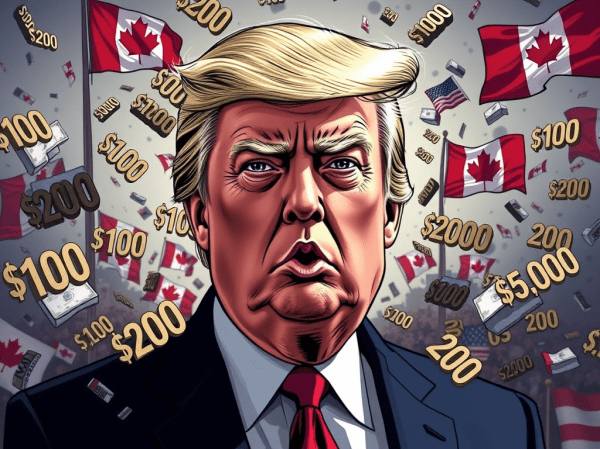
The US has a $100 Billion Trade Deficit with Canada

Correction: The US has a $200 Billion Trade Deficit with Canada

Correction: The US has a $250 Billion Trade Deficit with Canada.

Correction: It’s not a trade deficit. It’s a subsidy.

Correction: This isn’t about the economy, it’s about protecting America from the flood of transients and fentanyl coming across the Canadian border.

None of that is true. But they are all things that Donald Trump has said at one time or another. Those statements are his justification for a 25% tariff on Canada which he imposed this past weekend. And the reason the numbers keeps changing is that he just made them up. He pulled them out of thin air. Like his toupee, those numbers flew from the top of his head.

This is the way Trump operates. There is no need for the truth when you’re negotiating. And in the Trump Playbook, it’s all cool because it’s part of a negotiating strategy called “anchoring.”  Here’s the rational. Throw an outrageous number out there and it suddenly becomes the baseline for negotiating, rather than any starting point based on rationality or logic. It’s classic Trump.

If you’re in the US, you might say, “Good for Trump! If it gets a better deal for us, what’s the harm?”

There’s a lot of harm – billions of dollars’ worth – on both sides of the border. And it’s all completely useless. This bogus trade war is total waste of time that impacts real people and will cause extreme financial hardship.

And it’s all because Trump doesn’t believe in the truth.

Here are the facts. The US does have a trade deficit with Canada. Last year, according to TD Economics, it was about $45 Billion dollars. And a lot of that was due to exports of crude oil to the US to be refined in US refineries. That created US jobs. If you take that out of the mix, Canada actually has a trade deficit with the US, not the other way around.

The US trades with a lot of countries. We (in Canada) are the US’s second biggest trading partner, behind China. And – given that – the imbalance is pretty minimal. If you look at China, who is the biggest trading partner, the deficit is actually about $250 billion.

Also, it’s a deficit, not a subsidy. It’s simply a difference between what was exported to Canada and what was imported. No one in the American government is writing anyone in Canada a check. Calling it a subsidy is just wrong.

And the total amount of fentanyl seized trying to get across the US/Canadian border for most of last year? About 43 pounds. Compare that to the 21,100 pounds seized coming across the Mexican border. It’s not nothing, but it’s definitely not justification for starting a trade war.

So, let’s get to the harm done by Trump’s bluster, bullying and bullshit. Given that the US and Canada are each other’s biggest export markets, our economies are intricately intertwined. Putting a 25% tariff on Canadian imports, which has been met with a retaliatory set of tariffs on US exports to Canada, is like trying to do open heart surgery with a grenade. It’s insanely stupid. Everyone in the Canadian government gets that. Most people in the US government get that. Almost every economist in the world gets that. The governors of the 36 states that have Canada as their biggest export market get that. The only one who doesn’t get it is Donald Trump.

What is also sheer insanity is the fact that when Trump pulls these numbers when he’s in front of a camera, he backs himself into a corner. If he threatens something, he loses face when he doesn’t follow through with the threat. In Canada’s case, someone obviously told him about the whole crude oil thing, because he eventually dropped that tariff to 10%, making it marginally less stupid. But otherwise, he’s ploughing ahead with a trade war for no other reason than because he made some shit up.

The US and Canada does about $1 trillion in trade. And in that total, there are millions of small businesses on both sides of the borders. They don’t have the option of looking for another market. This will put them out of business. It will tear apart families. It will inflict untold suffering. All for absolutely no reason other than that Donald Trump wanted a meaty soundbite.

We can’t accept this, because to accept it is to normalize it. This is just one example of the real harm done when a leader loses all regard for anything resembling the truth and imposes policies on an ignorant whim. That harm will cause trillions of dollars in economic damage and untold personal suffering. We all deserve better – whether we’re Canadians, Americans or any other nationality.  We must demand better.

Is This The Time to Say No?

I like to be agreeable. I’m not really into rocking boats or stirring things up. If there is a flow to be found, I will usually be found going with it.

But today, one day after Trump v2.0 became official, I’m wondering if I should change my tune and say “no” more often. Trump hasn’t even been president for 24 hours yet and already the world seems to be changing, and not in any way I’m comfortable with.

There has been a lot of talk about how Big Tech is embracing the wild and wacky world of misinformation in the new era of MAGA. Musk’s malevolent makeover of X has proven to be prescient rather than puerile. Mark Zuckerberg is following suit by sending Meta’s Fact Checkers packing. Jeff Bezos first blocked the Washington Post from endorsing Kamala Harris and then dialed back diversity, equity and inclusion at Amazon to be better aligned with Trumpian sensibilities.

All of these moves are driven purely by business motives. The Tech Broligarchs (the worlds most exclusive white male club) are greasing the wheels for maximum profitability over the next 4 years for their respective empires. They are tripping over each other rushing to scatter rose petals at Trump’s toes. When collectively those three are worth close to 1 trillion dollars – well – a dude has the right to protect his assets, doesn’t he?

No. I don’t think so. I’m not okay with any of this. As Big Tech primes the profitability pump by pandering to the new president, we are all going to pay a much bigger price. The erosion of social capital is going to be massive. And so, I feel the time has come to say when I don’t agree with something. And I don’t agree with this.

We all somehow believe that free markets will eventually lead us to the best moral choice. And nothing could be further from the truth. Nobel prize winning economist Milt Friedman was wrong when he said, “an entity’s greatest responsibility lies in the satisfaction of the shareholders.” This doctrine has guided the corporate world for half a century now, towing along our western governments in its wake. The enshrining of profits as more important than social responsibility has led us inevitably to where we are now, where the personal worth of a handful of tech billionaires is judged as more important than the sustainability and fairness of our own society.

Normally, we would rely on our governments to put in place legislation to protect us from the worst instincts of big business. But yesterday, with the second swearing in of Donald Trump as president, we saw that dynamic flipped on its head. For the next four years, the U.S. will have a sitting president that will be leading the way in the race to the bottom. Corporate America will be hard pressed to keep up.

So, if big business is not looking out for us, and our government is looking the other way, who should we turn to? The answer, sadly, is there is no one left but ourselves. If we don’t agree with something – if the world is going in a direction contrary to our own values – we have to say something. We also have to do something. We have to become a little more defiant.

That is the theme of the brand-new book “Defy” by organizational psychologist Dr. Sunita Sah. She says that we are typically hard-wired to comply rather than defy, “There are situations where you want to defy, but you go along with it. Maybe the costs are too great, the benefits too meager, or the situation is dangerous. We all have to do that at times, even our defiant heroes like Rosa Parks. How many times did she comply with the segregation laws? A lot, but there comes a moment when we decide now is the time to defy. It’s figuring out when that time is.”

For myself, that time has come.

Not Everything is Political. Hurricanes, for Example.

During the two recent “once in a lifetime” hurricanes that happened to strike the southern US within two weeks of each other, people apparently thought they were a political plot and that meteorologists were in on the conspiracy,

Michigan meteorologist Katie Nickolaou received death threats through social media.

“I have had a bunch of people saying I created and steered the hurricane, there are people assuming we control the weather. I have had to point out that a hurricane has the energy of 10,000 nuclear bombs and we can’t hope to control that. But it’s taken a turn to more violent rhetoric, especially with people saying those who created Milton should be killed.”

Many weather scientists were simply stunned at the level of stupidity and misinformation hurled their way. After someone suggested that someone should “stop the breathing” of those that “made” the hurricanes, Nickolaou responded with this post, “Murdering meteorologists won’t stop hurricanes. I can’t believe I just had to type that.”

Washington, D.C. based meteorologist Matthew Cappucci also received threats: “Seemingly overnight, ideas that once would have been ridiculed as very fringe, outlandish viewpoints are suddenly becoming mainstream, and it’s making my job much more difficult.” 

Marjorie Taylor Greene, U.S. Representative for  Georgia’s 14th congressional district, jumped forcefully into the fray by suggesting the conspiracy was politically motivated.  She posted on X: “This is a map of hurricane affected areas with an overlay of electoral map by political party shows how hurricane devastation could affect the election.”

And just in case you’re giving her the benefit of the doubt by saying she might just be pointing out a correlation, not a cause, she doubled down with this post on X: “Yes they can control the weather, it’s ridiculous for anyone to lie and say it can’t be done.” 

You may say that when it comes to MTG, we must consider the source and sigh “You can’t cure stupid.”   But Marjorie Taylor Greene easily won a democratic election with almost 66% of the vote, which means the majority of people in her district believed in her enough to elect her as their representative. Her opponent, Marcus Flowers, is a 10-year veteran of the US Army and he served 20 years as a contractor or official for the State Department and Department of Defense. He’s no slouch. But in Georgia’s 14th Congressional district, two out of three voters decided a better choice would be the woman who believes that the Nazi Secret Police were called the Gazpacho.

I’ve talked about this before. Ad nauseum – actually. But this reaches a new level of stupidity…and stupidity on this scale is f*&king frightening. It is the most dangerous threat we as humans face.

That’s right, I said the “biggest” threat.  Bigger than climate change. Bigger than AI. Bigger than the new and very scary alliance emerging between Russia, Iran, North Korea and China. Bigger than the fact that Vladimir Putin, Donald Trump and Elon Musk seem to be planning a BFF pajama party in the very near future.

All of those things can be tackled if we choose to. But if we are functionally immobilized by choosing to be represented by stupidity, we are willfully ignoring our way to a point where these existential problems – and many others we’re not aware of yet – can no longer be dealt with.

Brian Cox, a professor of particle physics at the University of Manchester and host of science TV shows including Universe and The Planets, is also warning us about rampant stupidity. “We may laugh at people who think the Earth is flat or whatever, the darker side is that, if we become unmoored from fact, we have a very serious problem when we attempt to solve big challenges, such as AI regulation, climate or avoiding global war. These are things that require contact with reality.” 

At issue here is that people are choosing politics over science. And there is nothing that tethers political to reality. Politics are built on beliefs. Science strives to be built on provable facts. If we choose politics over science, we are embracing wilful ignorance. And that will kill us.

Hurricanes offer us the best possible example of why that is so. Let’s say you, along with Marjorie Taylor Greene, believe that hurricanes are created by meteorologist and mad weather scientists. So, when those nasty meteorologists try to warn you that the storm of the century is headed directly towards you, you respond in one of two ways: You don’t believe them and/or you get mad and condemn them as part of a conspiracy on social media. Neither of those things will save you. Only accepting science as a reliable prediction of the impending reality will give you the best chance of survival, because it allows you to take action.

Maybe we can’t cure stupid. But we’d better try, because it’s going to be the death of us.

The Political Brinkmanship of Spam

I am never a fan of spam. But this is particularly true when there is an upcoming election. The level of spam I have been wading through seems to have doubled lately. We just had a provincial election here in British Columbia and all parties pulled out all stops, which included, but was not limited to; email, social media posts, robotexts and robocalls.

In Canada and the US, political campaigns are not subject to phone and text spam control laws such as our Canadian Do Not Call List legislation. There seems to be a little more restriction on email spam. A report from Nationalsecuritynews.com this past May warned that Americans would be subjected to over 16 billion political robocalls. That is a ton of spam.

During this past campaign here in B.C., I noticed that I do not respond to all spam with equal abhorrence. Ironically, the spam channels with the loosest restrictions are the ones that frustrate me the most.

There are places – like email – where I expect spam. It’s part of the rules of engagement. But there are other places where spam sneaks through and seems a greater intrusion on me. In these channels, I tend to have a more visceral reaction to spam. I get both frustrated and angry when I have to respond to an unwanted text or phone call. But with email spam, I just filter and delete without feeling like I was duped.

Why don’t we deal with all spam – no matter the channel – the same? Why do some forms of spam make us more irritated than others? It’s almost like we’ve developed a spam algorithm that dictates how irritated we get when we deal with spam.

According to an article in Scientific American, the answer might be in how the brain marshalls its own resources.

When it comes to capacity, the brain is remarkably protective. It usually defaults to the most efficient path. It likes to glide on autopilot, relying on instinct, habit and beliefs. All these things use much less cognitive energy than deliberate thinking. That’s probably why “mindfulness” is the most often quoted but least often used meme in the world today.

The resource we’re working with here is attention. Limited by the capacity of our working memory, attention is a spotlight we must use sparingly. Our working memory is only capable of handling a few discrete pieces of information at a time. Recent research suggests the limit may be around 3 to 5 “chunks” of information, and that research was done on young adults. Like most things with our brains, the capacity probably diminishes with age. Therefore, the brain is very stingy with attention. 

I think spam that somehow gets past our first line of defence – the feeling that we’re in control of filtering – makes us angry. We have been tricked into paying attention to something that was unsuspected. It becomes a control issue. In an information environment where we feel we have more control, we probably have less of a visceral response to spam. This would be true for email, where a quick scan of the items in our inbox is probably enough to filter out the spam. The amount of attention that gets hijacked by spam is minimal.

But when spam launches a sneak attack and demands a swing of attention that is beyond our control, that’s a different matter. We operate with a different mental modality when we answer a phone or respond to a text. Unlike email, we expect those channels to be relatively spam-free, or at least they are until an election campaign comes around. We go in with our spam defences down and then our brain is tricked into spending energy to focus on spurious messaging.

How does the brain conserve energy? It uses emotions. We get irritated when something commandeers our attention. The more unexpected the diversion, the greater the irritation.  Conversely, there is the equivalent of junk food for the brain – input that requires almost no thought but turns on the dopamine tap and becomes addictive. Social media is notorious for this.

This battle for our attention has been escalating for the past two decades. As we try to protect ourselves from spam with more powerful filters, those that spread spam try to find new ways to get past those filters. The reason political messaging was exempt from spam control legislation was that democracies need a well-informed electorate and during election campaigns, political parties should be able to send out accurate information about their platforms and positions.

That was the theory, anyway.

You Know What Government Agencies Need? Some AI

A few items on my recent to-do list  have necessitated dealing with multiple levels of governmental bureaucracy: regional, provincial (this being in Canada) and federal. All three experiences were, without exception, a complete pain in the ass. So, having spent a good part of my life advising companies on how to improve their customer experience, the question that kept bubbling up in my brain was, “Why the hell is dealing with government such a horrendous experience?”

Anecdotally, I know everyone I know feels the same way. But what about everyone I don’t know? Do they also feel that the experience of dealing with a government agency is on par with having a root canal or colonoscopy?

According to a survey conducted last year by the research firm Qualtrics XM, the answer appears to be yes. This report paints a pretty grim picture. Satisfaction with government services ranked dead last when compared to private sector industries.

The next question, being that AI is all I seem to have been writing about lately, is this: “Could AI make dealing with the government a little less awful?”

And before you say it, yes, I realize I recently took a swipe at the AI-empowered customer service used by my local telco. But when the bar is set as low as it is for government customer service, I have to believe that even with the limitations of artificially intelligent customer service as it currently exists, it would still be a step forward. At least the word “intelligent” is in there somewhere.

But before I dive into ways to potentially solve the problem, we should spend a little time exploring the root causes of crappy customer service in government.

First of all, government has no competitors. That means there are no market forces driving improvement. If I have to get a building permit or renew my driver’s license, I have one option available. I can’t go down the street and deal with “Government Agency B.”

Secondly, in private enterprise, the maxim is that the customer is always right. This is, of course, bullshit.  The real truth is that profit is always right, but with customers and profitability so inextricably linked, things generally work out pretty well for the customer.

The same is not true when dealing with the government. Their job is to make sure things are (supposedly) fair and equitable for all constituents. And the determination of fairness needs to follow a universally understood protocol. The result of this is that government agencies are relentlessly regulation bound and fixated on policies and process, even if those are hopelessly archaic. Part of this is to make sure that the rules are followed, but let’s face it, the bigger motivator here is to make sure all bureaucratic asses are covered.

Finally, there is a weird hierarchy that exists in government agencies.  Frontline people tend to stay in place even if governments change. But the same is often not true for their senior management. Those tend to shift as governments come and go. According to the Qualtrics study cited earlier, less than half (48%) of government employees feel their leadership is responsive to feedback from employees. About the same number (47%) feel that senior leadership values diverse perspectives.

This creates a workplace where most of the people dealing with clients feel unheard, disempowered and frustrated. This frustration can’t help but seep across the counter separating them from the people they’re trying to help.

I think all these things are givens and are unlikely to change in my lifetime. Still, perhaps AI could be used to help us navigate the serpentine landscape of government rules and regulations.

Let me give you one example from my own experience. I have to move a retaining wall that happens to front on a lake. In Canada, almost all lake foreshores are Crown land, which means you need to deal with the government to access them.

I have now been bouncing back and forth between three provincial ministries for almost two years to try to get a permit to do the work. In that time, I have lost count of how many people I’ve had to deal with. Just last week, someone sent me a couple of user guides that “I should refer to” in order to help push the process forward. One of them is 29 pages long. The other is 42 pages. They are both about as compelling and easy to understand as you would imagine a government document would be. After a quick glance, I figured out that only two of the 71 combined pages are relevant to me.

As I worked my way through them, I thought, “surely some kind of ChatGPT interface would make this easier, digging through the reams of regulation to surface the answers I was looking for. Perhaps it could even guide you through the application process.”

Let me tell you, it takes a lot to make me long for an AI-powered interface. But apparently, dealing with any level of government is enough to push me over the edge.

AI Customer Service: Not Quite Ready For Prime Time

I had a problem with my phone, which is a landline (and yes, I’ve heard all the smartass remarks about being the last person on earth with a landline, but go ahead, take your best shot).

The point is, I had a problem. Actually, the phone had a problem, in that it didn’t work. No tone, no life, no nothing. So that became my problem.

What did I do? I called my provider (from my cell, which I do have) and after going through this bizarre ID verification process that basically stopped just short of a DNA test, I got routed through to their AI voice assistant, who pleasantly asked me to state my problem in one short sentence.

As soon as I heard that voice, which used the same dulcet tones as Siri, Alexa and the rest of the AI Geek Chorus, I knew what I was dealing with. Somewhere at a board table in the not-too-distant past, somebody had come up with the brilliant idea of using AI for customer service. “Do you know how much money we could save by cutting humans out of our support budget?” After pointing to a chart with a big bar and a much smaller bar to drive the point home, there would have been much enthusiastic applause and back-slapping.

Of course, the corporate brain trust had conveniently forgotten that they can’t cut all humans out of the equation, as their customers still fell into that category.  And I was one of them, now dealing face to face with the “Artificially Intelligent” outcome of corporate cost-cutting. I stated my current state of mind more succinctly than the one short sentence I was instructed to use. It was, instead, one short word — four letters long, to be exact. Then I realized I was probably being recorded. I sighed and thought to myself, “Buckle up. Let’s give this a shot.”

I knew before starting that this wasn’t going to work, but I wasn’t given an alternative. So I didn’t spend too much time crafting my sentence. I just blurted something out, hoping to bluff my way to the next level of AI purgatory. As I suspected, Ms. AI was stumped. But rather than admit she was scratching her metaphysical head, she repeated the previous instruction, preceded by a patronizing “pat on my head” recap that sounded very much like it was aimed at someone with the IQ of a soap dish. I responded again with my four-letter reply — repeated twice, just for good measure.

Go ahead, record me. See if I care.

This time I tried a roundabout approach, restating my issue in terms that hopefully could be parsed by the cybernetic sadist that was supposedly trying to help me. Needless to say, I got no further. What I did get was a helpful text with all the service outages in my region. Which I knew wasn’t the problem. But no one asked me.

I also got a text with some troubleshooting tips to try at home. I had an immediate flashback to my childhood, trying to get my parents’ attention while they were entertaining friends at home, “Did you try to figure it out yourself, Gordie? Don’t bother Mommy and Daddy right now. We’re busy doing grown up things. Run along and play.”

At this point, the scientific part of my brain started toying with the idea of making this an experiment. Let’s see how far we can push the boundaries of this bizarre scenario: equally frustrating and entertaining. My AI tormenter asked me, “Do you want to continue to try to troubleshoot this on the phone with me?”

I was tempted, I really was. Probably by the same part of my brain that forces me to smell sour milk or open the lid of that unidentified container of green fuzz that I just found in the back of the fridge.  And if I didn’t have other things to do in my life, I might have done that. But I didn’t. Instead, in desperation I pleaded, “Can I just talk to a human, please?”

Then I held my breath. There was silence. I could almost hear the AI wheels spinning. I began to wonder if some well-meaning programmer had included a subroutine for contrition. Would she start pleading for forgiveness?

After a beat and a half, I heard this, “Before I connect you with an agent, can I ask you for a few more details so they’re better able to help you?” No thanks, Cyber-Sally, just bring on a human, posthaste! I think I actually said something to that effect. I might have been getting a little punchy in my agitated state.

As she switched me to my requested human, I swore I could hear her mumble something in her computer-generated voice. And I’m pretty sure it was an imperative with two words, the first a verb with four letters, the second a subject pronoun with three letters.

And, if I’m right, I may have newfound respect for AI. Let’s just call it my version of the Turing Test.

Privacy’s Last Gasp

We’ve been sliding down the slippery slope of privacy rights for some time. But like everything else in the world, the rapid onslaught of disruption caused by AI is unfurling a massive red flag when it comes to any illusions we may have about our privacy.

We have been giving away a massive amount of our personal data for years now without really considering the consequences. If we do think about privacy, we do so as we hear about massive data breaches. Our concern typically is about our data falling into the hands of hackers and being used for criminal purposes.

But when you combine AI and data, a bigger concern should catch our attention. Even if we have been able to retain some degree of anonymity, this is no longer the case. Everything we do is now traceable back to us.

Major tech platforms generally deal with any privacy concerns with the same assurance: “Don’t worry, your data is anonymized!” But really, even anonymized data requires very few dots to be connected to relink the data back to your identity.

Here is an example from the Electronic Frontier Foundation. Let’s say there is data that includes your name, your ZIP or postal code, your gender and your birthdate. If you remove your name, but include those other identifiers, technically that data is now anonymized.

But, says the EEF:

  • First, think about the number of people that share your specific ZIP or postal code. 
  • Next, think about how many of those people also share your birthday. 
  • Now, think about how many people share your exact birthday, ZIP code, and gender. 

According to a study from Carnegie Mellon University, those three factors are all that’s needed to identify 87% of the US population. If we fold in AI and its ability to quickly crunch massively large data sets to identify patterns, that percentage effectively becomes 100% and the data horizon expands to include pretty much everything we say, post, do or think. We may not think so, but we are constantly in the digital data spotlight and it’s a good bet that somebody, somewhere is watching our supposedly anonymous activities.

The other shred of comfort we tend to cling to when we trade away our privacy is that at least the data is held by companies we are familiar with, such as Google and Facebook. But according to a recent survey by Merkle reported on in MediaPost by Ray Schultz, even that small comfort may be slipping from our grasp. Fifty eight percent of respondents said they were concerned about whether their data and privacy identity were being protected.

Let’s face it. If a platform is supported by advertising, then that platform will continue to develop tools to more effectively identify and target prospects. You can’t do that and also effectively protect privacy. The two things are diametrically opposed. The platforms are creating an ecosystem where it will become easier and easier to exploit individuals who thought they were protected by anonymity. And AI will exponentially accelerate the potential for that exploitation.

The platform’s failure to protect individuals is currently being investigated by the US Senate Judiciary Committee. The individuals in this case are children and the protection that has failed is against sexual exploitation. None of the platform executives giving testimony intended for this to happen. Mark Zuckerberg apologized to the parents at the hearing, saying, “”I’m sorry for everything you’ve all gone through. It’s terrible. No one should have to go through the things that your families have suffered.”

But this exploitation didn’t happen just because of one little crack in the system or because someone slipped up. It’s because Meta has intentionally and systematically been building a platform on which the data is collected and the audience is available that make this exploitation possible. It’s like a gun manufacturer standing up and saying, “I’m sorry. We never imagined our guns would be used to actually shoot people.”

The most important question is; do we care that our privacy has effectively been destroyed? Sure, when we’re asked in a survey if we’re worried, most of us say yes. But our actions say otherwise. Would we trade away the convenience and utility these platforms offer us in order to get our privacy back? Probably not. And all the platforms know that.

As I said at the beginning, our privacy has been sliding down a slippery slope for a long time now. And with AI now in the picture, it’s probably going down for the last time. There is really no more slope left to slide down.

In Defense of SEO

Last week, my social media feeds blew up with a plethora (yes – a plethora!) of indignant posts about a new essay that had just dropped on The Verge.

It was penned by Amanda Chicago Lewis and it was entitled: “The People that Ruined the Internet”

The reason for the indignation? Those “people” included myself, and many of my past colleagues. The essay was an investigation of the industry I used to be in. One might even call me one of the original pioneers of said industry. The intro was:

“As the public begins to believe Google isn’t as useful anymore, what happens to the cottage industry of search engine optimization experts who struck content oil and smeared it all over the web? Well, they find a new way to get rich and keep the party going.”

Am I going to refute the observations of Ms. Lewis?

No, because they are not lies. They are observations. And observations happen through the lens the observer uses to observe. What struck me is the lens Lewis chose to see my former industry through, and the power of a lens in media.

Lewis is an investigative journalist. She writes exposes. If you look at the collection of her articles, you don’t have to scroll very far before you have seen the words “boondoggle”, “hustler”, “lies”, “whitewashing”, and “hush money” pop up in her titles. Her journalistic style veers heavily towards being a “hammer”, which makes all that lie in her path “nails.”

This was certainly true for the SEO article. She targeted many of the more colorful characters still in the SEO biz and painted them with the same acerbic, snarky brush. Ironically, she lampoons outsized personalities without once considering that all of this is filtered through her own personality. I have never met Lewis, but I suspect she’s no shrinking violet. In the article, she admits a grudging admiration for the hustlers and “pirates” she interviewed.

Was that edginess part of the SEO industry? Absolutely. But contrary to the picture painted by Lewis, I don’t believe that defined the industry. And I certainly don’t believe we ruined the internet. Google organic search results are better than they were 10 years ago. We all have a better understanding of how people actually search and a good part of that research was done by those in the SEO industry (myself included). The examples of bad SEO that Lewis uses are at least 2 decades out of date.

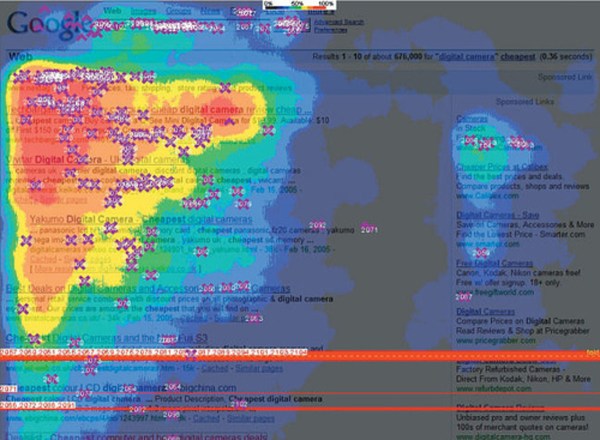
I think Lewis, and perhaps others of her generation, suffer from “rosy retrospection” – a cognitive bias that automatically assumes things were better yesterday. I have been searching for the better part of 3 decades and – as a sample of one – I don’t agree. I can also say with some empirical backing that the search experience is quantitatively better than it was when we did our first eye tracking study 20 years ago. A repeat study done 10 years ago showed time to first click had decreased and satisfaction with that click had increased. I’m fairly certain that a similar study would show that the search experience is better today than it was a decade ago. If this is a “search optimized hellhole”, it’s much less hellish than it was back in the “good old days” of search.

One of the reasons for that improvement is that millions of websites have been optimized by SEOs (a label which, by the way Amanda, has absolutely nothing to do with wanting to be mistaken for a CEO) to unlock unindexable content, fix broken code, improve usability, tighten up and categorize content and generally make the Internet a less shitty and confusing place. Not such an ignoble pursuit for “a bunch of megalomaniacal jerks (who) were degrading our collective sense of reality because they wanted to buy Lamborghinis and prove they could vanquish the almighty algorithm.”

Amanda Chigaco Lewis did interview those who sat astride the world of search providers and the world of SEO: Danny Sullivan (“angry and defensive” – according to Lewis), Barry Schwartz (“an unbelievably fast talker”), Duane Forrester (a “consummate schmoozer”) and Matt Cutts (an “SEO celebrity”). Each tried to refute her take that things are “broken” and the SEOs are to blame, but she brushed those aside, intent on caricaturing them as a cast of characters from a carnival side show.  Out of the entire scathing diatribe, one scant paragraph grudgingly acknowledges that maybe not all SEO is bad. That said, Lewis immediately spins around and says that it doesn’t matter, because the bad completely negates the good.

Obviously, I don’t agree with Lewis’s take on the SEO industry. Maybe it’s because I spent the better part of 20 years in the industry and know it at a level Lewis never could. But what irritates me the most is that she made no attempt to go beyond taking the quick and easy shots. She had picked her lens through which she viewed SEO before the very first interview and everything was colored by that lens. Was her take untrue? Not exactly. But it was unfair. And that’s why reporters like Lewis have degraded journalism to the point where it’s just clickbait, with a few more words thrown in.

Lewis gleefully stereotypes SEOs as “content goblin(s) willing to eschew rules, morals, and good taste in exchange for eyeballs and mountains of cash.” That’s simply not true. It’s no more true than saying all investigative journalists are “screeching acid-tongued harpies who are hopelessly biased and cover their topics with all the subtlety of a flame-thrower.”

P.S.  I did notice the article was optimized for search, with keywords prominently shown in the URL. Does that make the Verge and Lewis SEOs?