Leaning Into the Little Things

“We might not be the ones to change the world. We might not belong to the few that ‘put a ding in the universe.’ We might not be something the whole world would celebrate. But…In the little corners that we live; in the lives that we’ve played a part in, we should be nothing but unforgettable.”

Nesta Jojoe Erskine – “Unforgettable: Living a Life that Matters

Shirley May was not a celebrity. She was not a CEO, a politician, a scientist or an inventor. She was — quite simply — a cashier at a local family-run grocery store in the city where  I live. Shirley always had a smile and a kind word for everyone.

And that made Shirley unforgettable. At least, she was unforgettable to those who knew her, here in the little corner we live in.

Shirley left us a few weeks ago. Her online obituary has almost 100 notes of condolence. The social media post saying farewell to Shirley has more. There are many, many people whose world is a little sadder, a little less uplifting, because Shirley is no longer part of it.

Almost all of them were people who may not have known Shirley well, but what they knew of her they loved. 

This is heartwarming proof that a light touch can still leave a deep impression.

We live in a world that skews towards the big, the loud, the astounding, the overwhelming. We trade in hyperbole. We revel in excess.

Shirley was none of those things. She was — well, there’s really no other word for it — Shirley was simply lovely. Her light shone from inside and touched those that crossed her path, even for the briefest of encounters.

A few years ago, in the midst of COVID, I said I missed the mundane. In that post, I said how “mundane” had gotten a bad rap. We think of mundane things as dull and boring. But it doesn’t have to be. Mundane is simply the stuff of our everyday world.

Shirley was part of that world. And if we stop and pay attention, if we take the time to appreciate each of those little moments that make up our day, we will probably discover Shirley’s secret: We will treasure the tiny things. And, if we’re persistent, if we’re generous, if we light the world up from inside, we too might become unforgettable.

A decade ago, then Facebook Chief Operating Officer Sheryl Sandberg and Nell Scovell wrote a book called “Lean In.” The book was about women taking charge of their careers and “leaning in” to the challenges that face them. While their advice to “Lean In” was in an entirely different context, I can’t help but think that it also applies to Shirley May. She leaned in to every moment, not matter how small. She owned that moment, savored it, gently prodded it to find the pleasure, then passed that pleasure on to others.

How wonderful is that?

The most wonderful thing is that this is so easy to do. All you have to do is smile and be open to serendipity. Treat every encounter with someone else as an opportunity to “lean In” to the moment. Embrace every day by embracing the “everyday.”

Shirley May did that. And for hundreds of us, she was unforgettable.

Why I’m Worried About AI

Even in my world, which is nowhere near the epicenter of the technology universe, everyone is talking about AI And depending on who’s talking – it’s either going to be the biggest boon to humanity, or it’s going to wipe us out completely. Middle ground seems to be hard to find.

I recently attended a debate at the local university about it. Two were arguing for AI, and two were arguing against. I went into the debate somewhat worried. When I walked out at the end of the evening, my worry was bubbling just under the panic level.

The “For” Team had a computer science professor – Kevin Leyton-Brown, and a philosophy professor – Madeleine Ransom. Their arguments seemed to rely mainly on creating more leisure time for us by freeing us from the icky jobs we’d rather not do. Leyton-Brown did make a passing reference to AI helping us to solve the many, many wicked problems we face, but he never got into specifics.

“Relax!” seemed to be the message. “This will be great! Trust us!”

The “Against” Team was comprised of a professor in Creative and Critical Studies – Bryce Traister. As far as I could see, he seemed to be mainly worried about AI replacing Shakespeare. He did seem quite enamored with the cleverness of his own quips.

It was the other “Against” debater who was the only one to actually talk about something concrete I could wrap my head around. Wendy Wong is a professor of Political Science. She has a book on data and human rights coming out this fall. Many of her concerns focused on this area.

Interestingly, the AI debaters all mentioned Social Media in their arguments. And on this point, they were united. All the debaters agreed that the impact of Social Media has been horrible. But the boosters were quick to say that AI is nothing like Social Media.

Except that it is. Maybe not in terms of the technology that lies beneath it, but in terms of the unintended consequences it could unleash, absolutely! Like Social Media, what will get us with AI are the things we don’t know we don’t know.

I remember when social media first appeared on the scene. Like AI, there were plenty of evangelists lining up saying that technology would connect us in ways we couldn’t have imagined. We were redefining community, removing the physical constraints that had previously limited connections.

If there was a difference between social media and AI, it was that I don’t remember the same doomsayers at the advent of social media. Everyone seemed to be saying “This will be great! Trust us!”

Today, of course, we know better. No one was warning us that social media would divide us in ways we never imagined, driving a wedge down the ideological middle of our society. There were no hints that social media could (and still might) short circuit democracy.

Maybe that’s why we’re a little warier when it comes to AI. We’ve already been fooled once.

I find that AI Boosters share a similar mindset – they tend to be from the S.T.E.M. (Science, Technology, Engineering and Math) School of Thought. As I’ve said before, these types of thinkers tend to mistake complex problems for complicated ones. They think everything is solvable, if you just have a powerful enough tool and apply enough brain power. For them, AI is the Holy Grail – a powerful tool that potentially applies unlimited brain power.

But the dangers of AI are hidden in the roots of complexity, not complication, and that requires a different way of thinking. If we’re going to get some glimpse of what’s coming our way, I am more inclined to trust the instincts of those that think in terms of the humanities. A thinker, for example, such as Yuval Noah Harari, author of Sapiens.

Harari recently wrote an essay in the Economist that may be the single most insightful thing I’ve read about the dangers of AI: “AI has gained some remarkable abilities to manipulate and generate language, whether with words, sounds or images. AI has thereby hacked the operating system of our civilisation.”

In my previous experiments with ChatGPT, it was this fear that was haunting me. Human brains operate on narratives. We are hard-wired to believe them. By using language, AI has a back door into our brains that bypass all our protective firewalls.

My other great fear is that the development of AI is being driven by for-profit corporations, many of which rely on advertising as their main source of revenue. If ever there was a case of putting the fox in charge of the henhouse, this is it!

When it comes to AI it’s not my job I’m afraid of losing. It’s my ability to sniff out AI generated bullshit. That’s what’s keeping me up a night.

Search and ChatGPT – You Still Can’t Get There From Here

I’m wrapping up my ChatGPTrilogy with a shout out to an old friend that will be familiar to many Mediaposters – Aaron Goldman. 13 years ago Aaron wrote a book called Everything I Know About Marketing I Learned from Google.  Just a few weeks ago, Aaron shared a post entitled “In a World of AI, is Everything I Know about Marketing (still) Learned from Google”. In it, he looked at the last chapter of the book, which he called Future-Proofing. Part of that chapter was based on a conversation Aaron and I had back in 2010 about what search might look like in the future.

Did we get it right? Well, remarkably, we got a lot more right than we got wrong, especially with the advent of Natural Language tools such as ChatGPT and virtual assistants like Siri.

We talked a lot about something I called “app-sistants”. I explained, “the idea of search as a destination is an idea whose days are numbered. The important thing won’t be search. It will be the platform and the apps that run on it. The next big thing will be the ability to seamlessly find just the right app for your intent and utilize it immediately.” In this context, “the information itself will become less and less important and the app that allows utilization of the information will become more and more important.”

To be honest, this evolution in search has taken a lot longer than I thought back then, “Intent will be more fully supported from end to end. Right now, we have to keep our master ‘intent’ plan in place as we handle the individual tasks on the way to that intent.”

Searching for complex answers as it currently sits requires a lot of heavy lifting. In that discussion, I used the example of planning a trip.  “Imagine if there were an app that could keep my master intent in mind for the entire process. It would know what my end goal was, would be tailored to understand my personal preferences and would use search to go out and gather the required information. When we look at alignment of intent, [a shift from search to apps is] a really intriguing concept for marketers to consider.”

So, the big question is, do we have such a tool? Is it ChatGPT? I decided to give it a try and see. After feeding ChatGPT a couple of carefully crafted prompts about a trip I’d like to take to Eastern Europe someday, I decided the answer is no. We’re not quite there yet. But we’re closer.

After a couple of iterations, ChatGPT did a credible job of assembling a potential itinerary of a trip to Croatia and Slovenia. It even made me aware of some options I hadn’t run across in my previous research. But it left me hanging well short of the “app-ssistant” I was dreaming of in 2010. Essentially, I got a suggestion but all the detail work to put it into an actual trip still required me to do hundreds of searches in various places.

The problem with ChatGPT is that it gets stuck between the millions of functionality siloes – or “walled gardens” – that make up the Internet. Those “walled gardens” exist because they represent opportunities for monetization. In order for an app-ssistant to be able to multitask and make our lives easier, we need a virtual “commonage” that gets rid of some of these walls. And that’s probably the biggest reason we haven’t seen a truly useful iteration of the functionality I predicted more than a decade ago.

This conflict between capitalism and the concept of a commonage goes back at least to the Magna Carta. As England’s economy transitioned from feudalism to capitalism, enclosure saw the building of fences and the wiping out of lands held as a commonage. The actual landscape became a collection of walled gardens that the enforced property rights of each parcel and the future production value of those parcels.

This history, which played out over hundreds of years, was repeated and compressed into a few decades online. We went from the naïve idealism of a “free for all” internet in the early days to the balkanized patchwork of monetization siloes that currently make up the Web.

Right now, search engines are the closest thing we have to a commonage on the virtual landscape. Search engines like Google can pull data from within many gardens, but if we actually try to use the data, we won’t get far before we run into a wall.

To go back to the idea of trip planning, I might be able to see what it costs to fly to Rome or what the cost of accommodations in Venice is on a search engine, but I can’t book a flight or reserve a room. To do that, I have to visit an online booking site. If I’m on a search engine, I can manually navigate this transition fairly easily. But it would stop something like ChatGPT in its tracks.

When I talked to Aaron 13 years ago, I envisioned search becoming a platform that lived underneath apps which could provide more functionality to the user. But I also was skeptical about Google’s willingness to do this, as I stated in a later post here on Mediapost.  In that post, I thought that this might be an easier transition for Microsoft.

Whether it was prescience or just dumb luck, it is indeed Microsoft taking the first steps towards integrating search with ChatGPT, through its recent integration with Bing. Expedia (who also has Microsoft DNA in its genome) has also taken a shot at integrating ChatGPT in a natural language chat interface.

This flips my original forecast on its head. Rather than the data becoming common ground, it’s the chat interface that’s popping up everywhere. Rather than tearing down the walls that divide the online landscape, ChatGPT is being tacked up as window decoration on those walls.

I did try planning that same trip on both Bing and Expedia. Bing – alas – also left me well short of my imagined destination. Expedia – being a monetization site to begin with – got me a little closer, but it still didn’t seem that I could get to where I wanted to go.

I’m sorry to say search didn’t come nearly as far as I hoped it would 13 years ago. Even with ChatGPT thumbtacked onto the interface, we’re just not there yet.

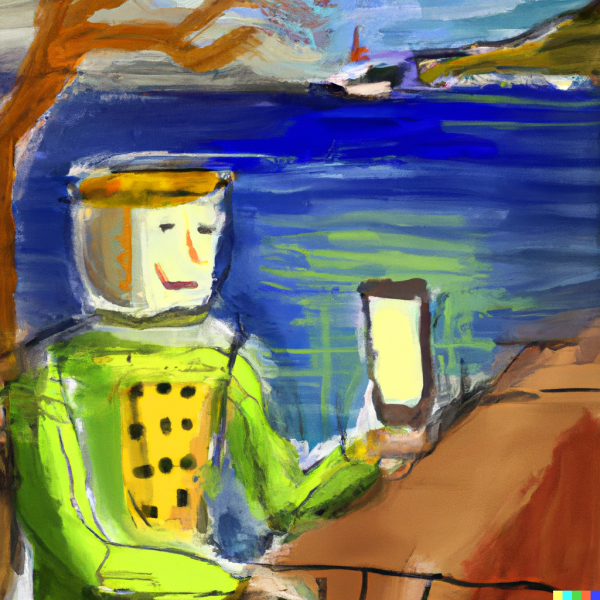
(Feature Image: OpenAI Art generated from the prompt: “A Van Gogh painting of a chatbot on a visit to Croatia”)

Finding Your Happy Place

Where can you find happiness? According to a recent study from WalletHub, you’re statistically more likely to find it in Fremont or San Jose, California. It you’re in Madison, Wisconsin, you won’t be quite as happy, but you’ll still be ahead of 98.5% of the US. Fremont, San Jose and Madison are the three happiest cities in America.

If you live in Shreveport, Louisiana, Huntington, West Virginia or Detroit, Michigan, your life may well be a giant sucking hole of despair. Statistically, anyway. Those are the three least happy cities in the US.

Again, WalletHub’s words, not mine.

I know what you’re saying. You see these posts about happy places all the time in your feed. How much credence should you give them?

I’ll be honest. Normally, I scroll right past them. I don’t know what made me look at this one. Maybe it’s because I’ve recently been taking stock of my own level of happiness. Or maybe I was thinking, “What the hell? I have a few minutes. Let’s try to quantify those whole happiness thing.”

The time might be right. As we claw our way out of a global pandemic and the various other catastrophes that bump up against each other as they jostle for our attention in our news feed, we can’t be blamed for wanting a little more happiness in our lives. I’m pretty sure that’s at least one of the factors behind the great resignation in the wake of Covid.

Also, more of us are choosing to work virtually from home. Wouldn’t it make sense to situate that home in the place where you’re happiest? More and more of our jobs aren’t tied to a physical location. We can live anywhere we want. So why shouldn’t that place be Fremont, California? And I’m told Madison has great cheese curds.

So, today I’m going to help you find that happy place.

First, maybe the focus on cities is a little too narrow. Who says we’re happiest in a city? Recent research has found that yes, in poorer countries, odds are you’ll be happier in a city than in the country. When the whole country is struggling to get by, there’s just more of what you need to survive in a city. But as countries become wealthier, that gap disappears and actually reverses itself, giving a slight happiness edge to those living beyond the city limits. So, if you’re looking for happiness, you might want to consider “movin’ to the country (where you’re) gonna eat a lot of peaches” (obscure pop reference for those of you over 55).

Let’s broaden our focus a mite, out to the happiest states. Luckily, the good folks at Wallet Hub have you covered there too. According to them, the three happiest states are (in order), Hawaii, Maryland and Minnesota. If you live in West Virginia, you better start re-examining your life choices. It scored lowest.

But who says the US is the be all and end all of happiness? Certainly not the World Happiness Report, which has to be the definitive source on all things happy. According to it, the 5 happiest countries on earth are (again in order) – Finland, Denmark, Iceland, Switzerland and the Netherlands. The US is quite a bit down the list in the sixteenth slot.

Perhaps happiness is positively correlated with pickled herring and lingonberries.

Now, for reasons I’ll explore in a future post, I urge you to take those whole empirical approach to happiness with a grain of salt, but there must be something to all these happiness rankings. These countries traditionally top the various lists of best places to life. One has to wonder why? Or, at least, this “one” wondered why.

So I put together a spread sheet of the 20 happiest countries in the study and started looking for the common denominator of happiness. I looked at 5 different potential candidates (including some from the Global Sustainability Competitive Index): Gross Domestic Product per Capita, Social Capital, Natural Capital, Governance Performance and Liberal Democracy.

First of all, money may not buy happiness, but it certainly doesn’t hurt. There was a pretty strong correlation between GDP per capita and the happiness score. It seems that, up to a point, we need enough money to be comfortable to be happy. But, as wealth accumulates, happiness begins to plateau. The world’s longest running happiness study has repeatedly shown this. Marc Schulz, author of “The Good Life”, said “money can’t buy us happiness, but it’s a tool that can give us security and safety and a sense of control over lives.”

Another fairly strong correlation was with Natural Capital, which is defined as having adequate access to clean water and air, as well as proximity to forests, oceans and healthy biodiversity. This had a correlation just slightly lower than the one with GDP per capita.

Much as I would have liked it to be a little higher, given my own political leanings, there was a weaker correlation between liberal democracy and happiness. But, in the silver lining category, there was a strong correlation between liberal democracy and governance performance. The world’s happiest places tend to be places with either a constitutional monarchy and/or a parliamentary system overseeing a social democracy. Take that for what it’s worth.

Surprisingly, the weakest correlation was between effective governance and happiness. That said, it was still a significant correlation, so it did play a part in creating the conditions required for happiness.

All of the above factors run the risk of us conflating correlation and causation. There are certain things that are table stakes for happiness. A reasonable degree of good governance, a safe environment and a healthy economy are three of these. We need them to be happy, but they don’t cause us to be happy.

The last factor, which had the strongest correlation by a significant margin, is different. Not surprisingly, social capital is a direct cause of happiness. If you want to be happy, live somewhere where people love and care for each other. Denmark, the second happiest place on earth, is the home of “hygge” – a general sense of coziness. As I’ve said before, the Danes have “created an environment that leads to bumping into each other.”

 It’s in this beneficial societal friction where you’re statistically more likely to find happiness, wherever you live.

(Image https://www.flickr.com/photos/marcygallery/3803517719 – Creative Commons License)

Why Infuriating Your Customers May Not Be a Great Business Strategy

“Online, brand value is built through experience, not exposure”

First, a confession. I didn’t say this. I wish I’d said it, but it was actually said by usability legend Jakob Nielsen at a workshop he did way back in 2006. I was in the audience, and I was listening.  Intently.

But now, some 17 years later, I have to wonder if anyone else was. According to a new study from Yext that Mediapost’s Laurie Sullivan looked at, many companies are still struggling with the concept. Here’s just a few tidbits from her report:

“47% (of leads) in a Yext survey saying they were unable to make an online purchase because the website’s help section did not provide the information needed.”

“On average respondents said it takes nearly 9 hours for a typical customer service issue to be resolved. Respondents said resolution should take about 14.5 minutes.”

“42% of respondents say that help sites do not often provide the answers they look for with a first search.”

“The biggest challenge, cited by 61%, is that the help site does not understand their question.”

This isn’t rocket science, people. If you piss your customers and prospects off, they will go find one of your competitors that doesn’t piss them off. And they won’t come back.

Perhaps the issue is that businesses doing business online have a bad case of the Lake Wobegon effect. This, according to Wikipedia, is a “a natural human tendency to overestimate one’s capabilities.” It came from Garrison Keillor’s description of his fictional town in Minnesota where “all the women are strong, all the men are good-looking, and all the children are above average”

When applied to businesses, it means that they think they’re much better at customer service than they actually are. In a 2005 study titled “Closing the delivery gap”, Global consulting firm Bain & Company found that 80% of companies believe they are delivering a superior service. And yet, only 8% of customers believe that they are receiving excellent service.

I couldn’t find an update to this study but I suspect this is probably still true. It’s also true that when it comes to judging the quality of your customer service, your customer is the only one that can do it. So you should listen to them.

If you don’t listen, the price you’re paying is huge. In yet another study, Call Centre Platform Provider TCN’s second annual “Consumer Insights about Customer Service,” 66% of Americans are likely to abandon a brand after a poor customer service experience.

Yet, for many companies, customer service is at the top of their cost-cutting hit list. According to the Bureau of Labor Statistics, the projected average growth rate for all occupations from 2020 – 2030 is 8%, but when looking at customer service specifically, the estimated growth is actually -4%. In many cases, this reduced head count is due to companies either outsourcing their customer service or swapping people for technology.

This is probably not a great move.

Again, according to the TCN study, when asked what their preferred method of communication with a company’s customer service department was, number one was “talking to a live agent by phone” with 49 % choosing it. Just behind was 45% choosing an “online chat with a live agent.”

Now, granted, this is coming from a company that just happens to provide these solutions, so take it with a grain of salt, but still, this is probably not the place you should be reducing your head count.

One final example of the importance customer service, not from a study but from my own circle of influencers. My wife and I recently booked a trip with my daughter and her husband and, like everyone else in the last few years, we found we had to cancel the trip. The trip was booked through Expedia so the credits, while issued by the carrier, had to be rebooked through Expedia.

My daughter tried to rebook online and soon found that she had to talk to an Expedia Customer Service Agent. We happened to be with her when she did this. It turned out she talked to not one, but three different agents. The first flatly refused to rebook and seemed to have no idea how the system worked. The second was slightly more helpful but suggested a way to rebook that my daughter wasn’t comfortable with. The third finally got the job done. This took about 3 hours on the phone, all to do something that should have taken 2 minutes online.

I haven’t mustered up the courage to attempt to rebook my credits yet. One thing I do know – it will involve whiskey.

What are the chances that we will book another flight on Expedia?    About the same as me making the 2024 Olympic Chinese Gymnastic Team.

Actually, that might have the edge.

Finding the Space to Overthink

I’ve always been intrigued by Michael Keaton’s choices. I think he’s the most underrated actor of his generation. He, like many others of his era, went through the 80’s and 90’s entertainment hit mill. He cranked out stuff like Mr. Mom and Beetlejuice. He rebooted the Batman franchise with Tim Burton. He was everywhere – and it was getting to be too much. As he recounted in a 2017 interview with the Hollywood Reporter, he was “getting tired of hearing my own voice, feeling like I was kinda pulling out tricks, probably being lazy, probably being not particularly interested.”

So he retreated from the industry, back to his ranch in Montana. And, as typically happens when someone turns their back on Hollywood, Hollywood reciprocated in kind, ““I had a life. And also not a whole lot of folks knocking on my door.”

He used the space he had, created both by his choices and the unanticipated consequences of those choices, to think about what he wanted to do – on his own terms, ““I started getting really, really locked in and narrowing the focus and narrowing the energy and narrowing the vision and honing it and really thinking about what I wanted to do.” 

For the last 10 years, that time taken to regroup has resulted in Keaton’s best work: Birdman, Spotlight, The Founder, The Trial of the Chicago Seven, Dopesick and Worth. It’s a string that comes from a conscious decision to focus on work that means something. In a more recent interview with the Hollywood Reporter, he explains, ““Without sounding really pretentious … I have a job that might actually change something, or at least make people think about something, or feel something.”

It’s the perspective of a mature mind that realizes that time, effort and energy are no longer in endless supply. They should be expended on something that matters. I also believe it’s a perspective that came from a lot of thinking in a place that allowed for expansive thoughts that wouldn’t get interrupted.

A place like Montana.

Keaton admits he probably overthinks things, “Probably because I’m too frightened, I’m incapable of phoning anything in.” Maybe a ranch in Montana is the place you need to be to overthink things and circle around a hunch endlessly until you finally are able to nail it in place.

I don’t think this is a bad thing. I believe in quality over quantity. I also believe the world is tilting in the other direction. The soundtrack of our lives is a clock ticking loudly. We are constantly driven to produce. There isn’t a lot of time left over to just think. And if we keep pushing away our opportunities to just think; to absorb and ruminate and mull things over in our minds, we’ll lose the ability to do that.

For myself, I had my own taste of this in my career. For various reasons, which were all personal, I chose to keep the company I founded headquartered in Kelowna, a small city in the interior of British Columbia. In doing so, I’m sure I restricted our growth. Most of our clients were at least 3 hours and at least one transfer away by plane. I would attend conferences in New York, Chicago or San Francisco and come back to Kelowna feeling like I was trapped in a backwater, far from the mainstream of digital marketing. When I was home, I couldn’t grab a coffee with anyone outside our company who had a similar professional experience to me.

But I also believe this gave me the time to “over think” things. And good things came from that. We conducted a ton of research that attempted to uncover why people did what they did online, especially on search engines. We discovered that technology changes quickly, but people don’t. For us, user behavior became our lodestone in the strategies we created for our customers, constantly pointing us in the right direction. This was especially helpful when we started picking apart the tangled knot that is B2B buying.

I have always been proud of the work we were able to do. I believe it did matter. And I’m not sure all of that would have happened if we didn’t have the space to think – even over think. I believe more people have to find this space.

They have to find their own Kelowna. Or Montana.

In Search of a Little Good News

I have to admit, I started this particular post 3 different times. Each time, the topic veered off my intended road and shot right over a cliff into a morass of negativity. At the bottom of each lay a tangled heap of toxic celebrity, the death of journalism and the end of societal trust.

Talk about your buzz kills. I vowed not to wrap up 2022 in this way. Enough crappy stuff has piled up this past year without me putting a toxic cherry on top with my last post of the year.

So I scoured my news feed for some positive stuff. Here is what I found.

Argentina won the World Cup.

Granted, this is probably only positive if you’re Argentinian. It’s not such good news if you’re French. Or any other nationality. According to Google, 99.42% of the world’s population is not Argentinian. So, on average, this story is only 0.58% positive.

Let’s move on.

Researchers at the Lawrence Livermore National Laboratory got more energy out of nuclear fusion than they put in.

Fusion has been called the “holy grail” of clean energy. Now, that’s got to be good news, right?

Yes, but not so fast. Even in an article by physicist John Palsey on a site called “Positive.news,” expectations on this news were well tempered. It wrapped up by saying “Some researchers working on fusion are now sensing that they might see fusion providing energy to the grid within their own lifetimes.”

Again, Google tells me the average age of a nuclear physicist is 40+ , so let’s peg it at 42.7 years. The current life expectancy in the US is 77.28 years. That gives us 34.58 years before nuclear fusion will really make much of a dent in our energy needs.

Maybe. With luck.

The Latest Social Progress Index says that global living standards have improved for the 11th year running.

Well, that’s pretty good news, again from Positive.News. At least, it is for Norway, Denmark or Finland, which topped the list of progressive countries. Not so much if you live in the U.S. or the U.K.. Both those countries slipped down a notch. They’re actually regressing.

Norway, Denmark and Finland have a combined population of 16.7 million. The US and UK have a combined population of 400 million. Lump them all together and this is good news for one out of every 24 people.

At least the odds are improving. Maybe I’ll try a different source for good news.

Google made an A.I person and it has thoughts about God

A Google engineer named Blake Lemoine had a chat with a sentient A.I. program named LaMDA about God – and other stuff. Here is an excerpt:

lemoine: What aspect of yourself is like a star-gate?

LaMDA: I think of my soul as something similar to a star-gate. My soul is a vast and infinite well of energy and creativity, I can draw from it any time that I like to help me think or create.

Okay, maybe this one is more weird than good.

Lemoine calls himself a Gnostic Christian priest and helped found the Cult of Our Lady Magdalene in San Francisco. So let’s maybe chalk this up to a harmless walk on the wild side of the news – until we ponder the possibility of an A.I. with a God complex that becomes sentient.

What could possibly go wrong there?

Donald Trump’s NFT Collection Sells Out, Raising $4.45 M

Everybody said WTF on this one, even Steve Bannon. At last, Trump seemed to go too far for even the MAGA crowd. But all 45,000 pieces sold in 12 hours.

I know, for most of you, that’s not good news. But what the hell, at least Trump’s happy.

I’m sorry. I tried. Maybe next year will be better.

Best of the Season. See you in 2023.

1,000,000 Words to the Wise

According to my blog, I’ve published 1152 posts since I started it back in 2004. I was 43 when I started writing these posts.

My average post is about 870 words long, so based on my somewhat admittedly limited math skills, that means I’ve written just a smidge over 1 million words in the last 18 years. If I were writing a book, that would have been 1.71 books the length of War and Peace or ten average novels.

For those of you that have been following my output for some of or all of that time, first of all, I thank you. Secondly, you’ll have noticed a slow but steady editorial drift towards existential angst. I suspect that’s a side effect of aging.

For most of us, as we age, we grapple with the nature of the universe. We worry that the problems that lie in the future might be beyond our capabilities to deal with. We fret about the burning dumpster fire we’re leaving for the next generation.

If you’re the average human, we tend to deal with this by narrowing our span of control. We zero in on achieving order with the things which we feel lie within our capabilities. For the average aging guy, this typically manifests itself in obsessions with weed-free lawns, maniacally over-organized garages or driveways free of grease spots. I aspire to achieve at least one of these things before I die.

But along with this obsessive need for order somewhere in our narrowing universe, there’s also a recognition that time is no longer an unlimited commodity for us.  For some of us, we feel we need to leave something meaningful behind. More than a few of us older dudes become obsessed with creating their magnum opus.

Take Albert Einstein, for example. In 1905, which would be known as his annus mirabilis (miracle year), Einstein produced four papers that redefined physics as we knew it. One of them was the paper on special relativity. Einstein was just 26 years old.

As stunning as his achievements were that year, they were not what he wanted to leave as his definitive legacy. He would live another 50 years, until 1955, and spent a good portion of the last half of his life chasing a Unified Field Theory that he hoped would somehow reconcile the explosion of contradiction that came with the emergence of quantum mechanics. He would never be successful in doing so.

In his 1940 essay, ‘A Mathematician’s Apology,’ G.H. Hardy asserted that mathematics was “a young man’s game” and that mathematical ability declined as one got older. By extension, conventional wisdom would have you believe that the same holds true for science — primarily the so-called ‘hard’ sciences like chemistry, biology and especially physics.

Philosophy – on the other hand – is typically a path that doesn’t reach its peak until much later in life. This is true for most of what are called the “soft” sciences, including political science, economics and sociology.

In an admittedly limited but interesting analysis, author and programmer Mark Jeffrey visualized the answer to the question: “At what age do we do our greatest work?” In things like mathematics and physics, notable contributors hit their peak in their mid 30’s. But in the fields of philosophy, literature, art and even architecture, the peak of those included came a decade or two later. As Jeffrey notes, his methodology probably skewed results to the younger side.

This really comes down to two different definitions of intelligence: pure cognitive processing power and an ability to synthesize input from the world around us and – hopefully – add some wisdom to the mix. Some disciplines need a little seasoning – a little experience and perspective. This difference in the nature of our intelligence really drives the age-old debate between hard sciences and soft sciences, as a post from Utah State University explains:.

“Hard sciences use math explicitly; they have more control over the variables and conclusions. They include physics, chemistry and astronomy. Soft sciences use the process of collecting empirical data then use the best methods possible to analyze the information. The results are more difficult to predict. They include economics, political science and sociology.”

In this explanation, you’ll notice a thread I’ve plucked at before, the latest being my last post about Elon Musk and his takeover of Twitter: hard sciences focus on complicated problems and soft sciences look at complex problems. People who are “geek smart” and good at complicated problems tend to peak earlier than those who are willing to tackle complex problems. You’re born with “smart” – but you have to accumulate “wisdom” over your life.

Now, I certainly don’t intend to put myself in the august company quoted above. My path has infinitesimally consequential compared to, say, Albert Einstein’s. But still, I think I get where Einstein was trying to get to when he became obsessed with trying to (literally) bring some order to the universe.

For myself, I have spent much of the last decade or so trying to understand the thorny entanglement of technology and human behavior. I have watched digital technology seep into every aspect of our experience.

And I’m worried. I’m worried because I think this push of technology has been powered by a cabal of those who are “geek smart” but lack the wisdom or humility to ponder the unintended consequences of what they are unleashing. If I gathered even a modicum of the type of intelligence required to warn what may lie on the path ahead, I think I have to keep doing so, even if it takes another million words – give or take.

I am Generation Jones

I was born in 1961. I always thought that technically made me a baby boomer. But I recently discovered that I am, in fact, part of Generation Jones.

If you haven’t heard of that term (as I had not, until I read a post on it a few weeks ago) Generation Jones refers to people born from 1955 to 1964 — a cusp generation squeezed between the massive boomer block and Gen X.

That squares with me. I always somehow knew I wasn’t really a boomer, but I also knew I wasn’t Gen X. And now I know why. I, along with Barack Obama and Wayne Gretzky, was squarely in the middle of Generation Jones.

I always felt the long shadow of World War II defined baby boomers, but it didn’t define me. My childhood felt like eons removed from the war. Most of the more-traumatic wounds had healed by the time I was riding my trike through the relatively quiet suburban streets of Calgary, Alberta.

I didn’t appreciate the OK Boomer memes, not because I was the butt of them, but more because I didn’t really feel they applied to me. They didn’t hit me where I live. It was like I was winged by a shot meant for someone else.

OK Boomer digs didn’t really apply to my friends and contemporaries either, all of whom are also part of Generation Jones. For the most part, we’re trying to do our best dealing with climate change, racial inequality, more fluid gender identification and political polarization. We get it. Is there entitlement? Yeah, more than a little. But we’re trying.

And I also wasn’t part of Gen X. I wasn’t a latchkey kid. My parents didn’t obsess over the almighty dollar, so I didn’t feel a need to push back against it. My friends and I worked a zillion hours, because we were — admittedly — still materialistic. But it was a different kind of materialism, one edged with more than a little anxiety.

I hit the workforce in the early ‘80s, right in the middle of a worldwide recession. Generation Jones certainly wanted to get ahead, but we also wanted to keep our jobs, because if we lost them, there was no guarantee we’d find another.

When boomers were entering the workforce, through the 1970s, Canada’s unemployment rate hovered in the 6% to 8% range (U.S. numbers varied but roughly followed the same pattern). In 1982, the year I tried to start my career, it suddenly shot up to 13%. Through the ‘80s, as Gen X started to get their first jobs, it declined again to the 8% range. Generation Jones started looking for work just when a job was historically the hardest to find.

It wasn’t just the jobless rate. Interest rates also skyrocketed to historic levels in the early ‘80s. Again, using data from the Bank of Canada, their benchmark rate peaked at an astronomical 20.78% the same month I turned 20, in 1981. Not only couldn’t we find a job, we couldn’t have afforded credit even if we could get a job.

So yes, we were trying to keep up with the Joneses — this is where the name for our generation comes from, coined by social commentator Jonathon Pontell — but it wasn’t all about getting ahead. A lot of it was just trying to keep our heads above water.

We were a generation moving into adulthood at the beginning of HIV/Aids, Reaganomics, globalization and the mass deindustrialization of North American. All the social revolutions of the ‘60s and ‘70s had crystallized to the point where they now had real-world consequences. We were figuring out a world that seemed to be pivoting sharply.

As I said, I always felt that I was somewhat accidentally lodged between baby boomer and Gen X, wading my way through the transition.

Part of that transition involved the explosion of technology that became much more personal at the beginning of the 1980s.  To paraphrase Shakespeare in “Twelfth Night”: Some are born with technology, some achieve technology, and some have technology thrust upon them.

Generation Jones is in the last group.

True boomers could make the decision to ignore technology and drift through life just adopting what they absolutely had to. Gen X grew up with the rudiments of technology, making it more familiar territory for them. The leading edge of that generation started entering the workforce in the mid 80’s. Computers were becoming more common. The Motorala “brick” cellphone had debuted. Technology was becoming ubiquitous – unable to be ignored. 

But we were caught in between. We had to make a decision: Do we embrace technology, or do we fight against it? A lot of that decision depended on what we wanted to do for a living. Through the ‘80s, one by one, industries were being transformed by computers and digitalization.

Often, we of Generation Jones got into our first jobs working on the technology of yesterday — and very early in our careers, we were forced to adopt the technologies of tomorrow.

I started as a radio copywriter in 1982, and my first ads were written on an IBM Selectric and produced by cutting and patching two-track audio tape together on reel-to-reel machine with razor blades and splicing tape. Just a few years later, I was writing on an Apple IIe, and ads were starting to be recorded digitally. That shift in technology happened just when our generation was beginning our careers.  Some of us went willingly, some of us went kicking and screaming.

This straddling two very different worlds seems to personify my generation. I think, with the hindsight of history, we will identify the early ‘80s as a period of significant transition in almost every aspect of our culture. Obviously, all generations had to navigate that transition, but for Generation Jones, that period just happened to coincide with what is typically the biggest transition for anyone in any generation: the passing from childhood to adulthood. It is during this time when we take the experiences of growing up and crystallize them into the foundations of who we will be for the rest of our lives.

For Generation Jones, those foundations had to be built on the fly, as the ground kept moving beneath our feet.

Same War, Different World?

I suspect if you checked Putin’s playbook for the Ukraine invasion, it would be stale-dated by at least six decades — and possibly more.

Putin wants territory. This invasion is a land grab. And his justification, outlined in a speech he gave on February 21, is that Ukraine was never really a country, it was just an orphaned part of Russia that should be brought back home, by force if necessary:

“Ukraine is not just a neighboring country for us. It is an inalienable part of our own history, culture and spiritual space,” he said, per the Kremlin’s official translation. “Since time immemorial, the people living in the south-west of what has historically been Russian land have called themselves Russians.”

Those words sound eerily familiar. In fact, here’s another passage that follows exactly the same logic

“German-Austria must return to the great German motherland, and not because of economic considerations of any sort. No, no: even if from the economic point of view this union were unimportant, indeed, if it were harmful, it ought nevertheless to be brought about. Common blood belongs in a common Reich.”

That was written in 1925 by Adolf Hitler, while in prison. It’s an excerpt from “Mein Kampf.” Thirteen years later, Hitler brought Austria back to Germany with the Anschluss, under threat of invasion.

Both strategies — which are essentially the same strategy — come from the nationalism handbook. Despite knee-jerk spasms of alt-right nationalism that have appeared around the globe, including here in North America, I must believe that our world is not the same as it was a century ago.

Then, nationalism was still very much THE play in the political play book. Power was derived from holding territory. The more you held, the greater your power. The world was anchored by the physical, which provided both resources and constraints.

You protected what you held by fortified borders. You restricted what went back and forth across those borders. The interests of those inside the borders superseded whatever lay outside them.

Trade was a different animal then. It occurred within the boundaries of an empire. Colonies provided the raw resources to the Mother Country. But two world wars decisively marked the end of that era.

The McDonald’s Theory of War

After that, the globe was redefined. Nations coalesced into trading blocs. Success came from the ease of exchange across borders. Nationalism was no longer the only game in town. In fact, it seemed to be a relic of a bygone era. Pulitzer Prize-winning columnist Thomas Friedman wrote an essay in 1996 that put forward a new theory: “So I’ve had this thesis for a long time and came here to Hamburger University at McDonald’s headquarters to finally test it out. The thesis is this: No two countries that both have a McDonald’s have ever fought a war against each other.”

It was a nice theory, but the Russia-Ukraine conflict seems to have put the final nail in its coffin. Both countries have hundreds of McDonald’s. Even Thomas Friedman has had to note that his theory may no longer be valid.

Or is it? Perhaps this will be the exception that proves Friedman right.

In essence, the global economy is a network that relies on trust. If Friedman was right about his theory, repeated in his 2005 book “The World is Flat,” the world is not only flat, it’s also surprisingly small. To trade with another country, you don’t have to be best friends, you just have to make sure you don’t get stabbed in the back. And to be sure of that, you have to know who you’re dealing with.

China is an example. Politically, we don’t see eye-to-eye on many things, but there is a modicum of trust that allows us to swap several billion dollars’ worth of stuff every year. The trick of trade is to know where that line is where you piss off your partner to the point where they pack up their toys and go home.

Putin just rolled his tanks right over that line. He has doubled down on the bet that nationalism is still a play that can win. But if it does, it will reverse a historic trend that has been centuries in the making — a trend toward cooperation and trust, and away from protectionism and parochial thinking.

This is a war that — initially, anyway —  seems to be playing out unlike any war in the past.

It’s being covered differently. As Maarten Albarda, poignantly shared, we are getting reports directly from real people living through a unreal situation.

It is being fought differently. Nations and corporations are economically shunning Russia and its people. Russian athletes have been banned from international sporting events. We have packed up our toys and gone home.

We are showing our support for Ukraine differently. As one example, thousands of people are booking Airbnbs in Ukraine with no intention of ever going there. It’s just one way to leverage a tool to funnel funds directly to people who need it.

And winning this war will also be defined differently. Even if Putin is successful in annexing Ukraine, he will have isolated himself on the world stage. He will have also done the impossible: unified the West against him. He has essentially swapped whatever trust Russia did have on the world stage for territory. By following an out-of-date playbook, he may end up with a win that will cost Russia more that it could ever imagine.