It’s the Buzz That Will Kill You

If you choose to play in the social arena, you have to accept that the typical peaks and valleys of business success can suddenly become impossibly steep.

In social media networks, your brand message is whatever meme happens to emerge from the collective activity of this connected market. Marketers have little control — and sometimes, they have no control. At best, all they can do is react by throwing another carefully crafted meme into the social-sphere and hope it picks up some juice and is amplified through the network.

That’s exactly what happened to Peloton in the past week and a half.

On Dec. 9, the HBO Max sequel to “Sex and the City” killed off a major character — Chris Noth’s Mr. Big — by giving him a heart attack after his one thousandth Peloton ride. Apparently, HBO Max gave Peloton no advance warning of this branding back hand.

On Dec. 10, according to Axios,  there was a dramatic spike in social interactions talking about Mr. Big’s last ride, peaking near 80 thousand. As you can imagine, the buzz was not good for Peloton’s business.

On Dec. 12, Peloton struck back with its own ad, apparently produced in just 24 hours by Ryan Reynold’s Maximum Effort agency. This turned the tide of the social buzz. Again, according to data from Newswhip and Axios, social media mentions peaked. This time, they were much more positive toward the Peloton brand.

It should be all good — right? Not so fast. On Dec 16, two sexual assault allegations were made against Chris Noth, chronicled in The Hollywood Reporter. Peloton rapidly scrubbed its ad campaign. Again, the social sphere lit up and Peloton was forced back into defensive mode.

Now, you might call all this marketing froth, but that’s  the way it is in our hyper-connected world. You just have to dance the dance — be nimble and respond.

But my point is not about the marketing side of this of this brouhaha – which has been covered to death, at least at MediaPost (sorry, pardon the pun.) I’m more interested  in what happens to the people who have some real skin in this particular game, whose lives depend on the fortunes of the Peloton brand. Because all this froth does have some very IRL consequences.

Take Peloton’s share price, for one.

The day before the HBO show aired, Peloton’s shares were trading at $45.91. The next day, they tumbled 16%. to $38.51.

And that’s just one chapter in the ongoing story of Peloton’s stock performance, which has been a hyper-compressed roller coaster ride, with the pandemic and a huge amount of social media buzz keeping the foot firmly on the accelerator of stock performance through 2020, but then subsequently dropping like a rock for most of 2021. After peaking as high as $162 a share exactly a year ago, the share price is back down to spitting distance of its pre-pandemic levels.

Obviously, Peloton’s share price is not just dependent on the latest social media meme. There are business fundamentals to consider as well.

Still, you have to accept that a more connected meme-market is going to naturally accelerate the speed of business upticks and declines. Peloton signed up for this dance — and  when you do that, you have to accept all that comes with it.

In terms of the real-world consequences of betting on the buzz, there are three “insider” groups (not including customers) that will be affected: the management, the shareholders and the employees. The first of these supposedly went into this with their eyes open. The second of these also made a choice. If they did their due diligence before buying the stock, they should have known what to expect. But it’s the last of these — the employees — that I really feel for.

With ultra-compressed business cycles like Peloton has experienced, it’s tough for employees to keep up. On the way up the peak, the company is running ragged trying to scale for hyper-growth. If you check employee review sites like Glassdoor.com, there are tales of creaky recruitment processes not being able to keep up. But at least the ride up is exciting. The ride down is something quite different.

In psychological terms, there is something called the locus of control. These are the things you feel you have at least some degree of control over. And there is an ever-increasing body of evidence that shows that locus of control and employee job satisfaction are strongly correlated. No one likes to be the one constantly waiting for someone else to drop the other shoe. It just ramps up your job stress. Granted, job stress that comes with big promotions and generous options on a rocket ship stock can perhaps be justified. But stress that’s packaged with panicked downsizing and imminent layoffs is not a fun employment package for anyone.

That’s the current case at Peloton. On Nov. 5 it announced an immediate hiring freeze. And while there’s been no official announcement of layoffs that I could find, there have been rumors of such posted to the site thelayoff.com.  This is not a fun environment for anyone to function in. Here’s what one post said: “I left Peloton a year ago when I realized it was morphing into the type of company I had no intention of working for.”

We have built a business environment that is highly vulnerable to buzz. And as Peloton has learned, what the buzz giveth, the buzz can also taketh away.

When Social Media Becomes the Message

On Nov. 23, U.K. cosmetics firm Lush said it was deactivating its Instagram, Facebook, TikTok and Snapchat accounts until the social media environment “is a little safer.” And by a “safer” environment, the company didn’t mean for advertisers, but for consumers. Jack Constantine, chief digital officer and product inventor at Lush, explains in an interview with the BBC:

“[Social media channels] do need to start listening to the reality of how they’re impacting people’s mental health and the damage that they’re causing through their craving for the algorithm to be able to constantly generate content regardless of whether it’s good for the users or not.”

This was not an easy decision for Lush. It came with the possibility of a substantial cost to its business, “We already know that there is potential damage of £10m in sales and we need to be able to gain that back,” said Constantine. “We’ve got a year to try to get that back, and let’s hope we can do that.”

In effect, Lush is rolling the dice on a bet based on the unpredictable network effects of social media. Would the potential loss to its bottom line be offset by the brand uptick it would receive by being true to its core values? In talking about Lush’s move on the Wharton Business Daily podcast, marketing lecturer Annie Wilson pointed out the issues in play here:

“There could be positive effects on short-term loyalty and brand engagement, but it will be interesting to see the long-term effect on acquiring new consumers in the future.”

I’m not trying to minimize Lush’s decision here by categorizing it as a marketing ploy. The company has been very transparent about how hard it’s been to drop — even temporarily — Facebook and its other properties from the Lush marketing mix. The brand had previously closed several of its UK social media accounts, but eventually found itself “back on the channels, despite the best intentions.”

You can’t overstate how fundamental a decision this is for a profit-driven business. But I’m afraid Lush is probably an outlier. The brand is built on making healthy choices. Lush eventually decided it had to stay true to that mission even if it hurts the bottom line.

Other businesses are far from wearing their hearts on their sleeves to the same extent as Lush. For every Lush that’s out there, there are thousands that continue to feed their budgets to Facebook and its properties, even though they fundamentally disagree with the tactics of the channel.

There has been pushback against these tactics before. In July of 2020, 1000 advertisers joined the #StopHateForProfit Boycott against Facebook. That sounds impressive – until you realize that Facebook has 9 million clients. The boycotters represented just over .01% of all advertisers. Even with the support of other advertisers who didn’t join the boycott but still scaled back their ad spend, it only had a fleeting effect on Facebook’s bottom line. Almost all the advertisers eventually returned after the boycott.

As The New York Times reported at the time, the damage wasn’t so much to Facebook’s pocketbook as to its reputation. Stephen Hahn-Griffiths, the executive vice president of the public opinion analysis company RepTrak, wrote in a follow-up post,

“What could really hurt Facebook is the long-term effect of its perceived reputation and the association with being viewed as a publisher of ‘hate speech’ and other inappropriate content.”

Of course, that was all before the emergence of a certain Facebook data engineer by the name of Frances Haugen. The whistleblower released thousands of internal documents to the Wall Street Journal this past fall. It went public in September of this year in a series called “The Facebook Files.” If we had any doubt about the culpability of Zuckerberg et al, this pretty much laid that to rest.

Predictably, after the story broke, Facebook made some halfhearted attempts to clean up its act by introducing new parental controls on Instagram and Facebook. This follows the typical Facebook handbook for dealing with emerging shit storms: do the least amount possible, while talking about it as much as possible. It’s a tactic known as “purpose-washing.”

The question is, if this is all you do after a mountain of evidence points to you being truly awful, how sincere are you about doing the right thing? This puts Facebook in the same category as Big Tobacco, and that’s pretty crappy company to be in.

Lush’s decision to quit Facebook also pinpoints an interesting dilemma for advertisers: What happens when an advertising platform that has been effective in attracting new customers becomes so toxic that it damages your brand just by being on it? What happens when, as Marshall McLuhan famously said, the medium becomes the message?

Facebook is not alone with this issue. With the systematic dismantling of objective journalism, almost every news medium now carries its own message. This is certainly true for channels like Fox News. By supporting these platforms with advertising, advertisers are putting a stamp of approval on those respective editorial biases and — in Fox’s case — the deliberate spreading of misinformation that has been shown to have a negative social cost.

All this points to a toxic cycle becoming more commonplace in ad-supported media: The drive to attract and effectively target an audience leads a medium to embrace questionable ethical practices. These practices then taint the platform itself, leading to it potentially becoming brand-toxic. The advertisers then must choose between reaching an available audience that can expand its business, or avoiding the toxicity of the platform. The challenge for the brand then becomes a contest to see how long it can hold its nose while it continues to maximize sales and profits.

For Lush, the scent of Facebook’s bullshit finally grew too much to bear — at least for now.

The Complexities Of Understanding Each Other

How our brain understands things that exist in the real world is a fascinating and complex process.

Take a telephone, for example.

When you just saw that word in print, your brain went right to work translating nine abstract symbols (including the same one repeated three times), the letters we use to write “telephone,” into a concept that means something to you. And for each of you reading this, the process could be a little different. There’s a very good likelihood you’re picturing a phone. The visual cortex of your brain is supplying you with an image that comes from your real-world experience with phones.

But perhaps you’re thinking of the sound a phone makes, in which case the audio center of your brain has come to life and you’re reimagining the actual sound of a phone.

recent study from the Max Planck Institute found there’s a hierarchy of understanding that activates in the brain when we think of things, going from the concrete at the lowest levels to the abstract at higher levels. It can all get quite complex — even for something relatively simple like a phone.

Imagine what a brain must go through to try to understand another person.

Another study from Ruhr University in Bochum, Germany, tried to unpack that question. The research team found, again, that the brain pulls many threads together to try to understand what another person might be going through. It pulls back clues that come through our senses. But, perhaps most importantly, in many cases it attempts to read the other person’s mind. The research team believes it’s this ability that’s central to social understanding.  “It enables us to develop an individual understanding of others that goes beyond the here and now,” explains researcher Julia Wolf. “This plays a crucial role in building and maintaining long-term relationships.”

In both these cases of understanding, our brains rely on our experience in the real world to create an internal realization in our own brains. The richer those experiences are, the more we have to work with when we build those representations in our mind.

This becomes important when we try to understand how we understand each other. The more real-world experience we have with each other, the more successful we will be when it comes to truly getting into someone else’s head. This only comes from sharing the same physical space and giving our brains something to work with. “All strategies have limited reliability; social cognition is only successful by combining them,” says study co-researcher Sabrina Coninx.

I have talked before about the danger of substituting a virtual world for a physical one when it comes to truly building social bonds. We just weren’t built to do this. What we get through our social media channels is a mere trickle of input compared to what we would get through a real flesh-and-blood interaction.

Worse still, it’s not even an unbiased trickle. It’s been filtered through an algorithm that is trying to interpret what we might be interested in. At best it is stripped of context. At worst, it can be totally misleading.

Despite these worrying limitations, more and more of us are relying on this very unreliable signal to build our own internal representations of reality, especially those involving other people.

Why is this so dangerous? It’s The negative impact of social media is twofold. First it strips us of the context we need to truly understand each other, and then it creates an isolation of understanding. We become ideologically balkanized.

Balkanization is the process through which those that don’t agree with each other become formally isolated from each other. It was first used to refer to the drawing of boundaries between regions (originally in the Balkan peninsula) that were ethnically, politically or religiously different from each other.

Balkanization increasingly relies on internal representations of the “other,” avoiding real world contact that may challenge those representations. The result is a breakdown of trust and understanding across those borders. And it’s this breakdown of trust we should be worried about.

Our ability to reach across boundaries to establish mutually beneficial connections is a vital component in understanding the progress of humans. In fact, in his book “The Rational Optimist,” Matt Ridley convincingly argues that this ability to trade with others is the foundation that has made homo sapiens dominant on this planet. But, to successfully trade and prosper, we have to trust each other. “As a broad generalisation, the more people trust each other in a society, the more prosperous that society is, and trust growth seems to precede income growth,” Ridley explains.

As I said, balkanization is a massive breakdown of trust. In every single instance in the history of humankind, a breakdown of trust leads to a society that regresses rather than advances. But if we take every opportunity to build trust and break down the borders of balkanization, we prosper.

Neuroeconomist Paul Zak, who has called the neurotransmitter oxytocin the “trust molecule,” says, “A 15% increase in the proportion of people in a country who think others are trustworthy, raises income per person by 1% per year for every year thereafter.”

We evolved to function in a world that was messy, organic and, most importantly, physical. Our social mechanisms work best when we keep bumping into each other, whether we want to or not. Technology might be wonderful at making the world more efficient, but it doesn’t do a very good job at making it more human.

The Relationship between Trust and Tech: It’s Complicated

Today, I wanted to follow up on last week’s post about not trusting tech companies with your privacy. In that post, I said, “To find a corporation’s moral fiber, you always, always, always have to follow the money.”

A friend from back in my industry show days — the always insightful Brett Tabke — reached out to me to comment, and mentioned that the position taken by Apple in the current privacy brouhaha with Facebook is one of convenience, especially this “holier-than-thou” privacy stand adopted by Tim Cook and Apple.

“I really wonder though if it is a case of do-the-right-thing privacy moral stance, or one of convenience that supports their ecosystem, and attacks a competitor?” he asked.

It’s hard to argue against that. As Brett mentioned, Apple really can’t lose by “taking money out of a side-competitors pocket and using it to lay more foundational corner stones in the walled garden, [which] props up the illusion that the garden is a moral feature, and not a criminal antitrust offence.”

But let’s look beyond Facebook and Apple for a moment. As Brett also mentioned to me, “So who does a privacy action really impact more? Does it hit Facebook or ultimately Google? Facebook is just collateral damage here in the real war with Google. Apple and Google control their own platform ecosystems, but only Google can exert influence over the entire web. As we learned from the unredacted documents in the States vs Google antitrust filings, Google is clearly trying to leverage its assets to exert that control — even when ethically dubious.”

So, if we are talking trust and privacy, where is Google in this debate? Given the nature of Google’s revenue stream, its stand on privacy is not quite as blatantly obvious (or as self-serving) as Facebook’s. Both depend on advertising to pay the bills, but the nature of that advertising is significantly different.

57% of Alphabet’s (Google’s parent company) annual $182-billion revenue stream still comes from search ads, according to its most recent annual report. And search advertising is relatively immune from crackdowns on privacy.

When you search for something on Google, you have already expressed your intent, which is the clearest possible signal with which you can target advertising. Yes, additional data taken with or without your knowledge can help fine-tune ad delivery — and Google has shown it’s certainly not above using this  — but Apple tightening up its data security will not significantly impair Google’s ability to make money through its search revenue channel.

Facebook’s advertising model, on the other hand, targets you well before any expression of intent. For that reason, it has to rely on behavioral data and other targeting to effectively deliver those ads. Personal data is the lifeblood of such targeting. Turn off the tap, and Facebook’s revenue model dries up instantly.

But Google has always had ambitions beyond search revenue. Even today, 43% of its revenue comes from non-search sources. Google has always struggled with the inherently capped nature of search-based ad inventory. There are only so many searches done against which you can serve advertising. And, as Brett points out, that leads Google to look at the very infrastructure of the web to find new revenue sources. And that has led to signs of a troubling collusion with Facebook.

Again, we come back to my “follow the money” mantra for rooting out rot in the system. And in this case, the money we’re talking about is the premium that Google skims off the top when it determines which ads are shown to you. That premium depends on Google’s ability to use data to target the most effective ads possible through its own “Open Bidding” system. According to the unredacted documents released in the antitrust suit, that premium can amount to 22% to 42% of the ad spend that goes through that system.

In summing up, it appears that if you want to know who can be trusted most with your data, it’s the companies that don’t depend on that data to support an advertising revenue model. Right now, that’s Apple. But as Brett also pointed out, don’t mistake this for any warm, fuzzy feeling that Apple is your knight in shining armour: “Apple has shown time and time again they are willing to sacrifice strong desires of customers in order to make money and control the ecosystem. Can anyone look past headphone jacks, Macbook jacks, or the absence of Macbook touch screens without getting the clear indication that these were all robber-baronesque choices of a monopoly in action? Is so, then how can we go ‘all in’ on privacy with them just because we agree with the stance?”

The Tech Giant Trust Exercise

If we look at those that rule in the Valley of Silicon — the companies that determine our technological future — it seems, as I previously wrote,  that Apple alone is serious about protecting our privacy. 

MediaPost editor in chief Joe Mandese shared a post late last month about how Apple’s new privacy features are increasingly taking aim at the various ways in which advertising can be targeted to specific consumers. The latest victim in those sights is geotargeting.

Then Steve Rosenbaum mentioned last week that as Apple and Facebook gird their loins and prepare to do battle over the next virtual dominion — the metaverse — they are taking two very different approaches. Facebook sees this next dimension as an extension of its hacker mentality, a “raw, nasty networker of spammers.” Apple is, as always, determined to exert a top-down restriction on who plays in its sandbox, only welcoming those who are willing to play by its rules. In that approach, the company is also signaling that it will take privacy in the metaverse seriously. Apple CEO Tim Cook said he believes “users should have the choice over the data that is being collected about them and how it’s used.”

Apple can take this stand because its revenue model doesn’t depend on advertising. To find a corporation’s moral fiber, you always, always, always have to follow the money. Facebook depends on advertising for revenue. And it has repeatedly shown it doesn’t really give a damn about protecting the privacy of users. Apple, on the other hand, takes every opportunity to unfurl the privacy banner as its battle standard because its revenue stream isn’t really impacted by privacy.

If you’re looking for the rot at the roots of technology, a good place to start is at anything that relies on advertising. In my 40 years in marketing, I have come to the inescapable conclusion that it is impossible for business models that rely on advertising as their primary source of revenue to stay on the right side of privacy concerns. There is an inherent conflict that cannot be resolved. In a recent earnings call,  Facebook CEO Mark Zuckerberg said it in about the clearest way it could be said, “As expected, we did experience revenue headwinds this quarter, including from Apple’s [privacy rule] changes that are not only negatively affecting our business, but millions of small businesses in what is already a difficult time for them in the economy.”

Facebook has proven time and time again that when the need for advertising revenue runs up against a question of ethical treatment of users, it will always be the ethics that give way.

It’s also interesting that Europe is light years ahead of North America in introducing legislation that protects privacy. According to one Internet Privacy Ranking study, four of the five top countries for protecting privacy are in Northern Europe. Australia is the fifth. My country, Canada, shares these characteristics. We rank seventh. The US ranks 18th.

There is an interesting corollary here I’ve touched on before. All these top-ranked countries are social democracies. All have strong public broadcasting systems. All have a very different relationship with advertising than the U.S. We that live in these countries are not immune from the dangers of advertising (this is certainly true for Canada), but our media structure is not wholly dependent on it. The U.S., right from the earliest days of electronic media, took a different path — one that relied almost exclusively on advertising to pay the bills.

As we start thinking about things like the metaverse or other forms of reality that are increasingly intertwined with technology, this reliance on advertising-funded platforms is something we must consider long and hard. It won’t be the companies that initiate the change. An advertising-based business model follows the path of least resistance, making it the shortest route to that mythical unicorn success story. The only way this will change will be if we — as users — demand that it changes.

And we should  — we must — demand it. Ad-based tech giants that have no regard for our personal privacy are one of the greatest threats we face. The more we rely on them, they more they will ask from us.

Moving Beyond Willful Ignorance

This is not the post I thought I’d be writing today. Two weeks ago, when I started to try to understand willful ignorance, I was mad. I suspect I shared that feeling with many of you. I was tired of the deliberate denial of fact that had consequences for all of us. I was frustrated with anti-masking, anti-vaxxing, anti-climate change and, most of all, anti-science. I was ready to go to war with those I saw in the other camp.

And that, I found out, is exactly the problem. Let me explain.

First, to recap. As I talked about two weeks ago, willful ignorance is a decision based on beliefs, so it’s very difficult – if not impossible – to argue, cajole or inform people out of it. And, as I wrote last week, willful ignorance has some very real and damaging consequences. This post was supposed to talk about what we do about that problem. I intended to find ways to isolate the impact of willful ignorance and minimize its downside. In doing so, I was going to suggest putting up even more walls to separate “us” from “them.”

But the more I researched this and thought about it, the more I realized that that was exactly the wrong approach. Because this recent plague of willful ignorance is many things, but – most of all – it’s one more example of how we love to separate “us” from “them.” And both sides, including mine, are equally guilty of doing this. The problem we have to solve here is not so much to change the way that some people process information (or don’t) in a way we may not agree with. What we have to fix is a monumental breakdown of trust.

Beliefs thrive in a vacuum. In a vacuum, there’s nothing to challenge them. And we have all been forced into a kind of ideological vacuum for the past year and a half. I talked about how our physical world creates a more heterogeneous ideological landscape than our virtual world does. In a normal life, we are constantly rubbing elbows with those of all leanings. And, if we want to function in that life, we have to find a way to get along with them, even if we don’t like them or agree with them. For most of us, that natural and temporary social bonding is something we haven’t had to do much lately.

It’s this lowering of our ideological defence systems that starts to bridge the gaps between us and them. And it also starts pumping oxygen into our ideological vacuums, prying the lids off our air-tight belief systems. It might not have a huge impact, but this doesn’t require a huge impact. A little trust can go a long way.

After World War II, psychologists and sociologists started to pick apart a fundamental question – how did our world go to war with itself? How, in the name of humanity, did the atrocities of the war occur? One of the areas they started to explore with vigour was this fundamental need of humans to sort ourselves into the categories of “us” and “them”.

In the 1970’s, psychologist Henri Tajfel found that we barely need a nudge to start creating in-groups and out-groups. We’ll do it for anything, even something as trivial as which abstract artist, Klee or Kandisky, we prefer. Once sorted on the flimsiest of premises, these groups started showing a strong preference to favour their own group and punish the other. There was no pre-existing animosity between the groups, but in games such as the Banker’s Game, they showed that they would even forego rewards for themselves if it meant depriving the other group of their share.

If we do this for completely arbitrary reasons such as those used by Tajfel, imagine how nasty we can get when the stakes are much higher, such as our own health or the future of the planet.

So, if we naturally sort ourselves into in groups and out groups and our likelihood to consider perspectives other than our own increases the more we’re exposed to those perspectives in a non-hostile environment, how do we start taking down those walls?

Here’s where it gets interesting.

What we need to break down the walls between “us” and “them” is to find another “them” that we can then unite against.

One of the theories about why the US is so polarized now is that with the end of the Cold War, the US lost a common enemy that united “us” in opposition to “them”. Without the USSR, our naturally tendency to categorize ourselves into ingroups and outgroups had no option but to turn inwards. You might think this is hogwash, but before you throw me into the “them” camp, let me tell you about what happened in Robbers Cave State Park in Oklahoma.

One of the experiments into this ingroup/outgroup phenomenon was conducted by psychologist Muzafer Sherif in the summer of 1954. He and his associates took 22 boys of similar backgrounds (ie they were all white, Protestant and had two parents) to a summer camp at Robbers Cave and randomly divided them into two groups. First, they built team loyalty and then they gradually introduced a competitive environment between the two groups. Predictably, animosity and prejudice soon developed between them.

Sherif and his assistants then introduced a four-day cooling off period and then tried to reduce conflict by mixing the two groups. It didn’t work. In fact, it just made things worse. Things didn’t improve until the two groups were brought together to overcome a common obstacle when the experimenters purposely sabotaged the camp’s water supply. Suddenly, the two groups came together to overcome a bigger challenge. This, by the way, is exactly the same theory behind the process that NASA and Amazon’s Blue Origin uses to build trust in their flight crews.

As I said, when I started this journey, I was squarely in the “us” vs “them” camp. And – to be honest – I’m still fighting my instinct to stay there. But I don’t think that’s the best way forward. I’m hoping that as our world inches towards a better state of normal, everyday life will start to force the camps together and our evolved instincts for cooperation will start to reassert themselves.

I also believe that the past 19 months (and counting) will be a period that sociologists and psychologists will study for years to come, as it’s been an ongoing experiment in human behavior at a scope that may never happen again.

We can certainly hope so.

Why Is Willful Ignorance More Dangerous Now?

In last week’s post, I talked about how the presence of willful ignorance is becoming something we not only have to accept, but also learn how to deal with. In that post, I intimated that the stakes are higher than ever, because willful ignorance can do real damage to our society and our world.

So, if we’ve lived with willful ignorance for our entire history, why is it now especially dangerous? I suspect it’s not so much that willful ignorance has changed, but rather the environment in which we find it.

The world we live in is more complex because it is more connected. But there are two sides to this connection, one in which we’re more connected, and one where we’re further apart than ever before.

Technology Connects Us…

Our world and our society are made of networks. And when it comes to our society, connection creates networks that are more interdependent, leading to complex behaviors and non-linear effects.

We must also realize that our rate of connection is accelerating. The pace of technology has always been governed by Moore’s Law, the tenet that the speed and capability of our computers will double every two years. For almost 60 years, this law has been surprisingly accurate.

What this has meant for our ability to connect digitally is that the number and impact of our connections has also increased exponentially, and it will continue to increase in our future. This creates a much denser and more interconnected network, but it has also created a network that overcomes the naturally self-regulating effects of distance.

For the first time, we can have strong and influential connections with others on the other side of the globe. And, as we forge more connections through technology, we are starting to rely less on our physical connections.

And Drives Us Further Apart

The wear and tear of a life spent bumping into each other in a physical setting tends to smooth out our rougher ideological edges. In face-to-face settings, most of us are willing to moderate our own personal beliefs in order to conform to the rest of the crowd. Exactly 80 years ago, psychologist Solomon Asch showed how willing we were to ignore the evidence of our own eyes in order to conform to the majority opinion of a crowd.

For the vast majority of our history, physical proximity has forced social conformity upon us. It leavens out our own belief structure in order to keep the peace with those closest to us, fulfilling one of our strongest evolutionary urges.

But, thanks to technology, that’s also changing. We are spending more time physically separated but technically connected. Our social conformity mechanisms are being short-circuited by filter bubbles where everyone seems to share our beliefs. This creates something called an availability bias:  the things we see coming through our social media feeds forms our view of what the world must be like, even though statistically it is not representative of reality.

It gives the willfully ignorant the illusion that everyone agrees with them — or, at least, enough people agree with them that it overcomes the urge to conform to the majority opinion.

Ignorance in a Chaotic World

These two things make our world increasingly fragile and subject to what chaos theorists call the Butterfly Effect, where seemingly small things can make massive differences.

It’s this unique nature of our world, which is connected in ways it never has been before, that creates at least three reasons why willful ignorance is now more dangerous than ever:

One: The impact of ignorance can be quickly amplified through social media, causing a Butterfly Effect cascade. Case in point, the falsehood that the U.S. election results weren’t valid, leading to the Capitol insurrection of Jan. 6.

The mechanics of social media that led to this issue are many, and I have cataloged most of them in previous columns: the nastiness that comes from arm’s-length discourse, a rewiring of our morality, and the impact of filter bubbles on our collective thresholds governing anti-social behaviors.

Secondly, and what is probably a bigger cause for concern, the willfully ignorant are very easily consolidated into a power base for politicians willing to play to their beliefs. The far right — and, to a somewhat lesser extent, the far left — has learned this to devastating impact. All you have to do is abandon your predilection for telling the truth so you can help them rationalize their deliberate denial of facts. Do this and you have tribal support that is almost impossible to shake.

The move of populist politicians to use the willfully ignorant as a launch pad for their own purposes further amplifies the Butterfly Effect, ensuring that the previously unimaginable will continue to be the new state of normal.

Finally, there is the third factor: our expanding impact on the physical world. It’s not just our degree of connection that technology is changing exponentially. It’s also the degree of impact we have on our physical world.

For almost our entire time on earth, the world has made us. We have evolved to survive in our physical environment, where we have been subject to the whims of nature.

But now, increasingly, we humans are shaping the nature of the world we live in. Our footprint has an ever-increasing impact on our environment, and that footprint is also increasing exponentially, thanks to technology.

The earth and our ability to survive on it are — unfortunately — now dependent on our stewardship. And that stewardship is particularly susceptible to the impact of willful ignorance. In the area of climate change alone, willful ignorance could — and has — led to events with massive consequences. A recent study estimates that climate change is directly responsible for 5 million deaths a year.

For all these reasons, willful ignorance is now something that can have life and death consequences.

Making Sense of Willful Ignorance

Willful ignorance is nothing new. Depending on your beliefs, you could say it was willful ignorance that got Adam and Eve kicked out of the Garden of Eden. But the visibility of it is higher than it’s ever been before. In the past couple of years, we have had a convergence of factors that has pushed willful ignorance to the surface — a perfect storm of fact denial.

Some of those effects include the social media effect, the erosion of traditional journalism and a global health crisis that has us all focusing on the same issue at the same time. The net result of all this is that we all have a very personal interest in the degree of ignorance prevalent in our society.

In one very twisted way, this may be a good thing. As I said, the willfully ignorant have always been with us. But we’ve always been able to shrug and move on, muttering “stupid is as stupid does.”

Now, however, the stakes are getting higher. Our world and society are at a point where willful ignorance can inflict some real and substantial damage. We need to take it seriously and we must start thinking about how to limit its impact.

So, for myself, I’m going to spend some time understanding willful ignorance. Feel free to come along for the ride!

It’s important to understand that willful ignorance is not the same as being stupid — or even just being ignorant, despite thousands of social media memes to the contrary.

Ignorance is one thing. It means we don’t know something. And sometimes, that’s not our fault. We don’t know what we don’t know. But willful ignorance is something very different. It is us choosing not to know something.

For example, I know many smart people who have chosen not to get vaccinated. Their reasons may vary. I suspect fear is a common denominator, and there is no shame in that. But rather than seek information to allay their fears, these folks have doubled down on beliefs based on little to no evidence. They have made a choice to ignore the information that is freely available.

And that’s doubly ironic, because the very same technology that enables willful ignorance has made more information available than ever before.

Willful ignorance is defined as “a decision in bad faith to avoid becoming informed about something so as to avoid having to make undesirable decisions that such information might prompt.”

And this is where the problem lies. The explosion of content has meant there is always information available to support any point of view. We also have the breakdown of journalistic principles that occurred in the past 40 years. Combined, we have a dangerous world of information that has been deliberately falsified in order to appeal to a segment of the population that has chosen to be willfully ignorant.

It seems a contradiction: The more information we have, the more that ignorance is a problem. But to understand why, we have to understand how we make sense of the world.

Making Sense of Our World

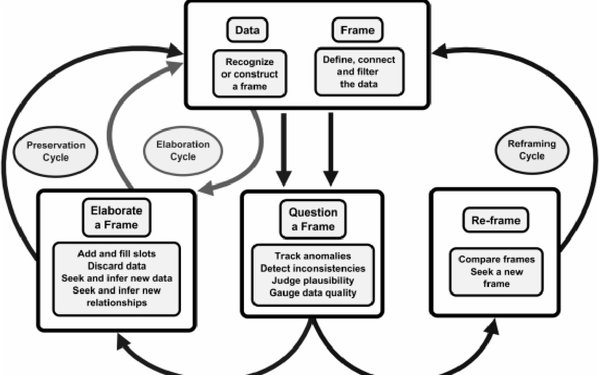
Sensemaking is a concept that was first introduced by organizational theorist Karl Weick in the 1970s. The concept has been borrowed by those working in the areas of machine learning and artificial intelligence. At the risk of oversimplification, it provides us a model to help us understand how we “give meaning to our collective experiences.”

D.T. Moore and R. Hoffman, 2011

The above diagram (from a 2011 paper by David T. Moore and Robert R. Hoffman) shows the sensemaking process. It starts with a frame — our understanding of what is true about the world. As we get presented with new data, we have to make a choice: Does it fit our frame or doesn’t it?

If it does, we preserve the frame and may elaborate on it, fitting the new data into it. If the data doesn’t support our existing frame, we then have to reframe, building a new frame from scratch.

Our brains loves frames. It’s much less work for the brain to keep a frame than to build a new one. That’s why we tend to stick with our beliefs — another word for a frame — until we’re forced to discard them.

But, as with all human traits, our ways of making sense of our world vary in the population. In the above diagram, some of us are more apt to spend time on the right side of the diagram, more open to reframing and always open to evidence that may cause us to reframe.

That, by the way, is exactly how science is supposed to work. We refer to this capacity as critical thinking: the objective analysis and evaluation of  data in order to form a judgment, even if it causes us to have to build a new frame.

Others hold onto their frames for dear life. They go out of their way to ignore data that may cause them to have to discard the frames they hold. This is what I would define as willful ignorance.

It’s misleading to think of this as just being ignorant. That would simply indicate a lack of available data. It’s also misleading to attribute this to a lack of intelligence.

That would be an inability to process the data. With willful ignorance, we’re not talking about either of those things. We are talking about a conscious and deliberate decision to ignore available data. And I don’t believe you can fix that.

We fall into the trap of thinking we can educate, shame or argue people out of being willfully ignorant. We can’t. This post is not intended for the willfully ignorant. They have already ignored it. This is just the way their brains work. It’s part of who they are. Wishing they weren’t this way is about as pointless as wishing they were a world-class pole vaulter, that they were seven feet tall or that their brown eyes were blue.

We have to accept that this situation is not going to change. And that’s what we have to start thinking about. Given that we have willful ignorance in the world, what can we do to minimize its impact?

Imagine a Pandemic without Technology

As the writer of a weekly post that tends to look at the intersection between human behavior and technology, the past 18 months have been interesting – and by interesting, I mean a twisted ride through gut-wrenching change unlike anything I have ever seen before.

I can’t even narrow it down to 18 months. Before that, there was plenty more that was “unprecedented” – to berrypick a word from my post from a few weeks back. I have now been writing for MediaPost in one place or another for 17 years. My very first post was on August 19, 2004. That was 829 posts ago. If you add the additional posts I’ve done for my own blog – outofmygord.com – I’ve just ticked over 1,100 on my odometer.  That’s a lot of soul searching about technology. And the last several months have still been in a class by themselves.

Now, part of this might be where my own head is at. Believe it or not, I do sometimes try to write something positive. But as soon as my fingers hit the keyboard, things seem to spiral downwards. Every path I take seems to take me somewhere dark. There has been precious little that has sparked optimism in my soul.

Today, for example, prior to writing this, I took three passes at writing something else. Each quickly took a swerve towards impending doom. I’m getting very tired of this. I can only imagine how you feel, reading it.

So I finally decided to try a thought experiment. “What if,” I wondered, “we had gone through the past 17 months without the technology we take for granted? What if there was no Internet, no computers, no mobile devices? What if we had lived through the Pandemic with only the technology we had – say – a hundred years ago, during the global pandemic of the Spanish Flu starting in 1918? Perhaps the best way to determine the sum total contribution of technology is to do it by process of elimination.”

The Cons

Let’s get the negatives out of the way. First, you might say that technology enabled the flood of misinformation and conspiracy theorizing that has been so top-of-mind for us. Well, yes – and no.

Distrust in authority is nothing new. It’s always been there, at one end of a bell curve that spans the attitudes of our society. And nothing brings the outliers of society into global focus faster than a crisis that affects all of us.

There was public pushback against the very first vaccine ever invented; the smallpox vaccine. Now granted, the early method was to rub puss from a cowpox blister into a cut in your skin and hope for the best. But it worked. Smallpox is now a thing of the past.

And, if we are talking about pushback against public health measures, that’s nothing new either. Exactly the same thing happened during the 1918-1919 Pandemic. Here’s one eerily familiar excerpt from a journal article looking at the issue, “Public-gathering bans also exposed tensions about what constituted essential vs. unessential activities. Those forced to close their facilities complained about those allowed to stay open. For example, in New Orleans, municipal public health authorities closed churches but not stores, prompting a protest from one of the city’s Roman Catholic priests.”

What is different, thanks to technology, is that public resistance is so much more apparent than it’s ever been before. And that resistance is coming with faces and names we know attached. People are posting opinions on social media that they would probably never say to you in a face-to-face setting, especially if they knew you disagreed with them. Our public and private discourse is now held at arms-length by technology. Gone are all the moderating effects that come with sharing the same physical space.

The Pros

Try as I might, I couldn’t think of another “con” that technology has brought to the past 17 months. The “pro” list, however, is far too long to cover in this post, so I’ll just mention a few that come immediately to mind.

Let’s begin with the counterpoint to the before-mentioned “Con” – the misinformation factor. While misinformation was definitely spread over the past year and a half, so was reliable, factual information. And for those willing to pay attention to it, it enabled us to find out what we needed to in order to practice public health measures at a speed previously unimagined. Without technology, we would have been slower to act and – perhaps – fewer of us would have acted at all. At worst, in this case technology probably nets out to zero.

But technology also enabled the world to keep functioning, even if it was in a different form. Working from home would have been impossible without it. Commercial engines kept chugging along. Business meetings switched to online platforms. The Dow Jones Industrial Average, as of the writing of this, is over 20% higher than it was before the pandemic. In contrast, if you look at stock market performance over the 1918 – 1919 pandemic, the stock market was almost 32% lower at the end of the third wave as it was at the start of the first. Of course, there are other factors to consider, but I suspect we can thank technology for at least some of that.

It’s easy to point to the negatives that technology brings, but if you consider it as a whole, technology is overwhelmingly a blessing.

What was interesting to me in this thought experiment was how apparent it was that technology keeps the cogs of our society functioning more effectively, but if there is a price to be paid, it typically comes at the cost of our social bonds.

Why is Everything Now ‘Unprecedented’?

Just once, I would like to get through one day without hearing the word “unprecedented.” And I wonder, is that just the media trying to get a click, or is the world truly that terrible?

Take the Olympics. In my lifetime, I’ve never seen an Olympics like this one. Empty stands. Athletes having to leave within 48 hours of their last event. Opening and closing ceremonies unlike anything we have ever seen. It’s, well — unprecedented.

The weather is unprecedented. What is happening in politics is unprecedented. The pandemic is unprecedented, at least in our lifetimes. I don’t know about you, but I feel like I’m watching a blockbuster where the world will eventually end — but we just haven’t got to that part of the movie yet. I feel the palpable sensation of teetering on the edge of a precipice. And I’m pretty sure it’s happened before.

Take the lead-ups to the two world wars, for example. If you plot a timeline of the events that led to either July 20, 1914 or Sept. 1, 1939, there is a noticeable acceleration of momentum. At first, the points on the timeline are spread apart, giving the world a chance to once again catch its collective breath. But as we get closer and closer to those dates circled in red, things pick up. There are cascades of events that eventually lead to the crisis point. Are we in the middle of such a cascade?

Part of this might just be network knock-on effects that happen in complex environments. But I also wonder if we just become a little shell- shocked, being nudged into a numb acceptance of things we would have once found intolerable.

Author and geographer Jared Diamond calls this “creeping normality. “ In his book “Collapse: How Societies Choose to Fail or Succeed,” he used the example of the deforestation and environmental degradation that happened on Easter Island — and how, despite the impending doom, the natives still decided to chop down the last tree: “I suspect, though, that the disaster happened not with a bang but with a whimper. After all, there are those hundreds of abandoned statues to consider. The forest the islanders depended on for rollers and rope didn’t simply disappear one day—it vanished slowly, over decades.”

Creeping normality continually and imperceptibly nudges us from the unacceptable to the acceptable and we don’t even notice it’s happening. It’s a cognitive bias that keeps us from seeing reality for what it is. Creeping normality is what happens when our view of the world comes through an Overton Window.

I have mentioned the concept of the Overton Window before.  Overton Window was first introduced by political analyst Joseph Lehman and was named after his colleague, Joseph Overton. It was initially coined to show that the political policies that the public finds acceptable will shift over time. What was once considered unthinkable can eventually become acceptable or even popular, given the shifting sensitivities of the public. As an example, the antics of Donald Trump would once be considered unacceptable in any public venue — but as our reality shifted, we saw them eventually become mainstream from an American president.

I suspect that the media does the same thing with our perception of the world in general. The news media demands the exceptional. We don’t click on “ordinary.” So it consistently shifts our Overton Window of what we pay attention to, moving us toward the outrageous. Things that once would have caused riots are now greeted with a yawn. This is combined with the unrelenting pace of the news cycle. What was outrageous today slips into yesterday, to be replaced with what is outrageous today.

And while I’m talking about outrageous, let’s look at the root of that term. The whole point of something being outrageous is to prompt us into being outraged — or moved enough to take action. And, if our sensitivity to outrage is constantly being numbed, we are no longer moved enough to act.

When we become insensitive to things that are unprecedented, we’re in a bad place. Our trust in information is gone. We seek information that comforts us that the world is not as bad as we think it is. And we ignore the red flags we should be paying attention to.

If you look at the lead-ups to both world wars, you see this same pattern. Things that happened regularly in 1914 or 1939, just before the outbreak of war, would have been unimaginable just a few years earlier. The momentum of mayhem picked up as the world raced to follow a rapidly moving Overton Window. Soon, before we knew it, all hell broke loose and the world was left with only one alternative: going to war.

An Overton Window can just happen, or it can be intentionally planned. Politicians from the fringes, especially the right, have latched on to the Window, taking something intended to be an analysis and turning it into a strategy. They now routinely float “policy balloons” that they know are on the fringe, hoping to trigger a move in our Window to either the right or left. Over time, they can use this strategy to introduce legislation that would once have been vehemently rejected.

The danger in all this is the embedding of complacency. Ultimately, our willingness to take action against threat is all that keeps our society functioning. Whether it’s our health, our politics or our planet, we have to be moved to action before it’s too late.

When the last tree falls on Easter Island, we don’t want to be the ones with the axe in our hands.