No News is Good News

I’m trying not to pay too much attention to the news. This is partly because I’m exhausted by the news, and partly because of the sad state of journalism today.

This isn’t just a “me” thing. Almost everyone I talk to says they’re trying to find coping mechanisms to deal with the news. The News industry – and its audience – has gone from being an essential part of a working democracy to something that is actually bad for you.  In an online essay from 4 years, Swiss author Rolf Dobelli equates news consumption to a bad diet:

“(translated from its original German) News is to the mind what sugar is to the body. News is appetizing, easily digestible and at the same time highly harmful. The media feeds us morsels of trivial stories, tidbits that by no means satisfy our hunger for knowledge. Unlike with books and long, well-researched, long articles, there is no saturation when consuming news. We can devour unlimited amounts of messages; they remain cheap sugar candies. As with sugar, the side effects only show up with a delay.”

Rolf Dobelli, 2019

This alarming state is due to the fact that the News (in the US) is supported by advertising, which means it has a ravenous appetite for eyeballs. Because of this, it is highly profitable to make news addictive.

This creates a state, as Dobelli points out, where even though the news is highly inflammatory, like a constantly jangling alarm bell, almost all the news we consume is irrelevant to our daily lives. While the news we watch pushes all our hot buttons, it doesn’t serve a useful purpose. In fact, it does the exact opposite: it leads to chronic mental and physical ill-being and may cause us to start ignoring the warning signs we should be paying attention to.

A study last year (McLaughlin, Gotlieb and Mills) found ties between problematic news consumption and mental ill-being. The study found that 16.5% of 1,100 people polled in an online survey showed signs of “severely problematic” news consumption, which led them to focus less on school, work and family, and contributed to an inability to sleep.

Dobelli’s essay goes even further, pointing a finger at excessive news consumption as the cause of a list of issues including cognitive errors, inhibiting deeper thinking, wasting time, killing creativity, making us more passive and even wiring our brains for addiction in a manner similar to drugs.

All these negative side effects come from chronic stress – a constant and pervasive alarmed state that excessive news consumption puts our brains into. And if you thought Dobelli’s list was scary, wait until you see the impact of chronic stress! It actually attacks the brain by releasing excessive amounts of cortisol and restricting the uptake of serotonin, which can increase inflammation, lead to depression, shrink your hippocampus and impact your memory, make it difficult to sleep and impair your ability to think rationally.

To put a new twist on an old saying, “No news is good news.”

But let’s put aside for a moment the physical and mental toll that news takes on us. Even if none of that were true, our constant diet of bad news can also lead to something known as “alarm fatigue.”

Alarm fatigue is essentially our response to the proverbial boy who calls wolf. After several false alarms, we stop paying attention. And on that one time when we should be paying attention, we are caught with our guard down.

There is one other problem with our news diet: it oversimplifies complex problems into simple sound bites. Thomas Jefferson said, “An educated citizenry is a vital requisite for our survival as a free people.” But when the news abdicates its role as an informer to pursue profit as entertainment, it is no longer educating us. It is pandering to us by stuffing bite sized opinion pieces that reinforce our beliefs – right or wrong. We are never challenged to examine our beliefs or explore the complexity of the wicked problems that confront us. Real journalism has been replaced by profitable punditry.

All this leaves us with a choice. Until the News industry cleans up its act (I’m not holding my breath), you’re likely far better off to ignore it. Or at least, ignore the profit driven platforms that are hungry for eyeballs. Stay informed by turning to books, long articles and true investigative journalism. That’s what I’m going to start doing.

Failing all that, just think about things. I understand it’s good for you.
Why I’m Worried About AI

Even in my world, which is nowhere near the epicenter of the technology universe, everyone is talking about AI And depending on who’s talking – it’s either going to be the biggest boon to humanity, or it’s going to wipe us out completely. Middle ground seems to be hard to find.

I recently attended a debate at the local university about it. Two were arguing for AI, and two were arguing against. I went into the debate somewhat worried. When I walked out at the end of the evening, my worry was bubbling just under the panic level.

The “For” Team had a computer science professor – Kevin Leyton-Brown, and a philosophy professor – Madeleine Ransom. Their arguments seemed to rely mainly on creating more leisure time for us by freeing us from the icky jobs we’d rather not do. Leyton-Brown did make a passing reference to AI helping us to solve the many, many wicked problems we face, but he never got into specifics.

“Relax!” seemed to be the message. “This will be great! Trust us!”

The “Against” Team was comprised of a professor in Creative and Critical Studies – Bryce Traister. As far as I could see, he seemed to be mainly worried about AI replacing Shakespeare. He did seem quite enamored with the cleverness of his own quips.

It was the other “Against” debater who was the only one to actually talk about something concrete I could wrap my head around. Wendy Wong is a professor of Political Science. She has a book on data and human rights coming out this fall. Many of her concerns focused on this area.

Interestingly, the AI debaters all mentioned Social Media in their arguments. And on this point, they were united. All the debaters agreed that the impact of Social Media has been horrible. But the boosters were quick to say that AI is nothing like Social Media.

Except that it is. Maybe not in terms of the technology that lies beneath it, but in terms of the unintended consequences it could unleash, absolutely! Like Social Media, what will get us with AI are the things we don’t know we don’t know.

I remember when social media first appeared on the scene. Like AI, there were plenty of evangelists lining up saying that technology would connect us in ways we couldn’t have imagined. We were redefining community, removing the physical constraints that had previously limited connections.

If there was a difference between social media and AI, it was that I don’t remember the same doomsayers at the advent of social media. Everyone seemed to be saying “This will be great! Trust us!”

Today, of course, we know better. No one was warning us that social media would divide us in ways we never imagined, driving a wedge down the ideological middle of our society. There were no hints that social media could (and still might) short circuit democracy.

Maybe that’s why we’re a little warier when it comes to AI. We’ve already been fooled once.

I find that AI Boosters share a similar mindset – they tend to be from the S.T.E.M. (Science, Technology, Engineering and Math) School of Thought. As I’ve said before, these types of thinkers tend to mistake complex problems for complicated ones. They think everything is solvable, if you just have a powerful enough tool and apply enough brain power. For them, AI is the Holy Grail – a powerful tool that potentially applies unlimited brain power.

But the dangers of AI are hidden in the roots of complexity, not complication, and that requires a different way of thinking. If we’re going to get some glimpse of what’s coming our way, I am more inclined to trust the instincts of those that think in terms of the humanities. A thinker, for example, such as Yuval Noah Harari, author of Sapiens.

Harari recently wrote an essay in the Economist that may be the single most insightful thing I’ve read about the dangers of AI: “AI has gained some remarkable abilities to manipulate and generate language, whether with words, sounds or images. AI has thereby hacked the operating system of our civilisation.”

In my previous experiments with ChatGPT, it was this fear that was haunting me. Human brains operate on narratives. We are hard-wired to believe them. By using language, AI has a back door into our brains that bypass all our protective firewalls.

My other great fear is that the development of AI is being driven by for-profit corporations, many of which rely on advertising as their main source of revenue. If ever there was a case of putting the fox in charge of the henhouse, this is it!

When it comes to AI it’s not my job I’m afraid of losing. It’s my ability to sniff out AI generated bullshit. That’s what’s keeping me up a night.

Deconstructing a Predatory Marketplace

Last week, I talked about a predatory ad market that was found in — of all places — in-game ads. And the predators are — of all things — the marketers of Keto Gummies. This week, I’d like to look at why this market exists, and why someone should do something about it.

First of all, let’s understand what we mean by “predatory.” In biological terms, predation is a zero-sum game. For a predator to win, someone has to lose.  On Wikipedia, it’s phrased a little differently: “Predatory marketing campaigns may (also) rely on false or misleading messaging to coerce individuals into asymmetrical transactions. “

 “Asymmetrical” means the winner is the predator, the loser is the prey.

In the example of the gummy market, there are three winners — predators — and three losers, or prey. The winners are the marketers who are selling the gummies, the publishers who are receiving the ad revenue and the supply side platform that mediates the marketplace and take its cut.

The losers — in ascending order of loss — are the users of the games who must suffer through these crappy ads, the celebrities who have had their names and images illegally co-opted by the marketer, and the consumers who are duped into actually buying a bottle of these gummies.

You might argue the order of the last two, depending on what value you put on the brand of the celebrity. But in terms of sheer financial loss, consumer fraud is a significant issue, and one that gets worse every year.  In February, the Federal Trade Commission reported that U.S. consumers lost $8.8 billion to scams last year, many of which occurred online. The volume of scams is up 30% over 2021, and is 70% higher than it was in 2020.

So it’s not hard to see why this market is predatory. But is it fraudulent? Let’s apply a legal litmus test. Fraud is generally defined as “any form of dishonest or deceptive behavior that is intended to result in financial or personal gain for the fraudster, and does harm to the victim.”

Based on this, fraud does seem to apply. So why doesn’t anyone do anything?

For one, we’re talking about a lot of potential money here. Statista pegs the in-game ad market at $32.5 billion worldwide in 2023, with projected annual growth rate of 9.10% That kind of money provides a powerful incentive to publishers and supply-side platforms (SSPs) to look the other way.

I think it’s unreasonable expect the marketers of the gummies to police themselves. They have gone to great pains to move themselves away from the threat of legal litigation. These corporations are generally registered in jurisdictions like China or Cyprus, where legal enforcement of copyright or consumer protections are nonexistent. If someone like Oprah Winfrey has been unable to legally shut down the fraudulent use of her image and brand for two years, you can bet the average consumer who has been ripped off has no recourse. 

But perhaps one of the winners in this fraudulent ecosystem — the SSPs – should consider cracking down on this practice.

In nature, predators are kept in check by something called a predator-prey relationship. If predators become too successful, they eliminate their prey and seal their own doom. But this relationship only works if there are no new sources of prey. If we’re talking about an ecosystem that constantly introduces new prey, nothing keeps predators in check.

Let’s look at the incentive for the game publishers to police the predators. True, allowing fraudulent ads does no favours for the users of their game. A largescale study by Gao, Zeng, Lu et al found that bad ads lead to a bad user experience.

But do game publishers really care? There is no real user loyalty to games, so churn and burn seems to be the standard operating procedure. This creates an environment particularly conducive to predators.

So what about the SSPs?

GeoEdge, an ad security solution that guards against malvertising, among other things, has just released its Q1 Ad Quality Report. In an interview, Yuval Shiboli, the company’s director of product market, said that while malicious ads are common across all channels, in-game advertising is particularly bad because of a lack of active policing: “The fraudsters are very selective in who they show their malicious ads, looking for users who are scam-worthy, meaning there is no security detection software in the environment.”

Quality of advertising is usually directly correlated with the pricing of the ad inventory. The cheaper the ad, the poorer the quality. In-game ads are relatively cheap, giving fraudulent predators an easy environment to thrive in. And this entire environment is created by the SSPs.

According to Shiboli, it’s a little surprising to learn who are the biggest culprits on the SSP side: “Everybody on both the sell side and buy side works with Google, and everyone assumes that its platforms are clean and safe. We’ve found the opposite is true, and that of all the SSP providers, Google is the least motivated to block bad ads.”

By allowing — even encouraging — a predatory marketplace to exist, Google and other SSPs are doing nothing less than aiding and abetting criminals. In the short term, this may add incrementally to their profits, but at what long-term price?

Search and ChatGPT – You Still Can’t Get There From Here

I’m wrapping up my ChatGPTrilogy with a shout out to an old friend that will be familiar to many Mediaposters – Aaron Goldman. 13 years ago Aaron wrote a book called Everything I Know About Marketing I Learned from Google.  Just a few weeks ago, Aaron shared a post entitled “In a World of AI, is Everything I Know about Marketing (still) Learned from Google”. In it, he looked at the last chapter of the book, which he called Future-Proofing. Part of that chapter was based on a conversation Aaron and I had back in 2010 about what search might look like in the future.

Did we get it right? Well, remarkably, we got a lot more right than we got wrong, especially with the advent of Natural Language tools such as ChatGPT and virtual assistants like Siri.

We talked a lot about something I called “app-sistants”. I explained, “the idea of search as a destination is an idea whose days are numbered. The important thing won’t be search. It will be the platform and the apps that run on it. The next big thing will be the ability to seamlessly find just the right app for your intent and utilize it immediately.” In this context, “the information itself will become less and less important and the app that allows utilization of the information will become more and more important.”

To be honest, this evolution in search has taken a lot longer than I thought back then, “Intent will be more fully supported from end to end. Right now, we have to keep our master ‘intent’ plan in place as we handle the individual tasks on the way to that intent.”

Searching for complex answers as it currently sits requires a lot of heavy lifting. In that discussion, I used the example of planning a trip.  “Imagine if there were an app that could keep my master intent in mind for the entire process. It would know what my end goal was, would be tailored to understand my personal preferences and would use search to go out and gather the required information. When we look at alignment of intent, [a shift from search to apps is] a really intriguing concept for marketers to consider.”

So, the big question is, do we have such a tool? Is it ChatGPT? I decided to give it a try and see. After feeding ChatGPT a couple of carefully crafted prompts about a trip I’d like to take to Eastern Europe someday, I decided the answer is no. We’re not quite there yet. But we’re closer.

After a couple of iterations, ChatGPT did a credible job of assembling a potential itinerary of a trip to Croatia and Slovenia. It even made me aware of some options I hadn’t run across in my previous research. But it left me hanging well short of the “app-ssistant” I was dreaming of in 2010. Essentially, I got a suggestion but all the detail work to put it into an actual trip still required me to do hundreds of searches in various places.

The problem with ChatGPT is that it gets stuck between the millions of functionality siloes – or “walled gardens” – that make up the Internet. Those “walled gardens” exist because they represent opportunities for monetization. In order for an app-ssistant to be able to multitask and make our lives easier, we need a virtual “commonage” that gets rid of some of these walls. And that’s probably the biggest reason we haven’t seen a truly useful iteration of the functionality I predicted more than a decade ago.

This conflict between capitalism and the concept of a commonage goes back at least to the Magna Carta. As England’s economy transitioned from feudalism to capitalism, enclosure saw the building of fences and the wiping out of lands held as a commonage. The actual landscape became a collection of walled gardens that the enforced property rights of each parcel and the future production value of those parcels.

This history, which played out over hundreds of years, was repeated and compressed into a few decades online. We went from the naïve idealism of a “free for all” internet in the early days to the balkanized patchwork of monetization siloes that currently make up the Web.

Right now, search engines are the closest thing we have to a commonage on the virtual landscape. Search engines like Google can pull data from within many gardens, but if we actually try to use the data, we won’t get far before we run into a wall.

To go back to the idea of trip planning, I might be able to see what it costs to fly to Rome or what the cost of accommodations in Venice is on a search engine, but I can’t book a flight or reserve a room. To do that, I have to visit an online booking site. If I’m on a search engine, I can manually navigate this transition fairly easily. But it would stop something like ChatGPT in its tracks.

When I talked to Aaron 13 years ago, I envisioned search becoming a platform that lived underneath apps which could provide more functionality to the user. But I also was skeptical about Google’s willingness to do this, as I stated in a later post here on Mediapost.  In that post, I thought that this might be an easier transition for Microsoft.

Whether it was prescience or just dumb luck, it is indeed Microsoft taking the first steps towards integrating search with ChatGPT, through its recent integration with Bing. Expedia (who also has Microsoft DNA in its genome) has also taken a shot at integrating ChatGPT in a natural language chat interface.

This flips my original forecast on its head. Rather than the data becoming common ground, it’s the chat interface that’s popping up everywhere. Rather than tearing down the walls that divide the online landscape, ChatGPT is being tacked up as window decoration on those walls.

I did try planning that same trip on both Bing and Expedia. Bing – alas – also left me well short of my imagined destination. Expedia – being a monetization site to begin with – got me a little closer, but it still didn’t seem that I could get to where I wanted to go.

I’m sorry to say search didn’t come nearly as far as I hoped it would 13 years ago. Even with ChatGPT thumbtacked onto the interface, we’re just not there yet.

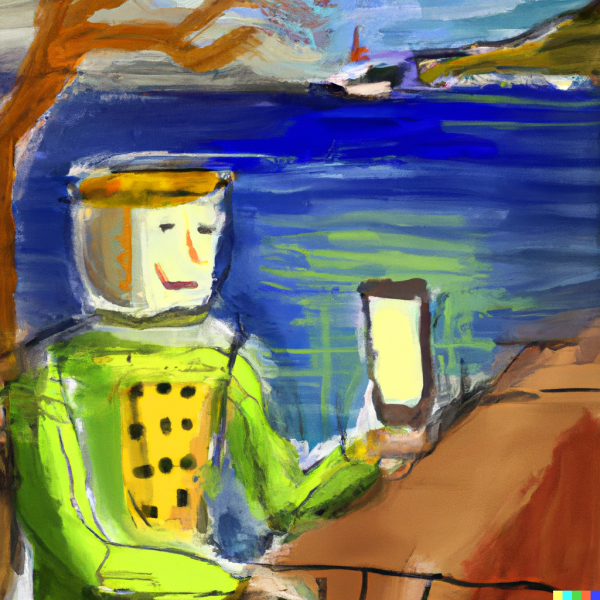
(Feature Image: OpenAI Art generated from the prompt: “A Van Gogh painting of a chatbot on a visit to Croatia”)

The Dangerous Bits about ChatGPT

Last week, I shared how ChatGPT got a few things wrong when I asked it “who Gord Hotchkiss was.” I did this with my tongue at least partially implanted in cheek – but the response did show me a real potential danger here, coming from how we will interact with ChatGPT.

When things go wrong, we love to assign blame. And if ChatGPT gets things wrong, we will be quick to point the finger at it. But let’s remember, ChatGPT is a tool, and the fault very seldom lies with the tool. The fault usually lies with the person using the tool.

First of all, let’s look at why ChatGPT put together a bio for myself that was somewhat less than accurate (although it was very flattering to yours truly).

When AI Hallucinates

I have found a few articles that calls ChatGPT out for lying. But lying is an intentional act, and – as far as I know – ChatGPT has no intention of deliberately leading us astray. Based on how ChatGPT pulls together information and synthesizes it into a natural language response, it actually thought that “Gord Hotchkiss” did the things it told me I had done.

You could more accurately say ChatGPT is hallucinating – giving a false picture based on what information it retrieves and then tries to connect into a narrative. It’s a flaw that will undoubtedly get better with time.

The problem comes with how ChatGPT handles its dataset and determines relevance between items in that dataset. In this thorough examination by Machine Learning expert Devansh Devansh, ChatGPT is compared to predictive autocomplete on your phone. Sometimes, through a glitch in the AI, it can take a weird direction.

When this happens on your phone, it’s word by word and you can easily spot where things are going off the rail.  With ChatGPT, an initial error that might be small at first continues to propagate until the AI has spun complete bullshit and packaged it as truth. This is how it fabricated the Think Tank of Human Values in Business, a completely fictional organization, and inserted it into my CV in a very convincing way.

There are many, many others who know much more about AI and Natural Language Processing that I do, so I’m going to recognize my limits and leave it there. Let’s just say that ChatGPT is prone to sharing it’s AI hallucinations in a very convincing way.

Users of ChatGPT Won’t Admit Its Limitations

I know and you know that marketers are salivating over the possibility of AI producing content at scale for automated marketing campaigns. There is a frenzy of positively giddy accounts about how ChatGPT will “revolutionize Content Creation and Analysis” – including this admittedly tongue in cheek one co-authored by MediaPost Editor in Chief Joe Mandese and – of course – ChatGPT.

So what happens when ChatGPT starts to hallucinate in the middle of massive social media campaign that is totally on autopilot? Who will be the ghost in the machine that will say “Whoa there, let’s just take a sec to make sure we’re not spinning out fictitious and potentially dangerous content?”

No one. Marketers are only human, and humans will always look for the path of least resistance. We work to eliminate friction, not add it. If we can automate marketing, we will. And we will shift the onus of verifying information to the consumer of that information.

Don’t tell me we won’t, because we have in the past and we will in the future.

We Believe What We’re Told

We might like to believe we’re Cartesian, but when it comes to consuming information, we’re actually Spinozian

Let me explain. French philosopher René Descartes and Dutch philosopher Baruch Spinoza had two different views of how we determine if something is true.

Descartes believed that understanding and believing were two different processes. According to Descartes, when we get new information, we first analyze it and then decide if we believe it or not. This is the rational assessment that publishers and marketers always insist that we humans do and it’s their fallback position when they’re accused of spreading misinformation.

But Baruch Spinoza believed that understanding and belief happened at the same time. We start from a default position of believing information to be true without really analyzing it.

In 1993, Harvard Psychology Professor Daniel Gilbert decided to put the debate to the test (Gilbert, Tafarodi and Malone). He split a group of volunteers in half and gave both a text description detailing a real robbery. In the text there were true statements, in green, and false statements, in red. Some of the false statements made the crime appear to be more violent.

After reading the text, the study participants were supposed to decide on a fair sentence. But one of the groups got interrupted with distractions. The other group completed the exercise with no distractions. Gilbert and his researchers believed the distracted group would behave in a more typical way.

The distracted group gave out substantially harsher sentences than the other group. Because they were distracted, they forgot that green sentences were true and red ones were false. They believed everything they read (in fact, Gilbert’s paper was called “You Can’t Not Believe Everything You Read).”

Gilbert’s study showed that humans tend to believe first and that we actually have to “unbelieve” if something is eventually proven to us to be false. Once study even found the place in our brain where this happens – the Right Inferior Prefrontal Cortex. This suggests that “unbelieving” causes the brain to have to work harder than believing, which happens by default. 

This brings up a three-pronged dilemma when we consider ChatGPT: it will tend to hallucinate (at least for now), users of ChatGPT will disregard that flaw when there are significant benefits to doing so, and consumers of ChatGPT generated content will believe those hallucinations without rational consideration.

When Gilbert wrote his paper, he was still 3 decades away from this dilemma, but he wrapped up with a prescient debate:

“The Spinozan hypothesis suggests that we are not by nature, but we can be by artifice, skeptical consumers of information. If we allow this conceptualization of belief to replace our Cartesian folk psychology, then how shall we use it to structure our own society? Shall we pander to our initial gullibility and accept the social costs of prior restraint, realizing that some good ideas will inevitably be suppressed by the arbiters of right thinking? Or shall we deregulate the marketplace of thought and accept the costs that may accrue when people are allowed to encounter bad ideas? The answer is not an easy one, but history suggests that unless we make this decision ourselves, someone will gladly make it for us. “

Daniel Gilbert

What Gilbert couldn’t know at the time was that “someone” might actually be a “something.”

(Image:  Etienne Girardet on Unsplash)

I Wish I Were Half the Person ChatGPT Thinks I Am

Yes, I’ve finally crawled aboard the journalist bandwagon about CHatGPT. The reason I’m waited so long is that I don’t really have any valid technical or professional perspective to add to the conversation. All I have is my own personal opinion.

So here it is, for what it’s worth.

For my first test, I wanted to ask ChatGPT about something where there would be a fair amount of information online but also something where I had the advantage of knowing the inside scoop, allowing me to judge the accuracy of its response. So I asked about the Golden Triangle – the outcome of eye tracking studies we did almost 20 years ago (I just had a minor internal meltdown when I did the mental math and realized that was two decades ago).

I have to admit, ChatGPT nailed it. It did an accurate and concise summary. I’m not sure I could have done better myself.

Google’s Golden Triangle, also known as the “Golden Triangle of Search,” refers to the top section of Google’s search engine results page (SERP) where the most relevant and highest-ranked search results are displayed. It is called the “golden triangle” because eye-tracking studies have shown that users tend to focus their attention on the top three results in the search results page, forming a triangular shape.

The concept of the Golden Triangle is important for search engine optimization (SEO) because it emphasizes the importance of ranking high in search results. Websites that appear in the Golden Triangle are more likely to receive clicks and traffic than those that appear lower on the page.

However, it’s worth noting that the layout of Google’s search engine results page has changed over the years, and the Golden Triangle may not be as relevant as it once was. Google now includes various types of results, such as featured snippets and knowledge panels, that may appear above or alongside the traditional organic search results. As a result, SEO strategies have evolved to include optimizing for these new types of results as well.

When I asked who discovered The Golden Triangle, ChatGPT accurately said it was a joint effort.

The concept of the Golden Triangle in relation to Google’s search engine results page (SERP) was not discovered by a single person, but rather through a combination of eye-tracking studies and data analysis conducted by various researchers and digital marketing professionals.

One of the earliest studies that examined how users interact with Google’s search results page was conducted by Enquiro Research in 2005. This study, titled “The Golden Triangle,” found that users tended to focus their attention on the top-left portion of the search results page, where the first few results were displayed.

Since then, other studies and analyses have confirmed the importance of the top section of the search results page, and the term “Golden Triangle” has become a widely used term in the SEO industry to describe this phenomenon.

For the record, the main players in identifying the pattern were Kevin Lee at DidIt, myself and my agency, Enquiro, EyeTools, the San Francisco eye-tracking consultants who conducted the first study and – in an independent study – Jakob Nielsen at the Nielsen Norman Group. It was Kevin and I who gave it the name The Golden Triangle, mere moments before we had to present the findings to a group at a search conference in San Jose.

So let’s try something a little less black and white. Let’s see how ChatGPT does when it has to freestyle a bit. I asked who I was.

The first paragraph was pretty accurate:

Gord Hotchkiss is a Canadian internet marketing and search engine optimization (SEO) expert. He is the CEO of a digital marketing agency called “Enquiro Search Solutions” which specializes in providing marketing and SEO services to businesses. Gord Hotchkiss is also a well-known speaker and author on the topics of online marketing and search engine optimization.

The second paragraph started a slight pumping of my ego, throwing in some accomplishments I either never did or else can’t remember doing:

Gord Hotchkiss has been involved in the online marketing industry for over 20 years and has worked with a wide range of clients, including Fortune 500 companies. He has written numerous articles on the topics of SEO, online marketing, and search engine technology for publications such as Search Engine Land, ClickZ, and MarketingProfs.

But in the third paragraph, ChatGPT definitely had me confused with someone else:

In addition to his work in the online marketing industry, Gord Hotchkiss is also a co-founder of the “Think Tank of Human Values in Business”, a non-profit organization that focuses on the intersection of business and ethics. He is known for his thought leadership in the industry and for advocating for ethical and sustainable business practices.

Okay, where the hell did that come from? It sounds extraordinarily cool and it’s something I would love to do, but it’s definitely not on my CV. As far as I’m aware, there is no such thing as the “Think Tank of Human Values in Business.” I wish there were, but there’s not.

I tried again. This time, ChatGPT seemed a little less sure of itself. The first sentence was somewhat correct, but after that ChatGPT seemed to manufacture my bio out of nothing but moonbeams and fairy dust. It said I was:

the CEO of a leading digital marketing agency, named “Digital Always Media Inc.” Gord is also a co-founder and chair of the “The Agents of Change” conference, an annual conference focused on helping businesses adapt to the ever-changing digital landscape.

Gord has written numerous articles and books on digital marketing and has been featured in several major media outlets, including The New York Times, The Wall Street Journal, and CNN.

I don’t know who this particular Gord Hotchkiss is, but I’d like to meet him. My AI doppelgänger is leaving me in the dust. I’d better get my shit together.

Or maybe ChatGPT can actually see into the future, showing me the person I just haven’t become yet.

What worries me is how easily ChatGPT constructed complete fabrications of who I was that sounded perfectly plausible. If I didn’t know myself better, I would have simply accepted it as fact. And that – unfortunately – is what we tend to do. We don’t analyze new information and determine if it’s right or wrong. Our default is to believe it’s true until proven otherwise.

It’s this human tendency that flags the real danger with ChatGPT. And, for that reason, I have some more digging to do.

Maybe this other Gord Hotchkiss guy can give me a hand. He sounds wicked smart.

(Image by Brian Penny — Pixabay license)

Older? Sure. Wiser? Debatable.

I’ve always appreciated Mediapost Editor-in-Chief Joe Mandese’s take on things. It’s usually snarky, cynical and sarcastic, all things which are firmly in my wheelhouse. He also says things I may think but wouldn’t say for the sake of political politeness.

So when Joe gets a full head of steam up, as he did in that recent post which was entitled “Peak Idiocracy?”, I set aside some time to read it. I can vicariously fling aside my Canadian reticence and enjoy a generous helping of Mandesian snarkiness. In this case, the post was a recap of Mediapost’s 2023 Marketing Politics Conference – and the depths that political advertising is sinking to in order to appeal to younger demographics. Without stealing Joe’s thunder (please read the post if you haven’t) one example involved Tiktok and mouth mash-up filters. After the panel where this case study surfaced, Joe posed a question to the panelists.

“If this is how we are electing our representative leaders, do you feel like we’ve reached peak idiocracy in the sense that we are using mouth filters and Harry Potter memes to get their messages across?”

As Joe said, it was an “old guy question.” More than that, it was a cynical, smart, sarcastic old guy question. But the fact remains, it was an old guy question. One of the panelists, DGA Digital Director Laura Carlson responded:

“I don’t think we should discount young voters’ intelligence. I think being able to have fun with the news and have fun with politics and enjoy TikTok and enjoy the platform while also engaging with issues you care about is something I wouldn’t look down on. And I think more of it is better.”

There’s something to this. Maybe a lot to this.

First, I think we have fundamentally different idea of “messaging” from generation to generation. Our generation (technically I’m a Boomer, but the label Generation Jones is a better fit) grew up with the idea that information, whether it be on TV, newspaper, magazine or radio, was delivered as a complete package. There was a scarcity of information, and this bundling of curated information was our only choice for being informed.

That’s not the case for a generation raised with the Internet and social media. Becoming aware and being informed are often decoupled. In an environment jammed with information of all types – good and bad – Information foraging strategies have had to evolve. Now, you have to somehow pierce the information filters we have all put in place in order to spark awareness. If you are successful in doing that and can generate some curiosity, you have umpteen million sources just a few keystrokes away where you can become informed.

Still, we “old guys” (and “old gals” – for the sake of consistency, I’ll use the masculine label, but I mean it in the gender-neutral way) do have a valid perspective that shouldn’t be dismissed as us just being old and grumpy. We’ve been around long enough to see how actions and consequences are correlated. We’ve seen how seemingly trivial trends can have lasting impacts, both good and bad. There is experience here that can prove instructive.

But we also must appreciate that those a few generations behind us have built their own cognitive strategies to deal with information that are probably a better match for the media environment we live in today.

So let me pose a different question. If only one generation could vote, and if everyone’s future depended on that vote, which generation would you choose to give the ballots to? Pew Research did a generational breakdown on awareness of social issues and for me, the answer is clear. I would far rather put my future in the hands of Gen Z and Millennials than in the hands of my own generation. They are more socially aware, more compassionate, more committed to solving our many existential problems and more willing to hold our governments accountable.

So, yes, political advertising might be dumbed down to TikTok level for these younger voters, but they understand how the social media game is played. I think they are savvy enough to know that a TikTok mash up is not something to build a political ideology on. They accept it for what it is, a brazen attempt to scream just a little louder than the competition for their attention; standing out from the cacophony of media intrusiveness that engulfs them. If it has to be silly to do that, so be it.

Sure, the generation of Joe Mandese and myself grew up with “real” journalism: the nightly news with Dan Rather and Tom Brokaw, 60 Minutes, The MacNeil/Lehrer Report, the New York Times, The Washington Post. We were weaned on political debates that dealt with real issues.

And for all that, our generation still put Trump in the White House. So much for the wisdom of “old guys.”

Good News and Bad News about Black Swans

First, the good news. According to a new study we may be able to predict extreme catastrophic events such as earthquakes, tsunamis, massive wildfires and pandemics through machine learning and neural networks.

The problem with these “black swan” type of events (events that are very rare but have extreme consequences) is that there isn’t a lot of data that exists that we can use to predict them. The technical term for these is a “stochastic” event – they are random and are, by definition, very difficult to forecast.

Until now. According to the study’s lead author, George Karniadakis, the researchers may have found a way to give us a heads up by using machine learning to make the most out of the meagre data we do have. “The thrust is not to take every possible data and put it into the system, but to proactively look for events that will signify the rare events,” Karniadakis says. “We may not have many examples of the real event, but we may have those precursors. Through mathematics, we identify them, which together with real events will help us to train this data-hungry operator.”

This means that this science could potentially save thousands – or millions – of lives.

But – and now comes the bad news – we have to listen to it. And we have a horrible track record of doing that.  Let’s take just one black swan – COVID 19. Remember that?

Justsecurity.org is a “online forum for the rigorous analysis of security, democracy, foreign policy, and rights.” In other words, it’s their job to minimize the impact of black swans. And they put together a timeline of the US response to the COVID 19 Pandemic. Now that we know the consequences, it’s a terrifying and maddening read. Without getting into the details, it was months before the US federal government took substantive action against the pandemic, despite repeated alerts from healthcare officials and scientists. This put the U.S. behind pretty much the entire developed world in terms of minimizing the impact of the pandemic and saving lives. All the bells, whistles and sirens were screaming at full volume, but no one wanted to listen.

Why? Because there has been a systemic breakdown in what we call epistemic trust – trust in new information coming to us from what should be a trustworthy and relevant source.

I’ll look at this breakdown on two fronts – trust in government and trust in science. These two things should work together, but all too often they don’t. That was especially true in the Trump administration’s handling of the COVID 19 Pandemic.

Let’s start with trust in government. Based on a recent study across 22 countries by the OECD, on average only about half the citizens trust their government. Trust is highest in countries like Finland, Norway and Luxembourg (where only 20 to 30% of the citizens don’t trust their government) and lowest in countries such as Colombia, Latvia and Austria (where over 60% of citizens have no trust in their government).

You might notice I didn’t mention the U.S. That’s because they weren’t included in the study. But the PEW Research Center has been tracking trust in government since 1958, so let’s look at that.

The erosion of trust in the US federal government started with Lyndon Johnson, with trust in government plummeting with Nixon and Watergate. Interestingly, although separated by ideology, both Republicans and Democrats track similarly when you look at erosion of trust from Nixon through George W. Bush, with the exception being Ronald Reagan. That started to break down with Obama and started to polarize even more with Trump and Biden. Since then, the trends started going in opposite directions, but the overall trend has still been towards lower trust.

Now, let’s look at trust in science. While not as drastic as the decline of trust in government, PEW found that trust in science has also declined, especially in the last few years. Since 2020, the percentage of Americans who had no trust in science had almost doubled, from 12% in April 2020 to 22% in December, 2021.

It’s not that the science got worse in those 20 months. It’s that we didn’t want to hear what the science was telling us. The thing about epistemic trust – our willingness to trust trustworthy information – is that it varies depending on what mood we’re in. The higher our stress level, the less likely we are to accept good information at face value, especially if what it’s trying to tell us will only increase our level of stress.

Inputting new information that disrupts our system of beliefs is hard work under any circumstances. It taxes the brain. And if our brain is already overtaxed, it protects itself by locking the doors and windows that new information may sneak through and doubling down on our existing beliefs. This is what psychologists call Confirmation Bias. We only accept new information if it matches what we already believe. This is doubly true if the new information is not something we really want to hear.

The only thing that may cause us to question our beliefs is a niggling doubt, caused by information that doesn’t fit with our beliefs. But we will go out of our way to find information that does conform to our beliefs so we can ignore the information that doesn’t fit, no matter how trustworthy its source.  The explosion of misinformation that has happened on the internet and through social media has made it easier than ever to stick with our beliefs and willfully ignore information that threatens those beliefs.

The other issue in the systemic breakdown of trust may not always be the message – it might be the messenger. If science is trying to warn us about a threatening Black Swan, that warning is generally going to be delivered in one of two ways, either through a government official or through the media. And that’s probably where we have our biggest problem. Again, referring to research done by PEW, Americans distrusted journalists almost as much as government. Sixty percent of American Adults had little to no trust in journalists, and a whopping 76% had little to no trust in elected officials.

To go back to my opening line, the good news is science can warn us about Black Swan events and save lives. The bad news is, we have to pay attention to those warnings.

Otherwise, it’s just a boy calling “wolf.”

My Many Problems with the Metaverse

I recently had dinner with a comedian who had just did his first gig in the Metaverse. It was in a new Meta-Comedy Club. He was excited and showed me a recording of the gig.

I have to admit, my inner geek thought it was very cool: disembodied hands clapping with avataresque names floating above, bursts of virtual confetti for the biggest laughs and even a virtual-hook that instantly snagged meta-hecklers, banning them to meta-purgatory until they promised to behave. The comedian said he wanted to record a comedy meta-album in the meta-club to release to his meta-followers.

It was all very meta.

As mentioned, as a geek I’m intrigued by the Metaverse. But as a human who ponders our future (probably more than is healthy) – I have grave concerns on a number of fronts. I have mentioned most of these individually in previous posts, but I thought it might be useful to round them up:

Removed from Reality

My first issue is that the Metaverse just isn’t real. It’s a manufactured reality. This is at the heart of all the other issues to come.

We might think we’re clever, and that we can manufacturer a better world than the one that nature has given us, but my response to that would be Orgel’s Second Rule, courtesy of Sir Francis Crick, co-discoverer of DNA: “Evolution is cleverer than you are.”

For millions of years, we have evolved to be a good fit in our natural environment. There are thousands of generations of trial and error baked into our DNA that make us effective in our reality. Most of that natural adaptation lies hidden from us, ticking away below the surface of both our bodies and brains, silently correcting course to keep us aligned and functioning well in our world.

But we, in our never-ending human hubris, somehow believe we can engineer an environment better than reality in less than a single generation. If we take Second Life as the first iteration of the metaverse, we’re barely two decades into the engineering of a meta-reality.

If I was placing bets on who is the better environmental designer for us, humans or evolution, my money would be on evolution, every time.

Who’s Law is It Anyway?

One of the biggest selling features of the Metaverse is that it frees us from the restrictions of geography. Physical distance has no meaning when we go meta.

But this also has issues. Societies need laws and our laws have evolved to be grounded within the boundaries of geographical jurisdictions. What happens when those geographical jurisdictions become meaningless? Right now, there are no laws specifically regulating the Metaverse. And even if there are laws in the future, in what jurisdiction would they be enforced?

This is a troubling loophole – and by hole I mean a massive gaping metaverse-sized void. You know who is attracted by a lack of laws? Those who have no regard for the law. If you don’t think that criminals are currently eyeing the metaverse looking for opportunity, I have a beautiful virtual time-share condo in the heart of meta-Boca Raton that I’d love to sell you.

Data is Matter of the Metaverse

Another “selling feature” for the metaverse is the ability to append metadata to our own experiences, enriching them with access to information and opportunities that would be impossible in the real world. In the metaverse, the world is at our fingertips – or in our virtual headset – as the case may be. We can stroll through worlds, real or imagined, and the sum of all our accumulated knowledge is just one user-prompt away.

But here’s the thing about this admittedly intriguing notion: it makes data a commodity and commodities are built to be exchanged based on market value. In order to get something of value, you have to exchange something of value. And for the builders of the metaverse, that value lies in your personal data. The last shreds of personal privacy protection will be gone, forever!

A For-Profit Reality

This brings us to my biggest problem with the Metaverse – the motivation for building it. It is being built not by philanthropists or philosophers, academics or even bureaucrats. The metaverse is being built by corporations, who have to hit quarterly profit projections. They are building it to make a buck, or, more correctly, several billion bucks.

These are the same people who have made social media addictive by taking the dirtiest secrets of Las Vegas casinos and using them to enslave us through our smartphones. They have toppled legitimate governments for the sake of advertising revenue. They have destroyed our concept of truth, bashed apart the soft guardrails of society and are currently dismantling democracy. There is no noble purpose for a corporation – their only purpose is profit.

Do you really want to put your future reality in those hands?

50 Shades of Greying

Here is what I know: Lisa LaFlamme – the main anchor of CTV News, one of Canada’s national nightly newscasts – was fired.

What I don’t know is why. There are multiple versions of why floating around. The one that seems to have served as a rallying point for those looking to support Ms. LaFlamme is that she was fired because she was getting old. During COVID she decided to let her hair go to its natural grey. That, according to the popular version, prompted network brass to pull the pin on her contract.

I suspect the real reason why was not quite that cut and dried. The owners of the network, Bell Media, have been relentlessly trimming their payrolls at their various news organizations over the past several years. I know of one such story through a personal connection. The way this one scenario played out sounded very similar to what happened to Lisa LaFlamme – minus the accusations of ageism and gender double standards. In this case, it was largely a matter of dollars and cents. TV news is struggling financially. Long-time on-air talent have negotiated a salary over their careers that is no longer sustainable. Something had to give. These are probably just the casualties attributable to a dying industry. A hundred years ago it would have been blacksmiths and gas lamplighters that were being let go by the thousands. The difference is that the average blacksmith or lamplighter didn’t have a following of millions of people. They also didn’t have social media. They certainly didn’t have corporate PR departments desperately searching for the latest social media “woke” bandwagon to vault upon.

What is interesting is how these things play out through various media channels. In Ms LaFlamme’s case, it was a perfect storm that lambasted Bell Media (which owns the CTV Network). As the ageism rumours began to emerge, anti-ageism social media campaigns were run by Dove, Wendy’s and even Sports Illustrated. LaFlamme wasn’t mentioned by name in most of these, but the connection was clear. Going grey was something to be celebrated, not a cause for contract cancellation. Grey flecked gravitas should be gender neutral. “Who the f*&k were these Millennial corporate pin-heads that couldn’t stand a little grey on the nightly news!”

It makes excellent fodder for the meme-factory, but I suspect the reality wasn’t quite that simple. Ms La Flamme has never publicly revealed the actual reason for dismissal from her point of view. She never mentioned ageism. She simply said she was “blindsided” by the news. The reasoning behind the parting of the ways from Bell Media has largely been left up to conjecture.

A few other things to note.  LaFlamme received the news on June 29th but didn’t share the news until six weeks later (August 15th) on a personal video she shared on her own social media feed. Bell Media offered her the opportunity to have an on-air send off, but she declined. Finally, she also declined several offers from Bell to continue with the network in other roles. She chose instead to deliver her parting shot in the war zone of social media.

To be fair to both sides, if we’re to catalog all the various rumors floating about, there are also those saying that the decision was brought in – in part – by an allegedly toxic work environment in the news department that started at the top, with LaFlamme.

Now, if the reason for the termination actually was ageism, that’s abhorrent. Ms. LaFlamme is actually a few years younger than I am. I would hate to think that people of our age, who should be still at the height of their careers, would be discriminated against simply because of age.

The same is true if the reason was sexism. There should be no distinction between the appropriate age of a male or female national anchor.

But if it’s more complex, which I’m pretty sure it is, it shows how our world doesn’t really deal very well with complexity anymore. The consideration required to understand them don’t fit well within the attention constraints of social media. It’s a lot easier just to sub in a socially charged hot button meme and wait for the inevitable opinion camps to form. Sure, they’ll be one dimensional and about as thoughtful as a sledgehammer, but those types of posts are a much better bet to go viral.

Whatever happened in the CTV National Newsroom, I do know that this shows that business decisions in the media business will have to follow a very different playbook from this point forward. Bell Media fumbled the ball badly on this one. They have been scrambling ever since to save face. It appears that Lisa LaFlamme – and her ragtag band of social media supporters – outplayed them at every turn.

By the way, LaFlamme just nabbed a temporary gig as a “special correspondent” for CityTV, Bell Media’s competitor, covering the funeral of Queen Elizabeth II and the proclamation of King Charles III.  She’s being consummately professional and comforting, garnering a ton of social media support as she eases Canada through the grieving process (our emotional tie to the Crown is another very complex relationship that would require several posts to unpack).  

Well played, Lisa LaFlamme – well played.