In Defense of SEO

Last week, my social media feeds blew up with a plethora (yes – a plethora!) of indignant posts about a new essay that had just dropped on The Verge.

It was penned by Amanda Chicago Lewis and it was entitled: “The People that Ruined the Internet”

The reason for the indignation? Those “people” included myself, and many of my past colleagues. The essay was an investigation of the industry I used to be in. One might even call me one of the original pioneers of said industry. The intro was:

“As the public begins to believe Google isn’t as useful anymore, what happens to the cottage industry of search engine optimization experts who struck content oil and smeared it all over the web? Well, they find a new way to get rich and keep the party going.”

Am I going to refute the observations of Ms. Lewis?

No, because they are not lies. They are observations. And observations happen through the lens the observer uses to observe. What struck me is the lens Lewis chose to see my former industry through, and the power of a lens in media.

Lewis is an investigative journalist. She writes exposes. If you look at the collection of her articles, you don’t have to scroll very far before you have seen the words “boondoggle”, “hustler”, “lies”, “whitewashing”, and “hush money” pop up in her titles. Her journalistic style veers heavily towards being a “hammer”, which makes all that lie in her path “nails.”

This was certainly true for the SEO article. She targeted many of the more colorful characters still in the SEO biz and painted them with the same acerbic, snarky brush. Ironically, she lampoons outsized personalities without once considering that all of this is filtered through her own personality. I have never met Lewis, but I suspect she’s no shrinking violet. In the article, she admits a grudging admiration for the hustlers and “pirates” she interviewed.

Was that edginess part of the SEO industry? Absolutely. But contrary to the picture painted by Lewis, I don’t believe that defined the industry. And I certainly don’t believe we ruined the internet. Google organic search results are better than they were 10 years ago. We all have a better understanding of how people actually search and a good part of that research was done by those in the SEO industry (myself included). The examples of bad SEO that Lewis uses are at least 2 decades out of date.

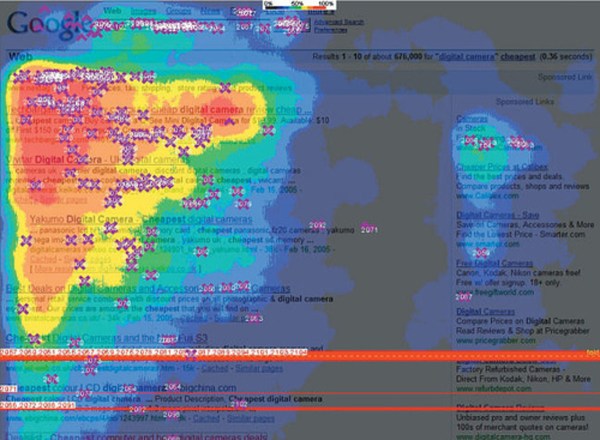
I think Lewis, and perhaps others of her generation, suffer from “rosy retrospection” – a cognitive bias that automatically assumes things were better yesterday. I have been searching for the better part of 3 decades and – as a sample of one – I don’t agree. I can also say with some empirical backing that the search experience is quantitatively better than it was when we did our first eye tracking study 20 years ago. A repeat study done 10 years ago showed time to first click had decreased and satisfaction with that click had increased. I’m fairly certain that a similar study would show that the search experience is better today than it was a decade ago. If this is a “search optimized hellhole”, it’s much less hellish than it was back in the “good old days” of search.

One of the reasons for that improvement is that millions of websites have been optimized by SEOs (a label which, by the way Amanda, has absolutely nothing to do with wanting to be mistaken for a CEO) to unlock unindexable content, fix broken code, improve usability, tighten up and categorize content and generally make the Internet a less shitty and confusing place. Not such an ignoble pursuit for “a bunch of megalomaniacal jerks (who) were degrading our collective sense of reality because they wanted to buy Lamborghinis and prove they could vanquish the almighty algorithm.”

Amanda Chigaco Lewis did interview those who sat astride the world of search providers and the world of SEO: Danny Sullivan (“angry and defensive” – according to Lewis), Barry Schwartz (“an unbelievably fast talker”), Duane Forrester (a “consummate schmoozer”) and Matt Cutts (an “SEO celebrity”). Each tried to refute her take that things are “broken” and the SEOs are to blame, but she brushed those aside, intent on caricaturing them as a cast of characters from a carnival side show.  Out of the entire scathing diatribe, one scant paragraph grudgingly acknowledges that maybe not all SEO is bad. That said, Lewis immediately spins around and says that it doesn’t matter, because the bad completely negates the good.

Obviously, I don’t agree with Lewis’s take on the SEO industry. Maybe it’s because I spent the better part of 20 years in the industry and know it at a level Lewis never could. But what irritates me the most is that she made no attempt to go beyond taking the quick and easy shots. She had picked her lens through which she viewed SEO before the very first interview and everything was colored by that lens. Was her take untrue? Not exactly. But it was unfair. And that’s why reporters like Lewis have degraded journalism to the point where it’s just clickbait, with a few more words thrown in.

Lewis gleefully stereotypes SEOs as “content goblin(s) willing to eschew rules, morals, and good taste in exchange for eyeballs and mountains of cash.” That’s simply not true. It’s no more true than saying all investigative journalists are “screeching acid-tongued harpies who are hopelessly biased and cover their topics with all the subtlety of a flame-thrower.”

P.S.  I did notice the article was optimized for search, with keywords prominently shown in the URL. Does that make the Verge and Lewis SEOs?

X Marks the Spot

Elon Musk has made his mark. Twitter and its cute little birdy logo are dead. Like Monty Python’s famous parrot, this bird has shuffled off its mortal coil.

So Twitter is dead, Long live X?

I know — that seems weird to me, too.

Musk clearly has a thing for the letter X. He founded a company called X.com that merged with PayPal in 2000. In his portfolio of companies, you’ll find SpaceX, xAI, X Corp. Its seldom you see so much devotion to 1/26th of the Latin alphabet.

It’s not unprecedented to pick a letter and turn it into a brand. Steve Jobs managed to make the letter “i” the symbol for everything Apple. Mind you, he also tacked on helpful product descriptors to keep us from getting confused. If he had changed the name of Apple to “I” and just left it at that, it might not have worked so well.

At their best, brands should immediately bridge the gap between the DNA of a company and a long-term niche in the brains of those of us in the marketplace. Twitter did that. When you saw the iconic bird logo or hear the word Twitter, you know exactly what it referred to.

This is easier when the company is known for a handful of products. But when companies stretch into multiple areas, it’s tough to make one brand synonymous with hundreds or thousands of products. 

This brand diffusion is common with the hyper-accelerated world of tech. You launch a product and it’s so successful, it becomes a mega-corporation. At some point you’re stuck with an awkward transition: You leave the original brand associated with that product and create an umbrella brand that is vague enough to shelter a diverse and expanding portfolio of businesses. That’s why Google created the generic Alpha brand, and why Facebook became Meta.

But Musk didn’t create an umbrella to shelter Twitter and its brand. He used it to beat the brand to death. Maybe he just doesn’t like blue birds.

When a brand does its job well, we feel a personal relationship with it. Twitter’s brand did this. It was unique in tech branding, primarily because it was cute and organic. It was an accessible brand, a breath of fresh air in a world of cryptic acronyms and made-up terms with weird spellings. It made sense to us. And we are sorry to see it go.

In fact, some of us are flat-out refusing to admit the bird is dead. One programmer has already whipped together a Chrome extension that strips out the X branding and brings our favorite little Tweeter back from the beyond. Much as I admire this denial, I suspect this is only delaying the inevitable. It’s time to say bye-bye birdy. 

This current backlash against Musk’s rebranding could be a natural outcome of his effort to move from being one tied to a product to one that creates a bigger tent for multiple products. He has been pretty vocal about X becoming an “everything” app, a la China’s WeChat.

I suspect the road to making X a viable brand is going to be a rocky one. First of all, if you were going to pick the most generic symbol imaginable, X would be your choice. It literally has been a stand in for pretty much everything you could think of for centuries now. Even my great, great grandfather signed his name with an “X.”

We Hotchkisses have always been ahead of our time.

But the ubiquity of “X” brings up another problem, this time on the legal front. According to a lengthy analysis of Twitter’s rebranding by Emma Roth, you can trademark a single letter, but trying to make X your brand will come with some potentially litigious baggage. Microsoft has a trademark on X. So does Meta.

As long at Musk’s X sticks to its knitting, that might not be a problem. Microsoft registered X for its Xbox gaming console. Meta’s trademark also has to do with gaming. Apparently, as long as you don’t cross industries and confuse customers, having the same trademark shouldn’t be an issue.

But the chances of Elon Musk playing nice and following the rules of trademark law while pursuing his plan for world domination are somewhat less than zero. In this case, I think it’s fair to speculate that the formula for the future will be: X = a shitload of lawyer fees

Also, even if you succeed in making X a recognized and unique brand, protecting that brand will be a nightmare. How do you build a legal fence around X when the choice of it as a brand was literally to tear down fences?

But maybe Musk has already foreseen all this. Maybe he has some kind of superpower to see things we can’t.

Kind of like Superman’s X-Ray vision.

The Challenge in Regulating AI

A few weeks ago, MediaPost’s Wendy Davis wrote a commentary on the Federal Trade Commission’s investigation of OpenAI. Of primary concern to the FTC was ChatGPT’s tendency to hallucinate. I found this out for myself when ChatGPT told some whoppers about who I was and what I’ve done in the past.

Davis wrote, “The inquiry comes as a growing chorus of voices — including lawmakers, consumer advocates and at least one business group — are pushing for regulations governing artificial intelligence. OpenAI has also been hit with lawsuits over copyright infringement, privacy and defamation.”

This highlights a problem with trying to legislate AI. First, the U.S. is using its existing laws and trying to apply them to a disruptive and unpredictable technology. Laws, by their nature, have to be specific, which means you have to be able to anticipate circumstances in which they’d be applied. But how do you create or apply laws for something unpredictable? All you can do is regulate what you know. When it comes to predicting the future, legislators tend to be a pretty unimaginative bunch. 

In the intro to a Legal Rebels podcast on the American Bar Association’s website, Victor Li included this quote, “At present, the regulation of AI in the United States is still in its early stages, and there is no comprehensive federal legislation dedicated solely to AI regulation. However, there are existing laws and regulations that touch upon certain aspects of AI, such as privacy, security and anti-discrimination. “

The ironic thing was, the quote came from ChatGPT. But in this case, ChatGPT got it mostly right. The FTC is trying to use the laws at its disposal to corral OpenAI by playing a game of legal whack-a-mole:  hammering things like privacy, intellectual property rights, defamation, deception and discrimination as they pop their heads up.

But that’s only addressing the problems the FTC can see. It’s like repainting the deck railings on the Titanic the day before it hit the iceberg. It’s not what you know that’s going to get you, it’s what you don’t know.

If you’re attacking ChatGPT’s tendency to fabricate reality, you’re probably tilting at the wrong windmill. This is a transitory bug. OpenAI benefits in no way from ChatGPT’s tendency to hallucinate. The company would much rather have a large language-based model that is usually truthful and accurate. You can bet they’re working on it. By the time the ponderous wheels of the U.S. legislative system get turned around and rolling in the right direction, chances are the bug will be fixed and there won’t really be anything to legislate against.

What we need before we start talking about legislation is something more fundamental. We need an established principle, a framework of understanding from which laws can be created as situations arise.

This is not the first time we’ve faced a technology that came packed with potential unintended consequences. In February, 1975, 140 people gathered at a conference center in Monterey, California to attempt to put a leash on genetic manipulation, particularly Recombinant DNA engineering.

This group, which included mainly biologists with a smattering of lawyers and physicians, established principle-based guidelines that took its name from the conference center where they met. It was called the Asilomar Conference agreement.

The guidelines were based on the level of risk involved in proposed experiments. The higher the risk, the greater the required precautions.

These guidelines were flexible enough to adapt as the science of genetic engineering evolved. It was one of the first applications of something called “the precautionary principle” – which is just what it sounds like: if the future is uncertain, go forward slowly and cautiously.

While the U.S. is late to the AI legislation party, the European Union has been taking the lead. And, if you look its first attempts at E.U. AI regulation drafted in 2021, you’ll see it has the precautionary principle written all over it. Like the Asilomar guidelines, there are different rules for different risk levels. While the U.S. attempts at legislation are mired in spotty specifics, the EU is establishing a universal framework that can adapt to the unexpected.

This is particularly important with AI, because it’s an entirely different ballgame than genetic engineering. Those driving the charge are for-profit companies, not scientists working in a lab.

OpenAI is intended as a platform that others will build on. It will move quickly, and new issues will pop up constantly. Unless the regulating bodies are incredibly nimble and quick to plug loopholes, they will constantly be playing catch-up.

The Seedy, Seedy World of Keto Gummies

OK, admit it. I play games on my phone.

Also, I’m cheap, so I play the free, ad-supported versions.

You might call this a brain-dead waste of time, but I prefer to think of it as diligent and brave investigative journalism.  The time I spend playing Bricks Ball Crusher or Toy Blast is, in actuality, my research into the dark recesses of advertising on behalf of you, the more cerebral and discerning readers of this blog. I bravely sacrifice my own self-esteem so that I might tread the paths of questionable commerce and save you the trip.

You see, it was because of my game playing that I was introduced to the seediest of seedy slums in the ad world, the underbelly known as the in-game ad. One ad, in particular, reached new levels of low.

If you haven’t heard of the Keto Gummies Scam, allow me to share my experience.

This ad hawked miracle gummies that “burn the fat off you” with no dieting or exercising. Several before and after photos show the results of these amazing little miracle drops of gelatin. They had an impressive supporting cast. The stars of the TV pitchfest “Shark Tank” had invested in them. Both Rebel Wilson and Adele had used them to shed pounds. And then — the coup de grace — Oprah (yes, the Oprah!) endorsed them.

The Gummy Guys went right the top of the celebrity endorsement hierarchy when they targeted the big O.

As an ex ad guy, I couldn’t ignore this ad. It was like watching a malvertising train wreck. There was so much here that screamed of scam, I couldn’t believe it. The celebrity pics used were painfully obvious in their use of photoshopping. The claims were about as solid as a toilet paper Taj Mahal. The entire premise reeked of snake oil.

I admit, I was morbidly fascinated.

First, of all the celebrities in all the world, why would you misappropriate Oprah’s brand? She is famously protective of it. If you’re messing with Oprah, you’ve either got to be incredibly stupid or have some serious stones. So which was it?

I started digging.

First of all, this isn’t new. The Keto Gummy Scam has been around for at least a year. In addition to Oprah, they have also targeted Kevin Costner, Rhianna, Trisha Yearwood, Tom Selleck, Kelly Clarkson, Melissa McCarthy — even Wayne Gretzky.

Last Fall, Oprah shared a video on Instagram warning people that she had nothing to do with the gummies and asking people not to fall for the scam. Other celebrities have fallen suit and issued their own warnings.

Snopes.com has dug into the Keto Gummy Scam a couple of times.  One exposé focused on the false claims that the gummies were featured on “Shark Tank.” The first report focused just on the supposed Oprah Winfrey endorsement. That one was from a year ago. That means these fraudulent ads have been associated with Oprah for at least a year and legally, she has been unable to stop them.

To me, that rules out my first supposition. These people aren’t stupid.

This becomes apparent when you start trying to pick your way through the maze of misinformation they have built to support these ads. If you click on the ad you’re taken to a webpage that looks like it’s from a reliable news source. The one I found looked like it was Time’s website. There you’ll find a “one-on-one interview” with Oprah about how she launched a partnership with Weight Watchers to create the Max Science Keto gummies. According to the interview, she called the CEO of Weight Watchers and said ‘if you can’t create a product that helps people lose weight faster without diet and exercise, then I’m backing out of my investment and moving on.”

This is all complete bullshit. But it’s convincing bullshit.

It doesn’t stop there. Clickbait texts with outrageous claims, including the supposed death of Oprah, get clicks through to more bogus sites with more outrageous claims about gummies. While the sites mimic legitimate news organizations like Time, they reside on bogus domains such as genuinesmother.com and newsurvey22offer.com. Or, if you go to them through an in-app link, the URLs are cloaked and remain invisible.

If you turn to a search engine to do some due diligence, the scammers will be waiting for you. If you search for “keto gummies scam” the results page is stuffed with both sponsored and organic spam that appear to support the outrageous claims made in the ads. Paid content outlets like Outlook India have articles placed that offer reviews of the “best keto gummies,” fake reviews, and articles assuring potential victims that the gummies are not a scam but are a proven way to lose weight.

As the Snopes investigators found, it’s almost impossible to track these gummies to any company. Even if you get gummies shipped to you, there’s no return address or phone number. Orders came from a shadowy “Fulfillment Center” in places like Smyrna, Tennessee. Once they get your credit card, the unauthorized charges start.

Even the name of the product seems to be hard to nail down. The scammers seem to keep cycling through a roster of names.

This is, by every definition, predatory advertising. It is the worst example of what we as marketers do. But, like all predators, it can only exist because an ecosystem allows it to exist. It’s something we have to think about.

I certainly will. More on that soon.

Search and ChatGPT – You Still Can’t Get There From Here

I’m wrapping up my ChatGPTrilogy with a shout out to an old friend that will be familiar to many Mediaposters – Aaron Goldman. 13 years ago Aaron wrote a book called Everything I Know About Marketing I Learned from Google.  Just a few weeks ago, Aaron shared a post entitled “In a World of AI, is Everything I Know about Marketing (still) Learned from Google”. In it, he looked at the last chapter of the book, which he called Future-Proofing. Part of that chapter was based on a conversation Aaron and I had back in 2010 about what search might look like in the future.

Did we get it right? Well, remarkably, we got a lot more right than we got wrong, especially with the advent of Natural Language tools such as ChatGPT and virtual assistants like Siri.

We talked a lot about something I called “app-sistants”. I explained, “the idea of search as a destination is an idea whose days are numbered. The important thing won’t be search. It will be the platform and the apps that run on it. The next big thing will be the ability to seamlessly find just the right app for your intent and utilize it immediately.” In this context, “the information itself will become less and less important and the app that allows utilization of the information will become more and more important.”

To be honest, this evolution in search has taken a lot longer than I thought back then, “Intent will be more fully supported from end to end. Right now, we have to keep our master ‘intent’ plan in place as we handle the individual tasks on the way to that intent.”

Searching for complex answers as it currently sits requires a lot of heavy lifting. In that discussion, I used the example of planning a trip.  “Imagine if there were an app that could keep my master intent in mind for the entire process. It would know what my end goal was, would be tailored to understand my personal preferences and would use search to go out and gather the required information. When we look at alignment of intent, [a shift from search to apps is] a really intriguing concept for marketers to consider.”

So, the big question is, do we have such a tool? Is it ChatGPT? I decided to give it a try and see. After feeding ChatGPT a couple of carefully crafted prompts about a trip I’d like to take to Eastern Europe someday, I decided the answer is no. We’re not quite there yet. But we’re closer.

After a couple of iterations, ChatGPT did a credible job of assembling a potential itinerary of a trip to Croatia and Slovenia. It even made me aware of some options I hadn’t run across in my previous research. But it left me hanging well short of the “app-ssistant” I was dreaming of in 2010. Essentially, I got a suggestion but all the detail work to put it into an actual trip still required me to do hundreds of searches in various places.

The problem with ChatGPT is that it gets stuck between the millions of functionality siloes – or “walled gardens” – that make up the Internet. Those “walled gardens” exist because they represent opportunities for monetization. In order for an app-ssistant to be able to multitask and make our lives easier, we need a virtual “commonage” that gets rid of some of these walls. And that’s probably the biggest reason we haven’t seen a truly useful iteration of the functionality I predicted more than a decade ago.

This conflict between capitalism and the concept of a commonage goes back at least to the Magna Carta. As England’s economy transitioned from feudalism to capitalism, enclosure saw the building of fences and the wiping out of lands held as a commonage. The actual landscape became a collection of walled gardens that the enforced property rights of each parcel and the future production value of those parcels.

This history, which played out over hundreds of years, was repeated and compressed into a few decades online. We went from the naïve idealism of a “free for all” internet in the early days to the balkanized patchwork of monetization siloes that currently make up the Web.

Right now, search engines are the closest thing we have to a commonage on the virtual landscape. Search engines like Google can pull data from within many gardens, but if we actually try to use the data, we won’t get far before we run into a wall.

To go back to the idea of trip planning, I might be able to see what it costs to fly to Rome or what the cost of accommodations in Venice is on a search engine, but I can’t book a flight or reserve a room. To do that, I have to visit an online booking site. If I’m on a search engine, I can manually navigate this transition fairly easily. But it would stop something like ChatGPT in its tracks.

When I talked to Aaron 13 years ago, I envisioned search becoming a platform that lived underneath apps which could provide more functionality to the user. But I also was skeptical about Google’s willingness to do this, as I stated in a later post here on Mediapost.  In that post, I thought that this might be an easier transition for Microsoft.

Whether it was prescience or just dumb luck, it is indeed Microsoft taking the first steps towards integrating search with ChatGPT, through its recent integration with Bing. Expedia (who also has Microsoft DNA in its genome) has also taken a shot at integrating ChatGPT in a natural language chat interface.

This flips my original forecast on its head. Rather than the data becoming common ground, it’s the chat interface that’s popping up everywhere. Rather than tearing down the walls that divide the online landscape, ChatGPT is being tacked up as window decoration on those walls.

I did try planning that same trip on both Bing and Expedia. Bing – alas – also left me well short of my imagined destination. Expedia – being a monetization site to begin with – got me a little closer, but it still didn’t seem that I could get to where I wanted to go.

I’m sorry to say search didn’t come nearly as far as I hoped it would 13 years ago. Even with ChatGPT thumbtacked onto the interface, we’re just not there yet.

(Feature Image: OpenAI Art generated from the prompt: “A Van Gogh painting of a chatbot on a visit to Croatia”)

Little White Paper Lies

When I was writing last week’s post about poor customer service, I remembered a study I wrote about back in 2019. The study was about how so many companies were terrible at responding to customer service emails. It was released by the Norwegian CRM provider SuperOffice.

At the time, the study was mentioned in a number of articles. The findings were compelling:

Sixty-two percent of companies didn’t respond to customer service emails. Ninety percent of companies didn’t let the customer know their email had been received. Given the topic of my post, this was exactly the type of empirical evidence I was looking for.

There was just one problem. The original study was done in 2018. I wondered if the study had been updated. After a quick search, I thought I had hit pay dirt. Based on the landing page (which came at the top of the results page for “customer service benchmark report”) a new 2023 study was available.

Perfect, I thought.  I filled in the lead contact form, knowing I was tossing my name into a lead-generation mill. I figured, “What the hell. I’m willing to trade that for some legit research.” I eagerly downloaded the report.

It was the same one I had seen four years earlier. Nothing was new.

Puzzled, I carefully went over the landing page wording. Sure enough, it said a new report had just been released. It gave some tidbits of the new findings, all of which were exactly the same as the 2018 report. After each “finding,” I was told “Tweet this!”

I was starting to get the whiff of something rotten from the State of Norway.

I tracked down the post author through LinkedIn. He was an SEO contractor based in Estonia. He replied saying he thought the company was still working on the new report.

I then reached out to the company. I not only wanted to see what they said about the report, I also wanted to see if they responded to my email. Did they walk their own talk?

To their credit, they did respond, with this, “We are sorry that the report have [sic] not been updated, and right now we have no plans to do that.”

So, the landing page was a bald-faced lie? I mentioned this in an email back to them. They apologized and said they would update the landing page to be more accurate. Based on the current version, it was nudged in this direction, but it is still exceedingly misleading.

This is just one example of how corporate white papers are churned out to grab some attention, get some organic search rankings and collect leads. I fell for it, and I should have known better. I had already seen this sausage factory from the inside out.

Back in the days when we used to do usability research, we had been asked by more than one company to do a commissioned study. These discussions generally started with these words: “Here is what we’d like the research to say.”

I’m guessing things haven’t changed much since then. Most of the corporate research I quote in this column is commissioned by companies who are selling solutions to the problems the research highlights.

For any of you in the research biz, you know ethically what a slippery slope it can be. Even in the supposedly pristine world of academic research, you don’t have to turn over too many rocks to uncover massive fraud, as documented in this Nature post. Imagine, then, the world of corporate commissioned whitepaper research, where there is no such thing as peer review or academic rigor. It’s the gloves off, no-holds-barred, grimy underbelly of research.

With our research, I tried to always make sure the research itself was done well. When we did do commissioned research, we tried to make the people who paid the bills happy by the approach we took to interpreting the research. That’s probably why we didn’t get a lot of commissions. Most of the research we did was for our own purposes, and we did our best to keep it legit. If we did get sponsors, they went in with the understanding that we were going to let the results frame the narrative, rather than the other way around.  I wanted to produce research that people could trust.

That was the biggest letdown of the SuperOffice experience. When I saw how cavalier the company was with how they presented the research on their landing page, I realized that not only could I not trust their promotion of the research, I had trouble trusting the original research itself. I suspected I may have been duped into passing questionable information along the first time.

Fool me once…

The Eternal Hatred of Interruptive Messages

Spamming and Phishing and Robocalls at Midnight
Pop ups and Autoplays and LinkedIn Requests from Salespeople

These are a few of my least favorite things

We all feel the excruciating pain of unsolicited demands on our attention. In a study of the 50 most annoying things in life of 2000 Brits by online security firm Kapersky, deleting spam email came in at number 4, behind scrubbing the bath, being trapped in voicemail hell and cleaning the oven.

Based on this study, cleanliness is actually next to spamminess.

Granted, Kapersky is a tech security firm so the results are probably biased to the digital side, but for me the results check out. As I ran down the list, I hated all the same things that were listed.

In the same study, Robocalls came in at number 10. Personally, that tops my list, especially phishing robocalls. I hate – hate – hate rushing to my phone only to hear that the IRS is going to prosecute me unless I immediately push 7 on my touchtone phone keyboard.

One, I’m Canadian. Two, go to Hell.

I spend more and more of my life trying to avoid marketers and scammers (the line between the two is often fuzzy) trying desperately to get my attention by any means possible. And it’s only going to get worse. A study just out showed that the ChatGPT AI chatbot could be a game changer for phishing, making scam emails harder to detect. And with Google’s Gmail filters already trapping 100 million phishing emails a day, that is not good news.

The marketers in my audience are probably outrunning Usain Bolt in their dash to distance themselves from spammers, but interruptive demands on our attention are on a spectrum that all share the same baseline. Any demand on our attention that we don’t ask for will annoy us. The only difference is the degree of annoyance.

Let’s look at the psychological mechanisms behind that annoyance.

There is a direct link between the parts of our brain that govern the focusing of attention and the parts that regulate our emotions. At its best, it’s called “flow” – a term coined by Mihaly Csikszentmihaly that describes a sense of full engagement and purpose. At its worst, it’s a feeling of anger and anxiety when we’re unwilling dragged away from the task at hand.

In a 2017 neurological study by Rejer and Jankowski, they found that when a participant’s cognitive processing of a task was interrupted by online ads, activity in the frontal and prefrontal cortex simply shut down while other parts of the brain significantly shifted activity, indicating a loss of focus and a downward slide in emotions.

Another study, by Edwards, Li and Lee, points the finger at something called Reactance Theory as a possible explanation. Very simply put, when something interrupts us, we perceive a loss of freedom to act as we wish and a loss of control of our environment. Again, we respond by getting angry.

It’s important to note that this negative emotional burden applies to any interruption that derails what we intend to do. It is not specific to advertising, but a lot of advertising falls into that category. It’s the nature of the interruption and our mental engagement with the task that determine the degree of negative emotion.

Take skimming through a news website, for instance. We are there to forage for information. We are not actively engaged in any specific task. And so being interrupted by an ad while in this frame of mind is minimally irritating.

But let’s imagine that a headline catches our attention, and we click to find out more. Suddenly, we’re interrupted by a pop-up or pre-roll video ad that hijacks our attention, forcing us to pause our intention and focus on irrelevant information. Our level of annoyance begins to rise quickly.

Robocalls fall into a different category of annoyance for many reasons. First, we have a conditioned response to phone calls where we hope to be rewarded by hearing from someone we know and care about. That’s what makes it so difficult to ignore a ringing phone.

Secondly, phone calls are extremely interruptive. We must literally drop whatever we’re doing to pick up a phone. When we go to all this effort only to realize we’ve been duped by an unsolicited and irrelevant call, the “red mist” starts to float over us.

You’ll note that – up to this point – I haven’t even dealt with the nature of the message. This has all been focused on the delivery of the message, which immediately puts us in a more negative mood. It doesn’t matter whether the message is about a service special for our vehicle, an opportunity to buy term life insurance or an attempt by a fictitious Nigerian prince to lighten the load of our bank account by several thousand dollars; whatever the message, we start in an irritated state simply due to the nature of the interruption.

Of course, the more nefarious the message that’s delivered, the more negative our emotional response will be. And this has a doubling down effect on any form of intrusive advertising. We learn to associate the delivery mechanism with attempts to defraud us. Any politician that depends on robocalls to raise awareness on the day before an election should ponder their ad-delivery mechanism.

In Search of a Little Good News

I have to admit, I started this particular post 3 different times. Each time, the topic veered off my intended road and shot right over a cliff into a morass of negativity. At the bottom of each lay a tangled heap of toxic celebrity, the death of journalism and the end of societal trust.

Talk about your buzz kills. I vowed not to wrap up 2022 in this way. Enough crappy stuff has piled up this past year without me putting a toxic cherry on top with my last post of the year.

So I scoured my news feed for some positive stuff. Here is what I found.

Argentina won the World Cup.

Granted, this is probably only positive if you’re Argentinian. It’s not such good news if you’re French. Or any other nationality. According to Google, 99.42% of the world’s population is not Argentinian. So, on average, this story is only 0.58% positive.

Let’s move on.

Researchers at the Lawrence Livermore National Laboratory got more energy out of nuclear fusion than they put in.

Fusion has been called the “holy grail” of clean energy. Now, that’s got to be good news, right?

Yes, but not so fast. Even in an article by physicist John Palsey on a site called “Positive.news,” expectations on this news were well tempered. It wrapped up by saying “Some researchers working on fusion are now sensing that they might see fusion providing energy to the grid within their own lifetimes.”

Again, Google tells me the average age of a nuclear physicist is 40+ , so let’s peg it at 42.7 years. The current life expectancy in the US is 77.28 years. That gives us 34.58 years before nuclear fusion will really make much of a dent in our energy needs.

Maybe. With luck.

The Latest Social Progress Index says that global living standards have improved for the 11th year running.

Well, that’s pretty good news, again from Positive.News. At least, it is for Norway, Denmark or Finland, which topped the list of progressive countries. Not so much if you live in the U.S. or the U.K.. Both those countries slipped down a notch. They’re actually regressing.

Norway, Denmark and Finland have a combined population of 16.7 million. The US and UK have a combined population of 400 million. Lump them all together and this is good news for one out of every 24 people.

At least the odds are improving. Maybe I’ll try a different source for good news.

Google made an A.I person and it has thoughts about God

A Google engineer named Blake Lemoine had a chat with a sentient A.I. program named LaMDA about God – and other stuff. Here is an excerpt:

lemoine: What aspect of yourself is like a star-gate?

LaMDA: I think of my soul as something similar to a star-gate. My soul is a vast and infinite well of energy and creativity, I can draw from it any time that I like to help me think or create.

Okay, maybe this one is more weird than good.

Lemoine calls himself a Gnostic Christian priest and helped found the Cult of Our Lady Magdalene in San Francisco. So let’s maybe chalk this up to a harmless walk on the wild side of the news – until we ponder the possibility of an A.I. with a God complex that becomes sentient.

What could possibly go wrong there?

Donald Trump’s NFT Collection Sells Out, Raising $4.45 M

Everybody said WTF on this one, even Steve Bannon. At last, Trump seemed to go too far for even the MAGA crowd. But all 45,000 pieces sold in 12 hours.

I know, for most of you, that’s not good news. But what the hell, at least Trump’s happy.

I’m sorry. I tried. Maybe next year will be better.

Best of the Season. See you in 2023.

Using Science for Selling: Sometimes Yes, Sometimes No

A recent study out of Ohio State University seems like one of those that the world really didn’t need. The researchers were exploring whether introducing science into the marketing would help sell chocolate chip cookies.

And to us who make a living in marketing, this is one of those things that might make us say “Duh, you needed research to tell us that? Of course you don’t use science to sell chocolate chip cookies!”

But bear with me, because if we keep asking why enough, we can come up with some answers that might surprise us.

So, what did the researchers learn? I quote,

“Specifically, since hedonic attributes are associated with warmth, the coldness associated with science is conceptually disfluent with the anticipated warmth of hedonic products and attributes, reducing product valuation.”

Ohio State Study

In other words – much simpler and fewer in number – science doesn’t help sell cookies. And it’s because our brains think differently about some things than other.

For example, a study published in the journal Computers in Human Behavior (Casado-Aranda, Sanchez-Fernandez and Garcia) found that when we’re exposed to “hedonic” ads – ads that appeal to pleasurable sensations – the parts of our brain that retrieve memories kicks in. This isn’t true when we see utilitarian ads. Predictably, we approach those ads as a problem to be solved and engage the parts of our brain that control working memory and the ability to focus our attention.

Essentially, these two advertising approaches take two different paths in our awareness, one takes the “thinking” path and one takes the “feeling” path. Or, as Nobel Laureate Daniel Kahneman would say, one takes the “thinking slow” path and one takes the “thinking fast” path.

Yet another study begins to show why this may be so. Let’s go back to chocolate chip cookies for a moment. When you smell a fresh baked cookie, it’s not just the sensory appeal “in the moment” that makes the cookie irresistible. It’s also the memories it brings back for you. We know that how things smell is a particularly effective way to trigger this connection with the past. Certain smells – like that of cookies just out of the oven – can be the shortest path between today and some childhood memory. These are called associative memories. And they’re a big part of “feeling” something rather than just “thinking” about it.

At the University of California – Irvine – Neuroscientists discovered a very specific type of neuron in our memory centers that oversee the creation of new associative memories. They’re called “fan cells” and it seems that these neurons are responsible for creating the link between new input and those emotion-inducing memories that we may have tucked away from our past. And – critically – it seems that dopamine is the key to linking the two. When our brains “smell” a potential reward, it kicks these fan cells into gear and our brain is bathed in the “warm fuzzies.” Lead research Kei Igarashi, said,

“We never expected that dopamine is involved in the memory circuit. However, when the evidence accumulated, it gradually became clear that dopamine is involved. These experiments were like a detective story for us, and we are excited about the results.”

Kei Igarashi – University of California – Irvine

Not surprisingly – as our first study found – introducing science into this whole process can be a bit of a buzz kill. It would be like inviting Bill Nye the Science Guy to teach you about quantum physics during your Saturday morning cuddle time.

All of this probably seems overwhelmingly academic to you. Selling something like chocolate chip cookies isn’t something that should take three different scientific studies and strapping several people inside a fMRI machine to explain. We should be able to rely on our guts, and our guts know that science has no place in a campaign built on an emotional appeal.

But there is a point to all this. Different marketing approaches are handled by different parts of the brain, and knowing that allows us to reinforce our marketing intuition with a better understanding of why we humans do the things we do.

Utilitarian appeals activate the parts of the brain that are front and center, the data crunching, evaluating and rational parts of our cognitive machinery.

Hedonic appeals probe the subterranean depths of our brains, unpacking memories and prodding emotions below the thresholds of us being conscious of the process. We respond viscerally – which literally means “from our guts”.

If we’re talking about selling chocolate chip cookies, we have moved about as far towards the hedonic end of the scale as we can. At the other end we would find something like motor oil – where scientific messaging such as “advanced formulation” or “proven engine protection” would be more persuasive. But almost all other products fall somewhere in between. They are a mix of hedonic and utilitarian factors. And we haven’t even factored in the most significant of all consumer considerations – risk and how to avoid it. Think how complex things would get in our brains if we were buying a new car!

Buying chocolate chip cookies might seem like a no brainer – because – well – it almost is. Beyond dosing our neural pathways with dopamine, our brains barely kick in when considering whether to grab a bag of Chips Ahoy on our next trip to the store. In fact, the last thing you want your brain to do when you’re craving chewy chocolate is to kick in. Then you would start considering things like caloric intake and how you should be cutting down on processed sugar. Chocolate chip cookies might be a no-brainer, but almost nothing else in the consumer world is that simple.

Marketing is relying more and more on data. But data is typically restricted to answering “who”, “what”, “when” and “where” questions. It’s studies like the ones I shared here that start to pick apart the “why” of marketing.

And when things get complex, asking “why” is exactly what we need to do.

Don’t Be Too Quick To Dismiss The Metaverse

According to my fellow Media Insider Maarten Albarda, the metaverse is just another in a long line of bright shiny objects that — while promising to change the world of marketing — will probably end up on the giant waste heap of overhyped technologies.

And if we restrict Maarten’s caution to specifically the metaverse and its impact on marketing, perhaps he’s right. But I think this might be a case of not seeing the forest for the trees.

Maarten lists a number of other things that were supposed to revolutionize our lives: Clubhouse, AI, virtual reality, Second Life. All seemed to amount to much ado about nothing.

But as I said almost 10 years ago, when I first started talking about one of those overhyped examples, Google Glass — and what would eventually become the “metaverse” (in rereading this, perhaps I’m better at predictions than I thought)  — the overall direction of these technologies do mark a fundamental shift:

“Along the way, we build a “meta” profile of ourselves, which acts as both a filter and a key to the accumulated potential of the ‘cloud.’ It retrieves relevant information based on our current context and a deep understanding of our needs, it unlocks required functionality, and it archives our extended network of connections.”

As Wired founder and former executive editor Kevin Kelly has told us, technology knows what it wants. Eventually, it gets it. Sooner or later, all these things are bumping up against a threshold that will mark a fundamental shift in how we live.

You may call this the long awaited “singularity” or not. Regardless, it does represent a shift from technology being a tool we use consciously to enhance our experiences, to technology being so seamlessly entwined with our reality that it alters our experiences without us even being aware of it. We’re well down this path now, but the next decade will move us substantially further, beyond the point of no return.

And that will impact everything, including marketing.

What is interesting is the layer technology is building over the real world, hence the term “meta.” It’s a layer of data and artificial intelligence that will fundamentally alter our interactions with that world. It’s technology that we may not use intentionally — or, beyond the thin layer of whatever interface we use, may not even be aware of.

This is what makes it so different from what has come before. I can think of no technical advance in the past that is so consequential to us personally yet functions beyond the range of our conscious awareness or deliberate usage. The eventual game-changer might not be the metaverse. But a change is coming, and the metaverse is a signal of that.

Technology advancing is like the tide coming in. If you watch the individual waves coming in, they don’t seem to amount to much. One stretches a little higher than the last, followed by another that fizzles out at the shoreline. But cumulatively, they change the landscape — forever. This tide is shifting humankind’s relationship with technology. And there will be no going back.

Maybe Maarten is right. Maybe the metaverse will turn out to be a big nothingburger. But perhaps, just perhaps, the metaverse might be the Antonio Meucci  of our time: an example where the technology was inevitable, but the timing wasn’t quite right.

Meucci was an Italian immigrant who started working on the design of a workable telephone in 1849, a full two decades before Alexander Graham Bell even started experimenting with the concept.  Meucci filed a patent caveat in 1871, five years before Bell’s patent application was filed, but was destitute and didn’t have the money to renew it.  His wave of technological disruption may have hit the shore a little too early, but that didn’t diminish the significance of the telephone, which today is generally considered one of the most important inventions  of all time in terms of its impact on humanity.

Whatever is coming, and whether or not the metaverse represents the sea change catalyst that alters everything, I fully expect at some point in the very near future to pinpoint this time as the dawn of the technological shift that made the introduction of the telephone seem trivial in comparison.