Will There Be a Big-Tech Reckoning?

Jeff Bezos, Mark Zuckerberg and Tim Cook must be thanking their lucky stars that Elon Musk is who he is. Musk is taking the brunt of any Anti-Trump backlash and seems to be relishing in it. Heaven only knows what is motivating Musk, but he is casting a smoke screen so wide and dense it’s obliterating the ass-kissing being done by the rest of the high-tech oligarchs.  In addition to Bezos, Zuckerberg and Cook, Microsoft’s Satya Nadella, Google’s Sundar Pichai and many other high-tech leaders have been making goo-goo eyes at Donald Trump.

Let’s start with Jeff Bezos. One assumes he is pandering to the president because his companies have government contracts worth billions. That pandering has included a pilgrimage to Trump’s Mar-a-Lago, a one million donation to his inauguration fund (which was streamed live on Amazon Prime), and green-lighting a documentary on Melania Trump. The Bezos-owned Washington Post declined from endorsing Kamala Harris as a presidential candidate, prompting some of its editorial staff to resign. At Amazon, the company has backed off some of its climate pledge commitments and started stripping Diversity, Equity and Inclusion programs from their HR handbook.

Mark Zuckerberg joined Trump supporting podcaster Joe Rogan for almost three hours to explain how they were realigning Facebook to be more Trump-friendly. This included canning their fact checkers and stopping policing of misinformation. During the interview, Zuckerberg took opportunities to slam media and the outgoing Biden administration for daring to question Facebook about misleading posts about Covid-19 vaccines. Zuckerberg, like Bezos, also donated $1 million to Trump’s inaugural fund and has rolled back DEI initiatives at Meta.

Tim Cook’s political back-bend had been a little more complicated. On the face of it, Apple’s announcement that it would be investing more than $500 billion in the U.S. and creating thousands of new jobs certainly sounds like a massive kiss to the Trumpian posterior but if you dig through the details, it’s really just putting a new spin on commitments Apple already made to support their development of Apple’s AI. And in many cases, the capital investment isn’t even coming from Apple. For instance, that new A.I. server manufacturing plant in Houston that was part of the announcement? That plant is actually being built by Apple partner Foxconn, not Apple.

As far as the rest of the Big Tech cabal, including Microsoft, Google and OpenAI, their new alignment with Trump is not surprising. Trump is promising to make the U.S. the undisputed leader in A.I. One would also imagine he would be more inclined than the Democrats to look the other way when it comes to things like anti-trust investigations and enforcement. So Big-Tech’s deferment to Trump is both entirely predictable and completely self-serving. I’m also guessing that all of them think they’re smarter than Trump and his administration, providing them a strategic opportunity to play Trump like a fiddle while pursuing their long-term corporate goals free from any governmental oversight or resistance. All evidence to date shows that they’re probably not mistaken in that assumption.

But all this comes at what cost? This could play out one of two ways. First, what happens if these High-Tech Frat Rat’s bets are wrong? There is an anti-Trump, anti-MAGA revolt building. Who knows what will happen, but in politically unprecedented times like this one has to consider every scenario, no matter how outrageous they may seem. One scenario is a significant percentage of Republicans decide their political future (and, hopefully, the future of the US as a democracy also factors into their thinking) is better off without a Donald Trump in it and start the wheels turning to remove him from power. If this is the case, things are going to get really, really nasty. There is going to be recrimination and finger pointing everywhere. And some of those fingers are going to be pointed at the big tech leaders who scrapped the ground bowing to Trump’s bluster and bullying.

Will that translate into a backlash against high-tech? I really am not sure. To date, these companies have been remarkably adept at sluffing off blame. IF MAGA ends up going down in flames, will Big Tech even get singed as they warm their hands at Donald Trump’s own bonfire of his vanities? Will we care about Big Tech’s obsequiousness when it comes time to order something from Amazon or get a new iPhone?

Probably not.  

But the other scenario is even more frightening: Trump stays in power and Big Tech is free to do whatever they hell they want. Based on what you know about Elon Musk, Mark Zuckerberg, Jeff Bezos and the rest, are you willing to let them be the sole architects of your future? Their about-face on Trump has shown that they will always, always, always place profitability above their personal ethics.

When Branding and Politics Collide

It is the worst timing possible to open a Tesla dealership.

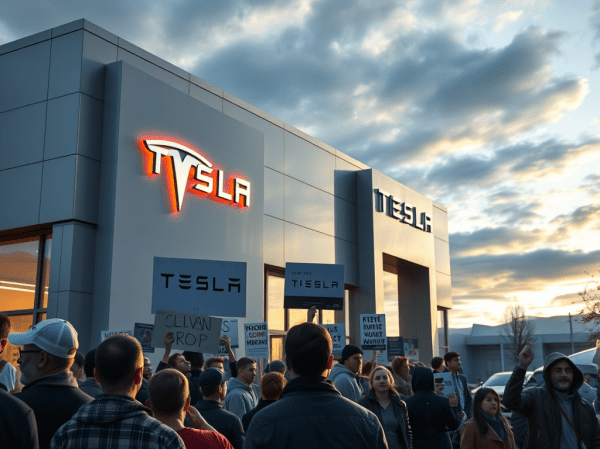
 In Kelowna, the western Canadian city I live in, a new 30,000 square foot Tesla dealership is scheduled to open their doors any day now.  When they do, I’m guessing business will not be brisk. It takes a lot to get Canadians worked up (hockey games aside) but the Trump administration has managed to do something I haven’t seen before in my lifetime – uniting Canadians in a passionate rage. Between picking a totally unjustified trade war with us and continually threatening to make us a 51st State, Donald Trump hasn’t made any friends in my country. And – by extension – that includes his hatchet/chainsaw man and the face of Tesla, Elon Musk.

This is not just happening here in Canada. Tesla owners are having a rough month everywhere. Their cars are being customized with swastikas. Their daily drive is regularly punctuated with middle finger salutes. They are being verbally accosted at Tesla charging stations. And, if they happen to have to go to their dealership, chances are very good that they’ll have to navigate past a pack of protesters. According to the website Actionnetwork.org, there are 101 TeslaTakedown protests scheduled across the US and around the world in the next few weeks.

That is a dramatic turnaround for a car brand that single handedly made driving an electric vehicle cool. The TeslaTakedown campaign is urging drivers to dump their cars and shareholders to sell their stock. A recent survey out of the Netherlands says that one in three Tesla owners are considering selling.

This has nothing to do with whether Teslas are good cars or not. They’re the same vehicles they were 6 months ago. This is simply about branding, and right now, the Tesla brand and Elon Musk are one and the same. That brand is not popular with the majority of the world right now, especially here in Canada.

Like I said – it’s really bad timing to open a new dealership.

As this is all playing out, it got me thinking about another car brand that got on the wrong side of politics 80 years ago. In 1945, Volkswagen was not the 2nd largest car manufacturer in the world, as it is now. It was a shuttered factory in Wolfsburg, Germany that was set to be dismantled by the Allied occupiers, led by the British.  

Volkswagen was founded in 1937 by the Nazi Party’s German Labor Front as a prestige project to show that German workers could produce the world’s best “People’s Car” (which is literally what “Volkswagen” means). That vehicle would be the first prototype of the now much-loved Beetle that we of a certain age immediately associate with Volkswagen. In 1938, Hitler himself christened this the KdF-Wagen, which stood for “Kraft durch Freude” – Strength through Joy. Even the car’s name was a banner for Nazi propaganda.

Eight years later – in 1945 – it was a different story. The Wolfsburg factory was to be dismantled as part of the de-Nazification of German industry and the equipment was to be sent to a British car manufacturer, but none of them wanted it. Three things saved Volkswagen:

  • The design was solid. The wartime version of the VW – the Kubelwagen – was exceptionally reliable
  • There was a desperate need for military transportation in the now occupied zone and there was no manufacturer able to fulfill that need
  • There was a factory ready to go and a skilled workforce who were in danger of starving if they didn’t go back to work

These three things convinced the British trustees to reopen the Wolfsburg plant. By March of 1946, the plant was producing 1000 cars a month.  In 1947, Volkswagen began exporting passenger vehicles to other European markets, including the Netherlands, Switzerland and Denmark. This export model became the Beetle in the form I first knew it.

By the end of the 1950’s, Volkswagen had expanded through Europe and was ready to take on the US, a market dominated by the Big Three (Ford, GM and Chrysler) domestic manufacturers. At the time, almost no imported vehicles were sold in America.

Thanks to an inspired “Think Small” advertising campaign, created by copywriter Julian Koenig and Art Director Helmut Krone from Doyle Dane Bernbach, Volkswagen became the US’s favorite import. The campaign used humor, honesty and irony to spark a love for the VW brand. This branding and the oil crisis of the 1970’s placed VW in the perfect position to capitalize on a sudden market for smaller, more fuel-efficient vehicles. In 1961, Volkswagen passed the 1 million vehicles manufactured per year milestone. By 1972, that had more than doubled to almost 2.2 million cars made per year. Three quarters of those were sold in export markets.

As I said, today the Volkswagen group is now the number 1 or 2 auto manufacturer in the world, depending on which yardstick you use (per unit sales or total revenue). They do fall short on the list of most valuable car companies in the world, based on market capitalization.

So, what is the most valuable car company in the world? Tesla.

For now, anyway.

The World vs Big Tech

Around the world, governments have their legislative cross hairs trained on Big Tech. It’s happening in the US, the EU and here in my country,  Canada. The majority of these are anti-trust suits. But Australia has just introduced a different type of legislation, a social media ban for those under 16. And that could change the game – and the conversation -completely for Big Tech.

There are more anti-trust actions in the queue in the US than at any time in the previous five decades. The fast and loose interpretation of antitrust enforcement in the US is that monopolies are only attacked when they may cause significant harm to customers through lack of competition. The US approach to anti-trust since the 1970s has typically followed the Chicago School of neoclassical economy theory, which places all trust in the efficiency of markets and tells government to keep their damned hands off the economy. Given this and given the pro-business slant of all US administrations, both Republican and Democratic, since Reagan, it’s not surprising that we’ve seen relatively few anti-trust suits in the past 50 years.

But the rapid rise of monolithic Big Tech platforms has raised more discussion about anti-trust in the past decade than in the previous 5 decades. These platforms suck along the industries they spawn in their wake and leave little room for upstart competitors to survive long enough to gain significant market share.

Case in point: Google. 

The recent Canadian lawsuit has the Competition Bureau (our anti-trust watchdog) suing Google for anti-competitive practices selling its online advertising services north of the 49th parallel. They’re asking Google to sell off two of its ad-tech tools, pay penalties worth up to 3% of the platform’s global gross revenues and prohibit the company from engaging in anti-competitive practices in the future.

According to a 3-year inquiry into Google’s Canadian business practices by the Bureau, Google controls 90% of all ad servers and 70% of advertising networks operating in the country. Mind you, Google started the online advertising industry in the relatively green fields of Canada back when I was still railing about the ignorance of Canadian advertisers when it came to digital marketing. No one else really had a chance. But Google made sure they never got one by wrapping its gigantic arms around the industry in an anti-competitive bear hug.

The recent Australian legislation is of a different category, however. Anti-trust suits are – by nature – not personal. They are all about business. But the Australian ban puts Big Tech in the same category as Big Tobacco, Big Alcohol and Big Pharma – alleging that they are selling an addictive product that causes physical or emotional harm to individuals. And the rest of the world is closely watching what Australia does. Canada is no exception.

The most pertinent question is how will Australia enforce the band? Restricting social media access to those under 16 is not something to be considered lightly.  It’s a huge technical, legal and logistical hurdle to get over. But if Australia can figure it out, it’s certain that other jurisdictions around the world will follow in their footsteps.

This legislation opens the door to more vigorous public discourse about the impact of social media on our society. Politicians don’t introduce legislation unless they feel that – by doing so – they will continue to get elected. And the key to being elected is one of two things; give the electorate what they want or protect them against what they fear. In Australia, recent polling indicates the ban is supported by 77% of the population. Even those opposing the ban aren’t doing so in defense of social media. They’re worried that the devil might be in the details and that the legislation is being pushed through too quickly.

These types of things tend to follow a similar narrative arc: fads and trends drive widespread adoption – evidence mounts about the negative impacts – industries either ignore or actively sabotage the sources of the evidence – and, with enough critical mass, government finally gets into the act by introducing protective legislation.

With tobacco in the US, that arc took a couple of decades, from the explosion of smoking after World War II to the U.S. Surgeon General’s 1964 report linking smoking and cancer. The first warning labels on cigarette packages appeared two years later, in 1966.

We may be on the cusp of a similar movement with social media. And, once again, it’s taken 20 years. Facebook was founded in 2004.

Time will tell. In the meantime, keep an eye on what’s happening Down Under.

Is the Customer Always Right?

You can’t always get what you want
But if you try sometimes, well, you might find
You get what you need

The Rolling Stones – 1969

When I retired from marketing 11 years ago, I did a brief stint running a tourism business, putting together custom bike tours. I thought it would be an ideal semi-retirement gig – riding bikes and hanging out with others who loved road cycling. Like many customer facing businesses, we lived and died by ratings. Because we were an experience curator, we regularly dealt with dozens of other tourism-based businesses. We were all dealing in the same currency – those elusive five-star ratings.

In theory, I think customer ratings are a good idea. But there is a dark side – the overly entitled customer that wields the threat of a negative review over the head of a proprietor. By the end of the season, all the operators we were dealing with were burnt out and frustrated. Overt entitlement sucked all the joy out of being in the tourism biz. This trend got much worse as we were pulling out of Covid. It was as if the entitled had doubled down on their demands during the pandemic. That was when I decided to hang up my cycling shoes. Life was too short to stress about catering to a bunch of whiny, demanding guests who threatened to bring the wrath of a bad TripAdvisor review down on me.

The internet’s early promise was to democratize markets that were traditionally asymmetrical. Suddenly, everyone had a voice. And, at first, it was wonderful. But predictably, we found a way to screw it up. Compared to the dumpster fire that is social media, online ratings are not pure evil, but they do have their dark side in a culture full of entitled customers.

If you doubt that North America is narcissistically entitled, I direct you to Jean Twenge and Keith Campbell’s book, the Narcissism Epidemic. Based on years of extensive research, it shows how we have fostered an age of entitlement that lives by the maxim that everyone should be treated special. That is now the baseline of expectation. We have brought this on ourselves, by insisting that we – and especially our children – receive special treatment. But, as any statistician can tell you, we can’t all be above average. Sooner or later, something has to give.

This is especially true in tourism. We all long for that magical, once-in a lifetime vacation. In fact, we now demand it. But that is impossible to deliver on. Just check into the most popular vacation destinations in the world: Paris, Rome, Barcelona, Venice and London. All are creaking under the weight of unprecedented numbers of tourist. And the supporting infrastructure can’t support it. Those places are popular because they have a sense of romance, history and magic. Everyone wants to experience strolling through the secluded streets of Rome at twilight, stopping to toss a coin into the Trevi Fountain.

But the reality is far different. Last year, Rome was invaded by an onslaught of 35 million tourists. Crowds ten to twelve deep push towards the fountain, crushing each other and providing the ideal environment for pick pockets. It’s gotten so bad; the City of Rome is looking at instituting a ticket reservation system to see the fountain.

That is the reality. Over tourism has stripped Rome of its magic. But marketing continues to push the elusive dream of the ideal Roman Holiday, leading us to believe that we’re entitled to that. Everyone else can put up with the crowds and the hassles. But not us – we’re special. And that expectation of special treatment unleashes a vicious cycle. Disappointment is sure to follow. We’ll voice our disappointment by leaving a nasty review somewhere. And some poor tourism operator who’s just trying to keep up will see his or her business slip away as the negative reviews pile up.

I do believe this idea of customer entitlement is particularly prevalent with North Americans. We have constructed it on pagan alter of crazy consumerism, as this post from on the Zendesk Blog by Susan Lahey explains, “ U.S. culture, especially American consumer culture, focuses a lot on making people feel special. After being treated like this in enough scenarios, people come to expect it. Then, when they don’t get their way, they’re upset. They feel like they have a right to act however they want towards others until they’re appeased—which winds up isolating the consumer and shaping their view of the world as ‘me against them.’ “

Lahey provides a counter-example of sustainable consumerism –aligned to a culture that embraces egalitarianism. You’ll find it in what are supposed to be the happiest countries on earth – Finland, Denmark, Iceland and Sweden: “One thing these countries have in common is a set of social norms called the Jante Laws, which say that no one is more special than anyone else. Far from making citizens unhappy, it seems to make them more resilient when they don’t get what they want.”

Less entitlement, more resiliency – that doesn’t sound like a bad plan for the future!

The Political Brinkmanship of Spam

I am never a fan of spam. But this is particularly true when there is an upcoming election. The level of spam I have been wading through seems to have doubled lately. We just had a provincial election here in British Columbia and all parties pulled out all stops, which included, but was not limited to; email, social media posts, robotexts and robocalls.

In Canada and the US, political campaigns are not subject to phone and text spam control laws such as our Canadian Do Not Call List legislation. There seems to be a little more restriction on email spam. A report from Nationalsecuritynews.com this past May warned that Americans would be subjected to over 16 billion political robocalls. That is a ton of spam.

During this past campaign here in B.C., I noticed that I do not respond to all spam with equal abhorrence. Ironically, the spam channels with the loosest restrictions are the ones that frustrate me the most.

There are places – like email – where I expect spam. It’s part of the rules of engagement. But there are other places where spam sneaks through and seems a greater intrusion on me. In these channels, I tend to have a more visceral reaction to spam. I get both frustrated and angry when I have to respond to an unwanted text or phone call. But with email spam, I just filter and delete without feeling like I was duped.

Why don’t we deal with all spam – no matter the channel – the same? Why do some forms of spam make us more irritated than others? It’s almost like we’ve developed a spam algorithm that dictates how irritated we get when we deal with spam.

According to an article in Scientific American, the answer might be in how the brain marshalls its own resources.

When it comes to capacity, the brain is remarkably protective. It usually defaults to the most efficient path. It likes to glide on autopilot, relying on instinct, habit and beliefs. All these things use much less cognitive energy than deliberate thinking. That’s probably why “mindfulness” is the most often quoted but least often used meme in the world today.

The resource we’re working with here is attention. Limited by the capacity of our working memory, attention is a spotlight we must use sparingly. Our working memory is only capable of handling a few discrete pieces of information at a time. Recent research suggests the limit may be around 3 to 5 “chunks” of information, and that research was done on young adults. Like most things with our brains, the capacity probably diminishes with age. Therefore, the brain is very stingy with attention. 

I think spam that somehow gets past our first line of defence – the feeling that we’re in control of filtering – makes us angry. We have been tricked into paying attention to something that was unsuspected. It becomes a control issue. In an information environment where we feel we have more control, we probably have less of a visceral response to spam. This would be true for email, where a quick scan of the items in our inbox is probably enough to filter out the spam. The amount of attention that gets hijacked by spam is minimal.

But when spam launches a sneak attack and demands a swing of attention that is beyond our control, that’s a different matter. We operate with a different mental modality when we answer a phone or respond to a text. Unlike email, we expect those channels to be relatively spam-free, or at least they are until an election campaign comes around. We go in with our spam defences down and then our brain is tricked into spending energy to focus on spurious messaging.

How does the brain conserve energy? It uses emotions. We get irritated when something commandeers our attention. The more unexpected the diversion, the greater the irritation.  Conversely, there is the equivalent of junk food for the brain – input that requires almost no thought but turns on the dopamine tap and becomes addictive. Social media is notorious for this.

This battle for our attention has been escalating for the past two decades. As we try to protect ourselves from spam with more powerful filters, those that spread spam try to find new ways to get past those filters. The reason political messaging was exempt from spam control legislation was that democracies need a well-informed electorate and during election campaigns, political parties should be able to send out accurate information about their platforms and positions.

That was the theory, anyway.

The Relationship Between Young(er) People and Capitalism: It’s Complicated

If you, like me, spend any time hanging out with Millennials or Gen Z’s, you’ll know that capitalism is not their favorite thing. That’s fair enough. I have my own qualms with capitalism.

But with capitalism, like most things, it’s not really what you say about it that counts. It’s what you do about it. And for all of us, Millennials and Gen Z included, we can talk all we want, but until we stop buying, nothing is going to change. And – based on a 2019 study from Epsilon – Gen Z and Millennials are outspending Baby Boomers in just about every consumer category.

Say all the nasty stuff you want about capitalism and our consumption obsessed society, but the truth is – buying shit is a hard habit to break

It’s not that hard to trace how attitudes towards capitalism have shifted over the generations that have been born since World War II, at least in North America. For four decades after the war, capitalism was generally thought to be a good thing, if only because it was juxtaposed against the bogeyman of socialism. Success was defined by working hard to get ahead, which led to all good things: buying a house and paying off the mortgage, having two vehicles in the garage and having a kitchen full of gleaming appliances. The capitalist era peaked in the 1980s: during the reign of Ronald Reagan in the US and the UK’s Margaret Thatcher.

But then the cracks of capitalism began to show. We began to realize the Earth wasn’t immune to being relentlessly plundered. We started to see the fabric of society showing wear and tear from being constantly pulled by conspicuous consumerism. With the end of the Cold War, the rhetoric against socialism began to be dialed down. Generations who grew up during this period had – understandably – a more nuanced view towards capitalism.

Our values and ethics are essentially formed during the first two decades of our lives. They come in part from our parents and in part from others in our generational cohort. But a critical factor in forming those values is also the environment we grow up in. And for those growing up since World War II, media has been a big part of that environment. We are – in part – formed by what we see on our various screens and feeds. Prior to 1980, you could generally count on bad guys in media being Communists or Nazis. But somewhere mid-decade, CEOs of large corporations and other Ultra-Capitalists started popping up as the villains.

I remember what the journalist James Fallows once said when I met him at a conference in communist China. I was asking how China managed to maintain the precarious balance between a regime based on Communist ideals and a society that embraced rampant entrepreneurialism. He said that as long as each generation believed that their position tomorrow would be better than it was yesterday, they would keep embracing the systems of today.

I think the same is true for generational attitudes towards capitalism. If we believed it was a road to a better future, we embraced it. But as soon as it looked like it might lead to diminishing returns, attitudes shifted. A recent article in The Washington Post detailed the many, many reasons why Americans under 40 are so disillusioned about capitalism. Most of it relates back to the same reason Fallows gave – they don’t trust that capitalism is the best road to a more promising tomorrow.

And this is where it gets messy with Millennials and Gen Z. If they grew up in the developed world, they grew up in a largely capitalistic society. Pretty much everything they understand about their environment and world has been formed, rightly or wrongly, by capitalism. And that makes it difficult to try to cherry-pick your way through an increasingly problematic relationship with something that is all you’ve ever known.

Let’s take their relationship with consumer brands, for example. Somehow, Millennials and Gen Z have managed the nifty trick of separating branding and capitalism. This is, of course, a convenient illusion. Brands are inextricably tied to capitalism. And Millennials and Gen Z are just as strongly tied to their favorite brands.

 According to a 2018 study from Ipsos, 57% of Millennials in the US always try to buy branded products. In fact, Millennials are more likely than Baby Boomers to say they rely on the brands they trust. This also extends to new brand offerings. A whopping 84% of Millennials are more likely to trust a new product from a brand they already know.

But – you may counter – it all depends on what the brand stands for. If it is a “green” brand that aligns with the values of Gen X and Millennials, then a brand may actually be anti-capitalistic.  

It’s a nice thought, but the Ipsos survey doesn’t support it. Only 12% of Millennials said they would choose a product or service because of a company’s responsible behavior and only 16% would boycott a product based on irresponsible corporate behavior. These numbers are about the same through every generational cohort, including Gen X and Baby Boomers.

I won’t even delve into the thorny subject of “greenwashing” and the massive gap between what a brand says they do in their marketing and what they actually do in the real world. No one has defined what we mean by a “ethical corporation” and until someone does and puts some quantifiable targets around it, companies are free to say whatever they want when it comes to sustainability and ethical behavior.

This same general disconnect between capitalism and marketing extends to advertising. The Ipsos study shows that – across all types of media – Millennials pay more attention to advertising than Baby Boomers and Gen X. And Millennials are also more likely to share their consumer opinions online than Boomers and Gen X. They may not like capitalism and consumerism, but they are still buying lots of stuff and talking about it.

The only power we have to fight the toxic effects of capitalism is with our wallets. Once something becomes unprofitable, it will disappear. But – as every generation is finding out – ethical consumerism is a lot easier said than done.

No News is Not Good News

Kelowna, the city I live in – with a population of about 250,000 – just ran its last locally produced TV news show. That marks the end of a 67-year streak. Our local station, CHBC – first signed on the air on September 21, 1957.

That streak was not without some hiccups. There have been a number of ownership changes. The trend in those transitions was away from local ownership towards huge nation spanning media conglomerates. In 2009, when the station became part of the Global network, the intention was to shut down the local station and run everything out of CHAN, the Vancouver Global operation. We kicked up a Kelowna fuss and convinced Global to at least keep a local news presence in the community. But – as it turned out – that was just buying us some time. 15 years later, the plug was finally pulled.

In that time, my city has also essentially lost its daily newspaper, which is a mere ghost of its former self; an anemic online version and a printed paper which is little more than a wrapper for a bunch of grocery flyers.  The tri weekly paper has suffered a similar fate. Radio stations have gutted their local news teams. The biggest news team in the region works for a local news portal. They are young and eager, but few of them are trained journalists.

CHBC started as an extension of local radio. At the time it was launched, only 500 households in the city had a TV set. Broadcasting was “over the air” and I live in a very mountainous location, so it was impossible to watch TV prior to the station signing on. 

Given that the first TV stations only signed on in Canada in 1952 (CBFT in Montreal and CBLT in Toronto), it’s rather amazing to think that my little town (population 10,000 at the time) had its own station just 5 years later. Part of the rapid roll out of TV in Canada was to prevent cultural colonization from the rapidly expanding American TV industry. Our federal government pushed hard to have Canadian programming available from coast to coast.

For the decades that followed, it was local news that defined communities. Local was granular and immediately relevant in a way networks news couldn’t be. It gave you what you needed to know to knowingly participate in local democracy.

For that alone, CHBC News will be missed here in Kelowna.

This story probably resonates with all of you. The death of local journalism is not unique to my city. I have just learned that I probably will be living in a news desert soon.  The  importance of local news is enshrined in the very definition of a news desert:

“a community, either rural or urban, with limited access to the sort of credible and comprehensive news and information that feeds democracy at the grassroots level.”

The death of local news was recently discussed at the Canadian Association of Journalists Annual conference in Toronto. There, April Lindgren, a professor at Toronto Metropolitan University’s School of Journalism and the principal investigator of the Local News Research Project, said this:

I think one of the things .. people don’t think about in terms of the mechanics of the role of local news in a community is the role that it plays in equipping people to participate in decision-making.”

We need local news. A recent study by Resonate said that Americans trust Local News more than any other source. And not just by a little margin. By a lot. The next closest answer was a full 15 percentage points behind.

But there are two existential problems that are pushing local news to the brink of an extinction event. First of all, most local news outlets were swallowed up into corporate mass media conglomerates over the past 3 or 4 decades. And secondly, the business model for local news has disappeared. Local advertising dollars have migrated to other platforms. So the fate of local news had become a P&L decision.

That’s what it was for CHBC. It’s owned by Corus entertainment. Corus owns the Global Network (15 stations), 39 radio stations, 33 specialty TV channels and a bunch of other media miscellanea.  

Oh, did I mention that Corus is also bleeding cash at a fatal rate? On the heels of an announced $770 Million loss (CDN) it cut 25% of its workforce. That was the death knell for CHBC. It didn’t have a hope in hell.

Local news doesn’t have to die. It just has to find another way to live. Like so much of our media environment, basing survival on advertising revenue is a sure recipe for disaster. That’s why the Local News Research Project is floating ideas like supporting local news with philanthropy. I’m not sure that’s a viable or scalable answer.

I think a better idea might be to move local news to protected species status. If we recognize its importance to democracy, especially at local levels, then perhaps tax dollars should go to ensuring it’s survival.

The scenario of government supported local journalism brings up a philosophical debate that I have ignited in the past, when I talked about public broadcasting. It split my readers along national lines, with those from the US giving a thumbs down to the idea, and those from Australia, New Zealand and Canada receiving it more favorably.

Let’s see what happens this time.

The Adoption of A.I.

Recently, I was talking to a reporter about AI. She was working on a piece about what Apple’s integration of AI into the latest iOS (cleverly named Apple Intelligence) would mean for its adoption by users. Right at the beginning, she asked me this question, “What previous examples of human adoption of tech products or innovations might be able to tell us about how we will fit (or not fit) AI into our daily lives?”

That’s a big question. An existential question, even. Luckily, she gave me some advance warning, so I had a chance to think about it.  Even with the heads up, my answer was still well short of anything resembling helpfulness. It was, “I don’t think we’ve ever dealt with something quite like this. So, we’ll see.”

Incisive? Brilliant? Erudite? No, no and no.

But honest? I believe so.

When we think in terms of technology adoption, it usually falls into two categories: continuous and discontinuous. Continuous innovation simply builds on something we already understand. It’s adoption that follows a straight line, with little risk involved and little effort required. It’s driving a car with a little more horsepower, or getting a smartphone with more storage.

Discontinuous innovation is a different beast. It’s an innovation that displaces what went before it. In terms of user experience, it’s a blank slate, so it requires effort and a tolerance for risk to adopt it. This is the type of innovation that is adopted on a bell curve, first identified by American sociologist Everett Rogers in 1962. The acceptance of these new technologies spreads along a timeline defined by the personalities of the marketplace. Some are the type to try every new gadget, and some hang on to the tried and true for as long as they possibly can. Most of us fall somewhere in between.

As an example, think about going from driving a tradition car to an electric vehicle. The change from one to the other requires some effort. There’s a learning curve involved. There’s also risk. We have no baseline of experience to measure against. Some will be ahead of the curve and adopt early. Some will drive their gas clunker until it falls apart.

Falling into this second category of discontinuous innovation, but different by virtue of both the nature of the new technology and the impact it wields, are a handful of innovations that usher in a completely different paradigm. Think of the introduction of electrical power distribution in the late 19th century, the introduction of computers in the second half of the 20th century, or the spread of the internet in the 21st Century.

Each of these was foundational, in that they sparked an explosion of innovation that wouldn’t have been possible if it were not for the initial innovation. These innovations not only change all the rules, they change the very game itself. And because of that, they impact society at a fundamental level. When these types of innovations come along, your life will change whether you choose to adopt the technology or not. And it’s these types of technological paradigm shifts that are rife with unintended consequences.

If I was trying to find a parallel for what AI means for us, I would look for it amongst these examples. And that presents a problem when we pull out our crystal ball and try to peer ahead at what might be. We can’t know. There’s just too much in flux – too many variables to compute with any accuracy. Perhaps we can project forward a few months or a year at the most, based on what we know today. But trying to peer any further forward is a fool’s game. Could you have anticipated what we would be doing on the Internet in 2024 when the first BBS (Bulletin Board System) was introduced in Chicago in 1978?

A.I. is like these previous examples, but it’s also different in one fundamental way. All these other innovations had humans at the switch. Someone needed to turn on the electrical light, boot up the computer or log on to the internet. At this point, we are still “using” A.I., whether it’s as an add-on in software we’re familiar with, like Adobe Photoshop, or a stand-alone app like ChatGPT, but generative A.I.’s real potential can only be discovered when it slips from the grasp of human control and starts working on its own, hidden under some algorithmic hood, safe from our meddling human hands.

We’ve never dealt with anything like this before. So, like I said, we’ll see.

Google Leak? What Google Leak?

If this were 15 years ago, I might have cared about the supposed Google Leak that broke in late May.

But it’s not, and I don’t. And I’m guessing you don’t either. In fact, you could well be saying “what Google leak?” Unless you’re a SEO, there is nothing of interest here. Even if you are a SEO, that might be true.

I happen to know Rand Fishkin, the person who publicly broke the leak last week. Neither Rand nor I are in the SEO biz anymore, but obviously his level of interest in the leak far exceeded mine. He devoted almost 6000 words to it in the post where he first unveiled the leaked documents, passed on to him by Erfan Azimi, CEO and director of SEO of EA Eagle Digital.

Rand and I spoke at many of the same conferences before I left the industry in 2012. Even at that time, our interests were diverging. He was developing what would become the Moz SEO tool suite, so he was definitely more versed in the technical side of SEO. I had already focused my attention on the user side of search, looking at how people interacted with a search engine page. Still, I always enjoyed my chats with Rand.

Back then, SEO was an intensely tactical industry. Conference sessions that delved into the nitty gritty of ranking factors and shared ways to tweak sites up the SERP were the ones booked into the biggest conference rooms, because organizers knew they’d be jammed to the rafters.

I always felt a bit like a fish out of water at these conferences. I tried to take a more holistic view, looking at search as just one touchpoint in the entire online journey. To me, what was most interesting was what happened both before the search click and after it. That was far more intriguing to me than what Google might be hiding under their algorithmic hood.

Over time, my sessions developed their own audience. Thanks to mentors like Danny Sullivan, Chris Sherman and Brett Tabke, conference organizers carved out space for me on their agendas. Ken Fadner and the MediaPost team even let me build a conference that did its best to deal with search at a more holistic level, the Search Insider Summit. We broadened the search conversation to include more strategic topics like multipoint branding, user experience and customer journeys.

So, when the Google leak story bleeped on my radar, I was immediately taken back to the old days of SEO. Here, again, there was what appeared to be a dump of documents that might give some insights into the nuts and bolts of Google’s ranking factors. Mediapost’s own post said that “leaked Google documents has given the search industry proprietary insight into Google Search, revealing very important elements that the company uses to rank content.” Predictably, SEOs swarmed over it like a flock of seagulls attacking a half-eaten hot dog on a beach. They were still looking for some magic bullet that might move them higher in the organic results.

They didn’t come up with much. Brett Tabke, who I consider one of the founders of SEO (he coined the term SERP), spent five hours combing through the documents and said it wasn’t a leak and the documents contained no algorithm-related information. To mash up my metaphors, the half-eaten hotdog was actually a nothingburger.

But Oh My SEOs – you still love diving into the nitty gritty, don’t you?

What is more interesting to me is how the actual search experience has changed in the past decade or two. In doing the research for this, I happened to run into a great clip about Tech monopolies from Last Week Tonight with John Oliver. He shows how much of the top of the Google SERP is now dominated by information and links from Google. Again, quoting a study from Rand Fishkin’s new company, SparkToro, Oliver showed that “64.82% of searches on Google…ended..without clicking to another web property.”

That little tidbit has some massive implications for marketers. The days of relying on a high organic ranking are long gone, because even if you achieve it, you’ll be pushed well down the page.

And on that, Rand Fishkin and I seem to agree. In his post, he does say, “If there was one universal piece of advice I had for marketers seeking to broadly improve their organic search rankings and traffic, it would be: ‘Build a notable, popular, well-recognized brand in your space, outside of Google search.’”

Amen.

You Know What Government Agencies Need? Some AI

A few items on my recent to-do list  have necessitated dealing with multiple levels of governmental bureaucracy: regional, provincial (this being in Canada) and federal. All three experiences were, without exception, a complete pain in the ass. So, having spent a good part of my life advising companies on how to improve their customer experience, the question that kept bubbling up in my brain was, “Why the hell is dealing with government such a horrendous experience?”

Anecdotally, I know everyone I know feels the same way. But what about everyone I don’t know? Do they also feel that the experience of dealing with a government agency is on par with having a root canal or colonoscopy?

According to a survey conducted last year by the research firm Qualtrics XM, the answer appears to be yes. This report paints a pretty grim picture. Satisfaction with government services ranked dead last when compared to private sector industries.

The next question, being that AI is all I seem to have been writing about lately, is this: “Could AI make dealing with the government a little less awful?”

And before you say it, yes, I realize I recently took a swipe at the AI-empowered customer service used by my local telco. But when the bar is set as low as it is for government customer service, I have to believe that even with the limitations of artificially intelligent customer service as it currently exists, it would still be a step forward. At least the word “intelligent” is in there somewhere.

But before I dive into ways to potentially solve the problem, we should spend a little time exploring the root causes of crappy customer service in government.

First of all, government has no competitors. That means there are no market forces driving improvement. If I have to get a building permit or renew my driver’s license, I have one option available. I can’t go down the street and deal with “Government Agency B.”

Secondly, in private enterprise, the maxim is that the customer is always right. This is, of course, bullshit.  The real truth is that profit is always right, but with customers and profitability so inextricably linked, things generally work out pretty well for the customer.

The same is not true when dealing with the government. Their job is to make sure things are (supposedly) fair and equitable for all constituents. And the determination of fairness needs to follow a universally understood protocol. The result of this is that government agencies are relentlessly regulation bound and fixated on policies and process, even if those are hopelessly archaic. Part of this is to make sure that the rules are followed, but let’s face it, the bigger motivator here is to make sure all bureaucratic asses are covered.

Finally, there is a weird hierarchy that exists in government agencies.  Frontline people tend to stay in place even if governments change. But the same is often not true for their senior management. Those tend to shift as governments come and go. According to the Qualtrics study cited earlier, less than half (48%) of government employees feel their leadership is responsive to feedback from employees. About the same number (47%) feel that senior leadership values diverse perspectives.

This creates a workplace where most of the people dealing with clients feel unheard, disempowered and frustrated. This frustration can’t help but seep across the counter separating them from the people they’re trying to help.

I think all these things are givens and are unlikely to change in my lifetime. Still, perhaps AI could be used to help us navigate the serpentine landscape of government rules and regulations.

Let me give you one example from my own experience. I have to move a retaining wall that happens to front on a lake. In Canada, almost all lake foreshores are Crown land, which means you need to deal with the government to access them.

I have now been bouncing back and forth between three provincial ministries for almost two years to try to get a permit to do the work. In that time, I have lost count of how many people I’ve had to deal with. Just last week, someone sent me a couple of user guides that “I should refer to” in order to help push the process forward. One of them is 29 pages long. The other is 42 pages. They are both about as compelling and easy to understand as you would imagine a government document would be. After a quick glance, I figured out that only two of the 71 combined pages are relevant to me.

As I worked my way through them, I thought, “surely some kind of ChatGPT interface would make this easier, digging through the reams of regulation to surface the answers I was looking for. Perhaps it could even guide you through the application process.”

Let me tell you, it takes a lot to make me long for an AI-powered interface. But apparently, dealing with any level of government is enough to push me over the edge.