The Relationship between Trust and Tech: It’s Complicated

Today, I wanted to follow up on last week’s post about not trusting tech companies with your privacy. In that post, I said, “To find a corporation’s moral fiber, you always, always, always have to follow the money.”

A friend from back in my industry show days — the always insightful Brett Tabke — reached out to me to comment, and mentioned that the position taken by Apple in the current privacy brouhaha with Facebook is one of convenience, especially this “holier-than-thou” privacy stand adopted by Tim Cook and Apple.

“I really wonder though if it is a case of do-the-right-thing privacy moral stance, or one of convenience that supports their ecosystem, and attacks a competitor?” he asked.

It’s hard to argue against that. As Brett mentioned, Apple really can’t lose by “taking money out of a side-competitors pocket and using it to lay more foundational corner stones in the walled garden, [which] props up the illusion that the garden is a moral feature, and not a criminal antitrust offence.”

But let’s look beyond Facebook and Apple for a moment. As Brett also mentioned to me, “So who does a privacy action really impact more? Does it hit Facebook or ultimately Google? Facebook is just collateral damage here in the real war with Google. Apple and Google control their own platform ecosystems, but only Google can exert influence over the entire web. As we learned from the unredacted documents in the States vs Google antitrust filings, Google is clearly trying to leverage its assets to exert that control — even when ethically dubious.”

So, if we are talking trust and privacy, where is Google in this debate? Given the nature of Google’s revenue stream, its stand on privacy is not quite as blatantly obvious (or as self-serving) as Facebook’s. Both depend on advertising to pay the bills, but the nature of that advertising is significantly different.

57% of Alphabet’s (Google’s parent company) annual $182-billion revenue stream still comes from search ads, according to its most recent annual report. And search advertising is relatively immune from crackdowns on privacy.

When you search for something on Google, you have already expressed your intent, which is the clearest possible signal with which you can target advertising. Yes, additional data taken with or without your knowledge can help fine-tune ad delivery — and Google has shown it’s certainly not above using this  — but Apple tightening up its data security will not significantly impair Google’s ability to make money through its search revenue channel.

Facebook’s advertising model, on the other hand, targets you well before any expression of intent. For that reason, it has to rely on behavioral data and other targeting to effectively deliver those ads. Personal data is the lifeblood of such targeting. Turn off the tap, and Facebook’s revenue model dries up instantly.

But Google has always had ambitions beyond search revenue. Even today, 43% of its revenue comes from non-search sources. Google has always struggled with the inherently capped nature of search-based ad inventory. There are only so many searches done against which you can serve advertising. And, as Brett points out, that leads Google to look at the very infrastructure of the web to find new revenue sources. And that has led to signs of a troubling collusion with Facebook.

Again, we come back to my “follow the money” mantra for rooting out rot in the system. And in this case, the money we’re talking about is the premium that Google skims off the top when it determines which ads are shown to you. That premium depends on Google’s ability to use data to target the most effective ads possible through its own “Open Bidding” system. According to the unredacted documents released in the antitrust suit, that premium can amount to 22% to 42% of the ad spend that goes through that system.

In summing up, it appears that if you want to know who can be trusted most with your data, it’s the companies that don’t depend on that data to support an advertising revenue model. Right now, that’s Apple. But as Brett also pointed out, don’t mistake this for any warm, fuzzy feeling that Apple is your knight in shining armour: “Apple has shown time and time again they are willing to sacrifice strong desires of customers in order to make money and control the ecosystem. Can anyone look past headphone jacks, Macbook jacks, or the absence of Macbook touch screens without getting the clear indication that these were all robber-baronesque choices of a monopoly in action? Is so, then how can we go ‘all in’ on privacy with them just because we agree with the stance?”

Moving Beyond Willful Ignorance

This is not the post I thought I’d be writing today. Two weeks ago, when I started to try to understand willful ignorance, I was mad. I suspect I shared that feeling with many of you. I was tired of the deliberate denial of fact that had consequences for all of us. I was frustrated with anti-masking, anti-vaxxing, anti-climate change and, most of all, anti-science. I was ready to go to war with those I saw in the other camp.

And that, I found out, is exactly the problem. Let me explain.

First, to recap. As I talked about two weeks ago, willful ignorance is a decision based on beliefs, so it’s very difficult – if not impossible – to argue, cajole or inform people out of it. And, as I wrote last week, willful ignorance has some very real and damaging consequences. This post was supposed to talk about what we do about that problem. I intended to find ways to isolate the impact of willful ignorance and minimize its downside. In doing so, I was going to suggest putting up even more walls to separate “us” from “them.”

But the more I researched this and thought about it, the more I realized that that was exactly the wrong approach. Because this recent plague of willful ignorance is many things, but – most of all – it’s one more example of how we love to separate “us” from “them.” And both sides, including mine, are equally guilty of doing this. The problem we have to solve here is not so much to change the way that some people process information (or don’t) in a way we may not agree with. What we have to fix is a monumental breakdown of trust.

Beliefs thrive in a vacuum. In a vacuum, there’s nothing to challenge them. And we have all been forced into a kind of ideological vacuum for the past year and a half. I talked about how our physical world creates a more heterogeneous ideological landscape than our virtual world does. In a normal life, we are constantly rubbing elbows with those of all leanings. And, if we want to function in that life, we have to find a way to get along with them, even if we don’t like them or agree with them. For most of us, that natural and temporary social bonding is something we haven’t had to do much lately.

It’s this lowering of our ideological defence systems that starts to bridge the gaps between us and them. And it also starts pumping oxygen into our ideological vacuums, prying the lids off our air-tight belief systems. It might not have a huge impact, but this doesn’t require a huge impact. A little trust can go a long way.

After World War II, psychologists and sociologists started to pick apart a fundamental question – how did our world go to war with itself? How, in the name of humanity, did the atrocities of the war occur? One of the areas they started to explore with vigour was this fundamental need of humans to sort ourselves into the categories of “us” and “them”.

In the 1970’s, psychologist Henri Tajfel found that we barely need a nudge to start creating in-groups and out-groups. We’ll do it for anything, even something as trivial as which abstract artist, Klee or Kandisky, we prefer. Once sorted on the flimsiest of premises, these groups started showing a strong preference to favour their own group and punish the other. There was no pre-existing animosity between the groups, but in games such as the Banker’s Game, they showed that they would even forego rewards for themselves if it meant depriving the other group of their share.

If we do this for completely arbitrary reasons such as those used by Tajfel, imagine how nasty we can get when the stakes are much higher, such as our own health or the future of the planet.

So, if we naturally sort ourselves into in groups and out groups and our likelihood to consider perspectives other than our own increases the more we’re exposed to those perspectives in a non-hostile environment, how do we start taking down those walls?

Here’s where it gets interesting.

What we need to break down the walls between “us” and “them” is to find another “them” that we can then unite against.

One of the theories about why the US is so polarized now is that with the end of the Cold War, the US lost a common enemy that united “us” in opposition to “them”. Without the USSR, our naturally tendency to categorize ourselves into ingroups and outgroups had no option but to turn inwards. You might think this is hogwash, but before you throw me into the “them” camp, let me tell you about what happened in Robbers Cave State Park in Oklahoma.

One of the experiments into this ingroup/outgroup phenomenon was conducted by psychologist Muzafer Sherif in the summer of 1954. He and his associates took 22 boys of similar backgrounds (ie they were all white, Protestant and had two parents) to a summer camp at Robbers Cave and randomly divided them into two groups. First, they built team loyalty and then they gradually introduced a competitive environment between the two groups. Predictably, animosity and prejudice soon developed between them.

Sherif and his assistants then introduced a four-day cooling off period and then tried to reduce conflict by mixing the two groups. It didn’t work. In fact, it just made things worse. Things didn’t improve until the two groups were brought together to overcome a common obstacle when the experimenters purposely sabotaged the camp’s water supply. Suddenly, the two groups came together to overcome a bigger challenge. This, by the way, is exactly the same theory behind the process that NASA and Amazon’s Blue Origin uses to build trust in their flight crews.

As I said, when I started this journey, I was squarely in the “us” vs “them” camp. And – to be honest – I’m still fighting my instinct to stay there. But I don’t think that’s the best way forward. I’m hoping that as our world inches towards a better state of normal, everyday life will start to force the camps together and our evolved instincts for cooperation will start to reassert themselves.

I also believe that the past 19 months (and counting) will be a period that sociologists and psychologists will study for years to come, as it’s been an ongoing experiment in human behavior at a scope that may never happen again.

We can certainly hope so.

Why Is Willful Ignorance More Dangerous Now?

In last week’s post, I talked about how the presence of willful ignorance is becoming something we not only have to accept, but also learn how to deal with. In that post, I intimated that the stakes are higher than ever, because willful ignorance can do real damage to our society and our world.

So, if we’ve lived with willful ignorance for our entire history, why is it now especially dangerous? I suspect it’s not so much that willful ignorance has changed, but rather the environment in which we find it.

The world we live in is more complex because it is more connected. But there are two sides to this connection, one in which we’re more connected, and one where we’re further apart than ever before.

Technology Connects Us…

Our world and our society are made of networks. And when it comes to our society, connection creates networks that are more interdependent, leading to complex behaviors and non-linear effects.

We must also realize that our rate of connection is accelerating. The pace of technology has always been governed by Moore’s Law, the tenet that the speed and capability of our computers will double every two years. For almost 60 years, this law has been surprisingly accurate.

What this has meant for our ability to connect digitally is that the number and impact of our connections has also increased exponentially, and it will continue to increase in our future. This creates a much denser and more interconnected network, but it has also created a network that overcomes the naturally self-regulating effects of distance.

For the first time, we can have strong and influential connections with others on the other side of the globe. And, as we forge more connections through technology, we are starting to rely less on our physical connections.

And Drives Us Further Apart

The wear and tear of a life spent bumping into each other in a physical setting tends to smooth out our rougher ideological edges. In face-to-face settings, most of us are willing to moderate our own personal beliefs in order to conform to the rest of the crowd. Exactly 80 years ago, psychologist Solomon Asch showed how willing we were to ignore the evidence of our own eyes in order to conform to the majority opinion of a crowd.

For the vast majority of our history, physical proximity has forced social conformity upon us. It leavens out our own belief structure in order to keep the peace with those closest to us, fulfilling one of our strongest evolutionary urges.

But, thanks to technology, that’s also changing. We are spending more time physically separated but technically connected. Our social conformity mechanisms are being short-circuited by filter bubbles where everyone seems to share our beliefs. This creates something called an availability bias:  the things we see coming through our social media feeds forms our view of what the world must be like, even though statistically it is not representative of reality.

It gives the willfully ignorant the illusion that everyone agrees with them — or, at least, enough people agree with them that it overcomes the urge to conform to the majority opinion.

Ignorance in a Chaotic World

These two things make our world increasingly fragile and subject to what chaos theorists call the Butterfly Effect, where seemingly small things can make massive differences.

It’s this unique nature of our world, which is connected in ways it never has been before, that creates at least three reasons why willful ignorance is now more dangerous than ever:

One: The impact of ignorance can be quickly amplified through social media, causing a Butterfly Effect cascade. Case in point, the falsehood that the U.S. election results weren’t valid, leading to the Capitol insurrection of Jan. 6.

The mechanics of social media that led to this issue are many, and I have cataloged most of them in previous columns: the nastiness that comes from arm’s-length discourse, a rewiring of our morality, and the impact of filter bubbles on our collective thresholds governing anti-social behaviors.

Secondly, and what is probably a bigger cause for concern, the willfully ignorant are very easily consolidated into a power base for politicians willing to play to their beliefs. The far right — and, to a somewhat lesser extent, the far left — has learned this to devastating impact. All you have to do is abandon your predilection for telling the truth so you can help them rationalize their deliberate denial of facts. Do this and you have tribal support that is almost impossible to shake.

The move of populist politicians to use the willfully ignorant as a launch pad for their own purposes further amplifies the Butterfly Effect, ensuring that the previously unimaginable will continue to be the new state of normal.

Finally, there is the third factor: our expanding impact on the physical world. It’s not just our degree of connection that technology is changing exponentially. It’s also the degree of impact we have on our physical world.

For almost our entire time on earth, the world has made us. We have evolved to survive in our physical environment, where we have been subject to the whims of nature.

But now, increasingly, we humans are shaping the nature of the world we live in. Our footprint has an ever-increasing impact on our environment, and that footprint is also increasing exponentially, thanks to technology.

The earth and our ability to survive on it are — unfortunately — now dependent on our stewardship. And that stewardship is particularly susceptible to the impact of willful ignorance. In the area of climate change alone, willful ignorance could — and has — led to events with massive consequences. A recent study estimates that climate change is directly responsible for 5 million deaths a year.

For all these reasons, willful ignorance is now something that can have life and death consequences.

Making Sense of Willful Ignorance

Willful ignorance is nothing new. Depending on your beliefs, you could say it was willful ignorance that got Adam and Eve kicked out of the Garden of Eden. But the visibility of it is higher than it’s ever been before. In the past couple of years, we have had a convergence of factors that has pushed willful ignorance to the surface — a perfect storm of fact denial.

Some of those effects include the social media effect, the erosion of traditional journalism and a global health crisis that has us all focusing on the same issue at the same time. The net result of all this is that we all have a very personal interest in the degree of ignorance prevalent in our society.

In one very twisted way, this may be a good thing. As I said, the willfully ignorant have always been with us. But we’ve always been able to shrug and move on, muttering “stupid is as stupid does.”

Now, however, the stakes are getting higher. Our world and society are at a point where willful ignorance can inflict some real and substantial damage. We need to take it seriously and we must start thinking about how to limit its impact.

So, for myself, I’m going to spend some time understanding willful ignorance. Feel free to come along for the ride!

It’s important to understand that willful ignorance is not the same as being stupid — or even just being ignorant, despite thousands of social media memes to the contrary.

Ignorance is one thing. It means we don’t know something. And sometimes, that’s not our fault. We don’t know what we don’t know. But willful ignorance is something very different. It is us choosing not to know something.

For example, I know many smart people who have chosen not to get vaccinated. Their reasons may vary. I suspect fear is a common denominator, and there is no shame in that. But rather than seek information to allay their fears, these folks have doubled down on beliefs based on little to no evidence. They have made a choice to ignore the information that is freely available.

And that’s doubly ironic, because the very same technology that enables willful ignorance has made more information available than ever before.

Willful ignorance is defined as “a decision in bad faith to avoid becoming informed about something so as to avoid having to make undesirable decisions that such information might prompt.”

And this is where the problem lies. The explosion of content has meant there is always information available to support any point of view. We also have the breakdown of journalistic principles that occurred in the past 40 years. Combined, we have a dangerous world of information that has been deliberately falsified in order to appeal to a segment of the population that has chosen to be willfully ignorant.

It seems a contradiction: The more information we have, the more that ignorance is a problem. But to understand why, we have to understand how we make sense of the world.

Making Sense of Our World

Sensemaking is a concept that was first introduced by organizational theorist Karl Weick in the 1970s. The concept has been borrowed by those working in the areas of machine learning and artificial intelligence. At the risk of oversimplification, it provides us a model to help us understand how we “give meaning to our collective experiences.”

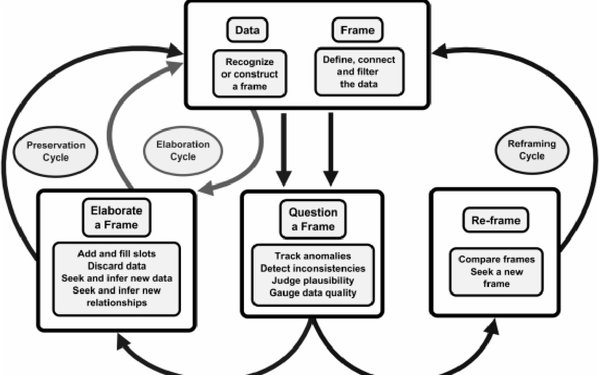
D.T. Moore and R. Hoffman, 2011

The above diagram (from a 2011 paper by David T. Moore and Robert R. Hoffman) shows the sensemaking process. It starts with a frame — our understanding of what is true about the world. As we get presented with new data, we have to make a choice: Does it fit our frame or doesn’t it?

If it does, we preserve the frame and may elaborate on it, fitting the new data into it. If the data doesn’t support our existing frame, we then have to reframe, building a new frame from scratch.

Our brains loves frames. It’s much less work for the brain to keep a frame than to build a new one. That’s why we tend to stick with our beliefs — another word for a frame — until we’re forced to discard them.

But, as with all human traits, our ways of making sense of our world vary in the population. In the above diagram, some of us are more apt to spend time on the right side of the diagram, more open to reframing and always open to evidence that may cause us to reframe.

That, by the way, is exactly how science is supposed to work. We refer to this capacity as critical thinking: the objective analysis and evaluation of  data in order to form a judgment, even if it causes us to have to build a new frame.

Others hold onto their frames for dear life. They go out of their way to ignore data that may cause them to have to discard the frames they hold. This is what I would define as willful ignorance.

It’s misleading to think of this as just being ignorant. That would simply indicate a lack of available data. It’s also misleading to attribute this to a lack of intelligence.

That would be an inability to process the data. With willful ignorance, we’re not talking about either of those things. We are talking about a conscious and deliberate decision to ignore available data. And I don’t believe you can fix that.

We fall into the trap of thinking we can educate, shame or argue people out of being willfully ignorant. We can’t. This post is not intended for the willfully ignorant. They have already ignored it. This is just the way their brains work. It’s part of who they are. Wishing they weren’t this way is about as pointless as wishing they were a world-class pole vaulter, that they were seven feet tall or that their brown eyes were blue.

We have to accept that this situation is not going to change. And that’s what we have to start thinking about. Given that we have willful ignorance in the world, what can we do to minimize its impact?

Why is Everything Now ‘Unprecedented’?

Just once, I would like to get through one day without hearing the word “unprecedented.” And I wonder, is that just the media trying to get a click, or is the world truly that terrible?

Take the Olympics. In my lifetime, I’ve never seen an Olympics like this one. Empty stands. Athletes having to leave within 48 hours of their last event. Opening and closing ceremonies unlike anything we have ever seen. It’s, well — unprecedented.

The weather is unprecedented. What is happening in politics is unprecedented. The pandemic is unprecedented, at least in our lifetimes. I don’t know about you, but I feel like I’m watching a blockbuster where the world will eventually end — but we just haven’t got to that part of the movie yet. I feel the palpable sensation of teetering on the edge of a precipice. And I’m pretty sure it’s happened before.

Take the lead-ups to the two world wars, for example. If you plot a timeline of the events that led to either July 20, 1914 or Sept. 1, 1939, there is a noticeable acceleration of momentum. At first, the points on the timeline are spread apart, giving the world a chance to once again catch its collective breath. But as we get closer and closer to those dates circled in red, things pick up. There are cascades of events that eventually lead to the crisis point. Are we in the middle of such a cascade?

Part of this might just be network knock-on effects that happen in complex environments. But I also wonder if we just become a little shell- shocked, being nudged into a numb acceptance of things we would have once found intolerable.

Author and geographer Jared Diamond calls this “creeping normality. “ In his book “Collapse: How Societies Choose to Fail or Succeed,” he used the example of the deforestation and environmental degradation that happened on Easter Island — and how, despite the impending doom, the natives still decided to chop down the last tree: “I suspect, though, that the disaster happened not with a bang but with a whimper. After all, there are those hundreds of abandoned statues to consider. The forest the islanders depended on for rollers and rope didn’t simply disappear one day—it vanished slowly, over decades.”

Creeping normality continually and imperceptibly nudges us from the unacceptable to the acceptable and we don’t even notice it’s happening. It’s a cognitive bias that keeps us from seeing reality for what it is. Creeping normality is what happens when our view of the world comes through an Overton Window.

I have mentioned the concept of the Overton Window before.  Overton Window was first introduced by political analyst Joseph Lehman and was named after his colleague, Joseph Overton. It was initially coined to show that the political policies that the public finds acceptable will shift over time. What was once considered unthinkable can eventually become acceptable or even popular, given the shifting sensitivities of the public. As an example, the antics of Donald Trump would once be considered unacceptable in any public venue — but as our reality shifted, we saw them eventually become mainstream from an American president.

I suspect that the media does the same thing with our perception of the world in general. The news media demands the exceptional. We don’t click on “ordinary.” So it consistently shifts our Overton Window of what we pay attention to, moving us toward the outrageous. Things that once would have caused riots are now greeted with a yawn. This is combined with the unrelenting pace of the news cycle. What was outrageous today slips into yesterday, to be replaced with what is outrageous today.

And while I’m talking about outrageous, let’s look at the root of that term. The whole point of something being outrageous is to prompt us into being outraged — or moved enough to take action. And, if our sensitivity to outrage is constantly being numbed, we are no longer moved enough to act.

When we become insensitive to things that are unprecedented, we’re in a bad place. Our trust in information is gone. We seek information that comforts us that the world is not as bad as we think it is. And we ignore the red flags we should be paying attention to.

If you look at the lead-ups to both world wars, you see this same pattern. Things that happened regularly in 1914 or 1939, just before the outbreak of war, would have been unimaginable just a few years earlier. The momentum of mayhem picked up as the world raced to follow a rapidly moving Overton Window. Soon, before we knew it, all hell broke loose and the world was left with only one alternative: going to war.

An Overton Window can just happen, or it can be intentionally planned. Politicians from the fringes, especially the right, have latched on to the Window, taking something intended to be an analysis and turning it into a strategy. They now routinely float “policy balloons” that they know are on the fringe, hoping to trigger a move in our Window to either the right or left. Over time, they can use this strategy to introduce legislation that would once have been vehemently rejected.

The danger in all this is the embedding of complacency. Ultimately, our willingness to take action against threat is all that keeps our society functioning. Whether it’s our health, our politics or our planet, we have to be moved to action before it’s too late.

When the last tree falls on Easter Island, we don’t want to be the ones with the axe in our hands.

A Hybrid Work Approach To Creativity

Last week I introduced the concept of burstiness, meaning the bursts of creativity that can happen when a group is on a roll.

Burstiness requires trust: a connection in the group that creates psychological safety. But I would go one step further. It also requires respect — an intuitive acknowledgement of the value of contribution from everyone in the group. It’s a type of recursive high that builds on itself, as each contribution sparks something else from the group. It’s like the room has caught fire and, as the burstiness continues, everyone tries to add to the flames.

We’ve used jazz as an example of burstiness. But there are other great examples, like theater improv. Research has found that the brain actually changes how it acts when it’s engaged in these activities, according to a Psychology Today article.

A 2008 fMRI study found that that different parts of the brain lit up when musicians improvised rather than just playing scales. The brain shifted into a different gear. The dorsolateral prefrontal cortex decreased in activity, and the medial prefrontal cortex increased. This is a fascinating finding, because the dorsolateral prefrontal cortex is the part of the brain where we look at ourselves critically and the media prefrontal cortex is linked with language and creativity. A follow-up study was done on improv actors, and the findings were remarkably similar.

This modality of the brain is important to understand. If we can create the conditions that lead to creativity, magic can happen.

Also, this is a team sport. Creativity is almost never exclusively a solo pursuit.

In 1995, Alfonso Montuori and Ronald Purser wrote an essay deconstructing the myth of the lone genius. In it, they showed that creativity almost always relies on social interaction. There is a system of creativity, an ecology that creates the conditions necessary for inspiration.

We love the story of the eccentric solitary genius toiling away in a loft somewhere, but it almost never happens that way. Da Vinci and Michelangelo had “schools” of apprentices that helped turn out their masterpieces. Mozart was a pretty social guy whose creativity fed off interactions with his court patrons and other composers of the era.

But we also have to understand that a little creative magic can go a long way. You don’t have to be 100% creative all the time. In a corporate setting, creativity is a spark. Then there is a lot of non-creative work required to fan it into a flame.

Given this, perhaps the advent of hybrid virtual-traditional workplace models might be a suitable fit for encouraging inspiration, if we use them correctly and not try to force-fit our intentions into the wrong workplace framework.

A virtual work-from-home environment is great for efficiency and getting stuff done. Our boss isn’t hovering over our cubicle asking us if we “have a second” to discuss whatever happens to be on his mind at this particular moment. We’re not wasting hours in tedious, unproductive meetings or on a workplace commute.

On the flip side, if creativity is our goal, there is no substitute for being “in the room where it happens.” A full bandwidth of human interaction is required for the psychological safety we need to take creative risks. These creative summits need to be in person and carefully constructed to provide the conditions needed for creativity. Interdisciplinary and diverse teams who know and trust each other implicitly need to be physically brought together for “improv” sessions. The rules of engagement should be clearly understood.

And unless bosses can participate fully “in kind” (a great example of this is Trevor Noah in the “Daily Show” example I mentioned last week from Adam Grant’s “Worklife” podcast), they should stay the hell out of the room.

Be ruthless about limiting attendance for creative sessions to just those who bring something to the table and have already built a psychological “safe space” with each other through face-to-face connections. Just one wrong person in the room can short-circuit the entire exercise.

This hybrid model doesn’t allow for the serendipity of creativity — that chance interaction in the lunchroom or the offhand comment that is the first domino to fall in an inspirational chain reaction. It also puts a constrained timeline on creativity, forcing it into specific squares on a calendar. But at least it recognizes the unique prerequisites of creativity and addresses them in an honest manner.

One last thought on creativity. Again, we go back to Anita Williams Wooley, the Carnegie Mellon professor who first identified “burstiness.” In a 2018 study with Christopher Riedl, she shows that even with a remote workplace, “bursty” communications can lead to more innovative teams.

“People often think that constant communication is most effective, but actually, we find that bursts of rapid communication, followed by longer periods of silence, are telltale signs of successful teams,” she notes.

This communication template mimics the hybrid model I mentioned before. It compartmentalizes our work activities, adopting communication styles that best suit the different modalities required: the effectiveness of collaboration and innovation, and the efficiency of getting the work done. Wooley suggests using a synchronous form of communication for the “bursts” — perhaps even the old-fashioned phone. And then leave everybody alone for a period of radio silence and let them get their work done.

Why Our Brains Struggle With The Threat Of Data Privacy

It seems contradictory. We don’t want to share our personal data but, according to a recent study reported on by MediaPost’s Laurie Sullivan, we want the brands we trust to know us when we come shopping. It seems paradoxical.

But it’s not — really.  It ties in with the way we’ve always been thinking.

Again, we just have to understand that we really don’t understand how the data ecosystem works — at least, not on an instant and intuitive level. Our brains have no evolved mechanisms that deal with new concepts like data privacy. So we have borrowed other parts of the brain that do exist. Evolutionary biologists call this “exaption.”

For example, the way we deal with brands seems to be the same way we deal with people — and we have tons of experience doing that. Some people we trust. Most people we don’t. For the people we trust, we have no problem sharing something of our selves. In fact, it’s exactly that sharing that nurtures relationships and helps them grow.

It’s different with people we don’t trust. Not only do we not share with them, we work to avoid them, putting physical distance between us and them. We’d cross to the other side of the street to avoid bumping into them.

In a world that was ordered and regulated by proximity, this worked remarkably well. Keeping our enemies at arm’s length generally kept us safe from harm.

Now, of course, distance doesn’t mean the same thing it used to. We now maneuver in a world of data, where proximity and distance have little impact. But our brains don’t know that.

As I said, the brain doesn’t really know how digital data ecosystems work, so it does its best to substitute concepts it has evolved to handle those it doesn’t understand at an intuitive level.

The proxy for distance the brain seems to use is task focus. If we’re trying to do something, everything related to that thing is “near” and everything not relevant to it is “far. But this is an imperfect proxy at best and an outright misleading one at worst.

For example, we will allow our data to be collected in order to complete the task. The task is “near.” In most cases, the data we share has little to do with the task we’re trying to accomplish. It is labelled by the brain as “far” and therefore poses no immediate threat.

It’s a bait and switch tactic that data harvesters have perfected. Our trust-warning systems are not engaged because there are no proximate signs to trigger them. Any potential breaches of trust happen well after the fact – if they happen at all. Most times, we’re simply not aware of where our data goes or what happens to it. All we know is that allowing that data to be collected takes us one step closer to accomplishing our task.

That’s what sometimes happens when we borrow one evolved trait to deal with a new situation:  The fit is not always perfect. Some aspects work, others don’t.

And that is exactly what is happening when we try to deal with the continual erosion of online trust. In the moment, our brain is trying to apply the same mechanisms it uses to assess trust in a physical world. What we don’t realize is that we’re missing the warning signs our brains have evolved to intuitively look for.

We also drag this evolved luggage with us when we’re dealing with our favorite brands. One of the reasons you trust your closest friends is that they know you inside and out. This intimacy is a product of a physical world. It comes from sharing the same space with people.

In the virtual world, we expect the brands we know and love to have this same knowledge of us. It frustrates us when we are treated like a stranger. Think of how you would react if the people you love the most gave you the same treatment.

This jury-rigging of our personal relationship machinery to do double duty for the way we deal with brands may sound far-fetched, but marketing brands have only been around for a few hundred years. That is just not enough time for us to evolve new mechanisms to deal with them.

Yes, the rational, “slow loop” part of our brains can understand brands, but the “fast loop” has no “brand” or “data privacy” modules. It has no choice but to use the functional parts it does have.

As I mentioned in a previous post, there are multiple studies that indicate that it’s these parts of our brain that fire instantly, setting the stage for all the rationalization that will follow. And, as our own neuro-imaging study showed, it seems that the brain treats brands the same way it treats people.

I’ve been watching this intersection between technology and human behaviour for a long time now. More often than not, I see this tendency of the brain to make split-section decisions in environments where it just doesn’t have the proper equipment to make those decisions. When we stop to think about these things, we believe we understand them. And we do, but we had to stop to think. In the vast majority of cases, that’s just not how the brain works.

Media: The Midpoint of the Stories that Connect Us

I’m in the mood for navel gazing: looking inward.

Take the concept of “media,” for instance. Based on the masthead above this post, it’s what this site — and this editorial section — is all about. I’m supposed to be on the “inside” when it comes to media.

But media is also “inside” — quite literally. The word means “middle layer,” so it’s something in between.

There is a nuance here that’s important. Based on the very definition of the word, it’s something equidistant from both ends. And that introduces a concept we in media must think about: We have to meet our audience halfway. We cannot take a unilateral view of our function.

When we talk about media, we have to understand what gets passed through this “middle layer.” Is it information? Well, then we have to decide what information is. Again, the etymology of the word “inform” shows us that informing someone is to “give form to their mind.” But that mind isn’t a blank slate or a lump of clay to be molded as we want. There is already “form” there. And if, through media, we are meeting them halfway, we have to know something about what that form may be.

We come back to this: Media is the midpoint between what we, the tellers,  believe, and what we want our audience to believe. We are looking for the shortest distance between those two points. And, as self-help author Patti Digh wrote, “The shortest distance between two people is a story.”

We understand the world through stories — so media has become the platform for the telling of stories. Stories assume a common bond between the teller and the listener. It puts media squarely in the middle ground that defines its purpose, the point halfway between us. When we are on the receiving end of a story, our medium of choice is the one closest to us, in terms of our beliefs and our world narrative. These media are built on common ideological ground.

And, if we look at a recent study that helps us understand how the brain builds models of the things around us, we begin to understand the complexity that lies within a story.

This study from the Max Planck Institute for Human Cognitive and Brain Sciences shows that our brains are constantly categorizing the world around us. And if we’re asked to recognize something, our brains have a hierarchy of concepts that it will activate, depending on the situation. The higher you go in the hierarchy, the more parts of your brain that are activated.

For example, if I asked you to imagine a phone ringing, the same auditory centers in your brain that activate when you actually hear the phone would kick into gear and give you a quick and dirty cognitive representation of the sound. But if I asked you to describe what your phone does for you in your life, many more parts of your brain would activate, and you would step up the hierarchy into increasingly abstract concepts that define your phone’s place in your own world. That is where we find the “story” of our phone.

As psychologist Robert Epstein  says in this essay, we do not process a story like a computer. It is not data that we crunch and analyze. Rather, it’s another type of pattern match, between new information and what we already believe to be true.

As I’ve said many times, we have to understand why there is such a wide gap in how we all interpret the world. And the reason can be found in how we process what we take in through our senses.

The immediate sensory interpretation is essentially a quick and dirty pattern match. There would be no evolutionary purpose to store more information than is necessary to quickly categorize something. And the fidelity of that match is just accurate enough to do the job — nothing more.

For example, if I asked you to draw a can of Coca-Cola from memory, how accurate do you think it would be? The answer, proven over and over again, is that it probably wouldn’t look much like the “real thing.”

That’s coming from one sense, but the rest of your senses are just as faulty. You think you know how Coke smells and tastes and feels as you drink it, but these are low fidelity tags that act in a split second to help us recognize the world around us. They don’t have to be exact representations because that would take too much processing power.

But what’s really important to us is our “story” of Coke. That was clearly shown in one of my favorite neuromarketing studies, done at Baylor University by Read Montague.

He and his team reenacted the famous Pepsi Challenge — a blind taste test pitting Coke against Pepsi. But this time, they scanned the participant’s brains while they were drinking. The researchers found that when Coke drinkers didn’t know what they were drinking, only certain areas of their brains activated, and it didn’t really matter if they were drinking Coke or Pepsi.

But when they knew they were drinking Coke, suddenly many more parts of the brain started lighting up, including the prefrontal cortex, the part of the brain that is usually involved in creating our own personal narratives to help us understand our place in the world.

And while the actual can of Coke doesn’t change from person to person, our Story of Coke can be an individual to us as our own fingerprints.

We in the media are in the business of telling stories. This post is a story. Everything we do is a story. Sometimes they successfully connect with others, and sometimes they don’t. But in order to make effective use of the media we chose as a platform, we must remember we can only take a story halfway. On the other end there is our audience, each of whom has their own narratives that define them. Media is the middle ground where those two things connect.

The Split-Second Timing of Brand Trust

Two weeks ago, I talked about how brand trust can erode so quickly and cause so many issues. I intimated that advertising and branding have become decoupled — and advertising might even erode brand trust, leading to a lasting deficit.

Now I think that may be a little too simplistic. Brand trust is a holistic thing — the sum total of many moving parts. Taking advertising in isolation is misleading. Will one social media ad for a brand lead to broken trust? Probably not. But there may be a cumulative effect that we need to be aware of.

In looking at the Edelman Trust Barometer study closer, a very interesting picture emerges. Essentially, the study shows there is a trust crisis. Edelman calls it information bankruptcy.

The slide in trust is probably not surprising. It’s hard to be trusting when you’re afraid, and if there’s one thing the Edelman Barometer shows, it’s that we are globally fearful. Our collective hearts are in our mouths. And when this happens, we are hardwired to respond by lowering our trust and raising our defenses.

But our traditional sources for trusted information — government and media — have also abdicated their responsibilities to provide it. They have instead stoked our fears and leveraged our divides for their own gains. NGOs have suffered the same fate. So, if you can’t trust the news, your leaders or even your local charity, who can you trust?

Apparently, you can trust a corporation. Edelman shows that businesses are now the most trusted organizations in North America. Media, especially social media, is the least trusted institution. I find this profoundly troubling, but I’ll put that aside for a future post. For now, let’s just accept it at face value.

As I said in that previous column, we want to trust brands more than ever. But we don’t trust advertising. This creates a dilemma for the marketer.

This all brings to mind a study I was involved with a little over 10 years ago. Working with Simon Fraser University, we wanted to know how the brain responded to trusted brands. The initial results were fascinating — but unfortunately, we never got the chance to do the follow-up study we intended.

This was an ERP study (event-related potential), where we looked at how the brain responded when we showed brand images as a stimulus. ERP studies are useful to better understand the immediate response of the brain to something — the fast loop I talk so much about — before the slow loop has a chance to kick in and rationalize things.

We know now that what happens in this fast loop really sets the stage for what comes after. It essentially makes up the mind, and then the slow loop adds rational justification for what has already been decided.

What we found was interesting: The way we respond to our favorite brands is very similar to the way we respond to pictures of our favorite people. The first hint of this occurred in just 150 milliseconds, about one-sixth of a second. The next reinforcement was found at 400 milliseconds. In that time, less than half a second in total, our minds were made up. In fact, the mind was basically made up in about the same time it takes to blink an eye.  Everything that followed was just window dressing.

This is the power of trust. It takes a split second for our brains to recognize a situation where it can let its guard down. This sets in motion a chain of neurological events that primes the brain for cooperation and relationship-building. It primes the oxytocin pump and gets it flowing. And this all happens just that quickly.

On the other side, if a brand isn’t trusted, a very different chain of events occurs just as quickly. The brain starts arming itself for protection. Our amygdala starts gearing up. We become suspicious and anxious.

This platform of brand trust — or lack of it — is built up over time. It is part of our sense-making machinery. Our accumulating experience with the brand either adds to our trust or takes it away.

But we must also realize that if we have strong feelings about a brand, one way or the other, it then becomes a belief. And once this happens, the brain works hard to keep that belief in place. It becomes virtually impossible at that point to change minds. This is largely because of the split-second reactions our study uncovered.

This sets very high stakes for marketers today. More than ever, we want to trust brands. But we also search for evidence that this trust is warranted in a very different way. Brand building is the accumulation of experience over all touch points. Each of those touch points has its own trust profile. Personal experience and word of mouth from those we know is the highest. Advertising on social media is one of the lowest.

The marketer’s goal should be to leverage trust-building for the brand in the most effective way possible. Do it correctly, through the right channels, and you have built trust that’s triggered in an eye blink. Screw it up, and you may never get a second chance.

Social Media Reflects Rights Vs. Obligations Split

Last week MediaPost writer (and my own editor here on Media Insider) Phyllis Fine asked this question in a post: “Can Social Media Ease the Path to Herd Immunity?” The question is not only timely, but also indicative of the peculiar nature of social media that could be stated thus: for every point of view expressed, there is an equal — and opposite — point of view. Fine’s post quotes a study from the Institute of Biomedical Ethics and History of Medicine at the University of Zurich, which reveals, “Anti-vaccination supporters find fertile ground in particular on Facebook and Twitter.”

Here’s the thing about social media. No matter what the message might be, there will be multiple interpretations of it. Often, the most extreme interpretations will be diametrically opposed to each other. It’s stunning how the very same content can illustrate the vast ideological divides that separate us.

I’ve realized that the only explanation for this is that our brains must work differently. We’re not even talking apples and oranges here. This is more like ostrich eggs and vacuum cleaners.

This is not my own revelation. There’s a lot of science behind it. An article in Scientific American catalogs some of the difference between conservative and liberal brains. Even the actual structure is different. According to the article: “The volume of gray matter, or neural cell bodies, making up the anterior cingulate cortex, an area that helps detect errors and resolve conflicts, tends to be larger in liberals. And the amygdala, which is important for regulating emotions and evaluating threats, is larger in conservatives.”

We have to understand that a right-leaning brain operates very differently than a left-leaning brain. Recent neuro-imaging studies have shown that they can consider the very same piece of information and totally different sections of their respective brains light up. They process information differently.

In a previous post about this topic, I quoted biologist and author Robert Sapolsky as saying, “Liberals are more likely to process information systematically, recognize differences in argument quality, and to be persuaded explicitly by scientific evidence, whereas conservatives are more likely to process information heuristically, attend to message-irrelevant cues such as source similarity, and to be persuaded implicitly through evaluative conditioning. Conservatives are also more likely than liberals to rely on stereotypical cues and assume consensus with like-minded others.”

Or, to sum it up in plain language: “Conservatives start gut and stay gut; liberals go from gut to head.”

This has never been clearer than in the past year. Typically, the information being processed by a conservative brain would have little overlap with the information being processed by a liberal brain. Each would care and think about different things.

But COVID-19 has forced the two circles of this particular Venn diagram together, creating a bigger overlap in the middle. We are all focused on information about the pandemic. And this has created a unique opportunity to more directly compare the cognitive habits of liberals versus conservatives.

Perhaps the biggest difference is in the way each group defines morality. At the risk of a vast oversimplification, the right tends to focus on individual rights, especially those they feel they’re personally are at risk of losing. The left thinks more in terms of societal obligations: What do we need to do — or not do — for the greater good of us all?  To paraphrase John F. Kennedy, conservatives ask what their country can do for them; liberals ask what they can do for their country.

This theory is part of Jonathon Haidt’s Moral Foundations Theory. What Haidt, working with others, has found is that both the right and left have morals, but they are defined differently. This “moral pluralism” means that two people can look at the same social media post but take two entirely different messages from it. And both will insist their interpretation is the correct one. Liberals can see a post about getting a vaccine as an appeal to their concern for the collective well being of their community. Conservatives see it as an attack on their personal rights.

So when we ask a question like “Can social media ease the path to herd immunity?” we run into the problem of message interpretation. For some, it will be preaching to the choir. For others, it will have the same effect as a red cape in front of a bull.

It’s interesting that the vaccine question is being road-blocked by this divide between rights and obligations. It shows just how far the two sides are apart. With a vaccine, at least both sides have skin in the game. Getting a vaccine can save your life, no matter how you vote. Wearing a face mask is a different matter.

In my lifetime, I have never seen a more overt signalling of ideological leanings than whether you choose to wear a face mask or not. When we talk about rights vs obligations, this is the ultimate acid test. If I insist on wearing a mask, as I do, I’m not wearing it for me, I’m wearing it for you. It’s part of my obligation to my community. But if you refuse to wear a mask, it’s pretty obvious who you’re focused on.

The thing that worries me the most about this moral dualism is that a moral fixation on individual rights is not sustainable. It’s assuming that our society is a zero-sum game. In order for me to win, you must lose. If we focus instead on our obligations, we approach society with an abundance mentality. As we contribute, we all benefit.

At least, that’s how my brain sees it.