Keillor and Altman Fans Rejoice!

I’m very excited, and it has nothing to do with anything online. A Prairie Home Companion is now playing. I’ve always been a huge Garrison Keillor fan, for 3 reasons. First, I grew up in a Norwegian prairie town (Sundre) that seems to be the Canadian equivalent of Lake Wobegon. Secondly, I started my career in radio. And third, he’s probably America’s greatest living humorist.

So when I heard he and Robert Altman were teaming up on a movie version of a Prairie Home Companion, I couldn’t wait. And what a cast! Meryl Streep, Kevin Kline, Lily Tomlin, Tommy Lee Jones…those are four of my favorites right there. Granted, it also has Lindsey Lohan, but apparently she’s pretty good in the role.

Not sure how many share my tastes, but if you do, check out the website.

Google, Microsoft, Print, TV and other Thoughts on a Rainy Day

It’s raining and I’m not feeling particularly industrious, so I’ll push back the “To do” pile a little bit farther and catch up on some blog posts.

There’s been a lot of buzz lately about the search engine’s foray into the world of print advertising, and Tacoda CEO Dave Morgan tries to pinpoint where Google’s attempt to introduce an auction based model to print could have gone wrong.

One point put forth in the column (although not Dave’s) that’s worth considering is that an auction based market is a tremendously efficient one. It has little overhead and it allows prices to find their own sustainable levels, based on the value in the buyer’s mind. This worked well for search because it presented untapped value. There was no place for search to go but up. Which it did.

Print is another matter. It represents an entire food chain with an accompanying industry that subsists on it. That comes with built in inefficiencies and therefore, pricing inflation. Arguably, when introduced to an open, dynamic, buyer controlled pricing market, print had nowhere to go but down. Which it did. And that was the problem.

But Dave points to another issue, and that’s the significant differences between print and search. Search is driven by intent, which means that search interactions generally lead to a purchase event in the not too distant future. And each click is an expression of that intent, which makes it easy for markets to start assessing value to the click. This measurable value provides easy justification for the bid price. In fact, it’s this direct response approach to search that’s introducing many of the challenges we face in trying to quantify value to search touch points as we move further away from the purchase.

Print is a different animal. It’s often used for branding, a much less quantifiable objective, and it’s not clickable. There’s no way to immediately and easily assign value, which makes bidding a guessing game at best, rather than a provable strategy.

In the end, it comes to down to a number of factors, including underestimating the inertia of the print market, the fact that in a price inflated market, an auction based model will find efficiencies, not profit, and, once again, Google thinking that as soon as they enter a new market and affix a Google label, the world will change rotational direction to accommodate them.

And yes, there is a theme emerging in my posts. I’m not a Google basher. I like much of what they do, I like their cocky optimism, I love what they’ve done for search and deep down inside, I do hope they reinvent at least part of the way we do business (nods to John Battelle) but the fact remains that I don’t agree with their strategy of attacking everything at once. It’s not sustainable.

I was in an interesting conversation yesterday with a multi year veteran of the technology wars. He said that Google takes a typical engineer’s view of the universe, and that is in any model, including business models, the more points you have between the producer and the end consumer, the more friction that is introduced. Google’s view is that friction is inefficient and should be eliminated, disintermediated, freeing the flow to go direct. Other companies, through long experience, including Microsoft, have learned differently. Friction is good, friction is valuable, and friction is inevitable in a world populated by people, not machines. Each friction point is an opportunity to add value.

With the two different views of the universe, it’s interesting to note that Microsoft is looking to enter the offline world as well. They announced that their vision of adCenter is a multi channel platform, that will introduce an auction based model and search like accountability to other channels, including television and print. Boy, if you thought print was a tough model to crack, wait til you take on television! Google’s problem, says Microsoft, is that they didn’t understand the print medium. By the way, in this story near the bottom there’s a really interesting line that speaks of many blog posts to come:

Bradford also indicated that Microsoft was gearing up to compete with Google for employees. She said Microsoft hopes to lure staff from Google when the company’s stock options begin vesting next year.

But another post, another day.

I don’t disagree with introducing efficiencies in the ad buying market. I believe it’s long, long, long over due. And I love the idea of introducing more accountability. But everyone has to understand going in that this means the tearing apart of an existing and considerable power construct (or several) and reinventing from the ground up. That takes time and resources. It takes patience. It takes adoption. Each of these speaks to a strategy that will take a considerable time for execution and to turn a profit. The fact that everyone is jumping on the Google print experiment (including Google themselves) because it wasn’t profitable out of the gate is a little ridiculous. Did Google really think they were going to change the world that quickly? Did the analysts? Did we learn nothing from the Dotcom bust?

Speaking of Google and TV, there’s an interesting column over at iMedia by Alan Shulman about the Googleization of TV. Check it out.

Okay, the rain is stopping, I thinned a few items out of my “blog fodder” in box, my “To do” pile is inching closer and the hordes are starting to gather at my door. Time to get back to work!

Friday’s Fodder Folder Clear Out

After almost 2 months of blogging, I’m started to get a system. Usually, when I see items of interest come through my inbox or have interesting conversations, I file them away for a future blog post in a folder called Blog Fodder. Well, the folder is overflowing, and I don’t have time to do full posts, but I did want to pass them along, so I’m cleaning house today.

More Search Research

The Daves (Williams and Berkowitz) and the rest of the gang over at 360i and SearchIgnite released a study looking at the value of multiple clicks on a search ad. This is an interesting indicator of the complexity of the search interaction in a purchase life cycle, something that needs a lot more light shone upon it. I remember Greg Sterling and I talking at one point at a SES session about the messy and twisting nature of a consumer’s online path in a purchase cycle. I’m happy to say that research companies are starting to focus on this Gordian knot (and I’m pretty sure it wasn’t named after me).

ComScore is one of those jumping on board with a recently announced study to look at the influence of online research on offline purchase. The value here is huge, just never quantified that well (or at all) and the ComScore study should be a step in the right direction. I’m hoping to chat with VP James Lamberti more about the study next week. If I’m able, I’ll drop a few tidbits about what they’re looking at.

OMD and Yahoo also released a study looking at this, called the Long and Winding Road. Speaking of Greg Sterling, he’s got a look at the study on his blog, with links to the press release and a few columns. Not sure how publicly available the study is. If you’re interested, perhaps contact your friendly neighborhood Yahoo rep. Fascinating reading!

The Bulls of SEM

Sapna Satagopan from JupiterResearch is bullish on the future of SEM, saying as the number and size of companies moving into search continues to increase, it will drive SEM outsourcing. At first glance, this seems to contradict the findings from the annual SEMPO survey, which indicates that more companies are bringing this in house. Steven Rappaport, a writer who’s currently working on an online advertising field guide for ARF, asked about this in a conversation this week. I explained that the two seeming different viewpoints are two stages in the same cycle. As companies dedicate more attention and budget to search, they do want to gain control in-house, so they are looking for search expertise to bring on board. While these new “directors of search” oversee search activities, they look for experts in specific areas to outsource to. It’s not really efficient for companies to set up an entire search marketing division in-house, and many companies realize this after going down this road for awhile.

Long Tail and other Musings

Cory Treffiletti wrote a column on the Long Tail model of business that has been exploited expertly by Amazon, eMusic, iTunes and the king of long tails, eBay. This is an idea I’ll have to come back to, as it has fascinating implications for retail. But until then, consider, an internet etail model doesn’t have any of the physical limitations of a traditional store. With virtual inventory, provided by direct suppliers, the store, or site, simply acts as the connector. And with expert use of search, the primary connection vehicle, it becomes possible for an online story to carry everything, but with the inventory infinitely segmentable. This brings about the idea of a mega-online shopping site, which is close to what eBay and Amazon have become. Tie this in with smarter shopping search tools and the social networking WOM power of a MySpace, and you’ve got a convergence model that’s mind blowing in its implications.

Tom Hespos takes a stab at a favorite subject of mine, the transference of control over brand messaging from the advertiser to the consumer.

American “Idol”izing Google Trends

First published June 8, 2006 in Mediapost’s Search Insider

Let me apologize right off the bat. I’m going to jump on a pop culture bandwagon, but I’m doing it to prove a point. Search trends reflect the interests of our society, and they can provide an invaluable way to gain intelligence about what’s on the public’s mind.

First of all, some facts to consider:

  • The most votes ever cast for a presidential candidate were 54.5 million, for Ronald Reagan in 1984.
  • On Wednesday, May 24, 63 million votes were cast in the final voting episode of “American Idol”
  • All votes for “American Idol” were cast in a 2-hour window. Typically polls are open for most elections for 13 hours, not including advance polling.
  • In “American Idol,” there was not one hanging chad.

Obviously, “American Idol” struck a chord with the public this year. Some say the final choice of Taylor Hicks was a surprise, but was it? With the help of Google Trends, I did a little forensic investigation and charted the rise in popularity of the contestants, as captured on Google.

A couple of caveats. Total search volumes are an approximation, as Google Trends doesn’t show actual numbers, and currently Google is only showing trends up to the end of April. But as you’ll see, for the purposes of this column, that’s enough.

I divided the contestants into three groups based on indicated search volumes: the Front Runners, the Also-Rans and the Basement Dwellers. I’ve included a link to the chart for each.

The Front Runners

Taylor Hicks started the strongest out of the gate, dominating search volumes in February during the early rounds. Although he lost ground to Kellie Pickler and Chris Daughtry in March, he came back strong in April, only being edged out in total volume for the month by Kellie, due to a surge in searches the week she was voted off.

Pretty boy Ace Young was No. 2 in February, but lost steam moving into March and never seemed to recover. Chris Daughtry was a slow starter in February, but built steam through strong performances in March. Unfortunately, he seemed to lose his edge in April, as search volumes started to drop from their high in mid-March.

The sleeper in this group was Katherine McPhee, who slowly built up steam through late February, March and April, with a huge peak towards the end of April.

If one was to predict outcomes based on search trends from February through April, I would have called it this way

1. Taylor Hicks

2. Katherine McPhee

3. Chris Daughtry

4. Kellie Pickler (one has to adjust for the spike on the week she was voted off)

Remember, this was almost a full month before the final show.

The Also-Rans

In the middle of the “Idol” pack was a group that just couldn’t seem to spark the interest of America, despite significant talent.

  • Lisa Tucker started off the strongest of the group, but could never seem to rise above the search volumes generated mid-February. There was no “buzz” around her. Kevin Covais, on the other hand, emerged out of nowhere and did build through February and March. It’s also interesting to note that when many of the contestants were voted off, their search volumes dropped off the Google trend radar. However, Kevin was voted off March 22, but kept showing up well into April.
  • Diva Mandisa started from nowhere, but generated some of the highest search volumes of all on the night she was voted off. Sometimes you don’t know what you’ve got till it’s gone. And poor Elliott Yamin didn’t have a chance. Despite a great voice (maybe the best, if you believe the judges) he just didn’t turn America’s crank. Although he built search volume slowly, he never emerged as a contender.

The Basement Dwellers

The three who were certified “buzz”-less were Paris Bennett (maybe she should change her name to Hilton), Bucky Covington and Melissa McGhee.

Paris started off hot right out of the starting gate in January, but never went anywhere from there. It seems we got used to the dynamic vocals, the pixie-like speaking voice and the cool hats–and ceased to care. Bucky and Melissa really only attracted significant volumes on the days they were voted off.

The point of this exercise is this. Search volumes do mirror public opinion, and can act as an amazingly accurate indicator of our collective interests. If you would have had access to search volume information, you could have called the results of “American Idol” long before the final show.

The other thing that was interesting was to see the power of community, both in the search results and the actual results. When you look at the top locations for searching, they are, in order: Greensboro, N.C., Charlottesville, Va., Raleigh, N.C., Charlotte, N.C. and Atlanta.

The North Carolina contingent was incredibly active in its quest for information on Chris, Kellie and to a lesser extent, Bucky, far out-searching the rest of the country for those individuals. The search demands for Taylor, Katharine and Ace were spread evenly throughout the country.

If you haven’t played with Google Trends yet, give it a spin. It can provide a fascinating glimpse into search buzz, and through it, what’s on our collective minds at any given time, on any given subject.

Tales of Mobile Woe

First published June 1, 2006 in Mediapost’s Search Insider

On Tuesday night, I was wondering aimlessly through the streets of Old Montreal, staring in hapless confusion at my Pocket PC. Prior to the trip, I thought I had passed into the elite of the technologically advanced road warrior. With Pocket Maps loaded, my hotel location pinpointed and a plethora of enticing little dots to explore, I set out on the cobblestoned streets, secure in the knowledge that the entire streetscape of Montreal was magically captured in my trusty iPAQ.

Exploring old-world Quebec, new-world style

I’m a pretty savvy traveler. I have a great sense of direction, usually study a map ahead to get the “lay of the land,” and can keep north and south straight in my head. My wife’s family often wonders how I do it, as they have no sense of direction at all.

I remember one trip to Vancouver with my father-in-law. I was heading for the Second Narrows Bridge to cross over into North Van, and was on the street that would take us right onto the bridge. My father-in-law asked where I thought I was going, and when I told him the bridge, he said I was way too far west; it was at least two miles further east. As we stayed on the road and eventually ended up on the bridge, he harrumphed and said they must have moved it. Obviously one of those migratory bridges.

So, with this innate ability, enhanced with my newfound technical navigational advantage, I figured there should be no stopping me. This was the trial run for a family trip this summer to France and Italy.


Input and output: kaput!


I got one block from the hotel and was totally lost. I had no idea where north and south were. The tiny 2.5- by 3.5-inch screen held no clues for me, as I zoomed in and out and helplessly panned around, looking for a street with which I could get my bearings. Street names sometimes appeared, and sometimes didn’t.

And the huge church in front of me, which I recognized as Basilique Notre Dame, one of Montreal’s most famous landmarks, for some reason didn’t show up on my diminutive map. Instead there was a little blue dot labeled “Vieux Seminare,” practically obliterated by hundreds of restaurant and hotel icons. I scratched around helplessly with my stylus as I slowly walked down the street, trying to pan to a section of map that looked familiar.

If you’ve never tried using a stylus while walking, be forewarned, you need the steady hands of a brain surgeon and the dexterity of a Cirque du Soleil performer. It’s not for the faint of heart. I would just get to a section of the map that looked promising when I would have to look up to avoid running into a lamppost or person and suddenly my stylus would leap across the screen and transport me to the nether regions of Montreal, miles from my current location. Once it accidentally opened a map of Manhattan, and I was halfway to Times Square before I realized what happened.

As I reached a square, I saw a map of Old Montreal conveniently placed for tourists, a real map, 3 feet by 4 feet, with icons that didn’t disappear and street names I could read. It was at a scale where I could look at more than a block of the map at a time and still see the points of interest. I pocketed the iPAQ, got my bearings and happily explored the rest of the Old City (which is fabulous, or as they say here, tres merveilleux) as the iPAQ dozed silently in its holster. Its wandering days are over.

And here we have the biggest problem with mobile. Getting information into it, and getting information out. We are not Lilliputians. My fingers can pretty much wipe out an entire family of BlackBerry keys in one swipe. And my thumbs are even more dangerous. This was not the way a 6-foot, 220-pound guy was meant to communicate. Give me a durable, beefy keyboard that can take my not-so-subtle advances.

The only thing meant to be seen on a 2.5- by 3.5-inch screen is Dr. Phil, because just when he gets to the peak of his self-righteous “I can’t help you unless you help yourself” diatribe, you can pretend you’re squishing his head between your thumb and forefinger. This also works with Donald Trump on “The Apprentice” and Simon Cowell on “American Idol,” by the way.

I dream of a heads-up display embedded in my eyeglasses, and a workable voice interface. You say what you want, and it instantly springs up in front of your eyes. Now that would be sweet. Hey, if anybody out there is working on this stuff, let me know. I’d like to buy stocks.

The wireless ransom

My first lesson with mobile data roaming came soon after getting the iPAQ. We hopped in the motorhome and headed to California. Of course, we experimented on the way with how nifty it was to check e-mail, look up Web sites and, for my wife, to chat on Messenger for several hours between Lincoln City and Florence (Oregon, not Italy) with her sister back home. We reached San Francisco and, in trying to locate Molinari’s delicatessen (a place you just have to get a sandwich, by the way), we just searched for the Web site, found the address and walked right to it. This was what being wired was being all about!

Then we got home and found out what being hosed was all about. We got the mobile bill: $800 in data charges for two weeks! Looking up the restaurant probably cost us more than the meal itself. I figure each of my wife’s Messenger chats averaged about 30 dollars. Since then, I’ve learned to not keep bringing up this point in domestic discussions.

Until we get some broadband upgrades, standardized rates and roaming agreements that cost less than the GNPs of most small countries, we’re scared to death of going online on a mobile device. It’s like going into your lawyer’s office. You get in, get what you want to say said, and get out. You don’t comment on décor, mention children or bring up holidays. At 300 bucks-plus an hour, it would be cheaper to call a 900 number and chew the fat about female self awareness with Jenn and Barbie at Dial-a-Date.com.

Convergence soon, please!

The third leg of the mobile conundrum is the usefulness of the apps you use. At first glance, they look great, but anemic features, lack of computing power and restricted storage space make you realize their limitations all too quickly. The concept is great; the execution leaves a little to be desired.

Case in point: although you can find points of interest in Pocket Maps, you can’t link them together with suggested routes. I realize the data to calculate the routes is a little much to expect from a Pocket PC, but why does it have to be that way? Isn’t technology here to solve our problems? Anyone trying to create an itinerary on the fly will soon give up.

Also, the points of interest and landmarks you find just give the title and address–nothing else. Even if they did give you a Web site link, you’d be afraid to click on it because Web sites get totally hacked on the small PDA screen, take forever to load and cost you a small fortune to access.

The promise of things yet to come

I want a smarter mobile navigational and search experience. I want to be able to indicate my starting point on my GPS-enabled mobile computer, feed in my interests, get a real search online function to help me find locations (Pocket Map’s 2006 is an improvement over 2004, but leaves a lot to be desired), have the best routes indicated, give me one-click access to information, menus, entertainment, prices and reservations for restaurants, integrate reviews and best- of lists like CitySearch and TripAdvisor, and switch to a satellite view if I wish.

Better yet, I’d like to indicate times I’d like to take a sight-seeing tour, a time I want to stop for supper, and have my PDA work as a smart assistant for me to take my likes and dislikes and provide me with a list of suggestions for my approval. Upon approval, it would lay out the best route and point out landmarks I should look for on the way. As always, search will be the functional layer that ties it all together.

Or think what shopping with a super-smart PDA would be like. You are in a shop and see something you absolutely love. You scan the label with your PDA and see if there are any others in a four-block radius at a lower cost. There is, in a store two blocks east (the map is already drawn) and in different colors. You send a request to the store to set them aside. You start delivering mobile functionality like that and you’ll leave desktop -bound PCs in the dust.

I’m sure most of the capabilities I dream about lie here and there in development, tiny little fragments of a yet-to-be-integrated solution. When it comes, it will be a wonderful thing. But for now, when I’m on the road, the iPAQ will probably spend more time in the holster than out of it. I haven’t totally given up yet, though. The Bluetooth GPS receiver I ordered from eBay is on its way, if it didn’t get lost!

Microsoft and the NY Time’s new reader

I always find it amusing (and a little frightening) when reality imitates parody. Does anybody remember a SNL skit about wearing a VR helmet and reading a virtual book, which was Moby Dick? In effect, somebody sat in a chair, donned this huge awkward helmet, which gave the experience of sitting in a chair, and reading a book.

Now, Microsoft and the NY Times have come perilously close to this with their new on screen News Reader.

http://www.businessweek.com/ap/financialnews/D8H9AJC8B.htm?campaign_id=alerts

The idea is to simulate the experience of reading a newspaper online, to more fully engage the reader. There is a cost. Apparently, the reader costs more than a year’s subscription to the Times.

Is it just me, or is this really dumb? We choose to read our news online because the online format gives us a different experience and more functionality. We are rapidly adapting to a new online way of assimilating information, and this includes news. To me, this is kind of like buying a car, but then getting a horse to pull it.

Canada’s Wired!

It’s been a few days without a post, so I thought I’d get a quick one in tonight before I call it a night. I’m in Montreal for the InfoPresse Search Marketing Event (catch my Search Insider this week for more adventures from Old Montreal) and as luck would have it, happened to see an article from MarketingSherpa about how wired Canadians are. I’ve been trying to tell people this for years. I read somewhere that Canadians were the best shoppers in the world. We research more before the purchase than anyone else. We also have more broadband penetration than the US. Add this up and it seems like a match made in heaven for search marketing, but Canadian business has been slow to jump on the bandwagon. The big brands are either not present in search at all, or are just toying with it. The good news is that Canadians marketers are beginning to wake up, as was seen by high interest rates at SES Toronto and at today’s event in Montreal.

Well, I’ve got an early flight tomorrow, and it’s almost midnight, so I’ll cut this short. Just wanted to thank Thomas Gobeil at Infopresse for the invite. The city was amazing and I’d love to come back. Thanks to all who attended the session as well and who bore with me through my acute unilingualism. Also had a chance to meet Mitch Joel from Twistimage and had a spirited discussion about “melt your brain” ideas that keep us both up at night. Check out Mitch’s blog. And thanks to Jonathon Markoff from Acquisio for the conversation over dinner. A great visit, all in all!


Engagement with Video Online

In the past week I’ve read a number of articles precipitated by Google’s move to show video ads across their network. The introduction of video to online seems to be heralded as “the next big thing” by almost everyone, and I admit I’ve taken a turn on that particular band wagon.

Yet, this weekend, I pondered the nature of our engagement with online video and find it wanting in many respects. Why? The particular event that triggered this train of thinking was my trying to watch the documentary “Loose Change” on my computer. If you haven’t seen the video, it’s a Michael Moore-ish type investigation of the events of 9/11. Whether you believe it or not, there’s little doubt that the subject matter is engrossing. I watched Bowling for Columbine and Fahrenheit 911 on my television and had no problem watching them in one sitting. I was highly engaged and was pretty much oblivious to other distractions, including children.

With Loose Change, I’ve been trying to watch the documentary for 2 months now, and I’m only half way through it. It’s not that it’s less interesting. It’s that my environment is different.

When we sit at a television, we’re used to being passive. I think the past 50 years have conditioned us to expect to relinquish control and be willing sponges for whatever happens to flash on the screen. Recently, remote controls and DVR’s have given us some degree of control over the box, but we’re just beginning to exercise that control. When we sit down in front of a TV set, we’re not expecting to “do” anything with it.

The other place where we tend to watch sights and sounds is the movie theater. Again, we expect to be a passive audience here.

But when we sit in front of a computer, we usually do so to accomplish a task. It’s the most useful box in the house, and I believe it’s this very usefulness that may be keeping video from being more engaging online.

Look at the videos that tend to be watched online. They’re short, they have to be highly stimulating and we usually only watch them because a trusted source has labelled them a “must see”. Either a friend has emailed us a link with their recommedation, or word of mouth has spread about the video and it’s the latest viral craze. And usually they require no intellectual engagement. The most watched clips on YouTube fit these criteria to a T. #1 is the Evolution of Dance, watching a (undoubtedly talented) comedian morph from one dance to another in 5 minutes. #2 is a lip sync done in a bedroom of two teenagers in an ode to Pokemon. And #3 is the live version of the Simpson’s intro. Production values are usually minimal, and there is no intellectual content. There is a kind of counter-culture, anti establishment feel to them, which probably adds to their viral appeal.

If a video meets all these criteria, then it will be watched online.

Now, what do we do with our computer, whether it be a laptop or a Media Center, if we want to watch a show on it in the same manner as we would on TV?We maximize the window, blocking out the other stimuli and making it a TV set.

Let’s go back to Loose Change. While arguably this has been a viral success online, it has still been a struggle for me to watch. Why? Well, it’s long, at an hour and 20 minutes. It’s online resolution forces me to watch it in a window, with other stimuli surrounding it. And I have to think and absorb, it’s not mindless.

When I’m watching a video in these circumstances, I find it very difficult not to be distracted by what surrounds it on the page. I feel this innate guiltiness, thinking that there are a hundred other useful things I should be doing rather than watch this video. In fact, we have been conditioned to consider watching a video as a “waste” of time. We can justify it if it’s a few short minutes out of our day. It’s mindless entertainment. But otherwise, guilt starts eating at us. An inexplicable anxiety starts, with the feeling that there has to be something more useful to do with my computer.

Back to my original point. I think we have to reinvent the paradigm through which we engage with video online. I don’t think moving the types of videos we used to watch on TV to our computer screen will work. And my prediction is that advertisers will spend millions of dollars to discover this. Probably the biggest success online has been the Subservient Chicken for Burger King. And the key? It’s different, and it’s interactive.

With Google’s announcement, there will be many who throw video online, in the assumption that it will be more engaging than a simple graphic ad, or even a text based ad. Don’t count on it. The rules are different, and they’re still being written.

Partnership-Palooza! But Do Any of Them Matter?

My inbox was inundated today with talk of new partnerships. Obviously, the search engines are rushing to fill up their dance cards (and when was the last time anyone used a dance card? Maybe it’s time we put that saying to rest.)

What’s interesting about these is the importance of sheer number of users in various online communities. The most travelled intersections of the webs are beginning to look to each other for obvious synergies, trying to stake out a larger slice of online interaction. It’s a bit like an online land grab.

Yahoo and eBay

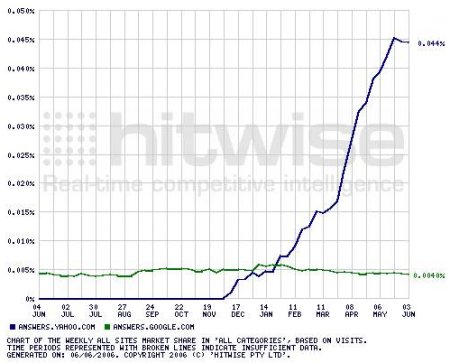
This is a pretty straightforward swap. Yahoo can show it’s ads to eBay’s 75 million users, and in return, Yahoo will help bolster eBay’s defences agains Google Base, which is seen as a major future threat to the auction based marketplace. Me thinks this threat might be a lot more bark than actual bite, as Hitwise’s Bill Tancer points out in the linked article.

Google and MSN and MySpace

This one’s still in the rumor category. Apparently, MySpace is the single biggest referrer to Google, accounting for 8.7% of its traffic, according to Hitwise (nice job grabbing press mentions Bill!). Apparently, MSN is also sniffing around MySpace, and they probably have things to prove after being beat out with AOL by Google. This one is probably more defensive than strategic for Google, who would hate to lose almost 9% of their traffic to a competitor. On the other side, I would think the motivation is huge for MSN, who have to start turning around their declining marketshare to hang on til the release of Vista. The hope with Vista is that tighter integration of search into apps and OS will immediately bolster marketshare.

Meanwhile, MySpace is booming, with no end in sight. They experienced 1000% growth in users last year, becoming the most visited property online. And it’s all about the numbers.

Associated Press and Topix

The last partnership isn’t really a partnership. Topix.net is a search engine that will work with Associated Press to try to enhance links to the lead source of a news story. The problem is that when stories go out on the wire, they’re picked up by other papers and the news engines don’t differentiate between them. The paper that breaks the story wants credit as the original source. Topix will enhance the links to the paper that’s been identified as the source.

There’s one flaw in this strategy. Who the hell is Topix? Nobody uses them to find news. People use Yahoo…26 million of them. People use CNN, about 24 million. They’re the number one and two sources of news (finally, one area where Google isn’t number one!). Going down the list, Topix ranks 29th, with 2.7 million visitors. So, all together now, a collective yawn as we say, “Who cares?” Again, the importance of visitors, or lack of them, is painfully apparent.

The so called partnership begins to make more sense when you know that Topix is controlled by three newspaper publishers, Gannett, Knight Ridder and Tribune. So it’s not so much a partnership as a directive.

It just shows, popularity is the only currency that matters online. If you have visitors, you matter.

Welcome to the Search Marketing Sweat Shop

First published May 25, 2006 in Mediapost’s Search Insider

In the latest Business Week, buried on page 70, there’s a story about outsourcing in search marketing. The story is titled “Life on the Web’s Factory Floor,” and it’s about the thriving business in assembling search marketing ads.

From the description, it sounds like search marketing is nothing more than a big Scrabble game. You throw a bunch of combinations of words up in the air, see how they land. and cut and paste them into your ads. In fact, in the story a search marketing specialist is defined as someone who “types phrases to drive ad traffic.” One gets the mental image of the proverbial room full of monkeys sitting at typewriters. At least the writer, Burt Helm, called the process “slightly creative.”

R-E-S-P-E-C-T: Find out what it means to SEM…

I admit there are companies, some thriving, who take this sweat-shop approach to search marketing. But every time I see the mainstream press reduce my passion to this elemental level, I die a little bit inside. I’m already having enough trouble explaining what I do for a living. Just this past weekend, I was trying to explain to an importer/exporter the rapid growth in search marketing, and what I did most days between 7 a.m. and 6 p.m. He had no idea the search marketing industry existed, and when I told him it was a $7 billion dollar a year industry (just guessing at where we’ll be this year) I could see the question in his eyes. “How the hell can $7 billion change hands in an industry that doesn’t seem to be based on anything?” I’ve been struggling with this attitude for years now, and had finally thought that I was past it. But in one short weekend, with the help of a two-page story in Business Week, I’m right back where I started.

Perhaps the problem is that most users’ touch point with search seems so simple. I type in words, I see words come back–and not a lot of them, either. Most messages are 15 to 20 words at most. How hard can it be? It’s this prevailing attitude that has made search the bastard child of the online ad space. We get no respect. From the outside, it seems like anyone with an IQ topping 60 could market this way. So agencies launch search divisions. Large companies find people that seem to have no pressing items on their to-do lists and make them the new director of search marketing. Everyone throws their hat in the ever increasing search marketing ring.

HELP, I need somebody (preferably a search marketer)…

As an aside, I always find it enlightening to sit at a table during lunch at a Search Engine Strategies show where I don’t know anyone. As introductions are made around the table, you can bet you’ll flush one of these newly minted search marketers out of the crowd. The story is usually the same–the boss thought it would be good to come to the show and “get up to speed.” They look at you with hapless confusion, shell-shocked with the sheer amount of data to digest. Four days, four tracks crammed with information. That’s well over 100 sessions and 400 individual presentations, all dealing with some nuance of search marketing. Before the show, these people thought they had search pretty much pegged. At best, they thought they’d pick up a hint or two. They come back from the show realizing they’ve just jumped into labyrinth of arcane knowledge and tactical expertise.

I Fall to Pieces…

It’s the sheer volume of minutiae in search marketing that makes it such a daunting proposition. I’ve been immersed in it for over 10 years now and I can tell you, there’s no way one person can stay on top of it. That used to be possible, but it’s not today. Even Danny Sullivan and Chris Sherman can’t keep up, and they work unbelievable hours to try.

Search is advancing on all fronts at once. You’ve got Google, Yahoo and MSN trying to gobble up new online territory at a frightening pace. You’ve got new players like MySpace emerging (for the first time, ComScore has included MySpace in its search share numbers). You’ve got new ways of using search, for broadband, on mobile devices and for finding local advertisers. And on top of that, we’re just starting to understand how, when and why consumers use search. I remember once in high school chemistry a classmate spilled a bunch of mercury on a workbench top. A hundred little globs of quicksilver scattered everywhere, proving impossible to round up and contain. That’s what search is like, multiplied by a factor of 100.

It’s Only Words, and Words Are All I Have…

I suppose when you pick search apart at the single message level, it can look pretty simple compared to other channels. Consider the time required to put together one message for one key phrase, compared to what it takes to put together a television ad.

We know that there’s this whole sexy industry behind television ads, with actors, special effects, huge buys and (sometimes) brilliant brand strategies. Now that’s something to admire. They’re like little tiny movies, and we all love movies. But a search ad is, well, just a few words thrown together. What we forget is that every key phrase is its own campaign, infinitely controllable and measurable. For the big search advertisers, that can mean millions of individual campaigns. We buy customers by the penny, building business click by click in a grueling marketing marathon.

There are a lot of moving parts to each of those campaigns, including page placement, maximum bids, messaging, landing page performance and other conversion factors. We obsess over numbers, fine-tuning each campaign to provide maximum performance–or at least, that’s what search marketing should be. It’s this incredible granularity that makes search such a challenge to execute properly.

Search is not easy. Given the choice, I think it would be far easier to consolidate your marketing strategy into a few television ads that are measured on an ephemeral “brand lift” metric, rather then fragment it into millions of individual campaigns, each measured down to the click.

I realize there’s a paradox here. I know it’s this incredible amount of detail that gives rise to the web factories that Burt Helm talks about in Business Week. There’s a lot of heavy lifting to be done. But don’t discount the entire industry by simplifying it down to a room full of people throwing words together. That’s one rather unfortunate aspect of an incredibly dynamic marketing channel. “Typing phrases to drive ad traffic.” Give me a break!