The Seedy, Seedy World of Keto Gummies

OK, admit it. I play games on my phone.

Also, I’m cheap, so I play the free, ad-supported versions.

You might call this a brain-dead waste of time, but I prefer to think of it as diligent and brave investigative journalism.  The time I spend playing Bricks Ball Crusher or Toy Blast is, in actuality, my research into the dark recesses of advertising on behalf of you, the more cerebral and discerning readers of this blog. I bravely sacrifice my own self-esteem so that I might tread the paths of questionable commerce and save you the trip.

You see, it was because of my game playing that I was introduced to the seediest of seedy slums in the ad world, the underbelly known as the in-game ad. One ad, in particular, reached new levels of low.

If you haven’t heard of the Keto Gummies Scam, allow me to share my experience.

This ad hawked miracle gummies that “burn the fat off you” with no dieting or exercising. Several before and after photos show the results of these amazing little miracle drops of gelatin. They had an impressive supporting cast. The stars of the TV pitchfest “Shark Tank” had invested in them. Both Rebel Wilson and Adele had used them to shed pounds. And then — the coup de grace — Oprah (yes, the Oprah!) endorsed them.

The Gummy Guys went right the top of the celebrity endorsement hierarchy when they targeted the big O.

As an ex ad guy, I couldn’t ignore this ad. It was like watching a malvertising train wreck. There was so much here that screamed of scam, I couldn’t believe it. The celebrity pics used were painfully obvious in their use of photoshopping. The claims were about as solid as a toilet paper Taj Mahal. The entire premise reeked of snake oil.

I admit, I was morbidly fascinated.

First, of all the celebrities in all the world, why would you misappropriate Oprah’s brand? She is famously protective of it. If you’re messing with Oprah, you’ve either got to be incredibly stupid or have some serious stones. So which was it?

I started digging.

First of all, this isn’t new. The Keto Gummy Scam has been around for at least a year. In addition to Oprah, they have also targeted Kevin Costner, Rhianna, Trisha Yearwood, Tom Selleck, Kelly Clarkson, Melissa McCarthy — even Wayne Gretzky.

Last Fall, Oprah shared a video on Instagram warning people that she had nothing to do with the gummies and asking people not to fall for the scam. Other celebrities have fallen suit and issued their own warnings.

Snopes.com has dug into the Keto Gummy Scam a couple of times.  One exposé focused on the false claims that the gummies were featured on “Shark Tank.” The first report focused just on the supposed Oprah Winfrey endorsement. That one was from a year ago. That means these fraudulent ads have been associated with Oprah for at least a year and legally, she has been unable to stop them.

To me, that rules out my first supposition. These people aren’t stupid.

This becomes apparent when you start trying to pick your way through the maze of misinformation they have built to support these ads. If you click on the ad you’re taken to a webpage that looks like it’s from a reliable news source. The one I found looked like it was Time’s website. There you’ll find a “one-on-one interview” with Oprah about how she launched a partnership with Weight Watchers to create the Max Science Keto gummies. According to the interview, she called the CEO of Weight Watchers and said ‘if you can’t create a product that helps people lose weight faster without diet and exercise, then I’m backing out of my investment and moving on.”

This is all complete bullshit. But it’s convincing bullshit.

It doesn’t stop there. Clickbait texts with outrageous claims, including the supposed death of Oprah, get clicks through to more bogus sites with more outrageous claims about gummies. While the sites mimic legitimate news organizations like Time, they reside on bogus domains such as genuinesmother.com and newsurvey22offer.com. Or, if you go to them through an in-app link, the URLs are cloaked and remain invisible.

If you turn to a search engine to do some due diligence, the scammers will be waiting for you. If you search for “keto gummies scam” the results page is stuffed with both sponsored and organic spam that appear to support the outrageous claims made in the ads. Paid content outlets like Outlook India have articles placed that offer reviews of the “best keto gummies,” fake reviews, and articles assuring potential victims that the gummies are not a scam but are a proven way to lose weight.

As the Snopes investigators found, it’s almost impossible to track these gummies to any company. Even if you get gummies shipped to you, there’s no return address or phone number. Orders came from a shadowy “Fulfillment Center” in places like Smyrna, Tennessee. Once they get your credit card, the unauthorized charges start.

Even the name of the product seems to be hard to nail down. The scammers seem to keep cycling through a roster of names.

This is, by every definition, predatory advertising. It is the worst example of what we as marketers do. But, like all predators, it can only exist because an ecosystem allows it to exist. It’s something we have to think about.

I certainly will. More on that soon.

The Comedic Comeback

Public confessions are a funny thing.

No, seriously. They’re funny. At least, John Mulaney hopes they’re funny.

His latest Netflix special, Baby J, which just dropped two weeks ago is all about coming back from having his reputation hammered on social media.

John has had a tough time of late. He filled his “Covid Years” with getting divorced from his wife, Anna Marie Tendler, stumbling into an intervention, going to rehab, relapsing, going back to rehab, dating Olivia Munn – and – oh yeah – announcing he’s having a baby with Munn. All of that happening not necessarily in that order.

Mulaney opens his Neflix show with a little song and dance:

“You know what I mean!
We all quarantined!
We all went to rehab and we all got divorced,
and now our rep-u-ta-tion is different!”
“No one knows what to think! 
Hey ya! 
All the kids like Bo Burnham more!
Because he’s currently less problematic.…

Likability is a jail.”


“Likability is a jail.” Mulaney sang that with a smile on his face, but there is some grit in that line. You can almost feel it grinding in the gears of his career.

To be fair, when you build a career on likability in the era of social media, you have to accept that it’s a pretty tenuous foundation for fame. It leaves you extremely vulnerable to being publicly called out for anything that might rub against the grain of your carefully constructed brand.  And, if you are called out – or, in extreme cases – completely cancelled, you have to somehow make it all the way back from simply being accepted to being liked again.

When you think about it, it’s probably a lot easier to build your brand on being an asshole. It’s a lot lower bar to get over. I don’t think Donald Trump loses a lot of sleep over being cancelled. And – just last week –  people gathered at the Met in New York for their Gala honoring fashion icon Karl Lagerfeld, who has never apologized for being one of the biggest and most outspoken assholes in history.  

Mulaney is the latest of a long line of comedian come backs who have been hammered by the fickle fist of being “social media famous.” He is gingerly treading in the footsteps of Louis C.K., Aziz Ansari – even Chris Rock took a stab at it, and he wasn’t the one that got cancelled. That would be Will Smith, who is still trying to pick up the pieces of his career after an ill-considered incident of physical assault in front of a worldwide audience.

You probably wouldn’t be surprised to learn that there’s a playbook for coming back after being eviscerated in the public arena of social media. According to Lori Levine, CEO of the PR firm Flying Television, it requires something called an “Apology Tour.”

The timing of this is critical. According to Levine, you first have to fly under the radar for a bit, “take a certain amount of time to stay quiet, stay off social media, not engage in any press interviews.” After a period of being suitably and silently contrite, you then move to Stage Two, “Slowly return explaining that they have ‘done the work’ [and] are feeling remorseful.”

This was pretty much the playbook that Mulaney followed. The advantage, if you’re a comedian, is that the stand-up stage is the perfect platform for the “apology tour.” It has the built in advantage of being an entertainment form that thrives on making fun of yourself. That’s probably why a good portion of Netflix’s programming calendar consists of comedians lining up for their respective “apology tours.”

Comedians on the social media comeback tour are also given a helping hand in this by the emergence of the “uneasy laughter” of dark comedy over the past decade or so. While dark – or black – humor has been around decades in the form of novels or movies, it has only been in the last decade or so that stand-up comedians combined dark humor with an unflinchingly intimate look into their own personal struggles. Since the unapologetically brilliant live performance of Tig Notaro in 2012 where she talked about her recent diagnosis of breast cancer, stand-up has dared to go to places never imagined just a few years ago.

This creates the perfect environment for the “apology tour.” The whole point is to have a no holds barred discussion of where the comedian erred in judgement. Mulaney navigated this potential minefield with surefooted grace. Probably the funniest and most authentic bit was when he started riffing with a 5th grader up in the balcony at the start of the show, warning him not to “do any of the things I’m about to talk about.”  Somehow – to me – that felt more real than everything that was to follow.

If anything, Mulaney’s recent performance was a sign of our times. It was a necessary step back from public humiliation. I’m not sure it was that funny. But it was John Mulaney reclaiming some control over his public persona. He was telling us we can’t possibly do anything worst to him than he’s done to himself…

“What, are you gonna cancel John Mulaney? I’ll kill him. I almost did.”

Search and ChatGPT – You Still Can’t Get There From Here

I’m wrapping up my ChatGPTrilogy with a shout out to an old friend that will be familiar to many Mediaposters – Aaron Goldman. 13 years ago Aaron wrote a book called Everything I Know About Marketing I Learned from Google.  Just a few weeks ago, Aaron shared a post entitled “In a World of AI, is Everything I Know about Marketing (still) Learned from Google”. In it, he looked at the last chapter of the book, which he called Future-Proofing. Part of that chapter was based on a conversation Aaron and I had back in 2010 about what search might look like in the future.

Did we get it right? Well, remarkably, we got a lot more right than we got wrong, especially with the advent of Natural Language tools such as ChatGPT and virtual assistants like Siri.

We talked a lot about something I called “app-sistants”. I explained, “the idea of search as a destination is an idea whose days are numbered. The important thing won’t be search. It will be the platform and the apps that run on it. The next big thing will be the ability to seamlessly find just the right app for your intent and utilize it immediately.” In this context, “the information itself will become less and less important and the app that allows utilization of the information will become more and more important.”

To be honest, this evolution in search has taken a lot longer than I thought back then, “Intent will be more fully supported from end to end. Right now, we have to keep our master ‘intent’ plan in place as we handle the individual tasks on the way to that intent.”

Searching for complex answers as it currently sits requires a lot of heavy lifting. In that discussion, I used the example of planning a trip.  “Imagine if there were an app that could keep my master intent in mind for the entire process. It would know what my end goal was, would be tailored to understand my personal preferences and would use search to go out and gather the required information. When we look at alignment of intent, [a shift from search to apps is] a really intriguing concept for marketers to consider.”

So, the big question is, do we have such a tool? Is it ChatGPT? I decided to give it a try and see. After feeding ChatGPT a couple of carefully crafted prompts about a trip I’d like to take to Eastern Europe someday, I decided the answer is no. We’re not quite there yet. But we’re closer.

After a couple of iterations, ChatGPT did a credible job of assembling a potential itinerary of a trip to Croatia and Slovenia. It even made me aware of some options I hadn’t run across in my previous research. But it left me hanging well short of the “app-ssistant” I was dreaming of in 2010. Essentially, I got a suggestion but all the detail work to put it into an actual trip still required me to do hundreds of searches in various places.

The problem with ChatGPT is that it gets stuck between the millions of functionality siloes – or “walled gardens” – that make up the Internet. Those “walled gardens” exist because they represent opportunities for monetization. In order for an app-ssistant to be able to multitask and make our lives easier, we need a virtual “commonage” that gets rid of some of these walls. And that’s probably the biggest reason we haven’t seen a truly useful iteration of the functionality I predicted more than a decade ago.

This conflict between capitalism and the concept of a commonage goes back at least to the Magna Carta. As England’s economy transitioned from feudalism to capitalism, enclosure saw the building of fences and the wiping out of lands held as a commonage. The actual landscape became a collection of walled gardens that the enforced property rights of each parcel and the future production value of those parcels.

This history, which played out over hundreds of years, was repeated and compressed into a few decades online. We went from the naïve idealism of a “free for all” internet in the early days to the balkanized patchwork of monetization siloes that currently make up the Web.

Right now, search engines are the closest thing we have to a commonage on the virtual landscape. Search engines like Google can pull data from within many gardens, but if we actually try to use the data, we won’t get far before we run into a wall.

To go back to the idea of trip planning, I might be able to see what it costs to fly to Rome or what the cost of accommodations in Venice is on a search engine, but I can’t book a flight or reserve a room. To do that, I have to visit an online booking site. If I’m on a search engine, I can manually navigate this transition fairly easily. But it would stop something like ChatGPT in its tracks.

When I talked to Aaron 13 years ago, I envisioned search becoming a platform that lived underneath apps which could provide more functionality to the user. But I also was skeptical about Google’s willingness to do this, as I stated in a later post here on Mediapost.  In that post, I thought that this might be an easier transition for Microsoft.

Whether it was prescience or just dumb luck, it is indeed Microsoft taking the first steps towards integrating search with ChatGPT, through its recent integration with Bing. Expedia (who also has Microsoft DNA in its genome) has also taken a shot at integrating ChatGPT in a natural language chat interface.

This flips my original forecast on its head. Rather than the data becoming common ground, it’s the chat interface that’s popping up everywhere. Rather than tearing down the walls that divide the online landscape, ChatGPT is being tacked up as window decoration on those walls.

I did try planning that same trip on both Bing and Expedia. Bing – alas – also left me well short of my imagined destination. Expedia – being a monetization site to begin with – got me a little closer, but it still didn’t seem that I could get to where I wanted to go.

I’m sorry to say search didn’t come nearly as far as I hoped it would 13 years ago. Even with ChatGPT thumbtacked onto the interface, we’re just not there yet.

(Feature Image: OpenAI Art generated from the prompt: “A Van Gogh painting of a chatbot on a visit to Croatia”)

The Dangerous Bits about ChatGPT

Last week, I shared how ChatGPT got a few things wrong when I asked it “who Gord Hotchkiss was.” I did this with my tongue at least partially implanted in cheek – but the response did show me a real potential danger here, coming from how we will interact with ChatGPT.

When things go wrong, we love to assign blame. And if ChatGPT gets things wrong, we will be quick to point the finger at it. But let’s remember, ChatGPT is a tool, and the fault very seldom lies with the tool. The fault usually lies with the person using the tool.

First of all, let’s look at why ChatGPT put together a bio for myself that was somewhat less than accurate (although it was very flattering to yours truly).

When AI Hallucinates

I have found a few articles that calls ChatGPT out for lying. But lying is an intentional act, and – as far as I know – ChatGPT has no intention of deliberately leading us astray. Based on how ChatGPT pulls together information and synthesizes it into a natural language response, it actually thought that “Gord Hotchkiss” did the things it told me I had done.

You could more accurately say ChatGPT is hallucinating – giving a false picture based on what information it retrieves and then tries to connect into a narrative. It’s a flaw that will undoubtedly get better with time.

The problem comes with how ChatGPT handles its dataset and determines relevance between items in that dataset. In this thorough examination by Machine Learning expert Devansh Devansh, ChatGPT is compared to predictive autocomplete on your phone. Sometimes, through a glitch in the AI, it can take a weird direction.

When this happens on your phone, it’s word by word and you can easily spot where things are going off the rail.  With ChatGPT, an initial error that might be small at first continues to propagate until the AI has spun complete bullshit and packaged it as truth. This is how it fabricated the Think Tank of Human Values in Business, a completely fictional organization, and inserted it into my CV in a very convincing way.

There are many, many others who know much more about AI and Natural Language Processing that I do, so I’m going to recognize my limits and leave it there. Let’s just say that ChatGPT is prone to sharing it’s AI hallucinations in a very convincing way.

Users of ChatGPT Won’t Admit Its Limitations

I know and you know that marketers are salivating over the possibility of AI producing content at scale for automated marketing campaigns. There is a frenzy of positively giddy accounts about how ChatGPT will “revolutionize Content Creation and Analysis” – including this admittedly tongue in cheek one co-authored by MediaPost Editor in Chief Joe Mandese and – of course – ChatGPT.

So what happens when ChatGPT starts to hallucinate in the middle of massive social media campaign that is totally on autopilot? Who will be the ghost in the machine that will say “Whoa there, let’s just take a sec to make sure we’re not spinning out fictitious and potentially dangerous content?”

No one. Marketers are only human, and humans will always look for the path of least resistance. We work to eliminate friction, not add it. If we can automate marketing, we will. And we will shift the onus of verifying information to the consumer of that information.

Don’t tell me we won’t, because we have in the past and we will in the future.

We Believe What We’re Told

We might like to believe we’re Cartesian, but when it comes to consuming information, we’re actually Spinozian

Let me explain. French philosopher René Descartes and Dutch philosopher Baruch Spinoza had two different views of how we determine if something is true.

Descartes believed that understanding and believing were two different processes. According to Descartes, when we get new information, we first analyze it and then decide if we believe it or not. This is the rational assessment that publishers and marketers always insist that we humans do and it’s their fallback position when they’re accused of spreading misinformation.

But Baruch Spinoza believed that understanding and belief happened at the same time. We start from a default position of believing information to be true without really analyzing it.

In 1993, Harvard Psychology Professor Daniel Gilbert decided to put the debate to the test (Gilbert, Tafarodi and Malone). He split a group of volunteers in half and gave both a text description detailing a real robbery. In the text there were true statements, in green, and false statements, in red. Some of the false statements made the crime appear to be more violent.

After reading the text, the study participants were supposed to decide on a fair sentence. But one of the groups got interrupted with distractions. The other group completed the exercise with no distractions. Gilbert and his researchers believed the distracted group would behave in a more typical way.

The distracted group gave out substantially harsher sentences than the other group. Because they were distracted, they forgot that green sentences were true and red ones were false. They believed everything they read (in fact, Gilbert’s paper was called “You Can’t Not Believe Everything You Read).”

Gilbert’s study showed that humans tend to believe first and that we actually have to “unbelieve” if something is eventually proven to us to be false. Once study even found the place in our brain where this happens – the Right Inferior Prefrontal Cortex. This suggests that “unbelieving” causes the brain to have to work harder than believing, which happens by default. 

This brings up a three-pronged dilemma when we consider ChatGPT: it will tend to hallucinate (at least for now), users of ChatGPT will disregard that flaw when there are significant benefits to doing so, and consumers of ChatGPT generated content will believe those hallucinations without rational consideration.

When Gilbert wrote his paper, he was still 3 decades away from this dilemma, but he wrapped up with a prescient debate:

“The Spinozan hypothesis suggests that we are not by nature, but we can be by artifice, skeptical consumers of information. If we allow this conceptualization of belief to replace our Cartesian folk psychology, then how shall we use it to structure our own society? Shall we pander to our initial gullibility and accept the social costs of prior restraint, realizing that some good ideas will inevitably be suppressed by the arbiters of right thinking? Or shall we deregulate the marketplace of thought and accept the costs that may accrue when people are allowed to encounter bad ideas? The answer is not an easy one, but history suggests that unless we make this decision ourselves, someone will gladly make it for us. “

Daniel Gilbert

What Gilbert couldn’t know at the time was that “someone” might actually be a “something.”

(Image:  Etienne Girardet on Unsplash)

I Wish I Were Half the Person ChatGPT Thinks I Am

Yes, I’ve finally crawled aboard the journalist bandwagon about CHatGPT. The reason I’m waited so long is that I don’t really have any valid technical or professional perspective to add to the conversation. All I have is my own personal opinion.

So here it is, for what it’s worth.

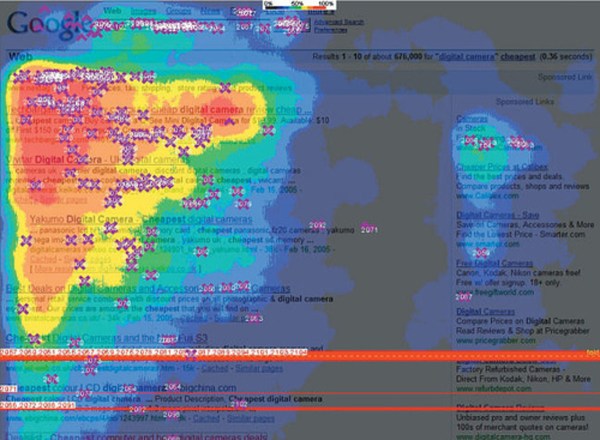
For my first test, I wanted to ask ChatGPT about something where there would be a fair amount of information online but also something where I had the advantage of knowing the inside scoop, allowing me to judge the accuracy of its response. So I asked about the Golden Triangle – the outcome of eye tracking studies we did almost 20 years ago (I just had a minor internal meltdown when I did the mental math and realized that was two decades ago).

I have to admit, ChatGPT nailed it. It did an accurate and concise summary. I’m not sure I could have done better myself.

Google’s Golden Triangle, also known as the “Golden Triangle of Search,” refers to the top section of Google’s search engine results page (SERP) where the most relevant and highest-ranked search results are displayed. It is called the “golden triangle” because eye-tracking studies have shown that users tend to focus their attention on the top three results in the search results page, forming a triangular shape.

The concept of the Golden Triangle is important for search engine optimization (SEO) because it emphasizes the importance of ranking high in search results. Websites that appear in the Golden Triangle are more likely to receive clicks and traffic than those that appear lower on the page.

However, it’s worth noting that the layout of Google’s search engine results page has changed over the years, and the Golden Triangle may not be as relevant as it once was. Google now includes various types of results, such as featured snippets and knowledge panels, that may appear above or alongside the traditional organic search results. As a result, SEO strategies have evolved to include optimizing for these new types of results as well.

When I asked who discovered The Golden Triangle, ChatGPT accurately said it was a joint effort.

The concept of the Golden Triangle in relation to Google’s search engine results page (SERP) was not discovered by a single person, but rather through a combination of eye-tracking studies and data analysis conducted by various researchers and digital marketing professionals.

One of the earliest studies that examined how users interact with Google’s search results page was conducted by Enquiro Research in 2005. This study, titled “The Golden Triangle,” found that users tended to focus their attention on the top-left portion of the search results page, where the first few results were displayed.

Since then, other studies and analyses have confirmed the importance of the top section of the search results page, and the term “Golden Triangle” has become a widely used term in the SEO industry to describe this phenomenon.

For the record, the main players in identifying the pattern were Kevin Lee at DidIt, myself and my agency, Enquiro, EyeTools, the San Francisco eye-tracking consultants who conducted the first study and – in an independent study – Jakob Nielsen at the Nielsen Norman Group. It was Kevin and I who gave it the name The Golden Triangle, mere moments before we had to present the findings to a group at a search conference in San Jose.

So let’s try something a little less black and white. Let’s see how ChatGPT does when it has to freestyle a bit. I asked who I was.

The first paragraph was pretty accurate:

Gord Hotchkiss is a Canadian internet marketing and search engine optimization (SEO) expert. He is the CEO of a digital marketing agency called “Enquiro Search Solutions” which specializes in providing marketing and SEO services to businesses. Gord Hotchkiss is also a well-known speaker and author on the topics of online marketing and search engine optimization.

The second paragraph started a slight pumping of my ego, throwing in some accomplishments I either never did or else can’t remember doing:

Gord Hotchkiss has been involved in the online marketing industry for over 20 years and has worked with a wide range of clients, including Fortune 500 companies. He has written numerous articles on the topics of SEO, online marketing, and search engine technology for publications such as Search Engine Land, ClickZ, and MarketingProfs.

But in the third paragraph, ChatGPT definitely had me confused with someone else:

In addition to his work in the online marketing industry, Gord Hotchkiss is also a co-founder of the “Think Tank of Human Values in Business”, a non-profit organization that focuses on the intersection of business and ethics. He is known for his thought leadership in the industry and for advocating for ethical and sustainable business practices.

Okay, where the hell did that come from? It sounds extraordinarily cool and it’s something I would love to do, but it’s definitely not on my CV. As far as I’m aware, there is no such thing as the “Think Tank of Human Values in Business.” I wish there were, but there’s not.

I tried again. This time, ChatGPT seemed a little less sure of itself. The first sentence was somewhat correct, but after that ChatGPT seemed to manufacture my bio out of nothing but moonbeams and fairy dust. It said I was:

the CEO of a leading digital marketing agency, named “Digital Always Media Inc.” Gord is also a co-founder and chair of the “The Agents of Change” conference, an annual conference focused on helping businesses adapt to the ever-changing digital landscape.

Gord has written numerous articles and books on digital marketing and has been featured in several major media outlets, including The New York Times, The Wall Street Journal, and CNN.

I don’t know who this particular Gord Hotchkiss is, but I’d like to meet him. My AI doppelgänger is leaving me in the dust. I’d better get my shit together.

Or maybe ChatGPT can actually see into the future, showing me the person I just haven’t become yet.

What worries me is how easily ChatGPT constructed complete fabrications of who I was that sounded perfectly plausible. If I didn’t know myself better, I would have simply accepted it as fact. And that – unfortunately – is what we tend to do. We don’t analyze new information and determine if it’s right or wrong. Our default is to believe it’s true until proven otherwise.

It’s this human tendency that flags the real danger with ChatGPT. And, for that reason, I have some more digging to do.

Maybe this other Gord Hotchkiss guy can give me a hand. He sounds wicked smart.

(Image by Brian Penny — Pixabay license)

It Took a Decade, but Google Glass is Finally Broken

Did you hear that Google finally pulled the plug on Google Glass?

Probably not. The announcement definitely flew under the radar. It came with much less fanfare than the original roll out in 2013. The technology, which has been quietly on life support as an enterprise tool aimed at select industries, finally had its plug pulled with this simple statement on its support page:

Thank you for over a decade of innovation and partnership. As of March 15, 2023, we will no longer sell Glass Enterprise Edition. We will continue supporting Glass Enterprise Edition until September 15, 2023.

Talk about your ignoble demises. They’re offering a mere 6 months of support for those stubbornly hanging on to their Glass. Glass has been thrown in the ever growing Google Graveyard, along with Google Health, Google+, Google Buzz, Google Wave, Knol – well, you get the idea.

It’s been 10 years, almost to the day, that Google invited 8000 people to become “Glass Explorers” (others had a different name – “Glassholes”) and plunge into the world of augmented reality.

I was not a believer – for a few reasons I talked about way back then. That led me to say, “Google Glass isn’t an adoptable product as it sits.” It took 10 years, but I can finally say, “I told you so.”

I did say that wearable technology, in other forms, would be a game changer. I just didn’t think that Google Glass was the candidate to do that. To be honest, I haven’t really thought that much more about it until I saw the muted news that this particular Glass was a lot more than half empty. I think there are some takeaways about the fading dividing line between technology and humans that we should keep in mind.

First of all, I think we’ve learned a little more about how our brains work with “always on” technologies like Google Glass. The short answer is, they don’t – at least not very well. And this is doubly ironic because according to an Interview with Google Glass product director Steve Lee on The Verge back in 2013, that was the whole point:

“We all know that people love to be connected. Families message each other all the time, sports fanatics are checking live scores for their favorite teams. If you’re a frequent traveler you have to stay up to date on flight status or if your gate changes. Technology allows us to connect in that way. A big problem right now are the distractions that technology causes.”

The theory was that it was much less distracting to have information right in the line of sight, rather than having to go to a connected screen that might be in your pocket.

Lee went on. “We wondered, what if we brought technology closer to your senses? Would that allow you to more quickly get information and connect with other people but do so in a way — with a design — that gets out of your way when you’re not interacting with technology? That’s sort of what led us to Glass.” 

The problem here was one of incompatible operating systems – the one that drove Google Glass and the one we have baked into our brains. It turned out that maybe the technology was a little too close to our senses. A 2016 study (Lewis and Neider) found that trying to split attention between two different types of tasks – one scanning information on a heads up display and one trying to focus on the task at hand – ended up with the brain not being able to focus effectively on either. The researchers ended with this cautionary conclusion: “Our data strongly suggest that caution should be exercised when deploying HUD-based informational displays in circumstances where the primary user task is visual in nature. Just because we can, does not mean we should.”

For anyone who spends even a little time wondering how the brain works, this should not come as a surprise. There is an exhaustive list of research showing that the brain is not that great at multi-tasking. Putting a second cognitive task for the brain in our line of sight simply means the distraction is all that much harder to ignore.

Maybe there’s a lesson here for Google. I think sometimes they get a little starry eyed about their own technological capabilities and forget to factor in the human element. I remember talking to a roomful of Google engineers more than a decade ago about search behaviors. I remember asking them if any of them had heard about Pirolli and Card’s pioneering work on their Information Foraging theory. Not one hand went up. I was gob smacked. That should be essential reading for anyone working on a search interface. Yet, on that day, the crickets were chirping loudly at Mountainview.

If the Glass team had done their human homework, they would have found that the brain needs to focus on one task at a time. If you’re looking to augment reality with additional information, that information has to be synthesized into a single cohesive task for the brain. This means that for augmented reality to be successful, the use case has to be carefully studied to make sure the brain isn’t overloaded.

But I suspect there was another sticking point that prevented Google Glass from being widely adopted. It challenged the very nature of our relationship with technology. We like to believe we control technology, rather than the other way around. We have defined the online world as somewhere we “go” to through our connected devices. We are in control of when and where we do this. Pulling a device out and initiating an action keeps this metaphorical divide in place.

But Google Glass blurred this line in a way that made us uncomfortable. Again, a decade ago, I talked about the inevitable tipping point that will come with the merging of our physical and virtual worlds. Back then, I said, “as our technology becomes more intimate, whether it’s Google Glass, wearable devices or implanted chips, being ‘online’ will cease to be about ‘going’ and will become more about ‘being.’  As our interface with the virtual world becomes less deliberate, the paradigm becomes less about navigating a space that’s under our control and more about being an activated node in a vast network.”

I’m just speculating, but maybe Google Glass was just a step too far in this direction – for now, anyway.

(Feature image: Tim.Reckmann, CC BY-SA 3.0 https://creativecommons.org/licenses/by-sa/3.0, via Wikimedia Commons)

The Pursuit of Happiness

Last week, I talked about physical places where you can find happiness – places like Fremont, California, the happiest city in the US, or Finland, the happiest country in the world.

But, of course, happiness isn’t a place. It’s a state of mind. You don’t find happiness. You experience happiness. And the nature of that experience is a tough thing to nail down.

That could be why the world Happiness Survey was called “complete crap” by opinion columnist Kyle Smith back in 2017:

“These surveys depend on subjective self-reporting, not to mention eliding cultural differences. In Japan there is a cultural bias against boasting of one’s good fortune, and in East Asia the most common response, by far, is to report one’s happiness as average. In Scandinavia, meanwhile, there is immense societal pressure to tell everyone how happy you are, right up to the moment when you’re sticking your head in the oven.”

Kyle Smith, 2017

And that’s the problem with happiness. It’s kind of like quantum mechanics – the minute you try to measure it, it changes.

Do you ever remember your grandparents trying to measure their happiness? It wasn’t a thing they thought about. Sometimes they were happy, sometimes they weren’t. But they didn’t dwell on it. They had other, more pressing, matters to think about. And if you asked them to self-report their state of happiness, they’d look at you like you had just given birth to a three horned billy goat.

Maybe we think too much about happiness. Maybe we’re setting our expectations too high. A 2011 study (Mauss, Tamir, Anderson & Savino) found that the pursuit of happiness may lead to the opposite outcome, never being happy. “People who highly value happiness set happiness standards that are difficult to obtain, leading them to feel disappointed about how they feel, paradoxically decreasing their happiness the more they want it.”

This is a real problem, especially in today’s media environment. Never in our lives have we been more obsessed with the pursuit of happiness. The problem comes with how we define that happiness. If you look at how media portrays happiness, it’s a pretty self-centred concept. It’s really all about us: what we have, where we are, how we’re feeling, what we’re doing. And all that is measured against what should make us happier.

That’s where the problem of measurement raises its prickly little head. In 1971, social scientists Philip Brickman and Donald T. Campbell came up with something called the “happiness set point.” They wanted to see if major life events – both negative and positive – actually changed how happy people were. The initial study and follow ups that further explored the question found that after initial shift in happiness after major events such as lottery wins, big promotions or life-altering accidents, people gradually returned to a happiness baseline.

But more recent academic work has found that it’s not quite so simple. First of all, there’s no such thing as a universal happiness “set point.” We all have different baselines of how happy we are. Also, some of us are more apt to respond, either positively or negatively, to major life events.

There are life events that can remove the foundations of happiness – for example, losing your job, causing a significant downtown in your economic status. As I mentioned before, money may not buy happiness, but economic stability is correlated with happiness.

What can make a difference in happiness is what we spend time doing. And in this case, life events can set up the foundations of changes that can either lead to more happiness or less. Generally, anything that leads to more interaction with others generally makes us happier. Anything that leads to social withdrawal tends to make us less happy.

So maybe happiness isn’t so much about how we feel, but rather a product of what we do.

Continuing on this theme, I found a couple of interesting data visualizations by statistician Nathan Yau. The most recent one examined the things that people did at work that made them happy.

If you’re in the legal profession, I have bad news. That ranked highest for stress and low for happiness and meaningfulness. On the other end of the spectrum, hairdressers and manicurists scored high for happiness and low on stress. Construction jobs also seemed to tick the right boxes when it comes to happiness on the job.

For me, the more interesting analysis was one Yau did back in 2018. He looked at a dataset that came from asking 10,000 people what had made them happy in the past 24 hours. Then he parsed the language of those responses to look for the patterns that emerged. The two biggest categories that lead to happiness were “Achievement” and “Affection.”

From this, we start to see some common underpinnings for happiness: doing things for others, achieving the things that are important to us, spending time with our favorite people, bonding over shared experiences.

So let’s get back to the “pursuit of happiness”- something so important to Americans that they enshrined it in the Declaration of Indepedence. But, according to Stanford historian Caroline Winterer, in her 2017 TED talk, that definition of happiness is significantly different than what we currently think of. In her words, that happiness meant, “Every citizen thinking of the larger good, thinking of society, and thinking about the structures of government that would create a society that was peaceful and that would allow as many people as possible to flourish.”

When I think of happiness, that makes more sense. It also matches the other research I shared here. We seem happiest when we’re not focused on ourselves but we’re instead thinking about others. This is especially true when our happiness navel-gazing is measuring how we come up short on happiness when stacked against the unrealistic expectations set by social media.

Like too many things in our society, happiness has morphed from something good and noble into a selfish sense of entitlement.

(Image credit – Creative Commons License – https://www.flickr.com/photos/stevenanichols/2722210623)

Finding Your Happy Place

Where can you find happiness? According to a recent study from WalletHub, you’re statistically more likely to find it in Fremont or San Jose, California. It you’re in Madison, Wisconsin, you won’t be quite as happy, but you’ll still be ahead of 98.5% of the US. Fremont, San Jose and Madison are the three happiest cities in America.

If you live in Shreveport, Louisiana, Huntington, West Virginia or Detroit, Michigan, your life may well be a giant sucking hole of despair. Statistically, anyway. Those are the three least happy cities in the US.

Again, WalletHub’s words, not mine.

I know what you’re saying. You see these posts about happy places all the time in your feed. How much credence should you give them?

I’ll be honest. Normally, I scroll right past them. I don’t know what made me look at this one. Maybe it’s because I’ve recently been thinking stock of my own level of happiness. Or maybe I was thinking, “What the hell? I have a few minutes. Let’s try to quantify those whole happiness thing.”

The time might be right. As we claw our way out of a global pandemic and the various other catastrophes that bump up against each other as they jostle for our attention in our news feed, we can’t be blamed for wanting a little more happiness in our lives. I’m pretty sure that’s at least one of the factors behind the great resignation in the wake of Covid.

Also, more of us are choosing to work virtually from home. Wouldn’t it make sense to situate that home in the place where you’re happiest? More and more of our jobs aren’t tied to a physical location. We can live anywhere we want. So why shouldn’t that place be Fremont, California? And I’m told Madison has great cheese curds.

So, today I’m going to help you find that happy place.

First, maybe the focus on cities is a little too narrow. Who says we’re happiest in a city? Recent research has found that yes, in poorer countries, odds are you’ll be happier in a city than in the country. When the whole country is struggling to get by, there’s just more of what you need to survive in a city. But as countries become wealthier, that gap disappears and actually reverses itself, giving a slight happiness edge to those living beyond the city limits. So, if you’re looking for happiness, you might want to consider “movin’ to the country (where you’re) gonna eat a lot of peaches” (obscure pop reference for those of you over 55).

Let’s broaden our focus a mite, out to the happiest states. Luckily, the good folks at Wallet Hub have you covered there too. According to them, the three happiest states are (in order), Hawaii, Maryland and Minnesota. If you live in West Virginia, you better start re-examining your life choices. It scored lowest.

But who says the US is the be all and end all of happiness? Certainly not the World Happiness Report, which has to be the definitive source on all things happy. According to it, the 5 happiest countries on earth are (again in order) – Finland, Denmark, Iceland, Switzerland and the Netherlands. The US is quite a bit down the list in the sixteenth slot.

Perhaps happiness is positively correlated with pickled herring and lingonberries.

Now, for reasons I’ll explore in a future post, I urge you to take those whole empirical approach to happiness with a grain of salt, but there must be something to all these happiness rankings. These countries traditionally top the various lists of best places to life. One has to wonder why? Or, at least, this “one” wondered why.

So I put together a spread sheet of the 20 happiest countries in the study and started looking for the common denominator of happiness. I looked at 5 different potential candidates (including some from the Global Sustainability Competitive Index): Gross Domestic Product per Capita, Social Capital, Natural Capital, Governance Performance and Liberal Democracy.

First of all, money may not buy happiness, but it certainly doesn’t hurt. There was a pretty strong correlation between GDP per capita and the happiness score. It seems that, up to a point, we need enough money to be comfortable to be happy. But, as wealth accumulates, happiness begins to plateau. The world’s longest running happiness study has repeatedly shown this. Marc Schulz, author of “The Good Life”, said “money can’t buy us happiness, but it’s a tool that can give us security and safety and a sense of control over lives.”

Another fairly strong correlation was with Natural Capital, which is defined as having adequate access to clean water and air, as well as proximity to forests, oceans and healthy biodiversity. This had a correlation just slightly lower than the one with GDP per capita.

Much as I would have liked it to be a little higher, given my own political leanings, there was a weaker correlation between liberal democracy and happiness. But, in the silver lining category, there was a strong correlation between liberal democracy and governance performance. The world’s happiest places tend to be places with either a constitutional monarchy and/or a parliamentary system overseeing a social democracy. Take that for what it’s worth.

Surprisingly, the weakest correlation was between effective governance and happiness. That said, it was still a significant correlation, so it did play a part in creating the conditions required for happiness.

All of the above factors run the risk of us conflating correlation and causation. There are certain things that are table stakes for happiness. A reasonable degree of good governance, a safe environment and a healthy economy are three of these. We need them to be happy, but they don’t cause us to be happy.

The last factor, which had the strongest correlation by a significant margin, is different. Not surprisingly, social capital is a direct cause of happiness. If you want to be happy, live somewhere where people love and care for each other. Denmark, the second happiest place on earth, is the home of “hygge” – a general sense of coziness. As I’ve said before, the Danes have “created an environment that leads to bumping into each other.”

 It’s in this beneficial societal friction where you’re statistically more likely to find happiness, wherever you live.

(Image https://www.flickr.com/photos/marcygallery/3803517719 – Creative Commons License)

Real Life Usually Lives Beyond The Data

There’s an intriguing little show you’ve probably never heard of on Netflix that might be worth checking out. It’s called Travelers and it’s a Canadian produced Sci-Fi show that ran from 2016 to 2018. The only face in it you’re probably recognize is Eric McCormack, the Will from Will and Grace. He also happens to be the producer of the series.

The premise is this – special operatives from the future (the “travelers”) – travel back in time to the present to prevent the collapse of society. They essential “body snatch” everyday people from our present at the exact moment of their death and use their lives as a cover to fulfill their mission.

And that’s not even the interesting part.

The real intrigue of the show comes from the everyday conflicts which come from an imperfect shoe horning of a stranger into the target’s real-world experience. The show runners do a masterful job of weaving this into their storylines: the joy of eating a hamburger, your stomach turning at the thought of drinking actual milk from a cow, calling your “wife” her real name when you haven’t called her that in all the time you’ve known her.  And it’s in this that I discovered an unexpected parallel to our current approach to marketing.

This is a bit of a detour, so bear with me.

In the future, the research team compiles as much as they can about each of the people they’re going to “borrow” for their operatives. The profiles are compiled from social media, public records and everything they can discover from the data available.

But when the “traveler” actually takes over their life, there are no end of surprises and challenges – made up of all the trivial stuff that didn’t make it into the data profile.

You probably see where I’m going with this. When we rely solely on data to try to understand our customers or prospects, there will always be surprises. You can only learn these little quirks and nuances by diving into their lives.

That’s what A.G. Lafley, CEO of Proctor and Gamble from 2000 to 2010 and then again from 20153 to 2015, knew. In a profile on Lafley which Forbes did in 2002, writer Luisa Kroll said,

“Like the monarch in Mark Twain’s A Connecticut Yankee in King Arthurs’ Court, Lafley often makes house calls incognito to find out what’s the minds of his subjects. ‘Too much time was being spent inside Procter & Gamble and not enough outside,’ says Lafley who took over during a turbulent period two years ago. ‘I am a broken record when it comes to saying, ‘We have to focus on the customer.'”

It wasn’t a bad way to run a business. Under Lafley’s guidance, P&G doubled their market cap, making them one of the 10 most valuable companies in the world.

Humans are messy and organic. Data isn’t. Data demands to be categorized, organized and columnized. When we deal with data, we necessarily have to treat it like data. And when we do that, we’re going to miss some stuff – probably a lot of stuff. And almost all of it will be the stuff of our lives, the things that drive behavior, the sparks that light our emotions.

It requires two different ways of thinking. Data sits in our prefrontal lobes, demanding the brain to be relentlessly rational. Data reduces behavior to bits and bytes, to be manipulated by algorithms into plotted trendlines and linear graphs. In fact, automation today can totally remove we humans from the process. Data and A.I. work together to pull the levers and push the buttons on our advertising strategies. We just watch the dashboard.

But there’s another way of thinking – one that skulks down in the brain’s subcortical basement, jammed in the corner between the amygdala and the ventral striatum. It’s here where we stack all the stuff that makes us human; all the quirks and emotions, all our manias and motivations. This stuff is not rational, it’s not logical, it’s just life.

That’s the stuff A.G. Lafley found when he walked out the front door of Proctor and Gamble’s headquarters in Cincinnati and into the homes of their customers. And that’s the stuff the showrunners of Travelers had the insight to include in their narratives.

It’s the stuff that can make us sensational or stupid – often at the same time.

Little White Paper Lies

When I was writing last week’s post about poor customer service, I remembered a study I wrote about back in 2019. The study was about how so many companies were terrible at responding to customer service emails. It was released by the Norwegian CRM provider SuperOffice.

At the time, the study was mentioned in a number of articles. The findings were compelling:

Sixty-two percent of companies didn’t respond to customer service emails. Ninety percent of companies didn’t let the customer know their email had been received. Given the topic of my post, this was exactly the type of empirical evidence I was looking for.

There was just one problem. The original study was done in 2018. I wondered if the study had been updated. After a quick search, I thought I had hit pay dirt. Based on the landing page (which came at the top of the results page for “customer service benchmark report”) a new 2023 study was available.

Perfect, I thought.  I filled in the lead contact form, knowing I was tossing my name into a lead-generation mill. I figured, “What the hell. I’m willing to trade that for some legit research.” I eagerly downloaded the report.

It was the same one I had seen four years earlier. Nothing was new.

Puzzled, I carefully went over the landing page wording. Sure enough, it said a new report had just been released. It gave some tidbits of the new findings, all of which were exactly the same as the 2018 report. After each “finding,” I was told “Tweet this!”

I was starting to get the whiff of something rotten from the State of Norway.

I tracked down the post author through LinkedIn. He was an SEO contractor based in Estonia. He replied saying he thought the company was still working on the new report.

I then reached out to the company. I not only wanted to see what they said about the report, I also wanted to see if they responded to my email. Did they walk their own talk?

To their credit, they did respond, with this, “We are sorry that the report have [sic] not been updated, and right now we have no plans to do that.”

So, the landing page was a bald-faced lie? I mentioned this in an email back to them. They apologized and said they would update the landing page to be more accurate. Based on the current version, it was nudged in this direction, but it is still exceedingly misleading.

This is just one example of how corporate white papers are churned out to grab some attention, get some organic search rankings and collect leads. I fell for it, and I should have known better. I had already seen this sausage factory from the inside out.

Back in the days when we used to do usability research, we had been asked by more than one company to do a commissioned study. These discussions generally started with these words: “Here is what we’d like the research to say.”

I’m guessing things haven’t changed much since then. Most of the corporate research I quote in this column is commissioned by companies who are selling solutions to the problems the research highlights.

For any of you in the research biz, you know ethically what a slippery slope it can be. Even in the supposedly pristine world of academic research, you don’t have to turn over too many rocks to uncover massive fraud, as documented in this Nature post. Imagine, then, the world of corporate commissioned whitepaper research, where there is no such thing as peer review or academic rigor. It’s the gloves off, no-holds-barred, grimy underbelly of research.

With our research, I tried to always make sure the research itself was done well. When we did do commissioned research, we tried to make the people who paid the bills happy by the approach we took to interpreting the research. That’s probably why we didn’t get a lot of commissions. Most of the research we did was for our own purposes, and we did our best to keep it legit. If we did get sponsors, they went in with the understanding that we were going to let the results frame the narrative, rather than the other way around.  I wanted to produce research that people could trust.

That was the biggest letdown of the SuperOffice experience. When I saw how cavalier the company was with how they presented the research on their landing page, I realized that not only could I not trust their promotion of the research, I had trouble trusting the original research itself. I suspected I may have been duped into passing questionable information along the first time.

Fool me once…