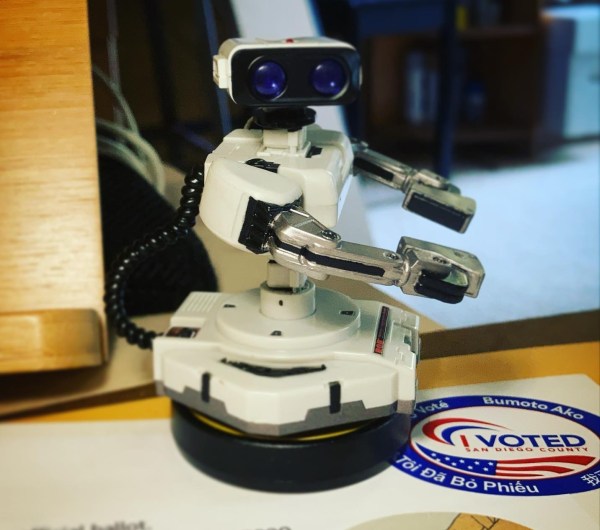
What If We Let AI Vote?

In his bestseller Homo Deus – Yuval Noah Harari thinks AI might mean the end of democracy. And his reasoning for that comes from an interesting perspective – how societies crunch their data.

Harari acknowledges that democracy might have been the best political system available to us – up to now. That’s because it relied on the wisdom of crowds. The hypothesis operating here is that if you get enough people together, each with different bits of data, you benefit from the aggregation of that data and – theoretically – if you allow everyone to vote, the aggregated data will guide the majority to the best possible decision.

Now, there are a truckload of “yeah, but”s in that hypothesis, but it does make sense. If the human ability to process data was the single biggest bottle neck in making the best governing decisions, distributing the processing amongst a whole bunch of people was a solution. Not the perfect solution, perhaps, but probably better than the alternatives. As Winston Churchill said, “it has been said that democracy is the worst form of Government except for all those other forms that have been tried from time to time.…’

So, if we look back at our history, democracy seems to emerge as the winner. But the whole point of Harari’s Homo Deus is to look forward. It is, he promises, “A Brief History of Tomorrow.” And that tomorrow includes a world with AI, which blows apart the human data processing bottle neck: “As both the volume and speed of data increase, venerable institutions like elections, parties and parliaments might become obsolete – not because they are unethical, but because they don’t process data efficiently enough.”

The other problem with democracy is that the data we use to decide is dirty. Increasingly, thanks to the network effect anomalies that come with social media, we are using data that has no objective value, it’s simply the emotional effluent of ideological echo chambers. This is true on both the right and left ends of the political spectrum. Human brains default to using available and easily digestible information that happens to conform to our existing belief schema. Thanks to social media, there is no shortage of this severely flawed data.

So, if AI can process data exponentially faster than humans, can analyze that data to make sure it meets some type of objectivity threshold, and can make decisions based on algorithms that are dispassionately rational, why shouldn’t we let AI decide who should form our governments?

Now, I pretty much guarantee that many of you, as you’re reading this, are saying that this is B.S. This will, in fact, be humans surrendering control in the most important of arenas. But I must ask in all seriousness, why not? Could AI do worse than we humans do? Worse than we have done in the past? Worse than we might do again in the very near future?

These are exactly the type of existential questions we have to ask when we ponder our future in a world that includes AI.

It’s no coincidence that we have some hubris when it comes to us believing that we’re the best choice for being put in control of a situation. As Harari admits, the liberal human view that we have free will and should have control of our own future was really the gold standard. Like democracy, it wasn’t perfect, but it was better than all the alternatives.

The problem is that there is now a lot of solid science that indicates that our concept of free will is an illusion. We are driven by biological algorithms which have been built up over thousands of years to survive in a world that no longer exists. We self-apply a thin veneer of ration and free will at the end to make us believe that we were in control and meant to do whatever it was we did. What’s even worse, when it appears we might have been wrong, we double down on the mistake, twisting the facts to conform to our illusion of how we believe things are.

But we now live in a world where there is – or soon will be – a better alternative. One without the bugs that proliferate in the biological OS that drives us.

As another example of this impending crisis of our own consciousness, let’s look at driving.

Up to now, a human was the best choice to drive a car. We were better at it than chickens or chimpanzees. But we are at the point where that may no longer be true. There is a strong argument that – as of today – autonomous cars guided by AI are safer than human controlled ones. And, if the jury is still out on this question today, it is certainly going to be true in the very near future. Yet, we humans are loathe to admit the inevitable and give up the wheel. It’s the same story as making our democratic choices.

So, let’s take it one step further. If AI can do a better job than humans in determining who should govern us, it will also do a better job in doing the actual governing. All the same caveats apply. When you think about it, democracy boils down to various groups of people pointing the finger at those chosen by other groups, saying they will make more mistakes than our choice. The common denominator is this; everyone is assumed to make mistakes. And that is absolutely the case. Right or left, Republican or Democrat, liberal or conservative, no matter who is in power, they will screw up. Repeatedly.

Because they are, after all, only human.

Fooling Some of the Systems Some of the Time

If there’s a system, there’s a way to game it. Especially when those systems are tied to someone making money.

Buying a Best Seller

Take publishing, for instance. New books that say they are on the New York Times Best-Seller List sell more copies than ones that don’t make the list. A 2004 study by University of Wisconsin economics professor Alan Sorenson found the bump is about 57%. That’s; certainly motivation for a publisher to game the system.

There’s also another motivating factor. According to a Times op-ed, Michael Korda, former editor in chief of Simon and Schuster, said that an author’s contract can include a bonus of up to $100,000 for hitting No. 1 on the list.

This amplifying effect is not a one-shot deal. Make the list for just one week, in any slot under any category, and you can forever call yourself a “NY Times bestselling author,” reaping the additional sales that that honor brings with it. Given the potential rewards, you can guarantee that someone is going to be gaming the system.

And how do you do that? Typically, by doing a bulk purchase through an outlet that feeds its sales numbers to TheTimes. That’s what Donald Trump Jr. and his publisher did for   his book “Triggered,” which hit No. 1 on its release in November of 2019, according to various reports.  Just before the release, the Republican National Committee reportedly placed a $94,800 order with a bookseller, which would equate to about 4,000 books, enough to ensure that “Triggered” would end up on the Times list. (Note: The Times does flag these suspicious entries with a dagger symbol when it believes that someone may be potentially gaming the system by buying in bulk.)

But it’s not only book sales where you’ll find a system primed for rigging. Even those supposedly objective 5-star buyer ratings you find everywhere have also been gamed.

5-Star Scams

A 2021 McKinsey report said that, depending on the category, a small bump in a star rating on Amazon can translate into a 30% to 200% boost in sales. Given that potential windfall, it’s no surprise that you’ll find fake review scams proliferate on the gargantuan retail platform.

A recent Wired exposé on these fake reviews found a network that had achieved a level of sophistication that was sobering. It included active recruitment of human reviewers (called “Jennies” — if you haven’t been recruited yet, you’re a “Virgin Jenny”) willing to write a fake review for a small payment or free products. These recruitment networks include recruiting agents in locations including Pakistan, Bangladesh and India working for sellers from China.

But the fake review ecosystem also included reviews cranked out by AI-powered automated agents. As AI improves, these types of reviews will be harder to spot and weed out of the system.

Some recent studies have found that, depending on the category, over one-third of the reviews you see on Amazon are fake. Books, baby products and large appliance categories are the worst offenders.

Berating Ratings…

Back in 2014, Itamar Simonson and Emanuel Rosen wrote a book called “Absolute Value: What Really Influences Customers in the Age of (Nearly) Perfect Information.” Spoiler alert: they posited that consumer reviews and other sources of objective information were replacing traditional marketing and branding in terms of what influenced buyers.

They were right. The stats I cited above show how powerful these supposedly objective factors can be in driving sales. But unfortunately, thanks to the inevitable attempts to game these systems, the information they provide can often be far from perfect.

Greetings from the Great, White (Frozen) North

This post comes to you from Edmonton, Alberta, where the outside temperature right now is minus forty degrees Celsius. If you’re wondering what that is in Fahrenheit, the answer is, “It doesn’t matter.” Minus forty is where the two scales match up.

If you add a bit of a breeze to that, you get a windchill factor that makes it feel like minus fifty Celsius (-58° F). The weather lady on the morning news just informed me that at that temperature, exposed flesh freezes in two to five minutes. Yesterday, an emergency alert flashed on my phone warning us that Alberta’s power grid was overloaded and could collapse under the demand, causing rotating power outages.

I don’t know about you, but I don’t think anyone should live in a place where winter can kill you. Nothing works as it should when it gets this cold, humans included. And yet, Albertans are toughing it out. I noticed that when it gets this cold, the standard niceties that people say change. Instead of telling me to “have a nice day,” everyone has been encouraging me to “stay warm.”

There’s a weird sort of bonding that happens when the weather becomes the common enemy. Maybe we all become brothers and sisters in arms, struggling to survive against the elements. It got me to wondering: Is there a different sense of community in places where it’s really cold in the winter?

When I asked Google which countries had the strongest social ties, it gave me a list of nine: Finland, Norway, Canada, Denmark, Switzerland, Australia, Netherlands, Iceland and Italy. Seven of those places have snowy, cold winters. If you look at countries that have strong social democracies — governments established around the ideal of the common good — again, you’ll find that most of them are well north (or south, in the case of New Zealand) of the equator.

But let’s leave politics aside. Maybe it’s just the act of constantly transitioning from extreme cold to warm and cozy places where there’s a friendly face sincerely wishing you’ll “stay warm” that builds stronger social bonds. As I mentioned in a previous post, the Danes even have a name for it: hygge. It translates loosely to “coziness.”

There are definitely physical benefits to going from being really cold to being really warm. The Finns discovered this secret thousands of years ago when they created the sauna. The whole idea is to repeatedly go from a little hut where the temperature hovers around 80-90° C (176-194° F) to then jump through a hole you’ve cut in the ice into waters barely above freezing. A paper from the Mayo Clinic lists the health benefits of saunas in a rather lengthy paragraph, touching on everything from reducing inflammation to clearer skin to fighting the flu. 

But the benefits aren’t just physical. Estonia, which is just south of Finland, also has a strong sauna culture. A brilliant documentary by Anna Hints, “Smoke Sauna Sisterhood,” shows that the sauna can be a sacred space. As Estonia’s official submission to the Oscars, it’s in contention for a nomination.

Hints’ documentary shows that saunas can touch us on a deeply spiritual level, healing scars that can build up through our lives. There is something in the cycle of heat and cold that taps into inner truths. As Hints said in a recent interview, “With time, deeper, deeper layers of physical dirt start to come up to the surface, but also emotional dirt starts to come up to the surface.”

While I didn’t visit any saunas on my Edmonton trip, every time I ventured outside it was a hot-cold adventure. Everyone turns the thermostat up a little when it gets this cold, so you’re constantly going through doors where the temperature can swing 75 degrees (Celsius, 130 degrees Fahrenheit) in an instant. I don’t know if there’s a health benefit, but I can tell you it feels pretty damned good to get that warm welcome when you’re freezing your butt off.

Stay warm!

A Look Back at 2023 from the Inside.

(Note: This refers to the regular feature on Mediapost – The Media Insider – which I write for every Tuesday)

It seems that every two years, I look back at what the Media Insiders were musing about over the past year. The ironic part is that I’m not an Insider. I haven’t been “inside” the Media industry for over a decade. Maybe that affords me just enough distance to be what I hope could be called an “informed observer.”

I first did this in 2019, and then again in 2021. This year, I decided to grab a back of an envelope (literally) and redo this far from scientific poll. Categorization of themes is always a challenge when I do this, but there are definitely some themes that have been consistent across the past 5 years.  I have tremendous respect for my fellow Insiders and I always find it enlightening to learn what was on their minds.

In 2019, the top three things we were thinking about were (in order): disruptions in the advertising business, how technology is changing us and how politics changed social media.

In 2021, the top three topics included (again) how technology was changing us, general marketing advice and the toxic impact of social media.

So, what about 2023? What were we writing about? After eliminating the columns that were reruns, I ended up with 230 posts in the past year.

It probably comes as a surprise to no one that artificial intelligence was the number one topic by a substantial margin. Almost 15% of all our Insider posts talked about the rise of AI and its impact on – well – pretty much everything!

The number two topic – at 12% – was TV, video and movies. Most of the posts touched on how this industry is going through ongoing disruption in every aspect – creation, distribution, buying and measurement.

Coming in at number three, at just under 12%, was social media. Like in the previous years, most of the posts were about the toxic nature of social media, but there was a smattering of positive case studies about how social platforms were used for positive change.

We Insiders have always been an existential bunch and last year was no different. Our number four topic was about our struggling to stay human in a world increasingly dominated by tech. This accounted for almost 11% of all our posts.

The next two most popular topics were both firmly grounded in the marketing industry itself. Posts about how to be a better marketer generated almost 9% of Insider content for 2023 and various articles about the business of tech marketing added another 8% of posts.

Continuing down the list, we have world events and politics (Dave Morgan’s columns about the Ukraine were a notable addition to this topic), examples of marketing gone wrong and the art and science of brand building.

We also looked at the phenomenon of fame and celebrity, sustainability, and the state of the News industry. In what might have been a wistful look back at what we remember as simpler times, there were even a few columns about retro-media, including the resurgence of the LP.

Interestingly, former hot topics like performance measurement, data and search all clustered near the bottom of the list in terms of number of posts covering these topics.

With 2023 in our rear view mirror, what are the takeaways? What can we glean from the collected year-long works of these very savvy and somewhat battle-weary veterans of marketing?

Well, the word “straddle” comes to mind. We all seem to have one foot still planted in the world and industry we thought we knew and one tentatively dipping its toes into the murky waters of what might come. You can tell that the Media Insiders are no less passionate about the various forms of media we write about, but we do go forward with the caution that comes from having been there and done that.

I think that, in total, I found a potentially worrying duality in this review of our writing. Give or take a few years –  all my fellow Insiders are of the same generation. But we are not your typical Gen-Xers/Baby Boomers (or, in my case, caught in the middle as a member of Generation Jones). We have worked with technology all our lives. We get it. The difference is, we have also accumulated several decades of life wisdom. We are past the point where we’re mesmerized by bright shiny objects. I think this gives us a unique perspective. And, based on what I read, we’re more than a little worried about what future might bring.

Take that for what it’s worth.

Wishful Thinking for 2024

I write this on the first day of 2024. My 2023 went out last night with a whimper. That was intentional. Given the global trauma inflicted on us over the past few years, I felt a muted goodbye was best. And I’d be lying if I said I was looking forward to 2024. I am approaching it with the same enthusiasm as a minefield I have to tiptoe to the other side of.

I never really got celebrating New Year’s. It is literally just another day. In my childhood, many eons ago, New Year’s Eve was significant only because it was the one day a year when we were able to get both potato chips and dip.  If I remember rightly French Onion was our dip of choice. And I got to stay up late. The glow of that perk had dimmed dramatically over the years.

I suppose New Year’s gives us a chance for a global reset, to put the past year behind us and promise to do better in the coming year. It’s like that moment right after you have sorted out your sock drawer, writ large. You go forward swearing that only matched and bundled socks will go there from this point forward. Of course, it’s probably only a matter of days before that first stray Nike athletic sock finds its way there and the portal to the alternative universe of mismatched socks is prised open, allowing them to proliferate in your drawer without restraint.

But still, a fellow can dream, can’t he?

So, in that spirit, I do have a few things I hope take place in 2024. They are not resolutions – more like wishful thoughts.

Less Toxic Social Media

Given that 2024 is a US election year and is promises to be the most bizarre one yet, I hope that social media starts to move away from the cesspool of misinformation it currently is. Digital Anthropologist Giles Crouch (a job title I wish I had pursued 30 years ago) thinks “the invisible hand” (subscription required) will start to move on social media. Recent lawsuits and more restrictive legislation are already impacting the profitability of the main platforms.

But more than that, usage is changing. People under 30 are using social media as a connector less and less, preferring to meet face to face IRL (in Real Life). And the toxic audience (yes, I’m talking about my generation) that made Facebook and X (the former Twitter) such a threat to democracy is aging out. Hopefully new social media players that fill this emerging gap will learn from past mistakes.

World Governments Getting Serious about Climate Change

I hope that 2023 will prove to be the tipping point for dealing with Climate Change, moving it from a right vs left campaign talking point to something that we actually start doing something about.  Here in Canada, I’ve seen a few promising signs. Our federal government has a nasty habit of setting climate targets and then completely ignoring them. The website Climateactiontracker lists our targets as “Almost Sufficient” but our overall action as “Highly Insufficient” (putting us behind the US, which is rated as “Insufficient”).

But after last summer, when much of our country was on fire, I think we might finally be getting some legislation with some teeth in it.  Canada just unveiled plans to phase out sales of gas-powered cars by 2035. We just have to make our government stick to that plan.

Make Conscientious Capitalism a Real Thing

My final hope is that this year, we start to find a way to make free markets, consumerism and capitalism work for a sustainable society rather than against it. History has proven that there is no more efficient engine for innovation than capitalism, but it has also shown that economist Milton Friedman was right: the only thing corporations care about (or should care about) is maximizing profit.

Maybe this year, we can find a way to make good behavior more profitable. And that puts the onus on us, the market. We have to make our purchase decisions with our future in mind. Ultimately, that future will follow the money and for that reason, the buck always stops with us. In a capitalist society, no one is more powerful than the consumer. We have to wield that power wisely.

It’s 2024. Good luck. I think we’ll need it.

(Image – Laura Billings – Creative Commons License)

A Column About Nothing

What do I have to say in my last post for 2023? Nothing.

Last week, I talked about the cost of building a brand. Then, this week, I (perhaps being the last person on earth to do so) heard about Nothing.  No – not small “n” nothing as in the absence of anything – Big “N” Nothing as in the London based tech start-up headed by Chinese born entrepreneur Carl Pei.

Nothing, according to their website, crafts “intuitive, flawlessly connected products that improve our lives without getting in the way. No confusing tech-speak. No silly product names. Just artistry, passion and trust. And products we’re proud to share with our friends and family. Simple.”

Now, just like the football talents of David Beckham I explored in my last post, the tech Nothing produces is good – very good – but not uniquely good. The Nothing phone (1) and the just released Nothing Phone (2) are capable mid-range smart phones. Again, from the Nothing website, you are asked to “imagine a world where all your devices are seamlessly connected.”

It may just be me, but isn’t that what Apple has been promising (and occasionally delivering) for the better part of the last quarter century? Doesn’t Google make the same basic promise? Personally, I see nothing earth shaking in Nothing’s mission. It all feels very “been there, done that.” Or, if you’ll allow me – it all seems like much ado about Nothing (sorry). Yet people have paid thousands over the asking price when the 100 units of the first Nothing phone were put up for auction prior to its public launch.

Why?  Because of the value of the Nothing brand. And that value comes from one place. No, not the tech. The community. Pei may be a pretty good building of phones, but he’s an even better building of community. He has expertly built a fan base who love to rave about Nothing. On the “Community” section of the Nothing Website, you’re invited to “abandon the glorification of I and open up to the potential of We.”  I’m not sure exactly what that means, but it all sounds very cool and idealistic, if a little vague.

Another genius move by Pei was to open up to the potential of Nothing. In what is probably a latent (or perhaps not so latent) backlash against over advertising and in-your-face branding, we were eager to jump on the Nothing bandwagon. It seems like anti-branding, but it’s not. It’s actually expertly crafted, by-the-book branding. Just like Seinfeld, a show about nothing that became one of the most popular tv shows in history, it has been shown that there is some serious branding swagger to the concept of nothing. I can’t believe no one thought to stake a claim to this branding goldmine before now.