The Problem with Leaders Who Make Stuff Up

Note: The writing of this post has been challenging because of the unpredictability of Trump’s “in the moment” trade policies. For instance, late yesterday Trump “paused’ the tariffs til March. If anything else is out of date by the time you read this – well – I tried.

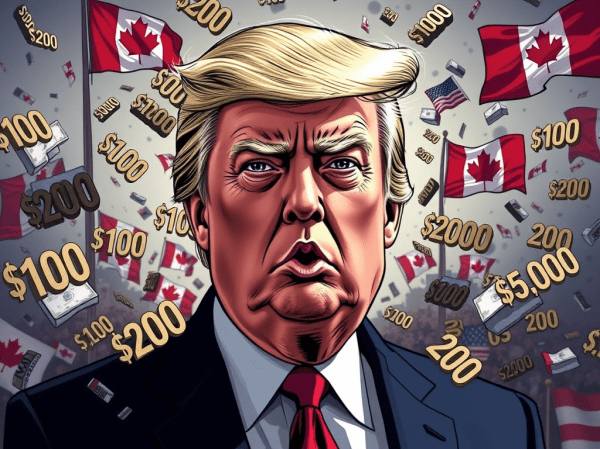
The US has a $100 Billion Trade Deficit with Canada

Correction: The US has a $200 Billion Trade Deficit with Canada

Correction: The US has a $250 Billion Trade Deficit with Canada.

Correction: It’s not a trade deficit. It’s a subsidy.

Correction: This isn’t about the economy, it’s about protecting America from the flood of transients and fentanyl coming across the Canadian border.

None of that is true. But they are all things that Donald Trump has said at one time or another. Those statements are his justification for a 25% tariff on Canada which he imposed this past weekend. And the reason the numbers keeps changing is that he just made them up. He pulled them out of thin air. Like his toupee, those numbers flew from the top of his head.

This is the way Trump operates. There is no need for the truth when you’re negotiating. And in the Trump Playbook, it’s all cool because it’s part of a negotiating strategy called “anchoring.”  Here’s the rational. Throw an outrageous number out there and it suddenly becomes the baseline for negotiating, rather than any starting point based on rationality or logic. It’s classic Trump.

If you’re in the US, you might say, “Good for Trump! If it gets a better deal for us, what’s the harm?”

There’s a lot of harm – billions of dollars’ worth – on both sides of the border. And it’s all completely useless. This bogus trade war is total waste of time that impacts real people and will cause extreme financial hardship.

And it’s all because Trump doesn’t believe in the truth.

Here are the facts. The US does have a trade deficit with Canada. Last year, according to TD Economics, it was about $45 Billion dollars. And a lot of that was due to exports of crude oil to the US to be refined in US refineries. That created US jobs. If you take that out of the mix, Canada actually has a trade deficit with the US, not the other way around.

The US trades with a lot of countries. We (in Canada) are the US’s second biggest trading partner, behind China. And – given that – the imbalance is pretty minimal. If you look at China, who is the biggest trading partner, the deficit is actually about $250 billion.

Also, it’s a deficit, not a subsidy. It’s simply a difference between what was exported to Canada and what was imported. No one in the American government is writing anyone in Canada a check. Calling it a subsidy is just wrong.

And the total amount of fentanyl seized trying to get across the US/Canadian border for most of last year? About 43 pounds. Compare that to the 21,100 pounds seized coming across the Mexican border. It’s not nothing, but it’s definitely not justification for starting a trade war.

So, let’s get to the harm done by Trump’s bluster, bullying and bullshit. Given that the US and Canada are each other’s biggest export markets, our economies are intricately intertwined. Putting a 25% tariff on Canadian imports, which has been met with a retaliatory set of tariffs on US exports to Canada, is like trying to do open heart surgery with a grenade. It’s insanely stupid. Everyone in the Canadian government gets that. Most people in the US government get that. Almost every economist in the world gets that. The governors of the 36 states that have Canada as their biggest export market get that. The only one who doesn’t get it is Donald Trump.

What is also sheer insanity is the fact that when Trump pulls these numbers when he’s in front of a camera, he backs himself into a corner. If he threatens something, he loses face when he doesn’t follow through with the threat. In Canada’s case, someone obviously told him about the whole crude oil thing, because he eventually dropped that tariff to 10%, making it marginally less stupid. But otherwise, he’s ploughing ahead with a trade war for no other reason than because he made some shit up.

The US and Canada does about $1 trillion in trade. And in that total, there are millions of small businesses on both sides of the borders. They don’t have the option of looking for another market. This will put them out of business. It will tear apart families. It will inflict untold suffering. All for absolutely no reason other than that Donald Trump wanted a meaty soundbite.

We can’t accept this, because to accept it is to normalize it. This is just one example of the real harm done when a leader loses all regard for anything resembling the truth and imposes policies on an ignorant whim. That harm will cause trillions of dollars in economic damage and untold personal suffering. We all deserve better – whether we’re Canadians, Americans or any other nationality.  We must demand better.

Democracy Dies in the Middle

As I write this, I don’t know what the outcome of the election will be. But I do know this. There has never been an U.S. Presidential election campaign quite like this one. If you were scripting a Netflix series, you couldn’t have made up a timeline like this (and this is only a sampling):

January 26 – A jury ordered Donald Trump to pay E. Jean Carroll $83 million in additional emotional, reputation-related, and punitive damages. The original award was $5 million.

April 15 – Trial of New York vs Donald Trump begins. Trump was charged with 34 counts of felony.

May 30 – Trump is found guilty on all 34 counts in his New York trial, making him the first U.S. president to be convicted of a felony

June 27 – Biden and Trump hold their first campaign debate hosted by CNN. Biden’s performance is so bad, it’s met with calls for him to suspend his campaign

July 1 – The U.S. Supreme Court delivers a 6–3 decision in Trump v. United States, ruling that Trump had absolute immunity for acts he committed as president within his core constitutional purview.  This effectively puts further legal action against Trump on hold until after the election

July 13 – Trump is shot in the ear in an assassination attempt at a campaign rally held in Butler, Pennsylvania. One bystander and the shooter are killed and two others are injured.

July 21 – Biden announces his withdrawal from the race, necessitating the start of an “emergency transition process” for the Democratic nomination. On the same day, Kamala Harris announces her candidacy for president.

September 6 – Former vice president Dick Cheney and former Congresswoman Liz Cheney announce their endorsements for Harris. That’s the former Republican Vice President and the former chair of the House Republican Conference, endorsing a Democrat.

September 15: A shooting takes place at the Trump International Golf Club in West Palm Beach, Florida, while Donald Trump is golfing. Trump was unharmed in the incident and was evacuated by Secret Service personnel.

With all of that, it’s rather amazing that – according to a recent PEW Research Centre report – Americans don’t seem to be any more interested in the campaign than in previous election years. Numbers of people closely following election news are running about the same as in 2020 and are behind what they were in 2016.

This could be attributed in part to a certain ennui on the part of Democrats. In the spring, their level of interest was running behind Republicans. It was only when Joe Biden dropped out in July that Democrats started tuning in in greater numbers. As of September, they were following just as closely as Republicans.

I also find it interesting to see where they’re turning for their election coverage. For those 50 plus, it is overwhelmingly television. News websites and apps come in a distant second.

But for those under 50, Social Media is the preferred source, with news websites and television tied in second place. This is particularly true for those under 30, where half turn to Social media. The 30 to 49 cohort is the most media-diverse, with their sources pretty much evenly split between TV, websites and social media. 

If we look at political affiliations impacting where people turn to be informed, there was no great surprise. Democrats favour the three networks (CBS, NBC and ABC, with CNN just behind. Republicans Turn first to Fox News, then the three networks, then conservative talk radio.

The thing to note here is that Republicans tend to stick to news platforms known for having a right-wing perspective, where Democrats are more open to what could arguably be considered more objective sources.

It is interesting to note that this flips a bit with younger Republicans, who are more open to mainstream media like the three networks or papers like the New York Times. Sixty percent of Republicans aged 18 – 29 cited the three networks as a source of election information, and 45% mentioned the New York Times.

But we also have to remember that all younger people, Republican or Democrat, are more apt to rely on social media to learn about the election. And there we have a problem. Recently, George Washington University political scientist Dave Karpf was interviewed on CBC Radio about how Big Tech is influencing this election.  What was interesting about Karpf’s comments is how social media is now just as polarized as our society. X has become a cesspool of right-leaning misinformation, led by Trump supporter Elon Musk, and Facebook has tried to depoliticize their content after coming under repeated fire for influencing previous campaigns.

So, the two platforms that Karpf said were the most stabilized in past elections have effectively lost their status as common ground for messaging to the right and the left.  Karpf explains, “Part of what we’re seeing with this election cycle is a gap where nothing has really filled into those voids and left campaigns wondering what they can do. They’re trying things out on TikTok, they’re trying things out wherever they can, but we lack that stability. It is, in a sense, the first post social media election.”

This creates a troubling gap. If those under the age of 30 turn first to social media to be informed, what are they finding there? Not much, according to Karpf. And what they are finding is terribly biased, to the point of lacking any real objectivity.

In 2017, the Washington Post added this line under their masthead: “Democracy Dies in Darkness”. , in this polarized mediascape, I think it’s more accurate to say “Democracy Dies in the Middle”.  There’s a Right-Wing reality and a Left-Wing reality. The truth is somewhere in the middle. But it’s getting pretty hard to find it.

Post-mortem of a Donald Trump Sound Bite

This past weekend, Donald Trump was campaigning in Dayton, Ohio. This should come as news to no one. You’ve all probably seen various blips come across your social media radar. And, as often happens, what Trump said has been picked up in the mainstream press.

Now, I am quite probably the last person in the world that would ever come to Donald Trump’s defense. But I did want to take this one example of how it’s the media, including social media, that is responsible for the distortion of reality that we often see happen.

My first impression of what happened is that Trump promised a retributive bloodbath for any and all opposition if he’s not elected president. And, like many of you, that first impression came through my social media feeds. Joe Biden’s X (formerly Twitter) post said “It’s clear this guy wants another January 6th” Republican Lawyer and founding member of the Lincoln Project George Conway also posted: “This is utterly unhinged.”  

There was also retweeting of ABC coverage featuring a soundbite from Trump that said, “There would be a bloodbath if he is not re-elected in November.” This was conflated with Trump’s decision to open the stump speech with a recording of “Justice for All” by the J6 Choir, made of inmates awaiting trial for their roles in the infamous insurrection after the last election. Trump saluted during the playing of the recording.

To be crystal clear, I don’t condone any of that. But that’s not the point. I’m not the audience this was aimed at.

First of all, Donald Trump was campaigning. In this case, he was making a speech aimed at his base in Ohio, many of whom are auto-workers. And the “bloodbath” comment had nothing to do with armed insurrection. It was Trump’s prediction of what would happen if he wasn’t elected and couldn’t protect American auto jobs from the possibility of a trade war with China over auto manufacturing.

But you would be hard pressed to know that based on what you saw, heard or read on either social media or traditional media.

You can say a lot of derogatory things about Donald Trump, but you can’t say he doesn’t know his base or what they want to hear. He’s on the campaign trail to be elected President of the United State. The way that game is played, thanks to a toxic ecosystem created by the media, is to pick your audience and tell them exactly what they want to hear. The more you can get that message amplified through both social and mainstream media, the better. And if you can get your opposition to help you by also spreading the message, you get bonus points.

Trump is an expert at playing that game. He is the personification of the axiom, “There is no such thing as bad press.”

If we try to pin this down to the point where we can assign blame, it becomes almost impossible. There was nothing untrue in the coverage of the Dayton Rally. It was just misleading due to incomplete information, conflation, and the highlighting of quotes without context. It was sloppy reporting, but it wasn’t illegal.

The rot here isn’t acute. It isn’t isolated to one instance. It’s chronic and systemic. It runs through the entire media ecosystem. It benefits from round after round of layoffs that have dismantled journalism and gutted the platform’s own fact checking and anti-misinformation teams. Republicans, led by House Judiciary Chairman Jim Jordan, are doubling down on this by investigating alleged anti-conservative censorship by the platforms.

I’m pretty sure things won’t get better. Social media feeds are – if anything – more littered than ever with faulty information and weaponized posts designed solely to provoke. So far, management of the platforms have managed to slither away from anything resembling responsibility. And the campaigns haven’t even started to heat up. In the 230 days between now and November 5th, the stakes will get higher and posts will become more inflammatory.

Buckle up. It promises to be a bumpy (or Trumpy?) ride!