
The Tesla Cybertruck’s Branding Blow-Up

The inexact science of branding is nowhere more evident that in the case of the Tesla Cybertruck, which looks like it might usurp the Edsel’s title as the biggest automotive flop in history.

First, a little of the Tesla backstory. No, it wasn’t founded by Elon Musk. It was founded in 2003 by Martin Eberhard and Marc Tarpenning. Musk came in a year later as a money man. Soon, he had forced Eberhard and Tarpenning out of the company. But their DNA remained, notably in the design and engineering of the hugely popular Tesla Model S, Model X and Model 3. These designs drove Tesla to capture over 50% of the electric car market and are straight line extensions of the original technology developed by Eberhard, Tarpenning and their initial team

Musk is often lauded as an eccentric genius in the mold of Steve Jobs, who had his fingers in every aspect of Tesla. While he was certainly influential, it’s not in the way most people think. The Model S, Model X and Model 3 soon became plagued by production issues, failed software updates, product quality red flags and continually failing to meet to meet Musk’s wildly optimistic and often delusional predictions, both in terms of sales and promised updates. Those things all happened on Musk’s watch.  Even with all this, Tesla was the darling of investors and media, driving it to be the most valuable car company in the world.

Then came the Cybertruck.

Introduced in 2019, the Cybertruck did have Musk’s fingerprints all over it. The WTF design, the sheer impracticality of a truck in name only, a sticker price nearly double of what Musk originally promised and a host of quality issues including body panels that have a tendency to fall off have caused sales to not even come close to projections.

In its first year of sales (2024), the Cybertruck sold 40,000 units, about 16% of what Musk predicted annual sales could be. That makes it a bigger fail than the Edsel, which sold 63,000 units against a target of 200,000 sales in its introductory year – 1958. The Edsel did worse in 1959 and was yanked from the market in 1960. The Cybertruck is sinking even faster. In the first quarter of this year, only 6406 Cybertrucks were sold, half the number sold in the same quarter a year ago. There are over 10,000 Cybertrucks on Tesla lots in the U.S., waiting for buyers that have yet to show up.

But it’s not just that the Cybertruck is a flawed product. Musk has destroyed Tesla’s brand in a way that can only be marvelled at. His erratic actions have managed to generate feelings of visceral hate in a huge segment of the market and that hate has found a visible target in the Cybertruck. It has become the symbol of Elon Musk’s increasingly evident meltdown.

I remember my first reaction when I heard that Musk had jumped on the MAGA bandwagon. “How the hell,” I thought, “does that square with the Tesla brand?” That brand, pre-Musk-meltdown and pre-Cybertruck, was a car for the environmentally conscious who had a healthy bank account – excitingly leading edge but not dangerously so. Driving a Tesla made a statement that didn’t seem to be in the MAGA lexicon at all. It was all very confusing.

But I think it’s starting to make a little more sense. That brand was built by vehicles that Musk had limited influence over. Sure, he took full credit for the brand, but just like company he took over, it’s initial form and future direction was determined by others.

The Cybertruck was a different story. That was very much Musk’s baby. And just like his biological ones (14 and counting), it shows all the hallmarks of Musk’s “bull in a China shop” approach to life. He lurches from project to project, completely tone-deaf to the implications of his actions. He is convinced that his genius is infallible. If the Tesla brand is a reflection of Musk, then the Cybertruck gives us a much truer picture. It shows what Tesla would have been if there had never been a Martin Eberhard and Marc Tarpenning and Musk was the original founder.

To say that the Cybertruck is “off brand” for Tesla is like saying that the Titanic had a tiny mishap. But it’s not that Musk made a mistake in his brand stewardship. It’s that he finally had the chance to build a brand that he believed in.
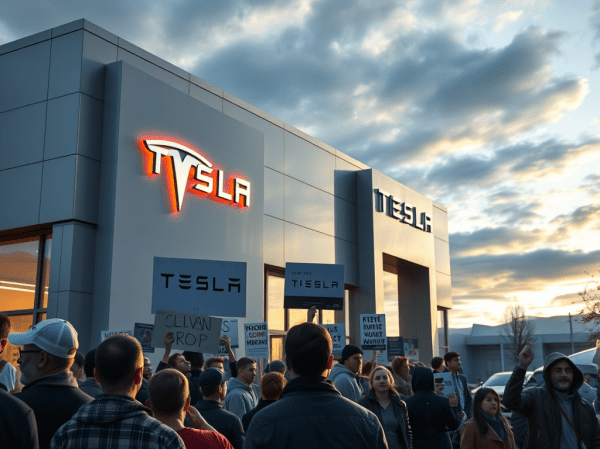
When Branding and Politics Collide

It is the worst timing possible to open a Tesla dealership.

 In Kelowna, the western Canadian city I live in, a new 30,000 square foot Tesla dealership is scheduled to open their doors any day now.  When they do, I’m guessing business will not be brisk. It takes a lot to get Canadians worked up (hockey games aside) but the Trump administration has managed to do something I haven’t seen before in my lifetime – uniting Canadians in a passionate rage. Between picking a totally unjustified trade war with us and continually threatening to make us a 51st State, Donald Trump hasn’t made any friends in my country. And – by extension – that includes his hatchet/chainsaw man and the face of Tesla, Elon Musk.

This is not just happening here in Canada. Tesla owners are having a rough month everywhere. Their cars are being customized with swastikas. Their daily drive is regularly punctuated with middle finger salutes. They are being verbally accosted at Tesla charging stations. And, if they happen to have to go to their dealership, chances are very good that they’ll have to navigate past a pack of protesters. According to the website Actionnetwork.org, there are 101 TeslaTakedown protests scheduled across the US and around the world in the next few weeks.

That is a dramatic turnaround for a car brand that single handedly made driving an electric vehicle cool. The TeslaTakedown campaign is urging drivers to dump their cars and shareholders to sell their stock. A recent survey out of the Netherlands says that one in three Tesla owners are considering selling.

This has nothing to do with whether Teslas are good cars or not. They’re the same vehicles they were 6 months ago. This is simply about branding, and right now, the Tesla brand and Elon Musk are one and the same. That brand is not popular with the majority of the world right now, especially here in Canada.

Like I said – it’s really bad timing to open a new dealership.

As this is all playing out, it got me thinking about another car brand that got on the wrong side of politics 80 years ago. In 1945, Volkswagen was not the 2nd largest car manufacturer in the world, as it is now. It was a shuttered factory in Wolfsburg, Germany that was set to be dismantled by the Allied occupiers, led by the British.  

Volkswagen was founded in 1937 by the Nazi Party’s German Labor Front as a prestige project to show that German workers could produce the world’s best “People’s Car” (which is literally what “Volkswagen” means). That vehicle would be the first prototype of the now much-loved Beetle that we of a certain age immediately associate with Volkswagen. In 1938, Hitler himself christened this the KdF-Wagen, which stood for “Kraft durch Freude” – Strength through Joy. Even the car’s name was a banner for Nazi propaganda.

Eight years later – in 1945 – it was a different story. The Wolfsburg factory was to be dismantled as part of the de-Nazification of German industry and the equipment was to be sent to a British car manufacturer, but none of them wanted it. Three things saved Volkswagen:

  • The design was solid. The wartime version of the VW – the Kubelwagen – was exceptionally reliable
  • There was a desperate need for military transportation in the now occupied zone and there was no manufacturer able to fulfill that need
  • There was a factory ready to go and a skilled workforce who were in danger of starving if they didn’t go back to work

These three things convinced the British trustees to reopen the Wolfsburg plant. By March of 1946, the plant was producing 1000 cars a month.  In 1947, Volkswagen began exporting passenger vehicles to other European markets, including the Netherlands, Switzerland and Denmark. This export model became the Beetle in the form I first knew it.

By the end of the 1950’s, Volkswagen had expanded through Europe and was ready to take on the US, a market dominated by the Big Three (Ford, GM and Chrysler) domestic manufacturers. At the time, almost no imported vehicles were sold in America.

Thanks to an inspired “Think Small” advertising campaign, created by copywriter Julian Koenig and Art Director Helmut Krone from Doyle Dane Bernbach, Volkswagen became the US’s favorite import. The campaign used humor, honesty and irony to spark a love for the VW brand. This branding and the oil crisis of the 1970’s placed VW in the perfect position to capitalize on a sudden market for smaller, more fuel-efficient vehicles. In 1961, Volkswagen passed the 1 million vehicles manufactured per year milestone. By 1972, that had more than doubled to almost 2.2 million cars made per year. Three quarters of those were sold in export markets.

As I said, today the Volkswagen group is now the number 1 or 2 auto manufacturer in the world, depending on which yardstick you use (per unit sales or total revenue). They do fall short on the list of most valuable car companies in the world, based on market capitalization.

So, what is the most valuable car company in the world? Tesla.

For now, anyway.