The Whole US – Canada Thing – “IMHO”

“Our old relationship with the United States, a relationship based on steadily increasing integration, is over. The system of open global trade anchored by the United States – a system that Canada has relied on since the second world war, a system that while not perfect has helped deliver prosperity for a country for decades – is over”

Mark Carney, the New Prime Minister of Canada

I hope the above is not true. Because I’m not ready to sever my relationships with a whole bunch of Americans that I truly love and respect. Maybe that’s denialism, or maybe it’s just my hope that someday – eventually – cooler heads will prevail, and we’ll put this current spat behind us.

There was a good stretch of my life where I spent almost as much time in the U.S. as I did in Canada. I crossed the border repeatedly every month. I was on a first name basis with some of the U.S. Customs and Border officials at SeaTac airport in Seattle. I ran out of visa stamp pages on my Canadian passport and had to get more added. Many people in the search industry at the time just assumed I was American. Some back here in Canada even told me I had picked up an American accent somewhere along the way.

In that time, I made many wonderful friends, who came from every corner of the US:  Boston, Atlanta, Sacramento, Minneapolis, Chicago, New York, Hartford, Phoenix, Palo Alto, San Diego and Seattle.

I have to admit, my trips to the U.S. have dropped dramatically since November 2016. Part of that is that I no longer need to go to the U.S. for business. But part of it is also just my emotional distress, especially in the past few months. One of the analogies that really seemed to resonate with me is that the current US-Canadian relationship is akin to a messy divorce, and we’re the kids caught in the consequences of that. Going to the U.S. right now would be like going to a family reunion after your mom and dad have just split up. You don’t want to have to deal with the inevitable awkwardness and potential confrontations.

I’m not alone in my reluctance to cross the border. Travel from Canada to the U.S. has plummeted this year. According to U.S. Customs and Border Protection, Canadian entries into the U.S. fell by 12.5% in February and dropped a further 18% in March.  A lot of Canadians have opted out of U.S travel, probably for many of the same reasons that I have.

But I think that’s part of the problem. As awkward as a conversation maybe between a Canadian and an American, whatever their politics, we need more of them, not less. Yes, there is a rift and damage has been done to one of the most successful international alliances in history, but as any counsellor will tell you, healing any relationship requires communication.

Also, I’ve never seen so much media attention from the U.S. turned towards Canada. Half of America seems to have chosen us as a beacon of democracy, truth and justice. While I appreciate that, I feel I have to level with you, my American friends and cousins; we are far from perfect. In fact, I have grave concerns about the future of Canada. We have our own extreme political polarization that has to be recognized and dealt with. It may be a little more polite and nuanced than what is happening currently in the U.S., but it is no less real.

We still have at least two provinces (Alberta and Quebec) who have political leaders that feel their futures would be better outside the Canadian dominion than within it. We have large segments of our population that feel unheard by our current government. We have many acute crises, including housing, a rising cost of living, broken promises to our indigenous community, an environment ravaged by climate change and many others. It’s just that the current economic crisis caused by Trump’s tariffs and vocal sabre rattling about becoming a 51st State has –  well – “Trumped” them all.

While we’re talking about Donald Trump, I have to admit that he does have a point – Canada has taken advantage of America’s willingness to protect the world. We have fallen well short of our 2% defense spending commitment to NATO since the end of the Cold War (we currently spend about 1.37% of our GDP). We have always enjoyed the benefits of cozying up to our American big brother. And in return, we have often repaid that with our own blend of passive aggressive sarcasm and a quiet feeling of moral superiority that is as much a part of the Canadian identity as hockey and Tim Horton’s coffee.

Being Canadian, I feel the need to apologize for that. I’m sorry.

Look. We’re in a tough spot right now. I get that. But I also believe this is not the time to retreat behind our own fences and refuse to talk to each other. This is the time to recognize how special what we had was. Emotions are running high but at some point, I’m fervently hoping this isn’t a permanent split.

Maybe we’re just taking a break. If you want to talk about it, I’m here.
The Quaint Concept of Borders

According to a recent Leger poll, one in five Americans would like their state to secede and join Canada. In contrast, according to the same poll, only one in 10 Canadians would like to see Canada become the 51st State.

Of course, no one takes either suggestion very seriously, except perhaps the President of the United States. And, given the current state of things, that job title is a little ridiculous. Those States are probably less united than they have been at any time since the American Civil War.

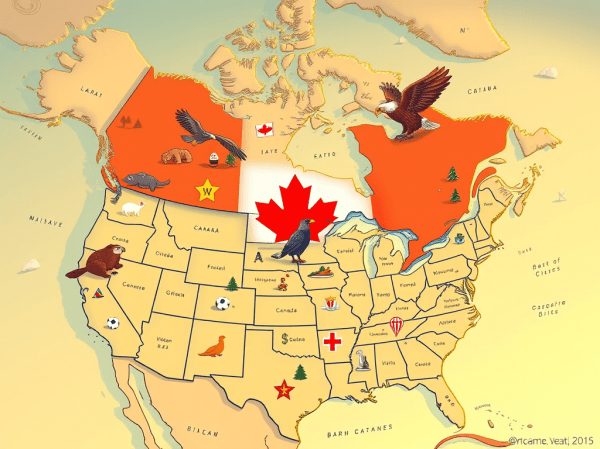
All this talk about borders does make a good Facebook meme though. You might have seen it – under the title “Problem Solved” there’s a map of North American with the Canadian border redrawn to extend down the east and west coast to include Washington, Oregon, California, New York, New Jersey and The New England States. Minnesota also gets to become part of the Great White North.

But – even if we took the suggestion seriously – does redrawing borders really solve any problem? Let’s assume that Canada really did become part of the US. It would be a “big, beautiful state,” according to Donald Trump. There have been a few that have pointed out that that state, with our 40 million potential voters, would probably vote overwhelmingly against Trump. Again, according to Canadian pollster Leger, only about 12% of Canadians support Trump.

While we’re redrawing the map of the world, even oceans can’t get in the way. Here in Canada, we are rushing to realign with Europe and its markets. The idea has even been floated that Canada should join the European Union.  Our new prime minister, Mark Carney, has said we have more in common with Europe and the values found there than we do with our American neighbors to the south.

But again, we use the faulty logic of Canadians, Americans or Europeans being identified as a cohesive bloc defined by a border. The recent rush of patriotism aside, Canadians rarely speak with one voice. For example, support for Trump runs highest in Alberta, where 23% of the province’s voters support him. He’s least popular in Canada’s Atlantic provinces, where support dips to 8%

Or let’s hop across the border to the state closest to me – Washington. If you take the state in aggregate, it is a blue state by almost 20 points. But again, that designation depends on an aggregation of votes within a territory defined by a fairly arbitrary border. If you look at Washington on a county-by-county basis, it’s hardly a cohesive voting bloc. Yes, the urban centers of Seattle and Olympia went heavily for Kamala Harris (74% in King County) but eastern Washington is a very different story. There in many counties, for every voter that chose Harris, 3 chose Trump. Ideologically, a resident of Pend Orielle County, Washington has much more in common with someone from Bonner County, which lies just across the border in Idaho, than they do with someone from Jefferson County, which lies on the west coast of Washington.

My point is this: given the polarization of our society, it’s almost impossible to draw a line anywhere on a map and think that it defines the people within that line in any identifiable way. Right now, nowhere on earth defines this more starkly than the United States. Because of the borders of the U.S. and the political structures that determine who leads the people within those borders, almost 2/3rds of Americans lives are being determined by a man they didn’t vote for. In fact, a big percentage of those 2/3rds are vehemently opposed to their President and his policies. How does that make any sense?

Borders were necessary where our survival was tied to a specific location and the resources to be found within that location. This forced a commonality on those that lived within those boundaries. They ate the same food, drank the same water, tilled the same fields, worked at the same factory, shopped at the same stores, attended the same church and their children went to the same schools.

But our digital world has lost much of that commonality. Online, we are defined by how we think, not where we live. This creates a new definition of “tribe” and, by extension, tribal territories. The divides between us now are based on differences in beliefs, not geographical obstacles. And the gap between our beliefs is getting wider and wider. This leaves the concept of a border threatened as something that is becoming increasingly anachronistic. Borders define something that is becoming less and less real and more and more problematic as the people who live in a state or country find less and less in common with their fellow citizens.  As Scottish journalist James Crawford says in his book, The Edge of the Plain: How Borders Make and Break Our World, the tension is usually felt more acutely on those arbitrary borders: “Wherever there are borders … that’s where you are going to find the most concentrated injustice.”

This redefining of our world as it decouples from the concept of “place” will place more and more pressure on the old idea of a border defining a place and a common ideology.  When there is less cohesivity between those living within the border than there is between ideologically aligned factions spread across the globe, we must wonder how to manage this given our current political structures based on the foundation of a common territory. This is particularly true for democracies, where you get a whipsaw backlash between the right and left as the two factions grow further and further apart. That prognosis is not a good one. As Steven Levitsky and Daniel Ziblatt said in their book How Democracies Die, “Democracies rarely survive extreme partisanship.”

The Problem with Leaders Who Make Stuff Up

Note: The writing of this post has been challenging because of the unpredictability of Trump’s “in the moment” trade policies. For instance, late yesterday Trump “paused’ the tariffs til March. If anything else is out of date by the time you read this – well – I tried.

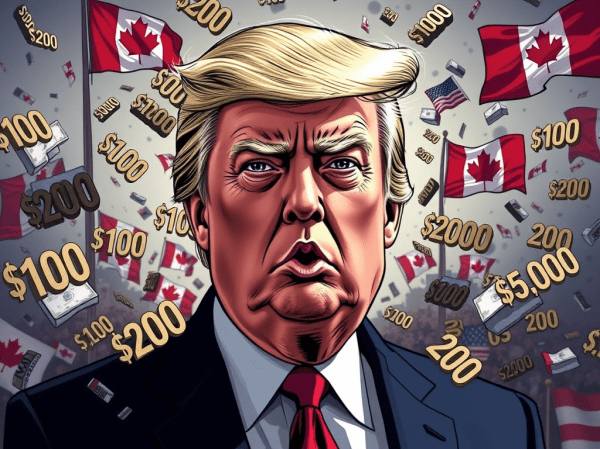
The US has a $100 Billion Trade Deficit with Canada

Correction: The US has a $200 Billion Trade Deficit with Canada

Correction: The US has a $250 Billion Trade Deficit with Canada.

Correction: It’s not a trade deficit. It’s a subsidy.

Correction: This isn’t about the economy, it’s about protecting America from the flood of transients and fentanyl coming across the Canadian border.

None of that is true. But they are all things that Donald Trump has said at one time or another. Those statements are his justification for a 25% tariff on Canada which he imposed this past weekend. And the reason the numbers keeps changing is that he just made them up. He pulled them out of thin air. Like his toupee, those numbers flew from the top of his head.

This is the way Trump operates. There is no need for the truth when you’re negotiating. And in the Trump Playbook, it’s all cool because it’s part of a negotiating strategy called “anchoring.”  Here’s the rational. Throw an outrageous number out there and it suddenly becomes the baseline for negotiating, rather than any starting point based on rationality or logic. It’s classic Trump.

If you’re in the US, you might say, “Good for Trump! If it gets a better deal for us, what’s the harm?”

There’s a lot of harm – billions of dollars’ worth – on both sides of the border. And it’s all completely useless. This bogus trade war is total waste of time that impacts real people and will cause extreme financial hardship.

And it’s all because Trump doesn’t believe in the truth.

Here are the facts. The US does have a trade deficit with Canada. Last year, according to TD Economics, it was about $45 Billion dollars. And a lot of that was due to exports of crude oil to the US to be refined in US refineries. That created US jobs. If you take that out of the mix, Canada actually has a trade deficit with the US, not the other way around.

The US trades with a lot of countries. We (in Canada) are the US’s second biggest trading partner, behind China. And – given that – the imbalance is pretty minimal. If you look at China, who is the biggest trading partner, the deficit is actually about $250 billion.

Also, it’s a deficit, not a subsidy. It’s simply a difference between what was exported to Canada and what was imported. No one in the American government is writing anyone in Canada a check. Calling it a subsidy is just wrong.

And the total amount of fentanyl seized trying to get across the US/Canadian border for most of last year? About 43 pounds. Compare that to the 21,100 pounds seized coming across the Mexican border. It’s not nothing, but it’s definitely not justification for starting a trade war.

So, let’s get to the harm done by Trump’s bluster, bullying and bullshit. Given that the US and Canada are each other’s biggest export markets, our economies are intricately intertwined. Putting a 25% tariff on Canadian imports, which has been met with a retaliatory set of tariffs on US exports to Canada, is like trying to do open heart surgery with a grenade. It’s insanely stupid. Everyone in the Canadian government gets that. Most people in the US government get that. Almost every economist in the world gets that. The governors of the 36 states that have Canada as their biggest export market get that. The only one who doesn’t get it is Donald Trump.

What is also sheer insanity is the fact that when Trump pulls these numbers when he’s in front of a camera, he backs himself into a corner. If he threatens something, he loses face when he doesn’t follow through with the threat. In Canada’s case, someone obviously told him about the whole crude oil thing, because he eventually dropped that tariff to 10%, making it marginally less stupid. But otherwise, he’s ploughing ahead with a trade war for no other reason than because he made some shit up.

The US and Canada does about $1 trillion in trade. And in that total, there are millions of small businesses on both sides of the borders. They don’t have the option of looking for another market. This will put them out of business. It will tear apart families. It will inflict untold suffering. All for absolutely no reason other than that Donald Trump wanted a meaty soundbite.

We can’t accept this, because to accept it is to normalize it. This is just one example of the real harm done when a leader loses all regard for anything resembling the truth and imposes policies on an ignorant whim. That harm will cause trillions of dollars in economic damage and untold personal suffering. We all deserve better – whether we’re Canadians, Americans or any other nationality.  We must demand better.