
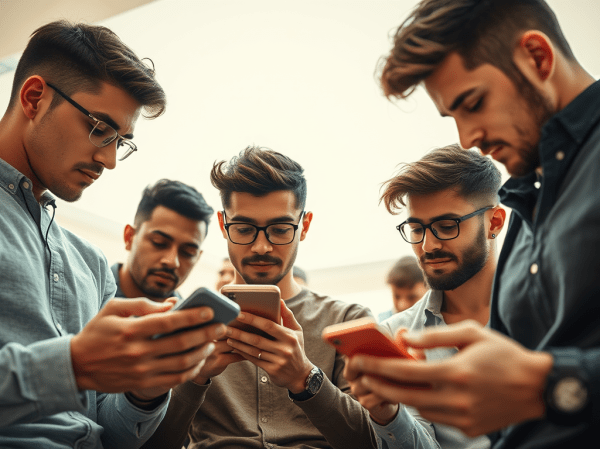
According to a study that was just released by the Movember Institute of Men’s Health, nearly two-thirds of 3000 young men surveyed in the US, the UK and Australia were regularly engaging with online masculinity influencers. They looked to them for inspiration on how to be fitter, more financially successful and how to increase the quantity and/or quality of their relationships.
Did they find what they were looking for?
It’s hard to say based on the survey results. While these young men said they found these influencers inspiring and were optimistic about their personal circumstances and the future social circumstances of men in general, they said some troubling things about their own mental health. They were less willing to prioritize mental health and were more likely to engage in risky health behaviors such as steroid use or ignoring their own bodies and pushing themselves to exercise too hard. These mixed signals seemed to come from influencers telling them that a man who can’t control is emotions is weak and is not a real man.
Also, not all the harm inflicted by these influencers was felt just by the men in their audience. Those in the study who followed influencers were more likely to report negative and limiting attitudes towards women and what they bring to a relationship. They felt that often women were being rude to them and that they didn’t have the same dating values as men.
Finally, men who followed influencers were almost twice as likely to value traits in their male friends such as ambition, popularity and wealth. They were less likely to look for trustworthiness or kindness in their male friends.
This brings us to a question. Why do young men need influencers to tell them how to be a better man? For that matter, why do any of us, regardless of age or sex, need someone to influence us? Especially if it’s someone who’s only qualification to dispense advice is that they happen to have a TikTok account with a million followers.
This is another unfortunate effect of social media. We have evolved to look for role models because to do so gives us a step up. Again, this made sense in our evolutionary past but may not do so today.
When we all belonged to a social group that was geographically bound together, it was advantageous to look at the most successful members of that group and emulate them. When we all competed in the same environment for the same resources, copying the ones that got the biggest share was a pretty efficient way to improve our own fortunes.
There was also a moral benefit to emulating a role model. Increasingly, as our fortunes relied more on creating better relationships with those outside our immediate group, things like trustworthiness became a behavior that we would do well to copy. Also, respect tended to accrue to the elderly. Our first role models were our parents and grandparents. In a community that depended on rules for survival, authority figures were another logical place to look for role models.
Let’s fast forward to today. Our decoupling with our evolutionarily determined, geographically limited idea of community has thrown several monkey wrenches into the delicate machinery of our society. Who we turn to as role models is just one example. As soon as we make the leap from rules based on physical proximity to the lure of mass influence, we inevitably run into problems.
Let’s go back to our masculinity influencers. These online influencers have one goal – to amass as many followers as possible. The economic reality of online influence is this: size of audience x depth of engagement = financial success. And how do you get a ton of followers? By telling them what they want to hear.
Let’s stare down some stark realities – well adjusted, mentally secure, emotionally mature, self-confident young males are less likely to desperately look for answers in online social media. There is no upside for influencers to go after this market. So they look elsewhere – primarily to young males who are none of the above things. And that audience doesn’t want to hear about emotional vulnerability or realistic appraisals of their dating opportunities. They want to hear that they can have it all – they can be real men. So the message (and the messenger) follows the audience, down a road that leads towards toxic masculinity.
Media provides a very distorted lens through which why might seek our new role models. We will still seek the familiar and the successful, but both those things are determined by what we see through media, rather than what we observe in real life. There is no proof that their advice or approach will pay off in the real world, but if they have a large following, they must be right.
Also, these are one-way “mentorships”. The influencers may know their audience in the aggregate, if only in terms of a market to be monetized, but they don’t know them individually. These are relationships without any reciprocity. There is no price that will be pad for passing on potentially harmful advice.
If there is damage done, it’s no big deal. It’s just one less follower.
 Out of My Gord