
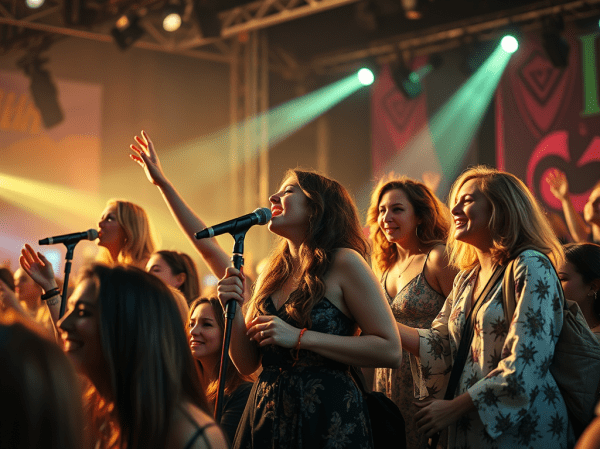
Lilith Fair: Building a Mystery, a new documentary released on Hulu (CBC Gem in Canada), is much more than a chronicle of a music festival. It’s a very timely statement on the both the strength and fragility of community.
Lilith Fair was the festival launched in 1997 by Canadian singer/songwriter Sarah McLachlan. It was conceived as a feminine finger in the eye of a determinedly misogynistic music industry. At the end of the 90’s, despite a boom in talented female singer songwriters (Tracy Chapman, Jewel, Paula Cole, Sheryl Crow, Natalie Merchant, Shawn Colvin, Lisa Loeb, Suzanne Vega and others too numerous to mention), radio stations wouldn’t run two songs by women back-to-back. They also wouldn’t book two women on the same concert ticket. The feeling, based on nothing other than male intuition, was that it would be too much “femininity” for the audience to handle.
McLachlan, in her charmingly polite Canadian way, said “Fudge you!” and launched her own festival. The first one, in 1997, played almost 40 concerts over 51 days across North America. The line-up was exclusively female – 70 singers in all playing on three stages. Almost every concert sold out. Apparently, there was an audience for female talent. Lilith Fair would be repeated in 1998 and 1999, with both tours being smashing successes.
The World needed Lilith Fair in the late 90s. It wasn’t only the music industry that was misogynistic and homophobic. It was our society. The women who played Lilith Fair found a community of support unlike anything they had ever experienced in their careers. Performers who had been feeling isolated for years suddenly found support and – more than anything – understanding.
It was women who made the rules and ran the Lilith Fair show. It was okay to perform when you were 8 months pregnant. It was okay to hold your baby onstage as you performed the group encore. It was okay to bring the whole family on tour and let the kids play backstage while you did your set. These were things that were – up until then – totally foreign in the music industry. It was the very definition of community – diverse people having something in common and joining together to deal from a position of strength.
But it didn’t happen overnight. It took a while – and a lot of bumping into each other backstage – for the community to gel. It also needed a catalyst, which turned out to be Amy Ray and Emily Saliers – officially known as the Indigo Girls. It was their out-going friendliness that initially broke the ice “because we were so gay and so puppy dog-like.”
This sense of community extended beyond the stage to the thousands who attended: men and women, old and young, straight and gay. It didn’t matter – Lilith Fair was a place where you would be accepted and understood. As documentary producer Dan Levy (of Schitt’s Creek fame) – who was 12 years old when he attended and was yet to come out – said, “Being there was one of the earliest memories I’ve had of safety.”
The unity and inclusiveness of Lilith Fair stood in stark contrast to another festival of the same era – Woodstock 99. There, toxic masculinity from acts like Limp Bizkit singer Fred Durst and Kid Rock, swung the vibe of the event heavily towards anarchy and chaos rather than community.
But while Lilith Fair showed the importance of community, it also showed how fragile it could be. The festival became the butt of jokes on late night television (including one particularly cringe-worthy one by Jay Leno about Paula Cole’s body hair) and those that sought to diminish its accomplishments and importance. Finally, at the end of the 1999 tour, McLachlan had had enough. The last concert was played in the rain at Edmonton, Alberta on August 31st.
McLachlan did try to revive Lilith Fair in 2010, but it was a complete failure. Whatever lightening in a bottle she had captured the first time was gone. The world had passed it by. The documentary didn’t dwell on this other than offering a few reasons why this might be. Perhaps Lilith Fair wasn’t needed anymore. Maybe it had done its job. After all, women had mounted some of the top tours of that time, including Taylor Swift, Madonna, Pink and Lady Gaga.
Or maybe it had nothing to do with the industry. Maybe it had everything to do with us, the audience.
The world of 1999 was very different place than the world of 2010. Community was in the midst of being redefined from those sharing a common physical location to those sharing a common ideology in online forums. And that type of community didn’t require a coming together. If anything, those types of communities kept us apart, staring at a screen – alone in our little siloes.
According to the American Time Use Survey, the time spent in-person socializing has been on a steady decline since 2000. This is especially true for those under the age of 25, the prime market for musical festivals. When we did venture forth to see a concert, we are looking for spectacle, not community. This world was moving too fast for the coalescing of the slow, sweet magic that made Lilith Fair so special.
At the end of the documentary, Sarah McLachlan made it clear that she’ll never attempt to bring Lilith Fair back to life. It was a phenomenon of that time. And that is sad – sad indeed.
 Out of My Gord