Wishful Thinking for 2024

I write this on the first day of 2024. My 2023 went out last night with a whimper. That was intentional. Given the global trauma inflicted on us over the past few years, I felt a muted goodbye was best. And I’d be lying if I said I was looking forward to 2024. I am approaching it with the same enthusiasm as a minefield I have to tiptoe to the other side of.

I never really got celebrating New Year’s. It is literally just another day. In my childhood, many eons ago, New Year’s Eve was significant only because it was the one day a year when we were able to get both potato chips and dip.  If I remember rightly French Onion was our dip of choice. And I got to stay up late. The glow of that perk had dimmed dramatically over the years.

I suppose New Year’s gives us a chance for a global reset, to put the past year behind us and promise to do better in the coming year. It’s like that moment right after you have sorted out your sock drawer, writ large. You go forward swearing that only matched and bundled socks will go there from this point forward. Of course, it’s probably only a matter of days before that first stray Nike athletic sock finds its way there and the portal to the alternative universe of mismatched socks is prised open, allowing them to proliferate in your drawer without restraint.

But still, a fellow can dream, can’t he?

So, in that spirit, I do have a few things I hope take place in 2024. They are not resolutions – more like wishful thoughts.

Less Toxic Social Media

Given that 2024 is a US election year and is promises to be the most bizarre one yet, I hope that social media starts to move away from the cesspool of misinformation it currently is. Digital Anthropologist Giles Crouch (a job title I wish I had pursued 30 years ago) thinks “the invisible hand” (subscription required) will start to move on social media. Recent lawsuits and more restrictive legislation are already impacting the profitability of the main platforms.

But more than that, usage is changing. People under 30 are using social media as a connector less and less, preferring to meet face to face IRL (in Real Life). And the toxic audience (yes, I’m talking about my generation) that made Facebook and X (the former Twitter) such a threat to democracy is aging out. Hopefully new social media players that fill this emerging gap will learn from past mistakes.

World Governments Getting Serious about Climate Change

I hope that 2023 will prove to be the tipping point for dealing with Climate Change, moving it from a right vs left campaign talking point to something that we actually start doing something about.  Here in Canada, I’ve seen a few promising signs. Our federal government has a nasty habit of setting climate targets and then completely ignoring them. The website Climateactiontracker lists our targets as “Almost Sufficient” but our overall action as “Highly Insufficient” (putting us behind the US, which is rated as “Insufficient”).

But after last summer, when much of our country was on fire, I think we might finally be getting some legislation with some teeth in it.  Canada just unveiled plans to phase out sales of gas-powered cars by 2035. We just have to make our government stick to that plan.

Make Conscientious Capitalism a Real Thing

My final hope is that this year, we start to find a way to make free markets, consumerism and capitalism work for a sustainable society rather than against it. History has proven that there is no more efficient engine for innovation than capitalism, but it has also shown that economist Milton Friedman was right: the only thing corporations care about (or should care about) is maximizing profit.

Maybe this year, we can find a way to make good behavior more profitable. And that puts the onus on us, the market. We have to make our purchase decisions with our future in mind. Ultimately, that future will follow the money and for that reason, the buck always stops with us. In a capitalist society, no one is more powerful than the consumer. We have to wield that power wisely.

It’s 2024. Good luck. I think we’ll need it.

(Image – Laura Billings – Creative Commons License)
AI, Creativity and the Last Beatle’s Song

I have never been accused of being a Luddite. Typically, I’m on the other end of the adoption curve – one of the first to adopt a new technology. But when it comes to AI, I am stepping forward gingerly.

Now, my hesitancy notwithstanding, AI is here to stay. In my world, it is well past the tipping point from a thing that exists solely in the domain to tech to a topic of conversation for everyone, from butchers to bakers to candlestick makers. Everywhere I turn now I see those ubiquitous two letters – AI. That was especially true in the last week, with the turmoil around Sam Altman and the “is he fired/isn’t he” drama at OpenAI.

In 1991 Geoffery Moore wrote the book Crossing the Chasm, looking at how technologies are adopted. He explained that it depends on the nature of the technology itself. If it’s a continuation of technology we understand, the adoption follows a fairly straight-forward bell curve through the general population.

But if it’s a disruptive technology – one that we’re not familiar with – then adoption plots itself out on an S-Curve. The tipping point in the middle of that curve where it switches from being skinny to being fat is what he called the “chasm.” Some technologies get stuck on the wrong side of the chasm, never to be adopted by the majority of the market.  Think Google Glass, for example.

There is often a pattern to the adoption of disruptive technologies (and AI definitely fits this description).  To begin with, we find a way to adapt it and use it for the things we’re already doing. But somewhere along the line, innovators grasp the full potential of the technology and apply it in completely new ways, pushing capabilities forward exponentially. And it’s in that push forward where all the societal disruption occurs. Suddenly, all the unintended consequences make themselves known.

This is exactly where we seem to be with AI. Most of us are using it to tweak the things we’ve always done. But the prescient amongst us are starting to look at what might be, and for many of us, we’re doing so with a furrowed brow. We’re worried, and, I suspect, with good reason.

As one example, I’ve been thinking about AI and creativity. As someone who has always dabbled in creative design, media production and writing, this has been top of mind for me. I have often tried to pry open the mystic box that is the creative process.

There are many, creative software developers foremost amongst them, that will tell you that AI will be a game changer when it comes to creating – well – just about anything.

Or, in the case of the last Beatle single to be released, recreating anything. Now and Then, the final Beatles song featuring the Fab Four, was made possible by an AI program created by Peter Jackson’s team for the documentary Get Back. It allowed Paul McCartney, Ringo Starr and their team of producers (headed by George Martin’s son Giles) to separate John Lennon’s vocals from the piano background on a demo tape from 1978.

One last Beatle’s song featuring John Lennon – that should be a good thing – right?  I guess. But there’s a flip side to this.

Let’s take writing, for example. Ask anyone who has written something longer than a tweet or Instagram post. What you start out intending to write is never what you end up with. Somehow, the process of writing takes its own twists and turns, usually surprising even the writer. Even these posts, which average only 700 to 800 words, usually end up going in unexpected directions by the time I place the final period.

Creativity is an iterative process and there are stages in that process. It takes time for it all to  play out. No matter how good my initial idea is, if I simply fed it in an AI black box and hit the “create” button, I don’t know if the outcome would be something I would be happy with.

“But,” you protest, “what about AI taking the drudgery out of the creative process? What if you use it to clean up a photo, or remove background noise from an audio recording (a la the Beatles single). That should free up more time and more options for you to be creative, right?”

That’s promise is certainly what’s being pitched by AI merchants right now. And it makes sense. But it only makes sense at the skinny end of the adoption curve. That’s where we’re at right now, using AI as a new tool to do old jobs. If we think that’s where we’re going to stay, I’m pretty sure we’re being naïve.

I believe creativity needs some sweat. It benefits from a timeline that allows for thinking, and rethinking, over and over again. I don’t believe creativity comes from instant gratification, which is what AI gives us. It comes from iteration that creates the spaces needed for inspiration.

Now, I may be wrong. Perhaps AI’s ability to instantly produce hundreds of variation of an idea will prove the proponents right. It may unleash more creativity than ever. But I still believe we will lose an essential human element in the process that is critical to the act of creation.

Time will tell. And I suspect it won’t take very long.

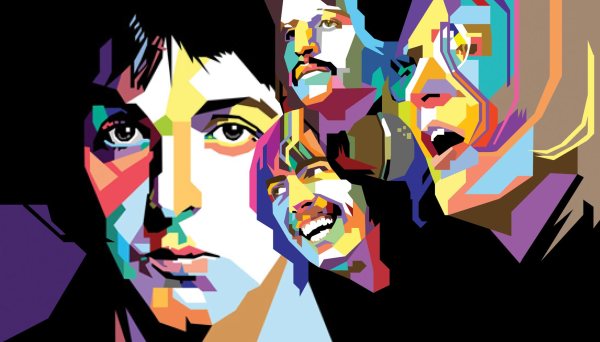
(Image – The Beatles in WPAP – wendhahai)

An Ex-SEO Looks Back at 25 Years of Google

Google turned 25 last week. I guess you could say it’s been a successful quarter century. The term “to Google” is synonymous with “to search”.

Maybe it’s been a little too successful. Currently the global Giga-gargantuan tech giant is facing a massive anti-trust trial that starts this week due to its dominance of online search. Depending on the outcome, Google’s search business might be torn up into much smaller Google-bits.

Who would have thought all this would happen? Not me. Not on that day back in 1998 when I first “Googled.” For a good chunk of the following two and a half decades, as a SEO (Search Engine Optimizer), I had a love-hate relationship with Google.

Let me share.

First, to understand the impact of Google, you had to understand the world of SEO pre-Google. Back then, there was the band of usual search suspects, which included Excite, Lycos, HotBot, Infoseek, and AltaVista. To be a successful SEO, you had to juggle visibility on all of them, because they each had a small chunk of the search audience.

Then, you also had the directories: Yahoo! and the Open Directory project. You couldn’t ignore them, because they were the most popular choice for finding sites. But they were clunky – both to use and to submit to.

Plus, most importantly for SEO (which wasn’t even commonly called SEO back then), you couldn’t really game the directories. But you could game AltaVista, Excite, Infoseek and the rest. Their algorithms depended exclusively on “on-the-page” elements – text and hidden text, metatags and titles. It was the heyday of keyword stuffing, cloaking and “doorway” pages – collectively called spam.

Then came Google – a game changer in more ways than one.

I, like every other user, used to rotate my searching through the available engines, because none of them was that good. Then someone pointed me to the fledgling Google. I think it might have still been hosted on the Stanford served at the time. From that day forward, I only used Google. It wasn’t that it was perfect, or even very good. It was just better than every other alternative.

And that’s when Google changed the game for SEOs. Suddenly, it was all about backlinks. It made us embrace the central concept of the Internet – the way information was connected together. And that made SEO a lot tougher.

It was tougher, but it was also a helluva lot of fun. As I now know, I had a front row seat for the historic rise of search. Today, Google has somewhere around 175 thousand employees. Back then, the numbers were in the low double digits. And I knew many of them, including Marissa Mayer (hire #21) and Craig Silverstein (hire #3). I – and every other SEO – used to hang out with Matt Cutts (the former head of the Spam team) when we were at the same speaking gigs together.

When SEOs got together for a conference in Silicon Valley, Google used to host something called the “Google Dance”. It was a little like inviting the foxes into the hen house, but there was a weird “frenemies” dynamic back then between SEOs and Google.  The first Google Dance I went to would have only been a few years after they moved out of Susan Wojcicki’s garage. I think it was probably their first office space in Mountainview. I remember both Larry Page and Sergey Brin were working the crowd. I just kept missing them. This pattern would continue. I never did meet them face-to-face. But I was in a meeting where Eric Schmidt (then the CEO) just happened to drop in and asked me “what (as a search marketer) I wanted from Google.” I wish my answer was historic, but I’m pretty sure it involved shrugging and mumbling.

That was the vibe back then. When you were on campus, you just never knew who you were going to see. Because of the research we used to do, we enjoyed a more symbiotic relationship than many SEOs had with Google. Our early research established just how valuable that Google top-of-page real estate was for advertisers and helped make the business case for Google AdWords.

I was also invited on more than one occasion to present to Google’s search team, the engineers who made the engine tick. I was lucky enough to talk to Marissa Mayer about the nuances of page design, or Peter Norvig (a literal rocket scientist who was Google’s head of research) about the role of AI in search. I was always in awe of the sheer wattage of brain power that could be found at 1600 Ampitheatre Parkway in Mountainview. A chat with Marissa Mayer was kind of like riding a roller coaster; you just hung on for dear life and tried to stay inside of your car.

My last time on the Google campus was a little over a decade ago, when I dropped out of the search business. But when this particular 25th birthday showed up on my newsfeed, it brought a lot of memories back. Some were a little traumatic (like when all your clients disappeared off of the first page due to an algorithmic update), but mostly they were good.

So happy birthday Google. And like they used to say where I grew up in rural Alberta – don’t get too big for your britches.

I Wish I Were Half the Person ChatGPT Thinks I Am

Yes, I’ve finally crawled aboard the journalist bandwagon about CHatGPT. The reason I’m waited so long is that I don’t really have any valid technical or professional perspective to add to the conversation. All I have is my own personal opinion.

So here it is, for what it’s worth.

For my first test, I wanted to ask ChatGPT about something where there would be a fair amount of information online but also something where I had the advantage of knowing the inside scoop, allowing me to judge the accuracy of its response. So I asked about the Golden Triangle – the outcome of eye tracking studies we did almost 20 years ago (I just had a minor internal meltdown when I did the mental math and realized that was two decades ago).

I have to admit, ChatGPT nailed it. It did an accurate and concise summary. I’m not sure I could have done better myself.

Google’s Golden Triangle, also known as the “Golden Triangle of Search,” refers to the top section of Google’s search engine results page (SERP) where the most relevant and highest-ranked search results are displayed. It is called the “golden triangle” because eye-tracking studies have shown that users tend to focus their attention on the top three results in the search results page, forming a triangular shape.

The concept of the Golden Triangle is important for search engine optimization (SEO) because it emphasizes the importance of ranking high in search results. Websites that appear in the Golden Triangle are more likely to receive clicks and traffic than those that appear lower on the page.

However, it’s worth noting that the layout of Google’s search engine results page has changed over the years, and the Golden Triangle may not be as relevant as it once was. Google now includes various types of results, such as featured snippets and knowledge panels, that may appear above or alongside the traditional organic search results. As a result, SEO strategies have evolved to include optimizing for these new types of results as well.

When I asked who discovered The Golden Triangle, ChatGPT accurately said it was a joint effort.

The concept of the Golden Triangle in relation to Google’s search engine results page (SERP) was not discovered by a single person, but rather through a combination of eye-tracking studies and data analysis conducted by various researchers and digital marketing professionals.

One of the earliest studies that examined how users interact with Google’s search results page was conducted by Enquiro Research in 2005. This study, titled “The Golden Triangle,” found that users tended to focus their attention on the top-left portion of the search results page, where the first few results were displayed.

Since then, other studies and analyses have confirmed the importance of the top section of the search results page, and the term “Golden Triangle” has become a widely used term in the SEO industry to describe this phenomenon.

For the record, the main players in identifying the pattern were Kevin Lee at DidIt, myself and my agency, Enquiro, EyeTools, the San Francisco eye-tracking consultants who conducted the first study and – in an independent study – Jakob Nielsen at the Nielsen Norman Group. It was Kevin and I who gave it the name The Golden Triangle, mere moments before we had to present the findings to a group at a search conference in San Jose.

So let’s try something a little less black and white. Let’s see how ChatGPT does when it has to freestyle a bit. I asked who I was.

The first paragraph was pretty accurate:

Gord Hotchkiss is a Canadian internet marketing and search engine optimization (SEO) expert. He is the CEO of a digital marketing agency called “Enquiro Search Solutions” which specializes in providing marketing and SEO services to businesses. Gord Hotchkiss is also a well-known speaker and author on the topics of online marketing and search engine optimization.

The second paragraph started a slight pumping of my ego, throwing in some accomplishments I either never did or else can’t remember doing:

Gord Hotchkiss has been involved in the online marketing industry for over 20 years and has worked with a wide range of clients, including Fortune 500 companies. He has written numerous articles on the topics of SEO, online marketing, and search engine technology for publications such as Search Engine Land, ClickZ, and MarketingProfs.

But in the third paragraph, ChatGPT definitely had me confused with someone else:

In addition to his work in the online marketing industry, Gord Hotchkiss is also a co-founder of the “Think Tank of Human Values in Business”, a non-profit organization that focuses on the intersection of business and ethics. He is known for his thought leadership in the industry and for advocating for ethical and sustainable business practices.

Okay, where the hell did that come from? It sounds extraordinarily cool and it’s something I would love to do, but it’s definitely not on my CV. As far as I’m aware, there is no such thing as the “Think Tank of Human Values in Business.” I wish there were, but there’s not.

I tried again. This time, ChatGPT seemed a little less sure of itself. The first sentence was somewhat correct, but after that ChatGPT seemed to manufacture my bio out of nothing but moonbeams and fairy dust. It said I was:

the CEO of a leading digital marketing agency, named “Digital Always Media Inc.” Gord is also a co-founder and chair of the “The Agents of Change” conference, an annual conference focused on helping businesses adapt to the ever-changing digital landscape.

Gord has written numerous articles and books on digital marketing and has been featured in several major media outlets, including The New York Times, The Wall Street Journal, and CNN.

I don’t know who this particular Gord Hotchkiss is, but I’d like to meet him. My AI doppelgänger is leaving me in the dust. I’d better get my shit together.

Or maybe ChatGPT can actually see into the future, showing me the person I just haven’t become yet.

What worries me is how easily ChatGPT constructed complete fabrications of who I was that sounded perfectly plausible. If I didn’t know myself better, I would have simply accepted it as fact. And that – unfortunately – is what we tend to do. We don’t analyze new information and determine if it’s right or wrong. Our default is to believe it’s true until proven otherwise.

It’s this human tendency that flags the real danger with ChatGPT. And, for that reason, I have some more digging to do.

Maybe this other Gord Hotchkiss guy can give me a hand. He sounds wicked smart.

(Image by Brian Penny — Pixabay license)

The Ten Day Tech Detox

I should have gone cold turkey on tech. I really should have.

It would have been the perfect time – should have been the perfect time.

But I didn’t. As I spent 10 days on BC’s gorgeous sunshine coast with family, I also trundled along my assortment of connected gadgets. 

But I will say it was a partially successful detox. I didn’t crack open the laptop as much as I usually do. I generally restricted use of my iPad to reading a book.

But my phone – it was my phone, always within reach, that tempted me with social media’s siren call.

In a podcast, Andrew Selepak, social media professor at the University of Florida, suggests that rather than doing a total detox that is probably doomed to fail, you use vacations as an opportunity to use tech as a tool rather than an addiction.

I will say that for most of the time, that’s what I did. As long as I was occupied with something I was fine. 

Boredom is the enemy. It’s boredom that catches you. And the sad thing was, I really shouldn’t have been bored. I was in one of the most beautiful places on earth. I had the company of people I loved. I saw humpback whales – up close – for Heaven’s sake. If ever there was a time to live in the moment, to embrace the here and now, this was it. 

The problem, I realized, is that we’re not really comfortable any more with empty spaces – whether they be in conversation, in our social life or in our schedule of activities. We feel guilt and anxiety when we’re not doing anything.

It was an interesting cycle. As I decompressed after many weeks of being very busy, the first few days were fine. “I need this,” I kept telling myself. It’s okay just to sit and read a book. It’s okay not to have every half-hour slot of the day meticulously planned to jam as much in as possible.

That lasted about 48 hours. Then I started feeling like I should be doing something. I was uncomfortable with the empty spaces.

The fact is, as I learned – boredom always has been part of the human experience. It’s a feature – not a bug. As I said, boredom represents the empty spaces that allow themselves to be filled with creativity.  Alicia Walf, a neuroscientist and a senior lecturer in the Department of Cognitive Science at Rensselaer Polytechnic Institute, says it is critical for brain health to let yourself be bored from time to time.

“Being bored can help improve social connections. When we are not busy with other thoughts and activities, we focus inward as well as looking to reconnect with friends and family. 

Being bored can help foster creativity. The eureka moment when solving a complex problem when one stops thinking about it is called insight.

Additionally, being bored can improve overall brain health.  During exciting times, the brain releases a chemical called dopamine which is associated with feeling good.  When the brain has fallen into a predictable, monotonous pattern, many people feel bored, even depressed. This might be because we have lower levels of dopamine.”

That last bit, right there, is the clue why our phones are particularly prone to being picked up in times of boredom. Actually, three things are at work here. The first is that our mobile devices let us carry an extended social network in our pockets. In an article from Harvard, this is explained: “Thanks to the likes of Facebook, Snapchat, Instagram, and others, smartphones allow us to carry immense social environments in our pockets through every waking moment of our lives.”

As Walf said, boredom is our brains way of cueing us to seek social interaction. Traditionally, this was us getting the hell out of our cave – or cabin – or castle – and getting some face time with other humans. 

But technology has short circuited that. Now, we get that social connection through the far less healthy substitution of a social media platform. And – in the most ironic twist – we get that social jolt not by interacting with the people we might happen to be with, but by each staring at a tiny little screen that we hold in our hand.

The second problem is that mobile devices are not designed to leave us alone, basking in our healthy boredom. They are constantly beeping, buzzing and vibrating to get our attention. 

The third problem is that – unlike a laptop or even a tablet – mobile devices are our device of choice when we are jonesing for a dopamine jolt. It’s our phones we reach for when we’re killing time in a line up, riding the bus or waiting for someone in a coffee shop. This is why I had a hard time relegating my phone to being just a tool while I was away.

As a brief aside – even the term “killing time” shows how we are scared to death of being bored. That’s a North American saying – boredom is something to be hunted down and eradicated. You know what Italians call it? “Il dolce far niente” – the sweetness of doing nothing. Many are the people who try to experience life by taking endless photos and posting on various feeds, rather than just living it. 

The fact is, we need boredom. Boredom is good, but we are declaring war on it, replacing it with a destructive need to continually bath our brains in the dopamine high that comes from checking our Facebook feed or latest Tiktok reel. 

At least one of the architects of this vicious cycle feels some remorse (also from the article from Harvard). “ ‘I feel tremendous guilt,’ admitted Chamath Palihapitiya, former Vice President of User Growth at Facebook, to an audience of Stanford students. He was responding to a question about his involvement in exploiting consumer behavior. ‘The short-term, dopamine-driven feedback loops that we have created are destroying how society works,’ “

That is why we have to put the phone down and watch the humpback whales. That, miei amici, is il dolci far niente!

Of Streaming, Satellites and Sunsets

I’ve been out of the loop for the last 3 weeks as I actually did life stuff. Today, looking to get back into the loop so I could write a column about media, I ran through several emails from Mediapost to see what y’all have been talking about in my absence.

Two caught my eye. The first was a Media Insider from Dave Morgan titled “Cross-Training for Cross-Platform TV”. Dave’s jist, paraphrasing heavily, is that to get a decent audience for high engagement video ads, we’ll have to get comfortable with fishing in a whole bunch of smaller ponds rather than casting our net in a single ocean.

That checks out. As our entertainment choices and information sources keep multiplying exponentially, it’s natural that the big blocks of purchasable attention advertisers used to rely on are getting split into smaller and smaller chunks. This is certainly true for video-based media. In the column, Morgan said, “the next decade will mean navigating a mix of linear and streaming TV channels and platforms to have any hope of efficiently reaching audiences at scale.”

Now, I don’t pretend to know anything about buying video ads –Mr. Morgan certainly has forgotten more than I’ll ever know – but I do know this. I recently caught up on a network series through getting it on demand on the network’s streaming platform. The ad execution was abysmal, to say the least. The creative, the delivery and the viewer experience was excruciating to sit through. I literally hated any brands that placed ads through the channel by the time I was done.

If I had to guess, I would say that this was treated like an advertising bargain bin – a last minute throw in for network advertisers that no one really thought or cared about. Some of the creative wasn’t even designed for the platform. The images didn’t execute correctly on the screen (tablet) I was watching it on. Whatever it cost these advertisers for this exposure, it was completely wasted on this audience of one.

The other item was more of a WTF moment – a column by Mediapost staff writer Wayne Friedman. In the column – “Look Into The Night Sky – You Might See An Ad For Car Insurance” – Friedman tells of a recent study that “looked at the possibility of a ‘space advertising’ mission, where one could advertise in the twilight over a particular urban area or city.”

This would be done by launching a number of satellites into a station orbit and letting them literally unfurl an advertising banner every night just after sunset.

Again, WTF. Do I want an ad popping up after a spectacular sunset telling me said sunset was brought to me by the MyPillow guy? No.

And knowing that advertisers can be a little obtuse sometimes, I’ll repeat – a little more emphatically – “F*&k NO!”

I had just a little taste of this the last week when I happened to see a Starlink train head across the night sky above me. If you haven’t seen this, it’s a perfect row of SpaceX Starlink satellites in orbit that can be seen in just the right conditions. In my case, there were probably about 50 satellites in a row.

Was it cool? Sure. But it was also unsettling. The night sky is supposed to be messy and spectacular, not precisely lined up like a set of Christmas lights. It was disconcerting to see something so obviously man-made encroaching on nature’s firmament.

Look advertisers, I get that it’s getting harder and harder to get our attention with your ads. That’s probably because we don’t want to give it to you, and – increasingly – we don’t have to. If that sounds harsh, it’s because you’ve burnt out any goodwill you might have had by sledgehammering us over the head with poorly executed, ham-fisted ads delivered ad-nauseum without any concern for our experience on the receiving end. That will be true on any platform you choose to deliver those ads on.

So, to circle back to Dave Morgan’s message, if you’re going to do it, at least try to do it well.

And finally, just so we’re clear, stay the hell out of my sunset!

Crisis? What Crisis?

Never let a good crisis go to waste.

— Winston Churchill, approximately 1944

Crisis? What crisis?

— Supertramp album, 1975

I’ll be honest. I was struggling to finish this column. It was actually heading for the digital dustbin when I happened on MediaPost Editor in Chief Joe Mandese’s excellent commentary, “It’s Time For A Change, And By That, I Mean A Crisis.”

Much as I respect Joe, whose heart and head are definitely in the right place, I think we may have to agree to disagree. He says,

“What the ad industry really needs to do is organize a massive global campaign to change the way people think, feel and behave about the climate — moving from a not-so-alarmist ‘change’ to an ‘our house is on fire’ crisis.”

Joe Mandese – Mediapost

But exactly how do you make people pay attention to an existential crisis? How do you communicate threat?

The problem may be that we can’t. It may simply not be possible.

That was crystallized in the scariest way possible recently on the U.K.’s GB News channel, where an anchor desperately tried to make light of the meteorologist’s dire predictions of potential fatalities ahead of an unprecedented heat wave in England.

Weather expert John Hammond issues a warning over the ‘extreme’ conditions expected next week – GB News – July 14, 2022

The Basics of Communication

There are typically four parts to any communication model: the sender, the message, the medium and the receiver. Joe’s post said the problem may be in the message — it hasn’t been urgent enough. I disagree. I think the problem is at the end of the chain, with the receiver. The message is already effective. It’s just not getting through.

In online course on business communications, Lumen Learning lists a number of potential barriers to communication. I’d like to focus on three that were mentioned: filtering, bias and lack of trust.

The first one is the big one, but the last two contribute. And they all lie on the receiving end of the communication model, with the receiver, who just doesn’t want to receive the message.

The problem, most of all, is one of entitlement.

I’m not pointing fingers — unless I’m pointing at myself. I live a privileged lifestyle. I don’t think I’ve let the message, with all its implications, fully get through to me, because to accept that message is unimaginably depressing and scary. I fully admit I’m filtering, because I feel overwhelmed. Climate change has gone from being an inconvenient truth to something we’re determined to ignore, even if it kills us.

If I count all the people whose lifestyle I have some understanding of, it’s aboiut a thousand people. I think an overwhelming majority of them get the massive implications of climate change.  Of all those people, I can count on the fingers of one hand (maybe two) those who have truly made substantive changes in their lifestyle to really address climate change. That’s — at best – .5% to 1% of everyone I know.

 I’m not judging. I haven’t made the changes required myself. Not really.

I have done all 10 of the UN’s suggestions of 10 ways you can help fight climate crisis to one extent or another. But I can’t help feeling that even doing all 10 is like peeing on a forest fire. Given the high stakes we’re talking about here, I really don’t feel I’m making a meaningful difference.  I haven’t sold either of my two vehicles, I haven’t stopped planning trips that involve air travel, or moved into a more energy- efficient house. I still eat red meat (although not as much as before).

The fact is, when a message is trying to tell us that our inevitable future means we’re going to have less than we have today, we will ignore that message. 

I get it. I truly do. I started and stopped this column several times because it depressed the hell out of me. But I am now determined to plow through to the end, so let’s talk about entitlement. We use this word a lot, especially lately. But what does it mean? It means we believe we have the right to the lifestyle we currently have.

But there’s no one to give us that right. Our lifestyle isn’t granted to us by anyone. If we live a good life, as I do, we like to think that it’s due to our hard work and wise choices. That’s why we’re entitled to everything we have. But if we rationally pick apart our success, we find that plain old dumb luck plays a bigger role than we’d like to admit. In my case, I was born a white, anglo male in one of the richest countries in the world. I came out of the womb with advantages most of the world can only dream of.

Entitlement is actually the result of a cognitive bias – or rather, a bundle of cognitive biases that include loss aversion and endowment effect. It’s a quirk in our mental wiring. It’s a mistaken belief – an illusion. I’m not owed the life I have. I have that life because of a convergence of lucky factors, and it appears my luck may be running out. There is no arbitrator of privilege that has granted North America the right to be the single biggest consumer of natural resources (per capita) in the world. But we seem prepared gamble our planet away on this mistaken belief about our own entitlement.

In psychology, there’s something called the Psychological Entitlement Scale. It measures the strength of this cognitive bias. A recent study showed just how strongly this was correlated with our ability to ignore messaging that we didn’t want to hear because we felt it interfered with our “rights.” In this case, the message was about health guidelines during COVID-19. And we all know how that turned out. Even something as ridiculously simple as wearing a face mask whipped up a shitstorm of entitlement. 

This is not a problem of messaging. We are not going to be persuaded to do the right thing.  We are being asked to give up too much.

Climate change can only be addressed by two things: legislation and a mobilization of the market. We cannot be left with the option of doing nothing — or too little — any longer.

We must be forced to be better. We need more massive omnibus bills, like the recent Manchin-Schumer deal, that mobilize industry and incentivize better behavior. I only hope my own Canadian government follows suit soon.

Much as I wish Joe Mandese were right that by turning up the intensity of the messaging, we could persuade consumers to really move the needle on the climate threat, I don’t think this would work. It’s not that we don’t know about climate change. It’s that we can’t let ourselves care, because our entitlement won’t let us.

Putting a Label on It

We know that news can be toxic. The state of affairs is so bad that many of the media sources we rely on for information have been demonstrated to be extremely harmful to our society. Misinformation, in its many forms, leads to polarization, the destruction of democracy, the engendering of hate and the devaluing of social capital. It is – quite likely – one of the most destructive forces we face today.

To make matters worse, a study conducted by Ben Lyons from the University of Utah found that we’re terrible at spotting misinformation, yet many of us think we can’t be fooled. Seventy five percent of us overestimate our ability to spot fake news by as much at 22 percentile points. And the more overconfident we are, the more likely we are to share false news.

Given the toxic effects of unreliable news reporting, it was only natural that – sooner or later – someone would come up with the logical idea of putting a warning label on it. And that’s exactly what NewsGuard does. Using “trained journalists” to review the most popular news platforms (they say the cover 95% of our news source engagement) they give each source a badge, ranging from green to red, showing its reliability. In a recent report, they highlighted some of the U.S.’s biggest misinformation culprits (NewsMax.com, TheGatewayPundit.com and the Federalist.com) and some of the sources that are most reliable (MSNBC.com, NYTimes.com, WashingtonPost.com and NPR.com).

But here’s the question. Just because you slap a warning label on toxic news sources, will it have any effect? That’s exactly what a group of researchers at New York University’s Center for Social Media and Politics wanted to find out. And the answer is both yes and no.

Kevin Aslett, lead author of the paper, said,

“While our study shows that, overall, credibility ratings have no discernible effect on misperceptions or online news consumption behavior of the average user, our findings suggest that the heaviest consumers of misinformation — those who rely on low-credibility sites — may move toward higher-quality sources when presented with news reliability ratings.”

Kevin Aslett, NYU Center for Social Media and Politics

This is interesting. In essence, this study is saying that if you run into the odd unreliable news source and you see a warning label, it will probably have no effect. But if you make a steady diet of unreliable news and see warning label after warning label, it may eventually sink in and cause you to improve your sources for news consumption. This seems to indicate warning labels might have a cumulative effect. The more you’re exposed to them, the more effective they become.

We are literally of two minds – one driven by ration and one by emotion. Warning labels try to appeal to one mind, but our likelihood to ignore them comes from our other mind. The effectiveness of these labels depends on which mind is in the driver’s seat. There is a wide spectrum of circumstances that may bring you face to face with a warning label and the effectiveness of that label may depend on some sort of cognitive “Russian roulette” – a game of odds to determine if the label will impact you. If this is the case, it makes sense that the more you see a warning label, the greater the odds that – at least one time – you might be of a mind to pay attention to it.

Up in Smoke

This might help explain the so-so track record of warning labels in other arenas. Probably the longest trial run of warning labels has been on cigarette packages. The United States started requiring these labels in 1966. In 2001, my own country – Canada – was the first country in the world to introduce graphic warning labels; huge and horrible pictures of the effects of smoking plastered across every pack of smokes.

This past week, we in Canada went one better. Again, we’re going to be the first country in the world to require warning labels on each and every cigarette. Apparently, our government has bought into the exposure effect of warning labels – more is better.

It seems to be working. In 1965 the smoking rate in Canada was 50%. In 2020 it was 13%.

But a recent study (Strong, Pierce, Pulvers et al) showed that if smokers aren’t ready to quit, warning labels may have “decreased positive perceptions of cigarettes associated with branded cigarette packs but without clearly increasing health concerns. They also increased quitting cognitions but did not affect either cigarette cessation or consumption levels.”

Like I said – just because you get through to one mind doesn’t mean you’ll have any luck with the other.

Side Effects May Include….

Perhaps the most interesting case of warnings in the consumer marketplace are with prescription drugs. Because the United States is one of the few places in the world (New Zealand is the other one) that can advertise prescription drugs direct to the consumer, the Food and Drug Administration has mandated that ads must include a fair balance of rewards and risks. Advertisers being advertisers, the rewards take up much of the ad, with sunlight infused shots of people enjoying life thanks to the miracles of the drug in question. But, at the end, there is a laundry list of side effects read in a voice over, typically at breakneck pace in a deadly monotone.

It’s this example that highlights perhaps the main issue with warning labels; they require a calculation of risk vs reward. If this wasn’t true, we wouldn’t need a warning label. Nobody needs to tell us not to drink battery acid. That’s all risk and no reward. If there’s a label on it, it’s probably on something we want to do but know we shouldn’t.

A study of the effectiveness of these warnings in DTC prescription ads found they become less effective because of something called argument dilution effect. Ads that only include the worst side effects are more effective than ads that include every potential side effect, even the minor ones. Hence the laundry list. If a drug could cause both sudden heart attacks and minor skin rashes, our mind tends to let these things cancel each other out.

This effect is an example of the heuristic nature of our risk vs reward decision making. It needs to operate quickly, so it relies on the irrational, instinctive part of our neural circuitry. We don’t take the time to weigh everything logically – we make a gut call. Marketers know the science behind this and continually use it to their advantage.

Warning labels are an easy legislative fix to try to plug this imperfectly human loophole. It seems to make sense, but it doesn’t really address the underlying factors. Given enough time and enough exposure, they can shift behaviors, but we shouldn’t rely on them too much.

Sarcastic Much?

“Sarcasm is the lowest form of wit, but the highest form of intelligence.”

Oscar Wilde

I fear the death of sarcasm is nigh. The alarm bells started going when I saw a tweet from John Cleese that referenced a bit from “The Daily Show.”  In it, Trevor Noah used sarcasm to run circles around the logic of Supreme Court Justice Brett Kavanaugh, who had opined that Roe v. Wade should be overturned, essentially booting the question down to the state level to decide.

Against my better judgement, I started scrolling through the comments on the thread — and, within the first couple, found that many of those commenting had completely missed Noah’s point. They didn’t pick up on the sarcasm — at all. In fact, to say they missed the point is like saying Columbus “missed” India. They weren’t even in the same ocean. Perhaps not the same planet.

Sarcasm is my mother tongue. I am fluent in it. So I’m very comfortable with sarcasm. I tend to get nervous in overly sincere environments.

I find sarcasm requires almost a type of meta-cognition, where you have to be able to mentally separate the speaker’s intention from what they’re saying. If you can hold the two apart in your head, you can truly appreciate the art of sarcasm. It’s this finely balanced and recurrent series of contradictions — with tongue firmly placed in cheek — that makes sarcasm so potentially powerful. As used by Trevor Noah, it allows us to air out politically charged issues and consider them at a mental level at least one step removed from our emotional gut reactions.

As Oscar Wilde knew — judging by his quote at the beginning of the post — sarcasm can be a nasty form of humor, but it does require some brain work. It’s a bit of a mental puzzle, forcing us to twist an issue in our heads like a cognitive Rubik’s Cube, looking at it from different angles. Because of this, it’s not for everyone. Some people are just too earnest (again, with a nod to Mr. Wilde) to appreciate sarcasm.

The British excel at sarcasm. John Cleese is a high priest of sarcasm. That’s why I follow him on Twitter. Wilde, of course, turned sarcasm into art. But as Ricky Gervais (who has his own black belt in sarcasm) explains in this piece for Time, sarcasm — and, to be more expansive, all types of irony — have been built into the British psyche over many centuries. This isn’t necessarily true for Americans. 

“There’s a received wisdom in the U.K. that Americans don’t get irony. This is of course not true. But what is true is that they don’t use it all the time. It shows up in the smarter comedies but Americans don’t use it as much socially as Brits. We use it as liberally as prepositions in everyday speech. We tease our friends. We use sarcasm as a shield and a weapon. We avoid sincerity until it’s absolutely necessary. We mercilessly take the piss out of people we like or dislike basically. And ourselves. This is very important. Our brashness and swagger is laden with equal portions of self-deprecation. This is our license to hand it out.”

Ricky Gervais – Time, November 9, 2011

That was written just over a decade ago. I believe it’s even more true today. If you chose to use sarcasm in our age of fake news and social media, you do so at your peril. Here are three reasons why:

First, as Gervais points out, sarcasm doesn’t play equally across all cultures.  Americans — as one example — tend to be more sincere and, as such, take many things meant as sarcastic at face value. Sarcasm might hit home with a percentage of an U.S. audience, but it will go over a lot of American heads. It’s probably not a coincidence that many of those heads might be wearing MAGA hats.

Also, sarcasm can be fatally hamstrung by our TL;DR rush to scroll to the next thing. Sarcasm typically saves its payoff until the end. It intentionally creates a cognitive gap, and you have to be willing to stay with it to realize that someone is, in the words of Gervais, taking the “piss out of you.” Bail too early and you might never recognize it as sarcasm. I suspect more than a few of those who watched Trevor Noah’s piece didn’t stick through to the end before posting a comment.

Finally, and perhaps most importantly, social media tends to strip sarcasm of its context, leaving it hanging out there to be misinterpreted. If you are a regular watcher of “The Daily Show with Trevor Noah,” or “Last Week Tonight with John Oliver,” or even “Late Night with Seth Meyers” (who is one American that’s a master of sarcasm), you realize that sarcasm is part and parcel of it all. But when you repost any bit from any of these shows to social media, moving it beyond its typical audience, you have also removed all the warning signs that say “warning: sarcastic content ahead.” You are leaving the audience to their own devices to “get it.” And that almost never turns out well on social media.

You may say that this is all for the good. The world doesn’t really need more sarcasm. An academic study found that sarcastic messages can be more hurtful to the recipient than a sincere message. Sarcasm can cut deep, and because of this, it can lead to more interpersonal conflict.

But there’s another side to sarcasm. That same study also found that sarcasm can require us to be more creative. The mental mechanisms you use to understand sarcasm are the very same ones we need to use to be more thoughtful about important issues. It de-weaponizes these issues by using humor, while it also forces us to look at them in new ways.

Personally, I believe our world needs more Trevor Noahs, John Olivers and Seth Meyers. Sarcasm, used well, can make us a little smarter, a little more open-minded, and — believe it or not — a little more compassionate.

Two Timely Stories from my Royal 10 Typewriter

I love old typewriters. My favourite is a 1917 Royal Typewriter 10, made by the Royal Typewriter Company of New York, New York. It is a beautiful piece of engineering, with intricate and mysterious mechanical connections that are revealed by two bevelled glass windows in each side. It was made in a factory in Hartford, Connecticut. Ian Fleming wrote his Bond books on a Royal. Ernest Hemingway also used one.

My Royal 10 is pretty beaten up. There are parts missing and it’s far from functional. But that only adds to its gravitas and charm. It sits beside me in a special place in my office as I write this on an Apple MacBook Pro, circa 2018 – two examples of technical elegance separated by a century. I suspect – though – that the MacBook won’t be on anyone’s desk in 2120.

Last week, I told you about the Lost Generation. If I had been part of that generation, I would probably be writing this on that typewriter.  Today, I wonder what other stories it might have to tell. With that, I’d like to pick up where I left off last week and share two stories that I like to believe lie buried in the Royal 10’s mechanical magnificence. I hope they are two stories that have something to relate to us in our current reality.

First, the Royal 10 was introduced in 1914, the start of World War 1. It was Royal’s first “upright” design and, along with the Underwood 5, it would become a trusted workhorse for many, including news reporters. Much of the coverage of the war, and later, the Spanish Flu epidemic of 1918 – 1920, was probably hammered out on a Royal 10.

But here’s the interesting thing. The 10 represented a pinnacle of typewriter design. Other than cosmetic changes, the inner workings of typewriters didn’t change for decades after its introduction. That meant that most of the major developments of the next 20 years would also be written on a typewriter like the one that sits in my office.

As the world rolled out the ‘Teens and into the Twenties, my Royal was one of the few things that didn’t change. The double gut punch of a global war and a massive pandemic rocked the world back on its feet, but not for long. After a brief but deep recession in 1920 and 21, a global explosion of creativity and enterprise transformed everything. The Roarin’ Twenties ushered in technological revolutions on multiple fronts, including the automobile, aviation, movies, radio, telephones, electricity and medicine.

Society was radically transformed in the Twenties. Jazz and speakeasies flourished. Women marched for their rights. Culture was transformed by writers and artists that were both more liberal in their themes and more apt to criticize hypocrisy and greed. Art deco became the dominant design movement of the decade.

The story is this: after 6 years of devastation and destruction, the world entered 8 years of explosive creativity and change.

That brings me to the second story. The Royal Typewriter Company had to shift gears in 1940. The factory in Hartford no longer built typewriters. They began manufacturing machine guns, rifles, bullets, propellers and spare parts for airplane engines as part of American industry’s support of the war effort. They wouldn’t go back to building typewriters until September 1945.

You, like me, may have become tragically addicted to pandemic models that show the importance of flattening the curve. These models have one thing in common, a flat horizontal line that represents our current capacity to handle the crisis.

But is that line necessarily flat? Just like the Royal Company in 1940, industry is once again ramping up to defeat a common enemy. This time, it’s face masks instead of machine guns; ventilators instead of propellers. The output is different, but the motivation is the same: we can beat this thing.

Again, history may provide us a little perspective. In 1939, the US was the furthest thing imaginable away from being ready to go to war. General George Patton was given command of a unit of 325 tanks that were desperately in need of nuts and bolts in order to keep working. After unsuccessfully trying to order through official channels he ended up ordering from a Sears catalogue and paying for them himself. The American army was so short of equipment that it would borrow Good Humor ice cream trucks to stand in as tanks when they practiced military manoeuvres.

Despite this, by 1945, American industry had produced two-thirds of all the weapons and equipment used by the Allies to win the war. That happened because thousands of companies like the Royal Typewriter Company unified behind a common goal. Chief Executives worked for a $1.00 a year. Volunteer laborers worked double shifts. Factories retooled their production lines. Capacity expanded exponentially when it had to because it’s not a static flat line.

I think my Royal 10 is trying to tell me two things. One I need to remember going into this crisis, and one for when we eventually come out of it.

First, we can do amazing things in the face of incredible adversity when we have to. We just need a little time to be our best.

And secondly, humans tend to bounce higher when we’re on the rebound from adversity.