Shari Thurow Talking Smack about Eye Tracking

You know, if I didn’t know better I’d say that Shari Thurow had issues with me and eye tracking. I ran across a column a couple of weeks ago where she was talking about the niches that SEO’s are carving out for themselves and she mentioned eye tracking specifically. In fact she devoted a whole section to eye tracking. Now, it’s pretty hard not to take it personally when Enquiro is the only search marketing company I know that does extensive eye tracking. We’re the only ones I’m aware of that have eye tracking equipment in-house. So when Shari singles out eye tracking and warns about using the results in isolation…

That brings me to my favorite group of SEO specialists: search usability professionals. As much as I read and admire their research, they, too, often don’t focus on the big picture.

…I’m not sure who else she might be talking about.

I’ve been meaning to post on this for awhile but I just didn’t get around to it. I’m on the road today and feeling a little cranky so what the heck. It’s time to respond in kind. First, here’s Shari’s take on on eye tracking and SEO.

Eye-tracking data is always fascinating to observe on a wide variety of Web pages, including SERPs (define). As a Web developer, I love eye-tracking data to let me know how well I’m drawing visitors’ attention to the appropriate calls to action for each page type.

Nonetheless, eye-tracking data can be deceiving. Most search marketers understand the SERP’s prime viewing area, which is in the shape of an “F.” Organic or natural search results are viewed far more often than search engine ads are, and (as expected) top, above-the-fold results are viewed more often than the lower, below-the-fold results. Viewing a top listing in a SERP isn’t the same as clicking that link and taking the Web site owner’s desired call to action.

Remember, usability testing isn’t the same as focus groups and eye tracking. Focus groups measure peoples’ opinions about a product or service. Eye-tracking data provide information about where people focus their visual attention. Usability testing is task-oriented. It measures whether participants complete a desired task. If the desired task isn’t completed, the tests often reveal the many roadblocks to task completion.

Eye-tracking tests used in conjunction with usability tests and Web analytics analysis can reveal a plethora of accurate information about search behavior. But eye-tracking tests used in isolation yield limited information, just as Web analytics and Web positioning data yield limited (and often erroneous) information.

Okay Shari, you didn’t mention me or Enquiro by name but again, who else would you be talking about?

Actually, Shari and I agree more than we disagree here. I agree that no single data source or research or testing approach provides all the answers, including eye tracking. However, eye tracking data adds an extraordinarily rich layer of data to common usability testing. When Shari says eye tracking is not the same as usability testing, she’s only half right. As Shari points out, eye tracking combines very well with usability testing but in many cases, can be overkill. Usability testing is task oriented. There’s no reason why eye tracking studies can’t be task oriented as well (most of ours are). The eye tracking equipment we use is very unobtrusive. It virtually like interacting with any computer in a usability lab. In usability testing you put someone in front of the computer with the task and asked them to complete the task. Typically you record the entire interaction with software such as TechSmith’s Morae. After you can replay the session and watch where the cursor goes. Eye tracking can capture all that, plus capture where the eyes went. It’s like taking a two dimensional test and suddenly making it three-dimensional. Everything you do in usability can also be done with eye tracking.

The fact is, the understanding we currently have of interaction with the search results would be impossible to know without eye tracking. I’d like to think that a lot of our current understanding of interaction with search results comes from the extensive eye tracking testing we’ve done on the search results page. The facts that Shari says are common knowledge among search marketers comes, in large part, from our work with eye tracking. And we’re not the only ones. Cornell and Microsoft have done their own eye tracking studies, as has Jakob Nielsen, and findings have been remarkably similar. I’ve actually talked to the groups responsible for these other eye tracking tests and we’ve all learned from each other.

When Enquiro produced our studies we took a deep dive into the data that we collected. I think we did an excellent job at not presenting just the top level findings but really tried to create an understanding of what the interaction with the search results page looks like. Over the course of the last two years I’ve talked to Google, Microsoft and Yahoo. I’ve shared the findings of our research and learned a little bit more about the findings of their own internal research. I think, on the whole, we know a lot more about how people interact with search than we did two years ago, thanks in large part to eye tracking technology. The big picture Shari keeps alluding to has broadened and been colored much more extensively thanks to those studies. And Enquiro has tried to share that information as much as possible. I don’t know of anyone else in the search marketing world who’s done more to help marketers understand how people interact with search. When we released our first study, Shari wrote a previous column that basically said, “Duh, who didn’t know this before?” Well, based on my discussions with hundreds, actually, thousands of people, almost everyone, save for a few usability people at each of the main engines.

There are some dangers with eye tracking. Perhaps the biggest danger is that heat maps are so compelling visually. People tend not to go any further. The Golden Triangle image has been displayed hundreds, if not thousands of times, since we first released it. It’s one aggregate snapshot of search activity. And perhaps this is what Shari’s referring to. If so, I agree with her completely. This one snapshot can be deceiving. You need to do a really deep dive into the data to understand all the variations that can take place. But it’s not the methodology of eye tracking that’s at fault here. It’s people’s unwillingness to roll up their sleeves and weed through the amount of data that comes with eye tracking, preferring instead to stop at those colorful heat maps and not go any further. Conclusions on limited data can be dangerous, no matter the methodology behind them. I actually said the same for an eye tracking study Microsoft did that had a few people drawing overly simplified conclusions. The same is true for usability testing, focus groups, quantitative analysis, you name it. I really don’t believe Enquiro is guilty of doing this. That’s why we released reports that are a couple hundred pages in length, trying to do justice to the data we collected.

Look, eye tracking is a tool, a very powerful one. And I don’t think there’s any other tool I’ve run across that can provide more insight into search experience, when it’s used with a well designed study. Personally, if you want to learn more about how people interact with engines, I don’t think there’s any better place to start than our reports. And it’s not just me saying so. I’ve heard as much from hundreds of people who have bought them, including representatives at every major search engine (they all have corporate licenses, as well as a few companies you might have heard of, IBM, HP, Xerox..to name a few). I know the results pages you see at each of the major engines look the way they do in part because of our studies.

Shari says we don’t focus on the big picture. Shari, you should know that you can’t see the big picture until you fill in the individual pieces of the puzzle. That’s what we’ve been trying to do. I only wish more people out there followed our example.

User-centricity is More than Just a Word

Ever since Time Magazine made you and I the person of the year, user experience has been the two words on the tip of everyone’s tongue. We’re all saying that the user is king and that we’re building everything around them. But I fear that user-centricity is quickly becoming one of those corporate clichés that’s easy to say, but much, much harder to do. All too often I see internal fighting in a lot of companies between those that truly get user centricity and have become the internal user champions and those that are continuing to push the corporate agenda, at the expense of the user experience. The tough part of user centricity is seeing things through the users eyes. We can do user testing but if we truly put the user first, it requires tremendous courage and fortitude to make the user the primary stakeholder. All too often, I see user considerations being one of several factors that are being balanced in the overall design. And often, it takes a backseat to other considerations, such as monetization. This is the trap that Yahoo currently finds themselves in. They talk about user experience all the time. But the fact is, over the last two years it’s really been the advertiser whose’s owned their search results page. I’ve recently seen signs of the balance tipping more towards the user’s favor with the rollout of Panama and a more judicious presentation of top sponsored ads. But I’m still not sure the user is winning the battle at Yahoo!

It’s not easy to step inside your user’s head when it comes to designing interfaces. It’s very tought to toggle the user perspective on and off when you’re going through a design cycle. The feedback we get from usability testing tends to be too far removed from the actual implementation of the design. By that time the meat of the findings has been watered down and diluted to the point where the user’s voice is barely heard. That’s why I like personas as a design vehicle. A well formulated persona keeps you on track. It keeps you in the mindset of the user. It gives you a mental framework you can step into quickly and readjust your perspective to that of the user, not the designer.

If you’re truly going to be user centric, be prepared to take a lot of flack from a lot of people. This is not a promise to be made lightly. You have to commit to it and not let anything dissuade you from delivering the best possible end-user experience, defined in the user’s own terms. This can’t be a corporate feel good thing. It has to be a corporate commitment that requires balls the size of Texas. And if you’re going to make a commitment, you better be damn sure that the entire company is also willing to make the same commitment. The user experience group can’t be a lone bastion for the user, fighting a huge sea of corporate momentum going in the opposite direction. This isn’t about balancing the user in the grand scheme of things, it’s about committing wholeheartedly to them and getting everyone else in the organization to make the same commitment. If you can do so, I think the potential wins are huge. There’s a lot of people talking about user centricity but there’s not a lot of people delivering on it consistently and wholeheartedly.

Personalized Search Brouhaha

Predictably, Google’s announcement late last week about pushing more users to personalized search results has created a lot of buzz in the blogosphere. There’s a lot of “what the hell does this mean” questioning going on out there. This will continue for the forseeable future as more engines move down the personalization road.

Normally, I’d be right in there swinging, but I have been on vacation this week, so I’m somewhat looking from afar. However, I do think that we can debate personalized search all we want in the SEM/SEO circles, but Google is going to do what Google is going to do. So, to that end, I’m reaching out to the two people who really have a say in this. Matt Cutts and I have been chatting about this for some time, but Matt wanted to defer an official interview until later this month (due, no doubt, to the timing of Google’s recent accouncement). I’m just confirming a time with Matt now. More details on this soon.

The other person I need to speak to is Marissa Mayer, on what this means for the Google search experience. Again, the wheels are in motion and I’m hoping to jump on this as soon as I get back (next week, reluctantly–I mean reluctantly returning to work, not reluctantly interviewing Marissa, which is always a delight!).

Which leads me to a lot of the buzz that’s currently happening. There’s a lot of talk about user experience. Honestly, most of the opposition I’ve heard to personalized search results are coming from SEO’s, and I have to question whether their motives are pure as they take up the UI banner here. Graywolf has been one of the most prolific critics, including posts on my blog. Here was one:

Let’s take personalized SERP’s a bit farther, let’s imagine we have something like digital books that can rewrite themselves based on user preferences. Instead of Hermione Granger being a brown haired slightly bookish student at Hogwarts, she’s a buxom blonde in a mini-skirt because I’ve demonstrated a preference for that in the past. For someone else she’s a raven haired gothic princess, for another she’s more of a debutante prom queen.

Sure the example is bit over the top but that’s not that far in concept to what they are doing. The top 10 listings in a SERP are pretty similar in concept to the main characters of a book, making them different for everyone is like having a different book for everyone.

Not sure I get the analogy here. It’s a stretch to try to compare SERP’s with a book. It doesn’t work on a number of levels. The average person spends a few seconds on a SERP, several hours with a book. And the goal is to spend as little time as possible on the results page.

Also, the nature of engagement is totally different. I’m looking for one link, the best one, on a SERP, not delving into the nuances of a character, whatever her appearance.

I do agree that Google is making it more difficult to know if you’re signed in, which is not ideal, and the current level of personalization is pretty watered down, but ultimately if personalization increases relevance to me, that’s a good thing.

Here are the challenges for Google in the personalization path they’re going down. Right now, the introduction of a few organic listings doesn’t really make a significant difference for the user. To significantly change the user experience, someone has to be bolder with personalization. And that means you have to be pretty confident that you’ve disambiguated intent. Google currently uses sites you’ve visited in the past as the indicator. As Danny said in his post, the net effect of this is your own sites, which you visit regularly, will enjoy a boost but other than that, I don’t really count this as personalization, at least not to the level I want.

What if you use the immediately preceding clickstream, as in behavioral targeting? What if you start identifying themes in the clickstream data and become bolder in grouping related search suggestions. What if you do, as Marissa Mayer suggested in her interview with me, and start mixing in contextual relevance based on your current task, as determined by Google desktop search or another Google plug in. And what if you use all this to drop the user into a much richer experience?

Let me give you an example. I’m currently on my way to Kauai, Hawaii. I’ve been doing a lot of searching for things to do, especially in the area around our hotel in Lihue. We’ve been looking for family beaches, places to go snorkeling, places to rent a bike, local events in the time frame we’re there, etc. This could have all been captured in my search history. Now, let me go to Google and launch a search for Kauai Restaurants. What would be cool is if Google presented me with restaurants close to my hotel, preferably with maps. Also, it could suggest other geographically targeted results or suggested searches. That’s personalization.

I do believe Google needs to allow users to toggle any type of customized results, with clear controls. One of the current user issues I have with Google is their transparent geo-targeting of results in Canada. When I search using a non-geographically specific query, as in “search engine marketing”, I see different results in Canada than I would in the US, favoring sites based in Canada. But 99.9999% of users in Canada would never know this, as there is nothing on the results page to indicate this. I only know it because we need to see results as they appear on both sides of the border and so use US based proxies a lot to fool Google into thinking we’re searching from the US.

For a lot of searches from Canada, it probably makes sense to push Canadian based sites higher in the result set, but for others, it doesn’t. Whatever the search, Google needs to be clearer when they filter results based on a criteria the user might not be aware of, such as personalization or geographic location.

For the search user experience, it comes down to two significant issues, and whoever can do this best will win:

Relevance Aligned to Intent: I’ve always said that search is the connector between intent and content. The more successful you can make that connection, the better. Take my intent and by whatever means necessary, personalization, demographic targeting, behavioral targeting, social targeting, give me links to the content I’m looking for. Be the best at doing that and you’ll win. And you simply can’t do that with universal search results. Personalization is inevitable.

User Control: If I have a quibble with what Google is doing, it’s in the taking control from the hands of the user. What we don’t want here is the “Google knows best” attitude that the company has been guilty of in the past. Always leave clear options for the user to navigate and tailor the results to their preferences. If you go to personalized results as a default, indicate how the user can toggle the option on and off.

We can debate whether personalization is a good or bad thing. Honestly, I think it’s a moot point. The next generation of search is impossible without personalization, in one form or another. In three interviews with usability people at Google, Yahoo and Microsoft, when I asked them about the biggest challenge to overcome, they all pointed to getting away from the current paradigm of a query box and a standard set of results. Everyone acknowledges that search is in it’s infancy. By saying that we shouldn’t go down the personalization path, it’s like saying we always want our baby to remain 9 months old. Sure, they’re easier to control at that age, but it makes it a little difficult for them to realize their potential as a human being.

 A new study from BIGResearch has shown that Word of Mouth continues to be the most influential factor in consumer decisions.

080193

There’s nothing too earth shaking about this. But consider how Word of Mouth is defined today.

The Web has taken Word of Mouth, which used to be restricted by geographic realities, and exploded it outwards in all directions. Even the very phrase implies a face to face conversation, which by necessity restricts how quickly word of mouth could spread. But now, word of mouth encompasses consumer generated media, which means that stated opinions can spread much further and faster than ever before.

Perhaps the easiest way to judge the implications of the web effect on word of mouth is to strip it back to it’s essential meaning, and then work outwards again.

Word of mouth implies that you’re getting an opinion from someone who:

    1. is familiar with a product or service through personal experience; and,
    2. can be objective because they have no vested interested in whether you buy the item or service in question.

If it meets these two criteria, word of mouth has the ring of authenticity, which is rapidly becoming a valuable commodity on the Web. Historically, word of mouth came primarily from friends and family, so our circle of potential influencers was limited to a few hundred people at the most. We received our word of mouth recommendations in two ways. Either the person giving the opinion had become an evangelist for the product and was offering their opinion whether it was asked for or not, or we would seek out someone we knew who we trusted and who we knew to have previous experience with a product or service. For me, the second type of word of mouth was generally a little more influential. In either case, the reach was restricted, because there was no way for the average person to expand their communication network beyond their normal contacts.

If you took an evangelist and tried to expand their coverage, the value of the message eroded. If the vendor facilitated this, the authenticity decreased and the message became a testimonial. Influential, yes, but not truly word of mouth. Or if the person happened to have a forum that allowed them the spread the word farther, i.e. a newspaper columnist or a TV personality, the authenticity was lost and it became another celebrity endorsement. Again, influential, but missing the grass roots power of true word of mouth.

For word of mouth to be truly powerful, it has to live close to the ground, come from real people, and not have the faintest whiff of commercialism about it.

Now, look at what the empowerment and connectivity of the Web has enabled. If a person chooses to be an evangelist, they still sacrifice authenticity, even if distribution of the message is done digitally. But search allows consumers to connect to real people, just like you and I, who have shared their opinion on something with us online. This maintains authenticity, and opens up the new power of word of mouth.

Think of what sites like TripAdvisor has done for travel. If you were going to go to Florence and you wanted to find a hotel, what would be the odds 15 years ago of finding someone in your social circle that would have the personal experience necessary to give you the advice you were looking for? Probably slim. But now, through search, you can find a number of people who have all stayed at hotels in Florence and have shared their experiences, both good and bad. TripAdvisor uses this collective “word of mouth” to rate the hotels. It’s tremendously influential and it’s available to all of us.

This tying together of consumers into ad hoc ideological communities around a product or service is becoming tremendously powerful, and is completely redefining the principles of marketing and branding.

Top Spot or Not in Google?

Brandt Dainow at Think Metrics shared the results of his campaign performance with Google Adwords and came up with the following conclusions:

    • There is no relationship between the position of an advertisement in the Google Ad listings and the chance of that ad being clicked on.
    • Bidding more per visitor in order to get a higher position will not get you more visitors.
    • The number one position in the listings is not the best position.
    • No ad position is any better than any other.
    • The factor which has the most bearing on your chance of being clicked on is the text in your ad, not the ad’s position.

These conclusions were arrived at after analyzing the Google ads he ran this year. He says,

“while position in the listings used to be important, it is not anymore. People are more discriminating in their use of Google Ads than they used to be; they have learned to read the ads rather than just click the first one they see”

This runs directly counter to all the research we’ve done, and also that done by others, including Atlas one point. So I decided it was worth a deeper dive.
First, some facts about the analysis. It was done on ads he ran in October and November of last year, for the Christmas season. He acknowledges that this isn’t a definitive analysis, but the results are surprising enough that he encourages everyone to test their own campaigns.
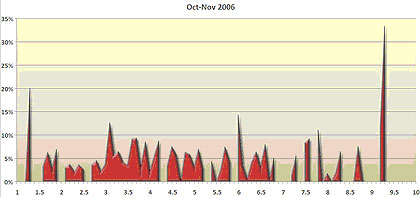
In the following chart, he tracks the click through per position.

Dainow
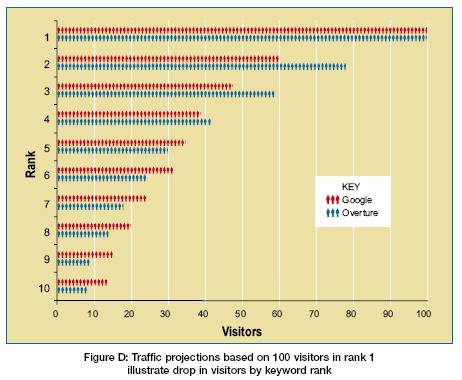
Brandt expected to see a chart that started high on the left, and tapered down as it moved to the right. But there seemed to be little correlation between position and click through. This runs counter to our eye tracking, which showed a strong correlation, primarily on first page visits. Top sponsored ads on Google received 2 to 3 times the click throughs.

enquirorank

Further, Atlas OnePoint did some analysis from their data set, and similarly found a fairly high correlation between position and click through on Google and Overture/Yahoo.

atlasrank

So why the difference?

Well, here are a couple thoughts right off the bat. Dainow’s data is exclusively for his campaigns. We don’t see click through rates for the other listings, both paid and non-paid, on the page, so we can’t see how his ads stack up against others on the page. Also, it may be that for the campaigns in question, Brandt’s creative is more relevant than the other ads that show. He makes the point that creative is more important than position. I don’t necessarily agree completely. The two work together. The odds of being seen are substantially higher in the top spots, and your creative doesn’t work if it isn’t seen. The discriminating searcher that Dainow sees emerging who takes the time to read all the ads isn’t the searcher we see in eye tracking tests. That searcher quickly scans 3 to 4 listings, usually top sponsored and the top 1 or 2 organic listings and then makes their choice. This is not only true of our study, but the recent Microsoft one that just came out. Although Dainow’s charts over time certainly seem to show that position is less important, there could be a number of other factors contributing to this.

I will agree with Brandt though that if seen, relevant and compelling copy does make a huge difference in the click through rate of the ad. And for consumer researchers in particular, I still see search advertiser’s cranking out copy that’s not aligned to intent. But all the evidence I’ve seen points to much higher visibility, and hence, click throughs, in the top sponsored spots.

When looking at analysis like Brandt Dainow is presenting, you have to be aware of all the variables. In this case, I’d really like to know the following:

  • What were the keywords that made up the campaigns
  • What was the creative that was running for his clients
  • What was the creative the competition was running
  • What were the overall click throughs for the page

In doing the analysis, you really need to control for these variables before you can make valid conclusions. Some are ones we can know, others, like the overall click throughs, only the engines would know.

But Dainow is quick to point that his findings show the need for individual testing on a campaign by campaign basis. And in that, we’re in complete agreement. Our eye tracking tests and other research shows general patterns over common searches, and the patterns have been surprisingly consistent from study to study. It probably gives us as good idea as any what typical searcher behavior might be. But as I’ve said before, there is no such thing as typical behavior. Look at enough searches and an average, aggregate pattern emerges, but each search is different. It depends on searcher intent, it depends on the results and what shows on the page, it depends on the engines,  it depends on what searchers find on the other side of the click. All these things can dramatically affect a scan pattern. So while you might look to our studies or others as a starting point, we continually encourage you to use our findings to set up your own testing frameworks. Don’t take anything for granted. But that’s a message that often doesn’t get through. And my concern is that advertisers looking for a magic bullet will read Dainow’s conclusions highlighted at the top of this post and swallow them whole, without bothering to digest them. And there’s still far too many question marks about this analysis for anyone to do that. I’ve contacted Dainow to set up a chat so I can find out more. Hopefully we can shed more light on this question.

Social Networking Research Update from KnowledgeStorm

A few posts ago I talked about KnowledgeStorm’s new study on the use of social networking by B2B technology buyers. Apparently, the two facts that were getting reported were a little misleading in the way they were presented. Matt Lohman from KnowledgeStorm clears them up:

“I wanted to thank you for referencing the recent research study from KnowledgeStorm. I thought I would clarify some of the confusion with the respondent percentages: The write up of results that you reference is a bit misleading. I’ll try to explain without getting too off the deep end…

We asked about familiarity with social networks first, for which 35% replied “not familiar at all” while another 42% replied “somewhat familiar” adding up to the 77% figure. As part of further validation, the next question asked “How often do you visit social networking sites?” from which we received 31% stating “Never”. This is very close to the 35% who were “not at all familiar” in the previous question. Good confirmation there. From that point forward in the questioning, we excluded anyone who claimed they “never” visit social networking sites (the 31%). Therefore, when we got to the question that asked “What are your primary reasons for using social networking sites?” the only respondents were those individuals who visit social networking sites at least once a month (69%). Of the individuals using these sites, 70% are doing so for business development networking or development reasons.

I still think your conclusions are valid but also wanted to make sure our research wasn’t getting misconstrued. “

Thanks Matt

Why No “Golden Triangle” in the Microsoft Eye Tracking Study

Over at Searchengineland, Danny Sullivan did a deeper dive into the Microsoft Eye Tracking Study that I posted about last Friday. In it, Danny said:

“Interesting, the pattern is different that the “golden triangle” that Enquiro has long talked about in its eye tracking studies, where you see all the red along the horizontal line of the top listing (indicating a lot of reading there), then less on the second listing, then less still as you move down. “

I just want to draw a few distinctions between the studies. In our study, we wanted to replicate typical search behavior as much as possible, so let people interact with actual results pages. In the Microsoft study, they were testing what would happen when the most relevant result was moved down the page and how searchers responded to different snippet lengths. The results, while actual results, were intercepted and were restructured in a way (i.e., stripping out sponsored ads) to let the researchers test different variables. We have said repeatedly that the Golden Triangle is not a constant, as is shown in our second study, but follows intent and the presentation of the search results.

In fact, the Microsoft study does confirm many of our findings, in the linear scanning of results, the scanning of groups of results and the importance of being in the top 5.

Another potential misconception that could be drawn from Danny’s interpretation of results is hard and fast rules about how many results searchers scan. He settled on the number five. When looking at eye tracking results, it’s vital to remember that there is no typical activity. Please don’t take an average and apply it as a rule of thumb. Averages, or aggregate heat maps, are just that. They’re what happens when you take a lot of different sessions, varying greatly, and mash them together. Scanning activity is highly dependent on the intent of the user and what appears on the search results page. A particularly relevant result in top sponsored, matched to the intent of the majority of users, would probably mean little scanning beyond the first or second organic result. On the other hand, if the query is more ambiguous, you could see scanning a lot deeper on the page. The Microsoft study used two tasks that would generate a limited number of queries, and recorded interactions based on this limited scope. Our studies, while using more tasks, still out of necessity represented the tiniest slice of possible interactions.

After looking at over a thousand sessions in the past 2 years, I’ve learned first hand that there are a lot of variables in scanning patterns and interactions with the search page. An eye tracking study provides clues, but no real answers. You have to take the results and try to extrapolate them beyond the scope of the study. We spent a lot of time doing this when writing up both our reports. You try to find universal behaviors and commonalities, but you have to be very careful not to accept the results at face value. Drawing conclusions such as snippet lengths should be longer or that official site tags should become standard are dangerous, because it’s not true for every search. The study actually found that ideal snippet length is highly dependent on the task and intent of the user.

If anything, what eye tracking has shown me is the need for more flexible search results, personalized to me and my intent at the time.

New Microsoft Eye Tracking Study

Microsoft has just released the results of an internal eye tracking study that looked at the impact of snippet length. For more detail, visit Marina Garrison’s blog where she looks at the notable findings.

msheatmapm

A few quick ones and some comments:

Snippet length doesn’t seem to impact people’s search strategies.

This makes sense to us. We found scanning for word patterns rather than actual reading. In fact, a longer snippet may actually detract from the user experience in certain scenarios, such as navigational search. It makes it more difficult to pick up information scent quickly. Remember, we’re on and off the search page as quickly as possible.

People scan 4 listings regardless

This is definitely aligned with the Rule of 3 (or 4) we found in our eye tracking study. We found, however, that this isn’t a hard and fast rule, but rather a pretty common tendency. It changes depending on whether top sponsored ads appeared, how closely aligned the top result was to intent and other factors. But in general, we would agree that most people tend to scan 3 or 4 listings before clicking on one.

Scenario Success Rates Dropped Dramatically as the “Best” Listing Moved Down the Page

No big surprise here. This was referred to in our first study as the “Google” Effect, and it comes from our being trained that best result should show up on top. I actually co-authored a paper with Dr. Bajaj and Dr. Wood at the University of Tulsa about this very topic. By the way, it was Dr. Bajaj that called it the “Google” Effect, not me, so please Yahoo and Microsoft, don’t beat me up on this one.

The report is available for download.

US Statistical Abstract: Time Well Spent?

The U.S. Census Bureau just released their new Statistical Abstact for 2007. In it, they predict the amount of time adults and teens will spend consuming media in various forms:

  • 65 days in front of the TV
  • 41 days listening to radio
  • A little over a week on the Internet in 2007
  • Adults will spend about a week reading a daily newspaper
  • Teens and adults will spend another week listening to recorded music
  • Consumer spending for media is forecasted to be $936.75 per person

What was interesting about this was noticing the gap that still exists between TV and Radio consumption and time spent on the Internet. To me, it’s indicative of the nature of engagement, at least for now.

According to these stats, we will spend 10X the amount of time in front of a television than we will spend in front of a computer cruising the Internet. The media release didn’t elaborate on the nature of time spent on the Internet. Does this mean work time as well?

Given these numbers, one can understand why the lion’s share of ad budgets still go to television, and I expect that TV sales execs will gleefully quote these given every possible opportunity. But consider the following:

  • The consumption of entertainment content online is in it’s infancy. Strike that, it’s actually embroyonic. If YouTube is the barometer of where we’re at, we have an immense way to go. All the hype about online video is still largely centered around viral growth amongst very early adopters who are watching amateur videos less than 3 minutes in length. It’s not the actual current  impact of online video that’s creating buzz, it’s the paradigm shifting that we have to do when we consider the democratization of content creation, the searchability of the digital format and the interactive possibilities that come with the online distribution channel.  All these things speak to a totally new experience. We’re just not there yet.
  • Think about the difference in your engagement level when you’re interacting with the Internet, as opposed to passively watching TV or listening to the radio. Think about how you respond to advertising messaging, especially when it’s relevant to the task you’re pursuing. The influence of this difference in engagement on consumers hasn’t been quantified yet, but at a gut level, we know it should be significant, probably a quantum leap in effectiveness. Actually, the numbers drive this home. In the research that’s been done on the impact of various channels on consumers, the Internet consistently ranks near the top, usually right after word of mouth, and much higher than television. And it has this impact with one tenth of the exposure time.
  • We need time to change our habits. Television watching has been ingrained in our daily routine for decades. Radio for a bit longer. Newspapers for centuries. The Internet is just celebrating its first decade as a widely accessible channel, and high speed access is less than 5 years old. Given that, the one week number is actually quite remarkable.

I’m sure these numbers will be quoted often, and spun in drastically different directions, depending on who’s doing the spinning. At first glance, my thought was “only one week?”. But as I thought about it, the numbers just emphasized the vast potential of online. What will be fascinating is to revisit this in a year’s time and see how these numbers change. In Internet terms, 12 months is an eternity.

No Real Surprises in the Latest iCrossing Study

iCrossing released the results of a new study conducted by Harris Interactive just before the holidays. The study looked at the role of online in the CPG market. A media release outlines the key findings, including:

  • Consumers look for CPG’s online, with 39% of US adults confirming they’ve conducted a search for CPG’s.
  • Women do this more than man. Footwear and apparel lead the categories searched for.
  • Online CPG searches often result in offline sales. Much of this activity is looking for sales or special offers at traditional bricks and mortar retail locations.
  • Activity is spread pretty evenly over search engines, retailer websites and manufacturer’s sites. Shopping engines and consumer information sites have substantially less traffic.

There are a few notable take aways here that speak to the future use of online. Most CPG’s have been slow to move to online as a marketing channel. The more commoditized the product, the less the online research activity, or so traditional marketing wisdom has told us. Certainly, CPG’s have been very slow to enter the search arena, yet the iCrossing study tells us that there is a significant portion of the consumer population are turning online to research these every day purchases.

To be honest, I think the study is probably underreporting the frequency of this. At Enquiro, we’re steering away from self reported survey based vehicles as a sole vehicle to look at search behavior, because we find that people have trouble recalling how often they use search and what they use it for. It’s become second nature for us to turn to online, and that in turn usually means search. So in a survey like the iCrossing one, memory lapses usually mean overly conservative numbers.

Another notable trend that would influence the findings are the increasing spread of high speed internet access. The likelihood of this CPG online activity happening is directly related to how handy a computer with an internet connection is. The more ubiquitous access is, the more we’ll do a quick look up on everything. About the only purchases I make now that I don’t do some form of online research about are groceries. And as local search becomes more robust, that will probably change too.

I’ve been predicting another surge of advertising dollars migrating into search over the next year or two. As we understand more how universal online research truly is, and how a lot of major advertisers are completely missing this very important touchpoint, more budget will find it’s way into search. While there are no real surprises in the iCrossing study, it’s good that major advertisers are continually reminded that they’re missing a rather large boat.