How Our Brains Process Price Information

On-Off-Switch-For-Human-BrainWe have a complex psychological relationship with pricing. A new brain scanning study out of Harvard and Stanford starts to pick apart the dynamics of that relationship.

Uma R. Karmarkar, Baba Shiv, and Brian Knutson wanted to see how we evaluate a potential purchase when the price is the first piece of information we get as opposed to the last piece of information. They used both fMRI scanning and behavioral tracking to see how the study participants responded. Participants were given $40 dollars to spend and then were presented with a number of sample offers. In all cases, the price represented an attractive bargain on the product featured. But one group was given the price first, and the second group was given the price last.

There was another critical difference in the evaluation process as well. In the first phase of the study, participants were shown products that they would like to buy, and in the second phase, they were shown products that they would have to buy. The difference between the two was how they activated the reward center of our brain – the nucleus accumbens. I’ve been talking for years about the importance of understanding the balance of risk and reward in our purchase decisions. This study provides a little more understanding about how our brain processes those two factors.

In the first phase, participants were shown a variety of products that they would consider rewarding. These would fall into the first quadrant of the risk/reward matrix I introduced in my column from 5 years ago. The researchers were paying particular attention to two different parts of the brain – the nucleus accumbens and the medial prefrontal cortex. For a layman’s analogy, think of you and a five year old walking down the toy aisle in a department store. The nucleus accumbens is the five year old who starts chanting, “I want it. I want it. I want it.” The medial prefrontal cortex is the adult who decides if they’re actually going to buy it. In the study, the researchers found that the sequence in which these two parts of the brain “lit up” depended on whether or not you saw the price first. If you saw the product first, the nucleus accumbens started its chant – “I want it.” If you saw the price first, the prefrontal medial cortex kicked into action and started evaluating whether the offer represented a good bargain. In the case of the reward products, although the sequence varied, the actually purchase process didn’t. In most cases, participants still ended up making the purchase, whether price was presented first or last.

But things changed when the researchers tried a variety of products that fell into the second quadrant of the risk reward matrix – low risk and low reward. These are the everyday items we have to buy. In the study, they included things like a water filtration pitcher, a pack of AA batteries, a USB drive, and a flashlight. There was nothing here that was likely to get the nucleus accumbens starting to chant.

Now, it should be noted that this follow-up study did not include the fMRI scanning, but by tracking purchasing behaviors we can make some pretty educated guesses as to what’s happening in the respective brains of our participants. Here, presenting prices first resulted in a significant increase in actual purchases over instances when price was presented last. If price comes first, we can imagine that the prefrontal cortex is indicating that it’s a good bargain on a needed product. But if a relatively boring product is presented first for evaluation to the nucleus accumbens, there’s little to excite the reward center.

An important caveat to this part of the study comes with knowing that the prices presented represented significant savings on the products. After the simulated purchases, participants were asked to indicate a price they would be willing to pay for the product. When the price was the lead, the named prices tended to be a little lower, indicating that if you are going to lead with price, especially for quadrant two products, you’d better make sure you’re offering a true bargain.

If anything, this study provides further proof of the value of knowing a prospect’s mental landscape. What are the risk and reward factors that will be motivating them? Will the media prefrontal cortex or the nucleus accumbens be calling the shots? What priming effects might an early introduction of price introduce into the process?

When I wrote about the risk/reward matrix five years ago, one commenter said “a simple low-high risk/low-high reward graph is not very useful for driving just in time and location based offers, discounts, etc.” I respectfully disagree. While more sophisticated models are certainly possible, I think even a simple 2X2 matrix that helps map out the decision factors that are in play with purchases would be a significant step forward. And this isn’t about driving real time variations on offers. It’s about understanding the fundamentals of the buyer’s decision process. There’s nothing wrong with simplicity, especially if it drives greater usage.

The Persona is Dead, Long Live the Person

First, let me go on record as saying up to this point, I’ve been a fan of personas. In my past marketing and usability work, I used personas extensively as a tool. But I’m definitely aware that not everyone is equally enamored with personas. And I also understand why.

Personas, like any tool, can be used both correctly and incorrectly. When used correctly, they can help bridge the gap between the left brain and the right brain. They live in the middle ground between instinct and intellectualism. They provide a human face to raw data.

But it’s just this bridging quality that tends to lead to abuse. On the instinct side, personas are often used as a short cut to avoid quantitative rigor. Data driven people typically hate personas for this reason. Often, personas end up as fluffy documents and life sized cardboard cutouts with no real purpose. It seems like a sloppy way to run things.

On the intellectual side, because quant people distrust personas, they also leave themselves squarely on data side of the marketing divide. They can understand numbers – people not so much. This is where personas can shine. At their best, they give you a conceptual container with a human face to put data into. It provides a richer but less precise context that allows you to identify, understand and play out potential behaviors that data alone may not pinpoint.

As I said, because personas are intended as a bridging tool, they often remain stranded in no man’s land. To use them effectively, the practitioner should feel comfortable living in this gap between quant and qual. Too far one way or the other and it’s a pretty safe bet that personas will either be used incorrectly or be discarded entirely.

Because of this potential for abuse, maybe it’s time we threw personas in the trash bin. I suspect they may be doing more harm than good to the practice of marketing. Even at their best, personas were meant as a more empathetic tool to allow you to thing through interactions with a real live person in mind. But in order to make personas play nice with real data, you have to be very diligent about continually refining your personas based on that data. Personas were never intended to be placed on a shelf. But all too often, this is exactly what happens. Usually, personas are a poor and artificial proxy for real human behaviors. And this is why they typically do more harm than good.

The holy grail of marketing would be to somehow give real time data a human face. If we could find a way to bridge left brain logic and right brain empathy in real time to discover insights that were grounded in data but centered in the context of a real person’s behaviors, marketing would take a huge leap forward. The technology is getting tantalizingly close to this now. It’s certainly close enough that it’s preferable to the much abused persona. If – and this is a huge if – personas were used absolutely correctly they can still add value. But I suspect that too much effort is spent on personas that end up as documents on a shelf and pretty graphics. Perhaps that effort would be better spent trying to find the sweet spot between data and human insights.

The Secret of Successful Marketing Lies in Split Seconds

affordanceThe other day, I was having lunch in a deli. I was also watching the front door, which you had to push to get in. Almost everyone who came to the door pulled, even though there was a fairly big sign over the handle which said “Push.” The problem? The door had the wrong kind of handle. It was a pull handle, not a push. The door had been mounted backwards. In usability terms, the door handle presented a misleading affordance.

I suspect the door had been there for many years. I was at the deli for about 30 minutes. In that time, about 70% of the people (probably close to 50) pulled rather than pushed. Extrapolating this to the whole, that means over the years, thousands and thousands of people have had to try twice to enter this particular place of business. Yet, the only acknowledgement of this instance of customer pain was the sign that had been taped to the door – “Push” – and I suspect there was an implied “(You Idiot)” following that.

I suspect most marketing falls in the same category as that sign. It’s an attempt to fight the intuitive actions that customers take – those split-second actions that happen before our brain has a chance to kick in. And we have to counteract those split-second decisions because the path we have created for our customers was built without an understanding of those intuitive actions. After we realize that our path runs counter to our customer’s natural behaviors do we rebuild the path? Does the deli owner pay a contractor to remount the door? No, we post a sign asking customers to push rather than pull. After all, all they have to do is think for a moment. It seems like a reasonable request.

But here’s the problem with that. You don’t want your customers to think. You want them to act. And you want them to act as quickly and naturally as possible. The battles of marketing are won in those split seconds before the brain kicks in.

Let me give you one example. A few years ago I did a study with Simon Fraser University in Canada. We wanted to know how the brain responded in those same split seconds to brands we like versus brands we have no particular affinity to. What we found was fascinating. In about 150 milliseconds (roughly a sixth of a second) our brain responds to a well-loved brand the same way we respond to a smiling face. This all happens before any rational part of the brain can kick in. This positive reaction sets the stage for a much different subsequent mental processing of the brand (which starts at about 450 milliseconds, or half a second). And the power of this alignment can be startling. As Dr. Read Montague discovered, it can literally alter your perception of the world.

If you can rebuild your path to purchase to align with your customer’s intuitive behaviors, you don’t need to put up “push” signs when they stray off course. You don’t have to make your customers think. Here’s why that is important. As long as we operate at the intuitive level, humans are a fairly predictable lot. Evolution has wired in a number of behaviors that are universal across the population. You would not be risking your vacation fund if you placed a bet that the majority of people would try to pull a door with a door handle that suggested your should pull it, even if there was a sign that said “push.” As long as we operate on auto-pilot, we can plot a predicted behavioral course with a fair degree of confidence (assuming, of course, we’ve taken the time to understand those behaviors).

But the minute we start to think, all bets are off. The miracle of the human brain is that it has two loops of activity – one fast and one slow. The fast loop relies on instinct and evolved behavioral habits. It’s incredibly efficient but stubbornly rigid. The slow loop brings the full power of human rationality to bear on the problem. It’s what happens when we think. And once the prefrontal cortex kicks it, we are amazingly flexible but we pay the price in efficiency. It takes time to think. It also brings a massive amount of variability into the equation. If we start thinking, behaviors become much more difficult to predict.

The longer you can keep your customers on the fast path, the closer you’ll be to a successful outcome. Plan that path carefully and remove any signs telling them to “push.”

Why More Connectivity is Not Just More – Why More is Different

data-brain_SMEric Schmidt is predicting from Davos that the Internet will disappear. I agree. I’ve always said that Search will go under the hood, changing from a destination to a utility. Not that Mr. Schmidt or the Davos crew needs my validation. My invitation seems to have got lost in the mail.

Laurie Sullivan’s recent post goes into some of the specifics of how search will become an implicit rather than an explicit utility. Underlying this is a pretty big implication that we should be aware of – the very nature of connectivity will change. Right now, the Internet is a tool, or resource. We access it through conscious effort. It’s a “task at hand.” Our attention is focused on the Internet when we engage with it. The world described by Eric Schmidt and the rest of the panel is much, much different.   In this world, the “Internet of Things” creates a connected environment that we exist in. And this has some pretty important considerations for us.

First of all, when something becomes an environment, it surrounds us. It becomes our world as we interpret it through our assorted sensory inputs. These inputs have evolved to interpret a physical world – an environment of things. We will need help interpreting a digital world – an environment of data. Our reality, or what we perceive our reality to be, will change significantly as we introduce technologically mediated inputs into it.

Our brains were built to parse information from a physical world. We have cognitive mechanisms that evolved to do things like keep us away from physical harm. Our brains were never intended to crunch endless reams of digital data. So, we will have to rely on technology to do that for us. Right now we have an uneasy alliance between our instincts and the capabilities of machines. We are highly suspicious of technology. There is every rational reason in the world to believe that a self-driving Google car will be far safer than a two ton chunk of accelerating metal under the control of a fundamentally flawed human, but who of us are willing to give up the wheel? The fact is, however, that if we want to function in the world Schmidt hints at, we’re going to have to learn not only to trust machines, but also to rely totally on them.

The other implication is one of bandwidth. Our brains have bottlenecks. Right now, our brain together with our senses subconsciously monitor our environment and, if the situation warrants, they wake up our conscious mind for some focused and deliberate processing. The busier our environment gets, the bigger this challenge becomes. A digitally connected environment will soon exceed our brain’s ability to comprehend and process information. We will have to determine some pretty stringent filtering thresholds. And we will rely on technology to do the filtering. As I said, our physical senses were not built to filter a digital world.

It will be an odd relationship with technology that will have to develop. Even if we lower our guard on letting machines do much of our “thinking” (in terms of processing environmental inputs for us) we still have to learn how to give machines guidelines so they know what our intentions are. This raises the question, “How smart do we want machines to become?” Do we want machines that can learn about us over time, without explicit guidance from us? Are we ready for technology that guesses what we want?

One of the comments on Laurie’s post was from Jay Fredrickson, “Sign me up for this world, please. When will this happen and be fully rolled out? Ten years? 20 years?” Perhaps we should be careful what we wish for.  While this world may seem to be a step forward, we will actually be stepping over a threshold into a significantly different reality. As we step over that threshold, we will change what it means to be human. And there will be no stepping back.

Learning about Big Data from Big Brother

icreach-search-illo-feature-hero-bYou may not have heard of ICREACH, but it has probably heard of you. ICREACH is the NSA’s own Google-like search engine.  And if Google’s mission is to organize the world’s information, ICREACH’s mission is to snoop on the world.  After super whistle blower Edward Snowden tipped the press off to the existence of ICREACH, the NSA fessed up last month. The amount of data we’re talking about is massive. According to The Intercept website, the tool can handle two to five billion new records every day, including data on the US’s emails, phone calls, faxes, Internet chats and text messages. It’s Big Brother meets Big Data.

I’ll leave aside for the moment the ethical aspect of this story.  What I’ll focus on is how the NSA deals with this mass of Big Data and what it might mean for companies who are struggling to deal with their own Big Data dilemmas.

Perhaps no one deals with more big data than the Intelligence Community. And Big Data is not new for them. They’ve been digging into data trying to find meaningful signals amongst the noise for decades. Finally, the stakes of successful data analysis are astronomically high here. Not only is it a matter of life and death – a failure to successfully connect the dots can lead to the kinds of nightmares that will haunt us for the rest of our lives. When the pressure is on to this extent, you can be sure that they’ve learned a thing or two. How the Intelligence community handles data is something I’ve been looking at recently. There are a few lessons to be learned here.

Owned Data vs Environmental Data

The first lesson is that you need different approaches for different types of data. The Intelligence Community has their own files, which include analyst’s reports, suspect files and other internally generated documentation. Then you have what I would call “Environmental” data. This includes raw data gathered from emails, phone calls, social media postings and cellphone locations. Raw data needs to be successfully crunched, screened for signals vs. noise and then interpreted in a way that’s relevant to the objectives of the organization. That’s where…

You Need to Make Sense of the Data – at Scale

Probably the biggest change in the Intelligence community has been to adopt an approach called “Sense making.”  Sense making really mimics how we, as humans, make sense of our environment. But while we may crunch a few hundred or thousand sensory inputs at any one time, the NSA needs to crunch several billion signals.

Human intuition expert Gary Klein has done much work in the area of sense making. His view of sense making relies on the existence of a “frame” that represents what we believe to be true about the world around us at any given time.  We constantly update that frame based on new environmental inputs.  Sometimes they confirm the frame. Sometimes they contradict the frame. If the contradiction is big enough, it may cause us to discard the frame and build a new one. But it’s this frame that allows us to not only connect the dots, but also to determine what counts as a dot. And to do this…

You Have to Be Constantly Experimenting

Crunching of the data may give you the dots, but there will be multiple ways to connect them. A number of hypothetical “frames” will emerge from the raw data. You need to test the validity of these hypotheses. In some cases, they can be tested against your own internally controlled data. Sometimes they will lie beyond the limits of that data. This means adopting a rigorous and objective testing methodology.  Objective is the key word here, because…

You Need to Remove Human Limitations from the Equation

When you look at the historic failures of Intelligence gathering, the fault usually doesn’t lie in the “gathering.” The signals are often there. Frequently, they’re even put together into a workable hypothesis by an analyst. The catastrophic failures in intelligence generally arise because some one, somewhere, made an intuitive call to ignore the information because they didn’t agree with the hypothesis. Internal politics in the Intelligence Community has probably been the single biggest point of failure. Finally…

Data Needs to Be Shared

The ICREACH project came about as a way to allow broader access to the information required to identify warning signals and test out hunches. ICREACH opens up this data pool to nearly two-dozen U.S. Government agencies.

Big Data shouldn’t replace intuition. It should embrace it. Humans are incredibly proficient at recognizing patterns. In fact, we’re too good at it. False positives are a common occurrence. But, if we build an objective way to validate our hypotheses and remove our irrational adherence to our own pet theories, more is almost always better when it comes to generating testable scenarios.

Why Cognitive Computing is a Big Deal When it comes to Big Data

IBM-Watson

Watson beating it’s human opponents at Jeopardy

When IBM’s Watson won against humans playing Jeopardy, most of the world considered it just another man against machine novelty act – going back to Deep Blue’s defeat of chess champion Garry Kasporov in 1997. But it’s much more than that. As Josh Dreller reminded us a few Search Insider Summits ago, when Watson trounced Ken Jennings and Brad Rutter in 2011, it ushered in the era of cognitive computing. Unlike chess, where solutions can be determined solely with massive amounts of number crunching, winning Jeopardy requires a very nuanced understanding of the English language as well as an encyclopedic span of knowledge. Computers are naturally suited to chess. They’re also very good at storing knowledge. In both cases, it’s not surprising that they would eventually best humans. But parsing language is another matter. For a machine to best a man here requires something quite extraordinary. It requires a machine that can learn.

The most remarkable thing about Watson is that no human programmer wrote the program that made it a Jeopardy champion. Watson learned as it went. It evolved the winning strategy. And this marks a watershed development in the history of artificial intelligence. Now, computers have mastered some of the key rudiments of human cognition. Cognition is the ability to gather information, judge it, make decisions and problem solve. These are all things that Watson can do.


Peter Pirolli - PARC

Peter Pirolli – PARC

Peter Pirolli, one of the senior researchers at Xerox’s PARC campus in Palo Alto, has been doing a lot of work in this area. One of the things that has been difficult for machines has been to “make sense” of situations and adapt accordingly. Remember, a few columns ago where I talked about narratives and Big Data, this is where Monitor360 uses a combination of humans and computers – computers to do the data crunching and humans to make sense of the results. But as Watson showed us, computers do have to potential to make sense as well. True, computers have not yet matched humans in the ability to sense make in an unlimited variety of environmental contexts. We humans excel at quick and dirty sense making no matter what the situation. We’re not always correct in our conclusions but we’re far more flexible than machines. But computers are constantly narrowing the gap and as Watson showed, when a computer can grasp a cognitive context, it will usually outperform a human.

Part of the problem machines face when making sense of a new context is that the contextual information needs to be in a format that can be parsed by the computer. Again, this is an area where humans have a natural advantage. We’ve evolved to be very flexible in parsing environmental information to act as inputs for our sense making. But this flexibility has required a trade-off. We humans can go broad with our environmental parsing, but we can’t go very deep. We do a surface scan of our environment to pick up cues and then quickly pattern match against past experiences to make sense of our options. We don’t have the bandwidth to either gather more information or to compute this information. This is Herbert Simon’s Bounded Rationality.

But this is where Big Data comes in. Data is already native to computers, so parsing is not an issue. That handles the breadth issue. But the nature of data is also changing. The Internet of Things will generate a mind-numbing amount of environmental data. This “ambient” data has no schema or context to aid in sense making, especially when several different data sources are combined. It requires an evolutionary cognitive approach to separate potential signal from noise. Given the sheer volume of data involved, humans won’t be a match for this task. We can’t go deep into the data. And traditional computing lacks the flexibility required. But cognitive computing may be able to both handle the volume of environmental Big Data and make sense of it.

If artificial intelligence can crack the code on going both broad and deep into the coming storm of data, amazing things will certainly result from it.

Want to Be More Strategic? Stand Up!

article-1388357-0050C69D00000258-771_472x345One of the things that always frustrated me in my professional experience was my difficulty in switching from tactical to strategic thinking. For many years, I served on a board that was responsible for the strategic direction of an organization. A friend of mine, Andy Freed, served as an advisor to the board. He constantly lectured us on the difference between strategy and tactics:

“Strategy is your job. Tactics are mine. Stick to your job and I’ll stick to mine.”

Despite this constant reminder, our discussions always seemed to quickly spiral down to the tactical level. We all caught ourselves doing it. It seemed that as soon as we started thinking about what needed to be done and why, we automatically shifted gears and thought about how it should be done.

A recent study may have found the problem. We were sitting down. We should have stood up. Better yet, we should have taken the elevator to the top of the building (we actually did do this at one board retreat in Scottsdale, Arizona). Two researchers at the University of Toronto (home, I should point out, of what was the tallest free standing structure in the world for many years – the CN Tower), Pankaj Aggarwal and Min Zhao, found that a subject’s physical situation impacted how strategic they were. When subjects were physically higher up, say standing on a tall stool, they were more likely to look at the “big picture.”

Our physical context has more than a little impact on how we think. It’s a phenomenon called Mental Construal. And it’s not just restricted to how strategic our thinking is. It can impact thinks like social judgment as well. In a 2006 paper, University of Michigan professor Norbert Schwartz gave some examples that fall under the category called “situated concepts.” For example, the mental images you retrieve when I say “chair” might be different if we’re standing in a living room rather than an airplane or movie theatre. Another example, which unfortunately speaks to a darker side of human nature, is how you would respond to the face of a young African American when shown in the context of a church scene versus the context of a street corner scene.

Schwartz also talks about levels of construal. We’re more successful staying at strategic levels when our planning is trouble free. The minute we hit a problem, we tend to revert to finer grained tactical thinking. Again, in my board experience, the minute we started hitting problems we immediately tried to solve them, which effectively derailed any strategic discussion.

In his book, Creativity: Flow and the Psychology of Discovery and Invention, Mihaly Csikszentmihalyi found that physical contexts can also impact creativity. Physicist Freeman Dyson found that walking was essential to drive the creative process,

“Again, I never went to a class that (Richard) Feynman taught. I never had any official connection with him at all, in fact. But we went for walks. Most of the time that I spent with him was actually walking, like the old style of philosophers who used to walk around under the cloisters.”

In a study where subjects were given pagers and were signaled at random times of the day, they were asked to rate how creative they felt. It turned out the highest level of creativity came while they were walking, driving or swimming. Perhaps it was the physical stimulation, but it may have also been mental construal at work. Perhaps physical movement primed the brain for mental movement.

So, if you need to be strategic, find the highest vantage point possible, with room to walk around, preferably with the smartest person you know.

Are Our Brains Trading Breadth for Depth?

ebrain1In last week’s column, I looked at how efficient our brains are. Essentially, if there’s a short cut to an end goal identified by the brain, it will find it. I explained how Google is eliminating the need for us to remember easily retrievable information. I also speculated about how our brains may be defaulting to an easier form of communication, such as texting rather than face-to-face communication.

Personally, I am not entirely pessimistic about the “Google Effect,” where we put less effort into memorizing information that can be easily retrieved on demand. This is an extension of Daniel Wegner’s “transactive memory”, and I would put it in the category of coping mechanisms. It makes no sense to expend brainpower on something that technology can do easier, faster and more reliably. As John Mallin commented, this is like using a calculator rather than memorizing times tables.

Reams of research has shown that our memories can be notoriously inaccurate. In this case, I partially disagree with Nicholas Carr. I don’t think Google is necessarily making us stupid. It may be freeing up the incredibly flexible power of our minds, giving us the opportunity to redefine what it means to be knowledgeable. Rather than a storehouse of random information, our minds may have the opportunity to become more creative integrators of available information. We may be able to expand our “meta-memory”, Wegner’s term for the layer of memory that keeps track of where to turn for certain kinds of knowledge. Our memory could become index of interesting concepts and useful resources, rather than ad-hoc scraps of knowledge.

Of course, this positive evolution of our brains is far from a given. And here Carr may have a point. There is a difference between “lazy” and “efficient.” Technology’s freeing up of the processing power of our brain is only a good thing if that power is then put to a higher purpose. Carr’s title, “The Shallows” is a warning that rather than freeing up our brains to dive deeper into new territory, technology may just give us the ability to skip across the surface of the titillating. Will we waste our extra time and cognitive power going from one piece of brain candy to the other, or will we invest it by sinking our teeth into something important and meaningful?

A historical perspective gives us little reason to be optimistic. We evolved to balance the efforts required to find food with the nutritional value we got from that food. It used to be damned hard to feed ourselves, so we developed preferences for high calorie, high fat foods that would go a long way once we found them. Thanks to technology, the only effort required today to get these foods is to pick them off the shelf and pay for them. We could have used technology to produce healthier and more nutritious foods, but market demands determined that we’d become an obese nation of junk food eaters. Will the same thing happen to our brains?

I am even more concerned with the short cuts that seem to be developing in our social networking activities. Typically, our social networks are built both from strong ties and weak ties. Mark Granovetter identified these two types of social ties in the 70’s. Strong ties bind us to family and close friends. Weak ties connect us with acquaintances. When we hit rough patches, as we inevitably do, we treat those ties very differently. Strong ties are typically much more resilient to adversity. When we hit the lowest points in our lives, it’s the strong ties we depend on to pull us through. Our lifelines are made up of strong ties. If we have a disagreement with someone with whom we have a strong tie, we work harder to resolve it. We have made large investments in these relationships, so we are reluctant to let them go. When there are disruptions in our strong tie network, there is a strong motivation to eliminate the disruption, rather than sacrifice the network.

Weak ties are a whole different matter. We have minimal emotional investments in these relationships. Typically, we connect with these either through serendipity or when we need something that only they can offer. For example, we typically reinstate our weak tie network when we’re on the hunt for a job. LinkedIn is the virtual embodiment of a weak tie network. And if we have a difference of opinion with someone to whom we’re weakly tied, we just shut down the connection. We have plenty of them so one more or less won’t make that much of a difference. When there are disruptions in our weak tie network, we just change the network, deactivating parts of it and reactivating others.

Weak ties are easily built. All we need is just one thing in common at one point in our lives. It could be working in the same company, serving on the same committee, living in the same neighborhood or attending the same convention. Then, we just need some way to remember them in the future. Strong ties are different. Strong ties develop over time, which means they evolve through shared experiences, both positive and negative. They also demand consistent communication, including painful communication that sometimes requires us to say we were wrong and we’re sorry. It’s the type of conversation that leaves you either emotionally drained or supercharged that is the stuff of strong ties. And a healthy percentage of these conversations should happen face-to-face. Could you build a strong tie relationship without ever meeting face-to-face? We’ve all heard examples, but I’d always place my bets on face-to-face – every time.

It’s the hard work of building strong ties that I fear we may miss as we build our relationships through online channels. I worry that the brain, given an easy choice and a hard choice, will naturally opt for the easy one. Online, our network of weak ties can grow beyond the inherent limits of our social inventory, known as Dunbar’s Number (which is 150, by the way). We could always find someone with which to spend a few minutes texting or chatting online. Then we can run off to the next one. We will skip across the surface of our social network, rather than invest the effort and time required to build strong ties. Just like our brains, our social connections may trade breadth for depth.

The Pros and Cons of a Fuel Efficient Brain

Transactive dyadic memory Candice Condon3Your brain will only work as hard as it has to. And if it makes you feel any better, my brain is exactly the same. That’s the way brains work. They conserve horsepower until when it’s absolutely needed. In the background, the brain is doing a constant calculation: “What do I want to achieve and based on everything I know, what is the easiest way to get there?” You could call it lazy, but I prefer the term “efficient.”

The brain has a number of tricks to do this that involve relatively little thinking. In most cases, they involve swapping something that’s easy for your brain to do in place of something difficult. For instance, consider when you vote. It would be extraordinarily difficult to weigh all the factors involved to truly make an informed vote. It would require a ton of brainpower. But it’s very easy to vote for whom you like. We have a number of tricks we use to immediately assess whether we like and trust another individual. They require next to no brainpower. Guess how most people vote? Even those of us who pride ourselves on being informed voters rely on these brain short cuts more than we would like to admit.

Here’s another example that’s just emerging, thanks to search engines. It’s called the Google Effect and it’s an extension of a concept called Transactive Memory. Researchers Betsy Sparrow, Jenny Liu and Daniel Wegner identified the Google Effect in 2011. Wegner first explained transactive memory back in the 80’s. Essentially, it means that we won’t both to remember something that we can easily reference when we need it. When Wegner first talked about transactive memory in the 80’s, he used the example of a husband and wife. The wife was good at remembering important dates, such as anniversaries and birthdays. The husband was good at remembering financial information, such as bank balances and when bills were due. The wife didn’t have to remember financial details and the husband didn’t have to worry about dates. All they had to remember was what each other was good at memorizing. Wegner called this “chunking” of our memory requirements “metamemory.”

If we fast-forward 30 years from Wegner’s original paper, we find a whole new relevance for transactive memory, because we now have the mother of all “metamemories”, called Google. If we hear a fact but know that this is something that can easily be looked up on Google, our brains automatically decide to expend little to no effort in trying to memorize it. Subconsciously, the brain goes into power-saver mode. All we remember is that when we do need to retrieve the fact, it will be a few clicks away on Google. Nicholar Carr fretted about whether this and other cognitive short cuts were making us stupid in his book “The Shallows.”

But there are other side effects that come from the brain’s tendency to look for short cuts without our awareness. I suspect the same thing is happening with social connections. Which would you think required more cognitive effort: a face-to-face conversation with someone or texting them on a smartphone?

Face-to-face conversation can put a huge cognitive load on our brains. We’re receiving communication at a much greater bandwidth than with text.   When we’re across from a person, we not only hear what they’re saying, we’re reading emotional cues, watching facial expressions, interpreting body language and monitoring vocal tones. It’s a much richer communication experience, but it’s also much more work. It demands our full attention. Texting, on the other hand, can easily be done along with other tasks. It’s asynchronous – we can pause and pick up when ever we want. I suspect its no coincidence that younger generations are moving more and more to text based digital communication. Their brains are pushing them in that direction because it’s less work.

One of the great things about technology is that it makes our life easier. But is that also a bad thing? If we know that our brains will always opt for the easiest path, are we putting ourselves in a long, technology aided death spiral? That was Nicholas Carr’s contention. Or, are we freeing up our brains for more important work?

More on this to come next week.

The Psychology of Usefulness: A New Model for Technology Acceptance.

In the last post, I reviewed the various versions of the Technology Acceptance Model. Today, I’d like to introduce my own thoughts on the subject and a proposed new model.  But first, I’d like to introduce an entirely new model to the discussion.

Introduction of Sense Making

I like Gary Klein’s Theory of Sense Making – a lot! And in the area of technology acceptance, I think it has to be part of the discussion. It introduces a natural Bayesian rhythm to the process that I think provides a intuitive foundation for our decisions on whether or not we’ll accept a new technology.
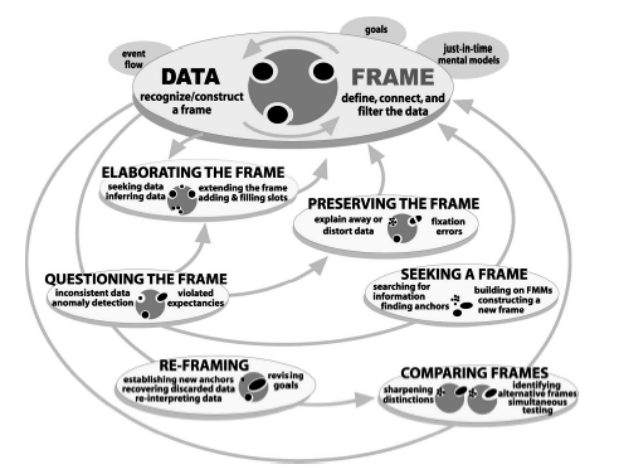
Kleins-Data-Frame-Model-of-Sensemaking

Gary Klein et al – Sensemaking Model How Might “Transformational” Technologies and Concepts be Barriers to Sensemaking in Intelligence Analysis

Essentially, the Sense Making Model says that when we try to make sense of something new, we begin with some type of perspective, belief or viewpoint. In Bayesian terms, this would be our prior. In Klein’s model, he called it a frame.

Now, this frame doesn’t only give us a context in which to absorb new data, it actually helps define what counts as data. This is a critical concept to remember, because it dramatically impacts everything that follows. Imagine, for example, that you arrive on the scene of a car accident. If your frame was that of a non-involved bystander, the data you might seek in making sense of the situation would be significantly different than if your frame was that of a person who recognized one of the vehicles involved as belonging to your next-door neighbor.

In the case of technology acceptance, this initial frame will shape what types of data we would seek in order to further qualify our decision. If we start with a primarily negative attitude, we would probably seek data that would confirm our negative bias. The opposite would be true if we were enthusiastic about the adoption of technology. For this reason, I believe the creation of this frame should be a step in any proposed acceptance model.

But Sense Making also introduces the concept of iterative reasoning. After we create our frame, we do a kind of heuristic “gap analysis” on our frame. We prod and poke to see where the weaknesses are. What are the gaps in our current knowledge? Are there inconsistencies in the frame? What is our level of conviction on our current views and attitudes? The weaker the frame, the greater our need to seek new data to strengthen it. This process happens without a lot of conscious consideration. For most of us, this testing of the frame is probably a subconscious evaluation that then creates an emotional valence that will impact future behavior. On one extreme, it could be a strongly held conviction, on the other it would be a high degree of uncertainty.

If we decide we need more data, the Sense Making Model introduces another “Go/No Go” decision point. If the new data confirms our initial frame, we elaborate that frame, making it more complete. We fill in gaps, strengthen beliefs, discard non-aligned data and update our frame. If our sense making is in support of a potential action and we seem to be heading in the right direction with our data foraging, this can be an iterative process that continually updates our frame until it’s strong enough to push us over the threshold of executing that action.

But, if the new data causes serious doubt about our initial frame, we may need to consider “reframing,” in which case we’d have to seek new frames, compare against our existing one and potentially discard it in favor of one of the new alternatives. This essentially returns us to square one, where we need to find  data to elaborate the new frame. And there the cycle starts again.

This double loop learning process illustrates that a decision process, such as accepting a new technology, can loop back on itself at any point, and may do so at several points. More than this, it is always susceptible to a “reframing” incident, where new data may cause the existing frame to be totally discarded, effectively derailing the acceptance process.

Revisiting Goal Striving

I also like Bagozzi’s Goal Striving model, for reasons outlined in a previous post. I won’t rehash them here, except to say that this model introduces a broader context that is more aligned with the complexity of our typical decision process. In this case, our desire to achieve goals is a fundamental part of the creation of the original frame, which forms the starting point for our technology acceptance decision. In this case, the Goal Desire step, at the left side of the model, could effectively be the frame that then gets updated as we move from Goal Intention to Behavioral Desire and then once again as we move to Behavioral Intention. All the inputs shown in Bagozzi’s model, shown as both external factors (ie Group Norms) and internal factors (Emotions, etc) would serve as data in either the updating or reframing loops in Klein’s model.
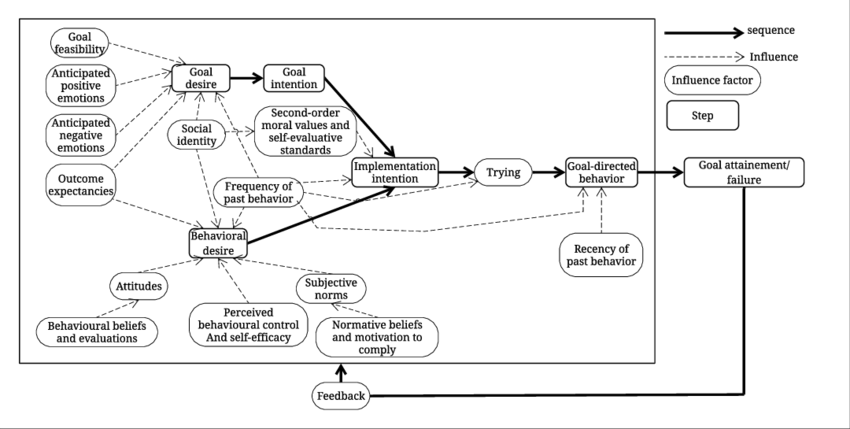
Bagozzis-purchasing-behavior-adoption-model

A New Model

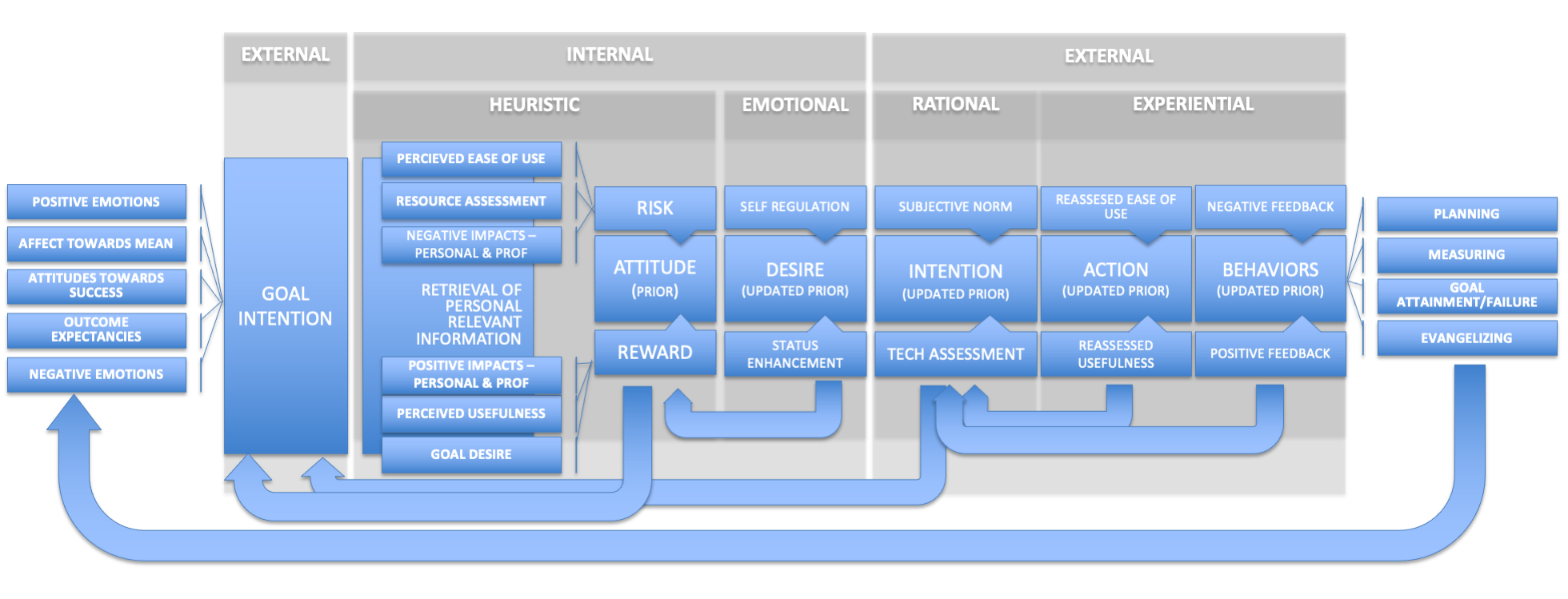
As the final step in this rather long process I’ve been dragging you through for the last several posts, I put forward a new proposed model for technology acceptance.
Slide1

I’ve attempted to include elements of Sense Making, Goal Striving and some of the more valuable elements from the original Technology Acceptance Models. I’ve also tried to show that this in an iterative journey – a series of data gathering and consideration steps, each one of which can result in either a decision to move forward (elaborate the frame) or move backwards to a previous step (reframe a frame). The entire model is shown below, but we’ll break it down into pieces to explore each step a little more deeply.


Setting the Frame
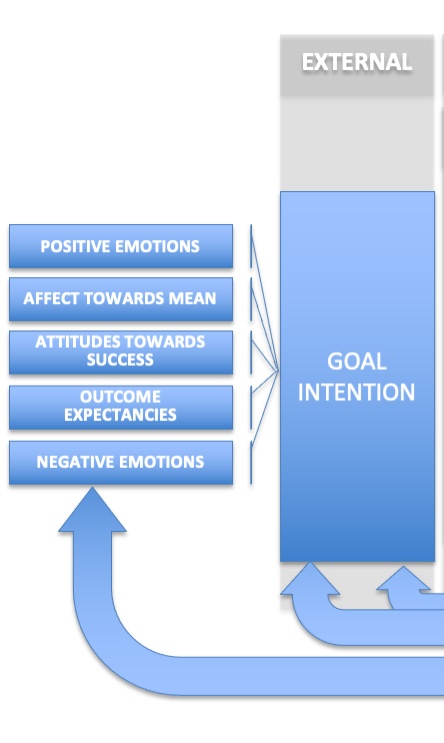
Gord Tam 1

The first step is to set the original frame, which is the Goal Intention. In this case, a goal is either presented to us, or we set the goal ourselves. The setting of this goal is the trigger to establish both a cognitive and emotional frame that sets the context for everything that follows. Factors that go into the creation of the Goal Intention can include both positive and negative emotions, our attitudes towards the success of the goal, how it will impact our current situation (affect towards the mean), and what we expect as far as outcomes. These factors will determine how  robust our Goal Intention is, which will factor heavily in any subsequent decisions that are made as part of this Goal Intention, including the decision to accept or reject any relevant technologies required to execute on our Goal Intention.

We can assume, because there is not an updating step shown here, that once the Goal Intention is formed, the person will move forward to the next step – the retrieval of internal information and the creation of our attitude towards the Goal to be achieved.

The Internal Update
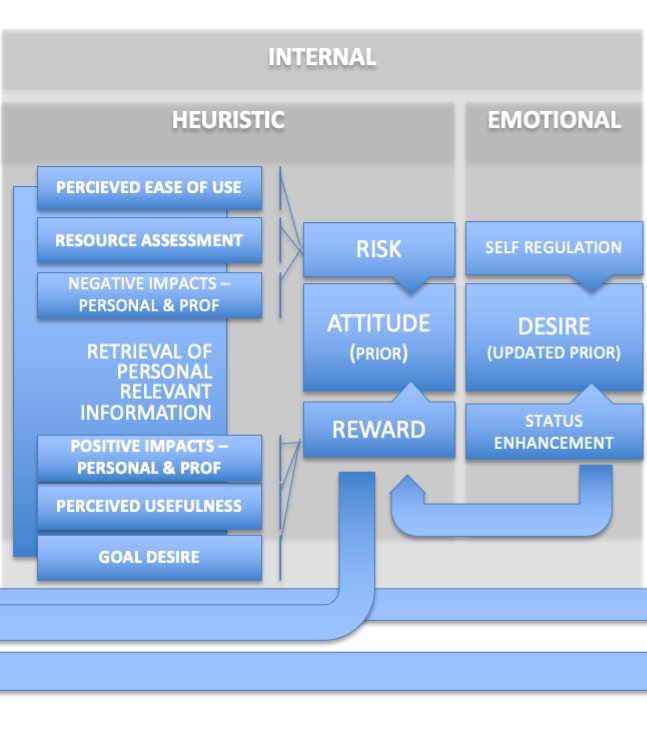
Gord Tam 2

With the setting of the goal intention, we have our frame. Now, it’s up to us to update that frame. Again, our confidence in this initial frame will determine how much data we feel we need to connect to update our frame. This follows Herbert Simon’s heuristic rules of thumb for Bounded Rationality. If we’re highly confident in our frame (to the point where it’s entrenched as a belief) we’ll seek little or no data, and if we do, the data we seek will tend to be confirmatory. If we’re less confident in our frame, we’ll actively go and forage for more data, and we’ll probably be more objective in our judgement of that data. Again, remember, Klein’s Sense Making model says that our frame determines what we define as data.

The first update will be a heuristic and largely subconscious one. We’ll retrieve any relevant information from our own memory. This information, which may be positive or negative in nature, will be assembled into an “attitude” towards the technology. This is our first real conscious evaluation of the technology in question. This would be akin to a Bayesian “prior” – a starting point for subsequent evaluation. It also represents an updating of the original frame. We’ve moved from Goal Intention to a emotional judgement of the technology to be evaluated.

The creation of the “Attitude” also requires us to begin the Risk/Reward balancing, similar to Charnov’s Marginal Value Theorem used in optimal foraging. Negative items we retrieve increase risk, positive ones increase reward. The balance between the two determine our next action. From this point forward, each updating of the frame leads us to a new decision point. At this decision point, we have to decide whether we move forward (elaborate our frame) or return to an earlier point in the decision process, with the possibility that we may need to reframe at that point. Each of these represents a “friction point” in the decision process, with reward driving the process forward and risk introducing new friction. At the attitude state, excessive risk may cause us to go all the way back to reconsidering the goal intention. Does the goal as we understand it still seem like the best path forward, given the degree of risk we have now assigned to the execution of that goal?

Let’s assume we’ve decided to move forward. Now we have to take that Attitude and translate it into Desire. Desire brings social aspects into the decision. Will the adoption of the technology elevate our social status? Will it cause us to undertake actions that may not fit into the social norms of the organization, or square well with our own social ethics? These factors will have a moderating effect on our desire. Even if we agree that the technology in question may meet the goal, our desire may flag because of the social costs that go along with the adoption decision. Again, this represents a friction point, where our desire may be enough to carry us forward, or where it may not be strong enough, causing us to re-evaluate our attitude towards the technology. If we bump back to the “Attitude” stage, a sufficiently negative judgement may in turn bump us even further back to goal intention.

The External Update
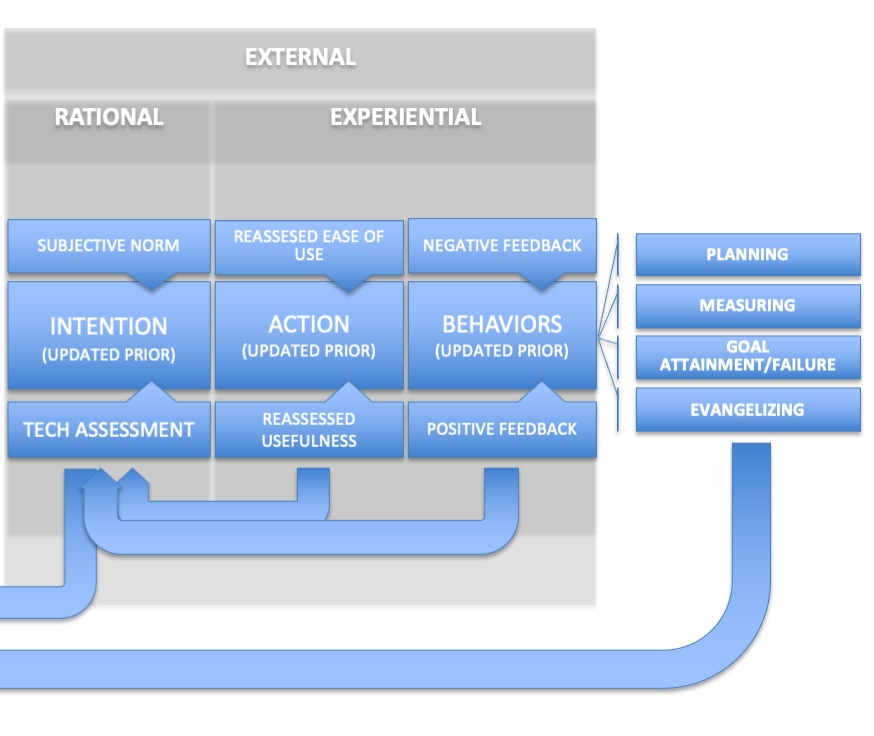
Gord TAM 3

With the next stage, we’ve moved from Desire to Intention. Up to now the process has been primarily internal and also primarily either emotional or heuristic. There has been little to no rational deliberation about whether or not to accept the technology in question. The frame that has been created to this point is an emotional and attitudinal frame.

But now, assuming that this frame is open to updating with more information, the process becomes more open to external variables and also to the input of data gathered for the express purpose of rational consideration. We start openly canvassing the opinions of others (subjective norm) and evaluating the technology based on predetermined factors. In the language of marketing, this is the consumer’s “consideration” stage. We know the next step is Action – where our intention becomes translated into behavior. In the previous TAM models, this step was a foregone conclusion. Here, however, we see that it’s actually another decision friction point. If the data we gather doesn’t support our intention, action will not result. We will loop back to Goal Intention and start looking for alternatives. At the very least, this one stage may loop back on itself, resulting in iterative cycles of setting new data criteria, gathering this data and pushing towards either a “go” or “no go” decision. Only when there is sufficient forward momentum will we move to action.

Here, at the Action stage, our evaluation will rely on experiential feedback. At this point, we resurrect the concepts of “Ease of Use” and “Perceived Usefulness” from previous versions of TAM. In this case, the Intention stage would have constructed an assumed “prior” for each of these – a heuristic assessment of how easy it will be to use the technology and also the usefulness of it. This then gets compared to our actual use of the technology. If the bar of our expectations is not met, the degree of friction increases, holding us back from repeating the action, which is required to entrench it as a behavior. This will be a Charnovian balancing act. If the usefulness is sufficient, we will put up with a shortfall in the perceived ease of use. On the flip side, no matter how easy the tool is to use, if it doesn’t deliver on our expectation of usefulness, it will get rejected. Too much friction at this point will result in a loop back to the Intention stage (where we may reassess our evaluation of the technology to see if the fault lies with us or with the tool) and will possibly cause a reversion all the way to our Goal Intention.

If our experience meets our expectation, repetition will begin to create an organizational behavior. At this stage, we move from trial usage to embedding the technology into our processes. At this point, organizational feedback becomes the key evaluative criterion. Even if we love the technology, sufficient negative feedback from the organization will cause us to re-evaluation our intention. Finally, if the technology being evaluated successfully navigates past this chain of decision points without becoming derailed, it becomes entrenched. We then evaluate if it successfully plays its part in our attainment of our goals. This brings up full circle, back to the beginning of the process.

Summing Up

The original goal of the Technology Acceptance Model was to provide a testable model to predict adoption. My goal is somewhat different, showing Technology Adoption as a series of Sense Making and Goal Attainment decisions, each offering the opportunity to move forward to the next stage or loop back to a previous stage. In extreme cases, it may result in outright rejection of the technology. As far as testing for predictability, this is not the parsimonious model envisioned by Venkatesh, but then again, I suspect parsimony was sacrificed even by the Venkatesh and contributing authors somewhere between the multiple revisions that were offered.

This is a model of Bayesian decision making, and I believe it could be applied to many considered decision scenarios. One could map most higher end consumer purchases on the same decision path. The value of the model is in understanding each stage of the decision path and the factors that both introduce risk related friction and reward related momentum. Ideally, it would be fascinating to start to identify representative risk/reward thresholds at each point, so factors can be rebalanced to achieve a successful outcome.

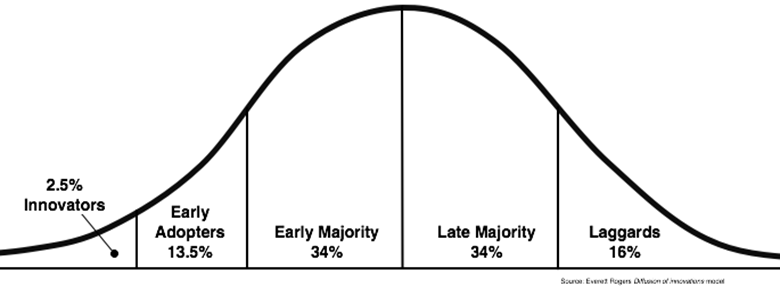
As we talk about the friction in these decision points, it’s also important to remember that we will all have different set points about how we balance risk and reward. When it comes to technology acceptance, our set point will determine where we fall on Everett Roger’s Diffusion of Technology distribution curve.


Those with a high tolerance for risk and an enhanced ability to envision reward will fall to the far left of the curve, either as Innovators or Early Adopters. Rogers noted in The Diffusion of Innovation:

Innovators may…possess a type of mental ability that better enables them to cope with uncertainty and to deal with abstractions. An innovator must be able to conceptualize relatively abstract information about innovations and apply this new information to his or her own situation

Those with a low tolerance for risk and an inability to envision rewards will be to the far right, falling into the Laggard category. The rest of us, representing 68% of the general population, will fall  somewhere in between. So, in trying to predict the acceptance of any particular technology, it will be important to assess the innovativeness of the individual making the decision.

This hypothetical model represents a culmination of the behaviors I’ve observed in many B2B adoption decisions. I’ve always stressed the importance of understanding the risk/reward balance of your target customers. I’ve also mapped out how this can vary from role to role in organizational acceptance decisions.

This post, which is currently pushing 3000 words, is lengthy enough for today. In the next post, I’ll revisit what this new model might mean for our evaluation of usefulness and subsequent user loyalty.