Dan Brown Rant

I’ve been surpressing this for a couple weeks now, but I’m threatening to blow a gasket if I don’t do some venting.

Enough with the frigging Da Vinci Code already!

While over in Europe, I fulfilled some lifelong dreams by visiting the Louvre in Paris, as well as Florence and Rome. But everywhere I turned, I kept bumping into adverts for the Da Vinci Code. The Louvre even has it’s own Da Vinci Code tour.

Okay, nothing against Dan Brown. I’ve read the book, as well as Angels and Demons and Deception Point. I enjoyed them. They’re entertaining, but they’re blips on the cultural radar. Mr. Brown is a writer on par with a John Grisham or a Michael Crichton. The plots are mildly interesting, the characters are about as thin as the paper it’s printed on and the dialogue is as stiff as the hard cover. The whole ancient religious sect angle raises it to slightly better than average, but just slightly. There is no justification for this tidal wave of attention that the book seems to be garnering. I thought it was restricted to this side of the Atlantic, but I was sadly disillusioned to see that it’s taken route in Europe as well. Give me a break, Paris, Rome and Florence, you’re better than this!

If you really want to see how this whole angle can be handled masterfully, take a big juicy bite out of some of Umberto Eco’s works. Compared to Foucault’s Pendulum or Name of the Rose, the Da Vinci Code is like a postcard of the original Mona Lisa.

Psst – Want a Hot Spot Paisano?

First published August 24, 2006 in Mediapost’s Search Insider

Surgeon General’s Warning: Prolonged exposure to the Internet can lead to physical dependency and addiction. Use of the Internet can increase levels of anxiety and reduce attention spans.Hello, my name is Gord, and I’m addicted to the Internet. I didn’t realize I was addicted until I recently spent three weeks in Europe and had to go through withdrawal. But after hanging around hotel lobbies trying to get a hit from a local hot spot, I’ve had to face up to the fact that I can’t kick the habit. I need my broadband, baby!

Fear and Loathing in l’Italia

I didn’t go totally cold turkey. I had my PDA to keep up on e-mails, but it just didn’t give me the rush I was looking for. Here I was, surrounded by the culmination of centuries of artistic achievement, and all I could think about was where my Google hook-up was coming from.

I speak somewhat facetiously, but there’s a lot of truth here. Here’s an online definition of addiction:

    1. Compulsive physiological and psychological need for a habit-forming substance.
    2. The condition of being habitually or compulsively occupied with or or involved in something.

It seems to me that going online qualifies on both counts. There’s no doubt that being online is habit forming. But it goes further than that. I realized in the last 20-plus days that it’s hard-wired into my physiology. Not having instant access was as foreign as not having my right hand.

I use online a lot, mainly to access and assimilate information. I enhance what I see in the real world by researching it online, letting me place it in context for myself. And for the past three weeks, every sense I have has been bombarded to the point of overload by input. Art, history, locations, music, literature, architecture, it was all right in front of me. Paris, Florence, Rome: cradles of civilization that I was standing in the center of, and it was if I couldn’t fully assimilate them, because I didn’t have access to an essential part of my cerebral hardware: the right brain, left brain and “wired” brain.

What’s it worth to you, amico?

The analogy carries even further. Accessing the Internet while traveling in Europe is rather like hunting for illicit substances, in that it can be difficult to find and notoriously expensive. Five euros (a little over six dollars U.S.) for fifteen minutes, thirteen euros for an hour, thirty euros for a day… I have a price list for hot spots around the continent imprinted in my memory.

I wasn’t the only one that went through withdrawal. My wife and two daughters showed similar symptoms, but for different reasons. For me, it was losing a logical and information-gathering extension of myself. For them, it was losing a communication channel. They have adopted e-mail as a primary way of keeping in touch (and instant messaging, in the case of my oldest daughter), and they felt somewhat cut off. This was somewhat demonstrative of the way men and women tend to use the Internet, something I talked about in a previous column.

This is your brain on high-speed

But addictions aren’t always harmful. One could argue that we’re addicted to oxygen. Breathing is certainly habit-forming. So is there anything wrong with developing a strong dependence on the Internet?

One theory that I have is that our brains tend to gear up a notch when we go online. There is so much we do through computers that we have difficulty  maintaining linear thinking when we’re online. Even if we’re focused on one task, there’s the knowledge that there’s e-mail to check, things to look up, a hundred other things that we could be doing. Being online seems to increase our level of both anxiety and distraction, just because it’s so damn useful in so many different ways. Focus is a tough thing to maintain.

We have seen manifestation of this trend in the way people act when online. It’s nothing short of frenetic, skipping all over the page, multi-tasking, grasping information in a hundred little forays around the screen. It’s a different interaction from much of what we do day to day. Is it harmful? I’m not sure, but it does seem to be making permanent changes in the way we learn and communicate.

Anyway, I’m back in the office tomorrow, and will once again have my cerebral cortex plugged back into the Matrix. I’ll be wired again. I guess that’s a good thing, but I’m sure going to miss the espressos, Chiantis and Calabrese salsiccia.

Oh, well, everything in life is a trade-off.

Usability and Asinine Comments from the Bay

Had a chance to catch one day of Jakob Nielsen’s Usability Week in San Francisco. Yesterday, I sat in on the eyetracking session and saw the results of the Nielsen Norman’s just completed study (numbers are still being crunched as we speak).

It was heartening to see that many of their findings mirrored our own, including F shaped scanning patterns, quick scans of pages and aversion of ads and large graphic blocks. It was in this last category that the asinine comments part comes (that’s why you’re really reading this, isn’t it?).

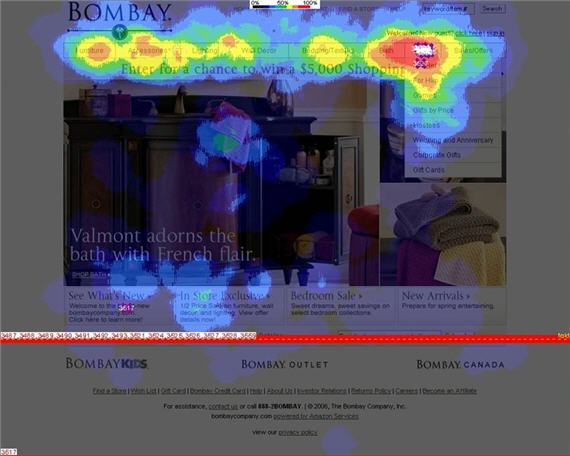
Jakob was demonstrating interaction with the home page of jcpenney.com. (The picture that I’ll be talking about has changed, but the basic page structure is the same). The heat map image showed clearly that the big block graphic, in this case a picture of a bed with a colorful spread, with some promotional text inset in the upper left and the lower right, received virtually no scanning. All the scanning was in the top navigation bar. The large block graphic “fenced in” the scan area, cutting users off from other promotional information that lay below the graphic. We saw the same thing occur with the Bombay Company site in a eyetracking study we did for MarketingSherpa (see below).

bombays

Some hot shot designer in the room decided to take exception with the proof in from of him, and called out some of the examples that Jakob has shown of large graphics that had received no scanning. He used words like apex composition and other regurgitated terms from a graphic design university text book to show that all the sites adhered to basic design principles and that the theoretical composition of the JCPenney picture was in fact spot on, drawing the eye from one promotional headline to the next. Jakob patiently pointed out the obvious, that the theory breaks down, because as the heat map clearly showed, no eyes were even being attracted, let alone drawn to any headlines. We settled back in our chairs, silently cheering the adroit handling of the blow hard in the back. Much to our amazement, the guy wouldn’t give up, continually going back to the point that the theory is right and works, despite evidence on a screen roughly 40 by 30 feet to the contrary. The mic finally had to be taken away from him.

A couple points here. Theories are theories, not fact. Heat maps are facts, at least for the sample of people in the study. And while you may argue that a sample of a couple hundred (the n of the NN/g study) isn’t representative, I would disagree. We’ve done enough to know that consistent behavior in eyetracking starts to emerge at about 10 people, then defines itself very clearly at 20 to 30 people. So designers, you just may have to forget everything you learned, because the way people interact with information is changing faster than new theories can be created. You have to keep an open mind.

Second of all, this guy was approaching this from a print paradigm, not an online one. His spouting of picture composition and eye flow comes from centuries of guessing about how we look at images. I remember talking to a university arts professor once who was really excited about eye tracking because we could finally find out if all the “crap that’s been spouted about how we look at paintings is even true or not”. I’m not saying century old principles are wrong, but you have to consider them in the appropriate context. Take our J.C. Penney picture. Mr. Design Dictionary is correct. The flow of the bed spread and the contours of the bed should hypothetically draw the eye from one headline to the other, if the eye entered the picture in the first place. In the print advertising world, photos act as an attractor. They grab the person who is reading adjacent, usually non relevant content, and pull them over to the ad. They are the entry point. If they do their job efficiently, you have altered the intent of the prospect. They have switched from reading a story to looking at your ad. The job of the photo is to channel this new intent to the right place.

With a website, you have the full intent of the user. That’s why they came to your site. A large block graphic gets in the way of that intent, and will be thin sliced out of the way. Worse, it could block the user from seeing the content on the site that they’re there to see. All the composition theory in the world won’t prevent that. Jakob’s point wasn’t that the picture was composed incorrectly; it was that the picture was a waste of valuable home page real estate.

Probably the most valuable thing I took from yesterday was a comment Jakob made as an aside. Branding online comes from the experience, not the exposure. This was in response to another comment somebody made about large graphics being present for branding purposes, and the seeming contradiction between the need for branding and best practices for usability. Online, a successful brand engagement and a successful user experience are the same thing. If you deliver efficiently on a user’s intent and make their online experience a pleasure, you will build more brand equity than you could ever build with gratuitous flash files, streaming media and huge graphics. The two aren’t mutually exclusive, but all too often online, the designers win at the user’s expense.

Tales of Mobile Woe

First published June 1, 2006 in Mediapost’s Search Insider

On Tuesday night, I was wondering aimlessly through the streets of Old Montreal, staring in hapless confusion at my Pocket PC. Prior to the trip, I thought I had passed into the elite of the technologically advanced road warrior. With Pocket Maps loaded, my hotel location pinpointed and a plethora of enticing little dots to explore, I set out on the cobblestoned streets, secure in the knowledge that the entire streetscape of Montreal was magically captured in my trusty iPAQ.

Exploring old-world Quebec, new-world style

I’m a pretty savvy traveler. I have a great sense of direction, usually study a map ahead to get the “lay of the land,” and can keep north and south straight in my head. My wife’s family often wonders how I do it, as they have no sense of direction at all.

I remember one trip to Vancouver with my father-in-law. I was heading for the Second Narrows Bridge to cross over into North Van, and was on the street that would take us right onto the bridge. My father-in-law asked where I thought I was going, and when I told him the bridge, he said I was way too far west; it was at least two miles further east. As we stayed on the road and eventually ended up on the bridge, he harrumphed and said they must have moved it. Obviously one of those migratory bridges.

So, with this innate ability, enhanced with my newfound technical navigational advantage, I figured there should be no stopping me. This was the trial run for a family trip this summer to France and Italy.


Input and output: kaput!


I got one block from the hotel and was totally lost. I had no idea where north and south were. The tiny 2.5- by 3.5-inch screen held no clues for me, as I zoomed in and out and helplessly panned around, looking for a street with which I could get my bearings. Street names sometimes appeared, and sometimes didn’t.

And the huge church in front of me, which I recognized as Basilique Notre Dame, one of Montreal’s most famous landmarks, for some reason didn’t show up on my diminutive map. Instead there was a little blue dot labeled “Vieux Seminare,” practically obliterated by hundreds of restaurant and hotel icons. I scratched around helplessly with my stylus as I slowly walked down the street, trying to pan to a section of map that looked familiar.

If you’ve never tried using a stylus while walking, be forewarned, you need the steady hands of a brain surgeon and the dexterity of a Cirque du Soleil performer. It’s not for the faint of heart. I would just get to a section of the map that looked promising when I would have to look up to avoid running into a lamppost or person and suddenly my stylus would leap across the screen and transport me to the nether regions of Montreal, miles from my current location. Once it accidentally opened a map of Manhattan, and I was halfway to Times Square before I realized what happened.

As I reached a square, I saw a map of Old Montreal conveniently placed for tourists, a real map, 3 feet by 4 feet, with icons that didn’t disappear and street names I could read. It was at a scale where I could look at more than a block of the map at a time and still see the points of interest. I pocketed the iPAQ, got my bearings and happily explored the rest of the Old City (which is fabulous, or as they say here, tres merveilleux) as the iPAQ dozed silently in its holster. Its wandering days are over.

And here we have the biggest problem with mobile. Getting information into it, and getting information out. We are not Lilliputians. My fingers can pretty much wipe out an entire family of BlackBerry keys in one swipe. And my thumbs are even more dangerous. This was not the way a 6-foot, 220-pound guy was meant to communicate. Give me a durable, beefy keyboard that can take my not-so-subtle advances.

The only thing meant to be seen on a 2.5- by 3.5-inch screen is Dr. Phil, because just when he gets to the peak of his self-righteous “I can’t help you unless you help yourself” diatribe, you can pretend you’re squishing his head between your thumb and forefinger. This also works with Donald Trump on “The Apprentice” and Simon Cowell on “American Idol,” by the way.

I dream of a heads-up display embedded in my eyeglasses, and a workable voice interface. You say what you want, and it instantly springs up in front of your eyes. Now that would be sweet. Hey, if anybody out there is working on this stuff, let me know. I’d like to buy stocks.

The wireless ransom

My first lesson with mobile data roaming came soon after getting the iPAQ. We hopped in the motorhome and headed to California. Of course, we experimented on the way with how nifty it was to check e-mail, look up Web sites and, for my wife, to chat on Messenger for several hours between Lincoln City and Florence (Oregon, not Italy) with her sister back home. We reached San Francisco and, in trying to locate Molinari’s delicatessen (a place you just have to get a sandwich, by the way), we just searched for the Web site, found the address and walked right to it. This was what being wired was being all about!

Then we got home and found out what being hosed was all about. We got the mobile bill: $800 in data charges for two weeks! Looking up the restaurant probably cost us more than the meal itself. I figure each of my wife’s Messenger chats averaged about 30 dollars. Since then, I’ve learned to not keep bringing up this point in domestic discussions.

Until we get some broadband upgrades, standardized rates and roaming agreements that cost less than the GNPs of most small countries, we’re scared to death of going online on a mobile device. It’s like going into your lawyer’s office. You get in, get what you want to say said, and get out. You don’t comment on décor, mention children or bring up holidays. At 300 bucks-plus an hour, it would be cheaper to call a 900 number and chew the fat about female self awareness with Jenn and Barbie at Dial-a-Date.com.

Convergence soon, please!

The third leg of the mobile conundrum is the usefulness of the apps you use. At first glance, they look great, but anemic features, lack of computing power and restricted storage space make you realize their limitations all too quickly. The concept is great; the execution leaves a little to be desired.

Case in point: although you can find points of interest in Pocket Maps, you can’t link them together with suggested routes. I realize the data to calculate the routes is a little much to expect from a Pocket PC, but why does it have to be that way? Isn’t technology here to solve our problems? Anyone trying to create an itinerary on the fly will soon give up.

Also, the points of interest and landmarks you find just give the title and address–nothing else. Even if they did give you a Web site link, you’d be afraid to click on it because Web sites get totally hacked on the small PDA screen, take forever to load and cost you a small fortune to access.

The promise of things yet to come

I want a smarter mobile navigational and search experience. I want to be able to indicate my starting point on my GPS-enabled mobile computer, feed in my interests, get a real search online function to help me find locations (Pocket Map’s 2006 is an improvement over 2004, but leaves a lot to be desired), have the best routes indicated, give me one-click access to information, menus, entertainment, prices and reservations for restaurants, integrate reviews and best- of lists like CitySearch and TripAdvisor, and switch to a satellite view if I wish.

Better yet, I’d like to indicate times I’d like to take a sight-seeing tour, a time I want to stop for supper, and have my PDA work as a smart assistant for me to take my likes and dislikes and provide me with a list of suggestions for my approval. Upon approval, it would lay out the best route and point out landmarks I should look for on the way. As always, search will be the functional layer that ties it all together.

Or think what shopping with a super-smart PDA would be like. You are in a shop and see something you absolutely love. You scan the label with your PDA and see if there are any others in a four-block radius at a lower cost. There is, in a store two blocks east (the map is already drawn) and in different colors. You send a request to the store to set them aside. You start delivering mobile functionality like that and you’ll leave desktop -bound PCs in the dust.

I’m sure most of the capabilities I dream about lie here and there in development, tiny little fragments of a yet-to-be-integrated solution. When it comes, it will be a wonderful thing. But for now, when I’m on the road, the iPAQ will probably spend more time in the holster than out of it. I haven’t totally given up yet, though. The Bluetooth GPS receiver I ordered from eBay is on its way, if it didn’t get lost!

Welcome to the Search Marketing Sweat Shop

First published May 25, 2006 in Mediapost’s Search Insider

In the latest Business Week, buried on page 70, there’s a story about outsourcing in search marketing. The story is titled “Life on the Web’s Factory Floor,” and it’s about the thriving business in assembling search marketing ads.

From the description, it sounds like search marketing is nothing more than a big Scrabble game. You throw a bunch of combinations of words up in the air, see how they land. and cut and paste them into your ads. In fact, in the story a search marketing specialist is defined as someone who “types phrases to drive ad traffic.” One gets the mental image of the proverbial room full of monkeys sitting at typewriters. At least the writer, Burt Helm, called the process “slightly creative.”

R-E-S-P-E-C-T: Find out what it means to SEM…

I admit there are companies, some thriving, who take this sweat-shop approach to search marketing. But every time I see the mainstream press reduce my passion to this elemental level, I die a little bit inside. I’m already having enough trouble explaining what I do for a living. Just this past weekend, I was trying to explain to an importer/exporter the rapid growth in search marketing, and what I did most days between 7 a.m. and 6 p.m. He had no idea the search marketing industry existed, and when I told him it was a $7 billion dollar a year industry (just guessing at where we’ll be this year) I could see the question in his eyes. “How the hell can $7 billion change hands in an industry that doesn’t seem to be based on anything?” I’ve been struggling with this attitude for years now, and had finally thought that I was past it. But in one short weekend, with the help of a two-page story in Business Week, I’m right back where I started.

Perhaps the problem is that most users’ touch point with search seems so simple. I type in words, I see words come back–and not a lot of them, either. Most messages are 15 to 20 words at most. How hard can it be? It’s this prevailing attitude that has made search the bastard child of the online ad space. We get no respect. From the outside, it seems like anyone with an IQ topping 60 could market this way. So agencies launch search divisions. Large companies find people that seem to have no pressing items on their to-do lists and make them the new director of search marketing. Everyone throws their hat in the ever increasing search marketing ring.

HELP, I need somebody (preferably a search marketer)…

As an aside, I always find it enlightening to sit at a table during lunch at a Search Engine Strategies show where I don’t know anyone. As introductions are made around the table, you can bet you’ll flush one of these newly minted search marketers out of the crowd. The story is usually the same–the boss thought it would be good to come to the show and “get up to speed.” They look at you with hapless confusion, shell-shocked with the sheer amount of data to digest. Four days, four tracks crammed with information. That’s well over 100 sessions and 400 individual presentations, all dealing with some nuance of search marketing. Before the show, these people thought they had search pretty much pegged. At best, they thought they’d pick up a hint or two. They come back from the show realizing they’ve just jumped into labyrinth of arcane knowledge and tactical expertise.

I Fall to Pieces…

It’s the sheer volume of minutiae in search marketing that makes it such a daunting proposition. I’ve been immersed in it for over 10 years now and I can tell you, there’s no way one person can stay on top of it. That used to be possible, but it’s not today. Even Danny Sullivan and Chris Sherman can’t keep up, and they work unbelievable hours to try.

Search is advancing on all fronts at once. You’ve got Google, Yahoo and MSN trying to gobble up new online territory at a frightening pace. You’ve got new players like MySpace emerging (for the first time, ComScore has included MySpace in its search share numbers). You’ve got new ways of using search, for broadband, on mobile devices and for finding local advertisers. And on top of that, we’re just starting to understand how, when and why consumers use search. I remember once in high school chemistry a classmate spilled a bunch of mercury on a workbench top. A hundred little globs of quicksilver scattered everywhere, proving impossible to round up and contain. That’s what search is like, multiplied by a factor of 100.

It’s Only Words, and Words Are All I Have…

I suppose when you pick search apart at the single message level, it can look pretty simple compared to other channels. Consider the time required to put together one message for one key phrase, compared to what it takes to put together a television ad.

We know that there’s this whole sexy industry behind television ads, with actors, special effects, huge buys and (sometimes) brilliant brand strategies. Now that’s something to admire. They’re like little tiny movies, and we all love movies. But a search ad is, well, just a few words thrown together. What we forget is that every key phrase is its own campaign, infinitely controllable and measurable. For the big search advertisers, that can mean millions of individual campaigns. We buy customers by the penny, building business click by click in a grueling marketing marathon.

There are a lot of moving parts to each of those campaigns, including page placement, maximum bids, messaging, landing page performance and other conversion factors. We obsess over numbers, fine-tuning each campaign to provide maximum performance–or at least, that’s what search marketing should be. It’s this incredible granularity that makes search such a challenge to execute properly.

Search is not easy. Given the choice, I think it would be far easier to consolidate your marketing strategy into a few television ads that are measured on an ephemeral “brand lift” metric, rather then fragment it into millions of individual campaigns, each measured down to the click.

I realize there’s a paradox here. I know it’s this incredible amount of detail that gives rise to the web factories that Burt Helm talks about in Business Week. There’s a lot of heavy lifting to be done. But don’t discount the entire industry by simplifying it down to a room full of people throwing words together. That’s one rather unfortunate aspect of an incredibly dynamic marketing channel. “Typing phrases to drive ad traffic.” Give me a break!

Day of Reckoning Coming for Big Brands; or, to Hell and Back on United

I’ll start with a caveat: I’m PO’d. I spent a night from hell on Tuesday trying to get to Toronto from Chicago. But I hope in the midst of my spouting I get a valid point across.

First, the story of why I’m PO’d. I was flying United on what was supposed to be a one hour hop from Chicago to Toronto. By the way, United asked over $500 for this hop.

I start off by grabbing a sandwich at a little express counter by the gate from a place called Reggio’s To Go. A basic ham and cheese cost me about 8 bucks. This is an airport, so I’m not expecting great things from the 8 dollar sandwich, but even with those low expectations set, I was surprised by how abysmal the sandwich actually was. I had to check twice to make sure it was the sandwich I was eating and not the packaging. It tasted like it had been sitting in the display case since the early Bronze Age. I happened to glance at the sign for Reggio’s, which is obviously a franchise. The brand message is “Fresh and Ready to Go”. “Ready to go” in the garbage seems to be what they meant.

We’re on board by 6:15, the scheduled departure time. The plane is packed, leg room is negligible, and to make matters worse, the person sitting to my immediate right is just coming back from Japan. There’s no room left in overhead, so she tries to jam a roller suitcase, a backpack and a large shopping bag under the seat. None of the 3 fit, so she piles them on the floor between her legs, hoping no one will notice. Nobody does..or at least, nobody mentions anything. This makes the already scarce leg room even more restricted. By this point, I’m resigned to a miserable one hour trip, but then again, it’s an airline, so I didn’t really expect anything more.

The plane is unbelievably hot, but no worries, we should be in the air soon, and hopefully the plane will cool down. We wait, and wait, and wait. After what seems like a century, the pilot comes on and let’s us know they’re having a problem with the fuel gauge. They’re going to try to fix it to know how much fuel we actually have, and then we’ll be on our way. I think it was about this point I passed out from sheer heat exhaustion. After another 20 minutes or so, I woke up, my neck screaming in agony, my legs dead from the waist down, and sweat starting to drip from my forehead. The fuel gauge is still not working, and there’s no progress in sight. After another 30 minutes, it appears that the fuel gauge is thwarting the best efforts of United’s top maintenance crew, so they at least let us off the pressure cooker, 90 minutes past departure time and no closer to Toronto. Somebody insightfully wonders aloud about what they used for a fuel gauge on the flight in?

We get to the gate and are told to stay close for updates. The passengers with connections try to get rebooked. They’re understandably upset. But United’s gate agents seem to think the best approach is to meet rudeness with rudeness. The agents are short tempered and surly, snapping at passengers who have the nerve to see if they can somehow get to Toronto before the clock strikes midnight. “Is your luggage checked? Yes? Sorry then, I can’t do anything for you. Go sit down.” I swear to God, that’s the exact quote I heard.

After another hour and a half at the gate, the recalcitrant fuel gauge gives in and we get back on the plane. We finally get in the air by 10, almost 4 hours after the scheduled departure time. The pilot came on to thank us for our patience and assures us we have 3 of United’s finest flight attendants looking after us. There’s nothing wrong with them, but there’s nothing very right either. There was absolutely no attempt to make it up to us. No gesture of apology. If these are United’s finest, the hiring standards must be pretty low.

As we touch down in Toronto, the pilot comes on again and thanks us for flying the friendly skies. Friendly skies? Frat house initiations are less painful than what I just went through!

And here’s my point. Brand messaging has to be more that a cool line for your ads. It should be a promise. It should drive every aspect of the company. It should embody the unique value you offer. I had the chance to share the keynote spotlight at a recent show with David Neeleman, CEO of JetBlue. David quipped at the beginning that when they started JetBlue, their goal was to raise the bar of the airline industry. Quickly they realized that within the industry, the bar was set so low that you could crawl over it. They soon had to look outside the industry to find examples of best practices that meant something.

The brand relationship should be built at every customer touchpoint. I had a number of touchpoints with the United brand on Tuesday, and the sum total left me feeling like I’d been mugged. If United really believes they offer a friendlier experience, then every employee should embody that attitude. None of the ones I met yesterday seemed to have been let in on the secret. The attitudes ranged from indifferent to downright surly.

United has probably spent billions getting their brand message out through advertising. But do you think they could spring a few hundred bucks to treat us all to a drink, or even a free cookie when it really mattered? Brand is built on the front lines, face to face with a customer. It’s delivering when the chips are down. It’s taking responsibility for a positive customer experience, and doing what it takes to fix it when it’s not. United abdicated this responsibility, so their brand message became nothing more than a brand lie. It’s worthless to me. In fact, it’s worse than that, because United just dug a hole for themselves with me that they may never get out of. I will avoid United like the plague from this point forward.

The same is true, to a lesser extent, with Reggio’s and the world’s worst sandwich (somewhat ironic, because I had one of my best sandwiches in Chicago the day before). If their slogan is to be any more than another brand lie, then they have to deliver edible food. The brand has to mean something. How do they expect it to mean something to the consumer when the company itself doesn’t believe the brand message?

Up to now, companies could get away with this. You could screw over the consumer and their circle of influence was limited. Sure, they’d complain, but as long as you kept bumping millions into slick TV ads painting idyllic pictures of brand nirvana, you could keep the ruse going. It was the “sucker born every minute” approach to advertising. But those days are coming to an end. Now, when I call bullshit on a brand message, I have an expanded reach through the internet. Some call it consumer generated media. I call it Bitching 2.0.

There’s a new ecosystem developing online. Marketing theorists have long known of mavens. Mavens are a key component in social epidemics, as Malcolm Gladwell pointed out in the Tipping Point. Traditionally, they’re the ones that have been entrusted to keep brands honest. They are the uber-consumers that the rest of us look for guidance to. They tell us what’s good, and what’s not. Traditionally, they needed social connectors to spread the word.

But what happens when you give a maven a blog? Suddenly, connectors are built into the infrastructure of the web. I would argue that the new mavens are the ones with the most read blogs. They’re thoughtful, they’re well informed, and many of us have them pegged in our feed readers. Suddenly, the scope of their influence expands exponentially. As an example, my blog is only a few weeks old, but most of my posts are read by hundreds of people. If I get a link in another blog, the viral impact starts to take over. My rant against a bogus brand message could reach thousands. And there were at least a hundred other passengers on that United flight, just as PO’d as me, any of which could be a blogging maven. The web puts the spread of word of mouth on a dramatically expanded scale, on a compressed timeline. Also, it makes word of mouth, traditionally a fleeting thing, into a permanent fixture online. This blog post will live in perpetuity on the web, searchable by any search engine. Suddenly, the big brands can’t take the reach of a single consumer for granted.

To me, this shift of power to the consumer is one of the most exciting aspects of the web, and it’s long overdue. Now, we have the power to force corporations to keep their brand promise, or perish.

And to the staff of United Flight 1110, let me pass this along. The definition of “friendly” is:

  1. Of, relating to, or befitting a friend
  2. Favorably disposed; not antagonistic
  3. Warm; comforting.

Please pass it along to every United staff member you know.

Ooops! It Really is a Small World After All

The Traffic Power guys are really too much. I had told you about the complaint that came my way from them. Seems these guys are also implying to prospective customers they have an “in” at Google because of a friendship with certain head engineers. Which engineers you ask? Well, the name Matt Cutts seems to be bandied about.

Hmmm..I know Matt. Wonder if he knows certain SEO’s are using his name in this manner? I just happened to have an email from a Traffic Power rep forwarded to me from a client that hinted at this special relationship. And I may have accidentally forwarded this to Matt. Ooops.

Matt’s words, “Extremely uncool”. Yeah..I’d echo that one. Come on, our industry has enough challenges without this. If an SEO tells you he’s friends with Matt Cutts, or any other person at any of the search engines, that’s one thing. It’s a small biz and we’re all pretty friendly. But if anyone hints that the keys to the church are for sale, based on a personal relationship with Matt or anyone esle, don’t believe them. Matt’s helped us out on occassion in understanding how Google indexes a site, just like he’s helped thousands of webmasters. That’s his job. But when it comes to influencing search results, there’s a church/state divide that just won’t be breached. Nuff said.

We’re Jet Setters, But Where’s the Paparazzi?

First published April 27, 2006 in Mediapost’s Search Insider

April has been a tough month. At last count, I’ve been in nine different cities (not including my home), a ski resort, on four different airlines for a total of two dozen flights and connections, in eight different hotels, at six different shows, and have also packed in assorted client and organizational meetings. I’ve been spending more time with search marketers than my family, and that can’t be a good thing. As lovely as Anne Kennedy, Greg Jarboe, Kevin Lee and Dana Todd are, I’m pretty sure we’re not related in any way. And I actually had to nix at least two shows from the agenda. It could have been worse!

My perception of reality is getting a little skewed. When you do too many industry shows in a row, you get a distorted sense of your own importance. In SEM circles, I’m fairly well-known. People tend to come up to me in the halls after a presentation and introduce themselves. Many are readers of this column. So, in my own, insignificant way, I guess I’m somewhat famous in search circles. But a rude awakening comes when you actually step out in the real world. The average ticket agent for American Airlines doesn’t really care that I helped define Google’s Golden Triangle or have spoken to standing-room-only audiences at SES in New York. It doesn’t get me a first class-upgrade. Those accomplishments also hold little weight with my wife, just in case you were wondering. The line “Do you know who I am?” usually lands with a decidedly flat thud whenever I try it.

The division between the search world and the real world has led me to postulate on the life of the average search marketer. We seem to be always jetting to some search hotspot (it’s not as exciting as it sounds; one hotspot happens to be Chicago in December). Our lives are lived on laptops and PDAs. We have all the trappings of a high-powered celebrity lifestyle, without the celebrity or the accompanying discretionary income.

If you’re part of the “circuit,” there are no shortage of speaking opportunities. There are search sessions everywhere, including a brand-new crop springing up to join the venerable stalwarts such as Search Engine Strategies, Ad:Tech and Webmaster World’s PubCon. Increasingly, there are cross-country “road shows” as well as demand for search-savvy speakers at other vertical industry shows. One could probably make a full-time job out of speaking, if one chose to. Just in case you’re interested in this job, the busy seasons are the spring and fall.

In part, this reflects search’s current status, caught somewhere between big business and cottage industry. The proliferation of speaking opportunities reflects the growing interest in search, and the demand for speakers is indicative of the relatively small number of thought leaders in the industry who are used to speaking in front of crowds. The ones who have proven themselves tend to find themselves a hot commodity. And for the most part, we do it for free, often covering our own travel costs, in return for raising our profile and hopefully attracting new business to our respective companies. We go from city to city, bleary-eyed and jet-lagged, promoting the gospel of search for all who care to listen.

From the outside, it looks to be an enviable position. In fact, some grumble that we in SEM’s elite “inner circle” unfairly use our connections to grab all the plum promotional opportunities. I understand, because I was once on the outside, looking at how to get in. I used to stalk Danny Sullivan and Chris Sherman at the shows, trying to figure out how to grab a spot on a session panel.

I can certainly share what worked for me. Come up with something different to talk about. For us, it was search user research, and we’ve invested thousands of dollars and man hours in different studies to give us the content we speak about at the shows. Be original, because it’s tough to be a thought leader when you’re just echoing other people’s thoughts.

But a word of warning: be careful what you wish for. Sure, the life of a search marketer may appear to be fast-paced and glamorous, but underneath it all, we’re really just the same as you, very humble and ordinary, and really, really sleep-deprived.

Of course, I’m probably just tired and grumpy. Did I mention that it’s been a tough month?

Is Search a Leech on the Internet?

First published February 23, 2006 in Mediapost’s Search Insider

Search is rapidly turning from the darling of the Internet to a demon. The latest attack, brought about by search’s phenomenal financial success, is that search is sucking all the value out of millions of Web sites by scraping content in bite-sized pieces and doling it out to searchers, at the same time monetizing traffic that’s being driven by content created by the site owners, not the search engine.

Usability guru Jakob Nielsen ran a post on his site a few weeks back taking the engines to task for fostering dependency on search traffic, while at the same time enjoying the impact of ever-escalating bid prices. A few analysts have also started to intimate that perhaps it’s time for marketers, especially those in direct response, to look beyond search, as click prices move the cost per acquisition beyond what’s reasonable.


Usability: Too Much of a Good Thing?

In a somewhat ironic twist, Nielsen illustrates how improved usability can be a big factor in driving up bid prices. When a new online search market emerges, bid prices usually settle out based on the relative conversion performance of the main bid contenders. Based on their current conversion and closing rates, the smarter search marketers determine what they can afford to pay per lead. But let’s say that one of the contenders suddenly makes its site a better conversion vehicle, doubling their capture and close rate. Suddenly, that marketer can bid twice as much and still end up with the same per unit ROI. It becomes more aggressive in bidding, and eventually, its competitors wake up, figure out what happened and launch their own improvement cycles. Bid prices escalate as marketers optimize every aspect of their campaign, and the search engines double their revenue by doing nothing. In this scenario, not only are engines leeches on the content of the Internet, they’re also sucking the blood out of the entire search marketing industry. The better we get, the more money they make.

Now, before we round up the lynch mob for the engines, there are a few things that have to be said on their behalf. In cases like what was described above, search acts as the initial matchmaker between a site and a prospect. True, if it’s a one-time transaction, search can skim off a substantial portion of the value realized from sale, but if it’s a situation where lifetime value is a multiple of the first sale, the returns from that search lead will far outweigh the one-time cost. Nielsen also acknowledges that traffic generated from organic referrals doesn’t add anything to the search engine coffers. While he dismisses this traffic source in one brief mention, I think it should be realized that search engines have continued to provide this service, devoting a substantial portion of their page real estate to organic listings. 3 out of every 4 users are still clicking on these listings.


Search: Providing Quick Answers

Another concern expressed by Nielsen, which has also been vocalized, very loudly, by the World Association of Newspapers (http://news.ft.com/cms/s/d0e8cf3e-928d-11da-977b-0000779e2340.html) is that many users use search as an answer engine. They need a quick answer to a question (i.e., what movie had Brad Pitt’s first starring role?) and often they don’t have to go any further than the search results page to find it. The answer is often contained in the snippet of text that comes from the listed site. If you did the search above, you’d find that the site tiscali.co.uk has the answer (“Dark Side of the Sun,” by the way). The content came from that site, answered your question and you’re merrily on the way, arguing about who played the corpse in “The Big Chill.” But that’s far from the experience the owners of tiscali.co.uk wanted. They pay for their site by selling advertising. On the page that snippet came from are three separate ads. You didn’t see any of them, but you did see the ads the engine chose to show you.

Is this a grey area? Absolutely. But the organizations that are investing in the production of that content that the engines so nonchalantly pilfer are getting tired of contributing to Google’s ever increasing bank accounts. While publishers (including book publishers) acknowledge that the search engines are necessary for connecting users with their content, they don’t want those same users stopping at the search results page, having found what they were looking for. Gavin O’Reilly, president of the World Association of Newspapers, summed it up, “We need search engines, and they do help consumers navigate an increasingly complicated medium, but they’re building (their business) on the back of kleptomania.”


The New Golden Rule of Online

While I understand the frustration, I think it’s time for a reality check. The fact is, it’s the new User Rule for online: Those that have the users, make the rules.

Search works. Users know that. With that come some positives, and some negatives. The way I see it, search brings much more to these content sites than it takes away, so it’s not a parasitic relationship. Would these sites be happier if the search engines didn’t index their content at all? If so, that’s doable with a simple robots.txt file. If not, quit your whining and get used to it!

Of Serendipity and Search Engines

First published in Mediapost’s Search Insider on Dec 13, 2004

I love the word serendipity. It’s like an entire poem in one word. Just saying it out loud makes you feel… well… serendipitous.

So, this week, with the holidays approaching, I was in a serendipitous mood and started noodling (another favorite word) with my Google toolbar. “Hmm” I said to myself, “I wonder how Google ranks on Google for the words “search engine.” Google’s whole promise is to bring the best to the top, right? So which search engine is Google giving its all-powerful vote of confidence?

Well, no one, as it turns out. SearchEngineWatch.com, Jupiter’s portal for search marketing and optimization, grabs the coveted top spot. So, surely, Google must be second. Nope, that would be Lycos. Now, as far as I can remember, Lycos is dying a long and lingering death, but according to Google, they’re No. 1. Well, actually No. 2, behind the site that isn’t a search engine.

In fact, Google ranks itself fifth, behind Dogpile and AltaVista. Can it be? Does Google have a secret inferiority complex? Is the cockiness of every Google employee I’ve ever met just a front for a shuddering mass of vulnerability? I dig further.

What if I refine my search? Let’s try “smartest search engine”. Oops, no search engine I recognize makes it to the top 10.

Okay, how about “best search engine”? Again, there aren’t too many familiar names in the top 10, although Dogpile does manage to sneak in at No. 8.

I’m getting desperate now, and serendipity is hanging by a thread, in mortal danger of giving way to unhealthy obsession. I type in “Larry and Sergei’s search engine,” figuring it’s time to get really specific. The strategy is lost on Google, which again serves up a list of unfamiliar sites, with the exception of Go.com in the No. 10 spot. Well, at least the first two letters are right.

One last stab in the dark: “Search engine with recent IPO that’s aiming for world domination.” Nada.

Maybe I’m using the wrong engine. I switch to Yahoo! And sure enough, there’s no identity crisis here. Yahoo! proudly ranks itself No. 1 for “search engine” and in a concession to the competition, throws the No. 2 spot to Google. Apparently, Yahoo! thinks more of Google than Google thinks of itself.

Let’s take Microsoft’s new algorithm for a spin. Again, MSN thinks a lot of SearchEngineWatch and gives them the top spot. And guess who gets No. 2? Google. Looking down the page, I see Search.com, AltaVista, Dogpile, Lycos, Northern Light (are they still around?), Webcrawler, and… no MSN. Didn’t even break the top 10. Well, maybe they haven’t gotten around to spidering themselves yet.

It’s time to Ask Jeeves. First, I had to scroll down past a zillion sponsored ads that pushed the real results off the page. And when I finally got to the results, they did a pretty good job of nailing the top engines. Like Yahoo!, Jeeves doesn’t mind blowing his own horn. Ask Jeeves is No. 1, Teoma (owned by Jeeves) is second, AltaVista third, Lycos fourth, AlltheWeb fifth, and Google comes in a distant sixth. Webcrawler, Dogpile, Yahoo!, and Excite round out the top 10.

All relevant, and all search engines, although the one-two finish of Ask.com properties smacks of a little judicious human intervention. Seems that Jeeves might know his stuff, even if he is a little egocentric. Google thinks Lycos is a search engine powerhouse, so how does Lycos feel about itself?

Well, Lycos apparently has no idea what a search engine actually is, because the only two search engines to break the top 10 are Overture and AOL. HotJobs is No. 1 and an eBay page for Thomas the Tank Engine is firmly embedded in the No. 3 spot. At least the HotJobs link might come in handy for the engineers currently working on the Lycos search algorithms.

There seems to be a building ground swell for AltaVista. Could this be a dark horse? I went to Yahoo!-owned AltaVista and found out that once again, the portal SearchEngineWatch takes the top spot. Is it coincidence that a portal for search engine optimization consistently takes the top spot, beating the engines at their own game? It’s deliciously ironic, if you ask me.

The irony continues with the fact that Google takes the No. 2 spot on the competitor’s engine, with hometown favorite AltaVista in No. 4, Yahoo in No. 5 and Dogpile in No. 6.

Survey Says…

And so, in a serendipitous, non-scientific poll, using GordRank, a sophisticated algorithm of my own invention, here are the top search engines, as ranked by the search engines themselves

1. Google (ranked higher by almost all the competitors than Google ranked themselves)
2. AltaVista
3. Yahoo!
4. Dogpile (yes, Dogpile)
5. Lycos
6. Teoma
7. All the Web
8. Webcrawler
9. Hotbot
10. Metacrawler

There are a couple of points that have to be said. Perhaps Larry and Sergei could hire a search optimization firm to help them rank better on Google. I know they have the money and it seems to be a challenge for them.

And despite Bill Gate’s bravado and bank account, no one seems to know that Microsoft has a search engine. Not even MSN!

Til next year, Happy Holidays!