The Art of Contradiction

First published March 28, 2007 in Mediapost’s Search Insider

From “The Argument Clinic,” Monty Python

Michael Palin: An argument isn’t just contradiction.
John Cleese: It can be.
Michael Palin: No it can’t. An argument is a connected series of statements intended to establish a proposition.
John Cleese: No it isn’t.
Michael Palin: Yes it is! It’s not just contradiction.
John Cleese: Look, if I argue with you, I must take up a contrary position.
Michael Palin: Yes, but that’s not just saying ‘No it isn’t.’
John Cleese: Yes it is!
Michael Palin: No it isn’t!
John Cleese: Yes it is!
Michael Palin: Argument is an intellectual process. Contradiction is just the automatic gainsaying of any statement the other person makes.
(short pause)
John Cleese: No it isn’t.

I think the world of SEO has spun into a prolonged Monty Python sketch. The flavor of the month seems to be manufactured debate designed to take up polar opposite positions on any given topic. There’s nothing like a little dustup online to get the creative juices going and generate a lot of blog activity, and, if the topic of that debate strikes enough nerves, a corresponding bushel of new links. It seems like no matter what someone says, someone else in the blogosphere automatically takes the contradictory viewpoint, sometimes not so much because he or she disagrees — but just because they want to post a comment on their blog and generate some links.

You Say “Potato,” I Say “Patattah”

There’s nothing new with online debate, but in the past it tended be fueled by real passion. Today I suspect that we’re all scanning the online landscape, looking for a viewpoint that we can be diametrically opposed to, just for the sake of generating some dialogue and some link bait.

And, just so we can be crystal-clear about this at the outset, when it comes to the above practice, I’m guilty as charged. In the past couple of months I’ve engaged in at least three or four of these debates in my own blog. Some I truly felt passionate about and some were simply me jumping on the other side of the question for the sheer purpose of having a little fun and perhaps generating a comment or two. Perhaps the low point of this particular form of online content generation reached its lowest point when both I and fellow SearchInsider David Berkowitz decided to open up the debate in this column on no less worthy a topic then Kevin Federline (just kidding, David, I know this wasn’t just a heartless exercise for you. I’m sure you’re very passionate about K-Fed.).

Dispassionate Debate

But I have to wonder how effective we can be in arguing if we don’t truly believe in the viewpoint that we’re arguing for. Dispassionate debate is supposed to be something we learn at school. We get randomly assigned one side of an argument, and it’s our job to effectively argue that viewpoint whether we believe it or not. The advantage of dispassionate debate is that you tend not to shoot your mouth off too fast. You take the time to do some research, learn the facts, and construct a logical argument without your face turning red, your heartbeat racing and your blood pressure rising through the roof. I’m the first to admit that when someone strikes a chord with me, I tend to take it a little more personally than I should — a situation I’m currently finding myself in with one of my blog debates.

Get The Juices Going!

But the debate that really get the juices going are those things we truly believe in. Just look at how passionate an entire industry got when the very validity of SEO was questioned. Take a browse through some of the hottest threads in either Webmaster World or Threadwatch and see how vitriolic comments can get when the raw nerves are exposed.

Passionate ideological debate is a good thing. It’s what built our society and it’s what’s driven the evolution of our civilization. If we can keep the focus of the debate on the validity of the ideas and not the person making the argument, then debate is a very good thing. It’s healthy, it lets the air in, it exposes ideas and allows us to ruminate on them. And if it happens on an online forum and it happens to help reinforce the structure of the Web by generating new links, then so be it. Again, it’s just one more way to where the Web takes the things we’ve always tended to do and elevates them to a new level.

In one particular debate I was told I should not take it so personally. After 45 years of living with myself, I realize I’m just not wired that way. I do tend to take things personally — and that’s usually what prompts me to post comments, whether they’re in a column like this or on my personal blog. And I’m not sure that’s such a bad thing. Yes, it might ruffle some feathers from time to time. But it’s a sign of passion — and one thing I truly love about this industry is the passion that always bubbles just below the surface. I love the fact that we’re quick to jump to the defense of ideas we hold dear. I love the fact that we’re a very eloquent group and we can make our points so well. In a column that came out last week, Bill McCloskey cried about the lack of passion in the e-mail industry. As Bill points out, I’ve never seen that to be true in search. We’re ready to argue anything, even if we don’t really hold our position to be true deep, deep in our heart.

After all, there’s no such thing as bad press — and perhaps there’s no such thing as bad link bait.

The Great K-Fed Debate

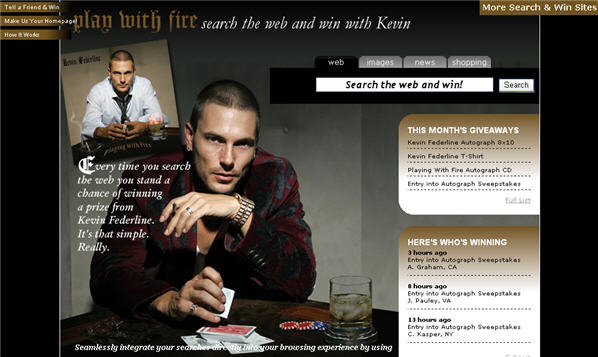
federlinesearchMy SearchInsider column last week took exception with K-Fed launching his own search engine. Actually, I take exception with the entire concept of K-Fed that but that’s another point. In today’s SearchInsider, David Berkowitz retorts, rebukes and refutes my negativity around all things Federline, saying that the K-Fed engine shows that search is ubiquitous, search is evolving and search shouldn’t be always all business, no fun. Ultimately he says let the market decide whether a Kevin Federline engine is a good idea or not. Hard to refute that point.

Anyway, knowing David, he had a lot of fun writing the column and I certainly had fun writing the original column. The thing that amazes me is that in the past week, 40% of the total ink (or whatever the virtual variation of ink is) on SearchInsider has been devoted to the topic of Kevin Federline. Perhaps someday soon you’ll be able to pick up your local copy of SearchInsider at the grocery checkout and we’ll have great juicy articles about Britney’s rehab and the latest alien that professes to be Elvis, living in Minot, North Dakota.

One last point though David. You quoted me as saying that I would rather wear Fiberglas underwear than use the Kevin Federline search engine. That’s not actually true, I would rather wear Fiberglas underwear than attend K-Fed’s birthday party. And you asked where the phrase comes from. For the life of me I can’t remember where I first heard it, but I’m pretty sure it’s not a Canadian thing. I tried to look it up and couldn’t find any references so what the hell, let’s say that I originated the saying.

K-Fed Up with Celebrity Skinned Search

First published March 22, 2007 in Mediapost’s Search Insider

I’ve got a question for you: Would you want to do anything with Kevin Federline? Personally, the more Federline-free my world is, the better. But apparently other people don’t see it that way. You may have noticed earlier this week that K-Fed is actually launching his own search engine. Well, to be more accurate, he’s slapping his face on an existing back end, so to speak. I won’t go into the details of the K-Fed engine, except to say that it’s powered by Yahoo and it’s offered by Prodege.com.

Par-Tee with Britney’s Ex!

Apparently, making this your primary search engine could open the door to a chance to win tickets to Kevin’s private birthday party (I would rather wear fiberglass underwear), T-shirts and other paraphernalia all related to the somewhat questionable K-Fed brand. Apparently, an invite to K-Fed’s birthday party is “a once in a lifetime opportunity.” This has the ring of truth, as I might consider killing myself if I actually won.

This got me thinking. If we’re in the era of consumer-generated media, are we also in the area of consumer-generated celebrities? Does the increasing fragmentation of our society through an explosion of online channels means that even marginal celebs like Kevin Federline get their own small sliver of fame? If we have enough Kevin Federline fans somewhere and the Web has empowered them to have a voice unlike anything they may have been able to have before, is there a place for a Kevin Federline search engine? And, if so, does the future hold the promise of a profusion of celebrity skinned search sites?

Google Dresses Up Your Home Page

Ironically, Google also made an announcement this week releasing six themes for their personalized homepage. In this case, Google went out of its way to make sure that the themes are not commercial in any way. In Google’s words, these themes are all about “art and personality.” The new Google themes are clever, in that they are location-sensitive and have some cool little twists designed to “delight” users. For example, some of the scenes are outdoors, and the sun rises and sets in sync with where you happen to be located. With a Google theme installed, you may never have to look out your window again. But in a conversation with Google folks, they made a point of saying that they’re hesitant to open up an API to Google themes, for fear that it would cause a rush of commercialized skins, which could encroach on the user experience.

Blatant Commercialism is Skin Deep

Commercially oriented skins are nothing new, of course. Movies have released custom skins for MP3 players and other online apps that bury functionality under a sea of advertising spin. There are hundreds and thousands of desktop themes, wallpaper and screen savers with a commercial bent. But up to this point, search has been relatively “spin-free,” save of course for the advertising on the actual results page. But at least I don’t have to look at Kevin Federline when I’m searching for the symptoms of gout or trying to find an update patch for my latest Windows problems.

Just Give Me My Results, Dammit!

Based on a few new entries in the search space, it suddenly seems like we need personality mixed in with our search functionality. Search innovator K-Fed is not the only one pointing us in this direction. Microsoft has been playing around with Ms. Dewey (again an unfortunate choice of words), with the assumption that an undeniably attractive but distinctively bitchy female guide standing in front of a Blade Runner-esque streetscape will somehow make our search experience more complete. Perhaps Ms. Dewey could be K-Fed’s rebound after his split with Britney. Or perhaps both of them should have a cup of tea with Jeeves and see how being a search mascot worked out for him.

My feeling is that we want search to be a pristine experience. We’d like it to be minimalist, and we want to start from a neutral palette. We are so focused on intent and the task at hand when we interact with search that anything that gets in the way is simply a distraction. It adds nothing to the user experience. Search is very utilitarian task. We get in, find what we’re looking for and get out. However, with the lion’s share of the search market tied up in the hands of so few players, perhaps any tactic is worth a try to see if they can wrest even a small sliver of those searches away from the Googles and Yahoos of the world.

Where Are They Now?

By the way, the other celebrities that have their own search engines with Prodege.com? Meatloaf, Andrew Dice Clay, and Wynonna Judd. So the progressive degrees of “washed up” seems to be: having your own reality show, appearing on “Dancing with the Stars,” then having your own search engine. Now, I ask you, if Paris doesn’t have her face (or other assorted body parts) plastered on a search engine somewhere, how hot can this trend really be?

The Bleeding Obvious File: Advertising Leads to Increased Search Volumes

Holy crap, it’s official! There is a link between advertising and the volume of searches. We now have research to prove it. A recent analysis for the Retail Advertising and Marketing Association found a direct link between consumers exposure to advertising and their likelihood to begin an online search.

Consumers said they were most motivated to begin an online search after viewing:

  • Advertising in magazines (47.2%)
  • Newspapers (42.3%)
  • Ads on TV (42.8%)
  • From reading articles (43.7%)

In a particularly insightful quote, Mike Gatti, Executive Director of RAMA, said, “… while search engine marketing continues to be a popular strategy, retailers should not lose sight of traditional advertising channels to promote products and services.”

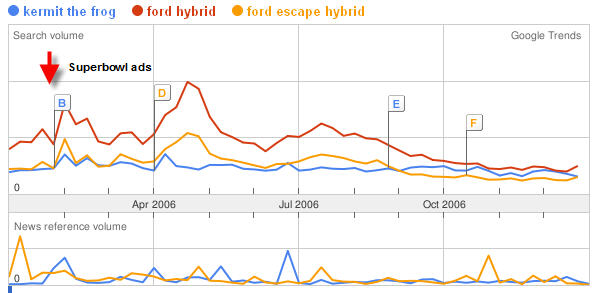
Huh? We’re now worried about search taking too much of the advertising budget away from TV, magazines and newspaper? Has Mr. Gatti seen how that particular pie is sliced up lately? If anything, we should flip this and tell all those advertisers dumping millions on television that they should back up those campaigns with a few bucks spent on relevant search terms. Here’s just one example. In 2006, Ford spent mega bucks to promote their new Green line of Hybrid Ford Escapes on the Super Bowl in television ads. They had Kermit the Frog as their spokesperson..er…spokesfrog. But what Ford didn’t remember is that all that media attention would probably drive a resulting spike in search activity. And sure enough, as we can see from the Google trends graph below, there was a spike:

ford campaign

Unfortunately, Ford forgot to bolster their keyword buy by including all related phrases, leaving the door open for General Motors to bid higher for a number of generic relevant phrases, including Ford’s own spokesperson, Kermit the Frog, and intercept search users with pinpointed messaging. The total cost for Ford to close the loop on this particular campaign? Probably less than the cost of Kermit’s personal assistant during the filming of the ad.

Shari Thurow Talking Smack about Eye Tracking

You know, if I didn’t know better I’d say that Shari Thurow had issues with me and eye tracking. I ran across a column a couple of weeks ago where she was talking about the niches that SEO’s are carving out for themselves and she mentioned eye tracking specifically. In fact she devoted a whole section to eye tracking. Now, it’s pretty hard not to take it personally when Enquiro is the only search marketing company I know that does extensive eye tracking. We’re the only ones I’m aware of that have eye tracking equipment in-house. So when Shari singles out eye tracking and warns about using the results in isolation…

That brings me to my favorite group of SEO specialists: search usability professionals. As much as I read and admire their research, they, too, often don’t focus on the big picture.

…I’m not sure who else she might be talking about.

I’ve been meaning to post on this for awhile but I just didn’t get around to it. I’m on the road today and feeling a little cranky so what the heck. It’s time to respond in kind. First, here’s Shari’s take on on eye tracking and SEO.

Eye-tracking data is always fascinating to observe on a wide variety of Web pages, including SERPs (define). As a Web developer, I love eye-tracking data to let me know how well I’m drawing visitors’ attention to the appropriate calls to action for each page type.

Nonetheless, eye-tracking data can be deceiving. Most search marketers understand the SERP’s prime viewing area, which is in the shape of an “F.” Organic or natural search results are viewed far more often than search engine ads are, and (as expected) top, above-the-fold results are viewed more often than the lower, below-the-fold results. Viewing a top listing in a SERP isn’t the same as clicking that link and taking the Web site owner’s desired call to action.

Remember, usability testing isn’t the same as focus groups and eye tracking. Focus groups measure peoples’ opinions about a product or service. Eye-tracking data provide information about where people focus their visual attention. Usability testing is task-oriented. It measures whether participants complete a desired task. If the desired task isn’t completed, the tests often reveal the many roadblocks to task completion.

Eye-tracking tests used in conjunction with usability tests and Web analytics analysis can reveal a plethora of accurate information about search behavior. But eye-tracking tests used in isolation yield limited information, just as Web analytics and Web positioning data yield limited (and often erroneous) information.

Okay Shari, you didn’t mention me or Enquiro by name but again, who else would you be talking about?

Actually, Shari and I agree more than we disagree here. I agree that no single data source or research or testing approach provides all the answers, including eye tracking. However, eye tracking data adds an extraordinarily rich layer of data to common usability testing. When Shari says eye tracking is not the same as usability testing, she’s only half right. As Shari points out, eye tracking combines very well with usability testing but in many cases, can be overkill. Usability testing is task oriented. There’s no reason why eye tracking studies can’t be task oriented as well (most of ours are). The eye tracking equipment we use is very unobtrusive. It virtually like interacting with any computer in a usability lab. In usability testing you put someone in front of the computer with the task and asked them to complete the task. Typically you record the entire interaction with software such as TechSmith’s Morae. After you can replay the session and watch where the cursor goes. Eye tracking can capture all that, plus capture where the eyes went. It’s like taking a two dimensional test and suddenly making it three-dimensional. Everything you do in usability can also be done with eye tracking.

The fact is, the understanding we currently have of interaction with the search results would be impossible to know without eye tracking. I’d like to think that a lot of our current understanding of interaction with search results comes from the extensive eye tracking testing we’ve done on the search results page. The facts that Shari says are common knowledge among search marketers comes, in large part, from our work with eye tracking. And we’re not the only ones. Cornell and Microsoft have done their own eye tracking studies, as has Jakob Nielsen, and findings have been remarkably similar. I’ve actually talked to the groups responsible for these other eye tracking tests and we’ve all learned from each other.

When Enquiro produced our studies we took a deep dive into the data that we collected. I think we did an excellent job at not presenting just the top level findings but really tried to create an understanding of what the interaction with the search results page looks like. Over the course of the last two years I’ve talked to Google, Microsoft and Yahoo. I’ve shared the findings of our research and learned a little bit more about the findings of their own internal research. I think, on the whole, we know a lot more about how people interact with search than we did two years ago, thanks in large part to eye tracking technology. The big picture Shari keeps alluding to has broadened and been colored much more extensively thanks to those studies. And Enquiro has tried to share that information as much as possible. I don’t know of anyone else in the search marketing world who’s done more to help marketers understand how people interact with search. When we released our first study, Shari wrote a previous column that basically said, “Duh, who didn’t know this before?” Well, based on my discussions with hundreds, actually, thousands of people, almost everyone, save for a few usability people at each of the main engines.

There are some dangers with eye tracking. Perhaps the biggest danger is that heat maps are so compelling visually. People tend not to go any further. The Golden Triangle image has been displayed hundreds, if not thousands of times, since we first released it. It’s one aggregate snapshot of search activity. And perhaps this is what Shari’s referring to. If so, I agree with her completely. This one snapshot can be deceiving. You need to do a really deep dive into the data to understand all the variations that can take place. But it’s not the methodology of eye tracking that’s at fault here. It’s people’s unwillingness to roll up their sleeves and weed through the amount of data that comes with eye tracking, preferring instead to stop at those colorful heat maps and not go any further. Conclusions on limited data can be dangerous, no matter the methodology behind them. I actually said the same for an eye tracking study Microsoft did that had a few people drawing overly simplified conclusions. The same is true for usability testing, focus groups, quantitative analysis, you name it. I really don’t believe Enquiro is guilty of doing this. That’s why we released reports that are a couple hundred pages in length, trying to do justice to the data we collected.

Look, eye tracking is a tool, a very powerful one. And I don’t think there’s any other tool I’ve run across that can provide more insight into search experience, when it’s used with a well designed study. Personally, if you want to learn more about how people interact with engines, I don’t think there’s any better place to start than our reports. And it’s not just me saying so. I’ve heard as much from hundreds of people who have bought them, including representatives at every major search engine (they all have corporate licenses, as well as a few companies you might have heard of, IBM, HP, Xerox..to name a few). I know the results pages you see at each of the major engines look the way they do in part because of our studies.

Shari says we don’t focus on the big picture. Shari, you should know that you can’t see the big picture until you fill in the individual pieces of the puzzle. That’s what we’ve been trying to do. I only wish more people out there followed our example.

User-centricity is More than Just a Word

Ever since Time Magazine made you and I the person of the year, user experience has been the two words on the tip of everyone’s tongue. We’re all saying that the user is king and that we’re building everything around them. But I fear that user-centricity is quickly becoming one of those corporate clichés that’s easy to say, but much, much harder to do. All too often I see internal fighting in a lot of companies between those that truly get user centricity and have become the internal user champions and those that are continuing to push the corporate agenda, at the expense of the user experience. The tough part of user centricity is seeing things through the users eyes. We can do user testing but if we truly put the user first, it requires tremendous courage and fortitude to make the user the primary stakeholder. All too often, I see user considerations being one of several factors that are being balanced in the overall design. And often, it takes a backseat to other considerations, such as monetization. This is the trap that Yahoo currently finds themselves in. They talk about user experience all the time. But the fact is, over the last two years it’s really been the advertiser whose’s owned their search results page. I’ve recently seen signs of the balance tipping more towards the user’s favor with the rollout of Panama and a more judicious presentation of top sponsored ads. But I’m still not sure the user is winning the battle at Yahoo!

It’s not easy to step inside your user’s head when it comes to designing interfaces. It’s very tought to toggle the user perspective on and off when you’re going through a design cycle. The feedback we get from usability testing tends to be too far removed from the actual implementation of the design. By that time the meat of the findings has been watered down and diluted to the point where the user’s voice is barely heard. That’s why I like personas as a design vehicle. A well formulated persona keeps you on track. It keeps you in the mindset of the user. It gives you a mental framework you can step into quickly and readjust your perspective to that of the user, not the designer.

If you’re truly going to be user centric, be prepared to take a lot of flack from a lot of people. This is not a promise to be made lightly. You have to commit to it and not let anything dissuade you from delivering the best possible end-user experience, defined in the user’s own terms. This can’t be a corporate feel good thing. It has to be a corporate commitment that requires balls the size of Texas. And if you’re going to make a commitment, you better be damn sure that the entire company is also willing to make the same commitment. The user experience group can’t be a lone bastion for the user, fighting a huge sea of corporate momentum going in the opposite direction. This isn’t about balancing the user in the grand scheme of things, it’s about committing wholeheartedly to them and getting everyone else in the organization to make the same commitment. If you can do so, I think the potential wins are huge. There’s a lot of people talking about user centricity but there’s not a lot of people delivering on it consistently and wholeheartedly.

The Personalized Results are Coming, The Personalized Results are Coming!

Okay, sometimes the temptation to say I told you so is overwhelming. Danny has a nice long post in Searchengineland about Google’s changes to Personalized Search, making it more of a default and less of an option for millions of users. Danny details it more than I intend to, so please check it out.

As Danny says, he’s been talking about personalization for years, but up to now, it never materialized. After interviews with head user experience people at all three engines, I felt the time was right for personalized search to roll out (check The Future of SEO in a Personalized Search Interface and The SEO Debate Continues). And it appears my sense of timing was bang on. Much as I’d like to claim to be prescient, it’s really just common sense. You could see all the engines inching towards it. Now, Google has just upped the ante a little.

There are two major implications to this: what it means for search marketers, especially organic optimizers, and what it means to users. I’ll deal with each in turn.

What it Means for Search Marketers

The “Is SEO Dead? Rocket Science? A Scam?” Debate has been winding it’s weary way through several blogs in the past few weeks. My take was that SEO is, and will continue to be, vitally important as long as organic search results continue to be important to the user. Based on what I’m seeing, that continues to be very much the case. But, organic optimization now has a completely new rule set, which will irritate the hell out of many organic optimizers. The disgruntlement is already beginning to show. Michael Gray, better known as Graywolf, was the first to post a comment on Danny’s story:

Just because I ordered my coke with extra ice last time doesn’t mean I want it that way this time. I hate personalized SERP’s, I despise it even more that they don’t tell me they are personalized, and I loathe not being able to turn it off. I also have extreme antipathy for not being able to keep my search history on and not be part of personalized search.

Let me have it the way I want, not the way you think I do. I don’t want SERP’s that work like Microsoft programs that try to anticipate what I want to do, because more often than not it’s wrong. Bring back truth, purity, and clarity to the SERP’s.

Graywolf is complaining as a user, but I can’t help thinking that the more significant pain he’s feeling is as an organic optimizer who’s world suddenly just became a lot more complicated. “Truth, purity and clarity to the SERP’s”? In whose eyes? Come on. Personalization is being implemented because it enhances the user experience. It doesn’t take a “Rocket Scientist” (sorry, couldn’t resist) to see that one set of search results is not the best way to serve millions of users.

As Danny said, there’s now an explosion of new fronts for the organic optimizer to consider. Right now, Google is only injecting a few personalized results into the search page, but expect that threshold to gradually creep up as Google gains confidence in the targeting of the results to the person. The days of the universal results page are numbered. Which means that the days of the reverse engineering approach to SEO are equally numbered. I’m sure people will try to figure out ways to spam personalized search, but as I’ve said before, reverse engineering requires a fixed constant to test against. Up to now, the results page and the other sites that appeared on it represented that fixed constant. That’s gone now.

So where does that leave SEO? Well, it’s certainly not dead, but it has dramatically changed. You can’t optimize against a results set, but you can optimize against a user. Let’s use an analogy that’s often been used before to describe SEO. Think of it as Public Relations on the Web. If you launch a PR campaign, you don’t target a particular position on the front page of the NY Times, you target a type of audience. You plan your release distribution and messaging accordingly. And you give reporters what you think will catch their attention. Most of all, you have to wrap your campaign around something that’s genuinely interesting. Then, you hope for the best.

Now, SEO becomes the same thing. You don’t target the first page of results on Google for a particular term. You target an end user. You wrap your site messaging in terms that resonate with that user. You write in their language, you give them a reason to seek you out, and you sure as hell don’t disappoint them when they click through to your site. You do all this, and you remove all the technical barriers between your content and the indexes you need to be in. Then, you hope for the best.

The problem with SEO has always been that it’s been treated like some magical voodoo that can be applied after the fact, like some “secret sauce”. And yes, that was what the infamous Dave Pasternack has been trying to say. He just went several steps too far. The fact is, with universal search results, you could actually do this. Thousands of affiliates have made millions of dollars doing it. Link spamming, cloaking, doorway sites..the fact is, up to now, this bag of tricks has worked. It’s gotten harder, but it’s worked. Site owners looked to SEO to help them hi jack traffic that wasn’t rightfully theirs. They hadn’t done the heavy lifting to create a site that justified a place in the top rankings, and they tried to take an easy short cut.

But now, organic optimization means that you have to do the heavy lifting. It has to be integrated into the entire online presence. What Marshall Simmonds has done with About.com and the NY Times is a perfect example of the new definition of SEO. Get to the front lines, to the people who are churning out the content, and teach them about what search engines are looking for. Make sure SEO best practices are baked right into the overall process flow. Work with the IT team to create a platform that entices the spider to crawl deeper. Work with the marketing team to crawl inside the head of your target audience and figure out the who, the when and the why. Don’t worry so much about the where, because you can’t really control that any more. It’s a tough paradigm to break. We’ve been struggling with our clients for the past year or so. They’re still fixated on “being number one” for a particular term. We’ve been trying to ease them into the new reality, but it’s not easy.

I guarantee this will create an identity crisis for the SEO industry. As recently as a few months ago I was moderating a panel that was talking about analytics, and in the Q&A someone asked the panel, who had a few very well known SEM’s on it, about what they used for ranking reporting. The names of various options were thrown out and people started scribbling them down. I saw this and thought I had to comment.

“You know, the whole concept of ranking is quickly becoming irrelevant”

Nobody lifted their head, they were still busy writing down tool names. Maybe they hadn’t heard.

“As search engines move to personalized results, there will be no such thing as ranking. It will all be relative to the user.”

That should get their attention. Nope, nothing.

One of the search marketers said, “Yes, but knowing how they rank is still important to people.”

Huh? Am I speaking a different language here? I shook my head and gave up.

So, does this mean SEO is dead? Absolutely not. It becomes more vital than ever. Here are a few things that remain to be true. Preliminary results from the new SEMPO survey say SEO continues to be the number one tactic in search marketing. Yes, people want to bring it in house, but they recognize it’s importance.

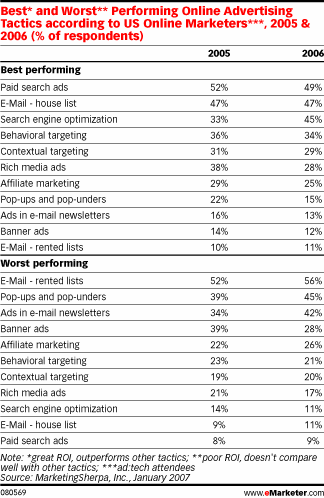
Why do they think it’s important? Because it kicks ass in ROI. Here are the results from another recent study by Ad:Tech and MarketingSherpa, asking advertisers about the return they get from various marketing channels.
080569

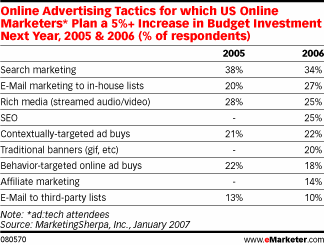
The biggest jump from year to year? SEO. Now, let’s look at where marketers plan to spend more money in the next year.

080570

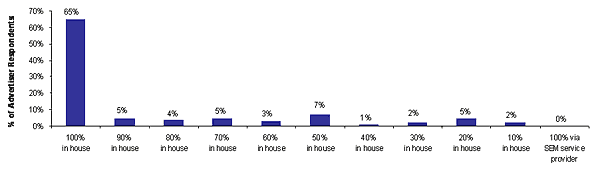
SEO, from flatlined last year to looking to spend 25% more this year. So SEO definitely isn’t dead. But it is moving to a new home. Here’s some early results from the SEMPO State of the Market Study (by the way, final results should be available next week. Look for them):

SEMPO2a

It’s true that most companies would far rather bring SEO in house, if they could. And when we consider the new definition of SEO, it probably makes sense for SEO to be integrated into the internal work flow. But the problem is that there’s not a lot of SEO expertise out there. If SEO was so easy, why don’t more companies do it, or do it well? Contrary to Pasternack’s argument, it’s not a “set and forget” type of tactic. It requires a champion, buy in and diligence.

I think the future is bright for SEO as a skill set, but we’re talking a modified set of skills. I talked about this in a recent SearchInsider column and a follow up online debate with Andrew Goodman. My view of the future for the really good SEO’s out there fall into three categories:

Get a (Really Good) Job

As companies bring this in house, there will be a firestorm of demand for skilled SEO Directors, but ideally as employees, not consultants.

Broaden Your View

Become an expert in how consumers navigate online and help your customers with the big picture, including the new reality of SEO.

Adapt and Survive

Find a new online niche where your search honed skills give you an advantage.

User’s View

Okay, this is already a much longer post than I intended, so I should probably talk about personalized search from the user’s perspective now.

Personalized search is a big win for the user. Don’t judge by the first few tentative steps Google is taking. Personalization is a much bigger deal than that. Google is easing us in so the experience isn’t too jarring. By the end of 2007, all 3 of the major engine’s results pages will look significantly different than they do today. Personalization will be like a breached dam. Right now we’re seeing the first few trickles, but there will be a wave of much deeper personalization options over the next several months. Search will become your personalized assistant, tailored to your tastes. As you search more, your results will draw more and more away from the universal default and closer and closer to your unique intent. Immediately after your query, you’ll be dropped into a much richer search experience. Disambiguation will become much more accurate, and you’ll find that you will pretty much always find just what you’re looking for right at the top of your page, without having to dig deeper. Here’s how I see it playing out at each of the big three:

Google

Google has a religious devotion to relevance, and as they gain confidence with personalized search and their ability to disambiguate, this will manifest itself with a laser focus on relevance above the fold. They will continue to maintain a good balance of organic results, but these results will not just be the current web search results. They could be local, image, news or a mix of each. And ads. Yes, you won’t escape ads, but Google will be the most judicious in what they show. Expect more stringent quality scoring, down to the landing page level and a high degree of relevancy in the ads that do show. Google will be the most concerned of the three in disambiguating intent.

Yahoo

Yahoo will put their own spin on personalization by wrapping in Social Search. They will continue to leverage their community, as they currently do in Yahoo! Answers so when you’re logged into Yahoo, you’ll be plugged into their community and that will impact the search results you see. Relevancy will be determined more by what the community finds interesting than what you find interesting, although it will be a mix between the two. Yahoo will target two types of searches, serendipitous search, where you’re looking to discover new sites, and what I call “frustrated” search, where your own efforts to unearth the data online have come up empty and you want the help of the community. When it comes to monetization, Yahoo will be the most aggressive, pushing more ads above the fold into Golden Triangle real estate. These ads will trail Google’s in terms of relevance

Microsoft

Microsoft will use their targeting capabilities and probably tie in some behavioral targeting to personalize their search results. Also expect personalization in the Microsoft product to be integrated at a deeper, more ubiquitous level, into apps and OS. This probably won’t happen in 07, but it will be a long term goal. When it comes to ad presentation, Microsoft will fall somewhere between Google and Yahoo in both the number and relevance of the ads being presented. The heaviest investment will be in building out the platform to manage and model the ad program, rather than in policing the quality of the ads themselves.

It promises to be a very interesting year in the Search Marketing biz!

BusinessWeek Dissing Paid Search (Again)

Okay, BusinessWeek is beginning to get a little obvious in its campaign against paid search. In my books, they just received their third strike.

Strike One

An “expose” on the SEM Sweat Shop floor that showed a remarkable ignorance for the diversity of the industry. I responded to this little journalistic gem in a SearchInsider column last May. In it, search marketers were called “digital bricklayers”. Here was one quote:

“The work ranges from the slightly creative, such as … crafting sentences for ads to snag search traffic, to the rote — typing in descriptions of hamburgers for online menus.”

It was not wrong so much as one dimensional. BusinessWeek shows a tendency to paint the entire industry with a single brush.

Strike Two

This time BusinessWeek took on click fraud, with a similarly one sided perspective. They approached it focusing on the most egregious cases of click fraud, with examples of both perpetrators and victims. This is fine to draw attention, but they should also provide an accurate assessment of the overall problem. They used numbers that came from faulty research, like Outsell’s much quoted study and passed it off as an accurate assessment of the scope of click fraud with the slippery qualifier, “most experts believe”. They virtually ignored the balancing viewpoint of the engines themselves. Again, I dealt with this in another SearchInsider column and a follow up post. This is just one of many articles from BusinessWeek pumping up concern about click fraud. And most imply that the majority of the problem lies with Google and Yahoo.

Strike Three

The latest one indicates that advertisers are souring on search ads because of rising click costs and decreasing ROI. Again, they’ve taken a few cases and given the impression that it represents the entire industry. So, let me dive in again. Yes, PPC costs are rising. And yes, if you’re not tweaking your campaigns, you could find your ROI dropping. But here’s the thing. The advertisers finding this are the direct marketers. And as I’ve said over and over, there’s an inherent disconnect here. Direct marketers are looking at selling something..now. And their ads say as much. One of the advertisers quoted as complaining about the ineffectiveness of paid search in the articles was eBags.com

Okay, let’s say I search for “best luggage” on Yahoo. Here are the ads that come up:

luggageexample

Hmm..apparently eBags isn’t that turned off sponsored. But let’s get to the disconnect. What are the chances that if I search for “best luggage”, I’m looking to buy right now? How interested am I in saving 60%? I’ll tell you, based on past research. Less than 1 in 10.  In fact, it’s probably less than 1 in 20. I’m looking to see what the best luggage is. I’m researching. And where will I click? Well, let me show you the number one organic result for the same search in Yahoo.

luggageorganic

This is where I’m going to click, because it’s a much better match to my intent.

So, for those advertisers hell bent on jamming a purchase down a consumer’s throat, I have three pieces of advice:

  • Get to know how search works better
  • Get to know your consumers better
  • Get to know how your consumers use search better

If you do those 3 things, you’ll get a much better return than you will from desperately steering budget into different channels without putting some solid strategy and understanding behind your campaigns. The problem is not that search is getting less effective, it’s that marketers using it aren’t getting any smarter.

From the “Living in Glass Houses” Category

And finally, when I went to try to read this article on BusinessWeek, I had to click through an interstitial. When the hell will online publishers learn that these are incredibly annoying and detract significantly from the user experience? Give me a bushel of paid search ads, aligned with my intent, any day over one interstitial.

Over 50% of CMOs aren’t looking for Big Agencies for Online

A new study has reaffirmed something I’m hearing more and more. Big agencies don’t get online.

Sapient, through Evalueserve, surveyed a number of CMO’s, and just over half of them believe that traditional, large ad agencies are “ill-suited to meet online marketing needs”. They believe that there’s too much invested in traditional models, and that agencies can’t think beyond these constraints.

The upshot? Fewer than 10% of those polled seek to partner with large agencies for online marketing. They instead look for partners with roots in technology, a high degree of creativity and traditional print expertise, or, even more common, to use multiple agencies.

It’s not that large agencies don’t have people capable of getting online. In many cases, they do. But they’re trapped in a rigid and bureaucratic structure that sucks the lifeblood out of the bold thinking and initiative essential for online. They spend more time fighting turf wars than they do providing value to clients, and it seems that the clients are getting tired of it.

Increasingly, large agencies are struggling to understand the shifting marketplace. They are fighting the idea of a participatory approach to branding, with a community of consumers at least as important in the process as the actual brand itself. They are far more comfortable with the more traditional, and much more profitable, command and controlled channel form of marketing that has been built over the last several decades. They’re struggling to win in a new game where they don’t know the rules, largely because they haven’t been written yet.

The big agencies are out there shopping right now. They’re looking to buy expertise needed. I wonder how successful this will be. It’s not just the expertise they’re lacking. It’s the environment needed to let their experts do their job. You can buy all the roses you want, but if you lock them in a dark basement, you’re not going to see much blooming.

A Day in the Life

First published January 4, 2007 in Mediapost’s Search Insider

The U.S. Census Bureau has just released its new statistical abstract. According to the study, here’s how the average adult or teen will spend his or her time in 2007:

  • 65 days in front of the TV;
  • 41 days listening to the radio;
  • A little over a week on the Internet;
  • A week reading a daily newspaper; and
  • Another week listening to recorded music.

I have just one question: Who the hell are these people? Nobody I know.

The Census Bureau was unavailable for comment on the findings, so I have to make some assumptions. I’m assuming that the Internet time includes any work-related activity. So I tallied up my time on the Internet, actively using it, and found I averaged about 4 hours a day. Granted, I’m not a normal user (in oh-so-many ways) but bear with me. That means I spend almost 2 months on the Internet in a year.

Okay, I represent an extreme, and I realize that. So how about my wife, Jill? She is above average in nearly every regard, but when it comes to Internet use, is probably a closer approximation of your garden-variety user. Jill spends about an hour-and-a-half online a day. That puts her at just over 3 weeks of surfing in a year. My kids? About two-and-a-half hours a day, the majority of that chatting with umpteen zillion friends simultaneously on Messenger and butchering the English language I love, but I digress. That’s about five-and-a-half weeks in a year.

Perhaps the whole Hotchkiss family is abnormal when it comes to using the Net. Who are the least Net-savvy people I know? My Mom and Dad. Even they spend a half hour a day online, which puts even them slightly higher than the U.S. average.

Let’s attack the question in a different way. Let’s put together a day in the life of this mythical average American. According to the statistical abstract, here’s how his or her day is spent:

4.27 hours watching TV

2.7 hours listening to the radio

And roughly a half hour each surfing the Net, reading a newspaper and listening to music

Let’s assume that this person gets an average of 7.5 hours sleep and spends another 1.5 hours eating. That leaves fewer than 7 hours a day to do everything else, including being gainfully employed (unless their job is actually watching TV). Into that basket would fall things like reading a book, going for a walk with your family, hitting the gym, cleaning up the house, going on a vacation and talking with friends. Something seems askew here.

So I’m left with two possibilities. Either I have a warped view of the world because everyone I know represents the extreme end of the spectrum, or the U.S. Census Bureau has its facts wrong. If it’s the former, that means there are people, somewhere, that are really dragging down our collective average by remaining comatose in front of the TV for the better part of a day. I knew they existed, I just didn’t know there were so many of them. And it can’t really be the second possibility, can it? I mean, when’s the last time you remember the government getting its facts wrong?