The Great K-Fed Debate

federlinesearchMy SearchInsider column last week took exception with K-Fed launching his own search engine. Actually, I take exception with the entire concept of K-Fed that but that’s another point. In today’s SearchInsider, David Berkowitz retorts, rebukes and refutes my negativity around all things Federline, saying that the K-Fed engine shows that search is ubiquitous, search is evolving and search shouldn’t be always all business, no fun. Ultimately he says let the market decide whether a Kevin Federline engine is a good idea or not. Hard to refute that point.

Anyway, knowing David, he had a lot of fun writing the column and I certainly had fun writing the original column. The thing that amazes me is that in the past week, 40% of the total ink (or whatever the virtual variation of ink is) on SearchInsider has been devoted to the topic of Kevin Federline. Perhaps someday soon you’ll be able to pick up your local copy of SearchInsider at the grocery checkout and we’ll have great juicy articles about Britney’s rehab and the latest alien that professes to be Elvis, living in Minot, North Dakota.

One last point though David. You quoted me as saying that I would rather wear Fiberglas underwear than use the Kevin Federline search engine. That’s not actually true, I would rather wear Fiberglas underwear than attend K-Fed’s birthday party. And you asked where the phrase comes from. For the life of me I can’t remember where I first heard it, but I’m pretty sure it’s not a Canadian thing. I tried to look it up and couldn’t find any references so what the hell, let’s say that I originated the saying.

K-Fed Up with Celebrity Skinned Search

First published March 22, 2007 in Mediapost’s Search Insider

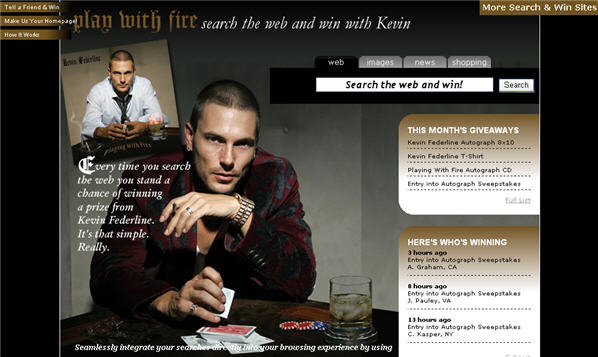
I’ve got a question for you: Would you want to do anything with Kevin Federline? Personally, the more Federline-free my world is, the better. But apparently other people don’t see it that way. You may have noticed earlier this week that K-Fed is actually launching his own search engine. Well, to be more accurate, he’s slapping his face on an existing back end, so to speak. I won’t go into the details of the K-Fed engine, except to say that it’s powered by Yahoo and it’s offered by Prodege.com.

Par-Tee with Britney’s Ex!

Apparently, making this your primary search engine could open the door to a chance to win tickets to Kevin’s private birthday party (I would rather wear fiberglass underwear), T-shirts and other paraphernalia all related to the somewhat questionable K-Fed brand. Apparently, an invite to K-Fed’s birthday party is “a once in a lifetime opportunity.” This has the ring of truth, as I might consider killing myself if I actually won.

This got me thinking. If we’re in the era of consumer-generated media, are we also in the area of consumer-generated celebrities? Does the increasing fragmentation of our society through an explosion of online channels means that even marginal celebs like Kevin Federline get their own small sliver of fame? If we have enough Kevin Federline fans somewhere and the Web has empowered them to have a voice unlike anything they may have been able to have before, is there a place for a Kevin Federline search engine? And, if so, does the future hold the promise of a profusion of celebrity skinned search sites?

Google Dresses Up Your Home Page

Ironically, Google also made an announcement this week releasing six themes for their personalized homepage. In this case, Google went out of its way to make sure that the themes are not commercial in any way. In Google’s words, these themes are all about “art and personality.” The new Google themes are clever, in that they are location-sensitive and have some cool little twists designed to “delight” users. For example, some of the scenes are outdoors, and the sun rises and sets in sync with where you happen to be located. With a Google theme installed, you may never have to look out your window again. But in a conversation with Google folks, they made a point of saying that they’re hesitant to open up an API to Google themes, for fear that it would cause a rush of commercialized skins, which could encroach on the user experience.

Blatant Commercialism is Skin Deep

Commercially oriented skins are nothing new, of course. Movies have released custom skins for MP3 players and other online apps that bury functionality under a sea of advertising spin. There are hundreds and thousands of desktop themes, wallpaper and screen savers with a commercial bent. But up to this point, search has been relatively “spin-free,” save of course for the advertising on the actual results page. But at least I don’t have to look at Kevin Federline when I’m searching for the symptoms of gout or trying to find an update patch for my latest Windows problems.

Just Give Me My Results, Dammit!

Based on a few new entries in the search space, it suddenly seems like we need personality mixed in with our search functionality. Search innovator K-Fed is not the only one pointing us in this direction. Microsoft has been playing around with Ms. Dewey (again an unfortunate choice of words), with the assumption that an undeniably attractive but distinctively bitchy female guide standing in front of a Blade Runner-esque streetscape will somehow make our search experience more complete. Perhaps Ms. Dewey could be K-Fed’s rebound after his split with Britney. Or perhaps both of them should have a cup of tea with Jeeves and see how being a search mascot worked out for him.

My feeling is that we want search to be a pristine experience. We’d like it to be minimalist, and we want to start from a neutral palette. We are so focused on intent and the task at hand when we interact with search that anything that gets in the way is simply a distraction. It adds nothing to the user experience. Search is very utilitarian task. We get in, find what we’re looking for and get out. However, with the lion’s share of the search market tied up in the hands of so few players, perhaps any tactic is worth a try to see if they can wrest even a small sliver of those searches away from the Googles and Yahoos of the world.

Where Are They Now?

By the way, the other celebrities that have their own search engines with Prodege.com? Meatloaf, Andrew Dice Clay, and Wynonna Judd. So the progressive degrees of “washed up” seems to be: having your own reality show, appearing on “Dancing with the Stars,” then having your own search engine. Now, I ask you, if Paris doesn’t have her face (or other assorted body parts) plastered on a search engine somewhere, how hot can this trend really be?

Improving the Odds of Connecting with Your Target Market

Kim Krause Berg had a interesting additional thought to my post about eye tracking. Her question, “What happens when your target market gets up on the wrong side of the bed?”.

This got me to thinking about the validity of market research and understanding more about your target customer. Kim’s point, which she makes quite clearly, is that people are people and all the research in the world won’t be able to tell you if your target customers having a bad day, or for that matter, an extraordinarily good day, when they are interacting with your site. How much of a role does emotion play with predicted behavior?

In marketing and user centered design circles, we often talk about our targeted users and customers. Companies with money to blow will run studies on who their target consumers are, or run focus groups on what people love and hate about their products. The human factors industry studies human-computer behavior. Usability companies try to understand what ticks off end users. Conversions experts look for all the reasons behind failed sales. Search engine marketers dig deep for keywords used by the perfect end user who knows exactly what they’re looking for.

Once all this data is gathered, white papers are written, case studies are published and articles are run that inform us about what our site visitors and product users want, what they like, how they make choices and why. We may think we’re very cool and savvy to have found the holy grail of ROI.

What if your product, service, internet application or website is humming along, primed for the perfect targeted end user and that person is suddenly different?

Perhaps they are emotionally upset. PMS. Menopausal. Facing surgery. Sleepless parents. Overworked wage earners. Out of work. On medication. Depressed. Drunk. Suffers a sudden loss of eyesight or use of their hands. There are a zillion reasons why someone has an “off” day, is feeling emotionally or mentally out of whack or drastically changes in some way. This can last for a day, or longer.

Either way, what they are dealing with, at the moment they are accessing your website, service, product or application, may have an impact on how successful they are at completing a task.

Marketing is a game of percentages. It’s all about increasing your odds of hitting that perfect combination: putting the right message in front of the right person at the right time. Will you get it right 100% of the time? Of course not. But then again, if you can improve your odds of success from 50% to 60 or 70% you’ve just scored a huge marketing coup.

When you reduce marketing to one to one communication, you’re completely dependent on the receptiveness of your intended target. Unless you’re in front of the person when you communicate with them, there’s no way for you to pick up their mood or emotion. You can’t alter your message accordingly to the signals that you’re picking up. But the interesting thing is, as variable as people are on an individual basis, if you put enough of them together they start reacting in predictable patterns. While it might be impossible to predict the success of your message on an individual basis, the greater the size of the group, the more confident you are in predicting what the aggregate patterns will look like. And that’s where understanding more about your target market can dramatically improve your odds. If Kim is in my target market, I might not know what her mood might be on any given day. If I have 10,000 Kim’s in my target market, I can be fairly sure that on any given day a certain percentage of them will be in a good mood, a certain percentage will be in a bad mood, and a certain percentage will be relatively ambivalent. I don’t have to be precise on a one-to-one level, because the law of averages works in my favor. I’ll get more right than wrong. What is important, however, is that you have a good understanding of what all those Kim’s generally like, what motivates them, and what their intent is when they interact with my brand.

There’s a lot of talk about personas as a tool to help you understand your target market better. One of the reasons people hesitate to use personas is that it feels odd, when your target market could be made up of thousands or millions of individuals, to build a conceptual framework represents just one individual. Again, it seems like you’re oversimplifying the collective needs and wants of your segment. But the power of a persona is the way it forces you to shift your paradigm, the way it forces you to look at things from a customer’s point of view and interact with your brand through their eyes, not yours. It’s this fundamental shift in thinking that has to happen to be able to effectively close communication. Once you build your persona framework, you can start dropping in the individual pieces of research intelligence you might have on your target market. It helps to create a profile, complete with a much greater understanding of what motivates that target, relative to your offering. It’s very difficult start a conversation with someone when you have no idea who you’re talking to.

The whole point of communication is to effectively connect and transfer information back and forth. The greater the understanding, the greater the odds of making that connection. Ideally, we should all be able to sit in front of each individual we’re communicating with and be able to read their body language, be able to pick up their signals, be able to interpret their moods and emotions. This being impossible (my track record with my wife is pretty abysmal and I live with her every day) the next best thing is to understand more about the group as a whole and what motivates them, and then to be able to craft your messaging in a way that resonates with them. Again, it’s all about improving your odds for success. If Kim gets up on the wrong side of the bed today, I might totally blow my chances of getting the right message to her, simply because she’s not in the mood to receive it. But for every one I get wrong, there will be several more that I get right.

Shari Thurow Talking Smack about Eye Tracking

You know, if I didn’t know better I’d say that Shari Thurow had issues with me and eye tracking. I ran across a column a couple of weeks ago where she was talking about the niches that SEO’s are carving out for themselves and she mentioned eye tracking specifically. In fact she devoted a whole section to eye tracking. Now, it’s pretty hard not to take it personally when Enquiro is the only search marketing company I know that does extensive eye tracking. We’re the only ones I’m aware of that have eye tracking equipment in-house. So when Shari singles out eye tracking and warns about using the results in isolation…

That brings me to my favorite group of SEO specialists: search usability professionals. As much as I read and admire their research, they, too, often don’t focus on the big picture.

…I’m not sure who else she might be talking about.

I’ve been meaning to post on this for awhile but I just didn’t get around to it. I’m on the road today and feeling a little cranky so what the heck. It’s time to respond in kind. First, here’s Shari’s take on on eye tracking and SEO.

Eye-tracking data is always fascinating to observe on a wide variety of Web pages, including SERPs (define). As a Web developer, I love eye-tracking data to let me know how well I’m drawing visitors’ attention to the appropriate calls to action for each page type.

Nonetheless, eye-tracking data can be deceiving. Most search marketers understand the SERP’s prime viewing area, which is in the shape of an “F.” Organic or natural search results are viewed far more often than search engine ads are, and (as expected) top, above-the-fold results are viewed more often than the lower, below-the-fold results. Viewing a top listing in a SERP isn’t the same as clicking that link and taking the Web site owner’s desired call to action.

Remember, usability testing isn’t the same as focus groups and eye tracking. Focus groups measure peoples’ opinions about a product or service. Eye-tracking data provide information about where people focus their visual attention. Usability testing is task-oriented. It measures whether participants complete a desired task. If the desired task isn’t completed, the tests often reveal the many roadblocks to task completion.

Eye-tracking tests used in conjunction with usability tests and Web analytics analysis can reveal a plethora of accurate information about search behavior. But eye-tracking tests used in isolation yield limited information, just as Web analytics and Web positioning data yield limited (and often erroneous) information.

Okay Shari, you didn’t mention me or Enquiro by name but again, who else would you be talking about?

Actually, Shari and I agree more than we disagree here. I agree that no single data source or research or testing approach provides all the answers, including eye tracking. However, eye tracking data adds an extraordinarily rich layer of data to common usability testing. When Shari says eye tracking is not the same as usability testing, she’s only half right. As Shari points out, eye tracking combines very well with usability testing but in many cases, can be overkill. Usability testing is task oriented. There’s no reason why eye tracking studies can’t be task oriented as well (most of ours are). The eye tracking equipment we use is very unobtrusive. It virtually like interacting with any computer in a usability lab. In usability testing you put someone in front of the computer with the task and asked them to complete the task. Typically you record the entire interaction with software such as TechSmith’s Morae. After you can replay the session and watch where the cursor goes. Eye tracking can capture all that, plus capture where the eyes went. It’s like taking a two dimensional test and suddenly making it three-dimensional. Everything you do in usability can also be done with eye tracking.

The fact is, the understanding we currently have of interaction with the search results would be impossible to know without eye tracking. I’d like to think that a lot of our current understanding of interaction with search results comes from the extensive eye tracking testing we’ve done on the search results page. The facts that Shari says are common knowledge among search marketers comes, in large part, from our work with eye tracking. And we’re not the only ones. Cornell and Microsoft have done their own eye tracking studies, as has Jakob Nielsen, and findings have been remarkably similar. I’ve actually talked to the groups responsible for these other eye tracking tests and we’ve all learned from each other.

When Enquiro produced our studies we took a deep dive into the data that we collected. I think we did an excellent job at not presenting just the top level findings but really tried to create an understanding of what the interaction with the search results page looks like. Over the course of the last two years I’ve talked to Google, Microsoft and Yahoo. I’ve shared the findings of our research and learned a little bit more about the findings of their own internal research. I think, on the whole, we know a lot more about how people interact with search than we did two years ago, thanks in large part to eye tracking technology. The big picture Shari keeps alluding to has broadened and been colored much more extensively thanks to those studies. And Enquiro has tried to share that information as much as possible. I don’t know of anyone else in the search marketing world who’s done more to help marketers understand how people interact with search. When we released our first study, Shari wrote a previous column that basically said, “Duh, who didn’t know this before?” Well, based on my discussions with hundreds, actually, thousands of people, almost everyone, save for a few usability people at each of the main engines.

There are some dangers with eye tracking. Perhaps the biggest danger is that heat maps are so compelling visually. People tend not to go any further. The Golden Triangle image has been displayed hundreds, if not thousands of times, since we first released it. It’s one aggregate snapshot of search activity. And perhaps this is what Shari’s referring to. If so, I agree with her completely. This one snapshot can be deceiving. You need to do a really deep dive into the data to understand all the variations that can take place. But it’s not the methodology of eye tracking that’s at fault here. It’s people’s unwillingness to roll up their sleeves and weed through the amount of data that comes with eye tracking, preferring instead to stop at those colorful heat maps and not go any further. Conclusions on limited data can be dangerous, no matter the methodology behind them. I actually said the same for an eye tracking study Microsoft did that had a few people drawing overly simplified conclusions. The same is true for usability testing, focus groups, quantitative analysis, you name it. I really don’t believe Enquiro is guilty of doing this. That’s why we released reports that are a couple hundred pages in length, trying to do justice to the data we collected.

Look, eye tracking is a tool, a very powerful one. And I don’t think there’s any other tool I’ve run across that can provide more insight into search experience, when it’s used with a well designed study. Personally, if you want to learn more about how people interact with engines, I don’t think there’s any better place to start than our reports. And it’s not just me saying so. I’ve heard as much from hundreds of people who have bought them, including representatives at every major search engine (they all have corporate licenses, as well as a few companies you might have heard of, IBM, HP, Xerox..to name a few). I know the results pages you see at each of the major engines look the way they do in part because of our studies.

Shari says we don’t focus on the big picture. Shari, you should know that you can’t see the big picture until you fill in the individual pieces of the puzzle. That’s what we’ve been trying to do. I only wish more people out there followed our example.

Post Mortem on Ten and Half Months of Posts

Well, my interview with Matt Cutts certainly seems to be causing ripples in the SEO world. At this point, it’s well on its way to becoming the most read blog posts I’ve ever made. The fact is, I have to thank Matt for my two highest traffic days ever. The first came when I launched my blog and Matt “Matt-dotted” it. That has been the record up until now, when my interview with Matt drove more daily visits and page views on Monday.

In a more analytical bent, it was interesting to see how the traffic ramped up. On Friday, when the interview was posted, the majority of traffic was coming from the predictable sources. There was a link from Search engine land and Search Engine Watch and Web Pro News also picked up the post and ran it in a couple of stories. This drove the majority of the traffic over the weekend. But as time went on (through Monday and today), the long tail kicked in and links to the post showed up in a number of blogs and forums, both here and overseas. While my referral base broadened out dramatically, the traffic kept rolling. Obviously, the long tail phenomenon occurs everywhere. In the last 24 hours, it’s been these widely dispersed links that have driven the majority of the traffic.

It’s also interesting to note the contrast in the pickup between Matt’s interview and the previous interview with Marissa Mayer. While Marissa’s interview actually contained more hard data on how personalization works on Google, Matt speculated on what personalization might do for the future of SEO. That was obviously a hot button and generated a number of pickups. Something about putting the name Matt Cutts and the letters SEO in the same title almost guarantees that you’re going to capture attention in this industry.

I always find it fascinating to see which blog posts pickup steam and which once seem to linger forever with hardly anyone reading them. In many cases, the posts I’m most proud of are the ones that seem to limp along, capturing a handful of page views every so often. Anything that touches on controversy seems to strike a chord.

Looking back at my blog records, my most read posts to date are:

Usability and Asinine Comments from the Bay

Controversy stirred up at a Jakob Nielsen Usability Summit in San Francisco where I discussed brand experience online and the use of graphics on websites

Relevancy Rules in Top Sponsored

A sneak preview of our eye tracking study that showed how importance relevance in those top sponsored ads were for attracting attention and clicks

The Matt Cutts Interview

Matt talks about personalization and its impact on Seo

The Personalized Results are Coming, The Personalized Results are Coming

My follow-up post when Google made its announcement early in February that was pushing more people toward signing up for personalized results

The Marissa Mayer Interview

Chatting with Marissa about personalization and its impact on user experience

For interest sake, I also looked back at my main referrer sources. Google by the bigger referrer source, driving about 14% of my traffic, with Matt’s blog second (a testament to it’s popularity, considering he’s only linked to my blog a couple of times) at 12.5%. After that it’s MediaPost, Search engine Land and Search Engine Guide.

For those of us always looking to build buzz on our blogs, it’s helpful to take a look back to see what our hits and misses were. For myself, I want to keep a balance between getting the posts out that I think are important, whether or not they attract a ton of links, and obviously giving my readers what they want. It looks like more sneak previews of our internal research and more interviews with the people that are shaping the search experience at Yahoo, Google and Microsoft are where I have to look in the future.

Webpronews Video: Who Said What?

I happened to be browsing through Webpronews on the weekend and saw one of their new video news updates. The clips are well produced, professional looking and even have their own attractive newscaster, Nicole Eggers. One I happened to pick, however, left a little to be desired on the accuracy front. As you’re probably aware, I just did a series of interviews with the top usability people at each of the three engines for Search Engine Land and a couple weeks ago I did a recap talking about the differences I saw between each of their philosophical approaches. The blurb on the video appeared to be on the same topic so I decided to give it a watch. If it, Webpronews indicated that search expert Danny Sullivan had talked to each of the three usability people at the engines and had come to the following conclusions:

  • That relevancy was almost a religion for Google
  • Yahoo had a heightened sensitivity to the needs of their advertising community
  • Microsoft was still finding their competitive niche

Huh? That’s exactly what my recap said. They even pulled a few quotes from it and attributed them to Danny. I quickly e-mailed Danny to see if we were doing some kind of weird Cyrano de Bergerac thing but Danny was apparently as out of the loop on this as I was. Anyway a quick e-mail to Webpronews seems to have got it straightened out. They’ve pulled the clip and apparently they’re redoing it.

Not that I mind being mistaken for Danny, but I just hate to be putting words in his mouth. By the way, does anyone else feel like they’re being scolded by Nicole? Again, not that I mind.

I Have Seen the Future (Thanks to Regular Coffee)

First published February 22, 2007 in Mediapost’s Search Insider

Why do epiphanies always happen in the middle of the night? Why can’t they be more conveniently scheduled during regular business hours, say between 10 and 11 in the morning or right after afternoon break at around 3: 30? But no, they usually occur somewhere between 2 and 4 in the morning. The fact that I was in a semiconscious state for this particular epiphany has everything to do with the fact that we ran out of decaf at the office yesterday, and I figured I could squeeze in just one cup of regular coffee without serious side effects. I was wrong.

Intel’s New Super Chip

This particular epiphany was catalyzed by a short news story about the new research processor chip that Intel is working on. It promises to be a performance breakthrough of breathtaking proportions and while it’s destined for supercomputers, the trickle-down effect to our everyday computing requirements is inevitable. Moore’s Law just keeps rolling along.

So, I asked myself, sometime between 2:45 and 2:49 a.m., with processing power set to take another leap forward, where would this new technology change our lives the most? The answer: mobile computing.

More Horsepower for Mobile

Some time ago I wrote a column about my frustrations with the limitations of mobile computing as it currently sits. But if you can pack enough horsepower into your average mobile device to facilitate things like speech recognition and more robust support for virtual displays, the mobile computing experience becomes much less frustrating. And when that happens, our entire interaction with the Web changes with it.

Right now the majority of our access probably happens in two places: at work or at home. Mobile access is generally limited to checking e-mails right now, and even that is a truncated experience where we’re scanning subject lines to see if there’s any fires we have to put out.

Godin’s Web4

Another thread that went into the weaving of this epiphany was a post I read on Seth Godin’s blog about a month ago, a post he called Web4. In it, Seth talked about the Web as our personal assistant that helps shuffle our schedule, introduces us to new interests and businesses, and generally makes our lives better in a number of helpful ways. For the Web4 that Godin envisions to happen, our computers have to know where we are, always be connected to the Internet, have a quick and easy way for us to communicate with it, and generally fit our lifestyle much better than the current boxes on our desks, whether they be at home or at work.

Living in the Wireless “Clouds”

Here’s another thread. Microsoft’s Live suite has one purpose: to put the functionality of Microsoft apps at your fingertips no matter where you are, no matter what your connection to online is. It “unhooks” you from the desktop and lets you move around and live your life with wireless freedom.

Computing and online access have to fit us, not the other way around. There are times during the day when we tend to stick in one spot for a while. When that happens, it makes sense for us to have a static access point and computing platform with some of the advantages that a little more elbow room could offer. Two places that come to mind immediately: our workplace, and when we sit down at home to be entertained. The rest of the time our computer should move with us.

The Home Box

At home our computers could become the oft-predicted convergent box that provides our entertainment options, but does more than that. It plugs into our home-based activities and keeps them organized for us. It becomes a communications center, our security system, an energy usage monitor, a recipe book and shopping, but most important, it’s our primary link to all our information and entertainment alternatives, allowing us to interact with those alternatives in ways never previously possible.

The Work Box

If we tend to stay in one place at work, it also makes sense to have a static access point to our corporate networks and the Internet. But the minute we get up from our seat, a mobile device would become the access point and computing platform of choice. All the data and functionality that defines us, the things we want at our fingertips, have to travel with us. When you get home you quickly plug it into your home system and the required information would be quickly transferred and the necessary updates would be done. When you get to work, you plug it in to your corporate network and again the required work-related information would be seamlessly transferred. The rest of the time, this little engineering marvel that knows where you are, what you like and what you have to do today would become your primary connection to the wired world.

Search as the Common Thread

When you look at this always-on, always-wired lifestyle, one can only imagine the dramatic uptick that would happen in all types of search activity. Once again, search becomes the common thread that runs through all that. It’s what allows us at home to search through all our entertainment options and find precisely what we would like to watch or listen to right now. At work, it’s what allows us to sift through the mountain of corporate data that resides either on our internal network or on vast online data repositories to find the file we need right now. And when we’re out there, interacting with the real world, it’s our trusted shortcut to the relevant content on the Web.

I happen to think this vision of the future is pretty darn cool. Unfortunately I’m already pushing the editorial boundaries of this column. There still seems to be a fair amount of regular coffee coursing through my veins, so check out my blog for some additional posts on the topic.

Bill Wise Leaving Did-It

Apparently Bill Wise and the Did-It Frog have had a difference of opinion.  The story this morning says that Bill Wise will be stepping down from the CEO position at Did-It but future plans haven’t been announced.  The split seems to be amicable at this point, but the two spokespeople are Bill and Kevin Lee and they’re both very diplomatic gentleman.

The split seems to come about from differing views of where Did-It should go in the future.  This is the challenge facing many SEMs and SEOs now as the industry continues to evolve at breakneck pace.  Of course, Did-It is also at the eye of the storm regarding the SEO/SEM controversy.

I had the privilege of being able to speak on a panel once with Bill Wise and was impressed with his clear view of search marketing strategy and the industry in general.  He’ll do very well no matter where he ends up. Good luck Bill.

Brain Numbing Ideas on a Friday Afternoon

I can’t help but get the feeling that when we look at online marketing, we tend to get blinded by the technology and lose sight of what’s really important: how it affects people.

Right now there’s a flurry of attention surrounding YouTube because of copyright issues and other factors.  And YouTube isn’t alone in this.  The majority of things I did in my in box focus on technology.  What will be the next killer platform?  I see mobile search, I see online video, I see social networking. It’s hard to keep your finger on the pulse of what’s really important.  I find it useful to step back a little bit and see how these things affect real people: people not like you and I, who are caught up in the promise of technology, but people like my daughter’s principal, people like my mom, people like my next-door neighbor.  People who are wary about technology and who will only embrace it if it makes their life better in some way.  This is not to discount the importance of technology, because it truly has turned our lives inside out in the last decade.  But there’s a distillation, a time when we have to get comfortable with change.  The dotcom boom and bust was not because of the lack of technology or its inadequacy.  To technology all things are possible.  But to people, it’s all about what’s in it for me.  And that, ultimately, is the success factor that has to be considered in all this.

So, is YouTube hot?  Is online video hot?  Is social networking hot?  All these things are, but not because of the technology that lies beneath, but rather because of the social change that they empower.  Consider online video for example.  A couple of items in my in box talked about how, at this point, we won’t watch television online.  Even the person at Google who was responsible for online video admitted that at this point, even with Google’s tremendous resources, online video at the quality that we’ve come to expect is not a scalable proposition. 

We interact with video in a far different way online.  For example, YouTube is all about the viral spiral.  It’s all about that cute little two to three minutes of video: something that is either funny or outrageous or awful.  There’s no tremendous requirement for engagement for this.  YouTube is the repository for a million different “in” jokes.  It’s the basket where we collect what titillates the fancy of our collective consciousness at any given time.  It gives us an easy reference point so we can take what interests us and forward it to others if we think they are interested as well.  We’re not ready to watch a one or two hour documentary on the web, simply because we’re not used to interacting with our computer screen in that way.  Our computers are things we do things on, not things we watch passively.  A commitment of two to three minutes to watch a little video screen is fine, but we don’t look to the Web for passive entertainment.  That’s not to say we won’t, some day, as connectivity and convergence moves our channels beyond the current paradigm and as we evolve and learn to interact with them in new ways. 

And it’s there that we start to pick apart at what truly makes technology, at least as far as it’s manifested on the web, really interesting.  It stitches together the fabric of our society.  It’s a synapse that allows our collective brain to fire more effectively than it did before. Communications can zing back and forth between us at a far faster rate.  What we find interesting, what we find intriguing, what we find funny, what we find painful to watch is now available for anyone to see.  It’s cataloged and categorized for our convenience.  It occupies a finite space in the virtual world that we can point to and say, “Look at this, it impacted me and I think it will impact you to.”

I recently had the opportunity to watch Dr. Gary Flake from Microsoft talk.  He started his presentation with the claim that the information technology revolution that we’re currently in will be more significant, as far as the change factor for our society, than anything that has gone before.  More important than the Industrial Revolution, more important than the invention of the printing press, more important than television.  To me the real power of the Internet is that it’s rewiring our society in ways we could never dream of and in ways we never anticipated.  To focus on the wiring or the technology of the Web is to take the mechanic’s view of the world.  To a mechanic or a car buff, a vehicle is a wonderful thing because of the internal combustion engine, because of the horsepower and how fast it can go from zero to 60.  They focus on what it is.  But when you look at how the automobile has affected our society, it’s not about what it is, it’s about what it does.  The automobile brought the world closer.  It allowed us to travel and see new things.  It allowed us to live in one place and work in another.  The macro change that the automobile engendered had nothing to do with how an internal combustion engine worked, it came from moving people from one place to another quickly, cheaply and efficiently.  It mobilized our society in a way that never existed before.

Likewise, the Web is not powerful because of Web 2.0 technologies, or speed of connection, or the ability to host video.  It’s important because it connects us in new and different ways.  It moves power from where it was stuck before into new hands.  It breaks down existing power structures and distributes that power amongst all of us.  It puts the individual in control and allows one individual to connect with another, freely and without paying a poll to the previous power brokers.

The really interesting thing about the Internet is the underlying social current, the groundswell of change that is redefining us and how we live together.  These fundamental factors are exerting a tremendous force within our day-to-day lives.  They’re precipitating change so fast that we haven’t been able to step back and see what the full impact to us will be.  We can’t see the trickle down effect of the things that are happening to us today.  The Internet is changing the very DNA of our society, and we are unable to take a long-term view of what those current mutations will mean for us.  One only has to look at the generational difference between the 45-year-old parent, myself, and my 13-year-old daughter, the first generation that has been fully immersed in online technology.  She interacts with the world in a completely different way.  She searches for information in a different way and evaluates it differently.  She takes these things for granted because she’s never known any other way.  What happens when this entire generation emerges as the shapers of our society?  What happens when they take control from us, with their innate understanding of what the Web makes possible, and redefine everything?

Here are three things that I believe are the foundations of social change being pushed by the Internet:

Access to Information

The amount of information we currently have access to is mind-boggling.  Never has so much raw information lived so close to us.  You can now think about any given topic in the universe of our consciousness, and that information exists just a mouse click away.  And, as the saying goes, information is power.  It empowers each one of us to take a more active role in our destiny.  This information has completely changed how people buy things.  It’s completely changed the relationship between vendors and buyers.  More and more, we go direct to the source, as educated, knowledgeable buyers who know exactly what we want and what we will pay for it.  The challenge on the Internet is that not all information is created equal.  There’s good information and there’s bad information.  However, we are becoming extremely good at being able to differentiate between the two.  We’re becoming amazingly adept at being able to recognize authenticity and we can sniff out BS.  In picking through the multiple threads of information that are available to us out there, we can recognize the scent of truth and quickly discount hype, spin and sheer lies. 

Again, as we begin to recognize the shifting of power to the consumer, the full impact has not shaken out yet.  When we can buy anything online, quickly, easily and confidently, will what will that mean for the entire bricks and mortar retail world out there?  Will there be shopping malls in 20 years?  Will there be stores at all?  Will we buy directly from the manufacturers, cutting out distributors, wholesalers and retailers?  Or will distribution of products to the world of consumers lie in the hands of a few mega, long tail retailers such as Amazon?  I certainly don’t know, the future is far too murky to be able to peer down this path.  And I don’t think it’s important to be able to predict the future, but I do think it’s vitally important to consider the quantum change that is likely in the future.

Searchability

As the amount of information available to us continues to multiply exponentially, the ability to connect with the right information at the right time becomes more and more important.  I’ve always maintained that search is the fundamental foundation of everything that will transpire online.  It is the essential connector between our intent, and the content we’re looking for.  But more than just the connector, the sheer functionality of search, both as it is today and as it will be in the future, creates another catalyst for change in our society. 

We are becoming used to having the answers just a few mouse clicks away.  We are becoming a society of instant gratification.  In the past, we accepted that we couldn’t know everything.  In divvying up the world’s knowledge, some of us were experts in one area and some of us were experts in another.  Some of us were experts in nothing.  But we held no pretensions that we would become experts in areas where we had no previous experience.  There was no path to follow so there was no reason to start the journey. 

But today, you can become an instant expert in anything, depending on how you define the scope of that expertise.  Within 30 seconds I can tell you every movie that Uma Thurman ever appeared in.  I can look up a medical condition and have access to the same information, likely more information, that a doctor 20 years ago would have access to, based on his own experience, education and reference materials.  But again, what is the impact of this?  Does having access to the information about a medical condition makes me an expert in treating that condition?  I have the information but I have no context in which to apply it.  As we gain access to information, will we use that information wisely without the experience and domain expertise that used to accompany that information?

And how will instant access to information alter education in the future?  I remember hearing an observation that if we had a modern day Rip van Winkle, who had gone to sleep 20 years ago and suddenly woke up today, the one place he would feel most comfortable would be in the elementary classroom.  While the outside world is changed dramatically in the past 20 years, the classroom in which your child spends the majority of their day has changed very little.  When I help my children do their homework, there isn’t much difference between the textbooks and the worksheets I see today and the ones I saw 30 years ago.  I recently had to explain to my daughter’s principal the difference between a Web browser and a search engine.  The classroom is like a backwater eddy in the rushing torrent of technological change that typifies the rest of the world.  And it’s not just elementary school where this is an issue.  We often speak to students who are currently going through marketing programs at the university level and are always aghast at how little they’re learning about this new world of marketing and the reality of consumer empowerment.  They’re learning the rules of a game that changed at least a decade ago.

So to bring the point home once more, what will the organization of the world’s information mean for our society?  As search gets better at connecting us to the content that we are looking for, what are the ripple effects for us?  Will our children’s and grandchildren’s brains be wired in a different way than ours are?  Will they assimilate information differently? Will they research differently? Will they structure their logic in a different way?

Creation of Ideological Communities

The Web has redefined our idea of community.  It used to be the communities were defined along geographic lines.  You need a physical proximity to people in order to create a community because physical proximity was a prerequisite for communication.  Communities could exist if there was two way communication.  That’s the reason why community and communication are extensions of the same root word and concept. 

Perhaps the most powerful change introduced by the Internet has been the enabling of real, two way communication between people where physical proximity was not required.  Consider the chain of events that typifies online interaction.  You become aware of someone who shares an ideological interest, usually through stumbling upon them somewhere online.  You initiate communication.  Depending on the scope of your shared interest, you may create the core of the community by inviting others into it.  The Internet gives us the platform that allows for the creation of ideological communities.  We see this happen all the time on properties such as YouTube or MySpace.  Ideological communities are created on the fly, flourish for awhile, and then fade away as interest in the idea that engendered them also fades away.  The Internet, at any given point in time, is a snapshot of thousands, or perhaps millions, of these ad hoc ideological communities.  They form, they flourish and then they disappear.

But in our real world there was physicality to the concept of community.  The way our world is built, our political boundaries, come from physical considerations.  There are distinct geographic boundaries like mountain ranges, oceans and rivers that, in the past, prevented the flow of people across them.  Because of the restricted ability to move, people spent long enough together to share ideals and create communities.  As time moved on these communities became larger and larger.  Transportation allowed us to share common ideals over a greater expanse and nations became possible.  The more efficient the transportation, the larger the nation became.  But throughout this entire process, the concept of geography defined communities and defined nations.  Our entire existing political structure was built around this geographic foundation.

With the Internet, geography ceases to have meaning.  It’s now a virtual world, and I can feel closer to someone in China with whom I share one particularly strong mutually held belief then I might with my next-door neighbor.  More fundamentally, I can belong to several different communities at the same time.  Again, the restraint of the physical world usually restricted the number of interests we had that we could share with those immediately around us.  Our sphere of interest as an individual was somewhat dictated by the critical mass each of those interest areas had within the community in which we lived.  If we thought particularly strongly about one interest we could physically move to a community where there were more people who shared that interest.  So we tended to move to communities that felt “right” ideologically as well as physically.  But with the Internet, does that need for ideological “sameness” where we live eventually disappear?  Does our physical need for community decrease as our ideological need for community is fulfilled through the Internet?

And, if this physical definition of community begins to erode, what does that do for the concept of nationhood and all the things that come along with it? Increasingly, communication and commerce travel along lines not defined by geography.  The idea of a nation, as we currently understand it, is inextricably bound to the realities of geography.  Politics, trade, laws and defense are all concepts that are rooted in thinking developed over the past several centuries.  In the past 30 years we’ve seen the erosion of the concept of nationhood through the creation of common markets and free trade areas.  The very breakdown of the Soviet Union comes from the inability to isolate the population from the concepts which flourished in the free world.  And that was before the Internet ever became a factor.  What happens when we take this movement, already afoot, and add the tremendous catalyst that is the Internet?

It’s in these macro trends that the true power of the Internet can be seen.  It’s not about an individual technology or even the cumulative power of all the technology.  It’s about how the sum of all that affects us as individuals, how we interact with the world around us and how we connect with other individuals.  The seeds have been planted, we can’t turn back, and we can’t foresee what will be.  The world is evolving and truly becoming a global community.  We are entering a time when change will accelerate faster than our society may be able to keep up.  There will be costs, certainly, but my hope and belief is that the rewards will far outweigh the costs.

The Goodman – Hotchkiss Smack Down

Okay…maybe it’s nowhere near the Pasternack vs the Rest of the SEO World Debate that’s currently going on (which is apparently now even spawning it’s own T-shirt), but Andrew Goodman took exception to my recent SearchInsider column, where I also ponder the future of SEM/SEO.

To save you a ton of reading, I’ll summarize the salient points of both.

My take:

SEM shops, and in particular, SEO shops, have been so tactical and have developed such a specialized set of skills that it will be difficult for us to step back and look at the bigger picture necessary to guide us in the next evolution of search into a more personalized channel. Further, as the current reality of universal search results pages gives way to personalized results, the market value of this highly developed skill set, largely based on the current paradigm of optimizing to gain rank, will begin to lose value to potential acquirers as rank ceases to have any meaning. This will create a shakeout in the industry as some of the best practitioners become employees with large companies and others can’t keep up with the new evolution of search.

Andrew’s take:

I missed some factors, in particular the fact that you can’t predict financial fads and roll ups and acquisition are often driven more by buzz from Wall Street than logic, and that acquisition is often driven by the target’s client list and expertise in a skill set that the buyer doesn’t currently have. Further, Goodman feels that contrary to my point, SEM’s are actually pretty strategic in their execution of campaigns and that our front line approach in customer acquisition is giving us exactly the skills needed to market in the new online reality. He goes on at some length about how the majority of the agency world is drastically out of touch with this new reality.

Of course, both Andrew and I being Canadians, we’re probably both way too polite and pragmatic to create much of a stir. Note the carefully worded way Andrew threw down the gauntlet:

Gord Hotchkiss argues that SEM firms aren’t getting acquired for large sums mainly because they’re too tactical and don’t have skills that help them work on segmenting and customer profiling. I tend to think that the picture is more complex. Or maybe, it’s actually simpler. Either way, Gord’s assessment of current reality is correct, but his analysis is wrong.

It’s kind of like Mac n Tosh, the really polite Warner Brothers gophers, in the WWF. “You hit me first.” “No, I insist, you take the first swing.” “No, no, that would be rude, please put me in a pile driver.”

But I do encourage you to read Andrew’s post, as I think it definitely adds to the perspective. And here, I’d like to dive a little deeper on some of the points Andrew brings up:

I happen to think search marketing is a fine training ground for the strategic mind. Of course, no small consulting firm is given the keys to the entire marketing strategy for a large client, but discounting for size, the influence of the search marketer is impressive. Look at all the data clients already let search marketers work with! While expensive, ponderous segmentation and market research exercises are not the typical MO of the searchie, that’s often because these don’t translate very well to the particular campaigns they’re asked to work on.

Well, in most instances, this usually contradicts the point Andrew is making. While I agree that we often get access to a lot of data, it’s usually in support of the crushing load of tactical work that has to be done in search. We need to dive into conversion data, site stats and a mound of other data to tweak and optimize the campaign. And it’s this deep dive into the data that often keeps us from seeing the big picture. And yes, segmentation and market profiling are ponderous work, and that is tactical, but it’s the ability to take the results and apply them strategically that truly sets apart great marketing. I agree with Andrew that there’s a real danger of misuse of profiling, and it’s horrendously abused in the traditional agency world to justify expensive sponsorships that are more about boondoggles and perks for agency execs than it is about effectively reaching target consumers. But to me, the biggest thing missing in Search is the who and the why. We know where and we guess at what, based on a series of tests.

Here’s how it usually works. We test for best position. We come up with messaging and test for effectiveness, often based on a set of metrics that are end of funnel targeted, because that’s the best we can do right now. There’s testing, testing and more testing.  Andrew makes this point as well:

(Testing is) certainly something search marketers are uniquely skilled to do. In paid search, we learned “direct marketing analysis on steroids,” not from any book, but from the ground up. Now we’re busy writing the book.

This brings us to a point that came up during our panel at the recent Microsoft Summit. One member of the audience equated search to direct marketing. This is a common comparison, but it points to the very reason most SEM’s are too myopically focused. Here’s one definition I found for direct marketing:

Direct marketing is a type of advertising campaign that seeks to elicit an action (such as an order, a visit to a store or Web site, or a request for further information) from a selected group of consumers in response to a communication from the marketer.

From a marketer’s perspective, this pretty much sums up search. It’s what we all want people to do through search. But, and here’s the thing, it’s often not what the user wants to do. The point at which search is used and the point at which the consumer is ready to take the action could be seperated by days, weeks or even months. Here’s another symptom of our short sightedness. When we measure actions, we show a strong bias towards the purchase end of the funnel. Most marketers either don’t or can’t measure promising activity earlier in the funnel. It’s often not our fault, because the leap from measuring end of funnel activity to full funnel activity is huge, and largely impossible. It requires a sophistication of reporting that’s beyond the ability of any single platform. So we tend to focus on what we can measure. And this leads to an increase in short sightedness.

What we need is the who and why. We need to look at presentation of our messaging through the eyes of the target. We need to understand intent, and deliver on it. That dramatically reduces testing cycles. When you learn to do that, your strategy defines itself. Contrary to Andrew’s point…

Customer profiling? I think it’s useful, but let’s not get too cute.
(By the way, I think Andrew’s Canadianism is showing here. Most Search Marketers I know would call it BS)

…knowing your customer isn’t cute, it’s critical. Up to know, search has been able to effectively deliver leads without this understanding. That’s a testament to the power of search as a channel. But those days are rapidly ending. My point is this view is now essential to reach customers in a more personalized search reality, or if it’s not essential now, it will be very very soon. And knowing your customer means research, profiling and creating paradigm shifting frameworks, such as personas. And I don’t mean in the way traditionally abused by agencies, but in highly effective ways pioneered by product designers and employed by Future Now, who Andrew refers to.

A few totally awesome data analysts in these firms – and a handful of independent analysts – are doing exactly the right things, while most everyone else in the agency infrastructure is not empowered to act on the power of the data (or put less politely, they’re just pretending). Agency culture is still dominated by the power of “creative,” and subjective judgments of “spots.”

Okay, here’s one point in where Andrew and I are in complete agreement. Agencies don’t get it, and although some bright individuals within the agency structure do, they’re hamstrung and stiffled by crushing inertia and old thinking. Andrew seems to think I implied agencies wouldn’t buy because they knew how to do it. That wasn’t my point. It was agencies won’t buy because they think they know how to do it. And the distinction is important. In fact, somewhere on my desktop is a half finished blog post where I looked at why this happens, but I shelved it because I thought it might be too “impolite”. Maybe it’s time I dug it up and finished it. But in the meantime, everything that Andrew points out as being wrong in the agency space I agree with totally.

From the ashes of all of this rises search. Which, though highly tactical, is a great training ground for strategic minds like Joe Morin, who is now CEO of StoryBids, a startup that offers an auction system for product placement.

Again, in trying to point out a difference in opinion, Andrew actually helps reinforce a point I was making. Joe is a good friend and a great example of the handful of survivors who are evolving into the new reality. I mentioned that the challenge for SEOs in particular (which was Joe’s background, along with being a private investigator) was in being willing to draw back from their current view and skill set and to reinvent themselves to find a niche in the rapidly evolving online ecosystem. Joe is a master of this and acts as a great example for the industry. Andrew also mentioned he has some skin in a new game, and as one of the smarter people in search, he’ll evolve quite nicely as well. And I think in the word “evolve” we come to the crux of this. Perhaps the best way is to sum up with the following comparisons

Traditional Agencies = Dinosaurs
SEMs/SEOs Unwilling to Change = Mastadons
SEMs/SEOs Embracing Change = Primates