Brain Numbing Ideas on a Friday Afternoon

I can’t help but get the feeling that when we look at online marketing, we tend to get blinded by the technology and lose sight of what’s really important: how it affects people.

Right now there’s a flurry of attention surrounding YouTube because of copyright issues and other factors.  And YouTube isn’t alone in this.  The majority of things I did in my in box focus on technology.  What will be the next killer platform?  I see mobile search, I see online video, I see social networking. It’s hard to keep your finger on the pulse of what’s really important.  I find it useful to step back a little bit and see how these things affect real people: people not like you and I, who are caught up in the promise of technology, but people like my daughter’s principal, people like my mom, people like my next-door neighbor.  People who are wary about technology and who will only embrace it if it makes their life better in some way.  This is not to discount the importance of technology, because it truly has turned our lives inside out in the last decade.  But there’s a distillation, a time when we have to get comfortable with change.  The dotcom boom and bust was not because of the lack of technology or its inadequacy.  To technology all things are possible.  But to people, it’s all about what’s in it for me.  And that, ultimately, is the success factor that has to be considered in all this.

So, is YouTube hot?  Is online video hot?  Is social networking hot?  All these things are, but not because of the technology that lies beneath, but rather because of the social change that they empower.  Consider online video for example.  A couple of items in my in box talked about how, at this point, we won’t watch television online.  Even the person at Google who was responsible for online video admitted that at this point, even with Google’s tremendous resources, online video at the quality that we’ve come to expect is not a scalable proposition. 

We interact with video in a far different way online.  For example, YouTube is all about the viral spiral.  It’s all about that cute little two to three minutes of video: something that is either funny or outrageous or awful.  There’s no tremendous requirement for engagement for this.  YouTube is the repository for a million different “in” jokes.  It’s the basket where we collect what titillates the fancy of our collective consciousness at any given time.  It gives us an easy reference point so we can take what interests us and forward it to others if we think they are interested as well.  We’re not ready to watch a one or two hour documentary on the web, simply because we’re not used to interacting with our computer screen in that way.  Our computers are things we do things on, not things we watch passively.  A commitment of two to three minutes to watch a little video screen is fine, but we don’t look to the Web for passive entertainment.  That’s not to say we won’t, some day, as connectivity and convergence moves our channels beyond the current paradigm and as we evolve and learn to interact with them in new ways. 

And it’s there that we start to pick apart at what truly makes technology, at least as far as it’s manifested on the web, really interesting.  It stitches together the fabric of our society.  It’s a synapse that allows our collective brain to fire more effectively than it did before. Communications can zing back and forth between us at a far faster rate.  What we find interesting, what we find intriguing, what we find funny, what we find painful to watch is now available for anyone to see.  It’s cataloged and categorized for our convenience.  It occupies a finite space in the virtual world that we can point to and say, “Look at this, it impacted me and I think it will impact you to.”

I recently had the opportunity to watch Dr. Gary Flake from Microsoft talk.  He started his presentation with the claim that the information technology revolution that we’re currently in will be more significant, as far as the change factor for our society, than anything that has gone before.  More important than the Industrial Revolution, more important than the invention of the printing press, more important than television.  To me the real power of the Internet is that it’s rewiring our society in ways we could never dream of and in ways we never anticipated.  To focus on the wiring or the technology of the Web is to take the mechanic’s view of the world.  To a mechanic or a car buff, a vehicle is a wonderful thing because of the internal combustion engine, because of the horsepower and how fast it can go from zero to 60.  They focus on what it is.  But when you look at how the automobile has affected our society, it’s not about what it is, it’s about what it does.  The automobile brought the world closer.  It allowed us to travel and see new things.  It allowed us to live in one place and work in another.  The macro change that the automobile engendered had nothing to do with how an internal combustion engine worked, it came from moving people from one place to another quickly, cheaply and efficiently.  It mobilized our society in a way that never existed before.

Likewise, the Web is not powerful because of Web 2.0 technologies, or speed of connection, or the ability to host video.  It’s important because it connects us in new and different ways.  It moves power from where it was stuck before into new hands.  It breaks down existing power structures and distributes that power amongst all of us.  It puts the individual in control and allows one individual to connect with another, freely and without paying a poll to the previous power brokers.

The really interesting thing about the Internet is the underlying social current, the groundswell of change that is redefining us and how we live together.  These fundamental factors are exerting a tremendous force within our day-to-day lives.  They’re precipitating change so fast that we haven’t been able to step back and see what the full impact to us will be.  We can’t see the trickle down effect of the things that are happening to us today.  The Internet is changing the very DNA of our society, and we are unable to take a long-term view of what those current mutations will mean for us.  One only has to look at the generational difference between the 45-year-old parent, myself, and my 13-year-old daughter, the first generation that has been fully immersed in online technology.  She interacts with the world in a completely different way.  She searches for information in a different way and evaluates it differently.  She takes these things for granted because she’s never known any other way.  What happens when this entire generation emerges as the shapers of our society?  What happens when they take control from us, with their innate understanding of what the Web makes possible, and redefine everything?

Here are three things that I believe are the foundations of social change being pushed by the Internet:

Access to Information

The amount of information we currently have access to is mind-boggling.  Never has so much raw information lived so close to us.  You can now think about any given topic in the universe of our consciousness, and that information exists just a mouse click away.  And, as the saying goes, information is power.  It empowers each one of us to take a more active role in our destiny.  This information has completely changed how people buy things.  It’s completely changed the relationship between vendors and buyers.  More and more, we go direct to the source, as educated, knowledgeable buyers who know exactly what we want and what we will pay for it.  The challenge on the Internet is that not all information is created equal.  There’s good information and there’s bad information.  However, we are becoming extremely good at being able to differentiate between the two.  We’re becoming amazingly adept at being able to recognize authenticity and we can sniff out BS.  In picking through the multiple threads of information that are available to us out there, we can recognize the scent of truth and quickly discount hype, spin and sheer lies. 

Again, as we begin to recognize the shifting of power to the consumer, the full impact has not shaken out yet.  When we can buy anything online, quickly, easily and confidently, will what will that mean for the entire bricks and mortar retail world out there?  Will there be shopping malls in 20 years?  Will there be stores at all?  Will we buy directly from the manufacturers, cutting out distributors, wholesalers and retailers?  Or will distribution of products to the world of consumers lie in the hands of a few mega, long tail retailers such as Amazon?  I certainly don’t know, the future is far too murky to be able to peer down this path.  And I don’t think it’s important to be able to predict the future, but I do think it’s vitally important to consider the quantum change that is likely in the future.

Searchability

As the amount of information available to us continues to multiply exponentially, the ability to connect with the right information at the right time becomes more and more important.  I’ve always maintained that search is the fundamental foundation of everything that will transpire online.  It is the essential connector between our intent, and the content we’re looking for.  But more than just the connector, the sheer functionality of search, both as it is today and as it will be in the future, creates another catalyst for change in our society. 

We are becoming used to having the answers just a few mouse clicks away.  We are becoming a society of instant gratification.  In the past, we accepted that we couldn’t know everything.  In divvying up the world’s knowledge, some of us were experts in one area and some of us were experts in another.  Some of us were experts in nothing.  But we held no pretensions that we would become experts in areas where we had no previous experience.  There was no path to follow so there was no reason to start the journey. 

But today, you can become an instant expert in anything, depending on how you define the scope of that expertise.  Within 30 seconds I can tell you every movie that Uma Thurman ever appeared in.  I can look up a medical condition and have access to the same information, likely more information, that a doctor 20 years ago would have access to, based on his own experience, education and reference materials.  But again, what is the impact of this?  Does having access to the information about a medical condition makes me an expert in treating that condition?  I have the information but I have no context in which to apply it.  As we gain access to information, will we use that information wisely without the experience and domain expertise that used to accompany that information?

And how will instant access to information alter education in the future?  I remember hearing an observation that if we had a modern day Rip van Winkle, who had gone to sleep 20 years ago and suddenly woke up today, the one place he would feel most comfortable would be in the elementary classroom.  While the outside world is changed dramatically in the past 20 years, the classroom in which your child spends the majority of their day has changed very little.  When I help my children do their homework, there isn’t much difference between the textbooks and the worksheets I see today and the ones I saw 30 years ago.  I recently had to explain to my daughter’s principal the difference between a Web browser and a search engine.  The classroom is like a backwater eddy in the rushing torrent of technological change that typifies the rest of the world.  And it’s not just elementary school where this is an issue.  We often speak to students who are currently going through marketing programs at the university level and are always aghast at how little they’re learning about this new world of marketing and the reality of consumer empowerment.  They’re learning the rules of a game that changed at least a decade ago.

So to bring the point home once more, what will the organization of the world’s information mean for our society?  As search gets better at connecting us to the content that we are looking for, what are the ripple effects for us?  Will our children’s and grandchildren’s brains be wired in a different way than ours are?  Will they assimilate information differently? Will they research differently? Will they structure their logic in a different way?

Creation of Ideological Communities

The Web has redefined our idea of community.  It used to be the communities were defined along geographic lines.  You need a physical proximity to people in order to create a community because physical proximity was a prerequisite for communication.  Communities could exist if there was two way communication.  That’s the reason why community and communication are extensions of the same root word and concept. 

Perhaps the most powerful change introduced by the Internet has been the enabling of real, two way communication between people where physical proximity was not required.  Consider the chain of events that typifies online interaction.  You become aware of someone who shares an ideological interest, usually through stumbling upon them somewhere online.  You initiate communication.  Depending on the scope of your shared interest, you may create the core of the community by inviting others into it.  The Internet gives us the platform that allows for the creation of ideological communities.  We see this happen all the time on properties such as YouTube or MySpace.  Ideological communities are created on the fly, flourish for awhile, and then fade away as interest in the idea that engendered them also fades away.  The Internet, at any given point in time, is a snapshot of thousands, or perhaps millions, of these ad hoc ideological communities.  They form, they flourish and then they disappear.

But in our real world there was physicality to the concept of community.  The way our world is built, our political boundaries, come from physical considerations.  There are distinct geographic boundaries like mountain ranges, oceans and rivers that, in the past, prevented the flow of people across them.  Because of the restricted ability to move, people spent long enough together to share ideals and create communities.  As time moved on these communities became larger and larger.  Transportation allowed us to share common ideals over a greater expanse and nations became possible.  The more efficient the transportation, the larger the nation became.  But throughout this entire process, the concept of geography defined communities and defined nations.  Our entire existing political structure was built around this geographic foundation.

With the Internet, geography ceases to have meaning.  It’s now a virtual world, and I can feel closer to someone in China with whom I share one particularly strong mutually held belief then I might with my next-door neighbor.  More fundamentally, I can belong to several different communities at the same time.  Again, the restraint of the physical world usually restricted the number of interests we had that we could share with those immediately around us.  Our sphere of interest as an individual was somewhat dictated by the critical mass each of those interest areas had within the community in which we lived.  If we thought particularly strongly about one interest we could physically move to a community where there were more people who shared that interest.  So we tended to move to communities that felt “right” ideologically as well as physically.  But with the Internet, does that need for ideological “sameness” where we live eventually disappear?  Does our physical need for community decrease as our ideological need for community is fulfilled through the Internet?

And, if this physical definition of community begins to erode, what does that do for the concept of nationhood and all the things that come along with it? Increasingly, communication and commerce travel along lines not defined by geography.  The idea of a nation, as we currently understand it, is inextricably bound to the realities of geography.  Politics, trade, laws and defense are all concepts that are rooted in thinking developed over the past several centuries.  In the past 30 years we’ve seen the erosion of the concept of nationhood through the creation of common markets and free trade areas.  The very breakdown of the Soviet Union comes from the inability to isolate the population from the concepts which flourished in the free world.  And that was before the Internet ever became a factor.  What happens when we take this movement, already afoot, and add the tremendous catalyst that is the Internet?

It’s in these macro trends that the true power of the Internet can be seen.  It’s not about an individual technology or even the cumulative power of all the technology.  It’s about how the sum of all that affects us as individuals, how we interact with the world around us and how we connect with other individuals.  The seeds have been planted, we can’t turn back, and we can’t foresee what will be.  The world is evolving and truly becoming a global community.  We are entering a time when change will accelerate faster than our society may be able to keep up.  There will be costs, certainly, but my hope and belief is that the rewards will far outweigh the costs.
The Inevitability of Personalized Search

First published February 15, 2007 in Mediapost’s Search Insider

Google’s announcement a little more than a week ago that it would be showing personalized search results to more people through a change in the sign-in/sign-out default signaled perhaps the most significant change in search marketing in the past few years. Fellow Search Insider David Berkowitz dealt with some of the SEO implications in his column on Tuesday. Today I’d like to deal more with the user side of the story. Although Google’s announcement heralds a relatively minor change in terms of user experience, at least for the present time, it represents a step down a path from which there is no return. This path marks a dramatically different direction for search that will have far-reaching implications, both for advertisers and users.

Google Gets Personal

First, a brief recap of Google’s announcement and what it means to users right now. Here are the details: Now, everyone signing up for a Google account gets Search History enabled by default. The opt-out box is positioned so that most people would likely not even notice it during the sign-in process.

Whether or not you have Search History enabled, you get personalized search turned on by default. This means that Google will subtly change your results, based on various “signals,” like what you have on your personalized Google Homepage and what sites you’ve bookmarked as Google favorites. Of course, if you have Search History enabled, this is the main “signal” for personalized search


Finally, and probably least significantly, everyone gets his or her own Google Home Page when s/he signs up for a Google account.

The End of One Page for All

Let’s leave aside the privacy issues of Search History right now. That’s a topic that deserves a column by itself. It’s the end of the universal search results page that I want to touch on today.

There has been significant dissent voiced about Google’s move to personalized search, and it’s coming primarily from one source: search engine optimizers. In opposing personalized search, they’re saying it degrades the user experience. I responded by saying that it was the wrench that personalized search throws into their SEO plans that was raising their ire. But let me set aside my jaundiced view of the search world for a moment and chronicle its concerns (excluding privacy issues), as near as I can understand them:


  • Taking control away from the user by making personalized search a default and making it more difficult to toggle on and off 
  • Fear of anomalous browsing patterns (i.e. going to visit a number of humor sites on a whim or the invite of a friend) unnaturally biasing search results 
  • The “machine learning” algorithms that power personalized search not being smart enough to really provide more relevant resultsI’ve come out as saying that personalized search is inevitable; the day when all of us see the same page of search results is rapidly coming to a close. To me, this just seems obvious. But still, there are those that protest. Here’s one example from Michael Gray, a well know SEO Blogger: “I’ve never met a business owner who’s said, ‘Man, you know what, I wish the search engines could create anarchy by making sure no two people got the exact same results for the exact same search — that would be the best thing since sliced bread.'”

    In fact, Michael’s beef seems to be a consistently recurring theme among the dissenters, that a move to personalization suddenly seems to open the door for chaos on the results page. I believe the opposite is true.

    Every Search is an Island

    I am an individual, with unique interests, experiences, values and goals. My intent when I search for hybrid vehicles, or New York hotels, or Smart Phones, or any of the hundreds of other things I search for monthly, will be significantly different than all the other people that launch those same searches. I want a search engine smart enough to know that. I’ve always said that humans are complex, far too complex for a simple search box to get it right. That’s why personalized search is inevitable. If we want search to move to the next level, to get smarter, more intuitive, more relevant, we need to leave standardized search results behind.

    Does this mean Google will get it right out of the box? No. It will take baby steps towards what personalization eventually needs to become (although I believe those steps will be in rapid succession, because Google can hear the competition hard on its heels). Yes, there will be many who find that in the early stages, personalization may be more frustrating than it is useful. But for search to mature, these are growing pains we’ll have to endure.

    I’ve been labeled as an early proponent of personalization. I’m not sure this is necessarily the case. To me, it’s not a question of liking or disliking the recent moves by Google. To me, fighting search personalization is as pointless as refusing to accept today’s weather.

Personalized Search Brouhaha

Predictably, Google’s announcement late last week about pushing more users to personalized search results has created a lot of buzz in the blogosphere. There’s a lot of “what the hell does this mean” questioning going on out there. This will continue for the forseeable future as more engines move down the personalization road.

Normally, I’d be right in there swinging, but I have been on vacation this week, so I’m somewhat looking from afar. However, I do think that we can debate personalized search all we want in the SEM/SEO circles, but Google is going to do what Google is going to do. So, to that end, I’m reaching out to the two people who really have a say in this. Matt Cutts and I have been chatting about this for some time, but Matt wanted to defer an official interview until later this month (due, no doubt, to the timing of Google’s recent accouncement). I’m just confirming a time with Matt now. More details on this soon.

The other person I need to speak to is Marissa Mayer, on what this means for the Google search experience. Again, the wheels are in motion and I’m hoping to jump on this as soon as I get back (next week, reluctantly–I mean reluctantly returning to work, not reluctantly interviewing Marissa, which is always a delight!).

Which leads me to a lot of the buzz that’s currently happening. There’s a lot of talk about user experience. Honestly, most of the opposition I’ve heard to personalized search results are coming from SEO’s, and I have to question whether their motives are pure as they take up the UI banner here. Graywolf has been one of the most prolific critics, including posts on my blog. Here was one:

Let’s take personalized SERP’s a bit farther, let’s imagine we have something like digital books that can rewrite themselves based on user preferences. Instead of Hermione Granger being a brown haired slightly bookish student at Hogwarts, she’s a buxom blonde in a mini-skirt because I’ve demonstrated a preference for that in the past. For someone else she’s a raven haired gothic princess, for another she’s more of a debutante prom queen.

Sure the example is bit over the top but that’s not that far in concept to what they are doing. The top 10 listings in a SERP are pretty similar in concept to the main characters of a book, making them different for everyone is like having a different book for everyone.

Not sure I get the analogy here. It’s a stretch to try to compare SERP’s with a book. It doesn’t work on a number of levels. The average person spends a few seconds on a SERP, several hours with a book. And the goal is to spend as little time as possible on the results page.

Also, the nature of engagement is totally different. I’m looking for one link, the best one, on a SERP, not delving into the nuances of a character, whatever her appearance.

I do agree that Google is making it more difficult to know if you’re signed in, which is not ideal, and the current level of personalization is pretty watered down, but ultimately if personalization increases relevance to me, that’s a good thing.

Here are the challenges for Google in the personalization path they’re going down. Right now, the introduction of a few organic listings doesn’t really make a significant difference for the user. To significantly change the user experience, someone has to be bolder with personalization. And that means you have to be pretty confident that you’ve disambiguated intent. Google currently uses sites you’ve visited in the past as the indicator. As Danny said in his post, the net effect of this is your own sites, which you visit regularly, will enjoy a boost but other than that, I don’t really count this as personalization, at least not to the level I want.

What if you use the immediately preceding clickstream, as in behavioral targeting? What if you start identifying themes in the clickstream data and become bolder in grouping related search suggestions. What if you do, as Marissa Mayer suggested in her interview with me, and start mixing in contextual relevance based on your current task, as determined by Google desktop search or another Google plug in. And what if you use all this to drop the user into a much richer experience?

Let me give you an example. I’m currently on my way to Kauai, Hawaii. I’ve been doing a lot of searching for things to do, especially in the area around our hotel in Lihue. We’ve been looking for family beaches, places to go snorkeling, places to rent a bike, local events in the time frame we’re there, etc. This could have all been captured in my search history. Now, let me go to Google and launch a search for Kauai Restaurants. What would be cool is if Google presented me with restaurants close to my hotel, preferably with maps. Also, it could suggest other geographically targeted results or suggested searches. That’s personalization.

I do believe Google needs to allow users to toggle any type of customized results, with clear controls. One of the current user issues I have with Google is their transparent geo-targeting of results in Canada. When I search using a non-geographically specific query, as in “search engine marketing”, I see different results in Canada than I would in the US, favoring sites based in Canada. But 99.9999% of users in Canada would never know this, as there is nothing on the results page to indicate this. I only know it because we need to see results as they appear on both sides of the border and so use US based proxies a lot to fool Google into thinking we’re searching from the US.

For a lot of searches from Canada, it probably makes sense to push Canadian based sites higher in the result set, but for others, it doesn’t. Whatever the search, Google needs to be clearer when they filter results based on a criteria the user might not be aware of, such as personalization or geographic location.

For the search user experience, it comes down to two significant issues, and whoever can do this best will win:

Relevance Aligned to Intent: I’ve always said that search is the connector between intent and content. The more successful you can make that connection, the better. Take my intent and by whatever means necessary, personalization, demographic targeting, behavioral targeting, social targeting, give me links to the content I’m looking for. Be the best at doing that and you’ll win. And you simply can’t do that with universal search results. Personalization is inevitable.

User Control: If I have a quibble with what Google is doing, it’s in the taking control from the hands of the user. What we don’t want here is the “Google knows best” attitude that the company has been guilty of in the past. Always leave clear options for the user to navigate and tailor the results to their preferences. If you go to personalized results as a default, indicate how the user can toggle the option on and off.

We can debate whether personalization is a good or bad thing. Honestly, I think it’s a moot point. The next generation of search is impossible without personalization, in one form or another. In three interviews with usability people at Google, Yahoo and Microsoft, when I asked them about the biggest challenge to overcome, they all pointed to getting away from the current paradigm of a query box and a standard set of results. Everyone acknowledges that search is in it’s infancy. By saying that we shouldn’t go down the personalization path, it’s like saying we always want our baby to remain 9 months old. Sure, they’re easier to control at that age, but it makes it a little difficult for them to realize their potential as a human being.

The Personalized Results are Coming, The Personalized Results are Coming!

Okay, sometimes the temptation to say I told you so is overwhelming. Danny has a nice long post in Searchengineland about Google’s changes to Personalized Search, making it more of a default and less of an option for millions of users. Danny details it more than I intend to, so please check it out.

As Danny says, he’s been talking about personalization for years, but up to now, it never materialized. After interviews with head user experience people at all three engines, I felt the time was right for personalized search to roll out (check The Future of SEO in a Personalized Search Interface and The SEO Debate Continues). And it appears my sense of timing was bang on. Much as I’d like to claim to be prescient, it’s really just common sense. You could see all the engines inching towards it. Now, Google has just upped the ante a little.

There are two major implications to this: what it means for search marketers, especially organic optimizers, and what it means to users. I’ll deal with each in turn.

What it Means for Search Marketers

The “Is SEO Dead? Rocket Science? A Scam?” Debate has been winding it’s weary way through several blogs in the past few weeks. My take was that SEO is, and will continue to be, vitally important as long as organic search results continue to be important to the user. Based on what I’m seeing, that continues to be very much the case. But, organic optimization now has a completely new rule set, which will irritate the hell out of many organic optimizers. The disgruntlement is already beginning to show. Michael Gray, better known as Graywolf, was the first to post a comment on Danny’s story:

Just because I ordered my coke with extra ice last time doesn’t mean I want it that way this time. I hate personalized SERP’s, I despise it even more that they don’t tell me they are personalized, and I loathe not being able to turn it off. I also have extreme antipathy for not being able to keep my search history on and not be part of personalized search.

Let me have it the way I want, not the way you think I do. I don’t want SERP’s that work like Microsoft programs that try to anticipate what I want to do, because more often than not it’s wrong. Bring back truth, purity, and clarity to the SERP’s.

Graywolf is complaining as a user, but I can’t help thinking that the more significant pain he’s feeling is as an organic optimizer who’s world suddenly just became a lot more complicated. “Truth, purity and clarity to the SERP’s”? In whose eyes? Come on. Personalization is being implemented because it enhances the user experience. It doesn’t take a “Rocket Scientist” (sorry, couldn’t resist) to see that one set of search results is not the best way to serve millions of users.

As Danny said, there’s now an explosion of new fronts for the organic optimizer to consider. Right now, Google is only injecting a few personalized results into the search page, but expect that threshold to gradually creep up as Google gains confidence in the targeting of the results to the person. The days of the universal results page are numbered. Which means that the days of the reverse engineering approach to SEO are equally numbered. I’m sure people will try to figure out ways to spam personalized search, but as I’ve said before, reverse engineering requires a fixed constant to test against. Up to now, the results page and the other sites that appeared on it represented that fixed constant. That’s gone now.

So where does that leave SEO? Well, it’s certainly not dead, but it has dramatically changed. You can’t optimize against a results set, but you can optimize against a user. Let’s use an analogy that’s often been used before to describe SEO. Think of it as Public Relations on the Web. If you launch a PR campaign, you don’t target a particular position on the front page of the NY Times, you target a type of audience. You plan your release distribution and messaging accordingly. And you give reporters what you think will catch their attention. Most of all, you have to wrap your campaign around something that’s genuinely interesting. Then, you hope for the best.

Now, SEO becomes the same thing. You don’t target the first page of results on Google for a particular term. You target an end user. You wrap your site messaging in terms that resonate with that user. You write in their language, you give them a reason to seek you out, and you sure as hell don’t disappoint them when they click through to your site. You do all this, and you remove all the technical barriers between your content and the indexes you need to be in. Then, you hope for the best.

The problem with SEO has always been that it’s been treated like some magical voodoo that can be applied after the fact, like some “secret sauce”. And yes, that was what the infamous Dave Pasternack has been trying to say. He just went several steps too far. The fact is, with universal search results, you could actually do this. Thousands of affiliates have made millions of dollars doing it. Link spamming, cloaking, doorway sites..the fact is, up to now, this bag of tricks has worked. It’s gotten harder, but it’s worked. Site owners looked to SEO to help them hi jack traffic that wasn’t rightfully theirs. They hadn’t done the heavy lifting to create a site that justified a place in the top rankings, and they tried to take an easy short cut.

But now, organic optimization means that you have to do the heavy lifting. It has to be integrated into the entire online presence. What Marshall Simmonds has done with About.com and the NY Times is a perfect example of the new definition of SEO. Get to the front lines, to the people who are churning out the content, and teach them about what search engines are looking for. Make sure SEO best practices are baked right into the overall process flow. Work with the IT team to create a platform that entices the spider to crawl deeper. Work with the marketing team to crawl inside the head of your target audience and figure out the who, the when and the why. Don’t worry so much about the where, because you can’t really control that any more. It’s a tough paradigm to break. We’ve been struggling with our clients for the past year or so. They’re still fixated on “being number one” for a particular term. We’ve been trying to ease them into the new reality, but it’s not easy.

I guarantee this will create an identity crisis for the SEO industry. As recently as a few months ago I was moderating a panel that was talking about analytics, and in the Q&A someone asked the panel, who had a few very well known SEM’s on it, about what they used for ranking reporting. The names of various options were thrown out and people started scribbling them down. I saw this and thought I had to comment.

“You know, the whole concept of ranking is quickly becoming irrelevant”

Nobody lifted their head, they were still busy writing down tool names. Maybe they hadn’t heard.

“As search engines move to personalized results, there will be no such thing as ranking. It will all be relative to the user.”

That should get their attention. Nope, nothing.

One of the search marketers said, “Yes, but knowing how they rank is still important to people.”

Huh? Am I speaking a different language here? I shook my head and gave up.

So, does this mean SEO is dead? Absolutely not. It becomes more vital than ever. Here are a few things that remain to be true. Preliminary results from the new SEMPO survey say SEO continues to be the number one tactic in search marketing. Yes, people want to bring it in house, but they recognize it’s importance.

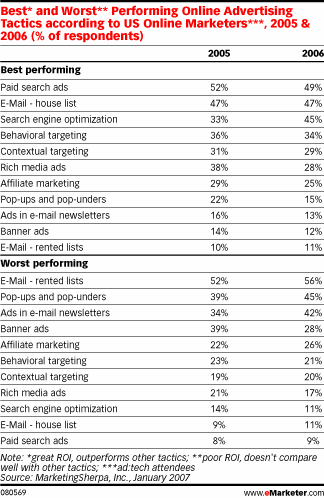
Why do they think it’s important? Because it kicks ass in ROI. Here are the results from another recent study by Ad:Tech and MarketingSherpa, asking advertisers about the return they get from various marketing channels.

080569

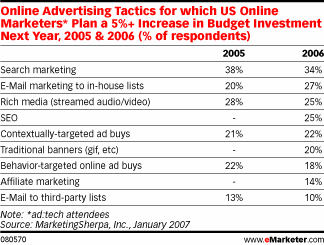
The biggest jump from year to year? SEO. Now, let’s look at where marketers plan to spend more money in the next year.

080570

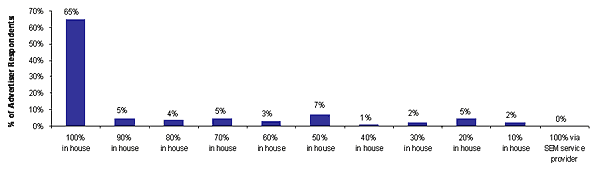
SEO, from flatlined last year to looking to spend 25% more this year. So SEO definitely isn’t dead. But it is moving to a new home. Here’s some early results from the SEMPO State of the Market Study (by the way, final results should be available next week. Look for them):

SEMPO2a

It’s true that most companies would far rather bring SEO in house, if they could. And when we consider the new definition of SEO, it probably makes sense for SEO to be integrated into the internal work flow. But the problem is that there’s not a lot of SEO expertise out there. If SEO was so easy, why don’t more companies do it, or do it well? Contrary to Pasternack’s argument, it’s not a “set and forget” type of tactic. It requires a champion, buy in and diligence.

I think the future is bright for SEO as a skill set, but we’re talking a modified set of skills. I talked about this in a recent SearchInsider column and a follow up online debate with Andrew Goodman. My view of the future for the really good SEO’s out there fall into three categories:

Get a (Really Good) Job

As companies bring this in house, there will be a firestorm of demand for skilled SEO Directors, but ideally as employees, not consultants.

Broaden Your View

Become an expert in how consumers navigate online and help your customers with the big picture, including the new reality of SEO.

Adapt and Survive

Find a new online niche where your search honed skills give you an advantage.

User’s View

Okay, this is already a much longer post than I intended, so I should probably talk about personalized search from the user’s perspective now.

Personalized search is a big win for the user. Don’t judge by the first few tentative steps Google is taking. Personalization is a much bigger deal than that. Google is easing us in so the experience isn’t too jarring. By the end of 2007, all 3 of the major engine’s results pages will look significantly different than they do today. Personalization will be like a breached dam. Right now we’re seeing the first few trickles, but there will be a wave of much deeper personalization options over the next several months. Search will become your personalized assistant, tailored to your tastes. As you search more, your results will draw more and more away from the universal default and closer and closer to your unique intent. Immediately after your query, you’ll be dropped into a much richer search experience. Disambiguation will become much more accurate, and you’ll find that you will pretty much always find just what you’re looking for right at the top of your page, without having to dig deeper. Here’s how I see it playing out at each of the big three:

Google

Google has a religious devotion to relevance, and as they gain confidence with personalized search and their ability to disambiguate, this will manifest itself with a laser focus on relevance above the fold. They will continue to maintain a good balance of organic results, but these results will not just be the current web search results. They could be local, image, news or a mix of each. And ads. Yes, you won’t escape ads, but Google will be the most judicious in what they show. Expect more stringent quality scoring, down to the landing page level and a high degree of relevancy in the ads that do show. Google will be the most concerned of the three in disambiguating intent.

Yahoo

Yahoo will put their own spin on personalization by wrapping in Social Search. They will continue to leverage their community, as they currently do in Yahoo! Answers so when you’re logged into Yahoo, you’ll be plugged into their community and that will impact the search results you see. Relevancy will be determined more by what the community finds interesting than what you find interesting, although it will be a mix between the two. Yahoo will target two types of searches, serendipitous search, where you’re looking to discover new sites, and what I call “frustrated” search, where your own efforts to unearth the data online have come up empty and you want the help of the community. When it comes to monetization, Yahoo will be the most aggressive, pushing more ads above the fold into Golden Triangle real estate. These ads will trail Google’s in terms of relevance

Microsoft

Microsoft will use their targeting capabilities and probably tie in some behavioral targeting to personalize their search results. Also expect personalization in the Microsoft product to be integrated at a deeper, more ubiquitous level, into apps and OS. This probably won’t happen in 07, but it will be a long term goal. When it comes to ad presentation, Microsoft will fall somewhere between Google and Yahoo in both the number and relevance of the ads being presented. The heaviest investment will be in building out the platform to manage and model the ad program, rather than in policing the quality of the ads themselves.

It promises to be a very interesting year in the Search Marketing biz!

SEM’s Seven Year Itch: Part Three

First published January 25, 2007 in Mediapost’s Search Insider

The 2004 acquisition of SEM firm iProspect by the advertising network Isobar marked a turning point in the search marketing industry. Various reports pegged the total value of the deal at about 50 million dollars, including potential earn-outs. IProspect founder Fredrick Marckini stood to be a very wealthy man.

The iProspect deal wasn’t the first or last acquisition to happen. But the valuation of the deal (together with an earlier Performics/DoubleClick deal) set a new high-water mark for the expectations of the owners of other search shops. Suddenly, it looked like there was a very lucrative exit possible. After years of struggling in the search space, we found that we might just be holding the winning lottery ticket. Up to this point, there was a bit of a taboo about talking of acquisition in SEM circles. We all routinely professed our love for search and how we just couldn’t see ourselves doing anything else. But, hey, a $50 million dollar check can change your thinking somewhat. Suddenly, the SEM community indulged in a little daydreaming and started frequenting the Jaguar Web site and checking out property prices in the Hamptons.

But the flood of acquisitions that was predicted never happened. It was more of a trickle, and when we were privy to details about valuations, they were significantly under the iProspect deal. There are a number of reasons for that (perhaps the topic of a future column). But the fact is, while the owners of search shops have had their appetites whetted, the window for highly profitable acquisitions may have passed by. Here’s why.

Tactically, We’re Awesome

Search marketers are brilliant tacticians, whether they work on the paid or organic side. It’s what we excel at. The biggest show in the SEM industry, ironically titled Search Engine Strategies, is really three or four days jammed packed with tactics, not strategies. We myopically focus on page position, always shooting higher. It’s all about rank. It’s all about being No.1.

What we’re not particularly good at is stepping back and looking at the big picture — the hows and whys of search, and, most importantly, the whos. While this is true across the search space, it’s most apparent with the organic optimizers. Virtually no one in the SEO world has given a hoot about messaging, user experience or intent. It’s all about crawling your way to the top spot. In the last year, I’ve seen a few SEOs starting to change their thinking, but the vast majority is still obsessed with blowing holes in the ranking algorithms.

Rank Becomes Irrelevant

However, we’re rapidly approaching the day when being No. 1 ceases to have any meaning. That’s a view that is tied to the concept of a universal results page. A user searching for “bass” in Seattle sees pretty much the same results page as someone searching in Salisbury or Saskatoon. In this context, rank not only has meaning, it’s the magic bullet.

Currently, the engines are rolling out personalization of results in a number of flavors. Soon geo-targeting, demographics and personal histories will be bigger determiners of the results, and the order you see them in, than the skill of a search optimizer. An aspiring musician in Seattle searching for “bass” may see the biggest selection of bass guitars in the Pacific Northwest in the No. 1 spot.  An angler in Saskatoon will probably see the top bass fishing spots in Western Canada. And the person using their laptop and wireless connection to search for “bass” in a Salisbury pub could well see the official site for Bass Pale Ale.

A New Rulebook

On the organic side, this dramatically changes the rules of search. The hyper-developed technical skill set of SEOs suddenly needs to be rounded out with a deep understanding of the target user. The optimization tactics we felt were going to guarantee us an early retirement, while still valuable, will take a back seat to the ability to segment and understand our target prospects. More important, we have to understand the online paths they’re likely to take, and help our clients intercept them with effective messaging and successful interactive experiences. These are the skills that will be in high demand in the future. There will always be a place for a talented organic optimizer, but it will be as a rather well-paid employee, not a multi-million-dollar acquisition.

Where do these new skills exist? Well, they’re more evident on the sponsored side, as new platform enhancements have allowed the best paid search practitioners to start to segment demographically and geographically. It’s forcing us to do our homework on who our prospects are. And unfortunately, our potential acquirers, the large agencies, believe they have deep bench strength when it comes to segmenting and profiling prospects, certainly deeper than the average SEM shop. I still don’t believe they’re done a particularly good job of porting traditional market research skills to the new consumer-empowered online reality, but I suspect I’d have a hard time convincing them of that.

You know who’s really honing these skills? The behavioral targeting practitioners. Search marketer should start paying a lot more attention to what’s happening in the BT camps.

A Chronic Itch

So where does that leave the average SEM agency? Is a profitable exit still an option as our seven-year itch demands to be scratched? If your valuation depends largely on tactics that gain higher rankings and concentrates on the “where” (on both the organic and sponsored side) rather than the “who” and “why,” your window has passed. But if you’re up for the change and not only embrace the inevitable reality of personalized and integrated search but pioneer the understanding of it, a new market will emerge. That’s the good news.

The bad news is that there’s a lot more hard work and learning that has to happen to position yourself in that market, and this time we’re not the front-runners. The truly passionate will persevere and adapt. The rest will find themselves with some pretty good job opportunities — but the summer house in the Hamptons and the Jag XKR convertible will be long shots.

Seth Godin’s Web 4.0 and the iPhone

Just as I’m doing one post about Seth’s log, he’s in the middle of making another post. Here it’s about Web 4.0 (yeah, he’s skipping a version or two). But in reading how Seth envisions the Web 4.0, it struck me how close it is to a vision I’ve had for some time (in fact, some of his examples sound eerily close to ones I’ve used in articles and presentations).

Seth’s quote:

“I’m booked on a flight from Toledo to Seattle. It’s cancelled. My phone knows that I’m on the flight, knows that it’s cancelled and knows what flights I should consider instead. It uses semantic data but it also has permission to interrupt me and tell me about it. Much more important, it knows what my colleagues are doing in response to this event and tells me. ‘Follow me’ gets a lot easier.

Google watches what I search. It watches what other people like me search. Every day, it shows me things I ought to be searching for that I’m not. And it introduces me to people who are searching for what I’m searching for.”

For those interested, here’s are a couple versions of my vision:

All Roads Lead Online: What Happens When Our Entertainment Choices Converge with Online and Become Interactive.

Tales of Mobile Woe: Looking for True Usability in a Handheld Device

It’s interesting and overwhelming to ponder. I think the next 5 years will prove to be cataclysmic. It’s all about making the Web more useful. It’s about making it ubiquitous and weaving it into our daily lives. And that’s where the introduction of revolutionary new handheld devices will shake things up dramatically. Apple’s iPhone could mark the beginning of a whole new phase of handheld functionality. As Cory Treffiletti points out in his column this week, Mobile Marketing is getting a lot more interesting with the promise of this functionality. On the flip side, Steve Smith reminds us that the mobile interfaces of most properties have a painfully long way to go.

ChaCha and the Search Tango

There’s a new crop of search interfaces coming out, many spin offs from the big engines themselves, and I’ll be trying to take a look at them from the user’s perspective. Today I took ChaCha for a spin. Here’s some background (and hype) from their About page

“ChaCha stands out as different and better in a landscape cluttered with common search engines because it uses the World’s most powerful technology – The human brain.

ChaCha’s goal is to provide a better search experience by combining results that are hand-picked by our knowledgeable human guides with the best computer-generated search results. In those cases where you can’t find what you need with our instant results, ChaCha will connect you with a live human guide who will find the information for you through an instant messaging-style search session.

Scott Jones and Brad Bostic, two dynamic entrepreneurs who were not satisfied with millions of irrelevant search results provided by first generation search engines, believed a better experience could be created by tapping into human intelligence. Since starting ChaCha, they have been hard at work with the ChaCha team to create:

  • A smart search engine that “learns” by tapping into human intelligence so its results are always improving
  • A place to find exactly what you’re looking for instantly
  • Help from people who are knowledgeable about the very thing you are looking for when instant results don’t have the answer “

Fellow Enquiro blogger Marina Garrison tried out Cha Cha and shared her thoughts. Here are mine. Unfortunately, there’s no good news here for the Cha Cha team.

“A Better Search Experience”

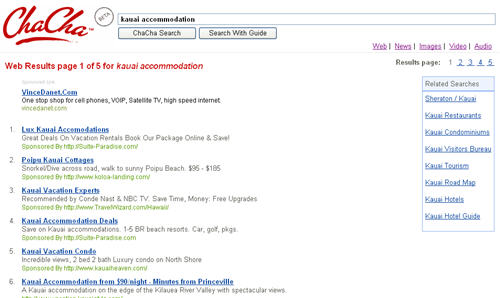
I started out by looking for hotels in Kauai. I used the default, automated search. At the same time, I did a search on Google for the same query. My intent was to compare my options, so I was looking for a link that would show me a number of properties. Google did pretty well, with both official and unofficial accommodation guides rounding out the top algorithmic results returned in the customary fraction of a second. Definitely something here I would click on.

Cha Cha’s automated results were far less satisfying.

  chachaorigsm

First, there was a sponsored link at the top, but no advertiser. That’s okay, it’s a beta, so I didn’t really expect one. But all the other results have a “sponsored by” line at the bottom. I’m confused. Are they sponsored links or not? Confusion is not good in a user experience. The results were mostly for individual properties, not very descriptive, and the same site showed twice in the top 4 results. The only guide I saw was well down on the top 10, and it wasn’t an official guide. The results weren’t really matched to my intent. Strike Two.  Once again, what was it that Cha Cha was offering?

ChaCha’s goal is to provide a better search experience by combining results that are hand-picked by our knowledgeable human guides with the best computer-generated search results.”

Oh..right. Okay, maybe I’ll try the “knowledgeable human guide” because after all, “it uses the World’s most powerful technology – The human brain”

I hit the search with guide button

The interface changed and opened up a pane on the left. There was a pause of at least 10 seconds while I waited to connect with a guide. In 10 seconds on Google, I’d have clicked off the page by now, but I’ll be patient. Finally I’m connected to DelaineL, who greeted me with a “Good Afternoon”. This despite I did this at 10 am local time. Hmmm..mental note for Scott and Brad, our “dynamic entrepreneuers”…you’ll have to work out that time change thing.

Now, I wasn’t sure what to do. Do they just pick up from the last query I did? There were no instructions I could see. I waited. Finally DelaineL sent me a “Hi!”. I guess I have to reenter my query in the message box. We’re approaching a minute now. I told Delaine (not sure whether this is a male or female Delaine) I was looking to compare hotels in Kauai. I wanted to be fair, giving my human guide a chance to give me the types of results I was looking for.

“Find exactly what you’re looking for instantly “

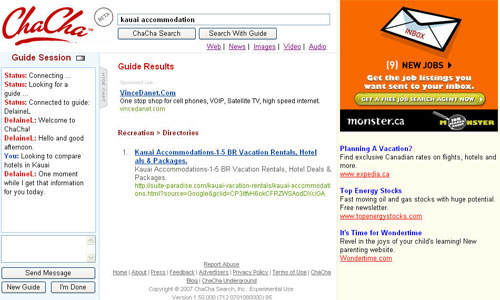
I was expecting a page of 10 results to pop right up. Instead, after many more seconds, I got one.

chacha1sm

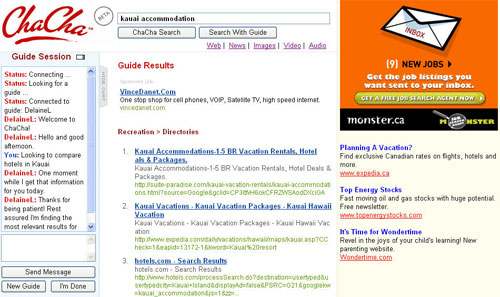
And it was for the same site that showed up twice in the top 4 organic results. This was the best that the “world’s most powerful technology” can do?  Also, the page they sent me was actually a landing page built for a Google Adwords campaign. Not really what I was looking for. So, was this the only result I was going to get? I asked my guide. I was told the second result was loading. When it came up, it was an Expedia search results page, along with an apology for the delay and the assurance that Delaine was looking for the most relevant results. The response sounded suspiciously canned though.

chacha2sm

I guess that’s what took the time, the guide went to Expedia and launched the search for me. I guess that’s good.

“People who are knowledgeable about the very thing you are looking for “

Okay, I’m sure Delaine is an excellent person, kind to kids and animals, and is probably an expert in many areas, but what makes him/her an expert on Kauai? How does Delaine know what I was searching for? Does ChaCha have a room full of people monitoring my initial search activity, and when I click on the guide button, a red light starts flashing and an announcement rings out at Cha Cha Headquarters, “Attention, we need a Kauai Expert on seach 1045..Stat!!” ? I somehow doubt it. Lets put the “knowledgeable” line down to more marketing spin.

Also, do we really want a human somewhere knowing what we’re searching for? I don’t think so. Most of us prefer to search anonymously, or at least what we think is anonymously (ignorance is bliss in this case, until we’re rudely awoken by a AOL debacle). I suppose if someone were really stuck, they would try their luck with a search guide, but based on my experience, it wouldn’t be something I would ever do again.

By this point, I had spent a good 2 or 3 minutes doing something that would take a few seconds on Google, and I didn’t get results any better than I would have received there. Sorry ChaCha, but you hit a sour note with me.

And now I go on my user experience diatribe. There’s obviously a lot of infrastructure behind Cha Cha. I have no idea how many human guides they have but to make this scalable (they say thousands), but it appears that they’re paid by the search. This is not a cheap start up. But this will undoubtedly fail. It offers no compelling reason to use it. It’s far inferior to other options that have established themselves with users. A little bit of research should have shown this. I’ve talked to a few people who have used it. None of them will ever use it again. I’m sure the people at ChaCha will say they had tremendous response from their initial tests. BS. If thats the response they got, they weren’t doing the tests correctly. This will be a waste of a lot of people’s time and some significant investment on somebody’s (apparently Jeff Bezos) part. And it could have been avoided with proper usability testing. There’s a lot wrong with ChaCha, and not much right. The interface is junky and clunky. It’s like a flashback to the dot com bubble.

If you’re going to Cha Cha, try not to step on your partner’s toes. I’m still limping.

Postscript

After the post, I ran across Rob Garner’s SearchInsider column from yesterday (obviously have to clean out my folders more often) on his experience with ChaCha. While not ideal, it seems Rob is more optimistic than I am:

“I would bet that they find a niche in the market with a loyal user base, and that we may see more innovation from them to come in the form of user interface, and/or behavioral research. “

I guess one thing ChaCha has going for it is the ability to get live user feedback, real time. I hope they listen.

SEM’s Seven Year Itch, Part Two

First published January 18, 2007 in Mediapost’s Search Insider

There’s another controversy stirring in the SEM blogosphere, and this one is revolving around the very future of organic optimization, the yin to the paid yang of search. While this debate rears its head with predictable regularity every few years, there’s a different flavor to this one. This time, rather than an inter-industry turf war, it’s the search user that will ultimately decide the fate of SEO. And that opens up part two of SEM’s seven-year itch: what life will be like on the agency side.

A (Very) Quick History of SEM

First, a little back story. The search marketing industry has gone through one significant evolution since it began in 1996. Back then, it was a grassroots movement that started on the back of the popular search engines. More than a few have called that relationship parasitic. We worked to game the algorithmic results of Infoseek, Altavista, Lycos and Excite. We did it because there was no choice. At the time, the only way we could buy results page real estate was with terribly ineffective banners. Everybody knew that it was only the results that people looked at, and they were generating huge amounts of traffic. The higher the position, the more traffic we could expect. The organic optimization side of search has actually changed very little in the past decade. The techniques have become more sophisticated, on both sides, but it’s still all about driving listings higher for selected key phrases.

In 1998, the first reinvention of search marketing took place. Bill Gross introduced paid search through Goto, later Overture, and now Yahoo. Google followed suit in 2000. Suddenly, a whole new dimension opened up. Many moved to the paid side of search. Some remained resolutely on the organic side. And, over time, many search shops embraced both.

The introduction of paid search has been the most significant change in our industry. It has largely propelled search to where it is today. From the agency side, it demanded a whole new skill set, as we pioneered the fundamentals of bid management and, more recently, market segmentation, conversion tracking and robust testing. But one thing remained the same. Fundamentally, whether paid or free, it was still all about gaining the best real estate on the search results page.

Our Day will Come (We Hope)

Whatever side of the search marketing street we hung our shingle on, many things remained in common. We started small. We remained dedicated to search. We worked our butts off. We loved what we did. And very few of us got rich. But, we consoled ourselves, we’re part of the fastest-growing sector in marketing, and there’s got to be a payoff. We know search. Everybody searches. That’s got to be worth something. Now, many years later, we’re beginning to wonder.

The paths SEM shops chose to take have diverged over the past seven or eight years. Some have remained small, largely built around one or two skilled practitioners. Some have pursued growth and built scalable infrastructures, often fueled by eager venture capital investment trying to grab a piece of the search tidal wave. In the later case, positioning themselves for an acquisition was a common exit strategy. In a few cases this has worked, the iProspect/Isobar deal being the most notable example. In some, the inevitable stress, change of culture and diversion of focus ended up knocking the legs out from under the company. At one point, Websourced was one of the largest SEM firms in the industry. A few weeks ago, it effectively closed its doors, being absorbed into its parent, MarketSmart Interactive.

Pondering Our Future

Whatever path we chose, we’re all coming to the same crossroads. We’ve put in a lot of sweat equity, often at the expense of huge portions of our non-search lives. Unlike the early employees of the search engines (see last week’s column), we don’t have any stock options sitting in a drawer somewhere–or even the security of a regular paycheck. We’ve invested everything we have, both personally and financially, in nurturing our individual companies along, hoping that at some point, in some way, we could cash in that asset to finance the next phase of our lives, whatever that might be. Up to now, the ride has been so fun that we weren’t too concerned about getting off. But soon, we may have no choice.

The fact is, search marketing is on the cusp of reinventing itself again, and if the introduction of paid search in 1998 split the industry in half, this new incarnation will fragment it in a million pieces.

Next week, I’ll continue by exploring the next reinvention of search–and where that leaves SEM agencies.

SEM’s Seven Year Itch, Part One

First published January 11, 2007 in Mediapost’s Search Insider

There’s been a lot of speculation lately about the future of Matt Cutts. A few of Cutts’ posts and a recent interview have dropped the odd hint that the world of Google and the world of Mr. Cutts may not always be one and the same. While this is certainly noteworthy on many levels, it’s only one symptom of a much bigger issue, and one that will change the search landscape dramatically.

The fact is, those of us in the search space who have been doing it for a while (in my case, dabbling for 11 years, dedicated for eight now) are getting tired. We’re becoming burnt-out. As exciting as the ride has been since 2000, we’re beginning to realize that there is a life beyond search, or at least, the seat that we’re currently sitting in. There are a number of individual issues emerging that signal a significant change coming, and the time is now. We are succumbing to our own version of the 7-Year Itch.

A Case of Google-itis

First, let’s look at what will be happening with the engines themselves:

Google was recently recognized by Fortune as the best place in America to work. Tales of perks beyond the imagination of most poor working stiffs emerged from the Mountain View Shangri-La. Those of us who have visited the Google campus knew about a lot of these, but you could hear the rest of America’s jaw drop. Oh my God, they said collectively, what a place to work!

Well, yes… and no. The things that make Google great also make it a meat grinder. When you sign your life over at Google, you’re entering yourself in a sprint without a defined finish line, against thousands of other people determined and capable of getting there first. That’s okay when you’re young (as everyone at Google is), but at some point, life edges in on the dream. People get married, people have babies, parents age and require care. Somehow, a $500 subsidy for take-out food or on-site dry cleaning can’t make the realities of that life go away. There’s no rule saying you have to work zillions of hours at Google, but when everyone else is doing it, especially the two founders, are you the one that’s going to slow down? Either you keep racing, or you drop out. There’s little middle ground here.

And My Option is…?

Combine that with the fact that most of Google’s old guard are sitting on stock options that make them multimillionaires. Matt’s a wonderful guy and I’d like to count him as one of the friends I’ve made in the industry, but it’s got to be tough to motivate yourself everyday to put in the hours it takes to be Matt Cutts when there’s the substantial carrot of a very early and very lush retirement constantly hanging just above your head.

Matt’s not alone. That’s why one-third of the first 300 employees are no longer with Google. A story in the Houston Chronicle relates how 16 Google insiders cashed in more that $3.7 billion in stock last year (half of this coming from Larry and Sergey themselves), filling California’s tax coffers. And there’s more to come. By 2008, the state is counting on a cumulative $1 billion in state income tax from the sale of Google stock as the early guard cashes in. That represents 1% of the state’s entire annual general fund budget.

Changing of the Guard

Somehow, staying in the race becomes less compelling when the alternative is so damned attractive. It’s a testament to Google’s culture that more haven’t taken Door Number Two yet. But as the old guard moves on, that culture is shifting. Again, this is not unique to Google. Startups everywhere go through this, but few have been as successful or watched as closely as Google. A San Francisco Chronicle article looked at the shift of Google from a highly democratic family to a more conservative bureaucracy: “The feeling of ownership among employees, a natural when a company has 100 workers, was nearly impossible to maintain after the workforce grew into the thousands.”

Google’s not alone in this. Just a few weeks ago, I wrote about Tim Converse’s departure from Yahoo. Yahoo has seen several move on, some voluntarily, some not, due to a series of reorgs. Yahoo is a perfect case study of the tempestuous nature of the Web. Once sitting on the top of the search heap, Yahoo has felt a series of very painful bumps on the way down. It is now reinventing itself so it can turn around its market-share slide. Yahoo is a curious mix of old guard and new saviors, as its culture becomes redefined, for different but no less effective reasons than Google.

And finally, there’s Microsoft, unique amongst the three. Being late into the search game might actually benefit the monolithic giant here. Most of the recently assembled search team still feels the motivation that comes from the promise of a new endeavor. Microsoft is in the unaccustomed position of being the startup, the new kid on the block. Their legs are still fresh.

Today, I looked at the effect of the 7-Year Itch on the engines, but the impact is also affecting hundreds of search marketing companies. Stay tuned for next week!

The SEO Debate Continues

My earlier post about the future of SEO caught Jason Lee Miller’s attention over at Webpronews. So far, Jason is one of the few to grasp the Richter Scale implications of this shift in the SEM landscape. Danny Sullivan saw the danger signs some time ago. I traded a few emails with Danny on this and his response was:

“I did a lot of writing about personalized search about two years ago sounding the same alarm. Then it never really happened, the personal results that is. They’ll come, of course.”

Meanwhile, Kevin Lee continues to poke away at the SEM-SEO controversy that his partner David Pasternack started. There are those suggesting that this is an elaborate link baiting scheme on Kevin’s part. While his speculating on the future of SEO is certainly generating lots of controversy, and hence, links out there in the blogosphere, the cynics are missing the point that all those links are pointing to Kevin’s Clickz column, not his corporate online properties. No, I suspect Kevin’s motivation in this case is his self professed tendency to be a intellectual shit disturber. He likes to stir up polarized discussion, because if you know Kevin, there’s nothing he likes better than a good debate.

As you know from the previous post, I have a slightly different take (and I use the word slightly deliberately, I happen to agree with a lot of what Kevin said in his last column) on the debate than does Kevin. His point is that SEO can be brought in-house because for a lot of websites, you just have to do the basics right and they’ll get a huge lift. Couple this with the desire, expressed in the latest SEMPO survey, of a lot of companies to handle all this SEO in-house because there’s a lack of a recognized and trusted leader in the SEO Marketplace and it’s not that hard to see Kevin’s point. To be fair, Kevin also pointed out that a lot of companies want to bring their paid search in-house as well.

But here’s the thing. SEO is going to get a lot harder, not easier. And that increasing difficulty is going to be in area that today’s crop of SEO’s have next to no experience in: knowing the end user. And that get’s back to Jason’s story in Webpronews. He states:

“While focus on keywords has been the law of the searchland, SEO professionals will have to more diligently and acutely focus on the end user – every unique end user – mulling scenarios, personalities, and motivations, which makes SEO more akin to traditional marketing, where a firm grasp of psychological concepts is as necessary as the technical acuity of keyword targeting.”

Exactly, but in that paragraph lies a world of adjustment, and I’m not sure most SEO’s are up to the challenge.

Here are some things to think about:

As results become more personalized, the work ranking ceases to have meaning. Just a few months ago the question of ranking reporting came up in an analytics session I was participating in. This has been part of SEO since the beginning and has been an ongoing sore spot between the engines and the SEO community. I mentioned that ranking reporting might soon become irrelevant, expecting it to generate a bit of controversy (in that, I do share Kevin’s delight in stirring the pot sometimes). To my surprise, nobody picked up on it. Fellow SEO’s on the panel even failed to take the bait. I felt like screaming “The whole world is about to change as you know it!” but I chose instead to go to the exhibit hall for the free drink. It was the end of the day and I was tired.

SEO’s are all about controlled experimentation. We live to tally up suspected algorithmic factors and test, tweak and twiddle. We reverse engineer the algorithms. Say what you want, that’s basically what SEO is. It’s all about tactical maneuvering. I’ve been bemoaning the lack of strategic thinking, based on what users are actually doing, for years now, but the industry hasn’t changed much. To reverse engineer, you need a control to test against. You need at least one fixed target. Up to now, the universal page of results was that fixed target. How do you reverse engineer when you have nothing to set your bearings against?

As Jason so rightly points out, this new world of SEO is much more about marketing than it is a technical skill set. It’s about knowing your user intimately and where they tend to hang out, given a specific intent. It’s about staking out the most traveled intersections and gaining some presence there. It’s about knowing how they’ll use the new version of search to navigate the online landscape. And it’s about accepting, once and for all, that you really can’t control your presence on the search results page, however it appears.

And it’s here where Kevin’s view and mine coincide. In a lot of cases, it will be about doing the fundamentals right. If you have a site that has an established presence, then this is often enough. Make sure you connect the spider with the content. Make sure the content and your target customer share the same vocabulary. Make sure you’re not throwing any road blocks between your site and the search index. Do that, and accept the fact that your control pretty much ends there. That’s not to downplay the importance of this knowledge. I agree with Danny Sullivan that SEO skills are not nearly as common as David Pasternack seems to indicate. But I believe the days of the SEO hacker/hired gun are numbered. Personalized search may be what finally kills black hat SEO.

With that, organic optimization returns to its roots, and what the word organic should have meant in the first place. It’s about working with the client to help them understand how consumers use online to research and to help them turn their organization into an organic content factory. Help them use online to provide multiple and useful touchpoints for the potential consumer. Extend your presence into the well travelled online intersections. Establish best practices for SEO, and let the rest take care of itself. As Kevin rightly points out in his column:

“Alternatively, one could simply focus on producing great content and take whatever links occur naturally (the way Sergey Brin and Lawrence Page intended in the original PageRank system).”

It’s here where SEO’s have their biggest challenge. Can they transition from a technical experimenter to a trusted guide to online traffic patterns? I have my doubts. I have seen little evidence of this in the past. SEM’s tend to be further ahead in this regard, because of the targeting opportunities that the back end platforms provide. Ironically, this is where interactive and traditional agencies could regain a foothold, but in the later case at least, they’re still struggling with the whole concept of an empowered online consumer, and until this paradigm shifts for them, they have a huge blind spot when it comes to online strategy.

SEO’s have to reinvent themselves, and soon. Some of the skills will be transferrable, but many new ones have to be acquired, and these are not usually skills that are found in the same place. I expect a shakeout, and soon. A lot of SEO’s have been doing this for a long time, and they’re getting a little tired. Reinventing themselves is probably the last thing they want to do. Cashing out was probably more in their anticipated plans.

So, how soon is this going to happen. Let’s get back to Danny’s point. Personalization is nothing new, but I think 2007 is the year where it will make a noticeable difference. There are a couple of indicators of that:

Google is already experimenting with Geo-targeting results based on IP identification. Those of you in the States probably haven’t noticed, because the online world is very US-centric, but those of us who live on the outside are already dealing with the effects. In Canada, there is a significant difference in results seen in the main Google index depending on whether the query is coming from the US or Canada. It’s a constant bain of our existence, being based in Canada but working primarily with US clients. So even in North America right now, there is no such thing as a universal set of Google results.

Personalized search that users opt in for is finally gaining significant traction. All the 3 engines offer this, and often the fact that you’re signed in is completely missed by the user. As adoption of other functionality offered by the engines increases, the odds of being signed in when you launch a search rises dramatically. And for the engines, search history is enough additional information to make them confident in presenting personalized results. It gives them another reference point in addition to the original query. The difficulty in disambiguating intent for a query was the sole reason results weren’t personalized up to now.

What does the future hold for SEO? Well, as long as users continue to want organic results (and I think personalization will make this more true, not less) there is a need to gain presence there. But the rules of the game are being rewritten. For those willing to retrench, there’s a golden opportunity to redefine marketing as we know it. But it requires looking at a big picture, and, more importantly, using a customer-centric lens to look at that picture. It means changing our approach dramatically. It means drawing back from some highly specialized skills that some have developed, and taking a more balanced approach. Personally, I’m very excited about the possibilities. A little tired, a little burnt out, but up for the challenge. But perhaps that’s because I saw it coming.