The Art of Contradiction

First published March 28, 2007 in Mediapost’s Search Insider

From “The Argument Clinic,” Monty Python

Michael Palin: An argument isn’t just contradiction.
John Cleese: It can be.
Michael Palin: No it can’t. An argument is a connected series of statements intended to establish a proposition.
John Cleese: No it isn’t.
Michael Palin: Yes it is! It’s not just contradiction.
John Cleese: Look, if I argue with you, I must take up a contrary position.
Michael Palin: Yes, but that’s not just saying ‘No it isn’t.’
John Cleese: Yes it is!
Michael Palin: No it isn’t!
John Cleese: Yes it is!
Michael Palin: Argument is an intellectual process. Contradiction is just the automatic gainsaying of any statement the other person makes.
(short pause)
John Cleese: No it isn’t.

I think the world of SEO has spun into a prolonged Monty Python sketch. The flavor of the month seems to be manufactured debate designed to take up polar opposite positions on any given topic. There’s nothing like a little dustup online to get the creative juices going and generate a lot of blog activity, and, if the topic of that debate strikes enough nerves, a corresponding bushel of new links. It seems like no matter what someone says, someone else in the blogosphere automatically takes the contradictory viewpoint, sometimes not so much because he or she disagrees — but just because they want to post a comment on their blog and generate some links.

You Say “Potato,” I Say “Patattah”

There’s nothing new with online debate, but in the past it tended be fueled by real passion. Today I suspect that we’re all scanning the online landscape, looking for a viewpoint that we can be diametrically opposed to, just for the sake of generating some dialogue and some link bait.

And, just so we can be crystal-clear about this at the outset, when it comes to the above practice, I’m guilty as charged. In the past couple of months I’ve engaged in at least three or four of these debates in my own blog. Some I truly felt passionate about and some were simply me jumping on the other side of the question for the sheer purpose of having a little fun and perhaps generating a comment or two. Perhaps the low point of this particular form of online content generation reached its lowest point when both I and fellow SearchInsider David Berkowitz decided to open up the debate in this column on no less worthy a topic then Kevin Federline (just kidding, David, I know this wasn’t just a heartless exercise for you. I’m sure you’re very passionate about K-Fed.).

Dispassionate Debate

But I have to wonder how effective we can be in arguing if we don’t truly believe in the viewpoint that we’re arguing for. Dispassionate debate is supposed to be something we learn at school. We get randomly assigned one side of an argument, and it’s our job to effectively argue that viewpoint whether we believe it or not. The advantage of dispassionate debate is that you tend not to shoot your mouth off too fast. You take the time to do some research, learn the facts, and construct a logical argument without your face turning red, your heartbeat racing and your blood pressure rising through the roof. I’m the first to admit that when someone strikes a chord with me, I tend to take it a little more personally than I should — a situation I’m currently finding myself in with one of my blog debates.

Get The Juices Going!

But the debate that really get the juices going are those things we truly believe in. Just look at how passionate an entire industry got when the very validity of SEO was questioned. Take a browse through some of the hottest threads in either Webmaster World or Threadwatch and see how vitriolic comments can get when the raw nerves are exposed.

Passionate ideological debate is a good thing. It’s what built our society and it’s what’s driven the evolution of our civilization. If we can keep the focus of the debate on the validity of the ideas and not the person making the argument, then debate is a very good thing. It’s healthy, it lets the air in, it exposes ideas and allows us to ruminate on them. And if it happens on an online forum and it happens to help reinforce the structure of the Web by generating new links, then so be it. Again, it’s just one more way to where the Web takes the things we’ve always tended to do and elevates them to a new level.

In one particular debate I was told I should not take it so personally. After 45 years of living with myself, I realize I’m just not wired that way. I do tend to take things personally — and that’s usually what prompts me to post comments, whether they’re in a column like this or on my personal blog. And I’m not sure that’s such a bad thing. Yes, it might ruffle some feathers from time to time. But it’s a sign of passion — and one thing I truly love about this industry is the passion that always bubbles just below the surface. I love the fact that we’re quick to jump to the defense of ideas we hold dear. I love the fact that we’re a very eloquent group and we can make our points so well. In a column that came out last week, Bill McCloskey cried about the lack of passion in the e-mail industry. As Bill points out, I’ve never seen that to be true in search. We’re ready to argue anything, even if we don’t really hold our position to be true deep, deep in our heart.

After all, there’s no such thing as bad press — and perhaps there’s no such thing as bad link bait.

The Great K-Fed Debate

federlinesearchMy SearchInsider column last week took exception with K-Fed launching his own search engine. Actually, I take exception with the entire concept of K-Fed that but that’s another point. In today’s SearchInsider, David Berkowitz retorts, rebukes and refutes my negativity around all things Federline, saying that the K-Fed engine shows that search is ubiquitous, search is evolving and search shouldn’t be always all business, no fun. Ultimately he says let the market decide whether a Kevin Federline engine is a good idea or not. Hard to refute that point.

Anyway, knowing David, he had a lot of fun writing the column and I certainly had fun writing the original column. The thing that amazes me is that in the past week, 40% of the total ink (or whatever the virtual variation of ink is) on SearchInsider has been devoted to the topic of Kevin Federline. Perhaps someday soon you’ll be able to pick up your local copy of SearchInsider at the grocery checkout and we’ll have great juicy articles about Britney’s rehab and the latest alien that professes to be Elvis, living in Minot, North Dakota.

One last point though David. You quoted me as saying that I would rather wear Fiberglas underwear than use the Kevin Federline search engine. That’s not actually true, I would rather wear Fiberglas underwear than attend K-Fed’s birthday party. And you asked where the phrase comes from. For the life of me I can’t remember where I first heard it, but I’m pretty sure it’s not a Canadian thing. I tried to look it up and couldn’t find any references so what the hell, let’s say that I originated the saying.

K-Fed Up with Celebrity Skinned Search

First published March 22, 2007 in Mediapost’s Search Insider

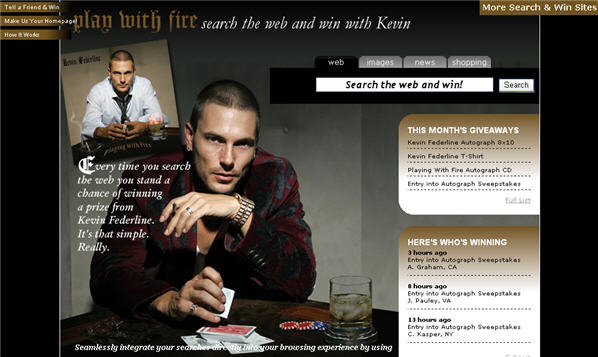
I’ve got a question for you: Would you want to do anything with Kevin Federline? Personally, the more Federline-free my world is, the better. But apparently other people don’t see it that way. You may have noticed earlier this week that K-Fed is actually launching his own search engine. Well, to be more accurate, he’s slapping his face on an existing back end, so to speak. I won’t go into the details of the K-Fed engine, except to say that it’s powered by Yahoo and it’s offered by Prodege.com.

Par-Tee with Britney’s Ex!

Apparently, making this your primary search engine could open the door to a chance to win tickets to Kevin’s private birthday party (I would rather wear fiberglass underwear), T-shirts and other paraphernalia all related to the somewhat questionable K-Fed brand. Apparently, an invite to K-Fed’s birthday party is “a once in a lifetime opportunity.” This has the ring of truth, as I might consider killing myself if I actually won.

This got me thinking. If we’re in the era of consumer-generated media, are we also in the area of consumer-generated celebrities? Does the increasing fragmentation of our society through an explosion of online channels means that even marginal celebs like Kevin Federline get their own small sliver of fame? If we have enough Kevin Federline fans somewhere and the Web has empowered them to have a voice unlike anything they may have been able to have before, is there a place for a Kevin Federline search engine? And, if so, does the future hold the promise of a profusion of celebrity skinned search sites?

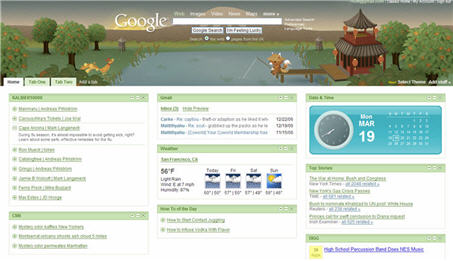
Google Dresses Up Your Home Page

Ironically, Google also made an announcement this week releasing six themes for their personalized homepage. In this case, Google went out of its way to make sure that the themes are not commercial in any way. In Google’s words, these themes are all about “art and personality.” The new Google themes are clever, in that they are location-sensitive and have some cool little twists designed to “delight” users. For example, some of the scenes are outdoors, and the sun rises and sets in sync with where you happen to be located. With a Google theme installed, you may never have to look out your window again. But in a conversation with Google folks, they made a point of saying that they’re hesitant to open up an API to Google themes, for fear that it would cause a rush of commercialized skins, which could encroach on the user experience.

Blatant Commercialism is Skin Deep

Commercially oriented skins are nothing new, of course. Movies have released custom skins for MP3 players and other online apps that bury functionality under a sea of advertising spin. There are hundreds and thousands of desktop themes, wallpaper and screen savers with a commercial bent. But up to this point, search has been relatively “spin-free,” save of course for the advertising on the actual results page. But at least I don’t have to look at Kevin Federline when I’m searching for the symptoms of gout or trying to find an update patch for my latest Windows problems.

Just Give Me My Results, Dammit!

Based on a few new entries in the search space, it suddenly seems like we need personality mixed in with our search functionality. Search innovator K-Fed is not the only one pointing us in this direction. Microsoft has been playing around with Ms. Dewey (again an unfortunate choice of words), with the assumption that an undeniably attractive but distinctively bitchy female guide standing in front of a Blade Runner-esque streetscape will somehow make our search experience more complete. Perhaps Ms. Dewey could be K-Fed’s rebound after his split with Britney. Or perhaps both of them should have a cup of tea with Jeeves and see how being a search mascot worked out for him.

My feeling is that we want search to be a pristine experience. We’d like it to be minimalist, and we want to start from a neutral palette. We are so focused on intent and the task at hand when we interact with search that anything that gets in the way is simply a distraction. It adds nothing to the user experience. Search is very utilitarian task. We get in, find what we’re looking for and get out. However, with the lion’s share of the search market tied up in the hands of so few players, perhaps any tactic is worth a try to see if they can wrest even a small sliver of those searches away from the Googles and Yahoos of the world.

Where Are They Now?

By the way, the other celebrities that have their own search engines with Prodege.com? Meatloaf, Andrew Dice Clay, and Wynonna Judd. So the progressive degrees of “washed up” seems to be: having your own reality show, appearing on “Dancing with the Stars,” then having your own search engine. Now, I ask you, if Paris doesn’t have her face (or other assorted body parts) plastered on a search engine somewhere, how hot can this trend really be?

Google Home Page gets Skinned – and One Change of Note for SEOs

I just had the official walk-through of Google’s recent announcement for personalized home pages. In a nutshell, they are allowing users the opportunity to skin their home page with one of six different themes. The goal, and I quote, is to “delight users”. And they don’t just want to delight them in the short term. They want this to be a long-lasting love affair with the Google home page.

Actually, in the call, we got sidetracked a little bit with something that, to me, was far more interesting. I’ll get to that in a second but first of all let’s look at the noteworthy aspects of Google’s announcement. The theory here is that the more you can personalize your home page, the more likely you are to interact with it on an ongoing basis. And if there’s a certain amount of cool involved, it will hopefully keep you coming back. Of course, Google wants this implementation to be technically clean so they’ve approached it with their typical engineering anal-retentiveness.

googlephpex(1)

The application of the theme is restricted to the top of your personalized home page. Google was very careful to make sure that the graphics didn’t impair either the performance of the page or your ability to get to the information on the page. They’ve taken some fairly ingenious workarounds to this. The themes are launched with a CSS framework and the foreground images are transparent gifs, layered over a tiled background that allows resizing of the browser without impairing the look and functionality of the page.

Google also, and again I quote, wanted this to be about “art and personality”, not about a thinly “skinned” (if you’ll pardon the pun) advertising pitches. They’ve only released six themes in this first round because they wanted to set the bar high. They indicated that they would likely be releasing more over time. And they also indicated that they are considering opening up a skinning API in the future, but they would rather not have highly commercially oriented skins, i.e. promoting the launch of a new movie, suddenly intruding on the personalized home page user experience.

One feature that is pretty cool about the new themes is that they are location sensitive. When you load a new theme the first thing you’ll be asked to do is enter your zip code (right now this release is only aimed at the US, but a release for Google’s other localization areas should come in the near future. I did add one in Canada, but I’m not sure if it’s updating itself). After that, you’ll find your seeing updates itself reflect the time of day and, in some cases, the season and your local weather.

Here are some examples. In Bus Stop, the weather impacting the bystanders changes based on what you might be seeing your window.

busstopresized

In Beach, the time of day will change your view over the seascape. When the sun sets out side, it should also be setting on your monitor.

googlebeach

And, in the seasonal theme, you’ll not only see the theme change based time of day, you’ll also see the changes of the seasons.

googleseasonal(1)

Google also promises some Easter eggs, hidden in amongst the themes.

All in all, it’s a cool add-on to the Google personalized homepage. Of course the rationale behind this announcement is fairly transparent. Google is pushing hard to gain more face time with the average user, and this gives them a front to attack on. The more time you spend the Google home page, the more chance you will have to interact the other Google properties. Apparently, Google is seeing some very strong growth trends through 2006 with personalized homepage usage. They’re also seeing a huge ramp-up of content delivered for the home page through their Gadgets API.

The SEM Easter Egg

But what about the search marketing implications? There’s nothing about this particular announcement that should impact how the personalized home page could be used for personalized search, other than Google’s hope that the addition of a personalized theme would lead to more interaction with your homepage. But there was a functional roll out recently by Google that could have implications for the search marketing community. This is something that I wasn’t aware of and was lucky enough to get a quick walk-through.

Googleaddatab

When you sign in to your personalized homepage, you’ll now see a small “add a tab” link beside the tab at the top of your home page. When you click on this you’re asked to name your tab and if you leave the Feeling Lucky check box checked, Google will go out and find the content to put on your new page.

Addatabdialogue

For example, I added a tab called SEO and Google automatically populated it with the latest headlines from SEOmoz, SEO News, Search Engine Land, Search Engine Watch and a number of other SEO sites.

Googletabseo

I asked Google how it was determined what sites would be included in this set of default content. Apparently, it’s decided by the most common choices of other people who have added a similarly named tab. In other words, these represent the aggregate choices of an ad hoc community, defined by the people who are interested in SEO and have decided to add these sites as content to their home page. And the set of default choices will constantly be refined, based on the most popular choices of people who add that tab. However, once you’ve added the tab to your own home page, your default content set remains static.

Okay, that’s interesting. But let’s factor in Google’s other recent announcement, the fact that they now have an integrated personal suite that shares user data from search history and what you have on your personalized home page. It’s not clear right now how much of an impact the content you’ve chosen to include on your personalized home page has on your personalized search results, but Google has said they wouldn’t “preclude” the use of this information in the personalized results algorithm.

Let’s further explore the implications. In these areas of interest, what gets included in the default content set under a possible “add a tab” category might have a significant advantage for any searches that fall within that content area. The more people who leave the Feeling Lucky? check box checked, the more people that will have these default content providers represented on the homepage, which will in turn likely impact their personalized search results. As we start exploring personalized search more and more, we’re starting to see the possible tactics that are emerging for gaining visibility on a personalized search page.

So what’s the bottom line here? Google’s new themes are cute and will likely lead to a higher degree of usage, but they have little impact on the world of search marketing. However, the “Add a Tab” functionality could potentially have a lot more impact.

Jimbo Wales and People-Powered Search: A Long Shot

First published March 15, 2007 in Mediapost’s Search Insider

Jimmy Wales, the co-founder of Wikipedia, is placing a fairly large bet that people can trump technology in the search engine game. According to a recent report in Yahoo, he’s putting $4 million (of other people’s money) plus an undisclosed “large amount” from Amazon on the line, betting that he can steal 5% of the total search market away from Google with his new project, Wikia.

Wales has called both Google and Yahoo the “black boxes” of the internet, criticizing them for the secrecy maintained around their ranking algorithms, but details on exactly how Wikia will work have been equally scarce. All we’ve heard so far is that an online community with “a distinct and clear purpose — a moral purpose — that unites people and brings them together to do something useful” will work to make Web search a better experience for us all. The “how” of how Wikia will work has been lacking to this point. But it’s likely to follow a similar path as Wikipedia. The online community will act as an army of human editors, ensuring the quality of the results by collectively agreeing on them in some fashion. The theory here is that there is no better filter for results aimed at humans than those same humans.

Human “Signal Noise”

But the minute you put people into the equation, you introduce “signal noise”: in engineering parlance, you add friction between the end user and the desired content. Automated algorithms are relatively friction-free. Results are ranked with mathematical objectivity, based on universally applicable principles. Queries flow through this channel to connect with the content as determined by the algorithms.

People are smarter and more intuitive than the smartest algorithm, but they’re also political. And the reality is, the very segment that Wikia (and Wikipedia) depends most on are those most prone to politics.

Anytime you depend on people to do things out of the “goodness of their hearts” you attract a certain kind of person. They’re community-minded, true, but it’s very much their definition of community. They can also be elitist, obstinate, territorial and dismissive of those “outside the circle.” These people tend to show up in the same places: condo strata councils, nonprofit organizations, PTAs, church groups, and, online, in forums and on wikis. They have the time to contribute, probably because no one can stand them, so they don’t have an active social life outside their chosen cause.

I’m not saying everyone that contributes falls into this category, but come on, admit it, everyone reading this now has someone firmly in mind that fits the above description. They get possessive about their online community, which is both a good and a bad thing. With possessiveness comes politics, and signal noise.

Good Intentions, Bad Results

If you need more evidence, look at what is currently happening in the best-known communities that depend on online “Good Samaritans.” On Digg, the Bury Brigade has been publicly acknowledged by Digg founder Kevin Rose: Any story that doesn’t meet their criteria for what is interesting gets quickly buried, never to rise to the surface again. That’s censorship, and it’s just some of the signal noise you can expect when you introduce people to the equation.

Wikipedia has come under frequent criticism for the same issue, a handful of community elite (with a decidedly left-wing bent) dictating what should and shouldn’t be included as entries.

A Growth Bottleneck

But perhaps the biggest challenge for Wikia is scalability. If you put your faith in people as your competitive advantage, you have to be prepared to accept the restrictions that come with that. If Wales is counting on people to help compile the index and rank it, that introduces a potentially significant bottleneck.

Search engines are different than encyclopedias. Encyclopedias are much less dynamic, even when you have an encyclopedia as fluid and ever-growing as Wikipedia. Search engines have to be much more sensitive to new content. A lower-traffic entry on Wikipedia could probably go untouched for months at a time and it wouldn’t significantly impact the value of that entry. But users of a search engine expect even long-tail queries to bring back fresh and timely results. Given this factor, it would be likely that Wikia would have to have a two-stage approach to including new content. They would need an automated spider and simple index, to be later augmented and edited by humans. This would create a significant divide in the quality of the results, between the edited and unedited entries, especially in newer, less popular segments of the index. And, as Wales himself admits, if the algorithms that power the automated portion are open source, the door is wide open to spammers.

What’s In It For Me?

Finally, we have to look at the motivation on why people contribute to Wikipedia, and ask ourselves if this would translate to a search engine. When you contribute to Wikipedia, you’ve staked your claim in online intellectual territory. You’ve left a mark, speaking to your expertise in a particular area, on a place on the Web where you can point and say, “See, that’s me. I did that!” It may not have your name on it, but it’s visible.

In a search engine, your contribution would be lost in a background process that would leave virtually no trace that you ever trod there. There are no bragging rights. And that’s essential to appeal to the segment of the online community that Wikia needs to survive. If we’re going to take even a few seconds out of our busy days to tag, vote, nominate or whatever else Wales needs us to do, there’d better be something in it for us, or it just won’t fly.

I applaud Jimmy Wales’s ideal of open access to technology and unlocking the “black box” for the masses, but I just can’t see how it will work for search. Much as I love humans, having been one on occasion, I’m not sure they’re the competitive advantage a search engine needs.

Webpronews Video: Who Said What?

I happened to be browsing through Webpronews on the weekend and saw one of their new video news updates. The clips are well produced, professional looking and even have their own attractive newscaster, Nicole Eggers. One I happened to pick, however, left a little to be desired on the accuracy front. As you’re probably aware, I just did a series of interviews with the top usability people at each of the three engines for Search Engine Land and a couple weeks ago I did a recap talking about the differences I saw between each of their philosophical approaches. The blurb on the video appeared to be on the same topic so I decided to give it a watch. If it, Webpronews indicated that search expert Danny Sullivan had talked to each of the three usability people at the engines and had come to the following conclusions:

  • That relevancy was almost a religion for Google
  • Yahoo had a heightened sensitivity to the needs of their advertising community
  • Microsoft was still finding their competitive niche

Huh? That’s exactly what my recap said. They even pulled a few quotes from it and attributed them to Danny. I quickly e-mailed Danny to see if we were doing some kind of weird Cyrano de Bergerac thing but Danny was apparently as out of the loop on this as I was. Anyway a quick e-mail to Webpronews seems to have got it straightened out. They’ve pulled the clip and apparently they’re redoing it.

Not that I mind being mistaken for Danny, but I just hate to be putting words in his mouth. By the way, does anyone else feel like they’re being scolded by Nicole? Again, not that I mind.

A Caffeine Fueled Vision of the Future

This week, for some reason (largely to do with thinking I could still handle caffeine and being horribly wrong), a number of pieces fell into place for me when it came to looking at how we might interact with computers and the Internet in the future.  I began to sketch that out in my SearchInsider column today (more details about the caffeine episode are in it) , but quickly found that I was at the end of my editorial limit and there were a lot of pieces of the vision that I wasn’t able to draw together.  So I promised to put a post on this blog going into a little more detail.

The ironic thing about this vision was that although I’d never seen it fully described before, as I thought about it I realized a lot of the pieces to make this happen are already in development.  So obviously, somewhere out there, somebody also seen the same vision, or at least pieces of it.  The other thing that struck me was: it all made sense as a logical extension of how I interacted with computers today.  Obviously there’s a lot of technology being developed but if you take each of those vectors and follow it forward into the future, they all seem to converge into a similar picture.

Actually, the most commonly referenced rendering of the future that I’ve seen is the world that Spielberg imagined in his movie Minority Report.  Although anchored in pop culture, the way that Spielberg arrived at his vision is interesting to note. He took the original short story by Philip K. Dick and fleshed it out by assembling a group of futurists, including philosophers, scientists and artists, and putting them together in a think tank.  Together they came up with a vision of the future that was both chilling and intriguing.

I mention Minority Report because there are certain aspects of what I saw the future to be that seem to mirror what Spielberg came up with for his future.  So, let me flesh out the individual components and provides links to technology currently under development that seem to point this way.

The Cloud

First of all, what will the web become?  There’s been a lot of talk about Web 2.0 and Web 3.0, or the Semantic Web envisioned by Tim Berners Lee.  Seth Godin had a particularly interesting post (referenced in my column) that he called the Web4.  All these visions of the Web’s future share common elements. In Godin’s version, “Web4 is about making connections, about serendipity and about the network taking initiative”. This Web knows what we’re doing, knows what we have to do in the future, knows where we are at any given time, knows what we want and works as our personal assistant to tie all those pieces together and make our lives easier.  More than that, it connects us a new ways, creating the ad hoc communities that I talked about in my earlier post, Brain Numbing Ideas on Friday afternoon.

For the sake of this post, I’m calling my version of the new Web “the Cloud”, borrowing some language from Microsoft. For me the Cloud is all about universal access, functionality, connection and information.  The Cloud becomes the repository where we put all our information, both that which we want to make publicly accessible and that which we want to keep private.  Initially this will cause some concern, as we wrestle with the change of thinking required to understand that physical ownership of data does not always equal security of that same data.  We’ll have to gain a sense of comfort that data stored in online repositories can still remain private. 

Another challenge will be understanding where we, ourselves, draw the line between the data we choose to make publicly accessible and the data we want to keep for our own personal use.  There will be inevitable mistakes of an embarrassing nature as we learn where to put up our own firewalls.  But the fascinating part about the Cloud is that it completely frees us physically. We can take all the data we need to keep our lives on track, stored in the Cloud, and have it accessible to us anywhere we are. What’s more, everyone else is doing the same thing.  So within the Cloud, we’ll be able to find anything that anyone chooses to share with us. This could include the music they create, the stories they write, or on a more practical level, what our favorite store currently has in stock, or what our favorite restaurant has on for it’s special tonight.  Flight schedules, user manuals, technical documentation, travel journals…the list is endless.  And it all resides in the Cloud, accessible to us if we choose.

The other really interesting aspect of the Cloud is the functionality it can offer as we begin to build true applications into the web, through Web 2.0 technology. We start to imagine a world where any functionality we could wish for is available when we need it, and where we can buy access as required.  The Cloud becomes a rich source of all the functionality we could ever want.  Some of that functionality we use daily, to create our own schedules, to communicate, to connect with others and to manage our finances.  Some of that functionality we may use once or twice in a lifetime.  It really doesn’t matter because it’s always there for us when we need it.

The functionality of the Cloud is already under development.  The two most notable examples can be found in Microsoft’s new Office Live Suite and in the collection of applications that Google is assembling.  Although both are early in their development cycles, one can already see where they could go in the future.

The final noteworthy aspect of the Cloud is that it will create the basic foundation for all communication in the future.  Our entertainment options will be delivered through the Cloud.  We will communicate with each other through the Cloud, either by talking, writing or seeing each other.  We will access all our information through the Cloud.

For the Cloud to work, it has to be ubiquitous.  This represents possibly the single greatest challenge at the current time.  The Cloud is already being built, but our ability to access the Cloud still depends on the speed of our connection and the fact is right now, our wireless infrastructure doesn’t allow for a robust enough connection to really leverage what the Cloud has to offer.  But universal wireless access is currently being rolled out in more and more locations, so the day is drawing near when access will cease to be a problem.

So, when the Cloud exists, the next question is how do we access it?  Let’s start with the two access points that are most common today: home and at work.

The Home Box

The Home Box becomes the nerve center of our home.  It acts as a control point for all the functionality and communication we need when we’re not at work.  The Home Box consists of a central unit, which doubles as our main entertainment center, and a number of “smart pods” located throughout the home, each connected to a touch screen.

So, what would the Home Box do?  Well first of all, it would inform and entertain us.  The pipeline that funnels our entertainment options to us would be directly connected to the Cloud.  We would choose what we want to see, so the idea of channels becomes obsolete.  All entertainment options exist in the Cloud and we pick and choose what we want, when we want.

Also, the Home Box makes each one of those entertainment options totally interactive.  We can engage with the programming and shape it as we see fit.  We can manipulate the content to match our preferences.  The Home Box can watch four or five sporting events and assemble a customized highlight reel based on what we want to see.  The Home Box can scan the Cloud for new works by artists, whether they be visual artists, music artists or video artists, notifies us when new content is ready for us to enjoy.  If we have an interest that suddenly develops in one particular area, for instance a location that we want to visit on an upcoming vacation, the Home Box assembles all the information that exists, sorted by our preferences, and brings it back to us.  And at any time, while watching a video about a particular destination, we can tag items of interest within the video for further reference.  As soon as they’re tagged, a background application can start compiling information on whatever we indicated we were interested in.  Advertising, in this manifestation, becomes totally interwoven into the experience.  We indicate when we’re interested in something and the connection to the advertiser is initiated by us with a quick click.

But the Home Box is much more than just a smarter TV set or stereo.  It also runs our home.  It monitors energy consumption levels and adjusts them as required.  It monitors what’s currently in our fridge and our pantry (by the way, computers are already being built into fridges) and notifies us when we’re out of something.  Or, if there’s a particular recipe we want to make, it will let us know what we currently have and what we need to go shopping for.

Microsoft already has the vision firmly in mind.  Many of the components are already here.  The limited success of Microsoft’s Windows Media Center has not dissuaded them from this vision of the future.  Windows Media Center is now built into premium versions of the Vista operating system. And the is Smart Pods I refer to?  Each Xbox 360 has the ability to tap right into windows XP Media Center.  The technology is already in place.

The Work Box

Probably the least amount of change that I see in the future is in how we access the Internet at work.  For those who of us who work in an office environment, we’re already fairly well connected to the Internet.  The primary difference in this case would be where the data resides.  Eventually, as we gain comfort with the security protocols that exists within the Cloud, we will feel more comfortable and realize the benefits that come with hosting our corporate data where it’s accessible to all members of the organization, no matter where they are physically located.

But consider what happens for the workers who don’t work in an office environment.  Access to the Cloud now allows them to substantially increase their connectivity and functionality while they’re mobile.  You could instantly access the inventory of any retail location within the chain.  You can see if a parts in stock at the warehouse.  You can access files and documents from anywhere, at any time.  And, you can tap into the core functionality of your office applications as you wish, where ever you happen to be.

Once again, much of the functionality that would enable this is already in place or being developed.  In the last year we at Enquiro have started to realize the capabilities of Microsoft Exchange Server and Sharepoint services.  Just today, Google announced new enterprise level apps would be available on the web. Increasingly, more and more collaborative tools that use the Internet as their common ground are being developed.  The logical next step is to allow these to reside within the Cloud and to free them from the constraints of our own internal hardware and software infrastructure.

The Mobile Device

When we talk about tangible technology that will enable this future; hardware that we can see and touch, the mobile piece of the equation is the most critical.  For us to truly realize the full functionality of the Cloud, we have to have universal access to it.  It has to come with us as we live our lives.  The new mobile device becomes a constant connection to the Cloud.  Small, sleek, GPS enabled, with extended communication capabilities, the new handheld device will become our computing device of choice.  All the data and the functionality that we could require at any time exists in the Cloud.  The handheld device acts as our primary connection to the Cloud  We pull down the information that we need, we rent functionality as required, we do what we have to do and then we move on with our lives.

Our mobile device comes with us and plugs into any environment that we’re in.  When we’re at work, we plug it into a small docking station and all the files that we require are interchanged automatically.  Work we did at home is automatically uploaded to the corporate section of the Cloud, our address books and appointment calendars are instantly updated, new communications are downloaded, and an accurate snapshot of our lives is captured and is available to us.  When we get home again we dock our mobile device and the personal half of our lives is likewise updated.

Consider some practical applications of this:

When we go to the gym, our exercise equipment is now “Cloud” enabled.  Our entire exercise program is recorded on our mobile device.  As we move from station to station we quickly plug it into a docking station, the weights are automatically adjusted, the number of reps is uploaded, and as we do our exercises, appropriate motivating music and messages are heard in our ear. At the same time, our heart rate and other biological signals are being monitored and are being fed back to the exercise equipment, maximizing our workout.

When we’re at home, we quickly plug our mobile device into the Smart Pod in the kitchen, and everything we need to get on our upcoming shopping trip is instantly uploaded.  What’s more, with the functionality built into the Cloud, the best specials on each of the items is instantly determined, the best route to pick up all the items is send to our GPS navigation module, and our shopping trip is efficiently laid out for us. While we’re there, the built in bar code scanner allows us to comparison shop on any item, in the geographic radius we choose.

As I fly back from San Francisco, a flight delay means that I may miss my connecting flight in Seattle.  My mobile device notes this, adjusts my schedule accordingly, automatically notifies my wife and scans airline schedules to see if an alternative flight might still get me home without an unexpected layover near SeaTac Airport. It there’s no way I can make it back, it books me a room at my prefered hotel.

The Missing Pieces

I happen to think this is a pretty compelling vision of the future.  And as it started to come together for me, I was surprised by how many of the components already exist or are being currently developed.  As I said in the beginning, it seems like a puzzle with a lot of the pieces already in place.  There are some things, however, we still need to come together for this vision to become real.  Here are the challenges as I see them.

Computing Horsepower

For the mobile device that I envisioned to become a reality, we have to substantially up the ante of the computing horsepower.  The story that led to my writing of the SearchInsider column was one about the new research chip that is currently under development at Intel.  Right now the super chips are being developed for a new breed of supercomputer, but the trickle-down effects are inevitable.  Just to give you an idea of the quantum leap in performance we’re talking about, the chip is designed to deliver teraflops performance.  Teraflops are trillions of calculations per second.  The first time teraflops performance was achieved was in 1997 on a supercomputer that took up more than 2000 square feet, powered by 10,000 Pentium Pro processors.  With the new development, that same performance is achieved on a single multi-core chip about the size of a fingernail. This opens the door to dramatic new performance capabilities, including a new level of artificial intelligence, instant video communications, photorealistic games, multimedia data mining and real-time speech recognition.

A descendent of this prototype chip could make our mobile device several orders of magnitude more powerful than our most powerful desktop box today.  And when implanted in our Home Box, this new super chip allows us to scan any video file and pick up specific items of interest.  You could scan the top 100 movies of any year to see how many of them reference the city of Cleveland, Ohio (not exactly sure why you’d want to do this), or included a product placement for Apple.

Better Speech Recognition

One of the biggest challenges with mobile computing is the input/output part of the problem.  Small just does not lend itself to being user-friendly when it comes to getting information in and out of the device.  We struggle with tiny keyboards and small screens.  But simply talking has proven to be a remarkably efficient communication tool for us for thousands of years.  The keyboard was a necessary evil because speech recognition wasn’t an option for us in the past.  We can talk much faster than we can talk.

I recently was introduced to Dragon Naturally Speaking for the first time.  I’ve been trying it for about three weeks now.  Although it’s still getting to know me and I’m still getting to know it, when it works it works very well.  I found it a much more efficient way to interact with my computer.  It would certainly make interacting with a mobile device infinitely more satisfying.  The challenge right now with this is that speech recognition requires a fairly quiet environment, you’re constantly speaking to yourself, and mobile devices just don’t have enough computing power to be able to handle it.

We’ve already dealt with the computing horsepower problem above.  So how do we deal with the challenge of being able to get our vocal commands recognized by our mobile device? Let me introduce you to the subvocalization mic.  The mic actually picks up the vibrations from our vocal cords, even if we’re only whispering, and renders recognizable speech without all the background noise.  New prototype sensors can detect sub vocal or silent speech.  We can speak quietly (even silently) to ourselves, no matter how noisy the environment, and our mobile device would be able to understand what we’re saying.

Better Visual Displays

The other challenge with a mobile device is in freeing ourselves from the tiny little 2.5″ x 2 .5″ screen.  It just does not produce a very satisfying user experience.  One of the biggest frustrations I hear about the lack of functionality with many of the mobile apps comes just because we don’t have enough screen real estate.  This is where a heads-up display could make our lives much, much easier.  Right now they’re still pretty cumbersome and make us look like cyborgs but you just know we’re not far from the day where they could easily be built into a pair of non-intrusive eyeglasses.  Then the output from our mobile device can be as large as we wanted to be.

Going this one step further, let’s borrow a scene from Spielberg’s Minority Report.  We have the heads-up display which creates a virtual 3-D representation of the interface.  We could also have sensors on our hands that would turn that display into a virtual 3-D touchscreen experience.  We could “touch” different things within the display and interact with our computing device in this way.  Combined with sub vocalization speech commands, this could create the ultimate user interface.  Does this sound far-fetched?  Microsoft has already developed much of the technology and has licensed it to a company called eon reality.  Like I said no matter what the mind can envision, it’s probably already under development. As I started down this path, it particularly struck me how many of the components under development had the Microsoft brand on them.

If you can fill in other pieces of the puzzle, or you have your own vision of the future, make sure you take a few moments to comment.

Marissa Mayer Interview on Personalization

marissa-mayer-7882_cnet100_620x433Below is the full transcript of the interview with Marissa Mayer on personalization of search results. For commentary, see the Just Behave column on Searchengineland.

Gord: It’s a little more than two weeks ago since Google made the announcement that personalization would become more of a default standard for more users on Google.  Why did you move towards making that call?

Marissa: We’ve had a very impressive suite of personalized products for awhile now: personalized homepage, search history, the personalized webpage and we haven’t had them integrated, which I think has made it somewhat confusing for users. A lot of people didn’t know if they had signed up for search history or personalized search; whether or not it was on.  What we really wanted to do was move to a signed in version of Google and a signed out version of Google.  So if you’re signed in you have access to the personalized home page, the personalized search results and search history.  You know all three of those are working for you when you’re signed in.  And if you’re signed out, meaning that you don’t see an email in the upper right hand corner that personalized search isn’t turned on.  If anything, it’s a cleaning up of the user model, to make it clearer to users what services they’re using them and when they’re using them.

Gord: But some of the criticism actually runs counter to that.  One of the criticisms is that it used to be clearer, as far as the user went, when you were signed in and when you are signed out.  There were more indicators on the Google results page whether you were getting personalized results or not.  Some of those have seemed to disappear, so personalized results have become more of a default now, rather than an option that’s available to the user.

Marissa: If you think about it as default-on when you’re signed in, I think that it’s still as clear on the search results page.  We removed the “turn off the personalized search results” link, but you still see very clearly up in the upper right-hand corner whether or not you’re signed in, your e-mail address appears, and that’s your clue Google has personalized you and that’s why that e-mail address is there.  I do think, based on our user studies and our own usage at Google, that we’ve made the model clearer.  We were actually ended up at the stage with our personalized product earlier this year where, at one point, Eric (Schmidt) asked “am I using personalized search?”  And the team’s answer as to whether or not he was currently using it was so complicated that even he couldn’t follow it.  You’d have to go to “my account”, see whether or not he was signed up for personalized search, make sure that your toggle hadn’t been turned off or on, and there was no way to just glance at the search results page and easily tell whether or not it was invoked.  So now it’s very easy, if you see your username and e-mail address up in the upper left-hand corner, you’re getting personalized results and if you don’t, you’re not.  So effectively there are two parallel universes of Google, per se.  One if you’re signed out where you see the classic homepage and the classic search results and one where you’re signed in, where you get the personalized home page and…you’ll be able to toggle back and forth, of course…and then the personalized search results page and the search history becomes coupled with all that because that’s how we personalize your search.

Gord: So, to sum up, it’s fair to say that really the search experience hasn’t changed that dramatically, it’s just cleaning up the user experience about whether you’re signed in or signed out and that’s been the primary change.

Marissa: That’s right.  Before you could be signed in and be using one of the three products or two of the three products but not all and, of course, because people like to experiment with a new product, they forget whether they signed up for personalized search.  Had they signed up for search history?  This just makes it cleaner.  If you’re signed in you’re using and/or have access to all three, if you’re signed out, you’re on the anonymous version of Google that doesn’t have personalization.

Gord: We can say that it cleans up the user experience because it makes it easier to you know when you’re signed in or signed out, but having done the eye tracking studies, we know that where the e-mail address shows is in a location that’s not prominently scanned as part of the page.  Do the changes mean that more people are going to be looking at personalized search results, just because we’ve made that more of a default opt in and we’ve moved the signals that you’re signed in a little bit out of the scanned area of the page.  Once people fixate on their task they are looking further down the page.  This should mean at a lot more people are looking at personalized search results than previously.

Marissa: Actually, I don’t think it will change the volume of personalized search all that much, not based on what we’ve seen on our logs and usage.  It makes it cleaner to understand whether or not you’re using it and I do think that over time, what it does is it pushes the envelope of search more such that you expect personalized results by default.  And we think that the search engines in the future will become better for a lot of different reasons, but one of the reasons will be that we understand the user better.  And so when we think about how we can advance towards that search engine of the future that we’re building, part of that will be personalization.  I do think that when we look five years out, 10 years out, users will have an expectation of better results.  One of the reasons that they have that expectation is that search engines will have become more personalized.  I think that in the future, working with the search engine that understands something about you will become the expectation.  But you’re right in that we believe that for users that are signed in, who find value in the personalized search results, over time as those users know they are signed in and that there search history is being kept track of, that their search results are being personalized, and they don’t need to look at every single search task to see whether or not they are signed in because that’s what their expectation is and they’re expecting personalized results.  So I do think we won’t see a drastic increase of volume right now of the use of personalized search but that it will hopefully change the user’s disposition over time to become more comfortable that personalization is a benefit for them and it’s something they come to expect.

Gord: There are a number of aspects of that question that I’d like to get into, and leave behind the question of whether you’re signed in or signed out of personalized search, but I have one question before we move on.  We’ve been talking a lot about existing users. The other change was where people were creating a new Google account and they got personalized search and search history by default.  The opt-out box is tucked into an area where most users would go right past it.  The placement of that opt-out box seems to indicate that Google would much rather have people opting into personalized search.

Marissa: I think that falls in with the philosophy that I just outlined. We believe that the search engines of the future will be personalized and that it will offer users better results.  And the way for us to get that benefit to our users is to try and have as many users signed up for personalized search as possible.  And so certainly we’re offering it to all of our users, and we’re going to be reasonably aggressive about getting them to try it out. Of course, we try to make sure they’re well-educated about how to turn it off if that’s what they prefer to do.

Gord: When this announcement came out I saw it as a pretty significant announcement for Google because it lays the foundation for the future.  I would think from Google’s perspective the challenge would be knowing what personalized search could be 5 to 10 years down the road,  what it would mean for the user experience and how do you start adding that incrementally to the user experience in the meantime?  From Google’s side, you have invested in algorithmic work to categorize content online. I would think the challenge would be just as significant to introduce the technology required to disambiguate intent and get to know more about users. You’re not going to hit that out of the park on the first pitch. That’s going to be a continuing trial and error process.  How do you maintain a fairly consistent user experience as you start to introduce personalization without negatively impacting that user experience?

Marissa: I will say that there are a lot of challenges there and a lot of this is something that’s going to be a pragmatic evolution for us.  You have to know that this is not a new development for us. We’ve been working on personalized search now for almost 4 years. It goes back to the Kaltix acquisition. So we’ve been working on it for awhile and our standards are really high.  We only want to offer personalized search if it offers a huge amount of end user benefit.  So we’re very comfortable and confident in the relevance seen from those technologies in order to offer them at all, let alone have them veered more towards the results, as we’re doing today.  We acquired a very talented team in March of 2003 from Kaltix.  It was a group of three students from Stanford doing their Ph.D, headed up by a guy named Sep Kamvar, who is the fellow who cosigned the post with me to the blog. Sep and his team did a lot of PageRank style work at Stanford.  Interestingly enough, one of the papers they produced was on how to compute PageRank faster.  They wrote this paper about how to compute page rank faster and it caused a huge media roil around the web because everyone said there are these students at Stanford who created an even faster version of Google.  Because the press obviously doesn’t understand search engines and thinks that we actually do the PageRank calculation on the fly on each query, as opposed to pre-computing it.  Their advance was actually significant not because it helps you prepare an index faster, which is what the press thought was significant.  Interestingly enough, the reason they were interested in building a faster version of PageRank was because what they wanted to do was be able to build a PageRank for each user.  So, based on seed data on which pages were important to you, and what pages you seemed to visit often, re-computing PageRank values based on that. PageRank as an algorithm is very sensitive to the seed pages.  And so, what they were doing, was that they had figured out a way to sort by host and as a result of sorting by host, be able to compute PageRank in a much more computationally efficient way to make it feasible to compute a PageRank per user, or as a vector of values that are different from the base PageRank.  The reason we were really interested in them was: one, because they really grasped and cogged all of Google’s technology really easily; and, two, because we really felt they were on the cutting edge of how personalization would be done on the web, and they were capable of looking at things like a searcher’s history and their past clicks, their past searches, the websites that matter to them, and ultimately building a vector of PageRank that can be used to enhance the search results.

We acquired them in 2003 and we’ve worked for some time since to outfit our production system to be capable of doing that computation and holding a vector for each user in parallel to the base computation.  We’ve been very responsible in the way that we’ve personalized Search Labs and we also did what we called Site Flavored Search on Labs where you can put a search box on your page and that is geared towards a page of interests that you’ve selected. So if you have a site about baseball you can say you want to base it on these three of your favorite baseball sites and have a search box that has a PageRank that’s veered in that direction for baseball queries.

So, the Kaltix team has been really successful at integrating all these Google technologies and taking this piece of theoretical research and ultimately bringing it to life on the Web.  And as it’s growing stronger and stronger and our confidence around the Kaltix technology grew, we’ve been putting it forward more and more.  We started off on Labs through a sign-up process, then we transitioned it over to Google.com and now we are in effect leaning towards a model where for people who use Google.com and have a Google account, they get personalized search basically by default.  If you look at the historical reviews of the Kaltix work it’s gotten pretty rave reviews.  The users that have noticed it and have been using it for a long time, like Danny (Sullivan), they’ll say that they think it’s one of the biggest advances to relevance that they’ve seen in the past three years.

Gord: So when you the Kaltix technology working over and above the base algorithm, obviously that’s going to be as good as the signals you’re picking up on the individual.  And right now the signals are past sites they visited, perhaps what they put on their personalized homepage and sites that they’ve bookmarked. But obviously the data that you can include to help create that on-the-fly, individual index improves as you get more signals to watch.  In our previous interview you said one thing that was really interesting to you was looking at the context of the task you are engaged in, for example, if you’re composing an e-mail in Gmail. So is contextual relevance another factor to look at.  Are those things that could potentially be rolled into this in the future?

Marissa: I think so.  I think that overall, we really feel that personalized search is something that holds a lot of promise, and we’re not exactly sure of the signals that will yield the best results.  We know that search history, your clicks and your searches together provide a really rich set of signals but it’s possible that some of the other data that Google gathers could also be useful. It’s a matter of understanding how.  There’s an interesting trade off around personalized search for the user which is, as you point out, the more signals that you have and the more data you have about the user, the better it gets.  It’s a hard sell sometimes, we’re asking them to sign up for a service where we begin to collect data in the form of search history yet they don’t see the benefits of that, at least in its fullest form, for some time.  It’s one of those things that we think about and struggle with. And that’s one reason why we’re trying to enter a model where search history and personalized search are, in fact, more expected.  And I should also note that as we look at reading some of the signals across different services we will obviously abide by the posted privacy policies.  So there are certain services where we’ve made it very clear we won’t cross correlate data. For example on Gmail, we’ve made it very clear that we won’t cross correlate that data with searches without being very, very explicit with the end user.  You don’t have to worry about things like that.

Gord: One of the points of concern seems to be how smart will that algorithm get and do we lose control?  For example, when we’re exploring new territory online and we’re trying to find answers we’ve refine our results based on our search experience.  So, at the beginning, we use very generic terms that cast a very wide net and then we narrow our search queries as we go. Somebody said to me, “Well, if we become better searchers, does that decrease the need for personalization?”  Do we lose some control in that?  Do we lose the ability to say “No, I want to see everything, and I will decide how I narrow or filter that query.  I don’t want Google filtering that query on the front end”?

Marissa: I think it really depends on how forcefully we’re putting forth personalization.  And right now we might be very forceful in getting people to sign up to it, or at least more forceful than we were. The actual implementation of personalized search is that as many as two pages of content, that are personalized to you, could be lifted onto the first page and I believe they never displace the first result, in our current substantiation, because that’s a level of relevance that we feel comfortable with.  So right now, at least eight of the results on your first page will be generic, vanilla Google results for that query and only up to two of them will be results from the personalized algorithm.  We’re introducing it in a fairly limited form for exactly the reason that you point out.  And I think if we tend to veer towards a model where there are more results that are personalized, we would have ways of making it clearer: “Do you want to explore this topic as a novice or with the personalization in place?” So the user will be able to toggle in a different filter form.  I think the other thing to remember is, even when personalization happens and lifts those two results onto the page, for most users it happens one out of every five times.  When you think about it, 20% of the queries are much better by doing that, but for 80% of the queries, people are, in fact, exploring topics that are unknown to them and we can tell from their search history that they haven’t searched for anything in this sphere before. There’s no other search like it. They’ve never clicked on any results that are related to this topic, and, as a result, we actually don’t change their query set at all because we know that they need the basic Google results.  The search history is valuable not only because it can help personalize the results but they’re also valuable because we can tell when not to.

Gord: There’s two parts to that: one is the intelligence of the algorithm to know when to push personalization and when not to push personalization, and two, as you said, right now this is only impacting one out of five searches where you may have a couple of new results being introduced into the top 10 as a result of personalization.  But that’s got to be a moving target.  As you become more confident in the technology and that it’s adding to the user experience, personalization will creep higher and higher up the fold and increasingly take over more of the search results page, right?

Marissa: Possibly.  I think that’s one of many things that could possibly happen, and I think that’s a pretty aggressive stance.  I look at our evolution and our foray into personalization, where we’re sitting here three or four years in, with some base technology that several years old already and it still has been very slight in a way that we have it interact with the user experience.  Mostly because we think that base Google is pretty good.  As it becomes more aggressive, certainly I would be pushing for an understanding of the ability of the user to know that these results are, in fact, coming from my personalization and not background and if I want to filter them out and get back to basics, that that would be possible.  One thing that we’ve struggled with is if we should actually mark the results are entering the page as a result of personalization but because team is currently and frequently doing experiments, we didn’t want to settle on a particular model or marker at this exact moment.

Gord: The challenge there is as you roll more personal results into the results page and get feedback from some users that they would want more control over what on the page is personalized and the degree of personalization and introduce more filters or more sophisticated toggles, it complicates the user experience. And as we know, that user experience needs to be very simple. Is it a delicate balance of how much control you give the user versus how much do you impact the 95% of the searches that are just a few seconds in duration and have to be really simple to do?

Marissa: There are two thoughts there.  One, even if we introduce them to filtering on the results page, it wouldn’t be any more complicated than what you had two weeks ago, so we already have that filter.  Two, we put the user first, and people have varying opinions about whether their search results page is too complicated, but the same people who designed that user experience will be the people who will be tackling this for Google, so I think you can expect results of a similar style and direction.

Gord: In the last few weeks, Google has introduced some new functionality, related searches and refine search suggestions, that are appearing at the bottom of the page for a number of searches.  To me that would seem to be a prime area that could be impacted by personalization opportunities that are coming.  As you make suggestions about other queries that you could be using, using that personalization data to refine those. Is that something you’re considering? And how long before personalization starts impacting the ads that are being presented to you on a search results page?

Marissa: Refinement is an interesting but a neophyte technology from our perspective.  We are finally now just beginning to develop some refining technologies that we believe in enough to use on the search results page.  A lot of people have been doing it for a lot longer. When you look at the overall utility, probably 1 to 5% of people will click those query refinements on any given search, where most users, probably more than two thirds of users, end up using one of our results. So in terms of utility and value that is delivered to the end user, the search results themselves and personalizing those are an order of magnitude more impactful then personalizing a query refinement.  So part of it is a question of, it’s such a new technology that we really haven’t looked at how we can make personalization make it work more effectively.  But the other thing is on a “bang for the buck” basis, personalizing those search results get us a lot more.

And as to ads, I think there are some easy ways to personalize ads that we’ve known for some time, but we’ve chosen at this point to focus on personalizing the search results because we wanted to make sure to delivered the end-user value on that, because that’s our focus, before we look at personalizing ads

Gord: So, no immediate plans for the personalization of ads?

Marissa: That’s right

Gord: Thank you so much for your time Marissa.

I Have Seen the Future (Thanks to Regular Coffee)

First published February 22, 2007 in Mediapost’s Search Insider

Why do epiphanies always happen in the middle of the night? Why can’t they be more conveniently scheduled during regular business hours, say between 10 and 11 in the morning or right after afternoon break at around 3: 30? But no, they usually occur somewhere between 2 and 4 in the morning. The fact that I was in a semiconscious state for this particular epiphany has everything to do with the fact that we ran out of decaf at the office yesterday, and I figured I could squeeze in just one cup of regular coffee without serious side effects. I was wrong.

Intel’s New Super Chip

This particular epiphany was catalyzed by a short news story about the new research processor chip that Intel is working on. It promises to be a performance breakthrough of breathtaking proportions and while it’s destined for supercomputers, the trickle-down effect to our everyday computing requirements is inevitable. Moore’s Law just keeps rolling along.

So, I asked myself, sometime between 2:45 and 2:49 a.m., with processing power set to take another leap forward, where would this new technology change our lives the most? The answer: mobile computing.

More Horsepower for Mobile

Some time ago I wrote a column about my frustrations with the limitations of mobile computing as it currently sits. But if you can pack enough horsepower into your average mobile device to facilitate things like speech recognition and more robust support for virtual displays, the mobile computing experience becomes much less frustrating. And when that happens, our entire interaction with the Web changes with it.

Right now the majority of our access probably happens in two places: at work or at home. Mobile access is generally limited to checking e-mails right now, and even that is a truncated experience where we’re scanning subject lines to see if there’s any fires we have to put out.

Godin’s Web4

Another thread that went into the weaving of this epiphany was a post I read on Seth Godin’s blog about a month ago, a post he called Web4. In it, Seth talked about the Web as our personal assistant that helps shuffle our schedule, introduces us to new interests and businesses, and generally makes our lives better in a number of helpful ways. For the Web4 that Godin envisions to happen, our computers have to know where we are, always be connected to the Internet, have a quick and easy way for us to communicate with it, and generally fit our lifestyle much better than the current boxes on our desks, whether they be at home or at work.

Living in the Wireless “Clouds”

Here’s another thread. Microsoft’s Live suite has one purpose: to put the functionality of Microsoft apps at your fingertips no matter where you are, no matter what your connection to online is. It “unhooks” you from the desktop and lets you move around and live your life with wireless freedom.

Computing and online access have to fit us, not the other way around. There are times during the day when we tend to stick in one spot for a while. When that happens, it makes sense for us to have a static access point and computing platform with some of the advantages that a little more elbow room could offer. Two places that come to mind immediately: our workplace, and when we sit down at home to be entertained. The rest of the time our computer should move with us.

The Home Box

At home our computers could become the oft-predicted convergent box that provides our entertainment options, but does more than that. It plugs into our home-based activities and keeps them organized for us. It becomes a communications center, our security system, an energy usage monitor, a recipe book and shopping, but most important, it’s our primary link to all our information and entertainment alternatives, allowing us to interact with those alternatives in ways never previously possible.

The Work Box

If we tend to stay in one place at work, it also makes sense to have a static access point to our corporate networks and the Internet. But the minute we get up from our seat, a mobile device would become the access point and computing platform of choice. All the data and functionality that defines us, the things we want at our fingertips, have to travel with us. When you get home you quickly plug it into your home system and the required information would be quickly transferred and the necessary updates would be done. When you get to work, you plug it in to your corporate network and again the required work-related information would be seamlessly transferred. The rest of the time, this little engineering marvel that knows where you are, what you like and what you have to do today would become your primary connection to the wired world.

Search as the Common Thread

When you look at this always-on, always-wired lifestyle, one can only imagine the dramatic uptick that would happen in all types of search activity. Once again, search becomes the common thread that runs through all that. It’s what allows us at home to search through all our entertainment options and find precisely what we would like to watch or listen to right now. At work, it’s what allows us to sift through the mountain of corporate data that resides either on our internal network or on vast online data repositories to find the file we need right now. And when we’re out there, interacting with the real world, it’s our trusted shortcut to the relevant content on the Web.

I happen to think this vision of the future is pretty darn cool. Unfortunately I’m already pushing the editorial boundaries of this column. There still seems to be a fair amount of regular coffee coursing through my veins, so check out my blog for some additional posts on the topic.

Bill Wise Leaving Did-It

Apparently Bill Wise and the Did-It Frog have had a difference of opinion.  The story this morning says that Bill Wise will be stepping down from the CEO position at Did-It but future plans haven’t been announced.  The split seems to be amicable at this point, but the two spokespeople are Bill and Kevin Lee and they’re both very diplomatic gentleman.

The split seems to come about from differing views of where Did-It should go in the future.  This is the challenge facing many SEMs and SEOs now as the industry continues to evolve at breakneck pace.  Of course, Did-It is also at the eye of the storm regarding the SEO/SEM controversy.

I had the privilege of being able to speak on a panel once with Bill Wise and was impressed with his clear view of search marketing strategy and the industry in general.  He’ll do very well no matter where he ends up. Good luck Bill.