“You ain’t seen nothing yet!”
Category Archives: Video and Virtual
Hyperlinking Reality
First published January 29, 2009 in Mediapost’s Search Insider
Fellow Search Insider David Berkowitz (David, it’s been too long since we riffed on each other’s columns!) allowed his curiosity to wander down some fascinating potential directions search may evolve in a couple of recent columns, first looking at Ford’s plans for integrating GPS-enabled voice search in all its vehicles, and then speculating how one search could be launched in 17 different ways, both today and in the future. One of his speculations is what I wanted to explore further today:
“Instead of entering a query, Penny may be able to put on a special set of glasses and scan her surroundings for store names and reviews. The headsets and eyewear from Vuzix now link up to other portable devices such as iPods and camcorders, but they keep including more functionality within the gadgets themselves.”
Picture This…
Sound far-fetched? Not according to the MOBVIS (Mobile Attentive Interfaces in Urban Scenarios) project in Europe. In a nutshell, the MOBVIS technology allows you to take a picture of your surroundings with your camera-equipped mobile device, then MOBVIS recognizes aspects of your environment and places hyperlinks on the items where it has relevant information. So, if you take a picture of a bus stop, MOBVIS can retrieve what buses stop there and what the schedule is. Assuming city buses are equipped with GPS and telemetric units, it could also tell you how long you have to wait for the next bus.
Currently, the MOBVIS project is visually mapping and testing in three European cities; Graz, Austria; Ljubljana, Slovenia; and Darmstadt, Germany). Geo-referenced imagery tied to streetscapes from these three centers is online and available to the scientific community. One has to imagine that Google would be paying particular attention to this, as it’s a natural tie-in with its Street View project.
Say Cheese and Search…
So, let’s imagine what MOBVIS could do. First of all, it could be an incredible interactive guide, bringing mountains of information about your surroundings to just one click away on your mobile device. Dining reviews, items on sale in local stores, entertainment schedules and reviews, transit schedules, self-guided tours, could all live on the other side of the MOBVIS linking icon. Now, all that is theoretically available through GPS positioning, but in urban pedestrian applications, GPS has some functional limitations. It’s difficult to get an accurate enough fix to narrow your location to even a half block radius, especially in the downtown “urban valley” core. MOBVIS allows you to restrict your information quest to exactly what you want to include in your viewfinder, making it a much more specific query tool. Also, MOBVIS could be tremendously useful for the visually impaired, allowing them to scan their surroundings and retrieve information.
Making Reality More Useful
What MOBVIS does, along with all the other search permutations mentioned by David, is point the way of search’s future. I’ve always said that search is not about the destination, whether it’s Google, Yahoo or Live. It’s about the functional engine that sits behind the portal. It’s about the ability to link people with relevant information and, more importantly, timely functionality. Search is about letting people do what they have to do. MOBVIS is just one more way to establish the link. It’s a pretty amazing way that opens up some intriguing possibilities, but what makes MOBVIS exciting is its potential for helping us navigate our current reality. David’s 17 ways to search, Aaron Goldman’s past speculations about ambient findability, and my ongoing exploration of search as an expression of us reaching for our goals all share a common theme: search enhances our ability to do things.
In a recent post, Silicon Valley writer Sarah Lacy speculated that Google might be nearing the end of its reign as online’s Golden Child. She used some dubious logic about usage and traffic to posit that the mantle is ready to be passed to Twitter or Facebook. What she missed is the central premise of Google’s mission. It’s not about driving traffic to Google.com. It’s about connecting us with what we’re looking for. What Google has been doing through Google Maps, Street View, Universal Search, personalization, Google Mobile and yes, even the lowly but ubiquitous Google Toolbar, is weaving together the functionality needed to deliver on that mission. It remains to be seen whether Google will be successful in doing so, but it’s certainly well in the lead. And that’s the power of Google’s potential. It’s about providing the infrastructure to connect all the dots, both online and in the real world. It’s not about being one of the dots.
Google Evolves Back to its Core
First published January 22, 2009 in Mediapost’s Search Insider
Last week, I talked about how the economy will sort out winners and losers even faster. This week, a trio of news releases seems to confirm that search, and Google, in particular, will be a winner. Unfortunately, almost no one will recognize that they’ve won.
Reports out of AdGooroo and Covario show that search is still ticking along better than ever. AdGooroo has Google and Microsoft on track for the best Q4 in history. Apparently, despite the gathering storm, people still search and still click on ads. And, relatively speaking, there’s been minimal impact on search ad budgets. We saw a lot of advertising budgets hold the course for 2009. This was a good news/bad news scenario. The good news was, budgets weren’t cut. The bad news was that planned increases, in some cases aggressive increases, were put on the shelf.
So, are there smiles in Mountain View? Not according to a MediaPost article from yesterday. Google is jettisoning every piece of financial baggage it can, drastically cutting costs to keep the financial boat upright in advance of the earnings report (due out today). The latest cut? Google’s newspaper business.
What Does It All Mean?
By any sane analysis, Google is doing very nicely, thank you. Jeffrey Lindsay, an analyst quoted in the MediaPost article, expects to see 23% year over year revenue growth, with 14.3% growth expected for 2009. In the rational world, that would be cause for popping Champagne corks and backs bruised from vigorous patting. Given the performance of every other company on the planet, double-digit growth is nothing short of miraculous. But in Google world, it’s an “all-hands-on-deck” disaster. True, Google’s stock price has retreated to levels not seen since 2005 (Psst.. stock tip: Buy!), but the financial engine is ticking along very nicely, thank you.
What is happening is a bit of natural selection and forced evolution at the Googleplex, and although this will be painful, it will be very healthy in the long term. Google is picking its winners and culling the losers. At the same time, its strategists are redefining themselves into a sustainable business model. I suspect Eric Schmidt and CFO Patrick Pichette have stolen a page from Rahm Emanuel’s book: “Never let a serious crisis go to waste.” The economic freefall and irrational pessimism of analysts gives them the opportunity to impose some logical constraint on the overexuberance we saw from Google in days gone past. Google was going to reinvent everything, from advertising to telecommunications to sustainable energy. Now, it appears Google realized there’s more than enough in its core mission (organizing the world’s information) to keep it busy for the foreseeable future. I always thought that the starry-eyed idealism was commendable but not sustainable. Google is growing up.
Think Search is Strong Now? Just Wait…
In the meantime, think for a moment how search has positioned itself. Despite one of the worst economic years in recent memory, Google showed 23% growth in revenues. During the same time period, every other economic metric went into free-fall. Consumer confidence plunged to its lowest levels ever. Retails sales and online sales both hit the skids. Let’s not even talk about home sales. The Dow Jones is down 40% in the past year. The economy didn’t just slow down. It screeched to a halt. But in this same time, search kept plugging through without a hiccup. Did the astronomical growth continue? No, but 23% is pretty damn good in anyone’s books.
People kept searching and clicking on ads. In fact, according to AdGooroo and Covario, they did so more than ever. The only thing impacting search right now is the sheer fear of advertisers who are being assailed on all fronts.
Understandable? Yes. Rational? No.
So, when we hit bottom and start climbing out of this economic black hole, search will have consolidated its position as the most accountable of marketing channels. It will form the basis of a new marketing model: consumer-driven, immediate, measurable, effective, interactive. And Google will be the most powerful player on the block. Best of all, the company can do it without worrying about selling newspaper ads, redefining America’s power grid or colonizing space. All Google has to do is focus on helping people find what they’re looking for.
Democracy Changed on November 4th
Even as a Canadian, I was amazed by what happened the night of November 4th.
Obviously, every journalist and pundit will be falling over themselves talking about the historic implications of this election. Democrats and Republicans alike were gushing and seemed a little speechless about the implications of Obama in the White House. I have my own feelings but that’s not what this column is about. For me, this election was fundamentally historic for another reason. It changed forever the fabric of democracy in America.
3 years ago, I sat in a hotel conference room somewhere (it might even have been Chicago) and heard Dana Todd, then the President of SEMPO, say that search would be a very important factor in the next election. I smiled to myself, because I had been watching the somewhat ham fisted use of online tactics in the election just finished. “Why”, I thought to myself, “do these candidates fail to understand the fundamental importance of online. Don’t they understand that this provides an amazing new platform for democracy. How could they be so clueless?” The one candidate that did seem to grasp it was Howard Dean, but unfortunately, Dean’s campaign had other challenges that eventually overcame his online momentum.
“But what”, I mused, “would happen if you took the lessons learned from the Dean campaign and fielded a candidate with a campaign that fully ‘got’ the power of virtual connection”. My guess would be that it would be incredibly effective. Even with that, I had no idea how earthshakingly important it would be.
Unknown to me, two people, Jascha Franklin Hodge and Joe Rospars, the architects of the Dean online machine and co founders of Blue State Digital, were already making plans for 2008. The candidate? A junior senator from Illinois who had just rocked the Democratic National Convention with a stirring speech: Barack Obama.
I watched the entire process unfold, and at each step, I was impressed with the grasp of online momentum, its nuances and social connections. With Franklin Hodge and Rospars as architects, and with the help of a very Net savvy staff, Obama’s campaign built an online momentum that shocked Clinton’s handlers in the primaries and eventually rolled over McCain as well. Yes, there were many factors that led to success, not the least of which is the candidate himself, but I can’t help thinking that this campaign managed to crystallize it in a brilliant way online. Obama navigated the currents and eddies of online buzz masterfully, creating mini campaigns of intense interest and passion, mobilizing votes and raising money..lots and lots and lots of money. He (with his campaign architects) understood the fundamental connection of online, reaching many, hearing from many, one at a time. It was a campaign launched and won by we, the people.
On November 19th, 1863, another politician from Illinois gave what was intended to be a few impromptu remarks at the dedication of the Soldier’s National Cemetery in Gettysburg, Pennsylvania. Lincoln finished that speech with these words:
“that this nation, under God, shall have a new birth of freedom — and that government of the people, by the people, for the people, shall not perish from the earth.”
On Tuesday night, there was a new birth of democracy, the culmination of an election that used a new technology to bridge millions of gaps between Washington and people, to erase decades of division, estrangement and alienation. Yes, it was a brilliant campaign tactic, but it was more than that. It was an understanding that people needed to reconnect with their President and to have their voices heard. It was true democracy. No matter what your political affiliation and your feelings about Obama, the man, you have to feel hopeful that somebody in the White House finally “gets” the Internet and its awesome power to connect and effect change.
Jobs: Reading is Dead
That’s right. As you’re reading this, let me be the first to tell you, you’re hopelessly out of touch with the world according to Steve Jobs:
“It doesn’t matter how good or bad the product is, the fact is that people don’t read anymore. 40% percent of the people in the U.S. read one book or less last year. The whole conception is flawed at the top because people don’t read anymore.”
That fresh from Macworld. The comments came from a quick dismissal of the Amazon Kindle book reader.
I have to admit I don’t get the logic of Kindle, but apparently a lot of people do. This article in Ad Age indicates the Kindle has a long waiting list. The same article states that reading of good, old fashioned books, the kind printed on (gasp) paper, seems to be very much alive and well, thank you. I would think that J.K. Rowling, Malcolm Gladwell and dozens of other best selling authors would tend to agree.
I actually carry 5 or 6 books at a time on my PDA, but I have to say, I still love the sensual attraction of a book. I love the heft, the texture, the sound and the smell. Sure, it can be inconvenient carrying them around, when the same bulk and size as one book gives you an entire virtual library. Not to mention the trees that needlessly give their lives so that I might swim upstream against the technological current. But in this case, I’m afraid I’m a hopeless Luddite.
Actually, I’ve pretty much ignored the TV in the past 6 months and taken up reading again in a big way. And I’m very thankful for it. If anything has to die, please God, let it be reality TV.
Jobs is a smart guy with his finger usually unerringly on the pulse of pop culture, but in this case, I think Steve’s out to lunch.
Does Online Video Give Us a New User Interface?
In Wednesday’s SearchInsider, Aaron Goldman looked at video search and what’s going to be required for it to truly become an interesting advertising vehicle. Some of the speculation comes from Aaron’s musing about what might happen if Google purchased Blinkx.
To me, video search is one of the more interesting growth areas for search in the future. Currently, there are some restrictions on video search that are imposed by the current state of technology. Our ability to index video is restricted to the addition of metadata. For each video clip, someone must take the time to include the tags indicating what the video is about. As long as video search relies on this, the opportunities for advancement are extremely limited. But right now we’re advancing on several technical fronts to be able to index content and not rely on metadata. Several organizations, including Microsoft, are working on visual recognition algorithms that allow for true indexing of video content. Advancements in computing horsepower will soon give us the sheer muscle required for the gargantuan indexing task. Once we remove humans from the equation, allowing for automated indexing video content, the world of video search suddenly becomes much more promising.
When this happens, we move accessing information in a video from being a linear experience to being a nonlinear experience. Suddenly we have random-access to information embedded within the video. As mentioned, the technology is being developed to enable this, but the question is, will we as viewers be able to adapt to this paradigm shift? The evolution of video has been one that is coming from a linear, storytelling experience. Every video is generally a self-contained story with a distinct beginning, middle and end. This is how we’re used to looking at video.
But when video search makes it possible to access information at any point in the video, how will that impact our engagement with that video? In the last 10 years, we’ve seen some fairly dramatic shifts in how we assimilate written information. We have moved from our past experience, where information was presented in very much a linear fashion in novels or books, to the way we currently assimilate information on websites. When we interact with websites, we “berry pick”, hunting in various places on the page for information cues that seemed to offer what we are looking for. Assimilation of the written word is much more erratic experience right now. We move in a nonlinear fashion through websites, picking up information and navigating based solely on our intent and the paths we choose for ourselves. One of the greatest revelations in website design was that we can not restrict users to a linear progression through our site, much as we might want to control their experience.
This adaptation has happened fairly quickly on websites, but will it happen as quickly with video? When we can search for and access information anywhere in the video, what does that do for the nature of our engagement with that video? Certainly it opens the door to some very interesting marketing opportunities, with what I’ve previously described as “product placement on steroids”. The ability to click on any item in a video and instantly be connected to more information about that item creates a tremendous opportunity for advertisers. But it also opens the potential for multiple paths through a video. Does watching a video become more like playing a video game, where we can pursue different paths and have different experiences depending on the path we choose? Does a travel video on Prague become an interactive virtual tour, where we choose our own path through Prague? And is that interactive virtual tour assembled on-the-fly from dozens of different video clips? do we assemble content based on our intent with the help of our video search tool? Do video producers take a dramatically more granular approach to producing content, leaving you to assemble the storyline from these individual bits of content, based on what you want to see?
This promises an extraordinarily rich user experience. Consider how this might play out for an individual user. We go to Google video search tool and search for the Loreta, one of the top tourist attractions in Prague. We find a clip that takes us on a quick virtual tour and within the clip we could click on other things of interest. For instance, we could climb to the top of the bell tower and take a look over Prague. We could click on any building and if there was a video available we would be instantly transported to that building. Or, if we choose, we could search for the nearest hotel and find the corresponding video clip. The entire video has been indexed so no matter what we click on, our video search engine can use that to initiate a query and bring us back the resulting clips. The clips are assembled into a virtual montage that we can navigate through depending on our interest areas. We create a virtual version of Prague, assembled from all the video content that’s available, and we can access just what we’re interested in and search for any content that might be embedded into any of those individual video files. Underneath this layer of video content there could be additional layers of functionality. For instance you could tie it in with mapping functionality, à la Google Earth. You could tie in Web search functionality so that you could easily click through to the relevant websites. This could also provide access to booking engines and a number of other potential actions that we could take.
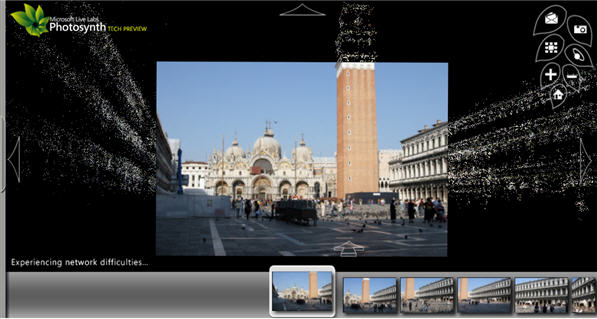
Such an experience is not that great a stretch from where we are currently at. To see how it might play out take a look at Microsoft’s PhotoSynth.
PhotoSynth View of Piazza San Marco in Venice
It does just what I’m describing with video, only with pictures. It creates a 3-D world from the thousands of pictures that have been publicly shared. I highly recommend taking it for a spin, as it provides a fascinating look at what human computer interfaces can be.
As we start considering the possibilities for video, the problem is we’re still stuck in our current paradigm of how we interact with video. My feeling is once indexing technology allows us to truly index the content of the video, the nature of our interaction with video will completely change. We’ll take the sensory input we expect from video and extend that into our typical user experience with more types of content. Our interfaces will be more satisfying because they will become more like real life. They will engage more of our senses and put us into a deeper and richer virtual world. More and more, as technology progresses, our interface with technology will start to look more like our experience with the physical world. As this happens, we will have the ability to step from a interface that engages our senses of sight and sound into a more abstract world where we interact with written text. The transition between these two interfaces will be seamless and we can step back and forth as we wish.
The promise of video lies not so much in taking video as we know it and bringing it online. The promise of video is that it provides a distinctly different user experience which could prove to be the new interface to technology. But to make this happen we have to be able to index and search for the content that lies embedded within video. We have to be able to take that video content and manipulate and mold it into a virtual world that we can interact with. And that is the promise that lies within the next-generation video search.
A Caffeine Fueled Vision of the Future
This week, for some reason (largely to do with thinking I could still handle caffeine and being horribly wrong), a number of pieces fell into place for me when it came to looking at how we might interact with computers and the Internet in the future. I began to sketch that out in my SearchInsider column today (more details about the caffeine episode are in it) , but quickly found that I was at the end of my editorial limit and there were a lot of pieces of the vision that I wasn’t able to draw together. So I promised to put a post on this blog going into a little more detail.
The ironic thing about this vision was that although I’d never seen it fully described before, as I thought about it I realized a lot of the pieces to make this happen are already in development. So obviously, somewhere out there, somebody also seen the same vision, or at least pieces of it. The other thing that struck me was: it all made sense as a logical extension of how I interacted with computers today. Obviously there’s a lot of technology being developed but if you take each of those vectors and follow it forward into the future, they all seem to converge into a similar picture.
Actually, the most commonly referenced rendering of the future that I’ve seen is the world that Spielberg imagined in his movie Minority Report. Although anchored in pop culture, the way that Spielberg arrived at his vision is interesting to note. He took the original short story by Philip K. Dick and fleshed it out by assembling a group of futurists, including philosophers, scientists and artists, and putting them together in a think tank. Together they came up with a vision of the future that was both chilling and intriguing.
I mention Minority Report because there are certain aspects of what I saw the future to be that seem to mirror what Spielberg came up with for his future. So, let me flesh out the individual components and provides links to technology currently under development that seem to point this way.
The Cloud
First of all, what will the web become? There’s been a lot of talk about Web 2.0 and Web 3.0, or the Semantic Web envisioned by Tim Berners Lee. Seth Godin had a particularly interesting post (referenced in my column) that he called the Web4. All these visions of the Web’s future share common elements. In Godin’s version, “Web4 is about making connections, about serendipity and about the network taking initiative”. This Web knows what we’re doing, knows what we have to do in the future, knows where we are at any given time, knows what we want and works as our personal assistant to tie all those pieces together and make our lives easier. More than that, it connects us a new ways, creating the ad hoc communities that I talked about in my earlier post, Brain Numbing Ideas on Friday afternoon.
For the sake of this post, I’m calling my version of the new Web “the Cloud”, borrowing some language from Microsoft. For me the Cloud is all about universal access, functionality, connection and information. The Cloud becomes the repository where we put all our information, both that which we want to make publicly accessible and that which we want to keep private. Initially this will cause some concern, as we wrestle with the change of thinking required to understand that physical ownership of data does not always equal security of that same data. We’ll have to gain a sense of comfort that data stored in online repositories can still remain private.
Another challenge will be understanding where we, ourselves, draw the line between the data we choose to make publicly accessible and the data we want to keep for our own personal use. There will be inevitable mistakes of an embarrassing nature as we learn where to put up our own firewalls. But the fascinating part about the Cloud is that it completely frees us physically. We can take all the data we need to keep our lives on track, stored in the Cloud, and have it accessible to us anywhere we are. What’s more, everyone else is doing the same thing. So within the Cloud, we’ll be able to find anything that anyone chooses to share with us. This could include the music they create, the stories they write, or on a more practical level, what our favorite store currently has in stock, or what our favorite restaurant has on for it’s special tonight. Flight schedules, user manuals, technical documentation, travel journals…the list is endless. And it all resides in the Cloud, accessible to us if we choose.
The other really interesting aspect of the Cloud is the functionality it can offer as we begin to build true applications into the web, through Web 2.0 technology. We start to imagine a world where any functionality we could wish for is available when we need it, and where we can buy access as required. The Cloud becomes a rich source of all the functionality we could ever want. Some of that functionality we use daily, to create our own schedules, to communicate, to connect with others and to manage our finances. Some of that functionality we may use once or twice in a lifetime. It really doesn’t matter because it’s always there for us when we need it.
The functionality of the Cloud is already under development. The two most notable examples can be found in Microsoft’s new Office Live Suite and in the collection of applications that Google is assembling. Although both are early in their development cycles, one can already see where they could go in the future.
The final noteworthy aspect of the Cloud is that it will create the basic foundation for all communication in the future. Our entertainment options will be delivered through the Cloud. We will communicate with each other through the Cloud, either by talking, writing or seeing each other. We will access all our information through the Cloud.
For the Cloud to work, it has to be ubiquitous. This represents possibly the single greatest challenge at the current time. The Cloud is already being built, but our ability to access the Cloud still depends on the speed of our connection and the fact is right now, our wireless infrastructure doesn’t allow for a robust enough connection to really leverage what the Cloud has to offer. But universal wireless access is currently being rolled out in more and more locations, so the day is drawing near when access will cease to be a problem.
So, when the Cloud exists, the next question is how do we access it? Let’s start with the two access points that are most common today: home and at work.
The Home Box
The Home Box becomes the nerve center of our home. It acts as a control point for all the functionality and communication we need when we’re not at work. The Home Box consists of a central unit, which doubles as our main entertainment center, and a number of “smart pods” located throughout the home, each connected to a touch screen.
So, what would the Home Box do? Well first of all, it would inform and entertain us. The pipeline that funnels our entertainment options to us would be directly connected to the Cloud. We would choose what we want to see, so the idea of channels becomes obsolete. All entertainment options exist in the Cloud and we pick and choose what we want, when we want.
Also, the Home Box makes each one of those entertainment options totally interactive. We can engage with the programming and shape it as we see fit. We can manipulate the content to match our preferences. The Home Box can watch four or five sporting events and assemble a customized highlight reel based on what we want to see. The Home Box can scan the Cloud for new works by artists, whether they be visual artists, music artists or video artists, notifies us when new content is ready for us to enjoy. If we have an interest that suddenly develops in one particular area, for instance a location that we want to visit on an upcoming vacation, the Home Box assembles all the information that exists, sorted by our preferences, and brings it back to us. And at any time, while watching a video about a particular destination, we can tag items of interest within the video for further reference. As soon as they’re tagged, a background application can start compiling information on whatever we indicated we were interested in. Advertising, in this manifestation, becomes totally interwoven into the experience. We indicate when we’re interested in something and the connection to the advertiser is initiated by us with a quick click.
But the Home Box is much more than just a smarter TV set or stereo. It also runs our home. It monitors energy consumption levels and adjusts them as required. It monitors what’s currently in our fridge and our pantry (by the way, computers are already being built into fridges) and notifies us when we’re out of something. Or, if there’s a particular recipe we want to make, it will let us know what we currently have and what we need to go shopping for.
Microsoft already has the vision firmly in mind. Many of the components are already here. The limited success of Microsoft’s Windows Media Center has not dissuaded them from this vision of the future. Windows Media Center is now built into premium versions of the Vista operating system. And the is Smart Pods I refer to? Each Xbox 360 has the ability to tap right into windows XP Media Center. The technology is already in place.
The Work Box
Probably the least amount of change that I see in the future is in how we access the Internet at work. For those who of us who work in an office environment, we’re already fairly well connected to the Internet. The primary difference in this case would be where the data resides. Eventually, as we gain comfort with the security protocols that exists within the Cloud, we will feel more comfortable and realize the benefits that come with hosting our corporate data where it’s accessible to all members of the organization, no matter where they are physically located.
But consider what happens for the workers who don’t work in an office environment. Access to the Cloud now allows them to substantially increase their connectivity and functionality while they’re mobile. You could instantly access the inventory of any retail location within the chain. You can see if a parts in stock at the warehouse. You can access files and documents from anywhere, at any time. And, you can tap into the core functionality of your office applications as you wish, where ever you happen to be.
Once again, much of the functionality that would enable this is already in place or being developed. In the last year we at Enquiro have started to realize the capabilities of Microsoft Exchange Server and Sharepoint services. Just today, Google announced new enterprise level apps would be available on the web. Increasingly, more and more collaborative tools that use the Internet as their common ground are being developed. The logical next step is to allow these to reside within the Cloud and to free them from the constraints of our own internal hardware and software infrastructure.
The Mobile Device
When we talk about tangible technology that will enable this future; hardware that we can see and touch, the mobile piece of the equation is the most critical. For us to truly realize the full functionality of the Cloud, we have to have universal access to it. It has to come with us as we live our lives. The new mobile device becomes a constant connection to the Cloud. Small, sleek, GPS enabled, with extended communication capabilities, the new handheld device will become our computing device of choice. All the data and the functionality that we could require at any time exists in the Cloud. The handheld device acts as our primary connection to the Cloud We pull down the information that we need, we rent functionality as required, we do what we have to do and then we move on with our lives.
Our mobile device comes with us and plugs into any environment that we’re in. When we’re at work, we plug it into a small docking station and all the files that we require are interchanged automatically. Work we did at home is automatically uploaded to the corporate section of the Cloud, our address books and appointment calendars are instantly updated, new communications are downloaded, and an accurate snapshot of our lives is captured and is available to us. When we get home again we dock our mobile device and the personal half of our lives is likewise updated.
Consider some practical applications of this:
When we go to the gym, our exercise equipment is now “Cloud” enabled. Our entire exercise program is recorded on our mobile device. As we move from station to station we quickly plug it into a docking station, the weights are automatically adjusted, the number of reps is uploaded, and as we do our exercises, appropriate motivating music and messages are heard in our ear. At the same time, our heart rate and other biological signals are being monitored and are being fed back to the exercise equipment, maximizing our workout.
When we’re at home, we quickly plug our mobile device into the Smart Pod in the kitchen, and everything we need to get on our upcoming shopping trip is instantly uploaded. What’s more, with the functionality built into the Cloud, the best specials on each of the items is instantly determined, the best route to pick up all the items is send to our GPS navigation module, and our shopping trip is efficiently laid out for us. While we’re there, the built in bar code scanner allows us to comparison shop on any item, in the geographic radius we choose.
As I fly back from San Francisco, a flight delay means that I may miss my connecting flight in Seattle. My mobile device notes this, adjusts my schedule accordingly, automatically notifies my wife and scans airline schedules to see if an alternative flight might still get me home without an unexpected layover near SeaTac Airport. It there’s no way I can make it back, it books me a room at my prefered hotel.
The Missing Pieces
I happen to think this is a pretty compelling vision of the future. And as it started to come together for me, I was surprised by how many of the components already exist or are being currently developed. As I said in the beginning, it seems like a puzzle with a lot of the pieces already in place. There are some things, however, we still need to come together for this vision to become real. Here are the challenges as I see them.
Computing Horsepower
For the mobile device that I envisioned to become a reality, we have to substantially up the ante of the computing horsepower. The story that led to my writing of the SearchInsider column was one about the new research chip that is currently under development at Intel. Right now the super chips are being developed for a new breed of supercomputer, but the trickle-down effects are inevitable. Just to give you an idea of the quantum leap in performance we’re talking about, the chip is designed to deliver teraflops performance. Teraflops are trillions of calculations per second. The first time teraflops performance was achieved was in 1997 on a supercomputer that took up more than 2000 square feet, powered by 10,000 Pentium Pro processors. With the new development, that same performance is achieved on a single multi-core chip about the size of a fingernail. This opens the door to dramatic new performance capabilities, including a new level of artificial intelligence, instant video communications, photorealistic games, multimedia data mining and real-time speech recognition.
A descendent of this prototype chip could make our mobile device several orders of magnitude more powerful than our most powerful desktop box today. And when implanted in our Home Box, this new super chip allows us to scan any video file and pick up specific items of interest. You could scan the top 100 movies of any year to see how many of them reference the city of Cleveland, Ohio (not exactly sure why you’d want to do this), or included a product placement for Apple.
Better Speech Recognition
One of the biggest challenges with mobile computing is the input/output part of the problem. Small just does not lend itself to being user-friendly when it comes to getting information in and out of the device. We struggle with tiny keyboards and small screens. But simply talking has proven to be a remarkably efficient communication tool for us for thousands of years. The keyboard was a necessary evil because speech recognition wasn’t an option for us in the past. We can talk much faster than we can talk.
I recently was introduced to Dragon Naturally Speaking for the first time. I’ve been trying it for about three weeks now. Although it’s still getting to know me and I’m still getting to know it, when it works it works very well. I found it a much more efficient way to interact with my computer. It would certainly make interacting with a mobile device infinitely more satisfying. The challenge right now with this is that speech recognition requires a fairly quiet environment, you’re constantly speaking to yourself, and mobile devices just don’t have enough computing power to be able to handle it.
We’ve already dealt with the computing horsepower problem above. So how do we deal with the challenge of being able to get our vocal commands recognized by our mobile device? Let me introduce you to the subvocalization mic. The mic actually picks up the vibrations from our vocal cords, even if we’re only whispering, and renders recognizable speech without all the background noise. New prototype sensors can detect sub vocal or silent speech. We can speak quietly (even silently) to ourselves, no matter how noisy the environment, and our mobile device would be able to understand what we’re saying.
Better Visual Displays
The other challenge with a mobile device is in freeing ourselves from the tiny little 2.5″ x 2 .5″ screen. It just does not produce a very satisfying user experience. One of the biggest frustrations I hear about the lack of functionality with many of the mobile apps comes just because we don’t have enough screen real estate. This is where a heads-up display could make our lives much, much easier. Right now they’re still pretty cumbersome and make us look like cyborgs but you just know we’re not far from the day where they could easily be built into a pair of non-intrusive eyeglasses. Then the output from our mobile device can be as large as we wanted to be.
Going this one step further, let’s borrow a scene from Spielberg’s Minority Report. We have the heads-up display which creates a virtual 3-D representation of the interface. We could also have sensors on our hands that would turn that display into a virtual 3-D touchscreen experience. We could “touch” different things within the display and interact with our computing device in this way. Combined with sub vocalization speech commands, this could create the ultimate user interface. Does this sound far-fetched? Microsoft has already developed much of the technology and has licensed it to a company called eon reality. Like I said no matter what the mind can envision, it’s probably already under development. As I started down this path, it particularly struck me how many of the components under development had the Microsoft brand on them.
If you can fill in other pieces of the puzzle, or you have your own vision of the future, make sure you take a few moments to comment.
Brain Numbing Ideas on a Friday Afternoon
I can’t help but get the feeling that when we look at online marketing, we tend to get blinded by the technology and lose sight of what’s really important: how it affects people.
Right now there’s a flurry of attention surrounding YouTube because of copyright issues and other factors. And YouTube isn’t alone in this. The majority of things I did in my in box focus on technology. What will be the next killer platform? I see mobile search, I see online video, I see social networking. It’s hard to keep your finger on the pulse of what’s really important. I find it useful to step back a little bit and see how these things affect real people: people not like you and I, who are caught up in the promise of technology, but people like my daughter’s principal, people like my mom, people like my next-door neighbor. People who are wary about technology and who will only embrace it if it makes their life better in some way. This is not to discount the importance of technology, because it truly has turned our lives inside out in the last decade. But there’s a distillation, a time when we have to get comfortable with change. The dotcom boom and bust was not because of the lack of technology or its inadequacy. To technology all things are possible. But to people, it’s all about what’s in it for me. And that, ultimately, is the success factor that has to be considered in all this.
So, is YouTube hot? Is online video hot? Is social networking hot? All these things are, but not because of the technology that lies beneath, but rather because of the social change that they empower. Consider online video for example. A couple of items in my in box talked about how, at this point, we won’t watch television online. Even the person at Google who was responsible for online video admitted that at this point, even with Google’s tremendous resources, online video at the quality that we’ve come to expect is not a scalable proposition.
We interact with video in a far different way online. For example, YouTube is all about the viral spiral. It’s all about that cute little two to three minutes of video: something that is either funny or outrageous or awful. There’s no tremendous requirement for engagement for this. YouTube is the repository for a million different “in” jokes. It’s the basket where we collect what titillates the fancy of our collective consciousness at any given time. It gives us an easy reference point so we can take what interests us and forward it to others if we think they are interested as well. We’re not ready to watch a one or two hour documentary on the web, simply because we’re not used to interacting with our computer screen in that way. Our computers are things we do things on, not things we watch passively. A commitment of two to three minutes to watch a little video screen is fine, but we don’t look to the Web for passive entertainment. That’s not to say we won’t, some day, as connectivity and convergence moves our channels beyond the current paradigm and as we evolve and learn to interact with them in new ways.
And it’s there that we start to pick apart at what truly makes technology, at least as far as it’s manifested on the web, really interesting. It stitches together the fabric of our society. It’s a synapse that allows our collective brain to fire more effectively than it did before. Communications can zing back and forth between us at a far faster rate. What we find interesting, what we find intriguing, what we find funny, what we find painful to watch is now available for anyone to see. It’s cataloged and categorized for our convenience. It occupies a finite space in the virtual world that we can point to and say, “Look at this, it impacted me and I think it will impact you to.”
I recently had the opportunity to watch Dr. Gary Flake from Microsoft talk. He started his presentation with the claim that the information technology revolution that we’re currently in will be more significant, as far as the change factor for our society, than anything that has gone before. More important than the Industrial Revolution, more important than the invention of the printing press, more important than television. To me the real power of the Internet is that it’s rewiring our society in ways we could never dream of and in ways we never anticipated. To focus on the wiring or the technology of the Web is to take the mechanic’s view of the world. To a mechanic or a car buff, a vehicle is a wonderful thing because of the internal combustion engine, because of the horsepower and how fast it can go from zero to 60. They focus on what it is. But when you look at how the automobile has affected our society, it’s not about what it is, it’s about what it does. The automobile brought the world closer. It allowed us to travel and see new things. It allowed us to live in one place and work in another. The macro change that the automobile engendered had nothing to do with how an internal combustion engine worked, it came from moving people from one place to another quickly, cheaply and efficiently. It mobilized our society in a way that never existed before.
Likewise, the Web is not powerful because of Web 2.0 technologies, or speed of connection, or the ability to host video. It’s important because it connects us in new and different ways. It moves power from where it was stuck before into new hands. It breaks down existing power structures and distributes that power amongst all of us. It puts the individual in control and allows one individual to connect with another, freely and without paying a poll to the previous power brokers.
The really interesting thing about the Internet is the underlying social current, the groundswell of change that is redefining us and how we live together. These fundamental factors are exerting a tremendous force within our day-to-day lives. They’re precipitating change so fast that we haven’t been able to step back and see what the full impact to us will be. We can’t see the trickle down effect of the things that are happening to us today. The Internet is changing the very DNA of our society, and we are unable to take a long-term view of what those current mutations will mean for us. One only has to look at the generational difference between the 45-year-old parent, myself, and my 13-year-old daughter, the first generation that has been fully immersed in online technology. She interacts with the world in a completely different way. She searches for information in a different way and evaluates it differently. She takes these things for granted because she’s never known any other way. What happens when this entire generation emerges as the shapers of our society? What happens when they take control from us, with their innate understanding of what the Web makes possible, and redefine everything?
Here are three things that I believe are the foundations of social change being pushed by the Internet:
Access to Information
The amount of information we currently have access to is mind-boggling. Never has so much raw information lived so close to us. You can now think about any given topic in the universe of our consciousness, and that information exists just a mouse click away. And, as the saying goes, information is power. It empowers each one of us to take a more active role in our destiny. This information has completely changed how people buy things. It’s completely changed the relationship between vendors and buyers. More and more, we go direct to the source, as educated, knowledgeable buyers who know exactly what we want and what we will pay for it. The challenge on the Internet is that not all information is created equal. There’s good information and there’s bad information. However, we are becoming extremely good at being able to differentiate between the two. We’re becoming amazingly adept at being able to recognize authenticity and we can sniff out BS. In picking through the multiple threads of information that are available to us out there, we can recognize the scent of truth and quickly discount hype, spin and sheer lies.
Again, as we begin to recognize the shifting of power to the consumer, the full impact has not shaken out yet. When we can buy anything online, quickly, easily and confidently, will what will that mean for the entire bricks and mortar retail world out there? Will there be shopping malls in 20 years? Will there be stores at all? Will we buy directly from the manufacturers, cutting out distributors, wholesalers and retailers? Or will distribution of products to the world of consumers lie in the hands of a few mega, long tail retailers such as Amazon? I certainly don’t know, the future is far too murky to be able to peer down this path. And I don’t think it’s important to be able to predict the future, but I do think it’s vitally important to consider the quantum change that is likely in the future.
Searchability
As the amount of information available to us continues to multiply exponentially, the ability to connect with the right information at the right time becomes more and more important. I’ve always maintained that search is the fundamental foundation of everything that will transpire online. It is the essential connector between our intent, and the content we’re looking for. But more than just the connector, the sheer functionality of search, both as it is today and as it will be in the future, creates another catalyst for change in our society.
We are becoming used to having the answers just a few mouse clicks away. We are becoming a society of instant gratification. In the past, we accepted that we couldn’t know everything. In divvying up the world’s knowledge, some of us were experts in one area and some of us were experts in another. Some of us were experts in nothing. But we held no pretensions that we would become experts in areas where we had no previous experience. There was no path to follow so there was no reason to start the journey.
But today, you can become an instant expert in anything, depending on how you define the scope of that expertise. Within 30 seconds I can tell you every movie that Uma Thurman ever appeared in. I can look up a medical condition and have access to the same information, likely more information, that a doctor 20 years ago would have access to, based on his own experience, education and reference materials. But again, what is the impact of this? Does having access to the information about a medical condition makes me an expert in treating that condition? I have the information but I have no context in which to apply it. As we gain access to information, will we use that information wisely without the experience and domain expertise that used to accompany that information?
And how will instant access to information alter education in the future? I remember hearing an observation that if we had a modern day Rip van Winkle, who had gone to sleep 20 years ago and suddenly woke up today, the one place he would feel most comfortable would be in the elementary classroom. While the outside world is changed dramatically in the past 20 years, the classroom in which your child spends the majority of their day has changed very little. When I help my children do their homework, there isn’t much difference between the textbooks and the worksheets I see today and the ones I saw 30 years ago. I recently had to explain to my daughter’s principal the difference between a Web browser and a search engine. The classroom is like a backwater eddy in the rushing torrent of technological change that typifies the rest of the world. And it’s not just elementary school where this is an issue. We often speak to students who are currently going through marketing programs at the university level and are always aghast at how little they’re learning about this new world of marketing and the reality of consumer empowerment. They’re learning the rules of a game that changed at least a decade ago.
So to bring the point home once more, what will the organization of the world’s information mean for our society? As search gets better at connecting us to the content that we are looking for, what are the ripple effects for us? Will our children’s and grandchildren’s brains be wired in a different way than ours are? Will they assimilate information differently? Will they research differently? Will they structure their logic in a different way?
Creation of Ideological Communities
The Web has redefined our idea of community. It used to be the communities were defined along geographic lines. You need a physical proximity to people in order to create a community because physical proximity was a prerequisite for communication. Communities could exist if there was two way communication. That’s the reason why community and communication are extensions of the same root word and concept.
Perhaps the most powerful change introduced by the Internet has been the enabling of real, two way communication between people where physical proximity was not required. Consider the chain of events that typifies online interaction. You become aware of someone who shares an ideological interest, usually through stumbling upon them somewhere online. You initiate communication. Depending on the scope of your shared interest, you may create the core of the community by inviting others into it. The Internet gives us the platform that allows for the creation of ideological communities. We see this happen all the time on properties such as YouTube or MySpace. Ideological communities are created on the fly, flourish for awhile, and then fade away as interest in the idea that engendered them also fades away. The Internet, at any given point in time, is a snapshot of thousands, or perhaps millions, of these ad hoc ideological communities. They form, they flourish and then they disappear.
But in our real world there was physicality to the concept of community. The way our world is built, our political boundaries, come from physical considerations. There are distinct geographic boundaries like mountain ranges, oceans and rivers that, in the past, prevented the flow of people across them. Because of the restricted ability to move, people spent long enough together to share ideals and create communities. As time moved on these communities became larger and larger. Transportation allowed us to share common ideals over a greater expanse and nations became possible. The more efficient the transportation, the larger the nation became. But throughout this entire process, the concept of geography defined communities and defined nations. Our entire existing political structure was built around this geographic foundation.
With the Internet, geography ceases to have meaning. It’s now a virtual world, and I can feel closer to someone in China with whom I share one particularly strong mutually held belief then I might with my next-door neighbor. More fundamentally, I can belong to several different communities at the same time. Again, the restraint of the physical world usually restricted the number of interests we had that we could share with those immediately around us. Our sphere of interest as an individual was somewhat dictated by the critical mass each of those interest areas had within the community in which we lived. If we thought particularly strongly about one interest we could physically move to a community where there were more people who shared that interest. So we tended to move to communities that felt “right” ideologically as well as physically. But with the Internet, does that need for ideological “sameness” where we live eventually disappear? Does our physical need for community decrease as our ideological need for community is fulfilled through the Internet?
And, if this physical definition of community begins to erode, what does that do for the concept of nationhood and all the things that come along with it? Increasingly, communication and commerce travel along lines not defined by geography. The idea of a nation, as we currently understand it, is inextricably bound to the realities of geography. Politics, trade, laws and defense are all concepts that are rooted in thinking developed over the past several centuries. In the past 30 years we’ve seen the erosion of the concept of nationhood through the creation of common markets and free trade areas. The very breakdown of the Soviet Union comes from the inability to isolate the population from the concepts which flourished in the free world. And that was before the Internet ever became a factor. What happens when we take this movement, already afoot, and add the tremendous catalyst that is the Internet?
It’s in these macro trends that the true power of the Internet can be seen. It’s not about an individual technology or even the cumulative power of all the technology. It’s about how the sum of all that affects us as individuals, how we interact with the world around us and how we connect with other individuals. The seeds have been planted, we can’t turn back, and we can’t foresee what will be. The world is evolving and truly becoming a global community. We are entering a time when change will accelerate faster than our society may be able to keep up. There will be costs, certainly, but my hope and belief is that the rewards will far outweigh the costs.
Online Video Needs Critical Mass
More on the topic of online video. It seems the majority of stories I’m seeing in this space recently have to do with moving video to the Net. A recent one was the agreement between YouTube and Warner.
YouTube is as hot as a high grade viral infection right now, which is what it essentially is. It’s the latest Net “Buzz” poster child, and it’s reaping huge amounts of traffic. That’s a great step towards sustainability, but as we’ve seen in the past, the Net’s traffic patterns are notoriously fickle. The tide can turn overnight and head to a new spot. What YouTube has to do is grow up without growing old. Kafka gets it right in his article.
Kudos to Warner for understanding the ebb and flow of the Internet. You have to watch where the new communities of interest are gathering, and shift your strategy to be in the right place at the right time. Presently, YouTube is the right place. The only question is how long is the “right time” window. YouTube in it’s present form is all hype and little substance. We’re still playing with the novelty of online video. We still get a kick out of watching teenagers lip sync to a popular song (or the theme song for Pokemon) in his/her bedroom. That will get old fast. Not to mention the questionable legality of most of the content on YouTube.
Warner is smart enough to realize that the consumer is at the wheel and will control where distribution occurs. They’re laying their bets on YouTube, and it’s probably a smart bet. At least, it’s a smarter bet that where the competition is placing their chips. Universal is still trying to maintain the illusion of control by going head to head with another red hot property, MySpace.com, with threats of legal action due to copyright infringement. EMI and Universal has also gone with SpiralFrog, a start up. They have obviously given up traffic for greater control.
But for YouTube, the trick will be to provide more meat as it transitions from a viral novelty to an internet mainstay. This trick has been successfully pulled off only a few times in the past. One was Google.
Google and the Future of Video
The talks that Google and Apple are currently in about video will likely start defining the future of video entertainment as we know it. And it’s just one more example of “push” going to “pull”.
The news story is about iTV, the new device that bridges the gap between the TV and the PC, letting you viewed video from your hard drive on your TV. It’s the continuation of convergence that I’ve been talking about for some time now.
But what is interesting about this to me is not so much the hardware as the extension of searchability to online entertainment. It’s just a matter of time before the walls come down between something like YouTube and the world of broadcast TV. They’re already crumbling rapidly. And setting your viewing preferences based on searchability opens up a whole new world. I’ve had just a taste of it through Microsoft’s Media Center and I like it. You can search up to two weeks of programming by keyword, looking for a particular topic, director or actor.
Now, let’s extend this the next logical step. Let’s open up the rapidly exploding world of video. All the movies, all the tv shows, all the documentaries ever made, as well as the crushing wave of consumer generated video content, all as searchable as the web thanks to Google. You in the mood for a show about 9/11 conspiracy theories? A quick search and you’re watching Loose Change. Plus, Google suggests other shows you might be interested on based on your topic. It’s just a matter of time before somebody does for video what Pandora is doing for music, allowing you to explore the world of video entertainment based on similarities to what you already like.
Social tagging opens up more possibilities, allowing you to tap into the most popular choices of the various online communities you belong to. The buzz effect takes over (as we see currently on YouTube) and suddenly watching online video becomes a communal experience.
It’s a revolution in video distribution, and the seeds are being sown currently in the chat that Steve Jobs and Eric Schmidt are likely having as we speak.