How Canada is Killing its News Industry

In Canada, an interesting game of brinkmanship is happening. To help bring you up to speed, here are the Cole’s notes:

  • Like everywhere in the world, Canada’s news outlets are starving for revenue. Advertising is drying up, as more budget moves online.
  • In an ill-advised attempt to shore up the Canadian News industry, the federal government passed bill C-18, the Online News Act, which says that Facebook, Google and other tech giants must pay news organizations when someone comes to a web story through a link on one of their platforms.
  • Meta said – basically – WTF? We’re sending you traffic. You want us to pay for that? Fine, we’ll shut off that traffic.

Back in June, Meta posted this notice:

“In order to comply with the Online News Act, we have begun the process of ending news availability in Canada. These changes start today, and will be implemented for all people accessing Facebook and Instagram in Canada over the course of the next few weeks.”

Those changes started stripping news from our social media feeds in the last few weeks. I haven’t seen one news item on my Facebook feed in the last week.

 If you’re confused, you have a lot of company north of the 49th. Logic seems to be totally missing from this particular legislative hammer toss from Justin Trudeau and his merry band of lawmakers.

If there is any logic, it may be that for many some users, they never bother to click through to the actual story. They apparently get all the news they need from doomscrolling on Facebook.

Michael Geist, the Canadian Research Chair in Internet and E-commerce law at the University of Ottawa, calls the bill a “Lose-Lose-Lose-Lose.” 

For the media outlets that this bill is supposedly protecting, Geist says, “It is difficult to overstate the harm that Bill C-18 will create for the media sector in Canada, with enormous losses that will run into the hundreds of millions of dollars.”

Oops.

Geist details how lobbyists and supporters of the bill were sure Meta was bluffing and would come to the table to negotiate when bidden to do so. A law professor from Carleton University said “I am not worried. The threats they are making, they are doing this all around the world.”

But Meta wasn’t bluffing. And why would they?  When you hold all the cards, you don’t have to bluff. Some news publishers estimate that as much as 50% of their traffic comes from these online channels. A recent study by Maru Public Opinion showed that 26% of Canadians say they get their news from social media sites. For younger age cohorts, this percentage jumps to 35%.

News publishers have now lost that traffic, with no offsetting revenue from Bill C-18 to compensate for it. For a bill that was supposed to save the Canadian news industry, this seems to be hammering nails in the coffin at an alarming rate.

Like Geist said, this is “a cautionary tale for a government that blithely ignored the warning signs, seemed to welcome a fight with the tech companies, and had no Plan B.”

If there are lessons to be learned – or, at least, points to be pondered – in this Canadian debacle, here are two to consider:

This shows that legislators, not just in Canada but around the world, have no idea of the new power dynamics in a digital economy. They still carry the quaint notion they are the power brokers within their borders. But this shows that Meta could care less about the Canadian market. We are a drop in their global revenue bucket. Not only have they not caved in when confronted with the awesome might of the Canadian government, they haven’t even bothered coming back to the table to talk. When the Liberal lawmakers decided to take on Meta, they were taking a knife to a gun fight.

Secondly, I wonder how one third of Canadians will now be informed about what’s happening in the world. With any information sources with even a shred of journalistic integrity stripped from their Facebook and Instagram feeds, who will they be listening to? In a bid for survival, Canada’s news publishers are supposedly launching a desperate campaign to “re-educate” us on how to find the news.

Yeah. We all know how successful “re-education” campaigns are.

Finally, in the irony of ironies, as they squared off against Facebook in this ill-fated battle, Canada’s Liberal government launched a new campaign asking for us to share our thoughts on a “Summer Check-In Survey.”

Their platform of choice for this campaign? Facebook.
X Marks the Spot

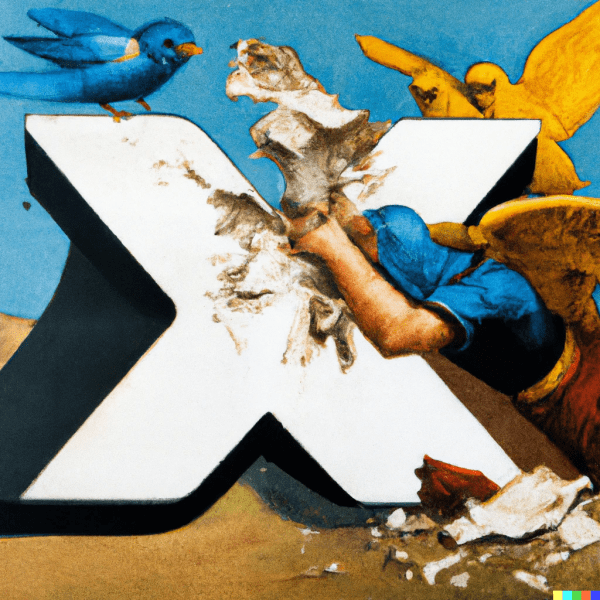
Elon Musk has made his mark. Twitter and its cute little birdy logo are dead. Like Monty Python’s famous parrot, this bird has shuffled off its mortal coil.

So Twitter is dead, Long live X?

I know — that seems weird to me, too.

Musk clearly has a thing for the letter X. He founded a company called X.com that merged with PayPal in 2000. In his portfolio of companies, you’ll find SpaceX, xAI, X Corp. Its seldom you see so much devotion to 1/26th of the Latin alphabet.

It’s not unprecedented to pick a letter and turn it into a brand. Steve Jobs managed to make the letter “i” the symbol for everything Apple. Mind you, he also tacked on helpful product descriptors to keep us from getting confused. If he had changed the name of Apple to “I” and just left it at that, it might not have worked so well.

At their best, brands should immediately bridge the gap between the DNA of a company and a long-term niche in the brains of those of us in the marketplace. Twitter did that. When you saw the iconic bird logo or hear the word Twitter, you know exactly what it referred to.

This is easier when the company is known for a handful of products. But when companies stretch into multiple areas, it’s tough to make one brand synonymous with hundreds or thousands of products. 

This brand diffusion is common with the hyper-accelerated world of tech. You launch a product and it’s so successful, it becomes a mega-corporation. At some point you’re stuck with an awkward transition: You leave the original brand associated with that product and create an umbrella brand that is vague enough to shelter a diverse and expanding portfolio of businesses. That’s why Google created the generic Alpha brand, and why Facebook became Meta.

But Musk didn’t create an umbrella to shelter Twitter and its brand. He used it to beat the brand to death. Maybe he just doesn’t like blue birds.

When a brand does its job well, we feel a personal relationship with it. Twitter’s brand did this. It was unique in tech branding, primarily because it was cute and organic. It was an accessible brand, a breath of fresh air in a world of cryptic acronyms and made-up terms with weird spellings. It made sense to us. And we are sorry to see it go.

In fact, some of us are flat-out refusing to admit the bird is dead. One programmer has already whipped together a Chrome extension that strips out the X branding and brings our favorite little Tweeter back from the beyond. Much as I admire this denial, I suspect this is only delaying the inevitable. It’s time to say bye-bye birdy. 

This current backlash against Musk’s rebranding could be a natural outcome of his effort to move from being one tied to a product to one that creates a bigger tent for multiple products. He has been pretty vocal about X becoming an “everything” app, a la China’s WeChat.

I suspect the road to making X a viable brand is going to be a rocky one. First of all, if you were going to pick the most generic symbol imaginable, X would be your choice. It literally has been a stand in for pretty much everything you could think of for centuries now. Even my great, great grandfather signed his name with an “X.”

We Hotchkisses have always been ahead of our time.

But the ubiquity of “X” brings up another problem, this time on the legal front. According to a lengthy analysis of Twitter’s rebranding by Emma Roth, you can trademark a single letter, but trying to make X your brand will come with some potentially litigious baggage. Microsoft has a trademark on X. So does Meta.

As long at Musk’s X sticks to its knitting, that might not be a problem. Microsoft registered X for its Xbox gaming console. Meta’s trademark also has to do with gaming. Apparently, as long as you don’t cross industries and confuse customers, having the same trademark shouldn’t be an issue.

But the chances of Elon Musk playing nice and following the rules of trademark law while pursuing his plan for world domination are somewhat less than zero. In this case, I think it’s fair to speculate that the formula for the future will be: X = a shitload of lawyer fees

Also, even if you succeed in making X a recognized and unique brand, protecting that brand will be a nightmare. How do you build a legal fence around X when the choice of it as a brand was literally to tear down fences?

But maybe Musk has already foreseen all this. Maybe he has some kind of superpower to see things we can’t.

Kind of like Superman’s X-Ray vision.

The Challenge in Regulating AI

A few weeks ago, MediaPost’s Wendy Davis wrote a commentary on the Federal Trade Commission’s investigation of OpenAI. Of primary concern to the FTC was ChatGPT’s tendency to hallucinate. I found this out for myself when ChatGPT told some whoppers about who I was and what I’ve done in the past.

Davis wrote, “The inquiry comes as a growing chorus of voices — including lawmakers, consumer advocates and at least one business group — are pushing for regulations governing artificial intelligence. OpenAI has also been hit with lawsuits over copyright infringement, privacy and defamation.”

This highlights a problem with trying to legislate AI. First, the U.S. is using its existing laws and trying to apply them to a disruptive and unpredictable technology. Laws, by their nature, have to be specific, which means you have to be able to anticipate circumstances in which they’d be applied. But how do you create or apply laws for something unpredictable? All you can do is regulate what you know. When it comes to predicting the future, legislators tend to be a pretty unimaginative bunch. 

In the intro to a Legal Rebels podcast on the American Bar Association’s website, Victor Li included this quote, “At present, the regulation of AI in the United States is still in its early stages, and there is no comprehensive federal legislation dedicated solely to AI regulation. However, there are existing laws and regulations that touch upon certain aspects of AI, such as privacy, security and anti-discrimination. “

The ironic thing was, the quote came from ChatGPT. But in this case, ChatGPT got it mostly right. The FTC is trying to use the laws at its disposal to corral OpenAI by playing a game of legal whack-a-mole:  hammering things like privacy, intellectual property rights, defamation, deception and discrimination as they pop their heads up.

But that’s only addressing the problems the FTC can see. It’s like repainting the deck railings on the Titanic the day before it hit the iceberg. It’s not what you know that’s going to get you, it’s what you don’t know.

If you’re attacking ChatGPT’s tendency to fabricate reality, you’re probably tilting at the wrong windmill. This is a transitory bug. OpenAI benefits in no way from ChatGPT’s tendency to hallucinate. The company would much rather have a large language-based model that is usually truthful and accurate. You can bet they’re working on it. By the time the ponderous wheels of the U.S. legislative system get turned around and rolling in the right direction, chances are the bug will be fixed and there won’t really be anything to legislate against.

What we need before we start talking about legislation is something more fundamental. We need an established principle, a framework of understanding from which laws can be created as situations arise.

This is not the first time we’ve faced a technology that came packed with potential unintended consequences. In February, 1975, 140 people gathered at a conference center in Monterey, California to attempt to put a leash on genetic manipulation, particularly Recombinant DNA engineering.

This group, which included mainly biologists with a smattering of lawyers and physicians, established principle-based guidelines that took its name from the conference center where they met. It was called the Asilomar Conference agreement.

The guidelines were based on the level of risk involved in proposed experiments. The higher the risk, the greater the required precautions.

These guidelines were flexible enough to adapt as the science of genetic engineering evolved. It was one of the first applications of something called “the precautionary principle” – which is just what it sounds like: if the future is uncertain, go forward slowly and cautiously.

While the U.S. is late to the AI legislation party, the European Union has been taking the lead. And, if you look its first attempts at E.U. AI regulation drafted in 2021, you’ll see it has the precautionary principle written all over it. Like the Asilomar guidelines, there are different rules for different risk levels. While the U.S. attempts at legislation are mired in spotty specifics, the EU is establishing a universal framework that can adapt to the unexpected.

This is particularly important with AI, because it’s an entirely different ballgame than genetic engineering. Those driving the charge are for-profit companies, not scientists working in a lab.

OpenAI is intended as a platform that others will build on. It will move quickly, and new issues will pop up constantly. Unless the regulating bodies are incredibly nimble and quick to plug loopholes, they will constantly be playing catch-up.

It’s All in How You Spin It

I generally get about 100 PR pitches a week. And I’m just a guy who writes a post on tech, people and marketing now and then. I’m not a journalist. I’m not even gainfully employed by anyone. I am just one step removed — thanks to the platform  MediaPost has provided me — from “some guy” you might meet at your local coffee shop.

But still, I get 100 PR pitches a week. Desperation for coverage is the only reason I can think of for this to be so. 99.9999% of the time, they go straight to my trash basket. And the reason they do is that they’re almost never interesting. They are — well, they’re pitches for free exposure.

Now, the average pitch, even if it isn’t interesting, should at least try to match the target’s editorial interest. It should be in the strike zone, so to speak.

Let’s do a little postmortem on one I received recently. It was titled “AI in Banking.” Fair enough. I have written a few posts on AI. Specifically, I have written a few posts on my fear of AI.

I have also written about my concerns about misuse of data. When it comes to the nexus between AI and data, I would be considered more than a little pessimistic. So, something linking AI and banking did pique my interest, but not in a good way. I opened the email.

There, in the first paragraph, I read this: “AI is changing how banks provide personalized recommendations and insights based on enriched financial data offering tailored suggestions, such as optimizing spending, suggesting suitable investment opportunities, or identifying potential financial risks.”

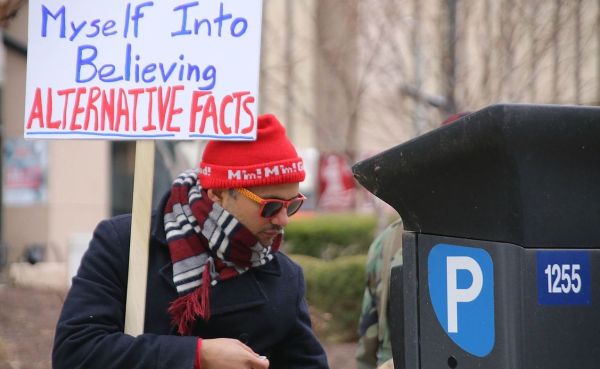
This, for those of you not familiar with “PR-ese,” is what we in the biz call “spin.” Kellyanne Conway once called it — more euphemistically — an alternative fact.

Let me give you an example. Let’s say that during the Tour de France half the Peloton crashes and bicyclists get a nasty case of road rash. A PR person would spin that to say that “Hundreds of professional cyclists discover a new miracle instant exfoliation technique from the South of France.”

See? It’s not a lie, it’s just an alternative fact.

Let’s go on. The second paragraph of the pitch continued: “Bud, a company that specializes in data intelligence is working with major partners across the country (Goldman Sachs, HSBC, 1835i, etc.) to categorize and organize financial information and data so that users are empowered to make informed decisions and gain a deeper understanding of their financial situation.”

Ah — we’re now getting closer to the actual fact. The focus is beginning to switch from the user, empowered to make better financial decisions thanks to AI, to what is actually happening: a data marketplace being built on the backs of users for sale to corporate America.

Let’s now follow the link to Bud’s website. There, in big letters on the home page, you read:

“Turn transactional data into real-time underwriting intelligence

Bud’s AI platform and data visualizations help lenders evaluate risk, reduce losses and unlock hidden revenue potential.”

Bingo. This is not about users, at least, not beyond using them as grist in a data mill. This is about slipping a Trojan Horse into your smartphone in the form of an app and hoovering your personal data up to give big banks an intimate glimpse into not just your finances, but also your thinking about those finances. As you bare your monetary soul to this helpful “Bud,” you have established a direct pipeline to the very institutions that hold your future in their greedy little fingers. You’re giving an algorithm everything it needs to automatically deny you credit.

This was just one pitch that happened to catch my eye long enough to dig a little deeper. But it serves as a perfect illustration of why I don’t trust big data or AI in the hands of for-profit corporations.

And that will continue to be true — no matter how you PR pros spin it.

No News is Good News

I’m trying not to pay too much attention to the news. This is partly because I’m exhausted by the news, and partly because of the sad state of journalism today.

This isn’t just a “me” thing. Almost everyone I talk to says they’re trying to find coping mechanisms to deal with the news. The News industry – and its audience – has gone from being an essential part of a working democracy to something that is actually bad for you.  In an online essay from 4 years, Swiss author Rolf Dobelli equates news consumption to a bad diet:

“(translated from its original German) News is to the mind what sugar is to the body. News is appetizing, easily digestible and at the same time highly harmful. The media feeds us morsels of trivial stories, tidbits that by no means satisfy our hunger for knowledge. Unlike with books and long, well-researched, long articles, there is no saturation when consuming news. We can devour unlimited amounts of messages; they remain cheap sugar candies. As with sugar, the side effects only show up with a delay.”

Rolf Dobelli, 2019

This alarming state is due to the fact that the News (in the US) is supported by advertising, which means it has a ravenous appetite for eyeballs. Because of this, it is highly profitable to make news addictive.

This creates a state, as Dobelli points out, where even though the news is highly inflammatory, like a constantly jangling alarm bell, almost all the news we consume is irrelevant to our daily lives. While the news we watch pushes all our hot buttons, it doesn’t serve a useful purpose. In fact, it does the exact opposite: it leads to chronic mental and physical ill-being and may cause us to start ignoring the warning signs we should be paying attention to.

A study last year (McLaughlin, Gotlieb and Mills) found ties between problematic news consumption and mental ill-being. The study found that 16.5% of 1,100 people polled in an online survey showed signs of “severely problematic” news consumption, which led them to focus less on school, work and family, and contributed to an inability to sleep.

Dobelli’s essay goes even further, pointing a finger at excessive news consumption as the cause of a list of issues including cognitive errors, inhibiting deeper thinking, wasting time, killing creativity, making us more passive and even wiring our brains for addiction in a manner similar to drugs.

All these negative side effects come from chronic stress – a constant and pervasive alarmed state that excessive news consumption puts our brains into. And if you thought Dobelli’s list was scary, wait until you see the impact of chronic stress! It actually attacks the brain by releasing excessive amounts of cortisol and restricting the uptake of serotonin, which can increase inflammation, lead to depression, shrink your hippocampus and impact your memory, make it difficult to sleep and impair your ability to think rationally.

To put a new twist on an old saying, “No news is good news.”

But let’s put aside for a moment the physical and mental toll that news takes on us. Even if none of that were true, our constant diet of bad news can also lead to something known as “alarm fatigue.”

Alarm fatigue is essentially our response to the proverbial boy who calls wolf. After several false alarms, we stop paying attention. And on that one time when we should be paying attention, we are caught with our guard down.

There is one other problem with our news diet: it oversimplifies complex problems into simple sound bites. Thomas Jefferson said, “An educated citizenry is a vital requisite for our survival as a free people.” But when the news abdicates its role as an informer to pursue profit as entertainment, it is no longer educating us. It is pandering to us by stuffing bite sized opinion pieces that reinforce our beliefs – right or wrong. We are never challenged to examine our beliefs or explore the complexity of the wicked problems that confront us. Real journalism has been replaced by profitable punditry.

All this leaves us with a choice. Until the News industry cleans up its act (I’m not holding my breath), you’re likely far better off to ignore it. Or at least, ignore the profit driven platforms that are hungry for eyeballs. Stay informed by turning to books, long articles and true investigative journalism. That’s what I’m going to start doing.

Failing all that, just think about things. I understand it’s good for you.

Why I’m Worried About AI

Even in my world, which is nowhere near the epicenter of the technology universe, everyone is talking about AI And depending on who’s talking – it’s either going to be the biggest boon to humanity, or it’s going to wipe us out completely. Middle ground seems to be hard to find.

I recently attended a debate at the local university about it. Two were arguing for AI, and two were arguing against. I went into the debate somewhat worried. When I walked out at the end of the evening, my worry was bubbling just under the panic level.

The “For” Team had a computer science professor – Kevin Leyton-Brown, and a philosophy professor – Madeleine Ransom. Their arguments seemed to rely mainly on creating more leisure time for us by freeing us from the icky jobs we’d rather not do. Leyton-Brown did make a passing reference to AI helping us to solve the many, many wicked problems we face, but he never got into specifics.

“Relax!” seemed to be the message. “This will be great! Trust us!”

The “Against” Team was comprised of a professor in Creative and Critical Studies – Bryce Traister. As far as I could see, he seemed to be mainly worried about AI replacing Shakespeare. He did seem quite enamored with the cleverness of his own quips.

It was the other “Against” debater who was the only one to actually talk about something concrete I could wrap my head around. Wendy Wong is a professor of Political Science. She has a book on data and human rights coming out this fall. Many of her concerns focused on this area.

Interestingly, the AI debaters all mentioned Social Media in their arguments. And on this point, they were united. All the debaters agreed that the impact of Social Media has been horrible. But the boosters were quick to say that AI is nothing like Social Media.

Except that it is. Maybe not in terms of the technology that lies beneath it, but in terms of the unintended consequences it could unleash, absolutely! Like Social Media, what will get us with AI are the things we don’t know we don’t know.

I remember when social media first appeared on the scene. Like AI, there were plenty of evangelists lining up saying that technology would connect us in ways we couldn’t have imagined. We were redefining community, removing the physical constraints that had previously limited connections.

If there was a difference between social media and AI, it was that I don’t remember the same doomsayers at the advent of social media. Everyone seemed to be saying “This will be great! Trust us!”

Today, of course, we know better. No one was warning us that social media would divide us in ways we never imagined, driving a wedge down the ideological middle of our society. There were no hints that social media could (and still might) short circuit democracy.

Maybe that’s why we’re a little warier when it comes to AI. We’ve already been fooled once.

I find that AI Boosters share a similar mindset – they tend to be from the S.T.E.M. (Science, Technology, Engineering and Math) School of Thought. As I’ve said before, these types of thinkers tend to mistake complex problems for complicated ones. They think everything is solvable, if you just have a powerful enough tool and apply enough brain power. For them, AI is the Holy Grail – a powerful tool that potentially applies unlimited brain power.

But the dangers of AI are hidden in the roots of complexity, not complication, and that requires a different way of thinking. If we’re going to get some glimpse of what’s coming our way, I am more inclined to trust the instincts of those that think in terms of the humanities. A thinker, for example, such as Yuval Noah Harari, author of Sapiens.

Harari recently wrote an essay in the Economist that may be the single most insightful thing I’ve read about the dangers of AI: “AI has gained some remarkable abilities to manipulate and generate language, whether with words, sounds or images. AI has thereby hacked the operating system of our civilisation.”

In my previous experiments with ChatGPT, it was this fear that was haunting me. Human brains operate on narratives. We are hard-wired to believe them. By using language, AI has a back door into our brains that bypass all our protective firewalls.

My other great fear is that the development of AI is being driven by for-profit corporations, many of which rely on advertising as their main source of revenue. If ever there was a case of putting the fox in charge of the henhouse, this is it!

When it comes to AI it’s not my job I’m afraid of losing. It’s my ability to sniff out AI generated bullshit. That’s what’s keeping me up a night.

Deconstructing a Predatory Marketplace

Last week, I talked about a predatory ad market that was found in — of all places — in-game ads. And the predators are — of all things — the marketers of Keto Gummies. This week, I’d like to look at why this market exists, and why someone should do something about it.

First of all, let’s understand what we mean by “predatory.” In biological terms, predation is a zero-sum game. For a predator to win, someone has to lose.  On Wikipedia, it’s phrased a little differently: “Predatory marketing campaigns may (also) rely on false or misleading messaging to coerce individuals into asymmetrical transactions. “

 “Asymmetrical” means the winner is the predator, the loser is the prey.

In the example of the gummy market, there are three winners — predators — and three losers, or prey. The winners are the marketers who are selling the gummies, the publishers who are receiving the ad revenue and the supply side platform that mediates the marketplace and take its cut.

The losers — in ascending order of loss — are the users of the games who must suffer through these crappy ads, the celebrities who have had their names and images illegally co-opted by the marketer, and the consumers who are duped into actually buying a bottle of these gummies.

You might argue the order of the last two, depending on what value you put on the brand of the celebrity. But in terms of sheer financial loss, consumer fraud is a significant issue, and one that gets worse every year.  In February, the Federal Trade Commission reported that U.S. consumers lost $8.8 billion to scams last year, many of which occurred online. The volume of scams is up 30% over 2021, and is 70% higher than it was in 2020.

So it’s not hard to see why this market is predatory. But is it fraudulent? Let’s apply a legal litmus test. Fraud is generally defined as “any form of dishonest or deceptive behavior that is intended to result in financial or personal gain for the fraudster, and does harm to the victim.”

Based on this, fraud does seem to apply. So why doesn’t anyone do anything?

For one, we’re talking about a lot of potential money here. Statista pegs the in-game ad market at $32.5 billion worldwide in 2023, with projected annual growth rate of 9.10% That kind of money provides a powerful incentive to publishers and supply-side platforms (SSPs) to look the other way.

I think it’s unreasonable expect the marketers of the gummies to police themselves. They have gone to great pains to move themselves away from the threat of legal litigation. These corporations are generally registered in jurisdictions like China or Cyprus, where legal enforcement of copyright or consumer protections are nonexistent. If someone like Oprah Winfrey has been unable to legally shut down the fraudulent use of her image and brand for two years, you can bet the average consumer who has been ripped off has no recourse. 

But perhaps one of the winners in this fraudulent ecosystem — the SSPs – should consider cracking down on this practice.

In nature, predators are kept in check by something called a predator-prey relationship. If predators become too successful, they eliminate their prey and seal their own doom. But this relationship only works if there are no new sources of prey. If we’re talking about an ecosystem that constantly introduces new prey, nothing keeps predators in check.

Let’s look at the incentive for the game publishers to police the predators. True, allowing fraudulent ads does no favours for the users of their game. A largescale study by Gao, Zeng, Lu et al found that bad ads lead to a bad user experience.

But do game publishers really care? There is no real user loyalty to games, so churn and burn seems to be the standard operating procedure. This creates an environment particularly conducive to predators.

So what about the SSPs?

GeoEdge, an ad security solution that guards against malvertising, among other things, has just released its Q1 Ad Quality Report. In an interview, Yuval Shiboli, the company’s director of product market, said that while malicious ads are common across all channels, in-game advertising is particularly bad because of a lack of active policing: “The fraudsters are very selective in who they show their malicious ads, looking for users who are scam-worthy, meaning there is no security detection software in the environment.”

Quality of advertising is usually directly correlated with the pricing of the ad inventory. The cheaper the ad, the poorer the quality. In-game ads are relatively cheap, giving fraudulent predators an easy environment to thrive in. And this entire environment is created by the SSPs.

According to Shiboli, it’s a little surprising to learn who are the biggest culprits on the SSP side: “Everybody on both the sell side and buy side works with Google, and everyone assumes that its platforms are clean and safe. We’ve found the opposite is true, and that of all the SSP providers, Google is the least motivated to block bad ads.”

By allowing — even encouraging — a predatory marketplace to exist, Google and other SSPs are doing nothing less than aiding and abetting criminals. In the short term, this may add incrementally to their profits, but at what long-term price?

The Seedy, Seedy World of Keto Gummies

OK, admit it. I play games on my phone.

Also, I’m cheap, so I play the free, ad-supported versions.

You might call this a brain-dead waste of time, but I prefer to think of it as diligent and brave investigative journalism.  The time I spend playing Bricks Ball Crusher or Toy Blast is, in actuality, my research into the dark recesses of advertising on behalf of you, the more cerebral and discerning readers of this blog. I bravely sacrifice my own self-esteem so that I might tread the paths of questionable commerce and save you the trip.

You see, it was because of my game playing that I was introduced to the seediest of seedy slums in the ad world, the underbelly known as the in-game ad. One ad, in particular, reached new levels of low.

If you haven’t heard of the Keto Gummies Scam, allow me to share my experience.

This ad hawked miracle gummies that “burn the fat off you” with no dieting or exercising. Several before and after photos show the results of these amazing little miracle drops of gelatin. They had an impressive supporting cast. The stars of the TV pitchfest “Shark Tank” had invested in them. Both Rebel Wilson and Adele had used them to shed pounds. And then — the coup de grace — Oprah (yes, the Oprah!) endorsed them.

The Gummy Guys went right the top of the celebrity endorsement hierarchy when they targeted the big O.

As an ex ad guy, I couldn’t ignore this ad. It was like watching a malvertising train wreck. There was so much here that screamed of scam, I couldn’t believe it. The celebrity pics used were painfully obvious in their use of photoshopping. The claims were about as solid as a toilet paper Taj Mahal. The entire premise reeked of snake oil.

I admit, I was morbidly fascinated.

First, of all the celebrities in all the world, why would you misappropriate Oprah’s brand? She is famously protective of it. If you’re messing with Oprah, you’ve either got to be incredibly stupid or have some serious stones. So which was it?

I started digging.

First of all, this isn’t new. The Keto Gummy Scam has been around for at least a year. In addition to Oprah, they have also targeted Kevin Costner, Rhianna, Trisha Yearwood, Tom Selleck, Kelly Clarkson, Melissa McCarthy — even Wayne Gretzky.

Last Fall, Oprah shared a video on Instagram warning people that she had nothing to do with the gummies and asking people not to fall for the scam. Other celebrities have fallen suit and issued their own warnings.

Snopes.com has dug into the Keto Gummy Scam a couple of times.  One exposé focused on the false claims that the gummies were featured on “Shark Tank.” The first report focused just on the supposed Oprah Winfrey endorsement. That one was from a year ago. That means these fraudulent ads have been associated with Oprah for at least a year and legally, she has been unable to stop them.

To me, that rules out my first supposition. These people aren’t stupid.

This becomes apparent when you start trying to pick your way through the maze of misinformation they have built to support these ads. If you click on the ad you’re taken to a webpage that looks like it’s from a reliable news source. The one I found looked like it was Time’s website. There you’ll find a “one-on-one interview” with Oprah about how she launched a partnership with Weight Watchers to create the Max Science Keto gummies. According to the interview, she called the CEO of Weight Watchers and said ‘if you can’t create a product that helps people lose weight faster without diet and exercise, then I’m backing out of my investment and moving on.”

This is all complete bullshit. But it’s convincing bullshit.

It doesn’t stop there. Clickbait texts with outrageous claims, including the supposed death of Oprah, get clicks through to more bogus sites with more outrageous claims about gummies. While the sites mimic legitimate news organizations like Time, they reside on bogus domains such as genuinesmother.com and newsurvey22offer.com. Or, if you go to them through an in-app link, the URLs are cloaked and remain invisible.

If you turn to a search engine to do some due diligence, the scammers will be waiting for you. If you search for “keto gummies scam” the results page is stuffed with both sponsored and organic spam that appear to support the outrageous claims made in the ads. Paid content outlets like Outlook India have articles placed that offer reviews of the “best keto gummies,” fake reviews, and articles assuring potential victims that the gummies are not a scam but are a proven way to lose weight.

As the Snopes investigators found, it’s almost impossible to track these gummies to any company. Even if you get gummies shipped to you, there’s no return address or phone number. Orders came from a shadowy “Fulfillment Center” in places like Smyrna, Tennessee. Once they get your credit card, the unauthorized charges start.

Even the name of the product seems to be hard to nail down. The scammers seem to keep cycling through a roster of names.

This is, by every definition, predatory advertising. It is the worst example of what we as marketers do. But, like all predators, it can only exist because an ecosystem allows it to exist. It’s something we have to think about.

I certainly will. More on that soon.

The Comedic Comeback

Public confessions are a funny thing.

No, seriously. They’re funny. At least, John Mulaney hopes they’re funny.

His latest Netflix special, Baby J, which just dropped two weeks ago is all about coming back from having his reputation hammered on social media.

John has had a tough time of late. He filled his “Covid Years” with getting divorced from his wife, Anna Marie Tendler, stumbling into an intervention, going to rehab, relapsing, going back to rehab, dating Olivia Munn – and – oh yeah – announcing he’s having a baby with Munn. All of that happening not necessarily in that order.

Mulaney opens his Neflix show with a little song and dance:

“You know what I mean!
We all quarantined!
We all went to rehab and we all got divorced,
and now our rep-u-ta-tion is different!”
“No one knows what to think! 
Hey ya! 
All the kids like Bo Burnham more!
Because he’s currently less problematic.…

Likability is a jail.”


“Likability is a jail.” Mulaney sang that with a smile on his face, but there is some grit in that line. You can almost feel it grinding in the gears of his career.

To be fair, when you build a career on likability in the era of social media, you have to accept that it’s a pretty tenuous foundation for fame. It leaves you extremely vulnerable to being publicly called out for anything that might rub against the grain of your carefully constructed brand.  And, if you are called out – or, in extreme cases – completely cancelled, you have to somehow make it all the way back from simply being accepted to being liked again.

When you think about it, it’s probably a lot easier to build your brand on being an asshole. It’s a lot lower bar to get over. I don’t think Donald Trump loses a lot of sleep over being cancelled. And – just last week –  people gathered at the Met in New York for their Gala honoring fashion icon Karl Lagerfeld, who has never apologized for being one of the biggest and most outspoken assholes in history.  

Mulaney is the latest of a long line of comedian come backs who have been hammered by the fickle fist of being “social media famous.” He is gingerly treading in the footsteps of Louis C.K., Aziz Ansari – even Chris Rock took a stab at it, and he wasn’t the one that got cancelled. That would be Will Smith, who is still trying to pick up the pieces of his career after an ill-considered incident of physical assault in front of a worldwide audience.

You probably wouldn’t be surprised to learn that there’s a playbook for coming back after being eviscerated in the public arena of social media. According to Lori Levine, CEO of the PR firm Flying Television, it requires something called an “Apology Tour.”

The timing of this is critical. According to Levine, you first have to fly under the radar for a bit, “take a certain amount of time to stay quiet, stay off social media, not engage in any press interviews.” After a period of being suitably and silently contrite, you then move to Stage Two, “Slowly return explaining that they have ‘done the work’ [and] are feeling remorseful.”

This was pretty much the playbook that Mulaney followed. The advantage, if you’re a comedian, is that the stand-up stage is the perfect platform for the “apology tour.” It has the built in advantage of being an entertainment form that thrives on making fun of yourself. That’s probably why a good portion of Netflix’s programming calendar consists of comedians lining up for their respective “apology tours.”

Comedians on the social media comeback tour are also given a helping hand in this by the emergence of the “uneasy laughter” of dark comedy over the past decade or so. While dark – or black – humor has been around decades in the form of novels or movies, it has only been in the last decade or so that stand-up comedians combined dark humor with an unflinchingly intimate look into their own personal struggles. Since the unapologetically brilliant live performance of Tig Notaro in 2012 where she talked about her recent diagnosis of breast cancer, stand-up has dared to go to places never imagined just a few years ago.

This creates the perfect environment for the “apology tour.” The whole point is to have a no holds barred discussion of where the comedian erred in judgement. Mulaney navigated this potential minefield with surefooted grace. Probably the funniest and most authentic bit was when he started riffing with a 5th grader up in the balcony at the start of the show, warning him not to “do any of the things I’m about to talk about.”  Somehow – to me – that felt more real than everything that was to follow.

If anything, Mulaney’s recent performance was a sign of our times. It was a necessary step back from public humiliation. I’m not sure it was that funny. But it was John Mulaney reclaiming some control over his public persona. He was telling us we can’t possibly do anything worst to him than he’s done to himself…

“What, are you gonna cancel John Mulaney? I’ll kill him. I almost did.”

Search and ChatGPT – You Still Can’t Get There From Here

I’m wrapping up my ChatGPTrilogy with a shout out to an old friend that will be familiar to many Mediaposters – Aaron Goldman. 13 years ago Aaron wrote a book called Everything I Know About Marketing I Learned from Google.  Just a few weeks ago, Aaron shared a post entitled “In a World of AI, is Everything I Know about Marketing (still) Learned from Google”. In it, he looked at the last chapter of the book, which he called Future-Proofing. Part of that chapter was based on a conversation Aaron and I had back in 2010 about what search might look like in the future.

Did we get it right? Well, remarkably, we got a lot more right than we got wrong, especially with the advent of Natural Language tools such as ChatGPT and virtual assistants like Siri.

We talked a lot about something I called “app-sistants”. I explained, “the idea of search as a destination is an idea whose days are numbered. The important thing won’t be search. It will be the platform and the apps that run on it. The next big thing will be the ability to seamlessly find just the right app for your intent and utilize it immediately.” In this context, “the information itself will become less and less important and the app that allows utilization of the information will become more and more important.”

To be honest, this evolution in search has taken a lot longer than I thought back then, “Intent will be more fully supported from end to end. Right now, we have to keep our master ‘intent’ plan in place as we handle the individual tasks on the way to that intent.”

Searching for complex answers as it currently sits requires a lot of heavy lifting. In that discussion, I used the example of planning a trip.  “Imagine if there were an app that could keep my master intent in mind for the entire process. It would know what my end goal was, would be tailored to understand my personal preferences and would use search to go out and gather the required information. When we look at alignment of intent, [a shift from search to apps is] a really intriguing concept for marketers to consider.”

So, the big question is, do we have such a tool? Is it ChatGPT? I decided to give it a try and see. After feeding ChatGPT a couple of carefully crafted prompts about a trip I’d like to take to Eastern Europe someday, I decided the answer is no. We’re not quite there yet. But we’re closer.

After a couple of iterations, ChatGPT did a credible job of assembling a potential itinerary of a trip to Croatia and Slovenia. It even made me aware of some options I hadn’t run across in my previous research. But it left me hanging well short of the “app-ssistant” I was dreaming of in 2010. Essentially, I got a suggestion but all the detail work to put it into an actual trip still required me to do hundreds of searches in various places.

The problem with ChatGPT is that it gets stuck between the millions of functionality siloes – or “walled gardens” – that make up the Internet. Those “walled gardens” exist because they represent opportunities for monetization. In order for an app-ssistant to be able to multitask and make our lives easier, we need a virtual “commonage” that gets rid of some of these walls. And that’s probably the biggest reason we haven’t seen a truly useful iteration of the functionality I predicted more than a decade ago.

This conflict between capitalism and the concept of a commonage goes back at least to the Magna Carta. As England’s economy transitioned from feudalism to capitalism, enclosure saw the building of fences and the wiping out of lands held as a commonage. The actual landscape became a collection of walled gardens that the enforced property rights of each parcel and the future production value of those parcels.

This history, which played out over hundreds of years, was repeated and compressed into a few decades online. We went from the naïve idealism of a “free for all” internet in the early days to the balkanized patchwork of monetization siloes that currently make up the Web.

Right now, search engines are the closest thing we have to a commonage on the virtual landscape. Search engines like Google can pull data from within many gardens, but if we actually try to use the data, we won’t get far before we run into a wall.

To go back to the idea of trip planning, I might be able to see what it costs to fly to Rome or what the cost of accommodations in Venice is on a search engine, but I can’t book a flight or reserve a room. To do that, I have to visit an online booking site. If I’m on a search engine, I can manually navigate this transition fairly easily. But it would stop something like ChatGPT in its tracks.

When I talked to Aaron 13 years ago, I envisioned search becoming a platform that lived underneath apps which could provide more functionality to the user. But I also was skeptical about Google’s willingness to do this, as I stated in a later post here on Mediapost.  In that post, I thought that this might be an easier transition for Microsoft.

Whether it was prescience or just dumb luck, it is indeed Microsoft taking the first steps towards integrating search with ChatGPT, through its recent integration with Bing. Expedia (who also has Microsoft DNA in its genome) has also taken a shot at integrating ChatGPT in a natural language chat interface.

This flips my original forecast on its head. Rather than the data becoming common ground, it’s the chat interface that’s popping up everywhere. Rather than tearing down the walls that divide the online landscape, ChatGPT is being tacked up as window decoration on those walls.

I did try planning that same trip on both Bing and Expedia. Bing – alas – also left me well short of my imagined destination. Expedia – being a monetization site to begin with – got me a little closer, but it still didn’t seem that I could get to where I wanted to go.

I’m sorry to say search didn’t come nearly as far as I hoped it would 13 years ago. Even with ChatGPT thumbtacked onto the interface, we’re just not there yet.

(Feature Image: OpenAI Art generated from the prompt: “A Van Gogh painting of a chatbot on a visit to Croatia”)