Google’s Etymological Dream Come True

First published November 14, 2013 in Mediapost’s Search Insider

Yesterday’s Search Insider column caught my eye. Aaron Goldman explained how search ads were the original native ads. He also explained why native ads work. This is backed up by research we did about 5 years ago, showing how contextual relevance substantially boosted ad effectiveness (but not, ironically, ad awareness). I did a fairly long blog post on the concept of “aligned” intent, if you really want to roll up your sleeves and dive in.

The funny thing was, I was struck by the use of the word “native” itself. For some reason, the use of the term in today’s more politically charged world struck a note of immediate uneasiness. On a gut level, it reminded me of the insensitivity of Daniel Snyder, owner of the Washington Redskins. There’s nothing immoral about the term itself, but it is currently tied to an emotionally charged issue.

As I often do, I decided to check the etymological roots of “native” and immediately noticed something different on the Google search page.  There, at the top, was an etymological time line, showing the root of “native” is the Latin “nasci” – meaning born. So, it was entirely appropriate, given Aaron’s assertion that “native” advertising was “born” on the search page. But it was at the bottom, where a downwards arrow promised “more,” that I hit etymological pay dirt.

Google showed me the typical dictionary entries, but at the bottom, it gave me a chart from it’s nGram viewer showing usage of “native” in books and publications over the past 200 years. Interestingly, the term has been in slow decline over the past 200 hundred years, with a bit of a resurgence over the last 25 years. When I clicked on the graph it broke it down further, showing that small-n “native” has been used less and less, but big-N “Native” took a jump in popularity in the mid-80’s, accounting for the mild bump.

Google’s nGram isn’t new, but its capabilities have been recently beefed up, providing a fascinating visual tool for us “wordies” out there. With it, you can plot the popularity of words over 500 years in a body of over 5 million books. For example, a blog post at Informationisbeautiful.net shows several fascinating word trend charts in the English corpus, including drug trends (cocaine was a popular topic in Victorian times, slowed down in the 20’s and exploded again in the 80’s), the battle of religion vs science (the popularity cross over was in 1930, but the trend has reversed and we’re heading for another one) and interest in sex vs. marriage (sex was barely mentioned prior to 1800, stayed relatively constant until 1910 and grew dramatically in the 70s, but lately it’s dropped off a cliff. Marriage has had a spikier history but has remained fairly constant in the last 200 years.)

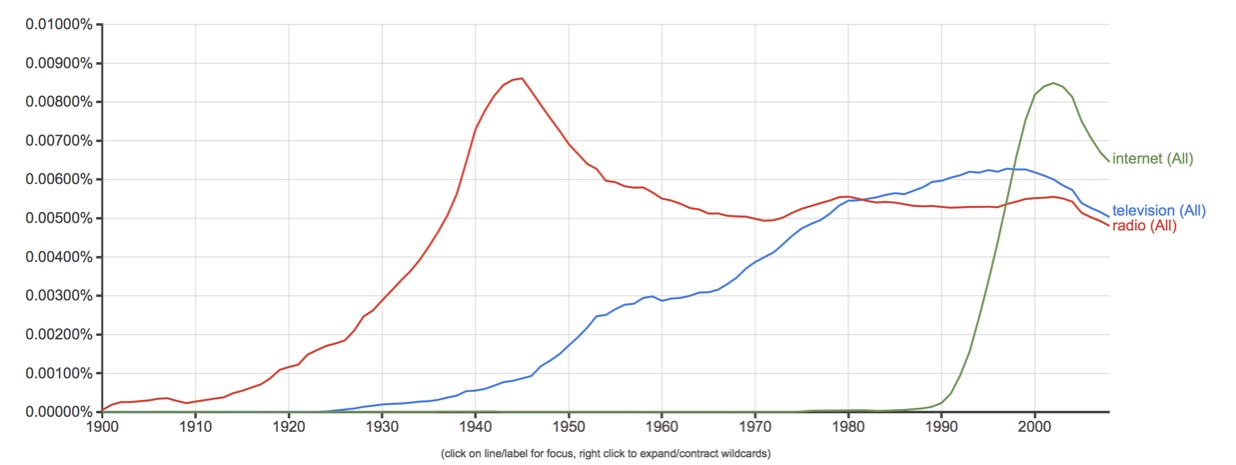
I tried a few charts of my own. Since 1885, “Evolution” has beaten “Creation,” but it took a noticeable drop during the 30’s. Since 1960 both have been on the rise.  In1980, Apple got off to an initial head start, but Microsoft passed it in 1992, never to look back (although it’s had a precipitous decline since 2000.)  Perhaps the most interesting chart is comparing “radio”, “television” and “internet” since 1900. Radio started growing in the 20’s and hit its popularity peak around 1945, but the cross-over with television would take another 40 years (about 1982.) Television would only enjoy a brief period of dominance. In 1990, the meteoric rise of the Internet started and it surpassed both radio and television around 1997.

tvradiointernet

My final chart was to see how Google fared in it’s own tool. Not surprisingly, Google has dominated the search space since 2001, and done so quite handily. Currently, it’s 6 times more popular than its rivals, Yahoo and Bing.  One caveat here though – Bing’s popularity started to climb in 1830, so I think they’re talking about either the cherry, Chinese people named Bing or a German company that used to make kitchen utensils.  Either that, or Microsoft has had their search engine in development a lot longer than anyone guessed.

googleyahoobing

Yahoo Under the Mayer Regime

First published November 7, 2013 in Mediapost’s Search Insider

marissa-mayer-7882_cnet100_620x433OK, it has a new logo. The mail interface has been redesigned. But according to a recent New York Timespiece, Yahoo still doesn’t know what it wants to be when it grows up. Marissa Mayer seems to be busy, with a robust hiring spree, eight new acquisitions, 15 new product updates, a nice 20% bump in traffic and a stock price that’s been consistently heading north. But all this activity hasn’t seemed to coalesce into a discernible strategy — from the outside, anyway.

It’s probably because Mayer is busy rebuilding the guts of the organization. Cultures are notoriously difficult things to change. In any organization where a major change in direction is required, you will have to deal with several layers of inertia — and, even more challenging, momentum heading the wrong way.  In the blog post, design guru Don Norman agrees, ““The major changes she has made are not what the logo looks like or a new Yahoo Mail. The major changes are what the company looks like internally. She’s revitalizing the inside of the company, and what everyone sees on the surface are just little ripples.”

To be fair, Yahoo has been an organization lacking a clear direction for a long, long time. I remember speaking at the Sunnyvale campus years ago, when Yahoo was still being remade into a media property, under the direction of Terry Semel. There were entire departments (including the core search team) that felt cut adrift. Since then, the strategic direction of Yahoo has resembled that of a Roomba vacuum, plowing forward until it senses an obstacle, then heading off in an entirely new direction.

What was interesting about the recent Times post was the marked contrast to the rumors and kvetching coming from Mayer’s old digs: Google. There, the big news seems to be the ultra-secret party barge anchored in San Francisco bay. And a Quora thread entitled “What’s the Worst Part about Working at Google?” paints a picture of a frat house that has yet to wake up and realize the party’s over:

  • Overqualified people working at menial jobs.
  • Frustration at not being able to contribute anything meaningful in an increasingly bureaucratic environment.
  • Engineers with egos outstripping their skills.
  • Bottlenecks preventing promotion,
  • A permanent “party” atmosphere that makes it difficult to get any actual work done.

But perhaps the most telling comment came from someone who spent seven years at Google, who said that all the meaningful innovation comes from an exceedingly small group, headed by Larry and Sergey. The rest of the Googlers are just along for the ride:

Here’s something to ponder.  The only meaningful organic products to come out of Google were Search and then AdSense.  (Android — awesome, purchased.  YouTube — awesome, purchased, etc. Larry and/or Sergey were obviously intimately involved in both.  Maps – awesome, purchased. Google Plus is a flop for all non-Googlers globally, Chrome browser is great, but no direct monetization (indirectly protects search), the world has passed the Chrome OS by… etc. ) Fast-forward 14 years, and the next big thing from Google, I bet, will be Google Glass, and guess who PMd it.  Sergey Brin.  Tiny number of wave creators, huge number of surfers.

So we have Google, still surfing a wave that started 15 years ago, and Yahoo struggling to get in position to catch the next one. For both, the challenge is a fundamental one: How do you effect change in a massive organization and get thousands of employees contributing in a meaningful way? Ironically, it may turn out that Marissa Mayer has significant advantage here. If you’re bright, ambitious and looking to do something meaningful with your career, what would be more appealing: trying to shoehorn your way into an already overcrowded house party, or the opportunity to roll up your sleeves and resurrect one of the Web’s great brands?

What Does Being “Online” Mean?

plugged-inFirst published October 24, 2013 in Mediapost’s Search Insider

If readers’ responses to my few columns about Google’s Glass can be considered a representative sample (which, for many reasons, it can’t, but let’s put that aside for the moment), it appears we’re circling the concept warily. There’s good reason for this. Privacy concerns aside, we’re breaking virgin territory here that may shift what it means to be online.

Up until now, the concept of online had a lot in common with our understanding of physical travel and acquisition. As Peter Pirolli and Stuart Card discovered, our virtual travels tapped into our evolved strategies for hunting and gathering. The analogy, which holds up in most instances, is that we traveled to a destination. We “went” online, to “go” to a website, where we “got” information. It was, in our minds, much like a virtual shopping trip. Our vehicle just happened to be whatever piece of technology we were using to navigate the virtual landscape of “online.”

As long as we framed our online experiences in this way, we had the comfort of knowing we were somewhat separate from whatever “online” was. Yes, it was morphing faster than we could keep up with, but it was under our control, subject to our intent. We chose when we stepped from our real lives into our virtual ones, and the boundaries between the two were fairly distinct.

There’s a certain peace of mind in this. We don’t mind the idea of online as long as it’s a resource subject to our whims. Ultimately, it’s been our choice whether we “go” online or not, just as it’s our choice to “go” to the grocery store, or the library, or our cousin’s wedding. The sphere of our lives, as defined by our consciousness, and the sphere of “online” only intersected when we decided to open the door.

As I said last week, even the act of “going” online required a number of deliberate steps on our part. We had to choose a connected device, frame our intent and set a navigation path (often through a search engine). Each of these steps reinforced our sense that we were at the wheel in this particular journey. Consider it our security blanket against a technological loss of control.

But, as our technology becomes more intimate, whether it’s Google Glass, wearable devices or implanted chips, being “online” will cease to be about “going” and will become more about “being.”  As our interface with the virtual world becomes less deliberate, the paradigm becomes less about navigating a space that’s under our control and more about being an activated node in a vast network.

Being “online” will mean being “plugged in.” The lines between “online” and “ourselves” will become blurred, perhaps invisible, as technology moves at the speed of unconscious thought. We won’t be rationally choosing destinations, applications or devices. We won’t be keying in commands or queries. We won’t even be clicking on links. All the comforting steps that currently reinforce our sense of movement through a virtual space at our pace and according to our intent will fade away. Just as a light bulb doesn’t “go” to electricity, we won’t “go” online.  We will just be plugged in.

Now, I’m not suggesting a Matrix-like loss of control. I really don’t believe we’ll become feed sacs plugged into the mother of all networks. What I am suggesting is a switch from a rather slow, deliberate interface that operates at the speed of conscious thought to a much faster interface that taps into the speed of our subconscious cognitive processing. The impulses that will control the gateway of information, communication and functionality will still come from us, but it will be operating below the threshold of our conscious awareness. The Internet will be constantly reading our minds and serving up stuff before we even “know” we want it.

That may seem like neurological semantics, but it’s a vital point to consider. Humans have been struggling for centuries with the idea that we may not be as rational as we think we are. Unless you’re a neuroscientist, psychologist or philosopher, you may not have spent a lot of time pondering the nature of consciousness, but whether we actively think about it or not, it does provide a mental underpinning to our concept of who we are.  We need to believe that we’re in constant control of our circumstances.

The newly emerging definition of what it means to be “online” may force us to explore the nature of our control at a level many of us may not be comfortable with.

Losing My Google Glass Virginity

Originally published October 17, 2013 in Mediapost’s Search Insider

Rob, I took your advice.

A few columns back, when I said Google’s Glass might not be ready for mass adoption, fellow Search Insider Rob Garner gave me this advice:“Don’t knock it until you try it.”  So, when a fellow presenter at a conference I was at last week brought along his Glass and offered me a chance to try them (Or “it”? Does anyone else find Google’s messing around with plural forms confusing and irritating?), I took him up on it. To say I jumped at it may be overstating the case – let’s just say I enthusiastically ambled to it.

I get Google Glass. I truly do. To be honest, the actual experience of using them came up a little short of my expectations, but not much. It’s impressive technology.

But here’s the problem. I’m a classic early adopter. I always look at what things will be, overlooking the limitations of what currently “is.” I can see the dots of potential extending toward a horizon of unlimited possibility, and don’t sweat the fact that those dots still have to be connected.

On that level, Google Glass is tremendously exciting, for two reasons that I’ll get to in a second. For many technologies, I’ll even connect a few dots myself, willing to trade off pain for gain. That’s what early adopters do. But not everyone is an early adopter. Even given my proclivity for nerdiness, I felt a bit like a jerk standing in a hotel lobby, wearing Glass, staring into space, my hand cupped over the built-in mike, repeating instructions until Glass understood me. I learned there’s a new label for this; for a few minutes I became a “Glasshole.”Screen-Shot-2013-05-19-at-2.09.03-AM

Sorry Rob, I still can’t see the mainstream going down this road in the near future.

But there are two massive reasons why I’m still tremendously bullish on wearable technology as a concept. One, it leverages the importance of use case in a way no previous technology has ever done. And two, it has the potential to overcome what I’ll call “rational lag time.”

The importance of use case in technology can be summed up in one word: iPad. There is absolutely no technological reason why tablets, and iPads in particular, should be as popular as they are. There is nothing in an iPad that did not exist in another form before. It’s a big iPhone, without the phone. The magic of an iPad lies in the fact that it’s a brilliant compromise: the functionality of a smartphone in a form factor that makes it just a little bit more user-friendly. And because of that, it introduced a new use case and became the “lounge” device. Unlike a smartphone, where size limits the user experience in some critical ways (primarily in input and output), tablets offer acceptable functionality in a more enjoyable form. And that is why almost 120 million tablets were sold last year, a number projected (by Gartner) to triple by 2016.

The use case of wearable technology still needs to be refined by the market, but the potential to create an addictive user experiences is exceptional. Even with Glass’ current quirks, it’s a very cool interface. Use case alone leads me to think the recent $19 billion by 2018 estimate of the size of the wearable technology market is, if anything, a bit on the conservative side.

But it’s the “rational lag time” factor that truly makes wearable technology a game changer.  Currently, all our connected technologies can’t keep up with our brains. When we decide to do something, our brains register subconscious activity in about 100 milliseconds, or about one tenth of a second. However, it takes another 500 milliseconds (half a second) before our conscious brain catches up and we become aware of our decision to act. In more complex actions, a further lag happens when we rationalize our decision and think through our possible alternatives. Finally, there’s the action lag, where we have to physically do something to act on our intention. At each stage, our brains can shut down  impulses if it feels like they require too much effort.  Humans are, neurologically speaking, rather lazy (or energy-efficient, depending on how you look at it).

So we have a sequence of potential lags before we act on our intent: Unconscious Stimulation > Conscious Awareness > Rational Deliberation > Possible Action. Our current interactions with technology live at the end of this chain. Even if we have a smartphone in our pocket, it takes several seconds before we’re actively engaging with it. While that might not seem like much, when the brain measures action in split seconds, that’s an eternity of time.

But technology has the potential to work backward along this chain. Let’s move just one step back, to rational deliberation. If we had an “always on” link where we could engage in less than one second, we could utilize technology to help us deliberate. We still have to go through the messiness of framing a request and interpreting results, but it’s a quantum step forward from where we currently are.

The greatest potential (and the greatest fear) lies one step further back – at conscious awareness. Now we’re moving from wearable technology to implantable technology. Imagine if technology could be activated at the speed of conscious thought, so the unconscious stimulation is detected and parsed and by the time our conscious brain kicks into gear, relevant information and potential actions are already gathered and waiting for us. At this point, any artifice of the interface is gone, and technology has eliminated the rational lag. This is the beginning of Kurzweil’s Singularity: the destination on a path that devices like Google Glass are starting down.

As I said, I like to look at the dots. Someone else can worry about how to connect them.

What a Social Media “Like” Should Really Mean

Originally posted in Mediapost’s Search Insider on October 3, 2013

Italy’s Agriturismo program has been a success by any measure you might want to use. Since the initial legislation was passed in 1985, thousands of small farms through Italy, teetering on the edge of extinction, have been thrown a financial lifeline by letting operators supplement their income  welcoming tourists to “stay on the farm.” The program includes one-time renovation grants and an ongoing marketing program. Today, there are almost 3,500 agriturismos throughout Italy. Many of these have sprung up just in the past decade. The program brings the market directly to the farm, allowing onsite sales of products to guests and showcasing the homegrown produce in the agriturismo’s restaurant.

The program’s success, however, has superheated the competition for tourism among the operators. In Tuscany, where I stayed at one such farm, there are 1,000 agriturismos, almost one third of the total number in Italy. You literally can’t throw a Tuscan stone without hitting some type of tourist-targeted operation. This competitive environment is made even more fervent when you consider that almost every restaurant in Italy is also an independent operation. There are no big chains. All these businesses are literally mom and pop (sorry, Momma and Poppa) operations. They run on a shoestring. There is little to no money for advertising. If ever there was a test bed for guerilla marketing, this is it.

Here, online ratings are the currency of choice. A top spot in an online directory is the difference between life and death for these businesses. In this almost perfect but unflinchingly brutal adaptive environment, if you’re terrible, you die quickly. If you’re mediocre, you die slowly. If you’re good, you stumble along. And for a very few exceptions, if you’re excellent, you may do OK and even prosper, relatively speaking. I would put Fausto and Susanna in this last category. They run a small agriturismo just outside San Gimignano.

When it comes to the directories that matter, one towers above the rest. TripAdvisor wields the same power in this market that Google wields in our world of search. It is the ultimate arbitrator of life and death. And the smartest of the operators have taken this to heart. They “get” social media at a level that is humbling to this particular North American online marketing “expert.” It’s not just asking for a “like” or a good review. They know that the best way to get a glowing review is to utterly, undeniably, completely deserve it.  There’s no faint praise here; you have to blow your customer’s socks off.

It’s this intimate, person-to-person exchange that makes this the most efficient market possible. No money or marketing efforts are wasted on inefficient channels.  There are no middlemen. It all takes place directly between the host and the guest. It’s completely genuine. How many marketing campaigns can you say that about? They give you the experience of a lifetime, and you say a heartfelt thank you. TripAdvisor (and Facebook, and Yelp, etc.) is just there to make sure the world hears about it.

If Fausto and Susanna have understood the power of social media, Marina Pasquino is teaching a master’s class in it. In all my years of staying in hotels and consulting to businesses, I’m not sure I’ve ever seen a better-run business than Signora Pasquino’s small hotel on the Adriatic coast. My jaw dropped during check-in, and didn’t manage to snap back into place until we left seven awestruck days later.

The Hotel Belvedere, a tiny hotel in Riccione with less than 50 rooms, has blown TripAdvisor’s review algorithm to smithereens. It doesn’t just top the ratings for hotels in its area – it’s TripAdvisor’s number-one hotel in all of Italy, and one of the top 25 hotels in the world! Of the over 800 reviews it’s collected, 97% of them are effusive over-the-top odes to the hotel, its staff and the complete Belvedere experience.  The feedback is so overwhelming positive, posts sometimes get flagged for manual review to ensure they’re not fraudulent. They’re not, by the way. I mean, how many hotel staff actually hug you when you check in? Seriously.

Business is almost completely generated by word of mouth (both traditionally and digitally). Guests come back every single year. And they bring their friends. During our week, several groups (many from Canada, where I’m from) were at the hotel. And all this is fueled by a warm contact through social media after you leave. With the Belvedere, when you talk about friending and liking, you don’t have to put quotes around the words. In this case, those labels match your intention.

I’ve talked before about how rugged adaptive environments drive the evolution of new breeds of marketers. I can’t think of any environment more rugged than the tourism industry in today’s Italy. And here, the Faustos, the Susannas and the Marinas are showing that if you work your ass off to be amazing, we’ll return the favor by letting people know. I’m not sure what you would call this particular species, but I hope it prospers. We could certainly use more of them in the world.

What is this “Online” You Speak Of?

First published September 12, 2013 in Mediapost’s Search Insider.

I was in an airport yesterday, and I was eavesdropping. That’s what I do in airports. It’s much more entertaining than watching the monitors. In this particular case, I was listening to a conversation between a well-dressed elderly gentleman, probably in his late ’80s, and what appeared to be his son. They were waiting for pre-boarding. The son was making that awkward small talk — you know, the conversation you have when you don’t really know your parent well enough anymore to be able to talk about what they’re really interested in, but you still feel the need to fill the silence. In this case, the son was talking to his dad about a magazine: “I used to get a copy every time I flew to London,” he said. “But they don’t publish it anymore. It’s all done online.”

The father, who had the look and appearance of a retired university professor, looked at his son quizzically for a few minutes. It’s as if the son had suddenly switched from English to Swahili midstream in his conversation.

“What’s ‘online’?”

“Online — on the Internet. It’s published electronically. There’s no print version anymore?”

The father grappled with the impact of this statement, then shook his head slowly and sadly. “That’s very sad. I suppose the mail service’s days are numbered too.”

The son replied, “Oh yes, I’m sure. No one mails things anymore.”

“But what will I do? I still buy things from catalogs.” It was as if the entire weight of the last two-and-a-half decades had suddenly settled on the frail gentleman’s shoulders.

At first, I couldn’t believe that anyone still alive didn’t know what “online” was. Isn’t that pretty much equivalent to oxygen or gravity now? Hasn’t it reached the point of ubiquity at which we all just take it for granted, no longer needing to think about it?

But then, because in the big countdown of life, I’m also on the downhill slope, closer to the end than to the beginning, I started thinking about how wrenching technological change has become. If you don’t keep up, the world you know is swept away, to be replaced with a world where your mail carrier’s days are numbered, the catalogs you depend on are within a few years of disappearing, and everything seems to be headed for the mysterious destination known as “online.”

As luck would have it, my seat on the airplane was close enough to this gentleman’s that I was able to continue my eavesdropping (if you see me at an airport, I advise you to move well out of earshot). You might have thought, as I first did, that he was in danger of losing his marbles. I assure you, nothing could be further from the truth. For over four hours, he carried on intelligent, informed conversations on multiple topics, made some amazing sketches in pencil, and generally showed every sign of being the man I hope to be when I’m approaching 90. This was not a man who had lost touch with reality; this was a man who is continually surprised (and, I would assume, somewhat frustrated) to find that reality seems to be a moving target.

We, the innovatively smug, may currently feel secure in our own technophilia, but our ability to keep up with the times may slip a little in the coming years. It’s human to feel secure with the world we grew up and functioned in. Our evolutionary environment was substantially more stable than the one we know today. As we step back from the hectic pace, don’t be surprised if we lose a little ground. Someday, when our children speak to us of the realities of their world, don’t be surprised if some of the terms they use sound a little foreign to our ears.

Google Glass and the Sixth Dimension of Diffusion

First published August 29, 2013 in Mediapost’s Search Insider

Tech stock analyst and blogger Henry Blodget has declared Google Glass dead on arrival. I’m not going to spend any time talking about whether or not I agree with Mr. Blodget (for the record, I do – Google Glass isn’t an adoptable product as it sits – and I don’t – wearable technology is the next great paradigm shifter) but rather dig into the reason that he feels Google Glasses are stillborn.

They make you look stupid.

The input for Google Glass is your voice, which means you have to walk around saying things like, “Glass, take a video” or “Glass, what is the temperature?” The fact is, to use Google Glass, you either have to accept the fact that you’ll look like a moron or the biggest jerk in the world. Either way, the vast majority of us aren’t ready to step into that particular spotlight.

Last week, I talked about Everett Rogers’ Diffusion of Technology and shared five variables that determine the rate of adoption. There is actually an additional factor that Rogers also mentioned: “the status-conferring aspects of innovations emerged as the sixth dimension predicting rate of adoption.”

If you look at Roger’s Diffusion curve, you’ll find the segmentation of the adoption population is as follows: Innovators (2.5% of the population), Early Adopters (13.5%), Early Majority (34%), Late Majority (34%)  and Laggards (16%).  But there’s another breed that probably hides out somewhere between Innovators and Early Adopters. I call them the PAs (for Pompous Asses). They love gadgets, they love spending way too much for gadgets, and they love being seen in public sporting gadgets that scream “PA.” Previously, they were the ones seen guffawing loudly into Bluetooth headsets while sitting next to you on an airplane, carrying on their conversation long after the flight attendant told them to wrap it up. Today, they’d be the ones wearing Google Glass.


This sixth dimension is critical to consider when the balance between the other five is still a little out of whack. Essentially, the first dimension, Relative Advantage, has to overcome the friction of #2, Compatibility, and #3, Complexity (#4, Trialability, and #5, Observability, are more factors of the actual mechanics of diffusion, rather then individual decision criteria). If the advantage of an innovation does not outweigh its complexity or compatibility, it will probably die somewhere on the far left slopes of Rogers’ bell curve. The deciding factor will be the Sixth Dimension.

This is the territory that Google Glass currently finds itself in. While I have no doubt that the advantages of wearable technology (as determined by the user) will eventually far outweigh the corresponding “friction” of adoption, we’re not there yet. And so Google Glass depends on the Sixth Dimension. Does adoption make you look innovative, securely balanced on the leading edge? Or does it make you look like a dork? Does it confer social status or strip it away? After the initial buzz about Glass, social opinion seems to be falling into the second camp.

This brings us to another important factor to consider when trying to cash in on a social adoption wave: timing. Google is falling into the classic Microsoft trap of playing its hand too soon through beta release. New is cool among the early adopter set, which makes timing critical. If you can get strategic distribution and build up required critical mass fast enough, you can lessen the “pariah” factor. It’s one thing to be among a select clique of technological PAs, but you don’t want to be the only idiot in the room. Right now, with only 8,000 pairs distributed, if you’re wearing a pair, you’re probably the one that everyone else is whispering about.

Of course, you might not be able to hear them over the sound of your own voice, as you stand in front of the mirror and ask Google Glass to “take a picture.”


Comparing and Contrasting the Classes of ’79 and ’13

First published July 2, 2013 in Mediapost’s Search Insider

My youngest daughter just graduated from high school. I graduated from my high school a third of a century ago. The things you read about every day here at MediaPost have made the world a much different place for her than it was for me.

Or have they?

I was actually struck these past few months with how her grad experience didn’t seem all that much different than mine. The biggest difference, it seemed, was in how she connected with her friends. But the “why” – the topics of those connections – seems very familiar.

She is graduating from a small school, with a grad class of just over 50. I graduated from a small-town high school in Alberta in a class of 70. Like me, she has gone to school with most of her class from kindergarten right through to grade 12 – so the social dynamics in both cases were fairly tightly woven.

Both classes, the class of ‘13 and the class of ’79, were under the temporary euphoria of youthful confidence. All things seem possible when you’re 18. The world is not a grinding gristmill of monthly mortgage payments, day-to-day job-related drudgery, vague yet persistent aches and pains and innumerable other nagging details that suck the life out of you. It’s a lion waiting to be tamed, a journey begging to be taken or an adventure still to be had. Is there any more optimistic time in your life than graduation? I wish that it could last forever, but I know better.

Both classes had their inevitable run-ins with authority that seemed unreasonable and inflexible. In both cases, said “run-ins” arose from social “traditions” that ran afoul of scheduled class time. Both times, the phrases “can’t condone” and “set a precedent” was used a lot by the school administration. Of course, such nuances don’t mean much to you when you’re 18. “Party” is a word with much more meaning.

Speaking of parties, both classes had their share. The biggest difference between ’79 and ’13 was in how word of these parties propagated through the grad social network. In 1979, “viral” meant hanging out at the main intersection of town (I told you I grew up in a small town) waiting for familiar trucks (I told you I grew up in Alberta) to go by, so you could ask where the party was. Today’s approach seems much more efficient.

Style also played a major role in both events. In many cases, it’s our first experience with formal wear, which means a lot of time is devoted to dress and/or suit shopping. My daughter has been wearing high heels in the house for the past week, hoping to master the trick of locomotion without severe injury. Of course, in my case it was a very stylish dark brown velvet tuxedo with matching bowtie. Hey, it was ’79, and my fashion influences were “The Love Boat” and Jack Tripper from “Three’s Company.” Cut me some slack! There were people who went in blue jeans (remember – rural Alberta).

Another major theme was, and is, “Who’s going with who (sic)” to graduation. For those of us who were less precocious in our experience with the opposite sex, a lot of pressure came with graduation. We had to get a date, or be labeled as “the guy who went stag.” This meant you had a lot of socially inept teenagers going through the trauma of a first date at the same time, in the same place. All the technology in the world can’t improve person-to-person communication in this scenario.

It seems to me that though the way the class of ’13 negotiated through their grad experience may have changed since 1979, the actual things that make up that experience seem remarkably familiar. It’s still about transition: whether it be in relationships, opportunities, routines or responsibility.  It’s that awesome experience of sitting on the cusp, when all things seem possible. It’s believing that you own the world – and that  the world is an essentially good place. Whether you express that on Facebook, Instagram or while leaning on the side of a Chevy pick-up at the “Four Corners” in Sundre, Alberta — the “how” may have changed, but the “why” has remained the same.

The Stress of Hyper-Success

Last week, I talked about the inflation of expectations. In that case, it was the vendors we deal with that were the victims of that inflation. But we don’t only have inflated expectations about others. Increasingly, we measure ourselves against our own expectations. And that is leading us down a dangerous path.

The problem is that success is a relative thing. We can only judge it by looking at others. This creates a problem, because increasingly, we’re looking at extreme outliers as our baseline for expectations.

Take social media, for instance. Women feel more stressed than satisfied after spending time on Pinterest, according to a recent survey. “Pinterest stress” is the official label for feelings of inadequacy in trying to measure up against the unrealistic examples of domestic perfection shared on the female-dominated social network.

But it’s not just women and Pinterest. One-third of Facebook users feel worse after visiting the site. Why? Because we feel envious after going through the pictures of someone else’s dream vacation. Social media invites comparison. We try to measure ourselves up to the achievements of others in our social circle. There are two problems with that: we are naturally jealous of our neighbors, and our neighbors tend to lie (or at least embellish) when they post of their own accomplishments.

Added to this is the unnatural effect of the Power Law curve. Not all online posts about accomplishments are equally popular. We tend to focus on those that are outstanding — those that are set apart from the average. These online examples, representing the extreme upper limits of success and achievement, take their place at the head of the Power Law curve, drawing a dramatically bigger audience. We ignore the commonplace, which lives somewhere in the Long Tail. Our own quest for the remarkable (humans never gossip about average, everyday topics) leads us to focus on the unrealistic.

So the more access we have to the achievements of others, the more skewed our idea of success becomes. What we don’t realize, however, is that we’re measuring ourselves against the very highest percentile of the human population.

Take salaries, for example. What would be a yearly amount that would make you happy? Economists Angus Deaton and Daniel Kahnemann asked that very question — and it turns out that $75,000 a year is the magic number. Below that number, the day-to-day stress of just getting by leads to chronic unhappiness. But above that number, people seem to feel more fulfilled and are generally in a more positive frame of mind. But after you get past that general threshold for happiness, more money doesn’t seem to always equate to increased happiness. Millionaires and billionaires are not that much happier than the rest of us.

Yet if I asked you how much you wanted to make, I suspect the number would be higher than $75,000. And I doubt that it would have much to do with happiness. It would be because we know of people making more than us — much more. We have no idea if those high wage earners are happy or not, but we do know they pull down a much bigger paycheck than we do. So we believe we should aspire to that standard, whether it’s realistic or not, in the mistaken belief that it will make us happier. It won’t, by the way. We humans are notoriously bad at forecasting our own happiness.

This is one of those strange Darwinian detours that evolution has saddled us with. In our original adaptive environment, doing better than our neighbors was a pretty sure bet for superior gene propagation. We’re hardwired to not just be envious but to strive to compete. That made sense when our target was the person we were competing against for food, shelter or sexual access.  It doesn’t make sense when our competition is a far removed, sometimes fictitious ideal propagated by the media and the viral force of social sharing.

Somewhere, a resetting of expectations is required before we self-destruct because of hyper competitiveness in trying to reach an unreachable goal. To end on a gratuitous pop culture quote, courtesy of Sheryl Crow: “It’s not having what you want, It’s wanting what you got.”

The Straw that Broke the Market’s Back

First published May 9, 2013 in Mediapost’s Search Insider

Customers are fickle — and I suspect they’re getting more fickle.  Perhaps they’re even feeling a little entitled.A recent survey shows that customers tend to bail on a company not because of a big time screw-up, but because of the accumulation of a lot of little annoyances. Soon, their frustration reaches a tipping point and they look elsewhere.

It would be easy to point the finger at the companies and demand that they get their collective acts together. But I suspect there’s more at play here. It would be my guess that customers are getting harder to please.  And I would further guess that the Web is largely to blame. I think it comes down to a constant rise in our collective expectations, while the reality of our experiences fall behind.

The balance between our expectations and the actual experience determines our loyalty to any course of action. If we have low expectations and a poor experience, we aren’t really surprised, which dampens our subsequent disappointment and leaves us more willing to forgive and forget.  If we have low expectations but a good experience, we’re pleasantly surprised, making us more apt to return. If we have high expectations and a good experience, we get a double hit of happiness. First, we enjoy the anticipation, then we appreciate that the experience actually lives up to our expectations. For a vendor, the scariest scenario is the last of the four: high expectations but a poor experience. In this case, we walk away disappointed and frustrated.

Now, balancing expectations and experience wouldn’t be that difficult for any moderately competent company if those expectations were realistic. But I suspect that more and more of us are entering into our respective experiences with unrealistic expectations. We’re setting our vendors up to fail.

Expectations are set partly based on our past experiences, but they’re also set by the experiences of others. We create our expectation set points based, in part, on what we hear from others.

The Web has created an open, accessible market of experiences and hearsay. We hear about the bad, a feedback loop that increasingly is calling out poor customer service. But we also hear about the good.  Correction – we hear about the exceptional. The “good” is not remarkable. It generally falls within our expectations and so goes without comment. But either the very good or the very bad is exceptional, and we are more apt to comment on it online. Not only do we comment, we also embellish, accentuating the plusses and minuses to make it a better story. Therefore, what we hear from others sets either a very low or very high bar. We steer clear of the low bars, but the high bars stick with us, contributing to the setting of future expectations.

The other thing the Web has done is create expectations that overlap domains.  Previously, when our expectations were set based on our own experiences, they tended to stay domain-specific. We had an expectation of what it would be like to buy a car, stay at a hotel, eat at a restaurant or purchase a new pair of shoes. With the Web, cross-pollination between domains is increasingly common. A head marketer for a well-known industrial manufacturer once said to me, “When it comes to online experience, my competitors are not the traditional ones. I’m competing against Amazon and eBay. That type of experience is what people expect.”

This “nudging up” of expectations is done without much rational consideration. We don’t care much for the reality of operational logistics in any particular domain. We just want our expectations to be met, no matter where those expectations might come from. And when they’re not, we pull the plug on that particular vendor, assuming another vendor can do better in meeting our inflated expectations. The Web has also engendered a virulent “grass is always greener” view of the world. We know a competitor is just a click away (whether or not that vendor is any better than the incumbent).

I’ll be the first to call out a bad customer experience, but when it comes to the increasing fickleness of customers, we should remember that there are two sides to this particular story.