Yahoo Rolls Out Relevancy Rankings on Paid Search

The rumblings have been in the works for sometime, but Yahoo has set Feb 5 as D-Day for the roll out of their new quality and relevancy scoring on paid search ads. No longer will bid price be the sole determining factor that determines position, bringing Yahoo! closer to Google’s model.

In a release that just hit my inbox, Yahoo says:

“With the new ranking model, all Yahoo! search marketing ads in the U.S. will be ranked by quality in addition to keyword bid price. As a result, Yahoo! will be able to provide a more relevant search experience to users, more valuable customer leads to advertisers, and additional opportunities to its distribution partners.

“Yahoo! is very excited to introduce our new, more quality-focused ranking model because it has the power to significantly enhance the experience we deliver to our users and unlock the full potential of Yahoo!’s search marketing network,” said Terry Semel, chief executive officer, Yahoo! Inc. “With this important piece in place our new search marketing system will allow Yahoo! to more effectively connect people with the businesses, products, services and information they are passionate about.”

Sure, it’s marketspeak, but what do you expect from a media release? Posts about the roll out should be going live soon on the YSM blog, but as of this posting, they weren’t live yet. There’ll probably be something on the Yodel blog as well, but again, nothing yet.

A number of people will post on what this means for execution of marketing strategies. I’d like to comment about the user experience and what this means. Here are some findings about interactions with top sponsored based on our most recent eye tracking study:

Yahoo devotes more screen real estate to top sponsored ads than either Google or MSN. This often marginalizes the presence of organic listings above the fold at typical resolutions. While Google and MSN often shows 2 or 3 organic results at 1024 X 768, often Yahoo only manages to squeeze one result in.

People tend to scan 3 or 4 results at a time, and they almost always start at the top, including these top sponsored ads. They also like to include one organic result in this initial scan set. Yahoo’s regular presentation of 4 top sponsored results breaks the user’s desire to have an organic alternative in their scan set.

Yahoo’s emphasis on top sponsored ads did mean they captured the highest click throughs of any of the 3 engines on top sponsored ads, FOR FIRST VISITS ONLY. On repeat visits, these click through rates dropped dramatically on Yahoo!, but Google managed to hold their rates steady.

Yahoo had the highest occurrence of pogo sticking (returning to the results page after clicking through to a site) and a number of these were after a click on a top sponsored ad. This indicated that many searchers didn’t find what they were looking for, and purposely avoided top sponsored ads on the repeat visits.

All of these findings indicate that Yahoo’s announcement will be good news for users. These top sponsored ads are a key monetization strategy for Yahoo, and if they can improve performance by increasing relevancy, it will mean less pogo sticking and keeping users from avoiding these listings on repeat visits. And good news for users will translate into better results for advertisers.

Of course the cynical side of me asks, “what took you so long?” I think the time is right for Yahoo to leapfrog Google, not keep playing catch up.

Top Spot or Not in Google?

Brandt Dainow at Think Metrics shared the results of his campaign performance with Google Adwords and came up with the following conclusions:

    • There is no relationship between the position of an advertisement in the Google Ad listings and the chance of that ad being clicked on.
    • Bidding more per visitor in order to get a higher position will not get you more visitors.
    • The number one position in the listings is not the best position.
    • No ad position is any better than any other.
    • The factor which has the most bearing on your chance of being clicked on is the text in your ad, not the ad’s position.

These conclusions were arrived at after analyzing the Google ads he ran this year. He says,

“while position in the listings used to be important, it is not anymore. People are more discriminating in their use of Google Ads than they used to be; they have learned to read the ads rather than just click the first one they see”

This runs directly counter to all the research we’ve done, and also that done by others, including Atlas one point. So I decided it was worth a deeper dive.
First, some facts about the analysis. It was done on ads he ran in October and November of last year, for the Christmas season. He acknowledges that this isn’t a definitive analysis, but the results are surprising enough that he encourages everyone to test their own campaigns.
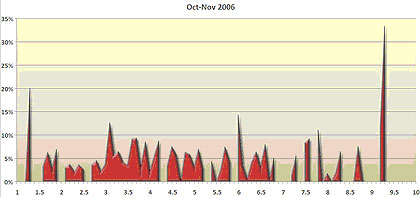
In the following chart, he tracks the click through per position.

Dainow
Brandt expected to see a chart that started high on the left, and tapered down as it moved to the right. But there seemed to be little correlation between position and click through. This runs counter to our eye tracking, which showed a strong correlation, primarily on first page visits. Top sponsored ads on Google received 2 to 3 times the click throughs.

enquirorank

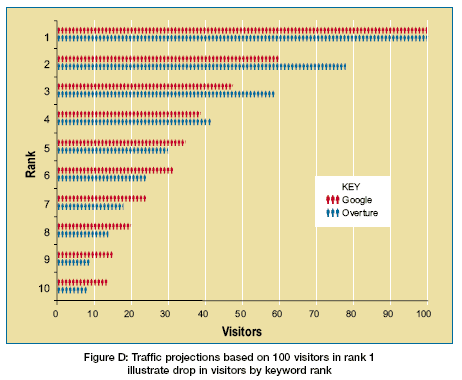
Further, Atlas OnePoint did some analysis from their data set, and similarly found a fairly high correlation between position and click through on Google and Overture/Yahoo.

atlasrank

So why the difference?

Well, here are a couple thoughts right off the bat. Dainow’s data is exclusively for his campaigns. We don’t see click through rates for the other listings, both paid and non-paid, on the page, so we can’t see how his ads stack up against others on the page. Also, it may be that for the campaigns in question, Brandt’s creative is more relevant than the other ads that show. He makes the point that creative is more important than position. I don’t necessarily agree completely. The two work together. The odds of being seen are substantially higher in the top spots, and your creative doesn’t work if it isn’t seen. The discriminating searcher that Dainow sees emerging who takes the time to read all the ads isn’t the searcher we see in eye tracking tests. That searcher quickly scans 3 to 4 listings, usually top sponsored and the top 1 or 2 organic listings and then makes their choice. This is not only true of our study, but the recent Microsoft one that just came out. Although Dainow’s charts over time certainly seem to show that position is less important, there could be a number of other factors contributing to this.

I will agree with Brandt though that if seen, relevant and compelling copy does make a huge difference in the click through rate of the ad. And for consumer researchers in particular, I still see search advertiser’s cranking out copy that’s not aligned to intent. But all the evidence I’ve seen points to much higher visibility, and hence, click throughs, in the top sponsored spots.

When looking at analysis like Brandt Dainow is presenting, you have to be aware of all the variables. In this case, I’d really like to know the following:

  • What were the keywords that made up the campaigns
  • What was the creative that was running for his clients
  • What was the creative the competition was running
  • What were the overall click throughs for the page

In doing the analysis, you really need to control for these variables before you can make valid conclusions. Some are ones we can know, others, like the overall click throughs, only the engines would know.

But Dainow is quick to point that his findings show the need for individual testing on a campaign by campaign basis. And in that, we’re in complete agreement. Our eye tracking tests and other research shows general patterns over common searches, and the patterns have been surprisingly consistent from study to study. It probably gives us as good idea as any what typical searcher behavior might be. But as I’ve said before, there is no such thing as typical behavior. Look at enough searches and an average, aggregate pattern emerges, but each search is different. It depends on searcher intent, it depends on the results and what shows on the page, it depends on the engines,  it depends on what searchers find on the other side of the click. All these things can dramatically affect a scan pattern. So while you might look to our studies or others as a starting point, we continually encourage you to use our findings to set up your own testing frameworks. Don’t take anything for granted. But that’s a message that often doesn’t get through. And my concern is that advertisers looking for a magic bullet will read Dainow’s conclusions highlighted at the top of this post and swallow them whole, without bothering to digest them. And there’s still far too many question marks about this analysis for anyone to do that. I’ve contacted Dainow to set up a chat so I can find out more. Hopefully we can shed more light on this question.

SEM’s Seven Year Itch, Part Two

First published January 18, 2007 in Mediapost’s Search Insider

There’s another controversy stirring in the SEM blogosphere, and this one is revolving around the very future of organic optimization, the yin to the paid yang of search. While this debate rears its head with predictable regularity every few years, there’s a different flavor to this one. This time, rather than an inter-industry turf war, it’s the search user that will ultimately decide the fate of SEO. And that opens up part two of SEM’s seven-year itch: what life will be like on the agency side.

A (Very) Quick History of SEM

First, a little back story. The search marketing industry has gone through one significant evolution since it began in 1996. Back then, it was a grassroots movement that started on the back of the popular search engines. More than a few have called that relationship parasitic. We worked to game the algorithmic results of Infoseek, Altavista, Lycos and Excite. We did it because there was no choice. At the time, the only way we could buy results page real estate was with terribly ineffective banners. Everybody knew that it was only the results that people looked at, and they were generating huge amounts of traffic. The higher the position, the more traffic we could expect. The organic optimization side of search has actually changed very little in the past decade. The techniques have become more sophisticated, on both sides, but it’s still all about driving listings higher for selected key phrases.

In 1998, the first reinvention of search marketing took place. Bill Gross introduced paid search through Goto, later Overture, and now Yahoo. Google followed suit in 2000. Suddenly, a whole new dimension opened up. Many moved to the paid side of search. Some remained resolutely on the organic side. And, over time, many search shops embraced both.

The introduction of paid search has been the most significant change in our industry. It has largely propelled search to where it is today. From the agency side, it demanded a whole new skill set, as we pioneered the fundamentals of bid management and, more recently, market segmentation, conversion tracking and robust testing. But one thing remained the same. Fundamentally, whether paid or free, it was still all about gaining the best real estate on the search results page.

Our Day will Come (We Hope)

Whatever side of the search marketing street we hung our shingle on, many things remained in common. We started small. We remained dedicated to search. We worked our butts off. We loved what we did. And very few of us got rich. But, we consoled ourselves, we’re part of the fastest-growing sector in marketing, and there’s got to be a payoff. We know search. Everybody searches. That’s got to be worth something. Now, many years later, we’re beginning to wonder.

The paths SEM shops chose to take have diverged over the past seven or eight years. Some have remained small, largely built around one or two skilled practitioners. Some have pursued growth and built scalable infrastructures, often fueled by eager venture capital investment trying to grab a piece of the search tidal wave. In the later case, positioning themselves for an acquisition was a common exit strategy. In a few cases this has worked, the iProspect/Isobar deal being the most notable example. In some, the inevitable stress, change of culture and diversion of focus ended up knocking the legs out from under the company. At one point, Websourced was one of the largest SEM firms in the industry. A few weeks ago, it effectively closed its doors, being absorbed into its parent, MarketSmart Interactive.

Pondering Our Future

Whatever path we chose, we’re all coming to the same crossroads. We’ve put in a lot of sweat equity, often at the expense of huge portions of our non-search lives. Unlike the early employees of the search engines (see last week’s column), we don’t have any stock options sitting in a drawer somewhere–or even the security of a regular paycheck. We’ve invested everything we have, both personally and financially, in nurturing our individual companies along, hoping that at some point, in some way, we could cash in that asset to finance the next phase of our lives, whatever that might be. Up to now, the ride has been so fun that we weren’t too concerned about getting off. But soon, we may have no choice.

The fact is, search marketing is on the cusp of reinventing itself again, and if the introduction of paid search in 1998 split the industry in half, this new incarnation will fragment it in a million pieces.

Next week, I’ll continue by exploring the next reinvention of search–and where that leaves SEM agencies.

Why No “Golden Triangle” in the Microsoft Eye Tracking Study

Over at Searchengineland, Danny Sullivan did a deeper dive into the Microsoft Eye Tracking Study that I posted about last Friday. In it, Danny said:

“Interesting, the pattern is different that the “golden triangle” that Enquiro has long talked about in its eye tracking studies, where you see all the red along the horizontal line of the top listing (indicating a lot of reading there), then less on the second listing, then less still as you move down. “

I just want to draw a few distinctions between the studies. In our study, we wanted to replicate typical search behavior as much as possible, so let people interact with actual results pages. In the Microsoft study, they were testing what would happen when the most relevant result was moved down the page and how searchers responded to different snippet lengths. The results, while actual results, were intercepted and were restructured in a way (i.e., stripping out sponsored ads) to let the researchers test different variables. We have said repeatedly that the Golden Triangle is not a constant, as is shown in our second study, but follows intent and the presentation of the search results.

In fact, the Microsoft study does confirm many of our findings, in the linear scanning of results, the scanning of groups of results and the importance of being in the top 5.

Another potential misconception that could be drawn from Danny’s interpretation of results is hard and fast rules about how many results searchers scan. He settled on the number five. When looking at eye tracking results, it’s vital to remember that there is no typical activity. Please don’t take an average and apply it as a rule of thumb. Averages, or aggregate heat maps, are just that. They’re what happens when you take a lot of different sessions, varying greatly, and mash them together. Scanning activity is highly dependent on the intent of the user and what appears on the search results page. A particularly relevant result in top sponsored, matched to the intent of the majority of users, would probably mean little scanning beyond the first or second organic result. On the other hand, if the query is more ambiguous, you could see scanning a lot deeper on the page. The Microsoft study used two tasks that would generate a limited number of queries, and recorded interactions based on this limited scope. Our studies, while using more tasks, still out of necessity represented the tiniest slice of possible interactions.

After looking at over a thousand sessions in the past 2 years, I’ve learned first hand that there are a lot of variables in scanning patterns and interactions with the search page. An eye tracking study provides clues, but no real answers. You have to take the results and try to extrapolate them beyond the scope of the study. We spent a lot of time doing this when writing up both our reports. You try to find universal behaviors and commonalities, but you have to be very careful not to accept the results at face value. Drawing conclusions such as snippet lengths should be longer or that official site tags should become standard are dangerous, because it’s not true for every search. The study actually found that ideal snippet length is highly dependent on the task and intent of the user.

If anything, what eye tracking has shown me is the need for more flexible search results, personalized to me and my intent at the time.

BusinessWeek Dissing Paid Search (Again)

Okay, BusinessWeek is beginning to get a little obvious in its campaign against paid search. In my books, they just received their third strike.

Strike One

An “expose” on the SEM Sweat Shop floor that showed a remarkable ignorance for the diversity of the industry. I responded to this little journalistic gem in a SearchInsider column last May. In it, search marketers were called “digital bricklayers”. Here was one quote:

“The work ranges from the slightly creative, such as … crafting sentences for ads to snag search traffic, to the rote — typing in descriptions of hamburgers for online menus.”

It was not wrong so much as one dimensional. BusinessWeek shows a tendency to paint the entire industry with a single brush.

Strike Two

This time BusinessWeek took on click fraud, with a similarly one sided perspective. They approached it focusing on the most egregious cases of click fraud, with examples of both perpetrators and victims. This is fine to draw attention, but they should also provide an accurate assessment of the overall problem. They used numbers that came from faulty research, like Outsell’s much quoted study and passed it off as an accurate assessment of the scope of click fraud with the slippery qualifier, “most experts believe”. They virtually ignored the balancing viewpoint of the engines themselves. Again, I dealt with this in another SearchInsider column and a follow up post. This is just one of many articles from BusinessWeek pumping up concern about click fraud. And most imply that the majority of the problem lies with Google and Yahoo.

Strike Three

The latest one indicates that advertisers are souring on search ads because of rising click costs and decreasing ROI. Again, they’ve taken a few cases and given the impression that it represents the entire industry. So, let me dive in again. Yes, PPC costs are rising. And yes, if you’re not tweaking your campaigns, you could find your ROI dropping. But here’s the thing. The advertisers finding this are the direct marketers. And as I’ve said over and over, there’s an inherent disconnect here. Direct marketers are looking at selling something..now. And their ads say as much. One of the advertisers quoted as complaining about the ineffectiveness of paid search in the articles was eBags.com

Okay, let’s say I search for “best luggage” on Yahoo. Here are the ads that come up:

luggageexample

Hmm..apparently eBags isn’t that turned off sponsored. But let’s get to the disconnect. What are the chances that if I search for “best luggage”, I’m looking to buy right now? How interested am I in saving 60%? I’ll tell you, based on past research. Less than 1 in 10.  In fact, it’s probably less than 1 in 20. I’m looking to see what the best luggage is. I’m researching. And where will I click? Well, let me show you the number one organic result for the same search in Yahoo.

luggageorganic

This is where I’m going to click, because it’s a much better match to my intent.

So, for those advertisers hell bent on jamming a purchase down a consumer’s throat, I have three pieces of advice:

  • Get to know how search works better
  • Get to know your consumers better
  • Get to know how your consumers use search better

If you do those 3 things, you’ll get a much better return than you will from desperately steering budget into different channels without putting some solid strategy and understanding behind your campaigns. The problem is not that search is getting less effective, it’s that marketers using it aren’t getting any smarter.

From the “Living in Glass Houses” Category

And finally, when I went to try to read this article on BusinessWeek, I had to click through an interstitial. When the hell will online publishers learn that these are incredibly annoying and detract significantly from the user experience? Give me a bushel of paid search ads, aligned with my intent, any day over one interstitial.

The SEO Debate Continues

My earlier post about the future of SEO caught Jason Lee Miller’s attention over at Webpronews. So far, Jason is one of the few to grasp the Richter Scale implications of this shift in the SEM landscape. Danny Sullivan saw the danger signs some time ago. I traded a few emails with Danny on this and his response was:

“I did a lot of writing about personalized search about two years ago sounding the same alarm. Then it never really happened, the personal results that is. They’ll come, of course.”

Meanwhile, Kevin Lee continues to poke away at the SEM-SEO controversy that his partner David Pasternack started. There are those suggesting that this is an elaborate link baiting scheme on Kevin’s part. While his speculating on the future of SEO is certainly generating lots of controversy, and hence, links out there in the blogosphere, the cynics are missing the point that all those links are pointing to Kevin’s Clickz column, not his corporate online properties. No, I suspect Kevin’s motivation in this case is his self professed tendency to be a intellectual shit disturber. He likes to stir up polarized discussion, because if you know Kevin, there’s nothing he likes better than a good debate.

As you know from the previous post, I have a slightly different take (and I use the word slightly deliberately, I happen to agree with a lot of what Kevin said in his last column) on the debate than does Kevin. His point is that SEO can be brought in-house because for a lot of websites, you just have to do the basics right and they’ll get a huge lift. Couple this with the desire, expressed in the latest SEMPO survey, of a lot of companies to handle all this SEO in-house because there’s a lack of a recognized and trusted leader in the SEO Marketplace and it’s not that hard to see Kevin’s point. To be fair, Kevin also pointed out that a lot of companies want to bring their paid search in-house as well.

But here’s the thing. SEO is going to get a lot harder, not easier. And that increasing difficulty is going to be in area that today’s crop of SEO’s have next to no experience in: knowing the end user. And that get’s back to Jason’s story in Webpronews. He states:

“While focus on keywords has been the law of the searchland, SEO professionals will have to more diligently and acutely focus on the end user – every unique end user – mulling scenarios, personalities, and motivations, which makes SEO more akin to traditional marketing, where a firm grasp of psychological concepts is as necessary as the technical acuity of keyword targeting.”

Exactly, but in that paragraph lies a world of adjustment, and I’m not sure most SEO’s are up to the challenge.

Here are some things to think about:

As results become more personalized, the work ranking ceases to have meaning. Just a few months ago the question of ranking reporting came up in an analytics session I was participating in. This has been part of SEO since the beginning and has been an ongoing sore spot between the engines and the SEO community. I mentioned that ranking reporting might soon become irrelevant, expecting it to generate a bit of controversy (in that, I do share Kevin’s delight in stirring the pot sometimes). To my surprise, nobody picked up on it. Fellow SEO’s on the panel even failed to take the bait. I felt like screaming “The whole world is about to change as you know it!” but I chose instead to go to the exhibit hall for the free drink. It was the end of the day and I was tired.

SEO’s are all about controlled experimentation. We live to tally up suspected algorithmic factors and test, tweak and twiddle. We reverse engineer the algorithms. Say what you want, that’s basically what SEO is. It’s all about tactical maneuvering. I’ve been bemoaning the lack of strategic thinking, based on what users are actually doing, for years now, but the industry hasn’t changed much. To reverse engineer, you need a control to test against. You need at least one fixed target. Up to now, the universal page of results was that fixed target. How do you reverse engineer when you have nothing to set your bearings against?

As Jason so rightly points out, this new world of SEO is much more about marketing than it is a technical skill set. It’s about knowing your user intimately and where they tend to hang out, given a specific intent. It’s about staking out the most traveled intersections and gaining some presence there. It’s about knowing how they’ll use the new version of search to navigate the online landscape. And it’s about accepting, once and for all, that you really can’t control your presence on the search results page, however it appears.

And it’s here where Kevin’s view and mine coincide. In a lot of cases, it will be about doing the fundamentals right. If you have a site that has an established presence, then this is often enough. Make sure you connect the spider with the content. Make sure the content and your target customer share the same vocabulary. Make sure you’re not throwing any road blocks between your site and the search index. Do that, and accept the fact that your control pretty much ends there. That’s not to downplay the importance of this knowledge. I agree with Danny Sullivan that SEO skills are not nearly as common as David Pasternack seems to indicate. But I believe the days of the SEO hacker/hired gun are numbered. Personalized search may be what finally kills black hat SEO.

With that, organic optimization returns to its roots, and what the word organic should have meant in the first place. It’s about working with the client to help them understand how consumers use online to research and to help them turn their organization into an organic content factory. Help them use online to provide multiple and useful touchpoints for the potential consumer. Extend your presence into the well travelled online intersections. Establish best practices for SEO, and let the rest take care of itself. As Kevin rightly points out in his column:

“Alternatively, one could simply focus on producing great content and take whatever links occur naturally (the way Sergey Brin and Lawrence Page intended in the original PageRank system).”

It’s here where SEO’s have their biggest challenge. Can they transition from a technical experimenter to a trusted guide to online traffic patterns? I have my doubts. I have seen little evidence of this in the past. SEM’s tend to be further ahead in this regard, because of the targeting opportunities that the back end platforms provide. Ironically, this is where interactive and traditional agencies could regain a foothold, but in the later case at least, they’re still struggling with the whole concept of an empowered online consumer, and until this paradigm shifts for them, they have a huge blind spot when it comes to online strategy.

SEO’s have to reinvent themselves, and soon. Some of the skills will be transferrable, but many new ones have to be acquired, and these are not usually skills that are found in the same place. I expect a shakeout, and soon. A lot of SEO’s have been doing this for a long time, and they’re getting a little tired. Reinventing themselves is probably the last thing they want to do. Cashing out was probably more in their anticipated plans.

So, how soon is this going to happen. Let’s get back to Danny’s point. Personalization is nothing new, but I think 2007 is the year where it will make a noticeable difference. There are a couple of indicators of that:

Google is already experimenting with Geo-targeting results based on IP identification. Those of you in the States probably haven’t noticed, because the online world is very US-centric, but those of us who live on the outside are already dealing with the effects. In Canada, there is a significant difference in results seen in the main Google index depending on whether the query is coming from the US or Canada. It’s a constant bain of our existence, being based in Canada but working primarily with US clients. So even in North America right now, there is no such thing as a universal set of Google results.

Personalized search that users opt in for is finally gaining significant traction. All the 3 engines offer this, and often the fact that you’re signed in is completely missed by the user. As adoption of other functionality offered by the engines increases, the odds of being signed in when you launch a search rises dramatically. And for the engines, search history is enough additional information to make them confident in presenting personalized results. It gives them another reference point in addition to the original query. The difficulty in disambiguating intent for a query was the sole reason results weren’t personalized up to now.

What does the future hold for SEO? Well, as long as users continue to want organic results (and I think personalization will make this more true, not less) there is a need to gain presence there. But the rules of the game are being rewritten. For those willing to retrench, there’s a golden opportunity to redefine marketing as we know it. But it requires looking at a big picture, and, more importantly, using a customer-centric lens to look at that picture. It means changing our approach dramatically. It means drawing back from some highly specialized skills that some have developed, and taking a more balanced approach. Personally, I’m very excited about the possibilities. A little tired, a little burnt out, but up for the challenge. But perhaps that’s because I saw it coming.

Will Wiki Whack Matt Cutts?

Danny Sullivan has an interesting post in Searchengineland about the virtual rumblings over at Wikipedia about removing Matt Cutts because he’s not notable. Say what?

You know, community is a wonderful thing, but there are community dynamics at play, no matter whether the community is based in the virtual world or the real one. There tend to be what I would call conscientious blockheads, strongly opinionated people with a lot of time on their hands that tend to have an undue influence on most forums and wiki’s, or, in traditional terms, volunteer organizations. It’s a bit of a love hate relationship, because they are, after all, volunteers and often are the sole reason that the organizations and volunteer initiatives can continue to survive. But they tend to bend the collective view to their own strongly held personal perspective. And often, they exert their own need for control and recognition in this relative vacuum. Think PTA’s, think the executive of service organizations, think strata councils, think churches. I’ll bet you’ve all already thought of a person just like I’m describing, right?

Well, this type of person, armed with an Internet connection, has now found a new home, and this is true wherever online communities are gathering. Wikipedia would be a case in point. I think any rational person who has a modicom of expertise in the search space would know that Matt Cutts is probably one of the 10 most notable people in search, for a number of reasons that Danny Sullivan outlines (and I think Danny is shortchanging his own notability, but that’s another post).

The beauty of online communities are that there is a certain degree of transparency. We can all participate, if we choose. And us voicing our (hopefully) informed opinion is enough to hold the conscientious blockheads in check. Danny is doing exactly what we should all do, voicing his opinion and filling the vacuum.

The Future of SEO in a Personalized Search Interface

This is a debate that seems to have legs. A few posts back, I came to the defense of SEO from the user’s perspective.

In catching up with a few articles and chatting with a few key people in the industry, I’ve got another perspective that I’d like to share.

First of all, Joe Laratro in last Friday’s SearchInsider debunked Three SEO Myths, one of which was “Natural Search is Dead”. In it, Joe correctly stated:

“Natural search engine optimization is still thriving. It is more difficult today than it was five or six years ago, but the core of search results are still free. Natural Search Engine Optimization being dead is a popular myth because of the standardization of methodology that is now used. Each of the major search engines has released guidelines for Webmasters that detail the dos and don’ts of Web site optimization. Since more of the online world is aware of successful optimization techniques, they do not work as well. In other words, there is more competition from knowledgeable optimizers armed with the same toolsets.”

Back to this in a minute. Also, in sorting through some old articles set aside, I ran across this one from Todd Friesen about Learning the New Rules of Search. It touched on the same topic, looking at what might happen when SEO’s no longer have access to the intelligence tools they use on their competitors, through some type of authentication requirement.

“A move like this, which would block our ability to do competitive research at that level, would be a setback, if not a crushing blow, to SEO as we know it. That got me thinking. Where would that leave all of us search engine optimizers? What research avenues would be left?”

Finally, in the last few weeks, I have talked to representatives from the usability teams at Google, Yahoo and Microsoft. I asked each what was the major challenge for search. The answer varied slightly, but it all went to providing better results, aligned to individual intent. (By the way, I’m currently working on a series of articles from these interviews..more about this to come later)

So, to go back to the orginal reason for the post. What is the future of SEO? Both Joe and Todd are looking at this assuming the current paradigm of one query, one page of 10 organic results holds. In fact, the entire SEO industry is hanging on this paradigm. Right now, link baiting/building, optimization, competitive intelligence and all the rest are aimed at securing a top spot in the organic results. But what happens when there no longer is a “top spot” because every result is personalized, based on your geographic origin, your past search history, your behavior or preferences you’ve shared with the engines. That’s where search is going, through a number of different initiatives, and if less transparency with access to tools would deal a “crushing blow to SEO” imagine what that would do.

Now, that doesn’t make organic any less important to the user. In fact, the increase in personal relevancy will make it more important than ever. So I still stand by my original thought that organic results, of some kind, will always be part of the results set presented. But from a tactical perspective, the disappearance of universal search results throws a King Kong sized monkey wrench in the SEO works. In Canada, we’re already dealing with this as Google experiments with re-ordering organic search results based on Geo-targeting of user IP’s. The same is true in the UK and other markets.

But how do you tactically deliver SEO services in this new environment? The word ranking ceases to have meaning. There will always be a hierarchy in the results, but it will be different for each person. The control of measuring progress by positions achieved will come to a crashing halt and with it, the SEO industry as we know it. If you thought SEO was a black box before, wait til you try it under these new rules.

Over 50% of CMOs aren’t looking for Big Agencies for Online

A new study has reaffirmed something I’m hearing more and more. Big agencies don’t get online.

Sapient, through Evalueserve, surveyed a number of CMO’s, and just over half of them believe that traditional, large ad agencies are “ill-suited to meet online marketing needs”. They believe that there’s too much invested in traditional models, and that agencies can’t think beyond these constraints.

The upshot? Fewer than 10% of those polled seek to partner with large agencies for online marketing. They instead look for partners with roots in technology, a high degree of creativity and traditional print expertise, or, even more common, to use multiple agencies.

It’s not that large agencies don’t have people capable of getting online. In many cases, they do. But they’re trapped in a rigid and bureaucratic structure that sucks the lifeblood out of the bold thinking and initiative essential for online. They spend more time fighting turf wars than they do providing value to clients, and it seems that the clients are getting tired of it.

Increasingly, large agencies are struggling to understand the shifting marketplace. They are fighting the idea of a participatory approach to branding, with a community of consumers at least as important in the process as the actual brand itself. They are far more comfortable with the more traditional, and much more profitable, command and controlled channel form of marketing that has been built over the last several decades. They’re struggling to win in a new game where they don’t know the rules, largely because they haven’t been written yet.

The big agencies are out there shopping right now. They’re looking to buy expertise needed. I wonder how successful this will be. It’s not just the expertise they’re lacking. It’s the environment needed to let their experts do their job. You can buy all the roses you want, but if you lock them in a dark basement, you’re not going to see much blooming.

Lee Odden’s Feed n Read List

In a brilliant example of win/win, Lee Odden has shared his OPML file for the 250 Must Read Blogs in the SEM space. Thanks for including me on the list Lee! As you may have noticed, I’m trying to be more diligent about posting this year (New Year’s Resolutions and all) so hopefully I can persuade you to remove the comment “posts about search marketing from time to time”.

But consider the win/win aspects of this:

  • Lee helps the community by sharing a great resource.
  • Those included on the list share the love by posting a link on their own blogs back to Lee’s post
  • Lee suddenly gets hundreds of links from the best blogs in the business
  • Lee’s authority goes up
  • Everybody wins!

For anyone looking at blog promotion, link baiting or just in how to align the online planets in your favor in general, this is a textbook example!