So, Six Seconds is the Secret, Huh?

First published February 13, 2014 in Mediapost’s Search Insider

oreo-superbowl-blackout-adApparently, the new official time limit for customer engagement is 6 seconds, according to a recent post on Real Time Marketing. How did we come up with 6? Well, in the world of social media engagement it seemed like a good number and no one has called bull shit on it yet, so 6 it is

Marketers love to talk about time – just in time, real time, right time. At the root of all this “time talk” is the realization that customers really don’t have any time for us, so we have to somehow jam our messages into the tiny little cracks that may appear in the wall of willful ignorance they carefully build against marketing. The marketer’s goal is to erode their defenses by looking for any weakness that may appear.

Look at the supposed poster child for Real Time Marketing – the Oreo coup staged during the black out in the 2013 Super Bowl. Because the messaging was surprising and clever, and because, let’s face it, we weren’t doing much of anything else anyway, Oreo managed to gain a foothold in our collective consciousness for a few precious seconds. So, marketers being marketers, we all stumbled over ourselves to proclaim a new channel and launch a series of new micro-attacks on consumers. That’s where the 6 seconds came from. Apparently, that’s the secret to storming the walls. Five seconds and you’re golden. Seven seconds and you’re dead.

Oreo surprised us, and it wasn’t because the message was 6 seconds long. It was because we weren’t expecting a highly relevant, highly timely message. Humans are built to respond to things that don’t fit within our expected patterns. The whole approach of marketing is to constantly blanket us with untimely, irrelevant messages. Marketers, to be fair, try to deliver the right message at the right time to the right person, but it’s really hard to do that. So, we overcompensate by delivering lots of messages all the time to everyone, hoping to get lucky. Not to take anything away from the cleverness and nimbleness of the Oreo campaign, but they got lucky. We were surprised and we let our defenses down long enough to be amused and entertained. Real time marketing wasn’t a brilliant new channel; it was a shot in the dark – literally.

And there’s no six-second gold standard of engagement. If you can deliver the right message at the right time to the right person, you can spend hours talking to your prospective customer.  It’s only when you’re trying to interrupt someone with something irrelevant that you have to hopefully shoehorn it into their consciousness. Think of it like a Maslow’s hierarchy of advertising effectiveness.  At it’s best advertising should be useful. This sits at the top of the pyramid. After usefulness comes relevance – even if I don’t find the ad useful to me right now, at least you’re talking to the right person. After relevance comes entertainment – I’ll willingly give you a few seconds of my time if I find your message amusing or emotionally engaging.  I may not buy, but I’ll spend some time with you. After entertainment comes the category the majority of advertising falls into – a total waste of my time.  Not useful, irrelevant, not emotionally engaging. And making an ad that falls into this category 5 seconds long, no matter what channel it’s delivered through, won’t change that. You may fool me once, but next time, I’m still going to ignore you.

There was something important happening during the Oreo campaign at the 2013 Super Bowl, but it had nothing to do with some new magic formula, some recently discovered loophole in our cognitive defenses. It was a sign of what may, hopefully, emerge as trend in advertising – nimble, responsive marketing that establishes a true feedback loop with prospects. What may have happened when the lights went out in New Orleans is that we may have found a new, very potent way to make sense of our market and establish a truly interactive, responsive dialogue with them. If this is the case, we may have just found a way climb a rung or two on the Advertising Effectiveness Hierarchy.
Google’s Etymological Dream Come True

First published November 14, 2013 in Mediapost’s Search Insider

Yesterday’s Search Insider column caught my eye. Aaron Goldman explained how search ads were the original native ads. He also explained why native ads work. This is backed up by research we did about 5 years ago, showing how contextual relevance substantially boosted ad effectiveness (but not, ironically, ad awareness). I did a fairly long blog post on the concept of “aligned” intent, if you really want to roll up your sleeves and dive in.

The funny thing was, I was struck by the use of the word “native” itself. For some reason, the use of the term in today’s more politically charged world struck a note of immediate uneasiness. On a gut level, it reminded me of the insensitivity of Daniel Snyder, owner of the Washington Redskins. There’s nothing immoral about the term itself, but it is currently tied to an emotionally charged issue.

As I often do, I decided to check the etymological roots of “native” and immediately noticed something different on the Google search page.  There, at the top, was an etymological time line, showing the root of “native” is the Latin “nasci” – meaning born. So, it was entirely appropriate, given Aaron’s assertion that “native” advertising was “born” on the search page. But it was at the bottom, where a downwards arrow promised “more,” that I hit etymological pay dirt.

Google showed me the typical dictionary entries, but at the bottom, it gave me a chart from it’s nGram viewer showing usage of “native” in books and publications over the past 200 years. Interestingly, the term has been in slow decline over the past 200 hundred years, with a bit of a resurgence over the last 25 years. When I clicked on the graph it broke it down further, showing that small-n “native” has been used less and less, but big-N “Native” took a jump in popularity in the mid-80’s, accounting for the mild bump.

Google’s nGram isn’t new, but its capabilities have been recently beefed up, providing a fascinating visual tool for us “wordies” out there. With it, you can plot the popularity of words over 500 years in a body of over 5 million books. For example, a blog post at Informationisbeautiful.net shows several fascinating word trend charts in the English corpus, including drug trends (cocaine was a popular topic in Victorian times, slowed down in the 20’s and exploded again in the 80’s), the battle of religion vs science (the popularity cross over was in 1930, but the trend has reversed and we’re heading for another one) and interest in sex vs. marriage (sex was barely mentioned prior to 1800, stayed relatively constant until 1910 and grew dramatically in the 70s, but lately it’s dropped off a cliff. Marriage has had a spikier history but has remained fairly constant in the last 200 years.)

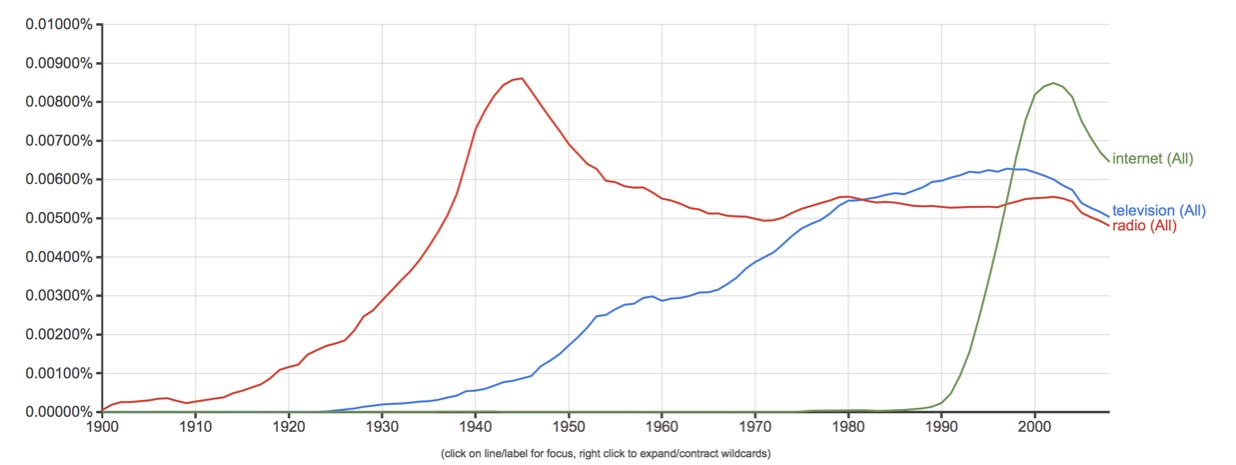
I tried a few charts of my own. Since 1885, “Evolution” has beaten “Creation,” but it took a noticeable drop during the 30’s. Since 1960 both have been on the rise.  In1980, Apple got off to an initial head start, but Microsoft passed it in 1992, never to look back (although it’s had a precipitous decline since 2000.)  Perhaps the most interesting chart is comparing “radio”, “television” and “internet” since 1900. Radio started growing in the 20’s and hit its popularity peak around 1945, but the cross-over with television would take another 40 years (about 1982.) Television would only enjoy a brief period of dominance. In 1990, the meteoric rise of the Internet started and it surpassed both radio and television around 1997.

tvradiointernet

My final chart was to see how Google fared in it’s own tool. Not surprisingly, Google has dominated the search space since 2001, and done so quite handily. Currently, it’s 6 times more popular than its rivals, Yahoo and Bing.  One caveat here though – Bing’s popularity started to climb in 1830, so I think they’re talking about either the cherry, Chinese people named Bing or a German company that used to make kitchen utensils.  Either that, or Microsoft has had their search engine in development a lot longer than anyone guessed.

googleyahoobing

What a Social Media “Like” Should Really Mean

Originally posted in Mediapost’s Search Insider on October 3, 2013

Italy’s Agriturismo program has been a success by any measure you might want to use. Since the initial legislation was passed in 1985, thousands of small farms through Italy, teetering on the edge of extinction, have been thrown a financial lifeline by letting operators supplement their income  welcoming tourists to “stay on the farm.” The program includes one-time renovation grants and an ongoing marketing program. Today, there are almost 3,500 agriturismos throughout Italy. Many of these have sprung up just in the past decade. The program brings the market directly to the farm, allowing onsite sales of products to guests and showcasing the homegrown produce in the agriturismo’s restaurant.

The program’s success, however, has superheated the competition for tourism among the operators. In Tuscany, where I stayed at one such farm, there are 1,000 agriturismos, almost one third of the total number in Italy. You literally can’t throw a Tuscan stone without hitting some type of tourist-targeted operation. This competitive environment is made even more fervent when you consider that almost every restaurant in Italy is also an independent operation. There are no big chains. All these businesses are literally mom and pop (sorry, Momma and Poppa) operations. They run on a shoestring. There is little to no money for advertising. If ever there was a test bed for guerilla marketing, this is it.

Here, online ratings are the currency of choice. A top spot in an online directory is the difference between life and death for these businesses. In this almost perfect but unflinchingly brutal adaptive environment, if you’re terrible, you die quickly. If you’re mediocre, you die slowly. If you’re good, you stumble along. And for a very few exceptions, if you’re excellent, you may do OK and even prosper, relatively speaking. I would put Fausto and Susanna in this last category. They run a small agriturismo just outside San Gimignano.

When it comes to the directories that matter, one towers above the rest. TripAdvisor wields the same power in this market that Google wields in our world of search. It is the ultimate arbitrator of life and death. And the smartest of the operators have taken this to heart. They “get” social media at a level that is humbling to this particular North American online marketing “expert.” It’s not just asking for a “like” or a good review. They know that the best way to get a glowing review is to utterly, undeniably, completely deserve it.  There’s no faint praise here; you have to blow your customer’s socks off.

It’s this intimate, person-to-person exchange that makes this the most efficient market possible. No money or marketing efforts are wasted on inefficient channels.  There are no middlemen. It all takes place directly between the host and the guest. It’s completely genuine. How many marketing campaigns can you say that about? They give you the experience of a lifetime, and you say a heartfelt thank you. TripAdvisor (and Facebook, and Yelp, etc.) is just there to make sure the world hears about it.

If Fausto and Susanna have understood the power of social media, Marina Pasquino is teaching a master’s class in it. In all my years of staying in hotels and consulting to businesses, I’m not sure I’ve ever seen a better-run business than Signora Pasquino’s small hotel on the Adriatic coast. My jaw dropped during check-in, and didn’t manage to snap back into place until we left seven awestruck days later.

The Hotel Belvedere, a tiny hotel in Riccione with less than 50 rooms, has blown TripAdvisor’s review algorithm to smithereens. It doesn’t just top the ratings for hotels in its area – it’s TripAdvisor’s number-one hotel in all of Italy, and one of the top 25 hotels in the world! Of the over 800 reviews it’s collected, 97% of them are effusive over-the-top odes to the hotel, its staff and the complete Belvedere experience.  The feedback is so overwhelming positive, posts sometimes get flagged for manual review to ensure they’re not fraudulent. They’re not, by the way. I mean, how many hotel staff actually hug you when you check in? Seriously.

Business is almost completely generated by word of mouth (both traditionally and digitally). Guests come back every single year. And they bring their friends. During our week, several groups (many from Canada, where I’m from) were at the hotel. And all this is fueled by a warm contact through social media after you leave. With the Belvedere, when you talk about friending and liking, you don’t have to put quotes around the words. In this case, those labels match your intention.

I’ve talked before about how rugged adaptive environments drive the evolution of new breeds of marketers. I can’t think of any environment more rugged than the tourism industry in today’s Italy. And here, the Faustos, the Susannas and the Marinas are showing that if you work your ass off to be amazing, we’ll return the favor by letting people know. I’m not sure what you would call this particular species, but I hope it prospers. We could certainly use more of them in the world.

The Marketing Classic Few Marketers Have Ever Read

First published August 22, 2013 in Mediapost’s Search Insider

It may be the best book you’ll ever read on marketing, but you won’t find it in the marketing section of Amazon.  They have it variously filed in three different categories: Politics and Social Sciences, Technology and Text Books. The book is Everett Rogers’ “Diffusion of Innovations,” and you should add it to your reading list.

The book is a comprehensive review of how new ideas spread and take hold in our society, and although it was first written in the 60s (it’s currently in its fifthedition), the findings are as fresh and relevant as ever. Its relevance to marketing is immediate and tangible. After all, what else is marketing but promoting the  adoption and diffusion of new things?

Rogers traces almost a century of diffusion research to see how everything from new high-yield corn varieties to birth control were adopted in various cultures. While there are not a lot of examples purely from the consumer marketplace, the generalized observations beg to be applied to marketing campaigns pushing new (and hopefully improved) products.

Consider these five innovation-specific variables that affect how quickly a new idea is adopted:

1)   Relative advantage – How much of a true advantage does the new innovation offer over what is currently being used? Rogers offers an important caveat here: “The receiver’s perceptions of the attributes of an innovation – not the attributes as classified by experts or change agents, affect its rate of adoption.”

2)   Compatibility – How well does the innovation fit into the framework of the customer’s current situation? Is it an incremental innovation, easily added, or a discontinuous innovation, requiring significant pain on the part of the user to adopt?

3)   Complexity – What is the learning curve that comes bundled with the innovation? The steeper the curve, the slower the rate of adoption.

4)   Trialability – Is it possible to try the product firsthand to determine the relative advantage (see #1)?

5)   Observability – Being the herders we are, adoption is sometimes a matter of “monkey see, monkey do.”

These factors may seem fundamental, but every day new “innovative” products are turned loose on the market, there to wither and die, simply because one or several of these check boxes remain unchecked.

Rogers also spend significant time looking at the social dynamics of diffusion and adoption, including the role of early adopters, change agents, influencers, mass communication channels and interpersonal persuasion. I found amazing close correlations to the findings of my own research into buying behaviors in the B2B world.

At the risk of oversimplifying this seminal work, Rogers found that adoption balances at the intersection of risk and reward. Risk stalls adoption, reward drives it forward, and clarity of communicating this risk/reward balance in a relevant way is either the catalyst or the inhibitor that determines how steep the adoption curve is.

This is a textbook, so expect a small investment of effort to wade through the rather academic delivery, but if you persevere (and to be fair, I’ve suffered through much worse in other books) you’ll come away with perhaps the clearest summation of marketplace dynamics ever put in print.

Marketing in the “Middle”

First published August 1, 2013 in Mediapost’s Search Insider

In case you haven’t heard, email is dead. In fact, it’s died several times. You could call it the cat of digital marketing, working it’s way through its nine lives. And it’s not alone. Search has died more than a few times. Display was DOA over a decade ago, and has resurrected itself, only to suffer several more untimely demises. In fact, for any digital channel you might care to mention, I can probably find an obituary.

For some reason, we love to declare things dead. We like clarity and finality, and there’s nothing like death for getting an unequivocal point across. Death, by its very nature, should be the final word – except that, in these cases, it almost never is. These channels, like Mark Twain, have had “the rumors of their deaths greatly exaggerated.”

It’s yet another example of how we hate ambiguity. We don’t like being in the middle, drifting between two far off anchor points. It feels uncertain and “mushy”. Humans don’t do well with “mushy”. We prefer predictability. We like to know where we stand, which requires knowing what’s under our feet. The middle represents “terra incognito” – undiscovered and unstable. We know, if we stand here, we have to be prepared to be nimble and fleet of foot.

This tendency comes down to an unfortunate human fragility – we like predictable outcomes, but we suck at making predictions. Not just some of us suck at it – we all suck at it. Philip Tetlock conducted a two-decade study looking at the success rate of “experts” in making predictions in a wide variety of subjects, especially politics. The outcome? Experts come out slightly ahead of coin tosses and chimps throwing darts. Tetlock’s long list of blundered predictions is staggering. Expertise does not lead to accuracy in divining the future. Yet, we still cling to this false hope. We crave a universe that unfolds as it should, or, at least, as we expect it to.

The messiness comes from the complexity of real life. There’s just too much “stuff” happening for us to make sense of it with our limited intellectual horsepower. Evolution, in its blind wisdom, has allowed for that by building in some natural defenses against complexity. We refer to them as instincts, emotions and beliefs. The nasty “gotch ya” in this is that the more we accumulate experience and knowledge, the more inflexible those beliefs and instincts become. We tend to adopt “big ideas” or “macro-beliefs” as guiding principles and philosophical anchors, which become the lens through which we see the world. We trade off open mindedness for expertise. Tetlock calls these “hedgehogs”, from Isiah Berlin’s essay. “Foxes”, on the other hand, draw on a wide variety of experiences to shape their views. They, by their nature, tend to live in the middle.  Tetlock found that foxes have much better track records when it comes to prediction. So, if you want to know what might happen, don’t ask an expert, especially one who is regularly seen on TV. Ask a dilettante – who is much more comfortable with “mushy.”

Ironically, Jim Collins, of Good to Great and Built to Last fame, also taps Berlin for the hedgehog and fox analogies, but he believed that “hedgehogs” are what makes great companies great, because they provide a single objective to focus on – the “hedgehog” concept.

So, who’s right – Tetlock or Collins? The answer, as you would expect in a column on this theme, is that they’re both right. The world is neither a place exclusively for foxes nor hedgehogs. The sweet spot is in the middle.

Nowhere is this truer than in marketing – which has to mirror all the irrationality of human behavior. There are no absolutes in marketing; there is just a lot of mushiness in the middle.  We need hedgehogs for the “big ideas” that make great marketing great. But we also need foxes to help us navigate through middle successfully.  In fact, the more time I’ve spent in marketing (trying assiduously to avoid becoming an “expert”) the more I’ve realized that the middle is where all the action is: between quantitative and qualitative, between strategy and big data, between creative branding and direct marketing, between science and art.

And here, in the middle, we hate to call anything “dead,” because you just never know what might happen.

The Ill Defined Problem of Attribution

First published July 11, 2013 in Mediapost’s Search Insider

For the past few years, I’ve sat on the board of a company that audits audience for various publications. One of the challenges the entire audience measurement industry has faced is the explosion of channels traditional publishers have been forced to use. It’s one thing to tally up the audience of a single newspaper, magazine or radio station. It’s quite another to try to get an aggregate view of an audience of publishers that, in addition to their magazines, have a website, several blogs, various email newsletters, a full slate of webinars, a YouTube channel, multiple Twitter accounts, Facebook pages, other social destinations, digital versions of magazines and an ever-growing collection of tablet and smartphone apps. Consider, for instance, how you would estimate the size of MediaPost’s total audience.

The problem, one quickly realizes, is how you find a common denominator across all these various points of audience engagement. It’s the classic “apples and oranges” challenge, multiplied several times over.

This is the opposite side of the attribution problem. How do you attribute value, whether it’s in terms of persuading a single prospect, or the degree of engagement across an entire audience, when there are so many variables at play?

Usually, when you talk about attribution, someone in the room volunteers that the answer to the problem can be found by coming up with the right algorithm, with the usual caveat something like this: “I don’t know how to do it, but I’m sure someone far smarter than I could figure it out.” The assumption is that if the data is there, there should be a solution hiding in there somewhere.

No disrespect to these hypothetical “smart” data-crunchers out there, but I believe there is a fundamental flaw in that assumption. The problem behind that assumption is that we’re accepting the problem as a “well defined” one – when in fact it’s an “ill-defined” problem.

We would like to believe that this is a solvable problem that could be reduced to a simplified and predictable model. This is especially true for media buyers (who use the audience measurement services) and marketers (who would like to find a usable attribution model). The right model, driven by the right algorithm, would make everyone’s job much easier. So, let’s quit complaining and just hire one of those really smart people to figure it out!

However, if we’re talking about an ill-defined problem, as I believe we are, then we have a significantly bigger challenge. Ill-defined problems defy clear solutions because of their complexity and unpredictability. They usually involve human elements impossible to account for. They are nuanced and “grey” as opposed to clear-cut “blacks and white.” If you try to capture an ill-defined problem in a model, you are forced to make heuristic assumptions that may be based on extraneous noise rather than true signals. This can lead to “overfitting.”

Let me give you an example. Let’s take that essential human goal: finding a life partner. Our task is to build an attribution model for successful courtship. Let us assume that we met our own livelong love in a bar. We would assume, then, that bars should have a relatively generous attribution of value in the partnership “conversion” funnel. But we’re ignoring all the “ill-defined” variables that went into that single conversion event: our current availability, the availability of the prospect, our moods, our level of intoxication, the friends we were with, the song that happened to be playing, the time of night, the necessity to get up early the next morning to go to work, etc.

In any human activity, the list of variables that must be considered to truly “define” the problem quickly becomes impossible. If we assume that bars are good places to find a partner, we must simplify to the point of “over-fitting.”  It may turn out that a grocery store, ATM or dentist’s waiting room would have served the purpose equally well.

Of course, you could take a purely statistical view, based on backwards-looking data. For example, we could say that of all couples, 23.7% of them met in bars. That may give us some very high level indications of “what” is happening, but it does little to help us understand the “why” of those numbers. Why do bars act as a good meeting ground?

In the end, audience measurement and attribution, being ill-defined problems, may end up as rough approximations at best. And that’s OK. It’s better than nothing. But I feel it’s only fair to warn those who believe there’s a “smarter” whiz out there who can figure all this out: Human nature is notoriously tough to predict.

Climbing the Slippery Slope of Advertising

First published June 6, 2013 in Mediapost’s Search Insider

Google’s Matt Cutts is warning advertisers not to try passing off “native ads” – or advertorials – as legit content. Apparently, the line between advertising and content continues to get blurrier. The reason is that advertisers are still trying to find an ad that works. And they have been for over 300 years.

The first newspaper ads, which seem to mark the dawn of advertising, appeared very early in the 18th century. Because they looked just like the articles surrounding them, they had to be labeled as an “Advertisement.” Sound familiar?

Now, wouldn’t you think that if you’ve been doing something for over 300 years, you would have figured it out? So why does most advertising still suck? Why are we still trying to find some magic formula that works.

We could attribute it to changing technologies, saying that advertising continues to evolve because the marketplace it operates in is in constant flux, along with the delivery channels it uses and the creative possibilities it offers. That would be what an “advertiser” would tell you.

The answer, I think, it a bit simpler than that.  It comes down to a three-century disconnect between the market and the marketers: marketers want advertising, the market doesn’t. At least, we don’t want advertising in the form that it usually takes. Advertisers have been tinkering for all that time to find something the public doesn’t reject outright.

Perhaps, as we often do in the Thursday Search Insider, we can find some clues in the etymology of the word. “Advertisement” comes from the French verb “avertir” – which means to give notice or, more ominously, warning. Ironically, the very word we use to label our industry came from roots that carry a negative connotation. To move it to a more positive light, we could say that the purpose of advertising is to make us aware of something we weren’t previously aware of. That seems rather benign. Helpful, even. And it would be accurate to say that the earliest ads aspired to this purpose.

But somewhere along the line, ads stepped over the line and became something we learned to hate. How did this happen?

Like many of the social issues that plague us today, the roots can be traced back to the Industrial Revolution. Technology enabled scale. Mass production became reality. And, to keep pace, advertising showed us its less benign side.

Prior to mass production, the output of a product was limited to the resources of a producer. Increasing quantity usually had an inverse impact on quality, which relied on the skills of a single craftsperson. One person could only produce so much. The first brands were introduced by these craftspeople to identify their products, differentiating them from inferior competitors.

But with mechanization and the introduction of the assembly line, suddenly scale became virtually unlimited. Uniform products could be produced by the trainload. Profits became tied to scale, and greed became tied to profit. From that point forward, the three moved in lock step.

It was at that point that advertising moved from being a helpful notice to an annoying plea to buy crap we don’t need. And that’s when advertisers had to learn to start pushing the public’s buttons, whether we wanted them pushed or not. Everything started to go off the rails early in the 20th century, and the wreckage really piled up with the introduction of mass communication. Suddenly, unlimited greed had an unlimited capacity to annoy us. Advertising couldn’t stop at informing. It had to start selling.

The twist in all this came right at the end of the “Century of Annoyance.”  In 1998, Goto.com introduced paid search (no, it wasn’t Google). It was an ad with one purpose, to make someone aware of something they weren’t previously aware of. And it was delivered in the perfect context. The market, in the form of a searcher, was looking to become more aware about something by seeking out new information. It gets even better. The searcher could decide whether or not to take the advertiser up on their offer by choosing to click or not.

Of course, with time, we advertisers will figure out a way to screw that up too. The good news, if you’re Matt Cutts, is that it means you’ll have a job for the foreseeable future.

The Momentum of Marketing

First published May 23, 2013 in Mediapost’s Search Insider

After becoming a parent, I discovered that there are no shortcuts to being a Dad. Contrary to popular belief, there’s no such thing as “quality time” with kids… there’s just time. You have to be there, as much as you can be, because you never know when those moments will occur that will cement your relationship with your children. You keep trying, you keep putting in the time, you keep doing the things you have to do to be a parent. Think of it as relationship “momentum.”

The same is true, I believe, in all worthwhile endeavors. Activity breeds success. And that includes marketing. If you take your foot off the gas, you lose momentum.

I’ve found that myself in the last few years. The marketing strategy of our company was all about activity. We conducted research, we published whitepapers, we blogged, we spoke at conferences, we held webinars — we never missed an opportunity to generate awareness. It was a lot of activity, aimed at maintaining our marketing momentum. And it worked. We had a profile in the industry that was probably out of proportion to our actual share of business. When it came to maintaining a profile, I think we punched above our weight.

I was the producer of much of this activity, so as our company profile rose, so did my own personal one. I was constantly fielding requests to speak, comment, participate or write.

But for various reasons, I’ve taken my foot off the gas recently. I’m not nearly as active in the industry as I was previously. My assumption was that the momentum would carry me for some period of time. I was wrong. The minute the activity decreased, so did the opportunities.

Now, this was partly by design. I knew that my previous industry profile would start to slip and so I didn’t panic. But still, I was surprised at how quickly it happened. And because of that, I suspect there’s a cautionary tale here for marketers. If you produce content or generate thought leadership, a hiatus can be costly. That lost momentum can take several months to build again. In fact, you might never get it back.

For myself, I’m now entering a new phase of my career, so my activity will change over the coming months. I still intend to be active — perhaps more so than ever — but it will be aimed in a new direction. I do have the advantage of past experience. I know it can work, because it has worked in the past.

So I leave you with these words of advice — be active in your marketing efforts. Always be producing new content, generating awareness, and raising your profile. I believe busy parents are generally good parents — and the same is true, I suspect, for marketers.

Live by the Data, Die by the Data

First published in Mediapost’s Search Insider – May 2, 2013

While the Search Insiders tear up the stage in Amelia Island, Fla., I’ve been lurking virtually, watching the posts that emanate from the Everglades. Apparently, “Shitty” marketing is done for, Pinterest is the new darling of search marketers, and those same marketers are apparently fudging the ROI numbers on their search campaigns, over attributing to paid at the expense of organic, just so those paid search budgets don’t shrink. I’m assuming all this has data to back it up.

Here are other things that data supports. Facebook ads that feature cute, fuzzy critters get “liked” more often. Retired execs love the PGA, but are increasingly watching it on mobile screens. And, if you really want to beat the stock market, just invest based on who wins the Super Bowl. If an original NFC team wins, the stock market will have a bull run over the next year. But if an original AFC team wins, the bears will rule and the market will tank (which is confusing, because the Chicago Bears are a NFC team, while the Buffalo Bills, which is the closest thing to a bull in the NFL, are an AFC team – but I digress). Since 1967, the correlation between the two is close to 80%, and for a 20-year streak from 1967 to 1987, the correlation was over 90%. That odds of that correlation are 1 in 4,500,000, give or take a few thousand.

It can’t be chance, can it? If we’re paying attention to the data, we should all fire our brokers and just invest according to the current holder of the Lombardi trophy.

And that’s the problem with an overreliance on data. You start seeing signals where there is just noise. We flip our perspective to convince ourselves that there is a story where there may be none. Let’s use the Super Bowl example again. We look at the 1 in 4,500,000 odds and assume it must be more than chance. But this is faulty logic. The probability of “one” ticket winning a Powerball lottery is astronomically low, but the probability of “a” ticket winning it in any given week is pretty good. Likewise, the probability of “a” given indicator correlating with stock market performance is low, but the probability of any indicator having a positive correlation is very good. By the way, other stock market indicators with a long winning streak are lipstick sales, the length of Vanna White’s hemline and butter production in Bangladesh.

The problem is one of “overfitting.” It’s what happens when the irrationality of humans runs headlong into a mountain of data. We try to make a model work based on a subset of data, and mistake random patterns for underlying relationships. What seems to work okay in a test environment falls apart in the real world. Models get too complex, trying to accommodate too many variables, and we fall into the trap of manipulating the “what” of the data, rather than trying to understanding the “why” that’s generating the data.

I see this happen all the time in marketing. It’s particularly prevalent in the world of multivariate testing. We test variables at random, looking for the best combination. In our ongoing tweaking, we fall into a testing spiral that focuses on detail, forgetting about what the overall objective is. For example, we maximize conversion rates on one particular call to action, not looking at the impact across the entire spectrum of user experience. We become myopically optimized at the same time we draw further and further away from understanding our customers and their intent.

Marketing is still about human connection. We can analyze mountains of data, trying to understand what’s driving our customer’s behaviors, seeing patterns where they may or may not exist.

Or, we could just ask a few of them.

Read more: http://www.mediapost.com/publications/article/199503/live-by-the-data-die-by-the-data.html#ixzz2Sdtedfcz

Seperating the Strategic Signal from the Tactical Noise in Marketing

First published April 4, 2013 in Mediapost’s Search Insider

It’s somewhat ironic that, as a die-hard Darwinist, I find myself in the position of defending strategy against the onslaught of Big Data. Since my initial column on this subject a few months ago, I’ve been diving deeper into this topic.

Here’s the irony.

Embracing Big Data is essentially embracing a Darwinist approach to marketing.  It resists taking a top-down approach (aka strategy) by using data feedback to enforce evolution of your marketing program. It makes marketing “antifragile,” in the words of Nassim Nicholas Taleb. In theory, it uses disorder, mistakes and unexpected events to continually improve marketing.

Embracing strategy — at least my suggested Bayesian approach to strategy — would be akin to embracing intelligent design. It defines what an expected outcome should be, then starts defining paths to get there. But it does this in the full realization that those paths will continually shift and change. In fact, it sets up the framework to enable this strategic fluidity. It still uses “Big Data,” but puts it in the context of “Big Testing” (courtesy Scott Brinker).

To remove the strategy from the equation, as some suggest, would be to leave your marketing subject to random chance. Undoubtedly, given perfect feedback and the ability to quickly adapt using that feedback, marketing could improve continually. After all, we evolved in just such an environment and we’re pretty complex organisms.  But it’s hard to argue that a designer would have designed such flaws as our pharynx, which is used both for eating and breathing, leading to a drastically higher risk of choking; our spinal column, which tends to become misaligned in a significant portion of the population; or the fact that our retinas are “inside out.”

Big Data also requires separating “signal” from “noise” in the data. But without a strategic framework, what is the signal and what is the noise? Which of the datum do you pay attention to, and which do you ignore?

Here’s an even bigger question. What constitutes success and failure in your marketing program? Who sets these criteria? In nature, it’s pretty simple. Success is defined by genetic propagation. But it’s not so clear-cut in marketing. Success needs to align to some commonly understood objectives, and these objectives should be enshrined in — you guessed it, your strategy.

I believe that if  “intelligent designers” are available, why not use them? And I would hope that most marketing executives should fit the bill. As long as strategy includes a rigorous testing methodology and honest feedback does not fall victim to egotistical opinions and “yes speak” (which is a huge caveat, and a topic too big to tackle here), a program infused with strategy should outperform one left to chance.

But what about Taleb’s “Black Swans”? He argues that by providing “top down” direction, leading to interventionism, you tend to make systems fragile. In trying to smooth out the ups and downs of the environment, you build in limitations and inflexibility. You lose the ability to deal with a Black Swan, that unexpected occurrence that falls outside of your predictive horizon.

It’s a valid point. I believe that Black Swans have to be expected, but should not dictate your strategy. By their very nature, they may never happen. And if they do, they will be infrequent. If your strategy meets a Black Swan head on, a Bayesian approach should come with the humility to realize that the rules have changed, necessitating a corresponding change in strategy. But it would be a mistake to abandon strategy completely based on a “what-if.”